HRM Report: 401k and Social Security Benefits Analysis

Verified

Added on  2022/08/12

|4
|824
|53
Report
AI Summary
This report provides an overview of 401k plans and Social Security, key components of Human Resource Management. It defines 401k plans as qualified retirement plans allowing employees to save for retirement with tax benefits, outlining the roles of employers and employees, along with merits and demerits. The report also explains Social Security, a US social security net providing retirement, disability, and survivor benefits. It details the eligibility criteria and the benefits provided by the Old Age, Survivors and Disability Insurance (OASDI). Additionally, the report lists employee benefits required by law in the US, such as workers' compensation, health insurance, social security, Medicare taxes, unemployment insurance, disability insurance, and family medical leave. The report is supported by cited references to academic sources.
Document Page
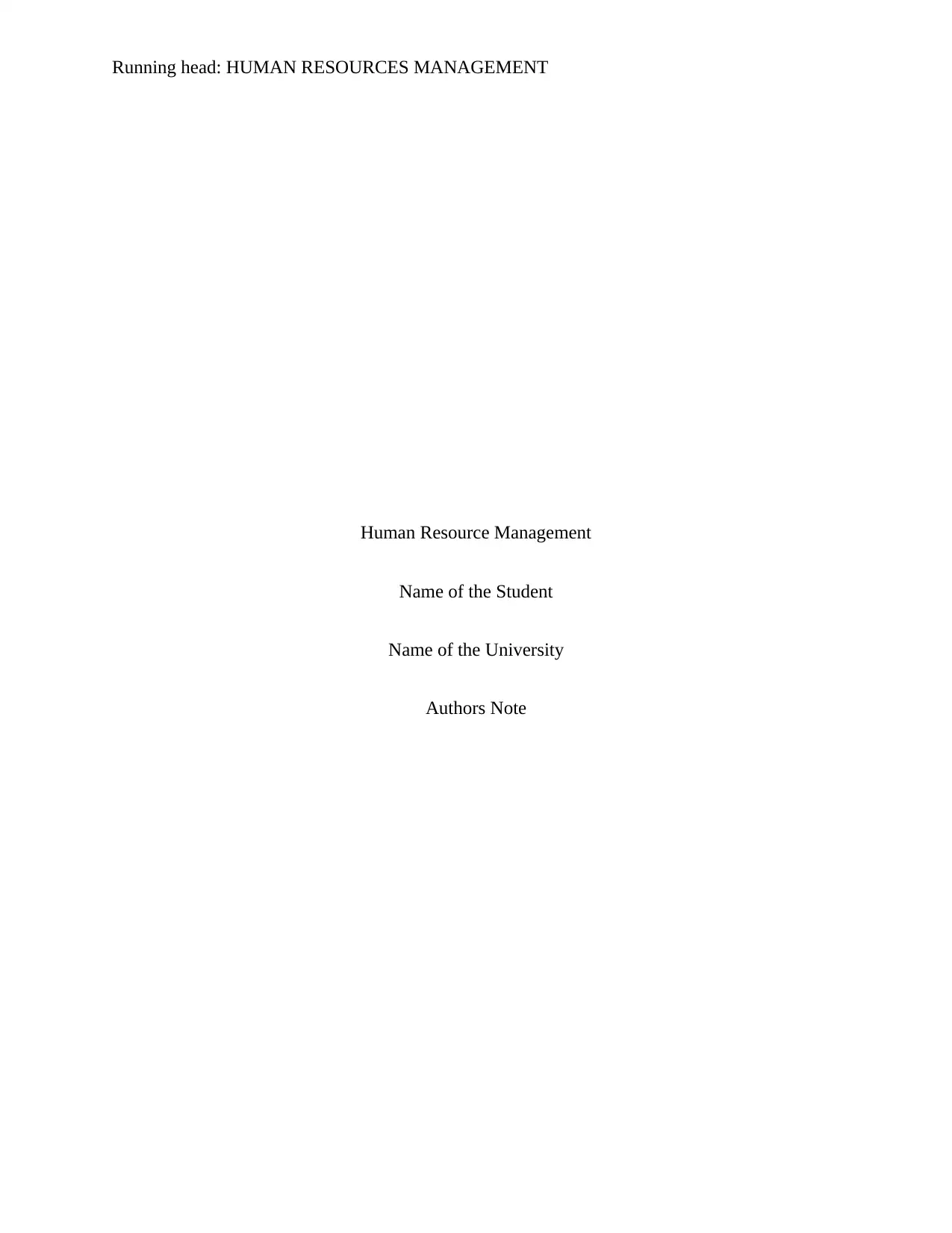
Running head: HUMAN RESOURCES MANAGEMENT
Human Resource Management
Name of the Student
Name of the University
Authors Note
tabler-icon-diamond-filled.svg

Paraphrase This Document

Need a fresh take? Get an instant paraphrase of this document with our AI Paraphraser
Document Page
1HUMAN RESOURCE MANAGEMENT
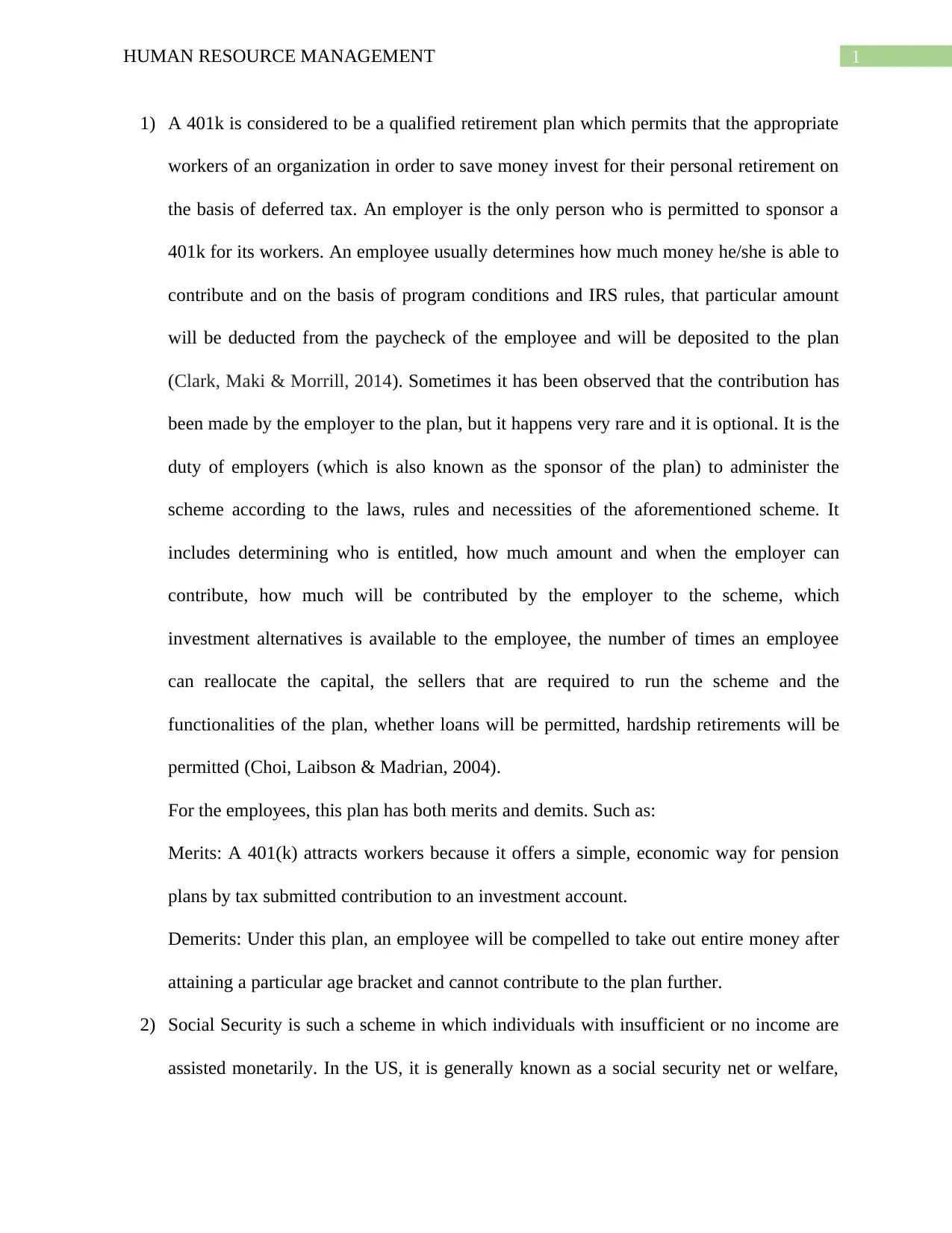
1) A 401k is considered to be a qualified retirement plan which permits that the appropriate
workers of an organization in order to save money invest for their personal retirement on
the basis of deferred tax. An employer is the only person who is permitted to sponsor a
401k for its workers. An employee usually determines how much money he/she is able to
contribute and on the basis of program conditions and IRS rules, that particular amount
will be deducted from the paycheck of the employee and will be deposited to the plan
(Clark, Maki & Morrill, 2014). Sometimes it has been observed that the contribution has
been made by the employer to the plan, but it happens very rare and it is optional. It is the
duty of employers (which is also known as the sponsor of the plan) to administer the
scheme according to the laws, rules and necessities of the aforementioned scheme. It
includes determining who is entitled, how much amount and when the employer can
contribute, how much will be contributed by the employer to the scheme, which
investment alternatives is available to the employee, the number of times an employee
can reallocate the capital, the sellers that are required to run the scheme and the
functionalities of the plan, whether loans will be permitted, hardship retirements will be
permitted (Choi, Laibson & Madrian, 2004).
For the employees, this plan has both merits and demits. Such as:
Merits: A 401(k) attracts workers because it offers a simple, economic way for pension
plans by tax submitted contribution to an investment account.
Demerits: Under this plan, an employee will be compelled to take out entire money after
attaining a particular age bracket and cannot contribute to the plan further.
2) Social Security is such a scheme in which individuals with insufficient or no income are
assisted monetarily. In the US, it is generally known as a social security net or welfare,
Document Page
2HUMAN RESOURCE MANAGEMENT
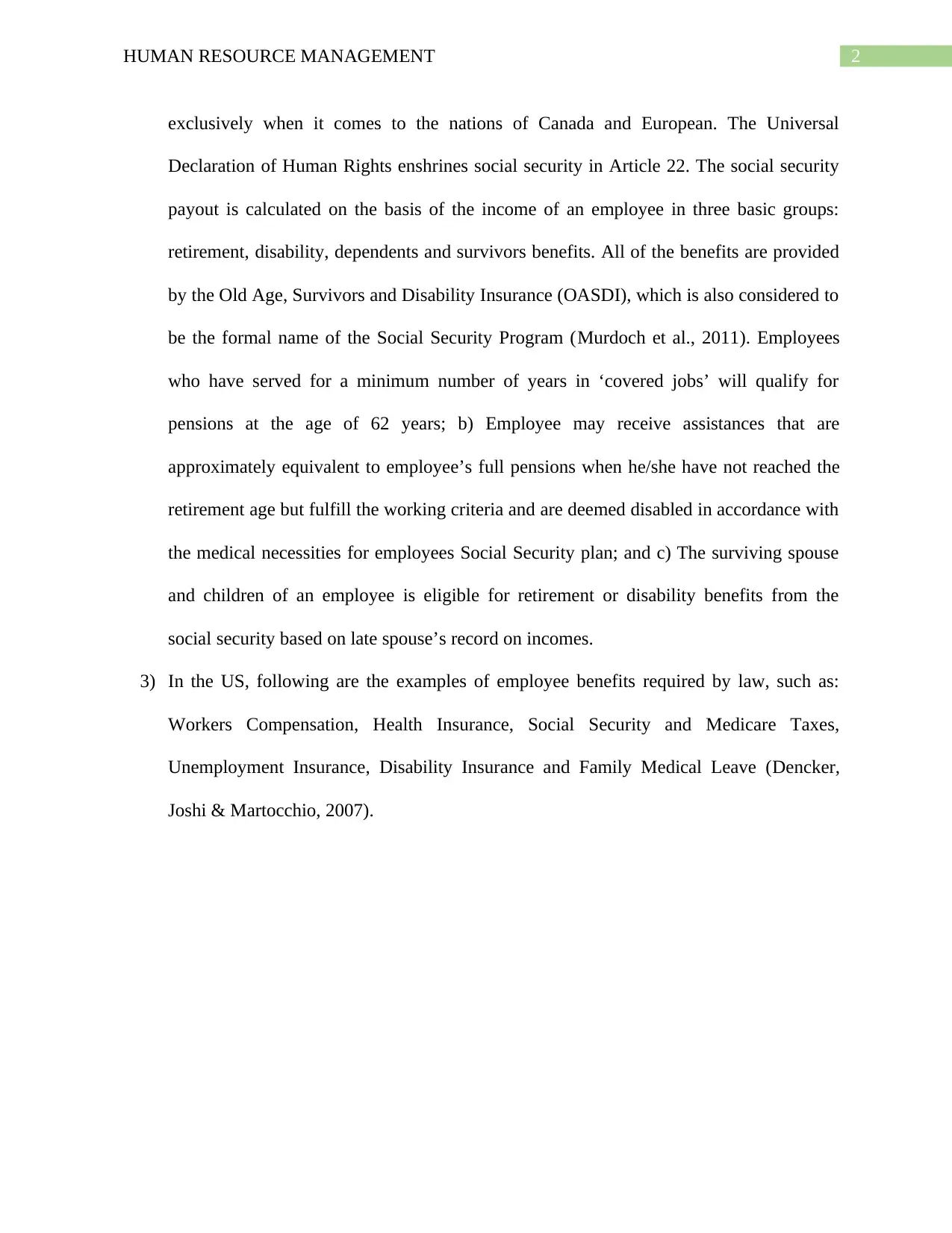
exclusively when it comes to the nations of Canada and European. The Universal
Declaration of Human Rights enshrines social security in Article 22. The social security
payout is calculated on the basis of the income of an employee in three basic groups:
retirement, disability, dependents and survivors benefits. All of the benefits are provided
by the Old Age, Survivors and Disability Insurance (OASDI), which is also considered to
be the formal name of the Social Security Program (Murdoch et al., 2011). Employees
who have served for a minimum number of years in ‘covered jobs’ will qualify for
pensions at the age of 62 years; b) Employee may receive assistances that are
approximately equivalent to employee’s full pensions when he/she have not reached the
retirement age but fulfill the working criteria and are deemed disabled in accordance with
the medical necessities for employees Social Security plan; and c) The surviving spouse
and children of an employee is eligible for retirement or disability benefits from the
social security based on late spouse’s record on incomes.
3) In the US, following are the examples of employee benefits required by law, such as:
Workers Compensation, Health Insurance, Social Security and Medicare Taxes,
Unemployment Insurance, Disability Insurance and Family Medical Leave (Dencker,
Joshi & Martocchio, 2007).
Document Page
3HUMAN RESOURCE MANAGEMENT
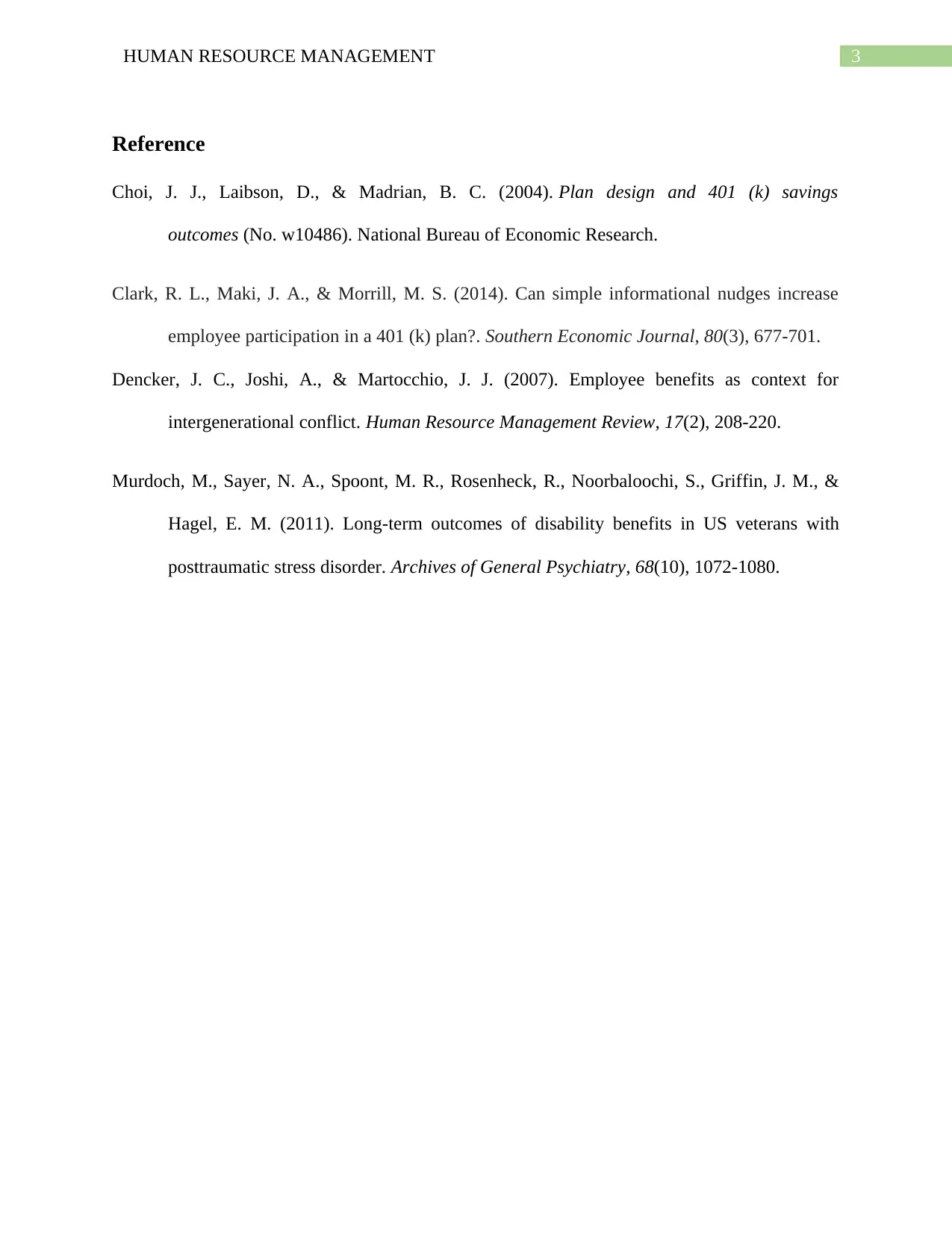
Reference
Choi, J. J., Laibson, D., & Madrian, B. C. (2004). Plan design and 401 (k) savings
outcomes (No. w10486). National Bureau of Economic Research.
Clark, R. L., Maki, J. A., & Morrill, M. S. (2014). Can simple informational nudges increase
employee participation in a 401 (k) plan?. Southern Economic Journal, 80(3), 677-701.
Dencker, J. C., Joshi, A., & Martocchio, J. J. (2007). Employee benefits as context for
intergenerational conflict. Human Resource Management Review, 17(2), 208-220.
Murdoch, M., Sayer, N. A., Spoont, M. R., Rosenheck, R., Noorbaloochi, S., Griffin, J. M., &
Hagel, E. M. (2011). Long-term outcomes of disability benefits in US veterans with
posttraumatic stress disorder. Archives of General Psychiatry, 68(10), 1072-1080.
chevron_up_icon
1 out of 4
circle_padding
hide_on_mobile
zoom_out_icon
[object Object]