Human Resource Frame Analysis: Strengths & Weaknesses of Cotton On
VerifiedAdded on 2020/04/21
|13
|3035
|103
Report
AI Summary
This report provides a comprehensive analysis of Cotton On through the lens of the human resource frame, examining both its strengths and weaknesses. The study highlights the company's effective communication, teamwork, supervisor support, proper hiring practices, shared values, and employee empowerment as key strengths. Conversely, the report identifies significant weaknesses, including a lack of growth opportunities, inadequate training programs, insufficient reward systems, poor work-life balance, and a lack of employee engagement. The analysis draws on various academic sources to support its findings, offering a balanced perspective on Cotton On's human resource practices and their impact on organizational performance. The report concludes by summarizing these strengths and weaknesses, providing insights into how Cotton On can improve its human resource management strategies to enhance employee satisfaction and overall organizational success. The report provides a detailed overview of the content, which is available on Desklib, a platform offering past papers and solved assignments for students.
Running head: HUMAN RESOURCE
Human Resource
Name of the Student:
Name of the University:
Author’s Note:
Human Resource
Name of the Student:
Name of the University:
Author’s Note:

Paraphrase This Document
Need a fresh take? Get an instant paraphrase of this document with our AI Paraphraser
1HUMAN RESOURCE
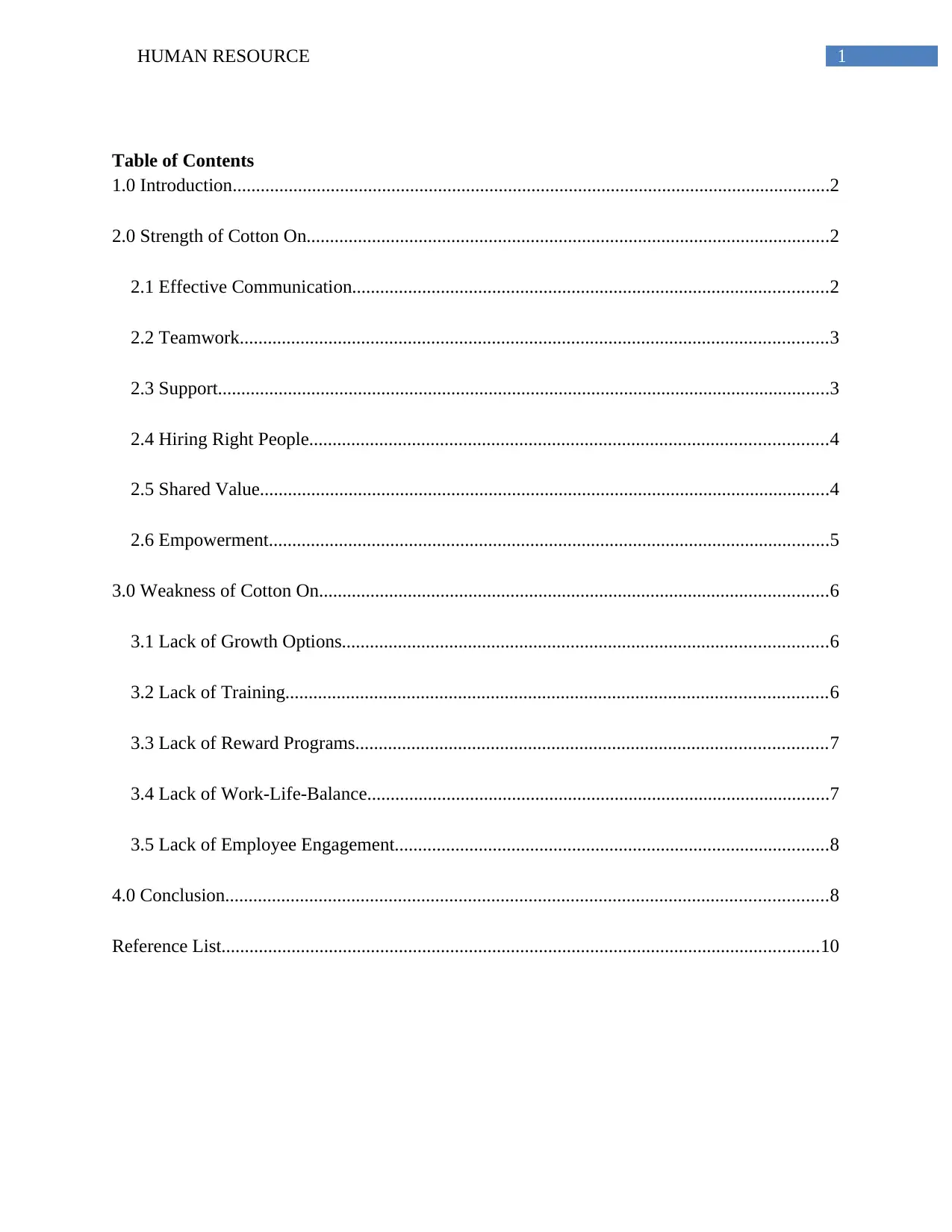
Table of Contents
1.0 Introduction................................................................................................................................2
2.0 Strength of Cotton On................................................................................................................2
2.1 Effective Communication......................................................................................................2
2.2 Teamwork..............................................................................................................................3
2.3 Support...................................................................................................................................3
2.4 Hiring Right People...............................................................................................................4
2.5 Shared Value..........................................................................................................................4
2.6 Empowerment........................................................................................................................5
3.0 Weakness of Cotton On.............................................................................................................6
3.1 Lack of Growth Options........................................................................................................6
3.2 Lack of Training....................................................................................................................6
3.3 Lack of Reward Programs.....................................................................................................7
3.4 Lack of Work-Life-Balance...................................................................................................7
3.5 Lack of Employee Engagement.............................................................................................8
4.0 Conclusion.................................................................................................................................8
Reference List................................................................................................................................10
Table of Contents
1.0 Introduction................................................................................................................................2
2.0 Strength of Cotton On................................................................................................................2
2.1 Effective Communication......................................................................................................2
2.2 Teamwork..............................................................................................................................3
2.3 Support...................................................................................................................................3
2.4 Hiring Right People...............................................................................................................4
2.5 Shared Value..........................................................................................................................4
2.6 Empowerment........................................................................................................................5
3.0 Weakness of Cotton On.............................................................................................................6
3.1 Lack of Growth Options........................................................................................................6
3.2 Lack of Training....................................................................................................................6
3.3 Lack of Reward Programs.....................................................................................................7
3.4 Lack of Work-Life-Balance...................................................................................................7
3.5 Lack of Employee Engagement.............................................................................................8
4.0 Conclusion.................................................................................................................................8
Reference List................................................................................................................................10
2HUMAN RESOURCE
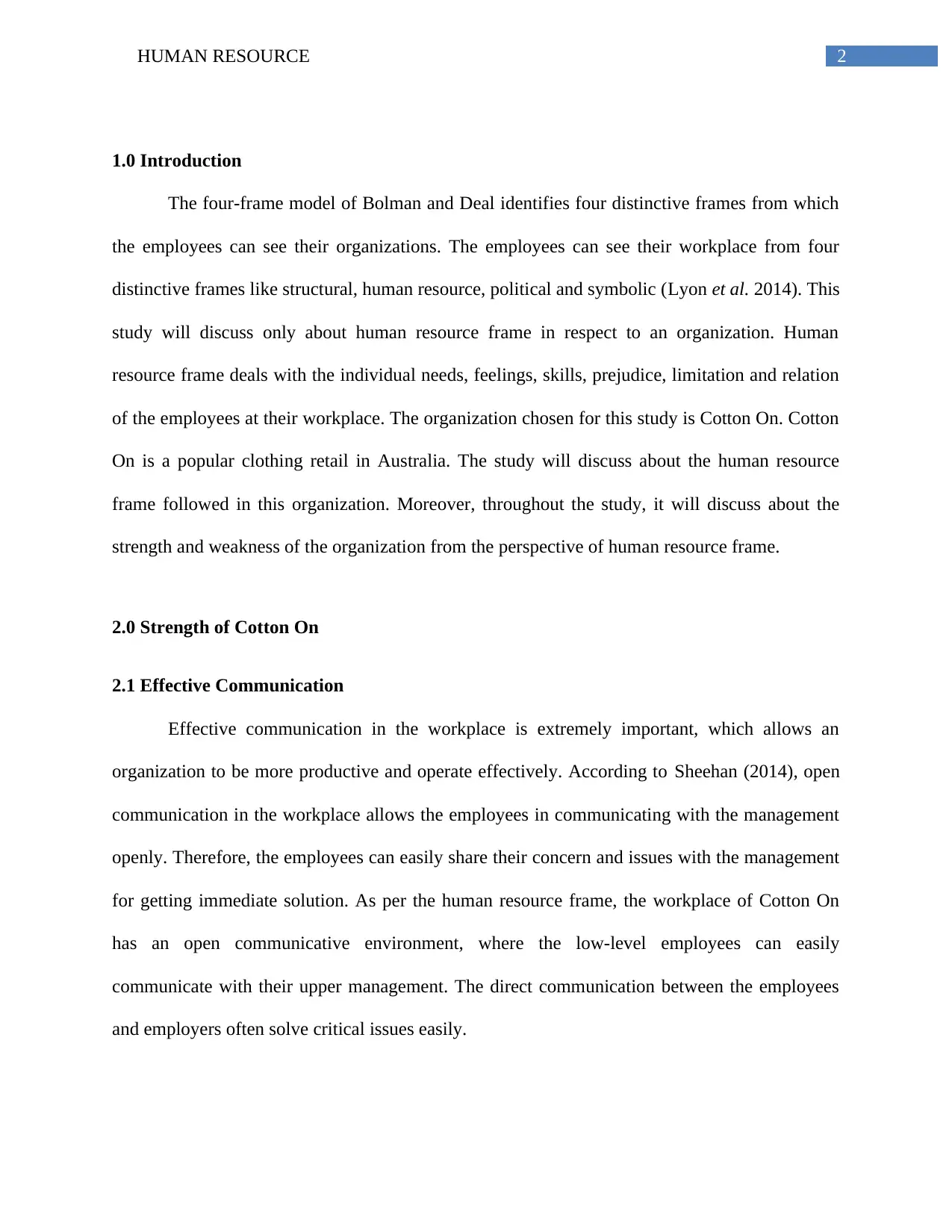
1.0 Introduction
The four-frame model of Bolman and Deal identifies four distinctive frames from which
the employees can see their organizations. The employees can see their workplace from four
distinctive frames like structural, human resource, political and symbolic (Lyon et al. 2014). This
study will discuss only about human resource frame in respect to an organization. Human
resource frame deals with the individual needs, feelings, skills, prejudice, limitation and relation
of the employees at their workplace. The organization chosen for this study is Cotton On. Cotton
On is a popular clothing retail in Australia. The study will discuss about the human resource
frame followed in this organization. Moreover, throughout the study, it will discuss about the
strength and weakness of the organization from the perspective of human resource frame.
2.0 Strength of Cotton On
2.1 Effective Communication
Effective communication in the workplace is extremely important, which allows an
organization to be more productive and operate effectively. According to Sheehan (2014), open
communication in the workplace allows the employees in communicating with the management
openly. Therefore, the employees can easily share their concern and issues with the management
for getting immediate solution. As per the human resource frame, the workplace of Cotton On
has an open communicative environment, where the low-level employees can easily
communicate with their upper management. The direct communication between the employees
and employers often solve critical issues easily.
1.0 Introduction
The four-frame model of Bolman and Deal identifies four distinctive frames from which
the employees can see their organizations. The employees can see their workplace from four
distinctive frames like structural, human resource, political and symbolic (Lyon et al. 2014). This
study will discuss only about human resource frame in respect to an organization. Human
resource frame deals with the individual needs, feelings, skills, prejudice, limitation and relation
of the employees at their workplace. The organization chosen for this study is Cotton On. Cotton
On is a popular clothing retail in Australia. The study will discuss about the human resource
frame followed in this organization. Moreover, throughout the study, it will discuss about the
strength and weakness of the organization from the perspective of human resource frame.
2.0 Strength of Cotton On
2.1 Effective Communication
Effective communication in the workplace is extremely important, which allows an
organization to be more productive and operate effectively. According to Sheehan (2014), open
communication in the workplace allows the employees in communicating with the management
openly. Therefore, the employees can easily share their concern and issues with the management
for getting immediate solution. As per the human resource frame, the workplace of Cotton On
has an open communicative environment, where the low-level employees can easily
communicate with their upper management. The direct communication between the employees
and employers often solve critical issues easily.
⊘ This is a preview!⊘
Do you want full access?
Subscribe today to unlock all pages.

Trusted by 1+ million students worldwide
3HUMAN RESOURCE
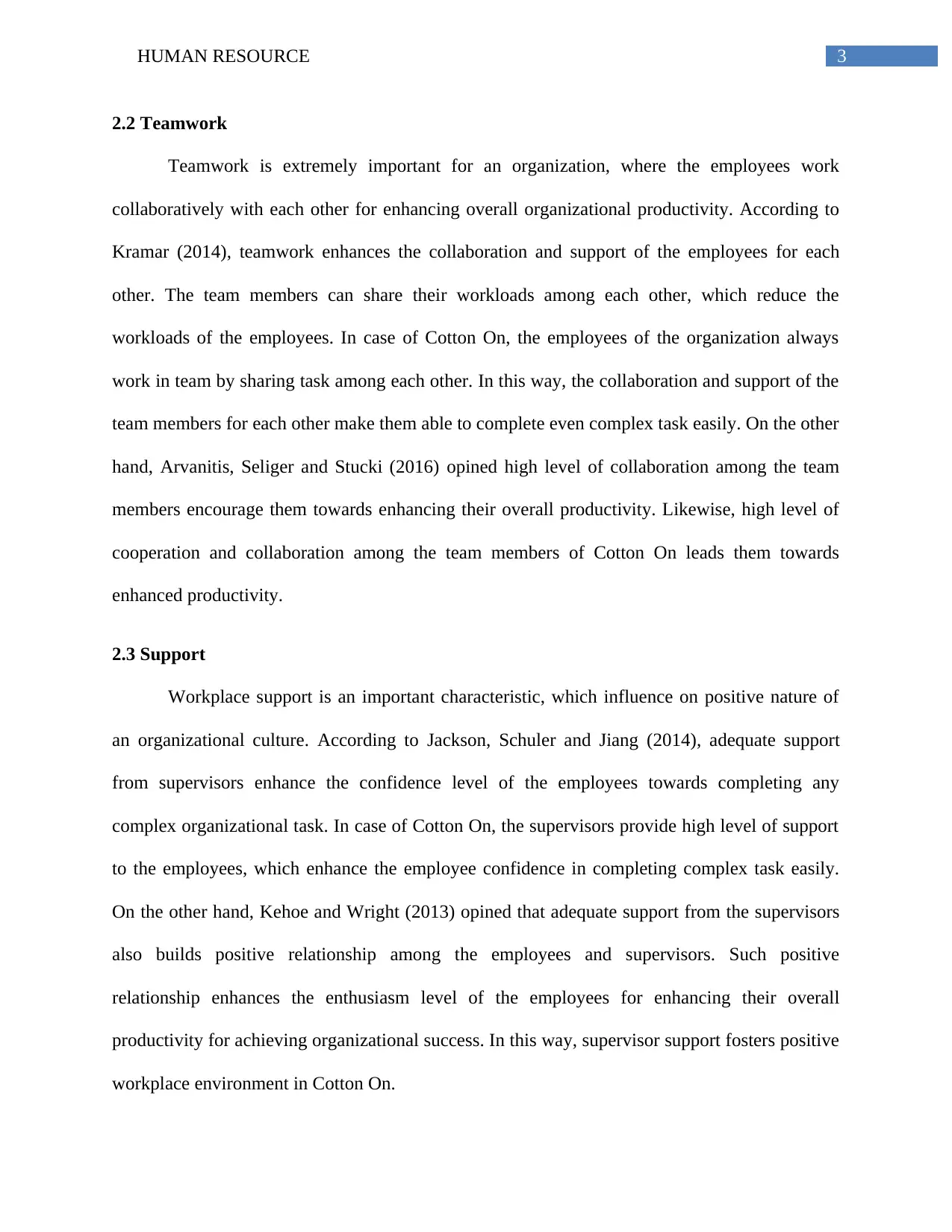
2.2 Teamwork
Teamwork is extremely important for an organization, where the employees work
collaboratively with each other for enhancing overall organizational productivity. According to
Kramar (2014), teamwork enhances the collaboration and support of the employees for each
other. The team members can share their workloads among each other, which reduce the
workloads of the employees. In case of Cotton On, the employees of the organization always
work in team by sharing task among each other. In this way, the collaboration and support of the
team members for each other make them able to complete even complex task easily. On the other
hand, Arvanitis, Seliger and Stucki (2016) opined high level of collaboration among the team
members encourage them towards enhancing their overall productivity. Likewise, high level of
cooperation and collaboration among the team members of Cotton On leads them towards
enhanced productivity.
2.3 Support
Workplace support is an important characteristic, which influence on positive nature of
an organizational culture. According to Jackson, Schuler and Jiang (2014), adequate support
from supervisors enhance the confidence level of the employees towards completing any
complex organizational task. In case of Cotton On, the supervisors provide high level of support
to the employees, which enhance the employee confidence in completing complex task easily.
On the other hand, Kehoe and Wright (2013) opined that adequate support from the supervisors
also builds positive relationship among the employees and supervisors. Such positive
relationship enhances the enthusiasm level of the employees for enhancing their overall
productivity for achieving organizational success. In this way, supervisor support fosters positive
workplace environment in Cotton On.
2.2 Teamwork
Teamwork is extremely important for an organization, where the employees work
collaboratively with each other for enhancing overall organizational productivity. According to
Kramar (2014), teamwork enhances the collaboration and support of the employees for each
other. The team members can share their workloads among each other, which reduce the
workloads of the employees. In case of Cotton On, the employees of the organization always
work in team by sharing task among each other. In this way, the collaboration and support of the
team members for each other make them able to complete even complex task easily. On the other
hand, Arvanitis, Seliger and Stucki (2016) opined high level of collaboration among the team
members encourage them towards enhancing their overall productivity. Likewise, high level of
cooperation and collaboration among the team members of Cotton On leads them towards
enhanced productivity.
2.3 Support
Workplace support is an important characteristic, which influence on positive nature of
an organizational culture. According to Jackson, Schuler and Jiang (2014), adequate support
from supervisors enhance the confidence level of the employees towards completing any
complex organizational task. In case of Cotton On, the supervisors provide high level of support
to the employees, which enhance the employee confidence in completing complex task easily.
On the other hand, Kehoe and Wright (2013) opined that adequate support from the supervisors
also builds positive relationship among the employees and supervisors. Such positive
relationship enhances the enthusiasm level of the employees for enhancing their overall
productivity for achieving organizational success. In this way, supervisor support fosters positive
workplace environment in Cotton On.
Paraphrase This Document
Need a fresh take? Get an instant paraphrase of this document with our AI Paraphraser
4HUMAN RESOURCE
2.4 Hiring Right People
Proper recruitment builds the foundation for organizational success. According to Alfes
et al. (2013), hiring right people can help an organization towards getting the best out of them for
achieving organizational success. Talented employees are always efficient in their performance,
which ultimately leads to organizational efficiency. Likewise, the hiring managers of Cotton On
always hire the best talents for achieving organizational efficiency. The talented employees can
properly understand the goals and objectives of the organization and align their efforts with
overall organizational goals for achieving organizational success. On the other hand, Marler and
Fisher (2013) opined that the skills and talents of the talented employees could also be exploited
for fostering organizational innovation towards gaining competitive advantage. Likewise, the
talented employees of Cotton On helps in giving innovative store ideas for enhanced store
convenience. In this way, hiring right employees helps Cotton On in achieving huge competitive
advantage.
2.5 Shared Value
Shared value within an organization fosters healthy business culture, which promotes and
models same level of shared value system from top to down. According to Messersmith and
Wales (2013), in shared value system, the leaders of an organization consider the value of every
employee and utilize them for business progress. Moreover, shared value system enhances the
worth of the employees in their workplace. They can have a great feel that they are really a part
of their organization. In this way, shared value system encourages the employees to be more
productive.
In case of Cotton On, the leaders of the organization shared important information of
their organization with the employees. In this way, the employees have very clear and
2.4 Hiring Right People
Proper recruitment builds the foundation for organizational success. According to Alfes
et al. (2013), hiring right people can help an organization towards getting the best out of them for
achieving organizational success. Talented employees are always efficient in their performance,
which ultimately leads to organizational efficiency. Likewise, the hiring managers of Cotton On
always hire the best talents for achieving organizational efficiency. The talented employees can
properly understand the goals and objectives of the organization and align their efforts with
overall organizational goals for achieving organizational success. On the other hand, Marler and
Fisher (2013) opined that the skills and talents of the talented employees could also be exploited
for fostering organizational innovation towards gaining competitive advantage. Likewise, the
talented employees of Cotton On helps in giving innovative store ideas for enhanced store
convenience. In this way, hiring right employees helps Cotton On in achieving huge competitive
advantage.
2.5 Shared Value
Shared value within an organization fosters healthy business culture, which promotes and
models same level of shared value system from top to down. According to Messersmith and
Wales (2013), in shared value system, the leaders of an organization consider the value of every
employee and utilize them for business progress. Moreover, shared value system enhances the
worth of the employees in their workplace. They can have a great feel that they are really a part
of their organization. In this way, shared value system encourages the employees to be more
productive.
In case of Cotton On, the leaders of the organization shared important information of
their organization with the employees. In this way, the employees have very clear and
5HUMAN RESOURCE
transparent ideas regarding their organizational goals. Therefore, they can perfectly align their
individual effort with the overall organizational goals and objectives for achieving organizational
success. On the other hand, Hoch and Dulebohn (2013) opined that shared value system
minimizes the gaps and enhances the transparencies between the employees and employers.
Likewise, the shared value system in Cotton On fosters positive relationship between the
employers and employees. In this way, shared value system develops positive workplace
relationship in an organization.
2.6 Empowerment
Employee empowerment provides certain degree of autonomy and responsibility to the
employees regarding decision making of their own task. According to Carmeli, Gelbard and
Reiter‐Palmon (2013), in employee empowerment, the leaders allow decision making to be made
at lower level of an organization, where the employees have some unique view of issues facing
the organization at certain level. Therefore, the employees can make better decision for their own
task by considering their specific issues. Likewise, the leaders of Cotton On provide enough
empowerment to the employees, which enhance value of the employees at their workplace. Such
enhanced value of the employees encourages the employees to be more productive.
Thunnissen, Boselie and Fruytier (2013) pointed out that empowered employees always
feel free to challenge their current status quo, which is extremely important for fast changing and
technology driven environment. Therefore, empowered employees are always willing to adapt
changes in an effective way towards bringing innovation in organization. Likewise, adequate
empowerment provided to the employees allows them towards embracing tough challenges for
completing complex organization task. Furthermore, empowered employees are also willing to
transparent ideas regarding their organizational goals. Therefore, they can perfectly align their
individual effort with the overall organizational goals and objectives for achieving organizational
success. On the other hand, Hoch and Dulebohn (2013) opined that shared value system
minimizes the gaps and enhances the transparencies between the employees and employers.
Likewise, the shared value system in Cotton On fosters positive relationship between the
employers and employees. In this way, shared value system develops positive workplace
relationship in an organization.
2.6 Empowerment
Employee empowerment provides certain degree of autonomy and responsibility to the
employees regarding decision making of their own task. According to Carmeli, Gelbard and
Reiter‐Palmon (2013), in employee empowerment, the leaders allow decision making to be made
at lower level of an organization, where the employees have some unique view of issues facing
the organization at certain level. Therefore, the employees can make better decision for their own
task by considering their specific issues. Likewise, the leaders of Cotton On provide enough
empowerment to the employees, which enhance value of the employees at their workplace. Such
enhanced value of the employees encourages the employees to be more productive.
Thunnissen, Boselie and Fruytier (2013) pointed out that empowered employees always
feel free to challenge their current status quo, which is extremely important for fast changing and
technology driven environment. Therefore, empowered employees are always willing to adapt
changes in an effective way towards bringing innovation in organization. Likewise, adequate
empowerment provided to the employees allows them towards embracing tough challenges for
completing complex organization task. Furthermore, empowered employees are also willing to
⊘ This is a preview!⊘
Do you want full access?
Subscribe today to unlock all pages.
Trusted by 1+ million students worldwide
6HUMAN RESOURCE
take responsibilities of their own task. In this way, they can better lead their own task in their
own way for achieving overall goals and objective of their organization.
3.0 Weakness of Cotton On
3.1 Lack of Growth Options
According to the viewpoint of Ployhart et al. (2014), it can be said that career growth
helps in motivating and retaining existing employees. Candidates are able to exercise various
roles that help in maximizing their growth potentialities. On the other hand, Wood, Bansal and
Kim (2016) pointed out that organizations try to hire candidates from external sources so that
diversified ideas are shared across branches. However, it influences existing employee
motivation, as the potential existing employee does not get the opportunity for promotion.
Eventually, growth potentiality is hampered. Furthermore, Wright, Coff and Moliterno (2014)
highlighted that when career growth opportunities are halted by the management, potentialities
are employees are not explored, which leads to improper resource consumption. Similarly,
Cotton On has been found to depend on external recruitment from agencies. This has influenced
the motivation of employees and there has been a huge gap in communication between the
middle level and lower level employees. Poor growth opportunities also resulted in gradually
accelerated attrition in the past years.
3.2 Lack of Training
Al Ariss, Cascio and Paauwe (2014) pointed out that training need analysis constructs the
pathway for human resource development, however since this is cost effective; most of the
organizations focus on onsite training rather than full time training session. This results in
inadequate training accomplishment. On the other hand, Jackson, Schuler and Jiang (2014)
take responsibilities of their own task. In this way, they can better lead their own task in their
own way for achieving overall goals and objective of their organization.
3.0 Weakness of Cotton On
3.1 Lack of Growth Options
According to the viewpoint of Ployhart et al. (2014), it can be said that career growth
helps in motivating and retaining existing employees. Candidates are able to exercise various
roles that help in maximizing their growth potentialities. On the other hand, Wood, Bansal and
Kim (2016) pointed out that organizations try to hire candidates from external sources so that
diversified ideas are shared across branches. However, it influences existing employee
motivation, as the potential existing employee does not get the opportunity for promotion.
Eventually, growth potentiality is hampered. Furthermore, Wright, Coff and Moliterno (2014)
highlighted that when career growth opportunities are halted by the management, potentialities
are employees are not explored, which leads to improper resource consumption. Similarly,
Cotton On has been found to depend on external recruitment from agencies. This has influenced
the motivation of employees and there has been a huge gap in communication between the
middle level and lower level employees. Poor growth opportunities also resulted in gradually
accelerated attrition in the past years.
3.2 Lack of Training
Al Ariss, Cascio and Paauwe (2014) pointed out that training need analysis constructs the
pathway for human resource development, however since this is cost effective; most of the
organizations focus on onsite training rather than full time training session. This results in
inadequate training accomplishment. On the other hand, Jackson, Schuler and Jiang (2014)
Paraphrase This Document
Need a fresh take? Get an instant paraphrase of this document with our AI Paraphraser
7HUMAN RESOURCE
pointed out that many organizations in retail sector believe in one-time training session, however
employees are hardly given sessions for updated operational procedures in future. This results in
poor performance and ultimately it is noticed huge gap between proposed and projected business
outcome. Considering Cotton On as well, the scenario is quite similar because there is no
seasonal training session. Most of the training needs are required for sales staffs and customer
support but those are hardly provided.
3.3 Lack of Reward Programs
While considering the viewpoint of Marler and Fisher (2013), rewarding creates a sense
of achievement among employees and this in turn inculcates drive for better performance. On the
other hand, Thunnissen, Boselie and Fruytier (2013) indicated that reward system forms a part of
hygiene factor which when is not present, creates dissatisfaction among employees. Cotton On
has been quite successful in the recent years but there is no monthly reward system. Any reward
scheme is applicable on or after every six months. Therefore, there is very less distinguishing
between poor and good performer. However, the fringe benefits and special allowance are quite
adequate but those do not depict the seniority and sense of achievement among employees. All
such reasons will create differences in future, as the organization will not able to retain
3.4 Lack of Work-Life-Balance
While considering the viewpoint of Wright, Coff and Moliterno (2014), it can be
highlighted that balance between work and personal life heels in boosting employee
performance. On the other hand, Hoch and Dulebohn (2013) pointed out that most of the
organizations fail to justify work-life balance, because of the time and budget and constraint.
This influences human resource management. Cotton On has been facing similar issues in the
past couple of months, as the managers of respective stores are not able to complete their roles
pointed out that many organizations in retail sector believe in one-time training session, however
employees are hardly given sessions for updated operational procedures in future. This results in
poor performance and ultimately it is noticed huge gap between proposed and projected business
outcome. Considering Cotton On as well, the scenario is quite similar because there is no
seasonal training session. Most of the training needs are required for sales staffs and customer
support but those are hardly provided.
3.3 Lack of Reward Programs
While considering the viewpoint of Marler and Fisher (2013), rewarding creates a sense
of achievement among employees and this in turn inculcates drive for better performance. On the
other hand, Thunnissen, Boselie and Fruytier (2013) indicated that reward system forms a part of
hygiene factor which when is not present, creates dissatisfaction among employees. Cotton On
has been quite successful in the recent years but there is no monthly reward system. Any reward
scheme is applicable on or after every six months. Therefore, there is very less distinguishing
between poor and good performer. However, the fringe benefits and special allowance are quite
adequate but those do not depict the seniority and sense of achievement among employees. All
such reasons will create differences in future, as the organization will not able to retain
3.4 Lack of Work-Life-Balance
While considering the viewpoint of Wright, Coff and Moliterno (2014), it can be
highlighted that balance between work and personal life heels in boosting employee
performance. On the other hand, Hoch and Dulebohn (2013) pointed out that most of the
organizations fail to justify work-life balance, because of the time and budget and constraint.
This influences human resource management. Cotton On has been facing similar issues in the
past couple of months, as the managers of respective stores are not able to complete their roles
8HUMAN RESOURCE
within mentioned time. Since the managers are given the responsibility to undertake quality
check, this has raised the period beyond normal, working hours. On the other hand, store
managers are responsible for undertaking on job training, resolving issues, preparing sales report
and operation management. Eventually work-life balance is hampered.
3.5 Lack of Employee Engagement
According to the viewpoint of Ployhart et al. (2014), it can be said that performance of
employee depends on how well they are engaged within a team. Engagement tends to form
motivation and this in turn ensures employee satisfaction and retention. On the other hand, while
considering the ideas of Hoch and Dulebohn (2013), it can be said that employee engagement is
impacted due to poor work culture, lack of leadership, poor training and biased human resource
management approach. Similarly, Cotton On is facing challenges related to staff management.
The most important issue is related to onsite staff engagement, as there are no fun activities,
reward and motivation or even leaders’ support. This has resulted in more hurdles among the
store managers as experienced and qualified human resource is no more interested to be
associated with the brand.
4.0 Conclusion
While concluding the study, it can be said that human resource frame of an organization
explore the needs, wants, prejudice, skills, limitation and relationship of the employees. Cotton
On has an effective communication framework in the workplace, where the low-level employees
can easily interact with high-level management. In this way, effective communication allows the
low-level employees towards sharing their issues with the management and get immediate
solution for those issues. On the other hand, the organization also has collaborative teamwork at
within mentioned time. Since the managers are given the responsibility to undertake quality
check, this has raised the period beyond normal, working hours. On the other hand, store
managers are responsible for undertaking on job training, resolving issues, preparing sales report
and operation management. Eventually work-life balance is hampered.
3.5 Lack of Employee Engagement
According to the viewpoint of Ployhart et al. (2014), it can be said that performance of
employee depends on how well they are engaged within a team. Engagement tends to form
motivation and this in turn ensures employee satisfaction and retention. On the other hand, while
considering the ideas of Hoch and Dulebohn (2013), it can be said that employee engagement is
impacted due to poor work culture, lack of leadership, poor training and biased human resource
management approach. Similarly, Cotton On is facing challenges related to staff management.
The most important issue is related to onsite staff engagement, as there are no fun activities,
reward and motivation or even leaders’ support. This has resulted in more hurdles among the
store managers as experienced and qualified human resource is no more interested to be
associated with the brand.
4.0 Conclusion
While concluding the study, it can be said that human resource frame of an organization
explore the needs, wants, prejudice, skills, limitation and relationship of the employees. Cotton
On has an effective communication framework in the workplace, where the low-level employees
can easily interact with high-level management. In this way, effective communication allows the
low-level employees towards sharing their issues with the management and get immediate
solution for those issues. On the other hand, the organization also has collaborative teamwork at
⊘ This is a preview!⊘
Do you want full access?
Subscribe today to unlock all pages.
Trusted by 1+ million students worldwide
9HUMAN RESOURCE
their workplace, which enhances the cooperation level of the team members among each other.
Adequate support from the supervisors facilitates the employees towards completing any
complex job easily. Furthermore, shared value and empowerment provided to the employees
encourage them towards more productivity with high sense of ownership at their workplace.
However, as per human resource frame, Cotton On has lack of adequate career growth option,
which often discourages the employees towards being more productive. Apart from that, the
organization also has lack of training programs for developing the skills level of the employees
as per changing business requirements. Therefore, the employees often feel lack of confidence in
doing any complex jobs without having adequate skills and knowledge. Furthermore, Cotton On
has lack of reward programs, which discourage the employees to be highly productive. Lack of
work-life-balance often fosters employee conflict and reduces their jib efficiency level. In this
way, the overall job efficiency level of the organization is reduced.
their workplace, which enhances the cooperation level of the team members among each other.
Adequate support from the supervisors facilitates the employees towards completing any
complex job easily. Furthermore, shared value and empowerment provided to the employees
encourage them towards more productivity with high sense of ownership at their workplace.
However, as per human resource frame, Cotton On has lack of adequate career growth option,
which often discourages the employees towards being more productive. Apart from that, the
organization also has lack of training programs for developing the skills level of the employees
as per changing business requirements. Therefore, the employees often feel lack of confidence in
doing any complex jobs without having adequate skills and knowledge. Furthermore, Cotton On
has lack of reward programs, which discourage the employees to be highly productive. Lack of
work-life-balance often fosters employee conflict and reduces their jib efficiency level. In this
way, the overall job efficiency level of the organization is reduced.
Paraphrase This Document
Need a fresh take? Get an instant paraphrase of this document with our AI Paraphraser
10HUMAN RESOURCE
Reference List
Al Ariss, A., Cascio, W.F. and Paauwe, J., 2014. Talent management: Current theories and future
research directions. Journal of World Business, 49(2), pp.173-179.
Alfes, K., Shantz, A.D., Truss, C. and Soane, E.C., 2013. The link between perceived human
resource management practices, engagement and employee behaviour: a moderated mediation
model. The international journal of human resource management, 24(2), pp.330-351.
Arvanitis, S., Seliger, F. and Stucki, T., 2016. The relative importance of human resource
management practices for innovation. Economics of Innovation and New Technology, 25(8),
pp.769-800.
Carmeli, A., Gelbard, R. and Reiter‐Palmon, R., 2013. Leadership, creative problem‐solving
capacity, and creative performance: The importance of knowledge sharing. Human Resource
Management, 52(1), pp.95-121.
Hoch, J.E. and Dulebohn, J.H., 2013. Shared leadership in enterprise resource planning and
human resource management system implementation. Human Resource Management
Review, 23(1), pp.114-125.
Jackson, S.E., Schuler, R.S. and Jiang, K., 2014. An aspirational framework for strategic human
resource management. Academy of Management Annals, 8(1), pp.1-56.
Kehoe, R.R. and Wright, P.M., 2013. The impact of high-performance human resource practices
on employees’ attitudes and behaviors. Journal of management, 39(2), pp.366-391.
Reference List
Al Ariss, A., Cascio, W.F. and Paauwe, J., 2014. Talent management: Current theories and future
research directions. Journal of World Business, 49(2), pp.173-179.
Alfes, K., Shantz, A.D., Truss, C. and Soane, E.C., 2013. The link between perceived human
resource management practices, engagement and employee behaviour: a moderated mediation
model. The international journal of human resource management, 24(2), pp.330-351.
Arvanitis, S., Seliger, F. and Stucki, T., 2016. The relative importance of human resource
management practices for innovation. Economics of Innovation and New Technology, 25(8),
pp.769-800.
Carmeli, A., Gelbard, R. and Reiter‐Palmon, R., 2013. Leadership, creative problem‐solving
capacity, and creative performance: The importance of knowledge sharing. Human Resource
Management, 52(1), pp.95-121.
Hoch, J.E. and Dulebohn, J.H., 2013. Shared leadership in enterprise resource planning and
human resource management system implementation. Human Resource Management
Review, 23(1), pp.114-125.
Jackson, S.E., Schuler, R.S. and Jiang, K., 2014. An aspirational framework for strategic human
resource management. Academy of Management Annals, 8(1), pp.1-56.
Kehoe, R.R. and Wright, P.M., 2013. The impact of high-performance human resource practices
on employees’ attitudes and behaviors. Journal of management, 39(2), pp.366-391.
11HUMAN RESOURCE
Kramar, R., 2014. Beyond strategic human resource management: is sustainable human resource
management the next approach?. The International Journal of Human Resource
Management, 25(8), pp.1069-1089.
Lyon, L.J., Nadersahi, N.A., Nattestad, A., Kachalia, P. and Hammer, D., 2014. A curricular
reform viewed through Bolman and Deal’s organizational frames. Journal of the Scholarship of
Teaching and Learning, 14(3), pp.16-33.
Marler, J.H. and Fisher, S.L., 2013. An evidence-based review of e-HRM and strategic human
resource management. Human Resource Management Review, 23(1), pp.18-36.
Messersmith, J.G. and Wales, W.J., 2013. Entrepreneurial orientation and performance in young
firms: The role of human resource management. International Small Business Journal, 31(2),
pp.115-136.
Ployhart, R.E., Nyberg, A.J., Reilly, G. and Maltarich, M.A., 2014. Human capital is dead; long
live human capital resources!. Journal of Management, 40(2), pp.371-398.
Sheehan, M., 2014. Human resource management and performance: Evidence from small and
medium-sized firms. International Small Business Journal, 32(5), pp.545-570.
Thunnissen, M., Boselie, P. and Fruytier, B., 2013. Talent management and the relevance of
context: Towards a pluralistic approach. Human Resource Management Review, 23(4), pp.326-
336.
Wood, M., Bansal, P. and Kim, A., 2016, January. The importance of scale on organizational
attention to issues. In Academy of Management Proceedings (Vol. 2016, No. 1, p. 10600).
Academy of Management.
Kramar, R., 2014. Beyond strategic human resource management: is sustainable human resource
management the next approach?. The International Journal of Human Resource
Management, 25(8), pp.1069-1089.
Lyon, L.J., Nadersahi, N.A., Nattestad, A., Kachalia, P. and Hammer, D., 2014. A curricular
reform viewed through Bolman and Deal’s organizational frames. Journal of the Scholarship of
Teaching and Learning, 14(3), pp.16-33.
Marler, J.H. and Fisher, S.L., 2013. An evidence-based review of e-HRM and strategic human
resource management. Human Resource Management Review, 23(1), pp.18-36.
Messersmith, J.G. and Wales, W.J., 2013. Entrepreneurial orientation and performance in young
firms: The role of human resource management. International Small Business Journal, 31(2),
pp.115-136.
Ployhart, R.E., Nyberg, A.J., Reilly, G. and Maltarich, M.A., 2014. Human capital is dead; long
live human capital resources!. Journal of Management, 40(2), pp.371-398.
Sheehan, M., 2014. Human resource management and performance: Evidence from small and
medium-sized firms. International Small Business Journal, 32(5), pp.545-570.
Thunnissen, M., Boselie, P. and Fruytier, B., 2013. Talent management and the relevance of
context: Towards a pluralistic approach. Human Resource Management Review, 23(4), pp.326-
336.
Wood, M., Bansal, P. and Kim, A., 2016, January. The importance of scale on organizational
attention to issues. In Academy of Management Proceedings (Vol. 2016, No. 1, p. 10600).
Academy of Management.
⊘ This is a preview!⊘
Do you want full access?
Subscribe today to unlock all pages.
Trusted by 1+ million students worldwide

1 out of 13


Related Documents


Your All-in-One AI-Powered Toolkit for Academic Success.
+13062052269
info@desklib.com
Available 24*7 on WhatsApp / Email
![[object Object]](/_next/static/media/star-bottom.7253800d.svg)
Unlock your academic potential
Copyright © 2020–2026 A2Z Services. All Rights Reserved. Developed and managed by ZUCOL.