Human Resource Management Report: Workforce and Turnover Analysis

Verified

Added on  2019/09/30

|6
|1179
|376
Report
AI Summary
This report delves into the crucial role of Human Resource Management (HRM) within an organization, emphasizing its impact on overall business growth and functionality. It examines the direct relationship between HRM and turnover, highlighting the significance of staffing, training and development, and performance management. The report also explores strategies to enhance workforce diversity, recognizing its benefits in terms of efficiency, innovation, and company reputation. Furthermore, it outlines steps for managing workforce increments and reductions, including recruitment strategies and methods for effective communication during workforce adjustments. The conclusion underscores the direct correlation between employee satisfaction, organizational performance, and revenue growth, emphasizing the vital role of a committed and productive workforce.

Document Page
HUMAN RESOURCE
MANAGEMENT
tabler-icon-diamond-filled.svg

Paraphrase This Document

Need a fresh take? Get an instant paraphrase of this document with our AI Paraphraser
Document Page
Table of Contents
INTRODUCTION...........................................................................................................................1
TASK 1............................................................................................................................................1
Impact of various HR Function on Turnover.........................................................................1
TASK 2............................................................................................................................................1
Steps to increase diversity in the work force..........................................................................1
TASK 3............................................................................................................................................2
Steps for increment and reduction in work force...................................................................2
CONCLUSION................................................................................................................................2
REFERENCES................................................................................................................................4
Document Page
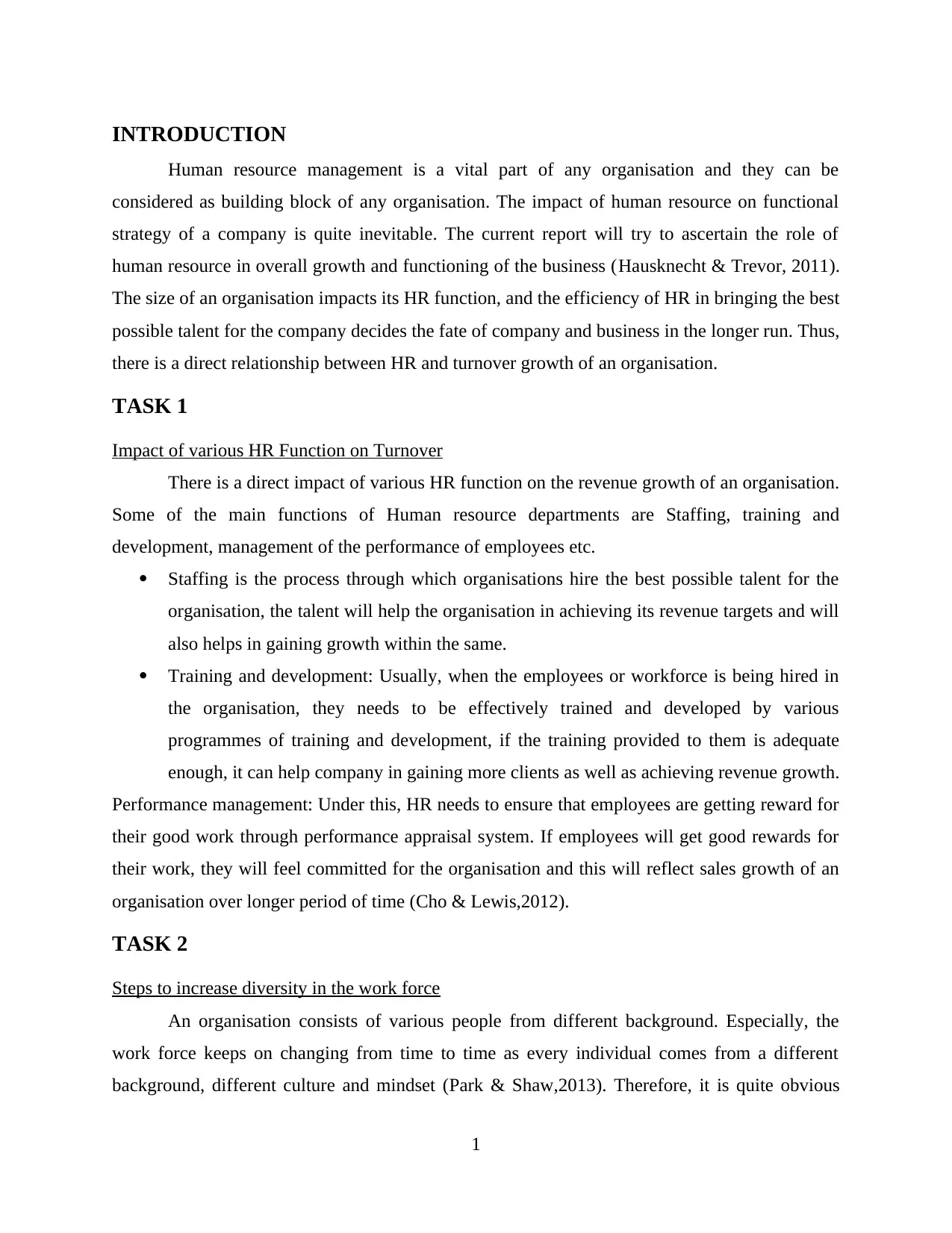
INTRODUCTION
Human resource management is a vital part of any organisation and they can be
considered as building block of any organisation. The impact of human resource on functional
strategy of a company is quite inevitable. The current report will try to ascertain the role of
human resource in overall growth and functioning of the business (Hausknecht & Trevor, 2011).
The size of an organisation impacts its HR function, and the efficiency of HR in bringing the best
possible talent for the company decides the fate of company and business in the longer run. Thus,
there is a direct relationship between HR and turnover growth of an organisation.
TASK 1
Impact of various HR Function on Turnover
There is a direct impact of various HR function on the revenue growth of an organisation.
Some of the main functions of Human resource departments are Staffing, training and
development, management of the performance of employees etc.
Staffing is the process through which organisations hire the best possible talent for the
organisation, the talent will help the organisation in achieving its revenue targets and will
also helps in gaining growth within the same.
Training and development: Usually, when the employees or workforce is being hired in
the organisation, they needs to be effectively trained and developed by various
programmes of training and development, if the training provided to them is adequate
enough, it can help company in gaining more clients as well as achieving revenue growth.
Performance management: Under this, HR needs to ensure that employees are getting reward for
their good work through performance appraisal system. If employees will get good rewards for
their work, they will feel committed for the organisation and this will reflect sales growth of an
organisation over longer period of time (Cho & Lewis,2012).
TASK 2
Steps to increase diversity in the work force
An organisation consists of various people from different background. Especially, the
work force keeps on changing from time to time as every individual comes from a different
background, different culture and mindset (Park & Shaw,2013). Therefore, it is quite obvious
1
Document Page
that an organisation will come across diversity in the business on its own. However, if an
organisation and its management want to make their work force more diverse so that
representation of each community of the society can be made, then various decision needs to be
taken. Some of the steps can be to talk with local organisations to hire relevant people for the
firm, asking employees for referrals (Jensen, Patel & Messersmith,2013).
The major benefits of diversity in work force is higher efficiency, new and diverse ideas
becomes part of organisation’s atmosphere, reputation of the company is also build if the
company would be representing every section of the society. It helps company in growing its
revenue as well as profitability in the longer run.
TASK 3
Steps for increment and reduction in work force
Workforce of companies is constantly changing and therefore it becomes important that
right kind of steps are taken to make sure that any reduction and increase in work force can be
productive for an organisation. In order to fill the workforce of the organisation in which
specialised skills are required, the HR manager of the company can hire capable individuals from
educational institutions depending upon the kind of skills that are required from employees
(Kehoe, & Wright, 2013). Other sources available include advertising, online hiring etc.
In order to reduce work force of the organisation, the HR manager can take various kinds
of decision. Some of the prominent one includes:
Reducing the amount of work hours available for employees
Shifting employee tasks to reduce the number of worker positions
Instituting mandatory furlough or layoffs.
It is also important that layoffs or reduction in workforce is communicated to the employees in
an effective manner over period of time (Bhatnagar, 2012.)
CONCLUSION
Thus, from the above discussion it can be said that HR department of any organisation
plays a very crucial role in the growth and development of business. If the work force hired by
the company is not committed as well as productive for the organisation, it can have serious
effects on the revenue and profitability growth of the company. Employees will not feel sense of
belonging for the company and negative outcome is expected from such kind of behaviour from
2
tabler-icon-diamond-filled.svg

Paraphrase This Document

Need a fresh take? Get an instant paraphrase of this document with our AI Paraphraser
Document Page
the workforce. Therefore, it is concluded that there is a direct relationship of employee’s
satisfaction and performance of organisation and its revenue growth.
3
Document Page
REFERENCES
Books and Journals
Bhatnagar, J. (2012). Management of innovation: role of psychological empowerment, work
engagement and turnover intention in the Indian context. The International Journal of
Human Resource Management, 23(5), 928-951.
Cho, Y. J., & Lewis, G. B. (2012). Turnover intention and turnover behavior: Implications for
retaining federal employees. Review of Public Personnel Administration, 32(1), 4-23.
Hausknecht, J. P., & Trevor, C. O. (2011). Collective turnover at the group, unit, and
organizational levels: Evidence, issues, and implications. Journal of management,
37(1), 352-388.
Jensen, J. M., Patel, P. C., & Messersmith, J. G. (2013). High-performance work systems and job
control: Consequences for anxiety, role overload, and turnover intentions. Journal of
Management, 39(6), 1699-1724.
Kehoe, R. R., & Wright, P. M. (2013). The impact of high-performance human resource
practices on employees’ attitudes and behaviors. Journal of management, 39(2), 366-
391.
Park, T. Y., & Shaw, J. D. (2013). Turnover rates and organizational performance: A meta-
analysis. Journal of Applied Psychology, 98(2), 268.
Selden, S. C., & Sowa, J. E. (2015). Voluntary turnover in nonprofit human service
organizations: The impact of high performance work practices. Human Service
Organizations: Management, Leadership & Governance, 39(3), 182-207.
4
chevron_up_icon
1 out of 6
circle_padding
hide_on_mobile
zoom_out_icon
[object Object]