Human Resource Management Practices Report for Vodafone Group
VerifiedAdded on 2022/12/26
|18
|4632
|216
Report
AI Summary
This report delves into the core aspects of Human Resource Management (HRM) within the context of Vodafone. It begins with an introduction to HRM, outlining its purpose and functions in workforce planning and resourcing, highlighting the importance of recruitment and selection, and the benefits of various HRM practices for both employers and employees. The report then explores the strengths and weaknesses of different recruitment and selection approaches, evaluates the effectiveness of HRM practices in relation to organizational profit and productivity, and analyzes the significance of employee relations in HRM decision-making. Additionally, the report identifies key elements of employment legislation and their impact on HRM. The report further illustrates the application of HRM practices using specific examples within Vodafone, providing a comprehensive overview of HRM strategies and their practical implications within a global organization. The report concludes by summarizing the key findings and recommendations for effective HRM implementation.

Unit: 3 Human Resource
Management
Management

Paraphrase This Document
Need a fresh take? Get an instant paraphrase of this document with our AI Paraphraser
Table of Contents
Part 1..........................................................................................................................................3
Introduction................................................................................................................................3
Main Body..................................................................................................................................3
P1 Explain the purpose and the functions of HRM, applicable to workforce planning and
resourcing an organisation.....................................................................................................3
P2 Explain the strengths and weaknesses of different approaches to recruitment and
selection..................................................................................................................................7
P3: Explain the benefits of different HRM practices within an organisation for both the
employer and employee.........................................................................................................9
P4: Evaluate the effectiveness of different HRM practices in terms of raising organisational
profit and productivity..........................................................................................................10
P5: Analyse the importance of employee relations in respect to influencing HRM decision-
making..................................................................................................................................11
P6: Identify the key elements of employment legislation and the impact it has upon HRM
decision-making...................................................................................................................12
Part 2........................................................................................................................................13
P7: Illustrate the application of HRM practices in a work-related context, using specific
examples...............................................................................................................................13
Conclusion................................................................................................................................16
References................................................................................................................................17
Part 1..........................................................................................................................................3
Introduction................................................................................................................................3
Main Body..................................................................................................................................3
P1 Explain the purpose and the functions of HRM, applicable to workforce planning and
resourcing an organisation.....................................................................................................3
P2 Explain the strengths and weaknesses of different approaches to recruitment and
selection..................................................................................................................................7
P3: Explain the benefits of different HRM practices within an organisation for both the
employer and employee.........................................................................................................9
P4: Evaluate the effectiveness of different HRM practices in terms of raising organisational
profit and productivity..........................................................................................................10
P5: Analyse the importance of employee relations in respect to influencing HRM decision-
making..................................................................................................................................11
P6: Identify the key elements of employment legislation and the impact it has upon HRM
decision-making...................................................................................................................12
Part 2........................................................................................................................................13
P7: Illustrate the application of HRM practices in a work-related context, using specific
examples...............................................................................................................................13
Conclusion................................................................................................................................16
References................................................................................................................................17
Part 1
Introduction
Human resource management is the process which is where the human resource manager
are responsible for execution of the different operations within business. In human resource
management, leadership are the greatest strategies which are followed up by the most of
organisation. This is one of the best and effective strategy which are used by the managers.
An organisation is totally depend on recruitment and selection process, which are needed
training and development process of an employee which is executive by human resource
team (Albarran, Mierzejewska, and Jung, 2018). This report will be going to cover different
function of HRM, strength and weakness of different approaches. It will further discuss the
benefits of HRM. For this the chosen organisation is Vodafone, as the need of HR practices
and their implication in the company is needed and important for the growth. Vodafone group
was founded in 1982, and headquartered in Berkshire, United Kingdom.
Main Body
P1 Explain the purpose and the functions of HRM, applicable to workforce planning and
resourcing an organisation
Definition of HRM:
This is the general process of recruiting, selecting and inducting employee, training
and development and many more benefits which are used for achieving the growth and
objectives of company. HR manager of Vodafone has the mission to earn revenue with the
help of providing the best services to their valuable client having effective team resource.
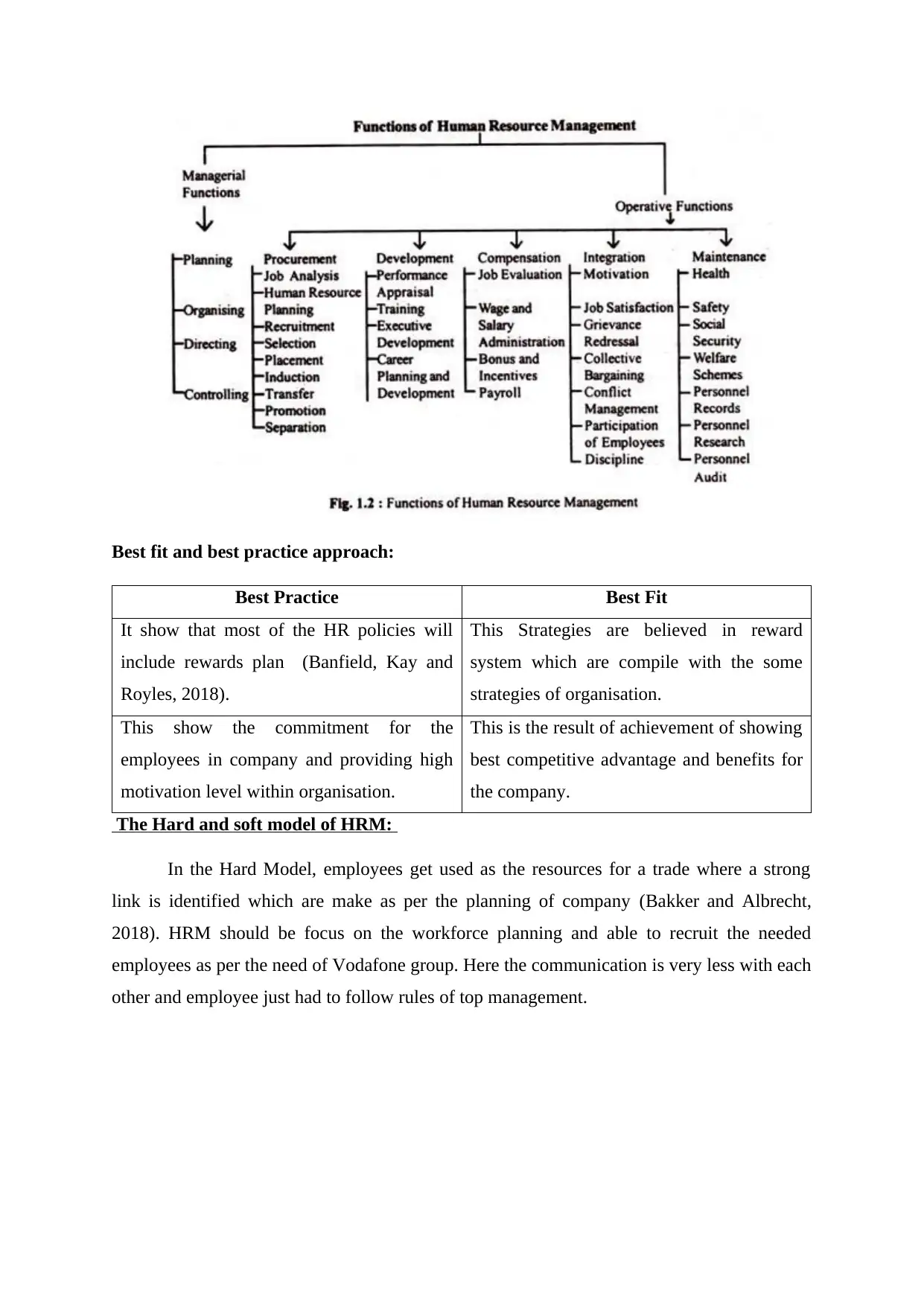
Functions and activities of HRM:
At Vodafone, HR team handle, all the activities which are related to employees, time
table of expiring training and development programme, assist team members issues, call for
interview, recruit and many other duties (Annarelli and Nonino, 2016). Some of the function
which are performed by HR manager of Vodafone, are support and train their team, excellent
multi-tasking skills, working in the independently, cross training session and make a
compliances culture. All of these function and activities are followed and complete by the HR
team of Vodafone group.
Introduction
Human resource management is the process which is where the human resource manager
are responsible for execution of the different operations within business. In human resource
management, leadership are the greatest strategies which are followed up by the most of
organisation. This is one of the best and effective strategy which are used by the managers.
An organisation is totally depend on recruitment and selection process, which are needed
training and development process of an employee which is executive by human resource
team (Albarran, Mierzejewska, and Jung, 2018). This report will be going to cover different
function of HRM, strength and weakness of different approaches. It will further discuss the
benefits of HRM. For this the chosen organisation is Vodafone, as the need of HR practices
and their implication in the company is needed and important for the growth. Vodafone group
was founded in 1982, and headquartered in Berkshire, United Kingdom.
Main Body
P1 Explain the purpose and the functions of HRM, applicable to workforce planning and
resourcing an organisation
Definition of HRM:
This is the general process of recruiting, selecting and inducting employee, training
and development and many more benefits which are used for achieving the growth and
objectives of company. HR manager of Vodafone has the mission to earn revenue with the
help of providing the best services to their valuable client having effective team resource.
Functions and activities of HRM:
At Vodafone, HR team handle, all the activities which are related to employees, time
table of expiring training and development programme, assist team members issues, call for
interview, recruit and many other duties (Annarelli and Nonino, 2016). Some of the function
which are performed by HR manager of Vodafone, are support and train their team, excellent
multi-tasking skills, working in the independently, cross training session and make a
compliances culture. All of these function and activities are followed and complete by the HR
team of Vodafone group.
⊘ This is a preview!⊘
Do you want full access?
Subscribe today to unlock all pages.

Trusted by 1+ million students worldwide
Best fit and best practice approach:
Best Practice Best Fit
It show that most of the HR policies will
include rewards plan (Banfield, Kay and
Royles, 2018).
This Strategies are believed in reward
system which are compile with the some
strategies of organisation.
This show the commitment for the
employees in company and providing high
motivation level within organisation.
This is the result of achievement of showing
best competitive advantage and benefits for
the company.
The Hard and soft model of HRM:
In the Hard Model, employees get used as the resources for a trade where a strong
link is identified which are make as per the planning of company (Bakker and Albrecht,
2018). HRM should be focus on the workforce planning and able to recruit the needed
employees as per the need of Vodafone group. Here the communication is very less with each
other and employee just had to follow rules of top management.
Best Practice Best Fit
It show that most of the HR policies will
include rewards plan (Banfield, Kay and
Royles, 2018).
This Strategies are believed in reward
system which are compile with the some
strategies of organisation.
This show the commitment for the
employees in company and providing high
motivation level within organisation.
This is the result of achievement of showing
best competitive advantage and benefits for
the company.
The Hard and soft model of HRM:
In the Hard Model, employees get used as the resources for a trade where a strong
link is identified which are make as per the planning of company (Bakker and Albrecht,
2018). HRM should be focus on the workforce planning and able to recruit the needed
employees as per the need of Vodafone group. Here the communication is very less with each
other and employee just had to follow rules of top management.
Paraphrase This Document
Need a fresh take? Get an instant paraphrase of this document with our AI Paraphraser
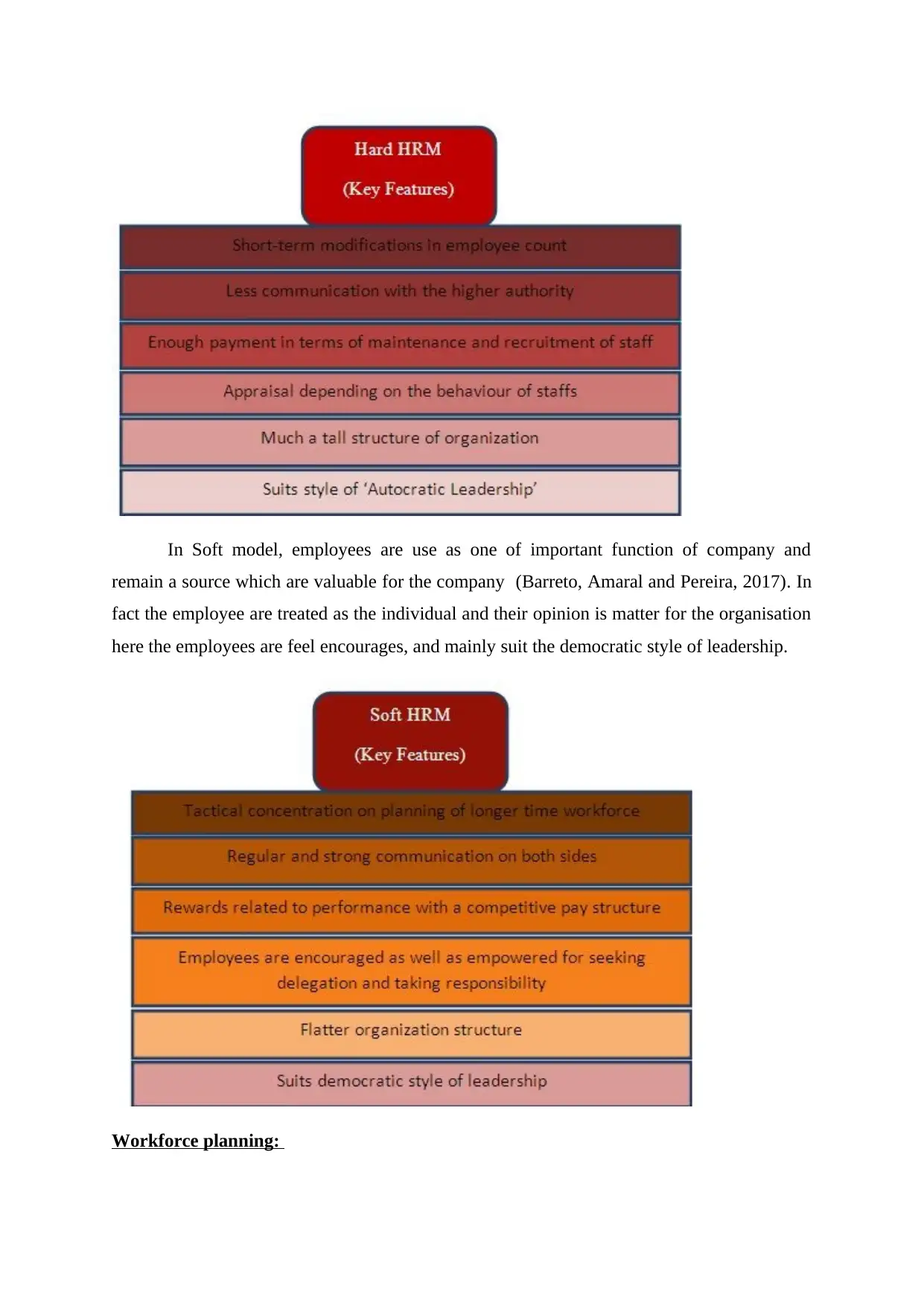
In Soft model, employees are use as one of important function of company and
remain a source which are valuable for the company (Barreto, Amaral and Pereira, 2017). In
fact the employee are treated as the individual and their opinion is matter for the organisation
here the employees are feel encourages, and mainly suit the democratic style of leadership.
Workforce planning:
remain a source which are valuable for the company (Barreto, Amaral and Pereira, 2017). In
fact the employee are treated as the individual and their opinion is matter for the organisation
here the employees are feel encourages, and mainly suit the democratic style of leadership.
Workforce planning:
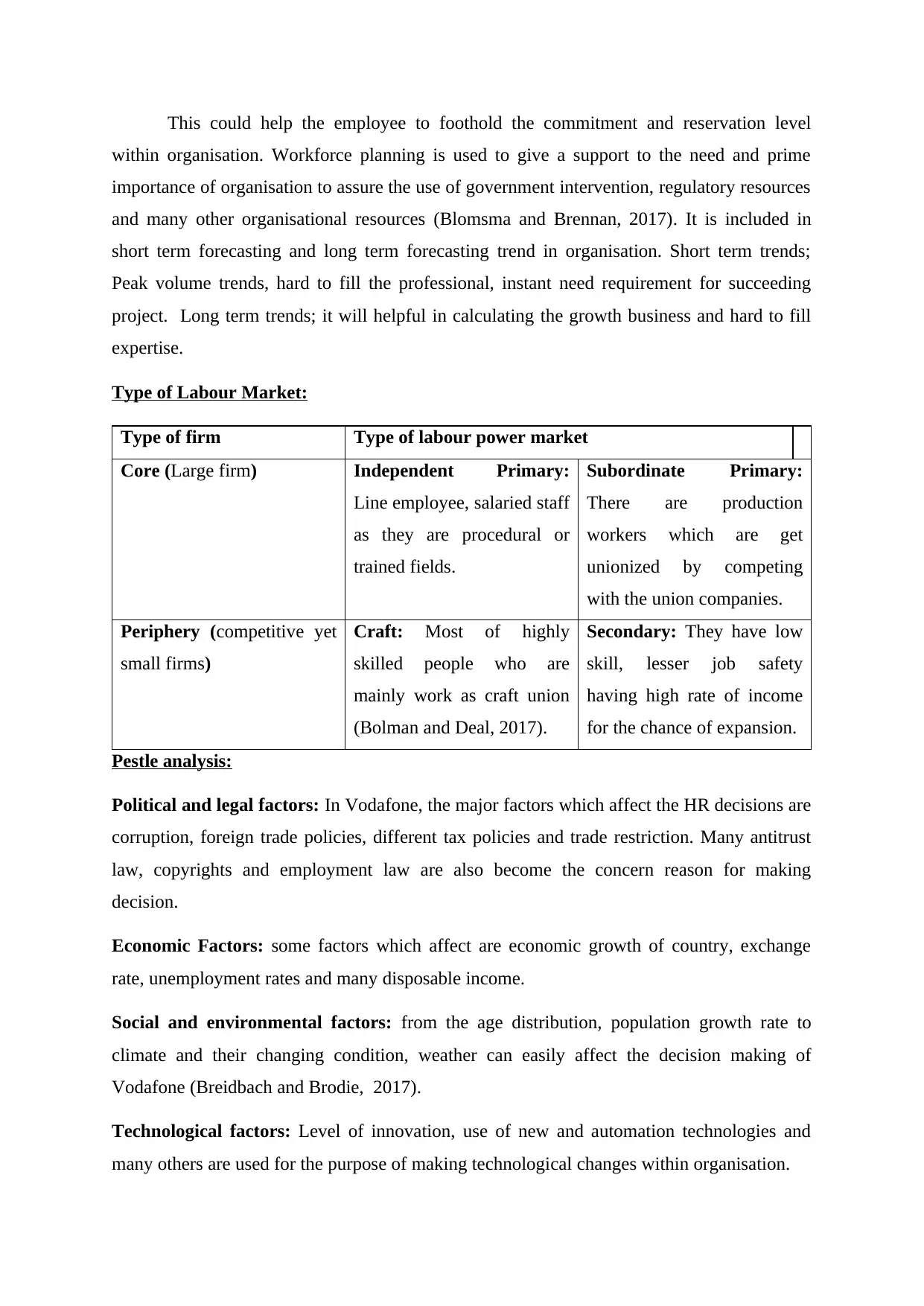
This could help the employee to foothold the commitment and reservation level
within organisation. Workforce planning is used to give a support to the need and prime
importance of organisation to assure the use of government intervention, regulatory resources
and many other organisational resources (Blomsma and Brennan, 2017). It is included in
short term forecasting and long term forecasting trend in organisation. Short term trends;
Peak volume trends, hard to fill the professional, instant need requirement for succeeding
project. Long term trends; it will helpful in calculating the growth business and hard to fill
expertise.
Type of Labour Market:
Type of firm Type of labour power market
Core (Large firm) Independent Primary:
Line employee, salaried staff
as they are procedural or
trained fields.
Subordinate Primary:
There are production
workers which are get
unionized by competing
with the union companies.
Periphery (competitive yet
small firms)
Craft: Most of highly
skilled people who are
mainly work as craft union
(Bolman and Deal, 2017).
Secondary: They have low
skill, lesser job safety
having high rate of income
for the chance of expansion.
Pestle analysis:
Political and legal factors: In Vodafone, the major factors which affect the HR decisions are
corruption, foreign trade policies, different tax policies and trade restriction. Many antitrust
law, copyrights and employment law are also become the concern reason for making
decision.
Economic Factors: some factors which affect are economic growth of country, exchange
rate, unemployment rates and many disposable income.
Social and environmental factors: from the age distribution, population growth rate to
climate and their changing condition, weather can easily affect the decision making of
Vodafone (Breidbach and Brodie, 2017).
Technological factors: Level of innovation, use of new and automation technologies and
many others are used for the purpose of making technological changes within organisation.
within organisation. Workforce planning is used to give a support to the need and prime
importance of organisation to assure the use of government intervention, regulatory resources
and many other organisational resources (Blomsma and Brennan, 2017). It is included in
short term forecasting and long term forecasting trend in organisation. Short term trends;
Peak volume trends, hard to fill the professional, instant need requirement for succeeding
project. Long term trends; it will helpful in calculating the growth business and hard to fill
expertise.
Type of Labour Market:
Type of firm Type of labour power market
Core (Large firm) Independent Primary:
Line employee, salaried staff
as they are procedural or
trained fields.
Subordinate Primary:
There are production
workers which are get
unionized by competing
with the union companies.
Periphery (competitive yet
small firms)
Craft: Most of highly
skilled people who are
mainly work as craft union
(Bolman and Deal, 2017).
Secondary: They have low
skill, lesser job safety
having high rate of income
for the chance of expansion.
Pestle analysis:
Political and legal factors: In Vodafone, the major factors which affect the HR decisions are
corruption, foreign trade policies, different tax policies and trade restriction. Many antitrust
law, copyrights and employment law are also become the concern reason for making
decision.
Economic Factors: some factors which affect are economic growth of country, exchange
rate, unemployment rates and many disposable income.
Social and environmental factors: from the age distribution, population growth rate to
climate and their changing condition, weather can easily affect the decision making of
Vodafone (Breidbach and Brodie, 2017).
Technological factors: Level of innovation, use of new and automation technologies and
many others are used for the purpose of making technological changes within organisation.
⊘ This is a preview!⊘
Do you want full access?
Subscribe today to unlock all pages.
Trusted by 1+ million students worldwide
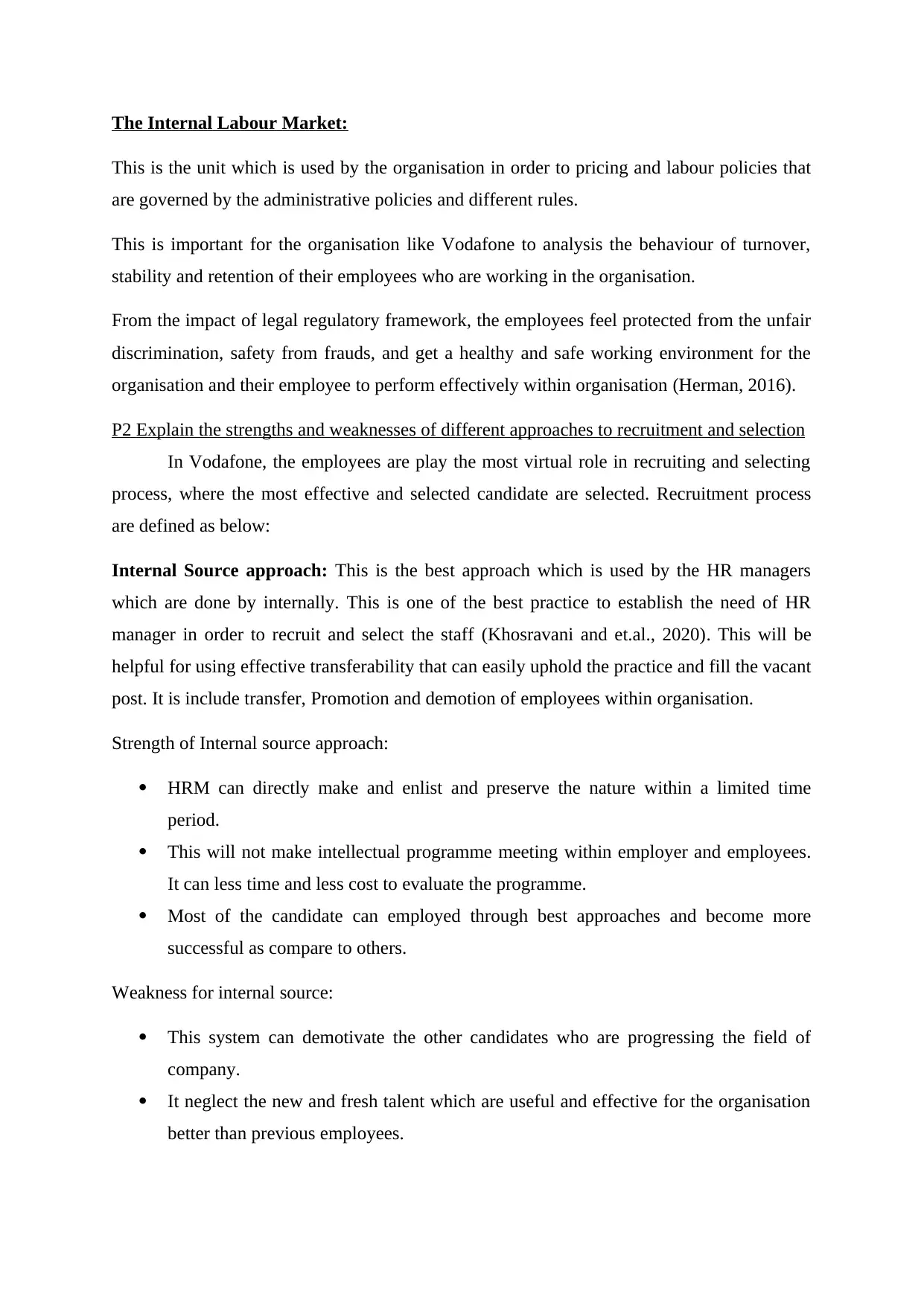
The Internal Labour Market:
This is the unit which is used by the organisation in order to pricing and labour policies that
are governed by the administrative policies and different rules.
This is important for the organisation like Vodafone to analysis the behaviour of turnover,
stability and retention of their employees who are working in the organisation.
From the impact of legal regulatory framework, the employees feel protected from the unfair
discrimination, safety from frauds, and get a healthy and safe working environment for the
organisation and their employee to perform effectively within organisation (Herman, 2016).
P2 Explain the strengths and weaknesses of different approaches to recruitment and selection
In Vodafone, the employees are play the most virtual role in recruiting and selecting
process, where the most effective and selected candidate are selected. Recruitment process
are defined as below:
Internal Source approach: This is the best approach which is used by the HR managers
which are done by internally. This is one of the best practice to establish the need of HR
manager in order to recruit and select the staff (Khosravani and et.al., 2020). This will be
helpful for using effective transferability that can easily uphold the practice and fill the vacant
post. It is include transfer, Promotion and demotion of employees within organisation.
Strength of Internal source approach:
HRM can directly make and enlist and preserve the nature within a limited time
period.
This will not make intellectual programme meeting within employer and employees.
It can less time and less cost to evaluate the programme.
Most of the candidate can employed through best approaches and become more
successful as compare to others.
Weakness for internal source:
This system can demotivate the other candidates who are progressing the field of
company.
It neglect the new and fresh talent which are useful and effective for the organisation
better than previous employees.
This is the unit which is used by the organisation in order to pricing and labour policies that
are governed by the administrative policies and different rules.
This is important for the organisation like Vodafone to analysis the behaviour of turnover,
stability and retention of their employees who are working in the organisation.
From the impact of legal regulatory framework, the employees feel protected from the unfair
discrimination, safety from frauds, and get a healthy and safe working environment for the
organisation and their employee to perform effectively within organisation (Herman, 2016).
P2 Explain the strengths and weaknesses of different approaches to recruitment and selection
In Vodafone, the employees are play the most virtual role in recruiting and selecting
process, where the most effective and selected candidate are selected. Recruitment process
are defined as below:
Internal Source approach: This is the best approach which is used by the HR managers
which are done by internally. This is one of the best practice to establish the need of HR
manager in order to recruit and select the staff (Khosravani and et.al., 2020). This will be
helpful for using effective transferability that can easily uphold the practice and fill the vacant
post. It is include transfer, Promotion and demotion of employees within organisation.
Strength of Internal source approach:
HRM can directly make and enlist and preserve the nature within a limited time
period.
This will not make intellectual programme meeting within employer and employees.
It can less time and less cost to evaluate the programme.
Most of the candidate can employed through best approaches and become more
successful as compare to others.
Weakness for internal source:
This system can demotivate the other candidates who are progressing the field of
company.
It neglect the new and fresh talent which are useful and effective for the organisation
better than previous employees.
Paraphrase This Document
Need a fresh take? Get an instant paraphrase of this document with our AI Paraphraser
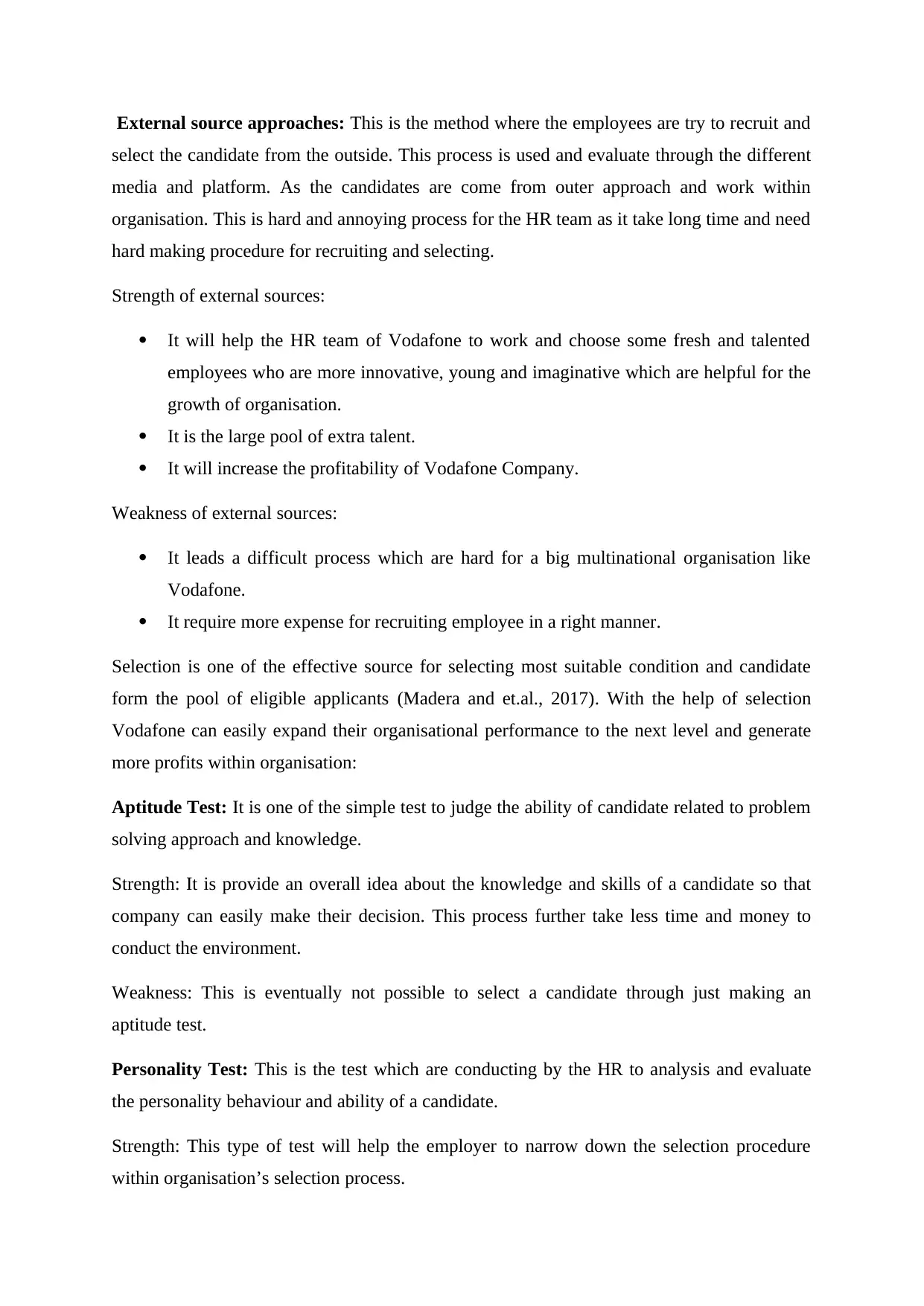
External source approaches: This is the method where the employees are try to recruit and
select the candidate from the outside. This process is used and evaluate through the different
media and platform. As the candidates are come from outer approach and work within
organisation. This is hard and annoying process for the HR team as it take long time and need
hard making procedure for recruiting and selecting.
Strength of external sources:
It will help the HR team of Vodafone to work and choose some fresh and talented
employees who are more innovative, young and imaginative which are helpful for the
growth of organisation.
It is the large pool of extra talent.
It will increase the profitability of Vodafone Company.
Weakness of external sources:
It leads a difficult process which are hard for a big multinational organisation like
Vodafone.
It require more expense for recruiting employee in a right manner.
Selection is one of the effective source for selecting most suitable condition and candidate
form the pool of eligible applicants (Madera and et.al., 2017). With the help of selection
Vodafone can easily expand their organisational performance to the next level and generate
more profits within organisation:
Aptitude Test: It is one of the simple test to judge the ability of candidate related to problem
solving approach and knowledge.
Strength: It is provide an overall idea about the knowledge and skills of a candidate so that
company can easily make their decision. This process further take less time and money to
conduct the environment.
Weakness: This is eventually not possible to select a candidate through just making an
aptitude test.
Personality Test: This is the test which are conducting by the HR to analysis and evaluate
the personality behaviour and ability of a candidate.
Strength: This type of test will help the employer to narrow down the selection procedure
within organisation’s selection process.
select the candidate from the outside. This process is used and evaluate through the different
media and platform. As the candidates are come from outer approach and work within
organisation. This is hard and annoying process for the HR team as it take long time and need
hard making procedure for recruiting and selecting.
Strength of external sources:
It will help the HR team of Vodafone to work and choose some fresh and talented
employees who are more innovative, young and imaginative which are helpful for the
growth of organisation.
It is the large pool of extra talent.
It will increase the profitability of Vodafone Company.
Weakness of external sources:
It leads a difficult process which are hard for a big multinational organisation like
Vodafone.
It require more expense for recruiting employee in a right manner.
Selection is one of the effective source for selecting most suitable condition and candidate
form the pool of eligible applicants (Madera and et.al., 2017). With the help of selection
Vodafone can easily expand their organisational performance to the next level and generate
more profits within organisation:
Aptitude Test: It is one of the simple test to judge the ability of candidate related to problem
solving approach and knowledge.
Strength: It is provide an overall idea about the knowledge and skills of a candidate so that
company can easily make their decision. This process further take less time and money to
conduct the environment.
Weakness: This is eventually not possible to select a candidate through just making an
aptitude test.
Personality Test: This is the test which are conducting by the HR to analysis and evaluate
the personality behaviour and ability of a candidate.
Strength: This type of test will help the employer to narrow down the selection procedure
within organisation’s selection process.
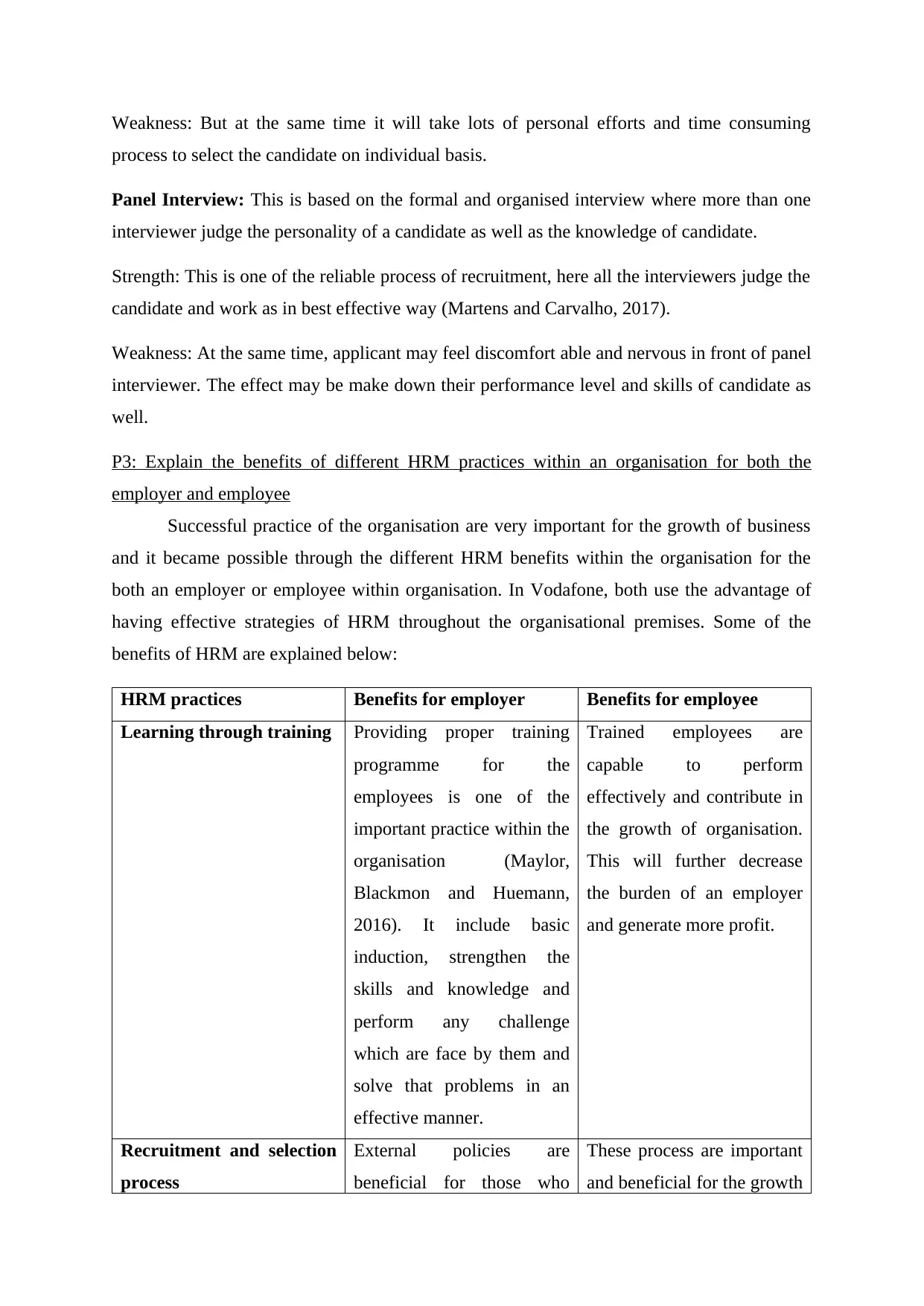
Weakness: But at the same time it will take lots of personal efforts and time consuming
process to select the candidate on individual basis.
Panel Interview: This is based on the formal and organised interview where more than one
interviewer judge the personality of a candidate as well as the knowledge of candidate.
Strength: This is one of the reliable process of recruitment, here all the interviewers judge the
candidate and work as in best effective way (Martens and Carvalho, 2017).
Weakness: At the same time, applicant may feel discomfort able and nervous in front of panel
interviewer. The effect may be make down their performance level and skills of candidate as
well.
P3: Explain the benefits of different HRM practices within an organisation for both the
employer and employee
Successful practice of the organisation are very important for the growth of business
and it became possible through the different HRM benefits within the organisation for the
both an employer or employee within organisation. In Vodafone, both use the advantage of
having effective strategies of HRM throughout the organisational premises. Some of the
benefits of HRM are explained below:
HRM practices Benefits for employer Benefits for employee
Learning through training Providing proper training
programme for the
employees is one of the
important practice within the
organisation (Maylor,
Blackmon and Huemann,
2016). It include basic
induction, strengthen the
skills and knowledge and
perform any challenge
which are face by them and
solve that problems in an
effective manner.
Trained employees are
capable to perform
effectively and contribute in
the growth of organisation.
This will further decrease
the burden of an employer
and generate more profit.
Recruitment and selection
process
External policies are
beneficial for those who
These process are important
and beneficial for the growth
process to select the candidate on individual basis.
Panel Interview: This is based on the formal and organised interview where more than one
interviewer judge the personality of a candidate as well as the knowledge of candidate.
Strength: This is one of the reliable process of recruitment, here all the interviewers judge the
candidate and work as in best effective way (Martens and Carvalho, 2017).
Weakness: At the same time, applicant may feel discomfort able and nervous in front of panel
interviewer. The effect may be make down their performance level and skills of candidate as
well.
P3: Explain the benefits of different HRM practices within an organisation for both the
employer and employee
Successful practice of the organisation are very important for the growth of business
and it became possible through the different HRM benefits within the organisation for the
both an employer or employee within organisation. In Vodafone, both use the advantage of
having effective strategies of HRM throughout the organisational premises. Some of the
benefits of HRM are explained below:
HRM practices Benefits for employer Benefits for employee
Learning through training Providing proper training
programme for the
employees is one of the
important practice within the
organisation (Maylor,
Blackmon and Huemann,
2016). It include basic
induction, strengthen the
skills and knowledge and
perform any challenge
which are face by them and
solve that problems in an
effective manner.
Trained employees are
capable to perform
effectively and contribute in
the growth of organisation.
This will further decrease
the burden of an employer
and generate more profit.
Recruitment and selection
process
External policies are
beneficial for those who
These process are important
and beneficial for the growth
⊘ This is a preview!⊘
Do you want full access?
Subscribe today to unlock all pages.
Trusted by 1+ million students worldwide
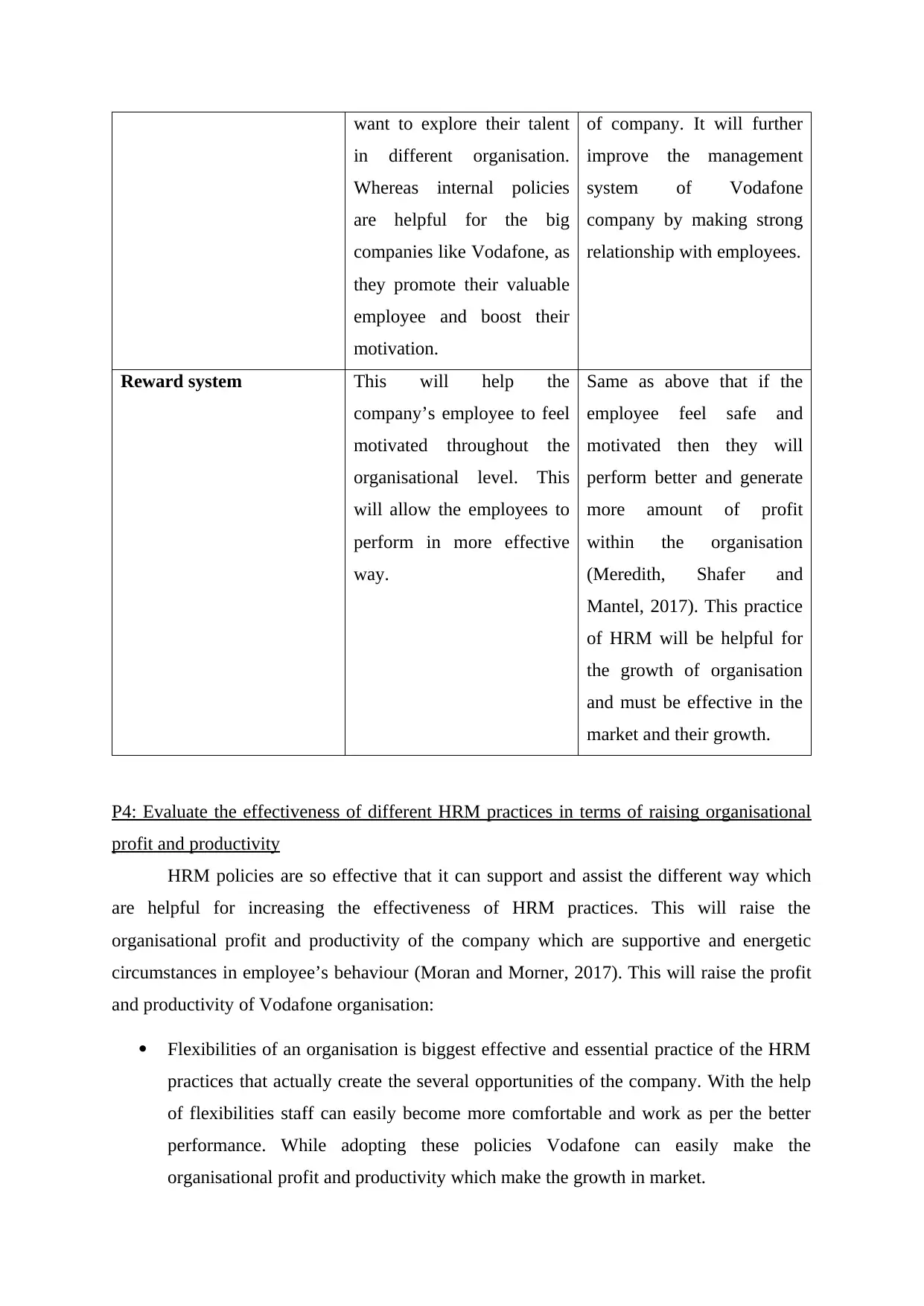
want to explore their talent
in different organisation.
Whereas internal policies
are helpful for the big
companies like Vodafone, as
they promote their valuable
employee and boost their
motivation.
of company. It will further
improve the management
system of Vodafone
company by making strong
relationship with employees.
Reward system This will help the
company’s employee to feel
motivated throughout the
organisational level. This
will allow the employees to
perform in more effective
way.
Same as above that if the
employee feel safe and
motivated then they will
perform better and generate
more amount of profit
within the organisation
(Meredith, Shafer and
Mantel, 2017). This practice
of HRM will be helpful for
the growth of organisation
and must be effective in the
market and their growth.
P4: Evaluate the effectiveness of different HRM practices in terms of raising organisational
profit and productivity
HRM policies are so effective that it can support and assist the different way which
are helpful for increasing the effectiveness of HRM practices. This will raise the
organisational profit and productivity of the company which are supportive and energetic
circumstances in employee’s behaviour (Moran and Morner, 2017). This will raise the profit
and productivity of Vodafone organisation:
Flexibilities of an organisation is biggest effective and essential practice of the HRM
practices that actually create the several opportunities of the company. With the help
of flexibilities staff can easily become more comfortable and work as per the better
performance. While adopting these policies Vodafone can easily make the
organisational profit and productivity which make the growth in market.
in different organisation.
Whereas internal policies
are helpful for the big
companies like Vodafone, as
they promote their valuable
employee and boost their
motivation.
of company. It will further
improve the management
system of Vodafone
company by making strong
relationship with employees.
Reward system This will help the
company’s employee to feel
motivated throughout the
organisational level. This
will allow the employees to
perform in more effective
way.
Same as above that if the
employee feel safe and
motivated then they will
perform better and generate
more amount of profit
within the organisation
(Meredith, Shafer and
Mantel, 2017). This practice
of HRM will be helpful for
the growth of organisation
and must be effective in the
market and their growth.
P4: Evaluate the effectiveness of different HRM practices in terms of raising organisational
profit and productivity
HRM policies are so effective that it can support and assist the different way which
are helpful for increasing the effectiveness of HRM practices. This will raise the
organisational profit and productivity of the company which are supportive and energetic
circumstances in employee’s behaviour (Moran and Morner, 2017). This will raise the profit
and productivity of Vodafone organisation:
Flexibilities of an organisation is biggest effective and essential practice of the HRM
practices that actually create the several opportunities of the company. With the help
of flexibilities staff can easily become more comfortable and work as per the better
performance. While adopting these policies Vodafone can easily make the
organisational profit and productivity which make the growth in market.
Paraphrase This Document
Need a fresh take? Get an instant paraphrase of this document with our AI Paraphraser
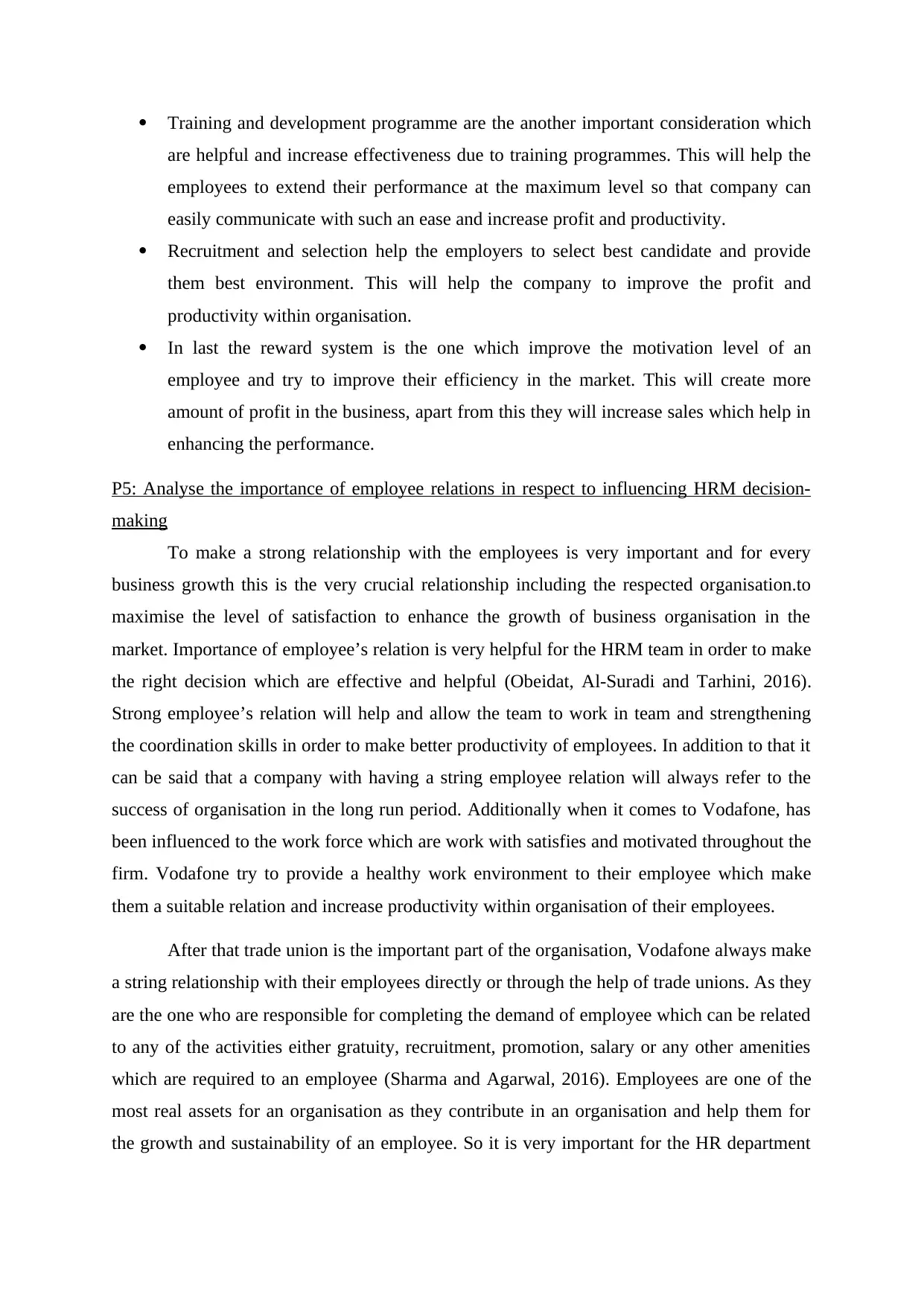
Training and development programme are the another important consideration which
are helpful and increase effectiveness due to training programmes. This will help the
employees to extend their performance at the maximum level so that company can
easily communicate with such an ease and increase profit and productivity.
Recruitment and selection help the employers to select best candidate and provide
them best environment. This will help the company to improve the profit and
productivity within organisation.
In last the reward system is the one which improve the motivation level of an
employee and try to improve their efficiency in the market. This will create more
amount of profit in the business, apart from this they will increase sales which help in
enhancing the performance.
P5: Analyse the importance of employee relations in respect to influencing HRM decision-
making
To make a strong relationship with the employees is very important and for every
business growth this is the very crucial relationship including the respected organisation.to
maximise the level of satisfaction to enhance the growth of business organisation in the
market. Importance of employee’s relation is very helpful for the HRM team in order to make
the right decision which are effective and helpful (Obeidat, Al-Suradi and Tarhini, 2016).
Strong employee’s relation will help and allow the team to work in team and strengthening
the coordination skills in order to make better productivity of employees. In addition to that it
can be said that a company with having a string employee relation will always refer to the
success of organisation in the long run period. Additionally when it comes to Vodafone, has
been influenced to the work force which are work with satisfies and motivated throughout the
firm. Vodafone try to provide a healthy work environment to their employee which make
them a suitable relation and increase productivity within organisation of their employees.
After that trade union is the important part of the organisation, Vodafone always make
a string relationship with their employees directly or through the help of trade unions. As they
are the one who are responsible for completing the demand of employee which can be related
to any of the activities either gratuity, recruitment, promotion, salary or any other amenities
which are required to an employee (Sharma and Agarwal, 2016). Employees are one of the
most real assets for an organisation as they contribute in an organisation and help them for
the growth and sustainability of an employee. So it is very important for the HR department
are helpful and increase effectiveness due to training programmes. This will help the
employees to extend their performance at the maximum level so that company can
easily communicate with such an ease and increase profit and productivity.
Recruitment and selection help the employers to select best candidate and provide
them best environment. This will help the company to improve the profit and
productivity within organisation.
In last the reward system is the one which improve the motivation level of an
employee and try to improve their efficiency in the market. This will create more
amount of profit in the business, apart from this they will increase sales which help in
enhancing the performance.
P5: Analyse the importance of employee relations in respect to influencing HRM decision-
making
To make a strong relationship with the employees is very important and for every
business growth this is the very crucial relationship including the respected organisation.to
maximise the level of satisfaction to enhance the growth of business organisation in the
market. Importance of employee’s relation is very helpful for the HRM team in order to make
the right decision which are effective and helpful (Obeidat, Al-Suradi and Tarhini, 2016).
Strong employee’s relation will help and allow the team to work in team and strengthening
the coordination skills in order to make better productivity of employees. In addition to that it
can be said that a company with having a string employee relation will always refer to the
success of organisation in the long run period. Additionally when it comes to Vodafone, has
been influenced to the work force which are work with satisfies and motivated throughout the
firm. Vodafone try to provide a healthy work environment to their employee which make
them a suitable relation and increase productivity within organisation of their employees.
After that trade union is the important part of the organisation, Vodafone always make
a string relationship with their employees directly or through the help of trade unions. As they
are the one who are responsible for completing the demand of employee which can be related
to any of the activities either gratuity, recruitment, promotion, salary or any other amenities
which are required to an employee (Sharma and Agarwal, 2016). Employees are one of the
most real assets for an organisation as they contribute in an organisation and help them for
the growth and sustainability of an employee. So it is very important for the HR department
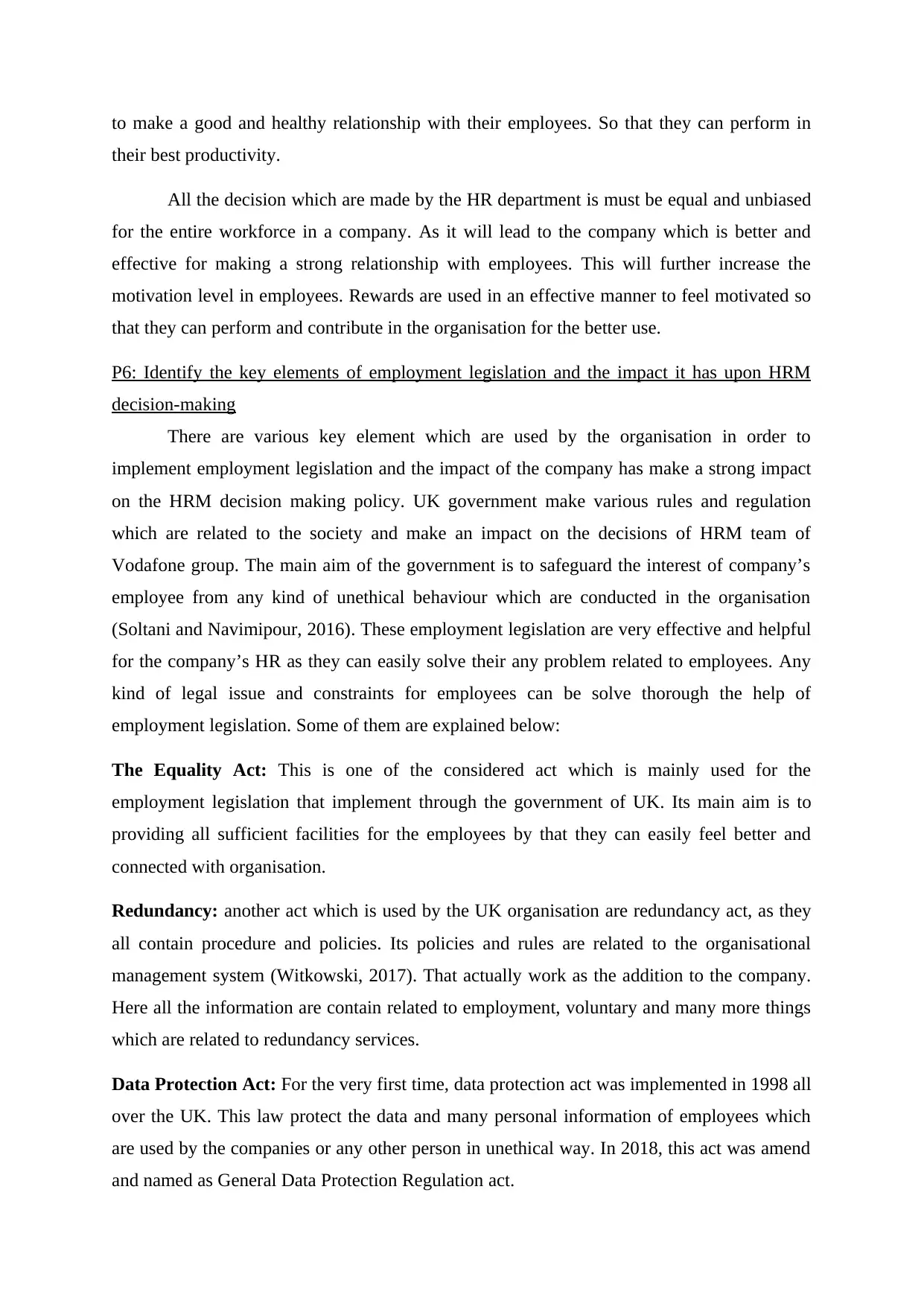
to make a good and healthy relationship with their employees. So that they can perform in
their best productivity.
All the decision which are made by the HR department is must be equal and unbiased
for the entire workforce in a company. As it will lead to the company which is better and
effective for making a strong relationship with employees. This will further increase the
motivation level in employees. Rewards are used in an effective manner to feel motivated so
that they can perform and contribute in the organisation for the better use.
P6: Identify the key elements of employment legislation and the impact it has upon HRM
decision-making
There are various key element which are used by the organisation in order to
implement employment legislation and the impact of the company has make a strong impact
on the HRM decision making policy. UK government make various rules and regulation
which are related to the society and make an impact on the decisions of HRM team of
Vodafone group. The main aim of the government is to safeguard the interest of company’s
employee from any kind of unethical behaviour which are conducted in the organisation
(Soltani and Navimipour, 2016). These employment legislation are very effective and helpful
for the company’s HR as they can easily solve their any problem related to employees. Any
kind of legal issue and constraints for employees can be solve thorough the help of
employment legislation. Some of them are explained below:
The Equality Act: This is one of the considered act which is mainly used for the
employment legislation that implement through the government of UK. Its main aim is to
providing all sufficient facilities for the employees by that they can easily feel better and
connected with organisation.
Redundancy: another act which is used by the UK organisation are redundancy act, as they
all contain procedure and policies. Its policies and rules are related to the organisational
management system (Witkowski, 2017). That actually work as the addition to the company.
Here all the information are contain related to employment, voluntary and many more things
which are related to redundancy services.
Data Protection Act: For the very first time, data protection act was implemented in 1998 all
over the UK. This law protect the data and many personal information of employees which
are used by the companies or any other person in unethical way. In 2018, this act was amend
and named as General Data Protection Regulation act.
their best productivity.
All the decision which are made by the HR department is must be equal and unbiased
for the entire workforce in a company. As it will lead to the company which is better and
effective for making a strong relationship with employees. This will further increase the
motivation level in employees. Rewards are used in an effective manner to feel motivated so
that they can perform and contribute in the organisation for the better use.
P6: Identify the key elements of employment legislation and the impact it has upon HRM
decision-making
There are various key element which are used by the organisation in order to
implement employment legislation and the impact of the company has make a strong impact
on the HRM decision making policy. UK government make various rules and regulation
which are related to the society and make an impact on the decisions of HRM team of
Vodafone group. The main aim of the government is to safeguard the interest of company’s
employee from any kind of unethical behaviour which are conducted in the organisation
(Soltani and Navimipour, 2016). These employment legislation are very effective and helpful
for the company’s HR as they can easily solve their any problem related to employees. Any
kind of legal issue and constraints for employees can be solve thorough the help of
employment legislation. Some of them are explained below:
The Equality Act: This is one of the considered act which is mainly used for the
employment legislation that implement through the government of UK. Its main aim is to
providing all sufficient facilities for the employees by that they can easily feel better and
connected with organisation.
Redundancy: another act which is used by the UK organisation are redundancy act, as they
all contain procedure and policies. Its policies and rules are related to the organisational
management system (Witkowski, 2017). That actually work as the addition to the company.
Here all the information are contain related to employment, voluntary and many more things
which are related to redundancy services.
Data Protection Act: For the very first time, data protection act was implemented in 1998 all
over the UK. This law protect the data and many personal information of employees which
are used by the companies or any other person in unethical way. In 2018, this act was amend
and named as General Data Protection Regulation act.
⊘ This is a preview!⊘
Do you want full access?
Subscribe today to unlock all pages.
Trusted by 1+ million students worldwide

1 out of 18


Related Documents


Your All-in-One AI-Powered Toolkit for Academic Success.
+13062052269
info@desklib.com
Available 24*7 on WhatsApp / Email
![[object Object]](/_next/static/media/star-bottom.7253800d.svg)
Unlock your academic potential
Copyright © 2020–2026 A2Z Services. All Rights Reserved. Developed and managed by ZUCOL.