University HRM Assignment: Writing and Reflection by Student
VerifiedAdded on 2022/10/02
|11
|2736
|135
Homework Assignment
AI Summary
This assignment, submitted by a student, is a comprehensive analysis of their learning and professional development within the field of Human Resource Management (HRM). It comprises four reflective journals focusing on key aspects of professional development. Journal 1 reports on a professional informational interview, highlighting the importance of financial reporting and analytical skills. Journals 2 and 3 delve into self-reflection, exploring the student's elevator pitch, teamwork experiences, and areas for improvement, such as communication and emotional intelligence. Journal 4 provides a critical overview and strategy summary, synthesizing key learnings, incorporating academic literature, and outlining a detailed plan for skill development to achieve career goals, including timelines and actionable steps. The assignment emphasizes the importance of interpersonal skills, communication, and emotional intelligence, alongside technical skills, for success in the finance sector and beyond. The student reflects on their experiences, identifies areas for improvement, and proposes strategies for personal and professional growth, drawing on academic research and practical insights.
Student’s Last Name 1
Human Resource Management: Writing and Reflection
By (Name)
Course
Professor
University
Date
Human Resource Management: Writing and Reflection
By (Name)
Course
Professor
University
Date

Paraphrase This Document
Need a fresh take? Get an instant paraphrase of this document with our AI Paraphraser
Student’s Last Name 2
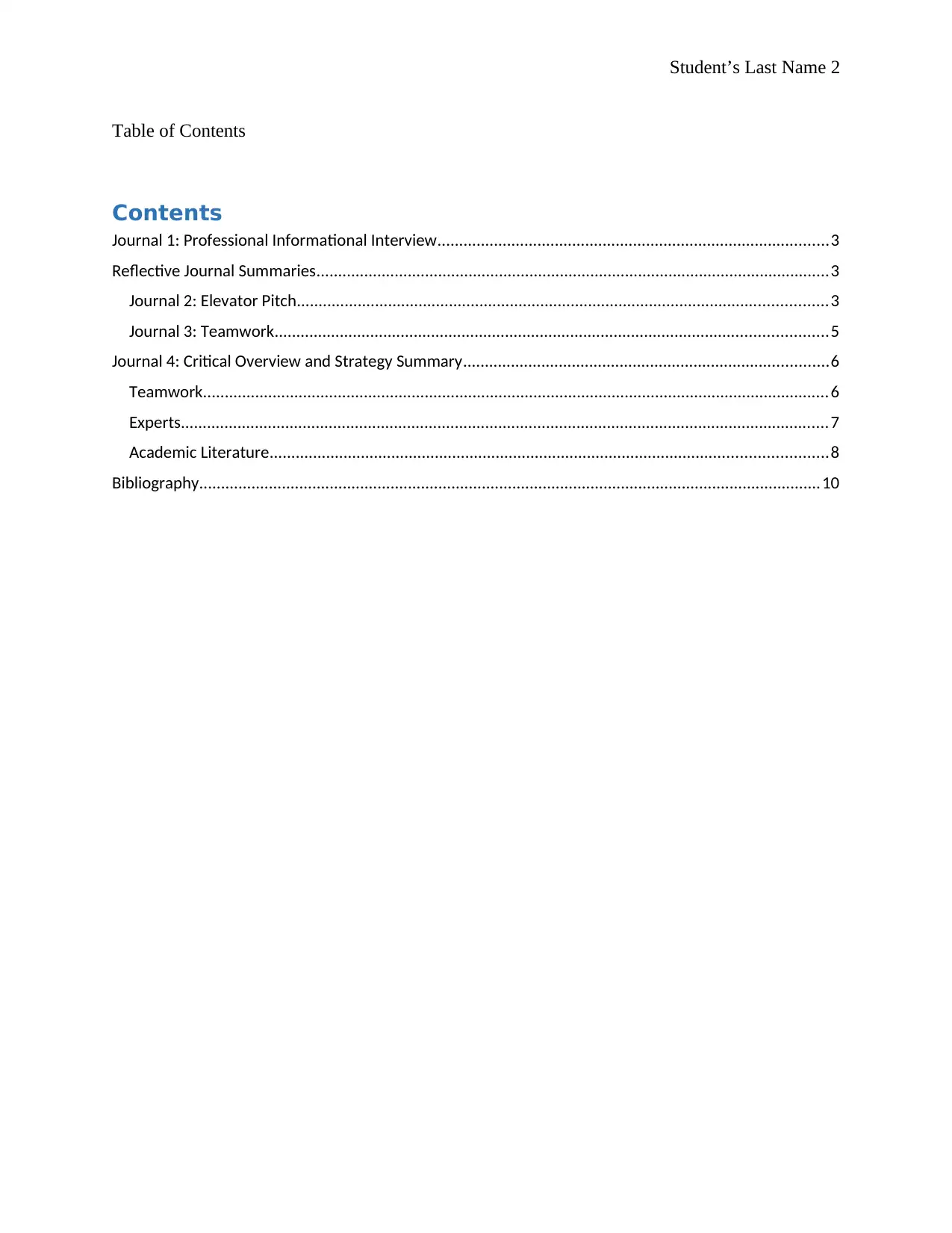
Table of Contents
Contents
Journal 1: Professional Informational Interview..........................................................................................3
Reflective Journal Summaries......................................................................................................................3
Journal 2: Elevator Pitch..........................................................................................................................3
Journal 3: Teamwork...............................................................................................................................5
Journal 4: Critical Overview and Strategy Summary....................................................................................6
Teamwork................................................................................................................................................6
Experts.....................................................................................................................................................7
Academic Literature................................................................................................................................8
Bibliography...............................................................................................................................................10
Table of Contents
Contents
Journal 1: Professional Informational Interview..........................................................................................3
Reflective Journal Summaries......................................................................................................................3
Journal 2: Elevator Pitch..........................................................................................................................3
Journal 3: Teamwork...............................................................................................................................5
Journal 4: Critical Overview and Strategy Summary....................................................................................6
Teamwork................................................................................................................................................6
Experts.....................................................................................................................................................7
Academic Literature................................................................................................................................8
Bibliography...............................................................................................................................................10
Student’s Last Name 3
Journal 1: Professional Informational Interview
This year’s units have majorly based on improving our employability skills in the highly
competitive career market. In most of these lessons, the professor repeatedly stressed on the
importance of financial reporting and analytical ability in our prospective future careers.
According to our professor, financial reporting and analytical ability were the most fundamental
skills to any finance officer. Being a mere accounting student, I looked forward to improving
these two essential skills. According to Breznik and Lahovnik (2016, pp. 168), the dynamic
capabilities of human capital are very vital for the firms’ efficiency and success. While financial
reporting mainly involves how to describe and present the financial estimates and projections of
a firm, analytical skills are very helpful in ascertaining that the financial data is accurate. The
two skills function simultaneously and interdependently. In one lecture, I recall, our professor
disclosed that his excellence at financial reporting and analysis are the skills that can be
attributed to his rising ranks, both in the corporate field and in the academic field. In our
professor’s wisdom, financial reporting and analytical ability are the most enviable items in our
professional toolkits. In my entire career, therefore, I developed an obligation to improve these
two skills throughout my career to increase my value as well as my employability index.
Reflective Journal Summaries
Journal 2: Elevator Pitch
Last month, our professor demanded that we needed to learn how to write a good and
persuasive elevator pitch. In the course of my writing, I learned that for the last two years, I had
learned new experiences, developed new hobbies and interests as well as improving on several
skills. Courtesy of this year's informative units, for instance, my passion for the finance field has
Journal 1: Professional Informational Interview
This year’s units have majorly based on improving our employability skills in the highly
competitive career market. In most of these lessons, the professor repeatedly stressed on the
importance of financial reporting and analytical ability in our prospective future careers.
According to our professor, financial reporting and analytical ability were the most fundamental
skills to any finance officer. Being a mere accounting student, I looked forward to improving
these two essential skills. According to Breznik and Lahovnik (2016, pp. 168), the dynamic
capabilities of human capital are very vital for the firms’ efficiency and success. While financial
reporting mainly involves how to describe and present the financial estimates and projections of
a firm, analytical skills are very helpful in ascertaining that the financial data is accurate. The
two skills function simultaneously and interdependently. In one lecture, I recall, our professor
disclosed that his excellence at financial reporting and analysis are the skills that can be
attributed to his rising ranks, both in the corporate field and in the academic field. In our
professor’s wisdom, financial reporting and analytical ability are the most enviable items in our
professional toolkits. In my entire career, therefore, I developed an obligation to improve these
two skills throughout my career to increase my value as well as my employability index.
Reflective Journal Summaries
Journal 2: Elevator Pitch
Last month, our professor demanded that we needed to learn how to write a good and
persuasive elevator pitch. In the course of my writing, I learned that for the last two years, I had
learned new experiences, developed new hobbies and interests as well as improving on several
skills. Courtesy of this year's informative units, for instance, my passion for the finance field has
⊘ This is a preview!⊘
Do you want full access?
Subscribe today to unlock all pages.

Trusted by 1+ million students worldwide
Student’s Last Name 4
greatly been boosted. Moreover, during the writing, I came to realize that there were various
subtle skills that I had not identified myself previously. For example, the many financial
documents, journals, and ledgers I had come across had significantly aided in the development of
my keenness to detail. I had become more keen and diligent. I had come to appreciate the value
of accuracy on financial documents. Most of my classmates usually present their documents to
me so that I can crosscheck and pinpoint any irregularities if present. Moreover, as I was writing,
I saw it was prudent to capture my persevering character. Throughout the year, I had tolerated
long hours while analyzing financial data both in-class time and in my free time. My general
level of determination towards excelling in my career could not miss in my elevator pitch.
The writing of my elevator pitch instigated in me a strong sense of admiration about
myself. I can attest that I was elated by the discoveries about myself. If it was not for my
boosted passion and enthusiasm for finance, my grades would not be very promising. It is
unlikely that I would be as focused as I am of now. This would have impacted relatively lower
grades and thus, lower employability index. My combination of hard work, diligence, and
perseverance has also contributed to my improving academic performance. By students having
me check for bugs in their documents, my self-esteem was also boosted.
I liked the fact that eventually, I had come to love and understand finance. I had become
more enthusiastic about my finance course, which would certainly lead to a successful career. I
learned that the skills would be my future drivers to a successful investment banker, and later, to
a vice president of one major investment banks.
As I was preparing myself for the job market, I had to combine all those skills in my
elevator pitch and postulate them during my workplace experience. This would ensure that I
greatly been boosted. Moreover, during the writing, I came to realize that there were various
subtle skills that I had not identified myself previously. For example, the many financial
documents, journals, and ledgers I had come across had significantly aided in the development of
my keenness to detail. I had become more keen and diligent. I had come to appreciate the value
of accuracy on financial documents. Most of my classmates usually present their documents to
me so that I can crosscheck and pinpoint any irregularities if present. Moreover, as I was writing,
I saw it was prudent to capture my persevering character. Throughout the year, I had tolerated
long hours while analyzing financial data both in-class time and in my free time. My general
level of determination towards excelling in my career could not miss in my elevator pitch.
The writing of my elevator pitch instigated in me a strong sense of admiration about
myself. I can attest that I was elated by the discoveries about myself. If it was not for my
boosted passion and enthusiasm for finance, my grades would not be very promising. It is
unlikely that I would be as focused as I am of now. This would have impacted relatively lower
grades and thus, lower employability index. My combination of hard work, diligence, and
perseverance has also contributed to my improving academic performance. By students having
me check for bugs in their documents, my self-esteem was also boosted.
I liked the fact that eventually, I had come to love and understand finance. I had become
more enthusiastic about my finance course, which would certainly lead to a successful career. I
learned that the skills would be my future drivers to a successful investment banker, and later, to
a vice president of one major investment banks.
As I was preparing myself for the job market, I had to combine all those skills in my
elevator pitch and postulate them during my workplace experience. This would ensure that I
Paraphrase This Document
Need a fresh take? Get an instant paraphrase of this document with our AI Paraphraser
Student’s Last Name 5
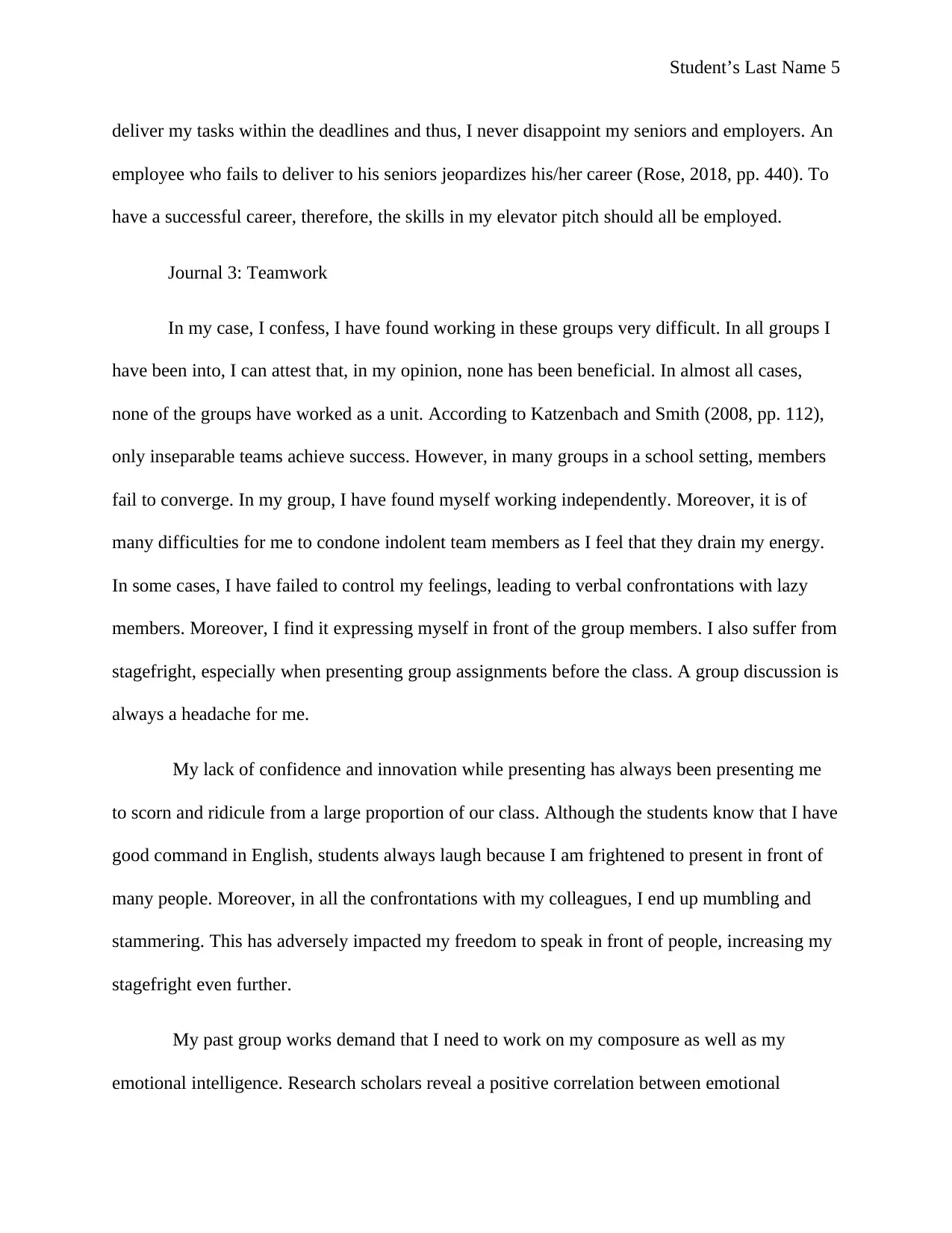
deliver my tasks within the deadlines and thus, I never disappoint my seniors and employers. An
employee who fails to deliver to his seniors jeopardizes his/her career (Rose, 2018, pp. 440). To
have a successful career, therefore, the skills in my elevator pitch should all be employed.
Journal 3: Teamwork
In my case, I confess, I have found working in these groups very difficult. In all groups I
have been into, I can attest that, in my opinion, none has been beneficial. In almost all cases,
none of the groups have worked as a unit. According to Katzenbach and Smith (2008, pp. 112),
only inseparable teams achieve success. However, in many groups in a school setting, members
fail to converge. In my group, I have found myself working independently. Moreover, it is of
many difficulties for me to condone indolent team members as I feel that they drain my energy.
In some cases, I have failed to control my feelings, leading to verbal confrontations with lazy
members. Moreover, I find it expressing myself in front of the group members. I also suffer from
stagefright, especially when presenting group assignments before the class. A group discussion is
always a headache for me.
My lack of confidence and innovation while presenting has always been presenting me
to scorn and ridicule from a large proportion of our class. Although the students know that I have
good command in English, students always laugh because I am frightened to present in front of
many people. Moreover, in all the confrontations with my colleagues, I end up mumbling and
stammering. This has adversely impacted my freedom to speak in front of people, increasing my
stagefright even further.
My past group works demand that I need to work on my composure as well as my
emotional intelligence. Research scholars reveal a positive correlation between emotional
deliver my tasks within the deadlines and thus, I never disappoint my seniors and employers. An
employee who fails to deliver to his seniors jeopardizes his/her career (Rose, 2018, pp. 440). To
have a successful career, therefore, the skills in my elevator pitch should all be employed.
Journal 3: Teamwork
In my case, I confess, I have found working in these groups very difficult. In all groups I
have been into, I can attest that, in my opinion, none has been beneficial. In almost all cases,
none of the groups have worked as a unit. According to Katzenbach and Smith (2008, pp. 112),
only inseparable teams achieve success. However, in many groups in a school setting, members
fail to converge. In my group, I have found myself working independently. Moreover, it is of
many difficulties for me to condone indolent team members as I feel that they drain my energy.
In some cases, I have failed to control my feelings, leading to verbal confrontations with lazy
members. Moreover, I find it expressing myself in front of the group members. I also suffer from
stagefright, especially when presenting group assignments before the class. A group discussion is
always a headache for me.
My lack of confidence and innovation while presenting has always been presenting me
to scorn and ridicule from a large proportion of our class. Although the students know that I have
good command in English, students always laugh because I am frightened to present in front of
many people. Moreover, in all the confrontations with my colleagues, I end up mumbling and
stammering. This has adversely impacted my freedom to speak in front of people, increasing my
stagefright even further.
My past group works demand that I need to work on my composure as well as my
emotional intelligence. Research scholars reveal a positive correlation between emotional
Student’s Last Name 6
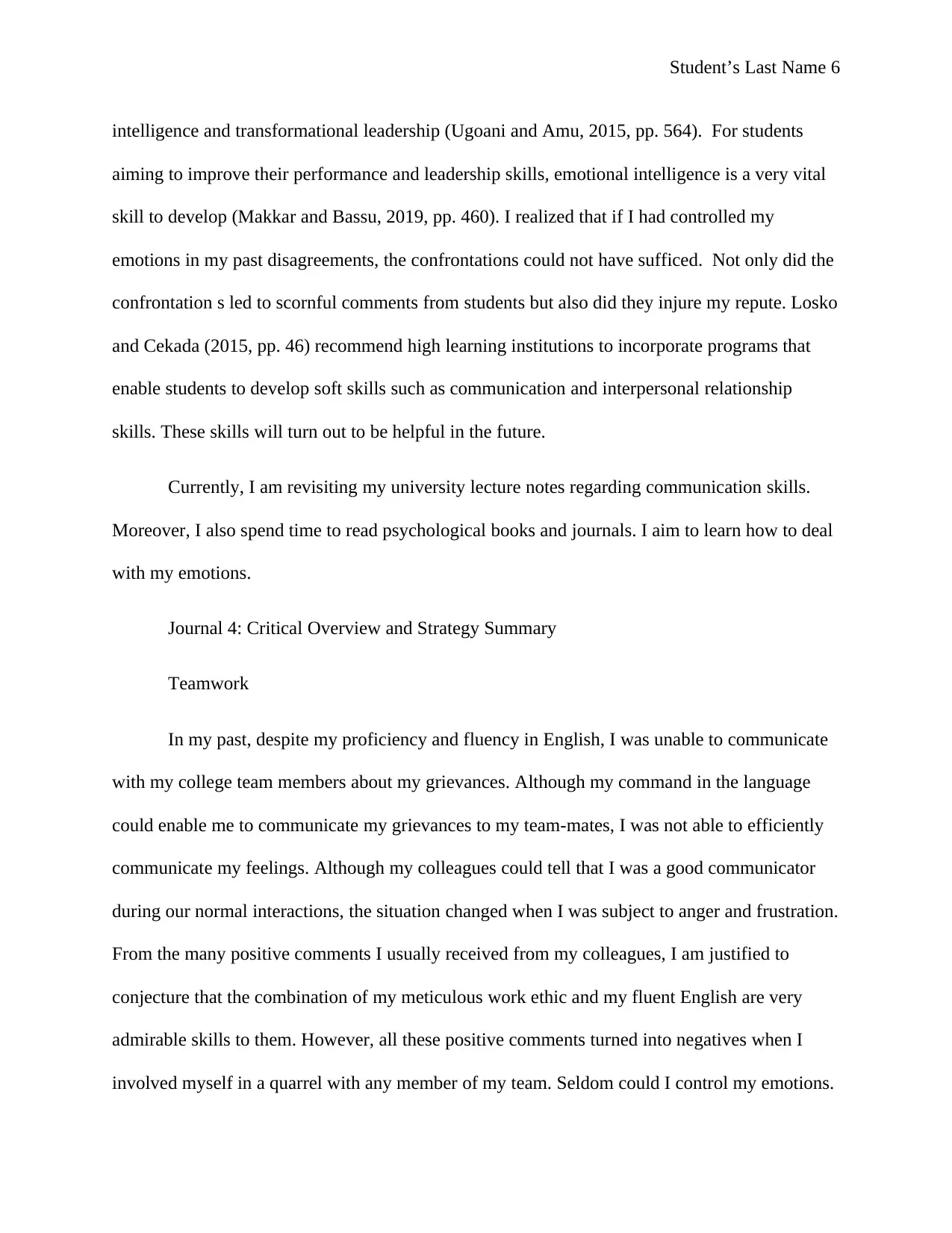
intelligence and transformational leadership (Ugoani and Amu, 2015, pp. 564). For students
aiming to improve their performance and leadership skills, emotional intelligence is a very vital
skill to develop (Makkar and Bassu, 2019, pp. 460). I realized that if I had controlled my
emotions in my past disagreements, the confrontations could not have sufficed. Not only did the
confrontation s led to scornful comments from students but also did they injure my repute. Losko
and Cekada (2015, pp. 46) recommend high learning institutions to incorporate programs that
enable students to develop soft skills such as communication and interpersonal relationship
skills. These skills will turn out to be helpful in the future.
Currently, I am revisiting my university lecture notes regarding communication skills.
Moreover, I also spend time to read psychological books and journals. I aim to learn how to deal
with my emotions.
Journal 4: Critical Overview and Strategy Summary
Teamwork
In my past, despite my proficiency and fluency in English, I was unable to communicate
with my college team members about my grievances. Although my command in the language
could enable me to communicate my grievances to my team-mates, I was not able to efficiently
communicate my feelings. Although my colleagues could tell that I was a good communicator
during our normal interactions, the situation changed when I was subject to anger and frustration.
From the many positive comments I usually received from my colleagues, I am justified to
conjecture that the combination of my meticulous work ethic and my fluent English are very
admirable skills to them. However, all these positive comments turned into negatives when I
involved myself in a quarrel with any member of my team. Seldom could I control my emotions.
intelligence and transformational leadership (Ugoani and Amu, 2015, pp. 564). For students
aiming to improve their performance and leadership skills, emotional intelligence is a very vital
skill to develop (Makkar and Bassu, 2019, pp. 460). I realized that if I had controlled my
emotions in my past disagreements, the confrontations could not have sufficed. Not only did the
confrontation s led to scornful comments from students but also did they injure my repute. Losko
and Cekada (2015, pp. 46) recommend high learning institutions to incorporate programs that
enable students to develop soft skills such as communication and interpersonal relationship
skills. These skills will turn out to be helpful in the future.
Currently, I am revisiting my university lecture notes regarding communication skills.
Moreover, I also spend time to read psychological books and journals. I aim to learn how to deal
with my emotions.
Journal 4: Critical Overview and Strategy Summary
Teamwork
In my past, despite my proficiency and fluency in English, I was unable to communicate
with my college team members about my grievances. Although my command in the language
could enable me to communicate my grievances to my team-mates, I was not able to efficiently
communicate my feelings. Although my colleagues could tell that I was a good communicator
during our normal interactions, the situation changed when I was subject to anger and frustration.
From the many positive comments I usually received from my colleagues, I am justified to
conjecture that the combination of my meticulous work ethic and my fluent English are very
admirable skills to them. However, all these positive comments turned into negatives when I
involved myself in a quarrel with any member of my team. Seldom could I control my emotions.
⊘ This is a preview!⊘
Do you want full access?
Subscribe today to unlock all pages.
Trusted by 1+ million students worldwide
Student’s Last Name 7
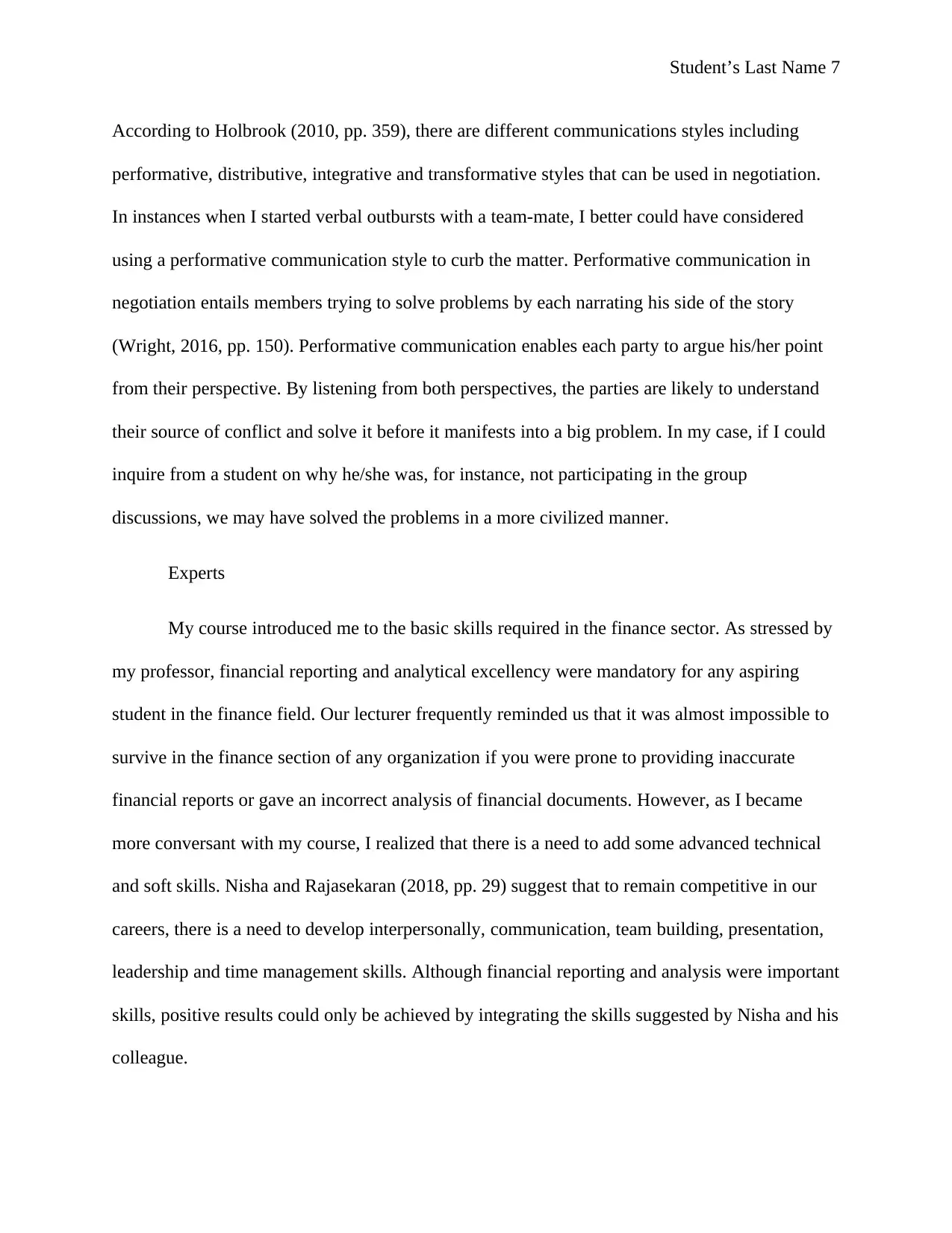
According to Holbrook (2010, pp. 359), there are different communications styles including
performative, distributive, integrative and transformative styles that can be used in negotiation.
In instances when I started verbal outbursts with a team-mate, I better could have considered
using a performative communication style to curb the matter. Performative communication in
negotiation entails members trying to solve problems by each narrating his side of the story
(Wright, 2016, pp. 150). Performative communication enables each party to argue his/her point
from their perspective. By listening from both perspectives, the parties are likely to understand
their source of conflict and solve it before it manifests into a big problem. In my case, if I could
inquire from a student on why he/she was, for instance, not participating in the group
discussions, we may have solved the problems in a more civilized manner.
Experts
My course introduced me to the basic skills required in the finance sector. As stressed by
my professor, financial reporting and analytical excellency were mandatory for any aspiring
student in the finance field. Our lecturer frequently reminded us that it was almost impossible to
survive in the finance section of any organization if you were prone to providing inaccurate
financial reports or gave an incorrect analysis of financial documents. However, as I became
more conversant with my course, I realized that there is a need to add some advanced technical
and soft skills. Nisha and Rajasekaran (2018, pp. 29) suggest that to remain competitive in our
careers, there is a need to develop interpersonally, communication, team building, presentation,
leadership and time management skills. Although financial reporting and analysis were important
skills, positive results could only be achieved by integrating the skills suggested by Nisha and his
colleague.
According to Holbrook (2010, pp. 359), there are different communications styles including
performative, distributive, integrative and transformative styles that can be used in negotiation.
In instances when I started verbal outbursts with a team-mate, I better could have considered
using a performative communication style to curb the matter. Performative communication in
negotiation entails members trying to solve problems by each narrating his side of the story
(Wright, 2016, pp. 150). Performative communication enables each party to argue his/her point
from their perspective. By listening from both perspectives, the parties are likely to understand
their source of conflict and solve it before it manifests into a big problem. In my case, if I could
inquire from a student on why he/she was, for instance, not participating in the group
discussions, we may have solved the problems in a more civilized manner.
Experts
My course introduced me to the basic skills required in the finance sector. As stressed by
my professor, financial reporting and analytical excellency were mandatory for any aspiring
student in the finance field. Our lecturer frequently reminded us that it was almost impossible to
survive in the finance section of any organization if you were prone to providing inaccurate
financial reports or gave an incorrect analysis of financial documents. However, as I became
more conversant with my course, I realized that there is a need to add some advanced technical
and soft skills. Nisha and Rajasekaran (2018, pp. 29) suggest that to remain competitive in our
careers, there is a need to develop interpersonally, communication, team building, presentation,
leadership and time management skills. Although financial reporting and analysis were important
skills, positive results could only be achieved by integrating the skills suggested by Nisha and his
colleague.
Paraphrase This Document
Need a fresh take? Get an instant paraphrase of this document with our AI Paraphraser
Student’s Last Name 8
Academic Literature
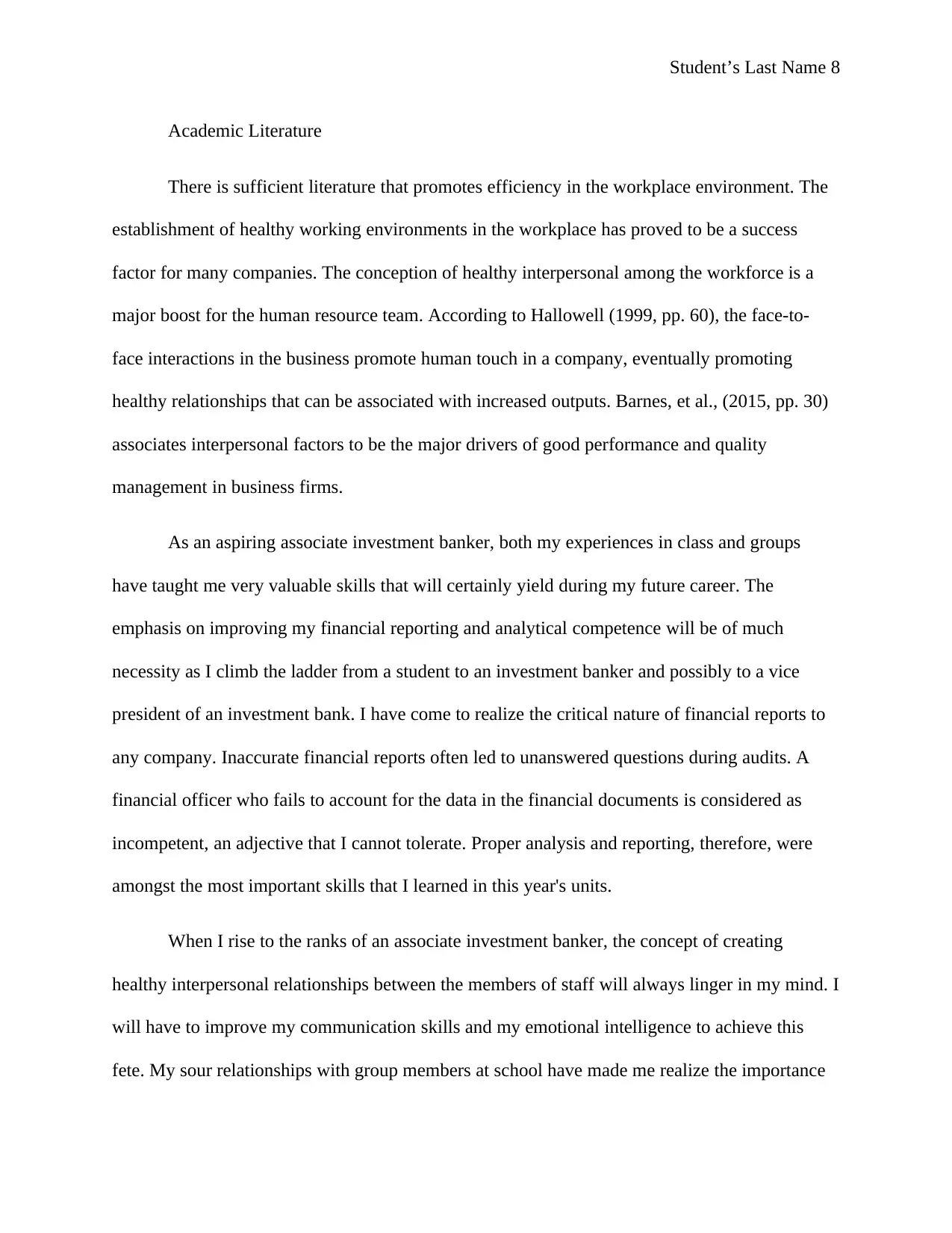
There is sufficient literature that promotes efficiency in the workplace environment. The
establishment of healthy working environments in the workplace has proved to be a success
factor for many companies. The conception of healthy interpersonal among the workforce is a
major boost for the human resource team. According to Hallowell (1999, pp. 60), the face-to-
face interactions in the business promote human touch in a company, eventually promoting
healthy relationships that can be associated with increased outputs. Barnes, et al., (2015, pp. 30)
associates interpersonal factors to be the major drivers of good performance and quality
management in business firms.
As an aspiring associate investment banker, both my experiences in class and groups
have taught me very valuable skills that will certainly yield during my future career. The
emphasis on improving my financial reporting and analytical competence will be of much
necessity as I climb the ladder from a student to an investment banker and possibly to a vice
president of an investment bank. I have come to realize the critical nature of financial reports to
any company. Inaccurate financial reports often led to unanswered questions during audits. A
financial officer who fails to account for the data in the financial documents is considered as
incompetent, an adjective that I cannot tolerate. Proper analysis and reporting, therefore, were
amongst the most important skills that I learned in this year's units.
When I rise to the ranks of an associate investment banker, the concept of creating
healthy interpersonal relationships between the members of staff will always linger in my mind. I
will have to improve my communication skills and my emotional intelligence to achieve this
fete. My sour relationships with group members at school have made me realize the importance
Academic Literature
There is sufficient literature that promotes efficiency in the workplace environment. The
establishment of healthy working environments in the workplace has proved to be a success
factor for many companies. The conception of healthy interpersonal among the workforce is a
major boost for the human resource team. According to Hallowell (1999, pp. 60), the face-to-
face interactions in the business promote human touch in a company, eventually promoting
healthy relationships that can be associated with increased outputs. Barnes, et al., (2015, pp. 30)
associates interpersonal factors to be the major drivers of good performance and quality
management in business firms.
As an aspiring associate investment banker, both my experiences in class and groups
have taught me very valuable skills that will certainly yield during my future career. The
emphasis on improving my financial reporting and analytical competence will be of much
necessity as I climb the ladder from a student to an investment banker and possibly to a vice
president of an investment bank. I have come to realize the critical nature of financial reports to
any company. Inaccurate financial reports often led to unanswered questions during audits. A
financial officer who fails to account for the data in the financial documents is considered as
incompetent, an adjective that I cannot tolerate. Proper analysis and reporting, therefore, were
amongst the most important skills that I learned in this year's units.
When I rise to the ranks of an associate investment banker, the concept of creating
healthy interpersonal relationships between the members of staff will always linger in my mind. I
will have to improve my communication skills and my emotional intelligence to achieve this
fete. My sour relationships with group members at school have made me realize the importance
Student’s Last Name 9
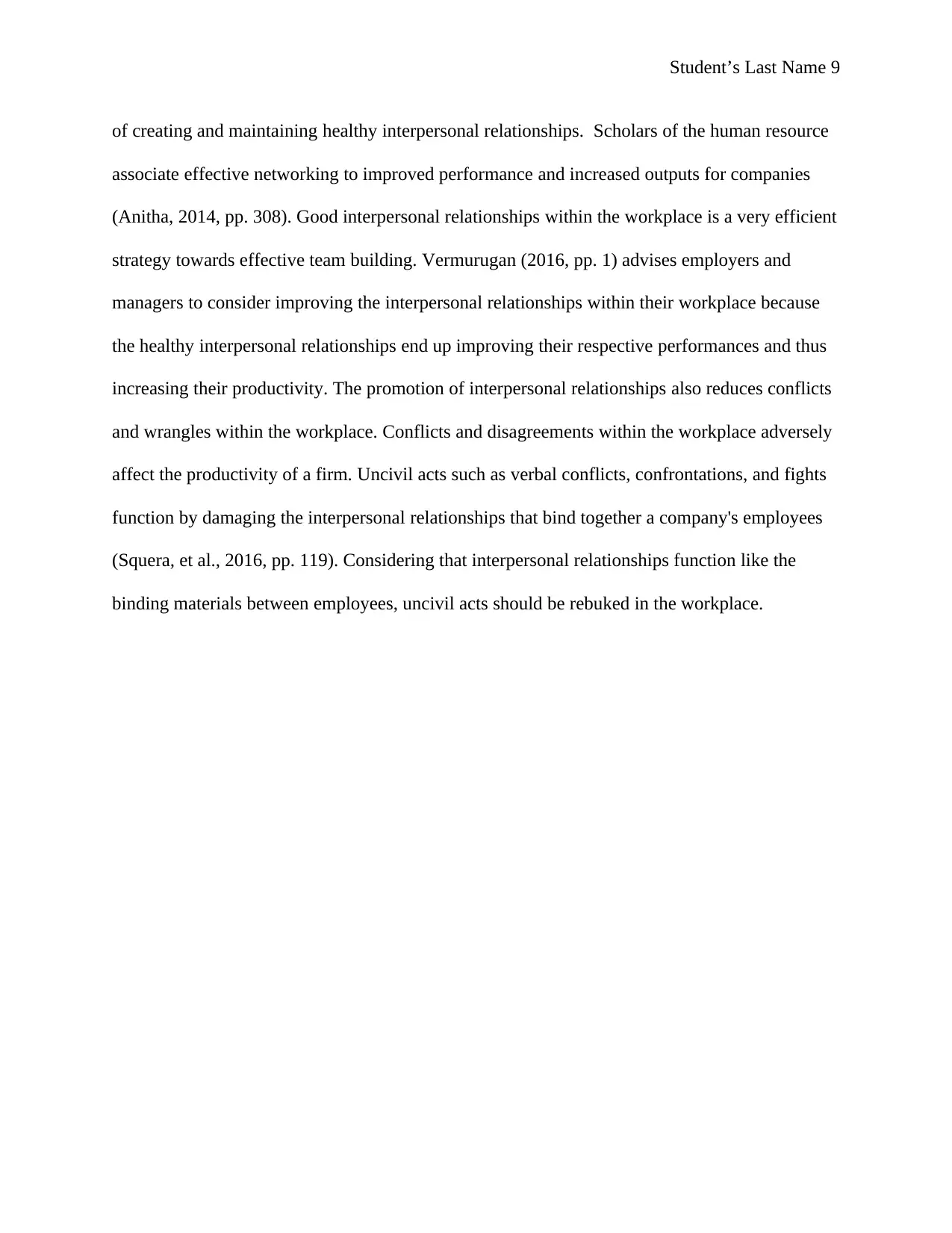
of creating and maintaining healthy interpersonal relationships. Scholars of the human resource
associate effective networking to improved performance and increased outputs for companies
(Anitha, 2014, pp. 308). Good interpersonal relationships within the workplace is a very efficient
strategy towards effective team building. Vermurugan (2016, pp. 1) advises employers and
managers to consider improving the interpersonal relationships within their workplace because
the healthy interpersonal relationships end up improving their respective performances and thus
increasing their productivity. The promotion of interpersonal relationships also reduces conflicts
and wrangles within the workplace. Conflicts and disagreements within the workplace adversely
affect the productivity of a firm. Uncivil acts such as verbal conflicts, confrontations, and fights
function by damaging the interpersonal relationships that bind together a company's employees
(Squera, et al., 2016, pp. 119). Considering that interpersonal relationships function like the
binding materials between employees, uncivil acts should be rebuked in the workplace.
of creating and maintaining healthy interpersonal relationships. Scholars of the human resource
associate effective networking to improved performance and increased outputs for companies
(Anitha, 2014, pp. 308). Good interpersonal relationships within the workplace is a very efficient
strategy towards effective team building. Vermurugan (2016, pp. 1) advises employers and
managers to consider improving the interpersonal relationships within their workplace because
the healthy interpersonal relationships end up improving their respective performances and thus
increasing their productivity. The promotion of interpersonal relationships also reduces conflicts
and wrangles within the workplace. Conflicts and disagreements within the workplace adversely
affect the productivity of a firm. Uncivil acts such as verbal conflicts, confrontations, and fights
function by damaging the interpersonal relationships that bind together a company's employees
(Squera, et al., 2016, pp. 119). Considering that interpersonal relationships function like the
binding materials between employees, uncivil acts should be rebuked in the workplace.
⊘ This is a preview!⊘
Do you want full access?
Subscribe today to unlock all pages.
Trusted by 1+ million students worldwide
Student’s Last Name 10
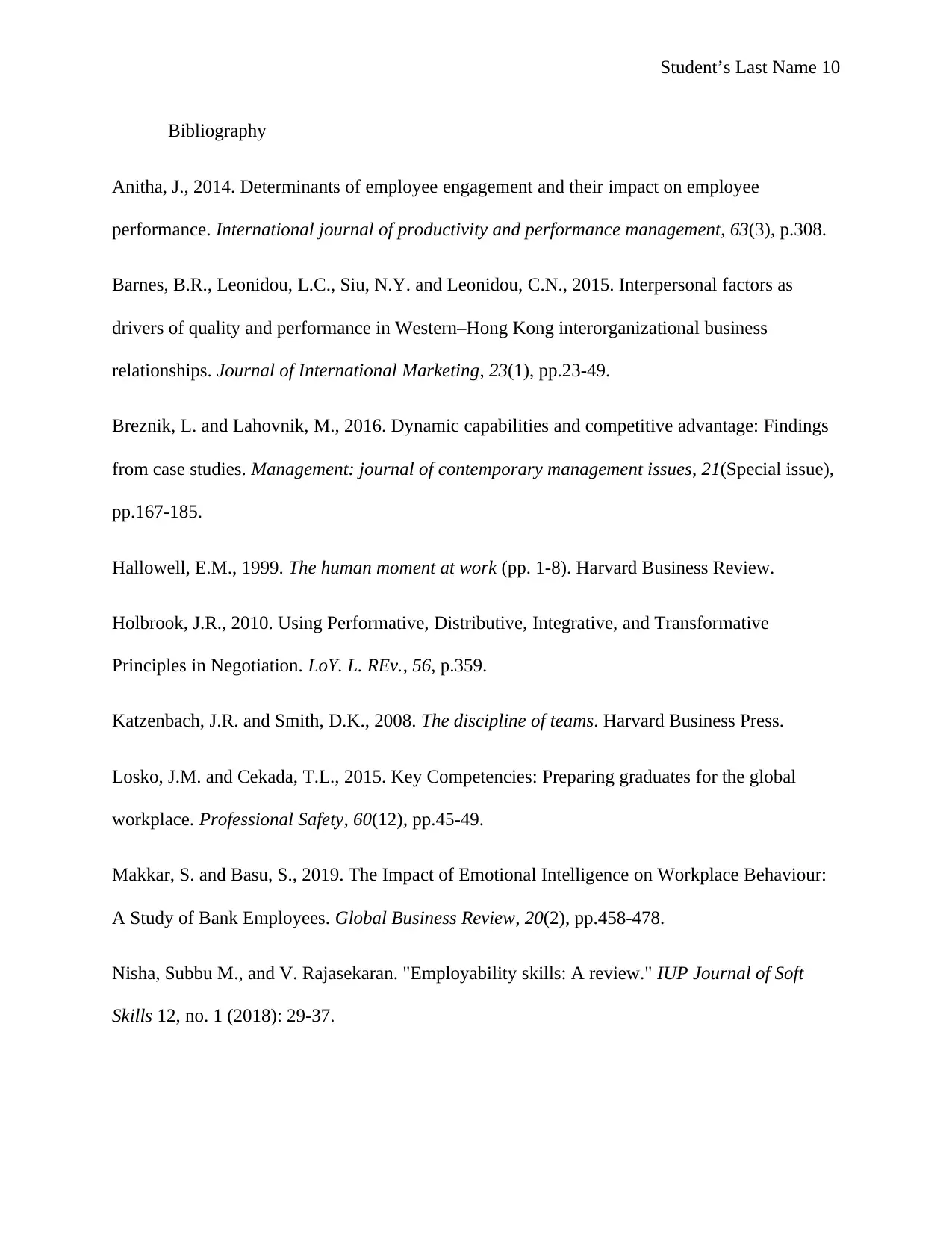
Bibliography
Anitha, J., 2014. Determinants of employee engagement and their impact on employee
performance. International journal of productivity and performance management, 63(3), p.308.
Barnes, B.R., Leonidou, L.C., Siu, N.Y. and Leonidou, C.N., 2015. Interpersonal factors as
drivers of quality and performance in Western–Hong Kong interorganizational business
relationships. Journal of International Marketing, 23(1), pp.23-49.
Breznik, L. and Lahovnik, M., 2016. Dynamic capabilities and competitive advantage: Findings
from case studies. Management: journal of contemporary management issues, 21(Special issue),
pp.167-185.
Hallowell, E.M., 1999. The human moment at work (pp. 1-8). Harvard Business Review.
Holbrook, J.R., 2010. Using Performative, Distributive, Integrative, and Transformative
Principles in Negotiation. LoY. L. REv., 56, p.359.
Katzenbach, J.R. and Smith, D.K., 2008. The discipline of teams. Harvard Business Press.
Losko, J.M. and Cekada, T.L., 2015. Key Competencies: Preparing graduates for the global
workplace. Professional Safety, 60(12), pp.45-49.
Makkar, S. and Basu, S., 2019. The Impact of Emotional Intelligence on Workplace Behaviour:
A Study of Bank Employees. Global Business Review, 20(2), pp.458-478.
Nisha, Subbu M., and V. Rajasekaran. "Employability skills: A review." IUP Journal of Soft
Skills 12, no. 1 (2018): 29-37.
Bibliography
Anitha, J., 2014. Determinants of employee engagement and their impact on employee
performance. International journal of productivity and performance management, 63(3), p.308.
Barnes, B.R., Leonidou, L.C., Siu, N.Y. and Leonidou, C.N., 2015. Interpersonal factors as
drivers of quality and performance in Western–Hong Kong interorganizational business
relationships. Journal of International Marketing, 23(1), pp.23-49.
Breznik, L. and Lahovnik, M., 2016. Dynamic capabilities and competitive advantage: Findings
from case studies. Management: journal of contemporary management issues, 21(Special issue),
pp.167-185.
Hallowell, E.M., 1999. The human moment at work (pp. 1-8). Harvard Business Review.
Holbrook, J.R., 2010. Using Performative, Distributive, Integrative, and Transformative
Principles in Negotiation. LoY. L. REv., 56, p.359.
Katzenbach, J.R. and Smith, D.K., 2008. The discipline of teams. Harvard Business Press.
Losko, J.M. and Cekada, T.L., 2015. Key Competencies: Preparing graduates for the global
workplace. Professional Safety, 60(12), pp.45-49.
Makkar, S. and Basu, S., 2019. The Impact of Emotional Intelligence on Workplace Behaviour:
A Study of Bank Employees. Global Business Review, 20(2), pp.458-478.
Nisha, Subbu M., and V. Rajasekaran. "Employability skills: A review." IUP Journal of Soft
Skills 12, no. 1 (2018): 29-37.
Paraphrase This Document
Need a fresh take? Get an instant paraphrase of this document with our AI Paraphraser
Student’s Last Name 11
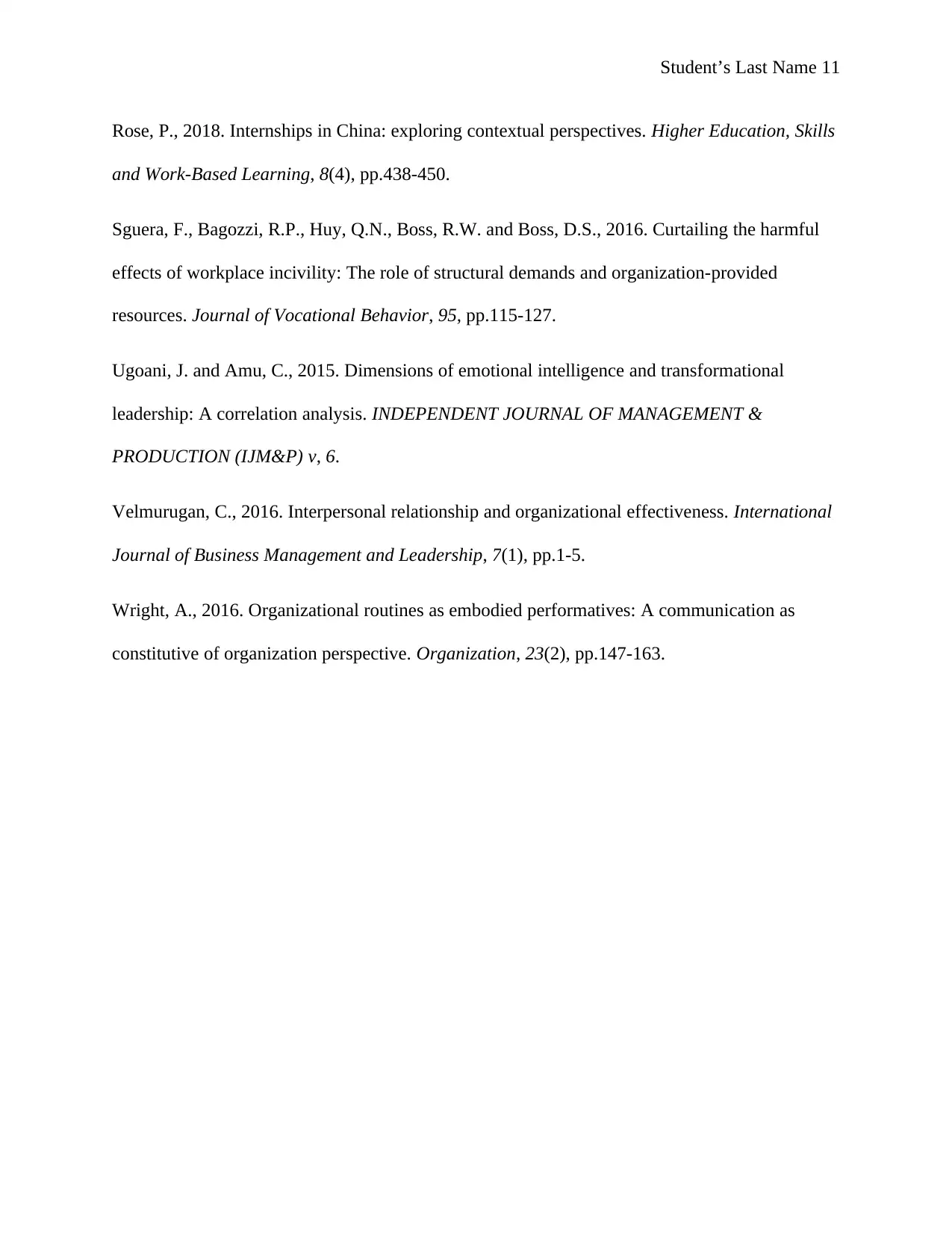
Rose, P., 2018. Internships in China: exploring contextual perspectives. Higher Education, Skills
and Work-Based Learning, 8(4), pp.438-450.
Sguera, F., Bagozzi, R.P., Huy, Q.N., Boss, R.W. and Boss, D.S., 2016. Curtailing the harmful
effects of workplace incivility: The role of structural demands and organization-provided
resources. Journal of Vocational Behavior, 95, pp.115-127.
Ugoani, J. and Amu, C., 2015. Dimensions of emotional intelligence and transformational
leadership: A correlation analysis. INDEPENDENT JOURNAL OF MANAGEMENT &
PRODUCTION (IJM&P) v, 6.
Velmurugan, C., 2016. Interpersonal relationship and organizational effectiveness. International
Journal of Business Management and Leadership, 7(1), pp.1-5.
Wright, A., 2016. Organizational routines as embodied performatives: A communication as
constitutive of organization perspective. Organization, 23(2), pp.147-163.
Rose, P., 2018. Internships in China: exploring contextual perspectives. Higher Education, Skills
and Work-Based Learning, 8(4), pp.438-450.
Sguera, F., Bagozzi, R.P., Huy, Q.N., Boss, R.W. and Boss, D.S., 2016. Curtailing the harmful
effects of workplace incivility: The role of structural demands and organization-provided
resources. Journal of Vocational Behavior, 95, pp.115-127.
Ugoani, J. and Amu, C., 2015. Dimensions of emotional intelligence and transformational
leadership: A correlation analysis. INDEPENDENT JOURNAL OF MANAGEMENT &
PRODUCTION (IJM&P) v, 6.
Velmurugan, C., 2016. Interpersonal relationship and organizational effectiveness. International
Journal of Business Management and Leadership, 7(1), pp.1-5.
Wright, A., 2016. Organizational routines as embodied performatives: A communication as
constitutive of organization perspective. Organization, 23(2), pp.147-163.

1 out of 11


Related Documents


Your All-in-One AI-Powered Toolkit for Academic Success.
+13062052269
info@desklib.com
Available 24*7 on WhatsApp / Email
![[object Object]](/_next/static/media/star-bottom.7253800d.svg)
Unlock your academic potential
Copyright © 2020–2026 A2Z Services. All Rights Reserved. Developed and managed by ZUCOL.