BTEC Level 3 Diploma: Human Resource Management Report Analysis
VerifiedAdded on 2023/03/29
|10
|2870
|490
Report
AI Summary
This report provides a comprehensive overview of Human Resource Management (HRM) within an organization. It begins by outlining the internal and external factors crucial for human resource planning, such as organizational structure, budget, compensation, legislation, political, social, and technological influences. The report then delves into the skills employees require to perform their jobs effectively, discussing methods like skills audits, skills transferability, and skills acquisition. It further explores how organizations motivate their employees, detailing strategies like performance-related pay, pension schemes, and corporate clothing. The report also examines how organizations obtain employee cooperation through contractual techniques, including employment contracts and entitlements. Finally, it analyzes various methods for measuring and managing employee performance, such as performance indicators, goal theory, and benchmarking. The report concludes by summarizing the key findings and emphasizing the importance of effective HRM practices for organizational success.

Human Resource
Management
Management

Paraphrase This Document
Need a fresh take? Get an instant paraphrase of this document with our AI Paraphraser
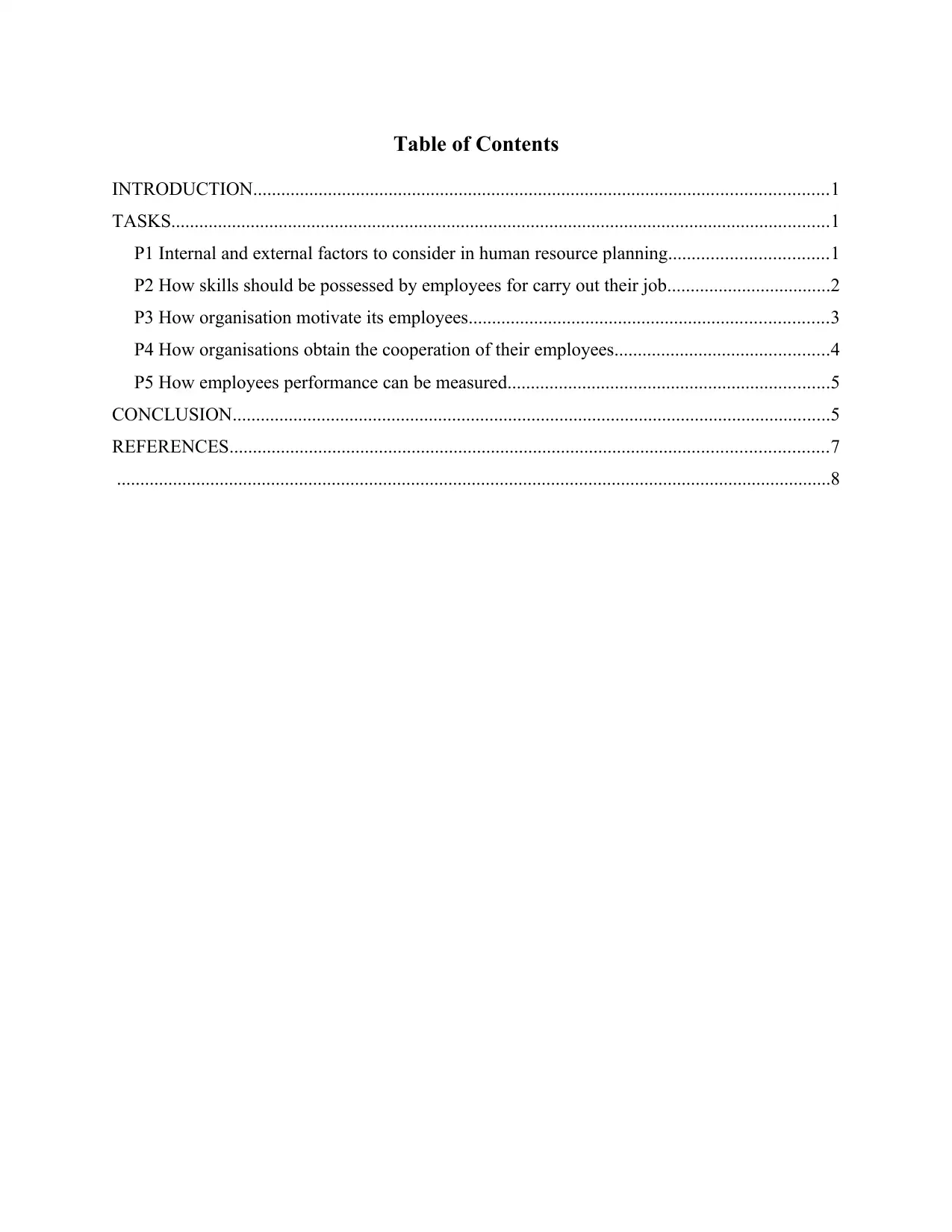
Table of Contents
INTRODUCTION...........................................................................................................................1
TASKS.............................................................................................................................................1
P1 Internal and external factors to consider in human resource planning..................................1
P2 How skills should be possessed by employees for carry out their job...................................2
P3 How organisation motivate its employees.............................................................................3
P4 How organisations obtain the cooperation of their employees..............................................4
P5 How employees performance can be measured.....................................................................5
CONCLUSION................................................................................................................................5
REFERENCES................................................................................................................................7
.........................................................................................................................................................8
INTRODUCTION...........................................................................................................................1
TASKS.............................................................................................................................................1
P1 Internal and external factors to consider in human resource planning..................................1
P2 How skills should be possessed by employees for carry out their job...................................2
P3 How organisation motivate its employees.............................................................................3
P4 How organisations obtain the cooperation of their employees..............................................4
P5 How employees performance can be measured.....................................................................5
CONCLUSION................................................................................................................................5
REFERENCES................................................................................................................................7
.........................................................................................................................................................8
INTRODUCTION
Human Resource Management is the term used to describe formal systems devised for
the management of people within an organization. The responsibilities of a human resource
manager fall into three major areas: staffing, employee compensation and benefits, and
defining/designing work (Armstrong and Taylor, 2014). This report is based on which is the
forth largest chain of supermarket in United Kingdom. This project will state about internal and
external factors that should be consider while human resource planning, skills that should be in
employees for performing their job and the way by which employees can be motivated. It will
also explain the method by which organisation can gain cooperation of their employees.
TASKS
P1 Internal and external factors to consider in human resource planning
Human resource planning is a process that identifies current and future human resources
needs for an organization to achieve its goals. There are various factors which should be consider
in human resource planning which are given below-
Internal factor- Organizational structure: One of the key internal factors to determine the optimal
staffing requirements is the organizational structure. Planners need to draw up a hierarchy
chart of the organization and clearly delineate the functions of each designation;
providing gaps for areas that need more employees and cutting out the people who do not
have a defined function. Budget: It is a critical internal factor that determines how human resources are utilized.
The total budgetary allocation determines how any people can be hired or retained or
promoted, and if any retention program can take place. In lean times, HR planners can
devise innovative solutions such as lower base pay, more stocks, better retirement
benefits, etc.
Compensation is a function of labour supply and is less in a crowded market vs. labour
shortage times. HR planners need to continually evaluate and ensure that the
compensation is market competitive.
Legislation is an external factor that affects the entire industry and HR planners need to
ensure compliance with any legislation affecting the organization.
1
Human Resource Management is the term used to describe formal systems devised for
the management of people within an organization. The responsibilities of a human resource
manager fall into three major areas: staffing, employee compensation and benefits, and
defining/designing work (Armstrong and Taylor, 2014). This report is based on which is the
forth largest chain of supermarket in United Kingdom. This project will state about internal and
external factors that should be consider while human resource planning, skills that should be in
employees for performing their job and the way by which employees can be motivated. It will
also explain the method by which organisation can gain cooperation of their employees.
TASKS
P1 Internal and external factors to consider in human resource planning
Human resource planning is a process that identifies current and future human resources
needs for an organization to achieve its goals. There are various factors which should be consider
in human resource planning which are given below-
Internal factor- Organizational structure: One of the key internal factors to determine the optimal
staffing requirements is the organizational structure. Planners need to draw up a hierarchy
chart of the organization and clearly delineate the functions of each designation;
providing gaps for areas that need more employees and cutting out the people who do not
have a defined function. Budget: It is a critical internal factor that determines how human resources are utilized.
The total budgetary allocation determines how any people can be hired or retained or
promoted, and if any retention program can take place. In lean times, HR planners can
devise innovative solutions such as lower base pay, more stocks, better retirement
benefits, etc.
Compensation is a function of labour supply and is less in a crowded market vs. labour
shortage times. HR planners need to continually evaluate and ensure that the
compensation is market competitive.
Legislation is an external factor that affects the entire industry and HR planners need to
ensure compliance with any legislation affecting the organization.
1
⊘ This is a preview!⊘
Do you want full access?
Subscribe today to unlock all pages.

Trusted by 1+ million students worldwide
External factor- Political- From a shift in local public opinion to a change in government or even a new
industrial world superpower entering the market, politics influence how much funding is
available, how much tax must be paid, minimum wage rates, how markets are controlled
and the quality and quantity of staff available for hire. Social- Several social factors may influence your HR planning, but you need to take into
account equalities and diversity in particular. Where there is a clear discrepancy of one
social group, it’s a good idea to build in ways of opening up new opportunities. For
example, if there are few Hispanic people in your company compared to numbers in the
wider community, determine why this is the case and what can be done to redress the
balance (Bloom and Van Reenen, 2011).
Technological- New technology brings new skills requirements, so companies always
need to be aware of proficiencies and training needs when planning human resources.
New products and services also may require recruiting highly skilled employees or
training existing employees to meet the need. Make sure HR managers are aware of new
equipment or knowledge be needed so they can build the required skills, and most likely
salary enhancements, into the plan.
P2 How skills should be possessed by employees for carry out their job
There are several ways through which can identify the required skills. Some of these
processes are by assessing the desired skills set, skills audit, skills transferability, skills
acquisition and by determining the impact of technology. To begin with, a skills audit is a
procedure that is used to identify the skill gaps in an organisation. In other words, it is a review
of employees’ existing skills against the skills that they will need both now and in the future. It
can help to identify existing skills, figure out which additional skills they may need to carry out a
role more effectively and to develop overall knowledge as well. Through this process, a company
investigates what skills their employees have and from this, identify whether certain individuals
need to develop their skills and how. A business might also assess the existing skills which an
employee has and thus find out whether these skills match new organisational objectives. In
many cases, some employees may already have the necessary skills, but may not be using them.
As such, the business concerned, can transfer an employee to a different department where their
skills might be more useful.
2
industrial world superpower entering the market, politics influence how much funding is
available, how much tax must be paid, minimum wage rates, how markets are controlled
and the quality and quantity of staff available for hire. Social- Several social factors may influence your HR planning, but you need to take into
account equalities and diversity in particular. Where there is a clear discrepancy of one
social group, it’s a good idea to build in ways of opening up new opportunities. For
example, if there are few Hispanic people in your company compared to numbers in the
wider community, determine why this is the case and what can be done to redress the
balance (Bloom and Van Reenen, 2011).
Technological- New technology brings new skills requirements, so companies always
need to be aware of proficiencies and training needs when planning human resources.
New products and services also may require recruiting highly skilled employees or
training existing employees to meet the need. Make sure HR managers are aware of new
equipment or knowledge be needed so they can build the required skills, and most likely
salary enhancements, into the plan.
P2 How skills should be possessed by employees for carry out their job
There are several ways through which can identify the required skills. Some of these
processes are by assessing the desired skills set, skills audit, skills transferability, skills
acquisition and by determining the impact of technology. To begin with, a skills audit is a
procedure that is used to identify the skill gaps in an organisation. In other words, it is a review
of employees’ existing skills against the skills that they will need both now and in the future. It
can help to identify existing skills, figure out which additional skills they may need to carry out a
role more effectively and to develop overall knowledge as well. Through this process, a company
investigates what skills their employees have and from this, identify whether certain individuals
need to develop their skills and how. A business might also assess the existing skills which an
employee has and thus find out whether these skills match new organisational objectives. In
many cases, some employees may already have the necessary skills, but may not be using them.
As such, the business concerned, can transfer an employee to a different department where their
skills might be more useful.
2
Paraphrase This Document
Need a fresh take? Get an instant paraphrase of this document with our AI Paraphraser
Therefore, in this situation, might use these existing employees instead of employing
new external staff. This process is known as skills transferability. In short, without the
information from a skills audit, an organisation will not know where to improve. Another
advantage of the skills audit is that, it enables future training and development to be better
targeted. The business will be aware of which aspects need further consideration and thus
improve, based on the results of the skills audit. Also, as a result, the employers will already
know which skills they lack and thus better define their recruitment criteria to address this
shortage and this is more likely to result in the most appropriate candidate being employed
(Boxall and Purcell, 2011).
P3 How organisation motivate its employees
Within all businesses it is important to ensure all staff is motivated and performing to the
best of their ability. Motivation is defined to be the type of work ethic that ensures employees are
interested and committed to the job role they are in and work to meet the necessary targets of the
organisation. This will affect sales, manufacturing, activity and atmosphere of the business
positively which makes motivated staff an essential for all businesses.
Motivation within - Just like many other businesses, it will use different tactics to
stimulate motivation within their staff. Most are financially based and perk packages offered for
specific scenarios, however all will have an overall positive effect of the staff within this
organisation. Performance related pay – This type of motivational method allows for a successful,
hard working employ to receive a benefit for their motivational attitude and extended
dedication to an organisation. For example, within specifically, if an employee was to
sell 40% more stock than expected and show a positive attitude whilst doing so this
company is likely to reward them with cash related bonus alongside their monthly check.
This will encourage other employees to become self-motivated to reach the standard
required for this bonus (CHUANG and Liao, 2010). Pension schemes – This type of will motivate staff specifically aware of their financial
stability after work. This type of reward may not appeal to everyone, such as young 17-
19 year old working within who may not be considering a pension scheme during this
proportion of their life. However, people in their late 20s/30’s may begin considering and
planning for their future with regards to finance. Having a pension scheme is very
3
new external staff. This process is known as skills transferability. In short, without the
information from a skills audit, an organisation will not know where to improve. Another
advantage of the skills audit is that, it enables future training and development to be better
targeted. The business will be aware of which aspects need further consideration and thus
improve, based on the results of the skills audit. Also, as a result, the employers will already
know which skills they lack and thus better define their recruitment criteria to address this
shortage and this is more likely to result in the most appropriate candidate being employed
(Boxall and Purcell, 2011).
P3 How organisation motivate its employees
Within all businesses it is important to ensure all staff is motivated and performing to the
best of their ability. Motivation is defined to be the type of work ethic that ensures employees are
interested and committed to the job role they are in and work to meet the necessary targets of the
organisation. This will affect sales, manufacturing, activity and atmosphere of the business
positively which makes motivated staff an essential for all businesses.
Motivation within - Just like many other businesses, it will use different tactics to
stimulate motivation within their staff. Most are financially based and perk packages offered for
specific scenarios, however all will have an overall positive effect of the staff within this
organisation. Performance related pay – This type of motivational method allows for a successful,
hard working employ to receive a benefit for their motivational attitude and extended
dedication to an organisation. For example, within specifically, if an employee was to
sell 40% more stock than expected and show a positive attitude whilst doing so this
company is likely to reward them with cash related bonus alongside their monthly check.
This will encourage other employees to become self-motivated to reach the standard
required for this bonus (CHUANG and Liao, 2010). Pension schemes – This type of will motivate staff specifically aware of their financial
stability after work. This type of reward may not appeal to everyone, such as young 17-
19 year old working within who may not be considering a pension scheme during this
proportion of their life. However, people in their late 20s/30’s may begin considering and
planning for their future with regards to finance. Having a pension scheme is very
3
important to many people in this age bracket, especially one with many benefits. By a
company offering one on general will motivate staff to work to the best of ability so that
they can enjoy a possible indulgent life during retirement. particularly has an award
winning pension scheme which will allow for their staff to be greatly motivated.
Corporate clothing – Many companies may not realise the full benefit of corporate
clothing. Having a specific dress code and uniform for a job will affect the performance
of an employee greatly.
P4 How organisations obtain the cooperation of their employees
Contractual techniques- Employment contracts are legal documents signed by the
employee and employer which states a number of things that is required from both parties. It is
an agreement which needs to be followed to ensure that both parties are kept happy. s use two
main types of contracts permanent or temporary contracts (Crook and et. al., 2011).
permanent contracts are when the employee's job is secure and can only be terminated for
a few reasons. whereas a temporary contract is when the employee is only hired for a certain
time period before their contract comes to an end. Within permanent contracts there is also
permanent full time and permanent part-time. This helps obtain cooperation from employees as
they are able to choose what type of contract suits their life. Allowing them to cooperate with the
team they work in as they are kept happy. There are a number of contractual entitlements that s
offer to their employees in the form of pay, hours of work, leave, notice period, pension and
benefits.
Pay is something that all employees are entitled to in s however it can vary depending on
the title of each job role or superiority. The more work required from you means the more money
you will be earning. s pay start from around £7.40 per hour. Hours vary depending on the type of
contract an employee has. Most employers consider working 35+ hours as a full time contract.
however those who work part time are able to pick up shifts where they are available meaning
that they can still work more than their contract says. Leave that each employee is entitled to is
24 days a year not including public holidays which increases to 28 days once you've been with s
for 3 years or more. The notice period within company depends on the time you have been with
the organisation. if you have been with the company for a year or under you are required to hand
a two weeks notice. However over 1 year requires a four weeks notice period for them to find a
replacement.
4
company offering one on general will motivate staff to work to the best of ability so that
they can enjoy a possible indulgent life during retirement. particularly has an award
winning pension scheme which will allow for their staff to be greatly motivated.
Corporate clothing – Many companies may not realise the full benefit of corporate
clothing. Having a specific dress code and uniform for a job will affect the performance
of an employee greatly.
P4 How organisations obtain the cooperation of their employees
Contractual techniques- Employment contracts are legal documents signed by the
employee and employer which states a number of things that is required from both parties. It is
an agreement which needs to be followed to ensure that both parties are kept happy. s use two
main types of contracts permanent or temporary contracts (Crook and et. al., 2011).
permanent contracts are when the employee's job is secure and can only be terminated for
a few reasons. whereas a temporary contract is when the employee is only hired for a certain
time period before their contract comes to an end. Within permanent contracts there is also
permanent full time and permanent part-time. This helps obtain cooperation from employees as
they are able to choose what type of contract suits their life. Allowing them to cooperate with the
team they work in as they are kept happy. There are a number of contractual entitlements that s
offer to their employees in the form of pay, hours of work, leave, notice period, pension and
benefits.
Pay is something that all employees are entitled to in s however it can vary depending on
the title of each job role or superiority. The more work required from you means the more money
you will be earning. s pay start from around £7.40 per hour. Hours vary depending on the type of
contract an employee has. Most employers consider working 35+ hours as a full time contract.
however those who work part time are able to pick up shifts where they are available meaning
that they can still work more than their contract says. Leave that each employee is entitled to is
24 days a year not including public holidays which increases to 28 days once you've been with s
for 3 years or more. The notice period within company depends on the time you have been with
the organisation. if you have been with the company for a year or under you are required to hand
a two weeks notice. However over 1 year requires a four weeks notice period for them to find a
replacement.
4
⊘ This is a preview!⊘
Do you want full access?
Subscribe today to unlock all pages.
Trusted by 1+ million students worldwide
P5 How employees performance can be measured
There are many ways at which Morrison measures the performance of employees, such as
performance indicators. This type of measurement is specifically dedicated to how an employee
is working and their current accomplishment. For example the sales team within Morrison will
have performance indicators with regards to their sales. The benefit to company when using this
type of performance measurement method is that they are able to visually see their current
highest ranking sales staff and those lacking in accomplishment. This can result in the company
potentially rewarding those who achieving and working hard, and re-train those who are not. By
doing this, it will overall improve the quality of their staff thus improving the business (Daley,
2012).
Goal theory is another performance measurement that Morrison uses. This method is
used between managers and employees and is the process of setting achievable goals. These
goals may be felt to be important for progression by both manager and employee. By using this
type of performance measurement firm is able to see each of their employees grow with regards
to their work ethic because they have something to aim for rather than the employee ding the
daily, necessary tasks. The goal theory is shown to work within organsiation due to the fact it is
achieving high profit revenue yearly, as well as a wide customer base due to the accomplishment
of these goals.
Bench marking is a final performance indicator that will be discussed within this
assignment. This method is used to measure the overall performance of a business by comparing
it to their rivals. The bench mark can be described to be the standard at which Morrison should
aim to perform at so that they are in fair comparison compared to its competitors. Company will
try to meet this bench mark and potentially better it, making the standard of the benchmark
higher for its competitors to attempt to achieve making firm the current market leader in this
scenario.
CONCLUSION
From the above report, it can be concluded that there are various factors which influence
human resource planning like budget, organisation structure, political etc. There are various
ways by which employees can be motivates such as by giving them performance related pay,
pension scheme etc. Employees co-operation is very important because if they will provide their
support then firm will be able to achieve its desired result or outcome. There are number of
5
There are many ways at which Morrison measures the performance of employees, such as
performance indicators. This type of measurement is specifically dedicated to how an employee
is working and their current accomplishment. For example the sales team within Morrison will
have performance indicators with regards to their sales. The benefit to company when using this
type of performance measurement method is that they are able to visually see their current
highest ranking sales staff and those lacking in accomplishment. This can result in the company
potentially rewarding those who achieving and working hard, and re-train those who are not. By
doing this, it will overall improve the quality of their staff thus improving the business (Daley,
2012).
Goal theory is another performance measurement that Morrison uses. This method is
used between managers and employees and is the process of setting achievable goals. These
goals may be felt to be important for progression by both manager and employee. By using this
type of performance measurement firm is able to see each of their employees grow with regards
to their work ethic because they have something to aim for rather than the employee ding the
daily, necessary tasks. The goal theory is shown to work within organsiation due to the fact it is
achieving high profit revenue yearly, as well as a wide customer base due to the accomplishment
of these goals.
Bench marking is a final performance indicator that will be discussed within this
assignment. This method is used to measure the overall performance of a business by comparing
it to their rivals. The bench mark can be described to be the standard at which Morrison should
aim to perform at so that they are in fair comparison compared to its competitors. Company will
try to meet this bench mark and potentially better it, making the standard of the benchmark
higher for its competitors to attempt to achieve making firm the current market leader in this
scenario.
CONCLUSION
From the above report, it can be concluded that there are various factors which influence
human resource planning like budget, organisation structure, political etc. There are various
ways by which employees can be motivates such as by giving them performance related pay,
pension scheme etc. Employees co-operation is very important because if they will provide their
support then firm will be able to achieve its desired result or outcome. There are number of
5
Paraphrase This Document
Need a fresh take? Get an instant paraphrase of this document with our AI Paraphraser

theory that can be used for evaluating employee performance like goals theory, benchmarking
etc.
6
etc.
6
REFERENCES
Books and journals
Armstrong, M. and Taylor, S., 2014. Armstrong's handbook of human resource management
practice. Kogan Page Publishers.
Bloom, N. and Van Reenen, J., 2011. Human resource management and productivity. Handbook
of labor economics. 4. pp.1697-1767.
Boxall, P. and Purcell, J., 2011. Strategy and human resource management. Palgrave Macmillan.
CHUANG, C.H. and Liao, H.U.I., 2010. Strategic human resource management in service
context: Taking care of business by taking care of employees and customers.Personnel
psychology. 63(1). pp.153-196.
Crook, T.R and et. al., 2011. Does human capital matter? A meta-analysis of the relationship
between human capital and firm performance.
Daley, D.M., 2012. Strategic human resources management. Public Personnel Management,
pp.120-125.
Gruman, J.A. and Saks, A.M., 2011. Performance management and employee engagement.
Human Resource Management Review. 21(2). pp.123-136.
Guest, D.E., 2011. Human resource management and performance: still searching for some
answers. Human resource management journal. 21(1). pp.3-13.
Human resource management: theory and practice. Palgrave Macmillan.
Huselid, M.A. and Becker, B.E., 2011. Bridging micro and macro domains: Workforce
differentiation and strategic human resource management.
Jiang, K and et. al., 2012. How does human resource management influence organizational
outcomes? A meta-analytic investigation of mediating mechanisms. Academy of
management Journal. 55(6). pp.1264-1294.
Kehoe, R.R. and Wright, P.M., 2013. The impact of high-performance human resource practices
on employees’ attitudes and behaviors. Journal of management. 39(2). pp.366-391.
Lengnick-Hall, C.A., Beck, T.E. and Lengnick-Hall, M.L., 2011. Developing a capacity for
organizational resilience through strategic human resource management. Human
Resource Management Review. 21(3). pp.243-255.
Ployhart, R.E. and Moliterno, T.P., 2011. Emergence of the human capital resource: A multilevel
model. Academy of Management Review. 36(1). pp.127-150.
Policy and Practice in European Human Resource Management: The Price Waterhouse
Cranfield Survey. Taylor & Francis.
Purce, J., 2014. The impact of corporate strategy on human resource management. New
Perspectives on Human Resource Management (Routledge Revivals). 67.
Vörösmarty, C.J and et. al., 2010. Global threats to human water security and river biodiversity.
Nature. 467(7315). pp.555-561.
Wright, P.M. and McMahan, G.C., 2011. Exploring human capital: putting ‘human’back into
strategic human resource management. Human Resource Management Journal. 21(2).
pp.93-104.
Online
7
Books and journals
Armstrong, M. and Taylor, S., 2014. Armstrong's handbook of human resource management
practice. Kogan Page Publishers.
Bloom, N. and Van Reenen, J., 2011. Human resource management and productivity. Handbook
of labor economics. 4. pp.1697-1767.
Boxall, P. and Purcell, J., 2011. Strategy and human resource management. Palgrave Macmillan.
CHUANG, C.H. and Liao, H.U.I., 2010. Strategic human resource management in service
context: Taking care of business by taking care of employees and customers.Personnel
psychology. 63(1). pp.153-196.
Crook, T.R and et. al., 2011. Does human capital matter? A meta-analysis of the relationship
between human capital and firm performance.
Daley, D.M., 2012. Strategic human resources management. Public Personnel Management,
pp.120-125.
Gruman, J.A. and Saks, A.M., 2011. Performance management and employee engagement.
Human Resource Management Review. 21(2). pp.123-136.
Guest, D.E., 2011. Human resource management and performance: still searching for some
answers. Human resource management journal. 21(1). pp.3-13.
Human resource management: theory and practice. Palgrave Macmillan.
Huselid, M.A. and Becker, B.E., 2011. Bridging micro and macro domains: Workforce
differentiation and strategic human resource management.
Jiang, K and et. al., 2012. How does human resource management influence organizational
outcomes? A meta-analytic investigation of mediating mechanisms. Academy of
management Journal. 55(6). pp.1264-1294.
Kehoe, R.R. and Wright, P.M., 2013. The impact of high-performance human resource practices
on employees’ attitudes and behaviors. Journal of management. 39(2). pp.366-391.
Lengnick-Hall, C.A., Beck, T.E. and Lengnick-Hall, M.L., 2011. Developing a capacity for
organizational resilience through strategic human resource management. Human
Resource Management Review. 21(3). pp.243-255.
Ployhart, R.E. and Moliterno, T.P., 2011. Emergence of the human capital resource: A multilevel
model. Academy of Management Review. 36(1). pp.127-150.
Policy and Practice in European Human Resource Management: The Price Waterhouse
Cranfield Survey. Taylor & Francis.
Purce, J., 2014. The impact of corporate strategy on human resource management. New
Perspectives on Human Resource Management (Routledge Revivals). 67.
Vörösmarty, C.J and et. al., 2010. Global threats to human water security and river biodiversity.
Nature. 467(7315). pp.555-561.
Wright, P.M. and McMahan, G.C., 2011. Exploring human capital: putting ‘human’back into
strategic human resource management. Human Resource Management Journal. 21(2).
pp.93-104.
Online
7
⊘ This is a preview!⊘
Do you want full access?
Subscribe today to unlock all pages.
Trusted by 1+ million students worldwide

Employment legislation. 2017. [Online]. Available through:
<http://businesscasestudies.co.uk/business-theory/people/employment-
legislation.html>. [Accessed on 18th August 2017].
Six Main Functions of a Human Resource Department. 2017. [Online]. Available
through:<http://smallbusiness.chron.com/six-main-functions-human-resource-
department-60693.html>. [Accessed on 18th August 2017].
8
<http://businesscasestudies.co.uk/business-theory/people/employment-
legislation.html>. [Accessed on 18th August 2017].
Six Main Functions of a Human Resource Department. 2017. [Online]. Available
through:<http://smallbusiness.chron.com/six-main-functions-human-resource-
department-60693.html>. [Accessed on 18th August 2017].
8

1 out of 10


Related Documents


Your All-in-One AI-Powered Toolkit for Academic Success.
+13062052269
info@desklib.com
Available 24*7 on WhatsApp / Email
![[object Object]](/_next/static/media/star-bottom.7253800d.svg)
Unlock your academic potential
Copyright © 2020–2026 A2Z Services. All Rights Reserved. Developed and managed by ZUCOL.