Strategic Human Resource Management in Australian Context
VerifiedAdded on 2020/02/19
|10
|2709
|36
Essay
AI Summary
This essay provides a comprehensive overview of Human Resource Management (HRM) in Australia, focusing on the strategic aspects and its impact on the workforce. The essay discusses the crucial role of HRM in selecting, training, appraising, and motivating employees, while also emphasizing the importance of maintaining safety and security. It examines how Australian businesses employ effective HRM techniques, including addressing the shortage of skilled labor and implementing strategies for ethical practices and uniformity. The essay highlights government policies like gender pay equity and legal steps taken to combat discrimination. Furthermore, it delves into strategic HRM, emphasizing its link to organizational goals, the importance of employee involvement in strategy formulation, and key factors such as the integration of HR policies with business objectives, employee competency, and performance. The essay also explores the evolution of HRM, the shift towards strategic approaches, and the significance of communication between HR and top management.
Running head: HUMAN RESOURCE MANAGEMENT
Human Resource Management
Name of the Student
Name of the University
Author Note
Human Resource Management
Name of the Student
Name of the University
Author Note

Paraphrase This Document
Need a fresh take? Get an instant paraphrase of this document with our AI Paraphraser
1
HUMAN RESOURCE MANAGEMENT
In today’s world, an organization cannot build an effective team of working professionals
without any good team of the Human Resources. I believe the major functions of the team of the
Management of the Human Resources involves selecting/recruitment of the employees, training
them appraising their performances, motivating them and maintaining the safety and security of
the employees. Therefore, in this essay I will discuss about the role of the Human Resource
Management in Australia and the importance of the Strategic Human Resource Management.
In the competitive environment of today's world, Australian workforce has been using
effective techniques in order to manage the human resources. There is a wide range of
philosophy that is implemented by the Australian workforce in different department, in order to
deal with the challenge related to human resources. The Australian business firms are mainly
known to implement the basic strategy related to human resource practice (Marchington et al.,
2016). This I believe is one of the most effective ways to deal with the complex level of
challenges that are often encountered by various organizations. One of the major issues that are
often encountered in the current day human resource practice is due to the shortage of skilled
labors. It is also possible to deal with most of the important challenges related to human resource
practice in order to improve upon the production rate of every organization.
I strongly believe that with the help of effective human resource practice that are
implemented across various organizations in Australia it is possible for them to have significant
competitive advantage. The organizations across Australia also follow the practice of uniform
distribution related to the human resource practice that helps them to deal with all type of ethical
issues related to human resource practice. The uniformity in the human resource practice is it
essential as I think this can help to motivate the workers and also help them to improve upon
their performance level (Brewster et al., 2016).
HUMAN RESOURCE MANAGEMENT
In today’s world, an organization cannot build an effective team of working professionals
without any good team of the Human Resources. I believe the major functions of the team of the
Management of the Human Resources involves selecting/recruitment of the employees, training
them appraising their performances, motivating them and maintaining the safety and security of
the employees. Therefore, in this essay I will discuss about the role of the Human Resource
Management in Australia and the importance of the Strategic Human Resource Management.
In the competitive environment of today's world, Australian workforce has been using
effective techniques in order to manage the human resources. There is a wide range of
philosophy that is implemented by the Australian workforce in different department, in order to
deal with the challenge related to human resources. The Australian business firms are mainly
known to implement the basic strategy related to human resource practice (Marchington et al.,
2016). This I believe is one of the most effective ways to deal with the complex level of
challenges that are often encountered by various organizations. One of the major issues that are
often encountered in the current day human resource practice is due to the shortage of skilled
labors. It is also possible to deal with most of the important challenges related to human resource
practice in order to improve upon the production rate of every organization.
I strongly believe that with the help of effective human resource practice that are
implemented across various organizations in Australia it is possible for them to have significant
competitive advantage. The organizations across Australia also follow the practice of uniform
distribution related to the human resource practice that helps them to deal with all type of ethical
issues related to human resource practice. The uniformity in the human resource practice is it
essential as I think this can help to motivate the workers and also help them to improve upon
their performance level (Brewster et al., 2016).
2
HUMAN RESOURCE MANAGEMENT
The policies that are implemented by the Australian government in order to ensure
uniformity among employees are one of the major steps that can help to maintain a perfect
balance within the entire work force. There is also the policy of gender pay equity, which is one
of the major steps that are implemented by Australian government (De Cieri & Kramar, 2003).
This help to ensure that most of the challenges related to discrimination within the workplace can
be neutralized. The Australian people have also encountered issues due to racial discrimination
within the workforce that have compromised upon the performance level of the organization.
The human right commission of Australia has implemented legal steps in order to deal with the
issues related to unethical practice in Human Resource Department. The act of equal pay for
equal work in Australia is one of the major landmark legal policies that are implemented in order
to deal with all type of unethical discrimination within the workplace. I do believe that the
Australian government and the human right Commission have very effectively handle the issues
related to racial and gender discrimination within the past few years. This is evident from the fact
that there is more participation of women and candidates from Asian and African countries in the
workforce of Australia. This variation can be witnessed from all sectors from manufacturing,
services, and hospitality and government jobs (De Cieri & Kramar, 2003).
The genetic policies and procedures that are implemented across various departments in
Australia have helped to mitigate risks that are associated with all type of business operational
process (Bartram, 2005). The generic policies that are implemented across all organizations in
Australia have helped to reflect upon the human resource practices and organizational culture. In
this context, it is important to mention that the motivating work culture within the Australian
workforce is one of the major elements that have helped to deal with the challenge of excess
pressure and stress within the workplace.
HUMAN RESOURCE MANAGEMENT
The policies that are implemented by the Australian government in order to ensure
uniformity among employees are one of the major steps that can help to maintain a perfect
balance within the entire work force. There is also the policy of gender pay equity, which is one
of the major steps that are implemented by Australian government (De Cieri & Kramar, 2003).
This help to ensure that most of the challenges related to discrimination within the workplace can
be neutralized. The Australian people have also encountered issues due to racial discrimination
within the workforce that have compromised upon the performance level of the organization.
The human right commission of Australia has implemented legal steps in order to deal with the
issues related to unethical practice in Human Resource Department. The act of equal pay for
equal work in Australia is one of the major landmark legal policies that are implemented in order
to deal with all type of unethical discrimination within the workplace. I do believe that the
Australian government and the human right Commission have very effectively handle the issues
related to racial and gender discrimination within the past few years. This is evident from the fact
that there is more participation of women and candidates from Asian and African countries in the
workforce of Australia. This variation can be witnessed from all sectors from manufacturing,
services, and hospitality and government jobs (De Cieri & Kramar, 2003).
The genetic policies and procedures that are implemented across various departments in
Australia have helped to mitigate risks that are associated with all type of business operational
process (Bartram, 2005). The generic policies that are implemented across all organizations in
Australia have helped to reflect upon the human resource practices and organizational culture. In
this context, it is important to mention that the motivating work culture within the Australian
workforce is one of the major elements that have helped to deal with the challenge of excess
pressure and stress within the workplace.
⊘ This is a preview!⊘
Do you want full access?
Subscribe today to unlock all pages.

Trusted by 1+ million students worldwide
3
HUMAN RESOURCE MANAGEMENT
The manual of the employees, have been designed in order to deal with the opportunity of
improving the workforce balance. I think it has also provided the opportunity to improve upon
the scopes that have helped to overcome the basic challenges related to the shortage of skills in
the Australian workforce. I strongly believe that it is important for all the managers to strictly
follow the guidelines of HR policies in order to ensure that there is no discrimination and
unethical practice within the workforce. It is also essential to implement effective HR practice in
order to deal with the procedure challenges of the workforce. The multinational corporations of
Australia in the current day encourage workers from different cultural background, which I
believe have helped to improve upon cultural diversity within the workplace and also ensure
mixed talents are present within the company (Fenton-O'Creevy et al., 2008). They also
encourage innovative practice, which is essential component of motivation.
Overall, I believe the culture that are implemented within the human resource practice of
Australia and help them to be one of the production effective workforces of the globe. This has
also been a major contribution for the economic progress of the country. The multinational
corporations of Australia have also been able to deal with the challenge of racial and gender
discrimination, which is a significant improvement that I have witnessed in recent years.
The strategies of the human resource management can be defined as the link between the
human resources with the strategic goals and the objectives in order to improve the performance
of the business and to develop the culture of the organization that can foster the innovation,
competitive advantages and the flexibility in the organization. In an organization the role of the
HUMAN RESOURCE MANAGEMENT
The manual of the employees, have been designed in order to deal with the opportunity of
improving the workforce balance. I think it has also provided the opportunity to improve upon
the scopes that have helped to overcome the basic challenges related to the shortage of skills in
the Australian workforce. I strongly believe that it is important for all the managers to strictly
follow the guidelines of HR policies in order to ensure that there is no discrimination and
unethical practice within the workforce. It is also essential to implement effective HR practice in
order to deal with the procedure challenges of the workforce. The multinational corporations of
Australia in the current day encourage workers from different cultural background, which I
believe have helped to improve upon cultural diversity within the workplace and also ensure
mixed talents are present within the company (Fenton-O'Creevy et al., 2008). They also
encourage innovative practice, which is essential component of motivation.
Overall, I believe the culture that are implemented within the human resource practice of
Australia and help them to be one of the production effective workforces of the globe. This has
also been a major contribution for the economic progress of the country. The multinational
corporations of Australia have also been able to deal with the challenge of racial and gender
discrimination, which is a significant improvement that I have witnessed in recent years.
The strategies of the human resource management can be defined as the link between the
human resources with the strategic goals and the objectives in order to improve the performance
of the business and to develop the culture of the organization that can foster the innovation,
competitive advantages and the flexibility in the organization. In an organization the role of the
Paraphrase This Document
Need a fresh take? Get an instant paraphrase of this document with our AI Paraphraser
4
HUMAN RESOURCE MANAGEMENT
strategic human resource management is to accept and engage the human resource team in the
formulation and the implementation of the strategies of the company through the activities of the
HR including recruiting, rewarding , training and selecting the candidates in the organization
(Jackson, Schuler & Jiang, 2014).
The strategies are the concepts that are multi dimensional that are going well beyond the
traditional form of the competitive concepts of strategies. The strategies are broad form of
statements that are set in one proper direction. The strategies are always obtainable, measurable
and specific those are carefully developed with the proper involvement of the stakeholders of the
organization. The statements of the action are linked to the individuals and the individuals who
are accountable and empowered for the achievement of the individuals that have stated the
results in the specific timeframe that are desired. They are the patterns of the action, policies and
the decisions that can be guide for the group towards the vision or the goals.
I believe that strategic management of the human resource are designed for helping the
companies for meting their best needs of the employees while for promoting the goals of the
company. The human resource management deals with the different aspects of the business that
affects the employees’ hiring and payment structure, benefits in the job, administration and
provision to various trainings (Mitchell, Obeidat & Bray, 2013). The human resources can also
work towards providing the incentives for the work, information regarding the safety procedures
and the leaves that are given due to the sickness and vacations.
The strategic form of management of the human resource is the proactive form of
management of the people. It requires the talent to think ahead and planning the various ways to
meet the needs of the employees (Alfes et al., 2013). This phenomenon can highly effect the
HUMAN RESOURCE MANAGEMENT
strategic human resource management is to accept and engage the human resource team in the
formulation and the implementation of the strategies of the company through the activities of the
HR including recruiting, rewarding , training and selecting the candidates in the organization
(Jackson, Schuler & Jiang, 2014).
The strategies are the concepts that are multi dimensional that are going well beyond the
traditional form of the competitive concepts of strategies. The strategies are broad form of
statements that are set in one proper direction. The strategies are always obtainable, measurable
and specific those are carefully developed with the proper involvement of the stakeholders of the
organization. The statements of the action are linked to the individuals and the individuals who
are accountable and empowered for the achievement of the individuals that have stated the
results in the specific timeframe that are desired. They are the patterns of the action, policies and
the decisions that can be guide for the group towards the vision or the goals.
I believe that strategic management of the human resource are designed for helping the
companies for meting their best needs of the employees while for promoting the goals of the
company. The human resource management deals with the different aspects of the business that
affects the employees’ hiring and payment structure, benefits in the job, administration and
provision to various trainings (Mitchell, Obeidat & Bray, 2013). The human resources can also
work towards providing the incentives for the work, information regarding the safety procedures
and the leaves that are given due to the sickness and vacations.
The strategic form of management of the human resource is the proactive form of
management of the people. It requires the talent to think ahead and planning the various ways to
meet the needs of the employees (Alfes et al., 2013). This phenomenon can highly effect the
5
HUMAN RESOURCE MANAGEMENT
way in which the whole things are been done at the site of the business and by improving
everything starting from the hiring of the practices of the employees and their various training
programs to the techniques of assessing them and techniques.
The strategic human resource management is a dub field of the Human resource
management. From the early and the traditional form of the literature of Human Resource
Management treated the notion of the superficial level of strategy rather than the pure matter of
the operation, the results of which can cascade throughout the institution (Mitchell, Obeidat &
Bray, 2013). There is a unsaid form of territory that exists between the value of the people of the
department of Human Resource and the harder form of the values that are practiced in the
business that values that are implemented in the corporate cultures.
The practitioners of the human resources felt very uncomfortable in the difficult environment
where the strategies of the corporate world were formulated.
It has been observed that there has been an increase in the awareness of the functions of the
human resource that functions like an island unto itself with the softer form of values that are
centred to the people that has no connection with the real world of business (Alfes et al., 2013).
For justifying the existence of the human resource, their functions are being seen to be more
intimately connected with the various strategies of the daily progress of the business side of the
organization.
Several researchers have found out that in the late nineteenth century, the clamouring of
the rigorous approach to the management of the people of the organization have started to
change the traditional way of managing the people according to the models of the industrial
HUMAN RESOURCE MANAGEMENT
way in which the whole things are been done at the site of the business and by improving
everything starting from the hiring of the practices of the employees and their various training
programs to the techniques of assessing them and techniques.
The strategic human resource management is a dub field of the Human resource
management. From the early and the traditional form of the literature of Human Resource
Management treated the notion of the superficial level of strategy rather than the pure matter of
the operation, the results of which can cascade throughout the institution (Mitchell, Obeidat &
Bray, 2013). There is a unsaid form of territory that exists between the value of the people of the
department of Human Resource and the harder form of the values that are practiced in the
business that values that are implemented in the corporate cultures.
The practitioners of the human resources felt very uncomfortable in the difficult environment
where the strategies of the corporate world were formulated.
It has been observed that there has been an increase in the awareness of the functions of the
human resource that functions like an island unto itself with the softer form of values that are
centred to the people that has no connection with the real world of business (Alfes et al., 2013).
For justifying the existence of the human resource, their functions are being seen to be more
intimately connected with the various strategies of the daily progress of the business side of the
organization.
Several researchers have found out that in the late nineteenth century, the clamouring of
the rigorous approach to the management of the people of the organization have started to
change the traditional way of managing the people according to the models of the industrial
⊘ This is a preview!⊘
Do you want full access?
Subscribe today to unlock all pages.
Trusted by 1+ million students worldwide
6
HUMAN RESOURCE MANAGEMENT
relations. The strategic forms of the human resource management mainly focus on the various
programs with the objectives for the longer terms. However, instead of focusing purely on the
internal issues of the human resources, the focus is invariably to address and solve the problems
that effect the programs for managing the people for a longer period that have been seen globally
(Martín Alcázar et al., 2013). Therefore, the prime goal of the strategic management of human
resource is to raise the level of productivity of the individuals where the strategies can be
implemented for a long run for improving the overall motivation and productivity of the
employee in the organization. However, it is very important to have a proper communication
between the Human resource and the top management of the company that is crucial for having
an active form of the participation in the work in the organization.
In this section, I will discuss about the various key factors of the strategic human resource
management. There is an explicit linkage between HR policy and practices and overall
organizational strategic aims and the organizational environment. Many of the responsibilities of
the management of the human resources have developed in the later years.
The human resource management always tries to attempt to link the activities of the Human
Resource with the measures of competency-based performances (Martín Alcázar et al., 2013).
They also attempt to link the activities of the Human Resource activities with the business
surpluses or the profit.
These two approaches indicate the two of the main factors that exists in the setting of the
organization. The first factor talks about the human factors, competency and the performance of
the employees and the later is the surplus production in the business. The approach to the people
who are concerned is based on the belief that are formed that the human resources plays an
HUMAN RESOURCE MANAGEMENT
relations. The strategic forms of the human resource management mainly focus on the various
programs with the objectives for the longer terms. However, instead of focusing purely on the
internal issues of the human resources, the focus is invariably to address and solve the problems
that effect the programs for managing the people for a longer period that have been seen globally
(Martín Alcázar et al., 2013). Therefore, the prime goal of the strategic management of human
resource is to raise the level of productivity of the individuals where the strategies can be
implemented for a long run for improving the overall motivation and productivity of the
employee in the organization. However, it is very important to have a proper communication
between the Human resource and the top management of the company that is crucial for having
an active form of the participation in the work in the organization.
In this section, I will discuss about the various key factors of the strategic human resource
management. There is an explicit linkage between HR policy and practices and overall
organizational strategic aims and the organizational environment. Many of the responsibilities of
the management of the human resources have developed in the later years.
The human resource management always tries to attempt to link the activities of the Human
Resource with the measures of competency-based performances (Martín Alcázar et al., 2013).
They also attempt to link the activities of the Human Resource activities with the business
surpluses or the profit.
These two approaches indicate the two of the main factors that exists in the setting of the
organization. The first factor talks about the human factors, competency and the performance of
the employees and the later is the surplus production in the business. The approach to the people
who are concerned is based on the belief that are formed that the human resources plays an
Paraphrase This Document
Need a fresh take? Get an instant paraphrase of this document with our AI Paraphraser
7
HUMAN RESOURCE MANAGEMENT
important factor for the success rate of the sustained business (Martín Alcázar et al., 2013). The
organization majorly gains the advantage by using their employees effectually implementing the
expertise and knowledge of the employees for the clarification of the defined objectives. The
integration of the surplus in the business to the competency of the performances are required for
the implementation of the strategies. Now, the role of the strategy comes in the picture. The way
in which the employees are managed, deployed and motivated and the availability of the skills
and expertise that are possessed by the employees plays a major role in shaping up the strategies
of the business. The strategic orientation of the business then requires the effective orientation of
human resource to competency and performance excellence.
HUMAN RESOURCE MANAGEMENT
important factor for the success rate of the sustained business (Martín Alcázar et al., 2013). The
organization majorly gains the advantage by using their employees effectually implementing the
expertise and knowledge of the employees for the clarification of the defined objectives. The
integration of the surplus in the business to the competency of the performances are required for
the implementation of the strategies. Now, the role of the strategy comes in the picture. The way
in which the employees are managed, deployed and motivated and the availability of the skills
and expertise that are possessed by the employees plays a major role in shaping up the strategies
of the business. The strategic orientation of the business then requires the effective orientation of
human resource to competency and performance excellence.
8
HUMAN RESOURCE MANAGEMENT
References
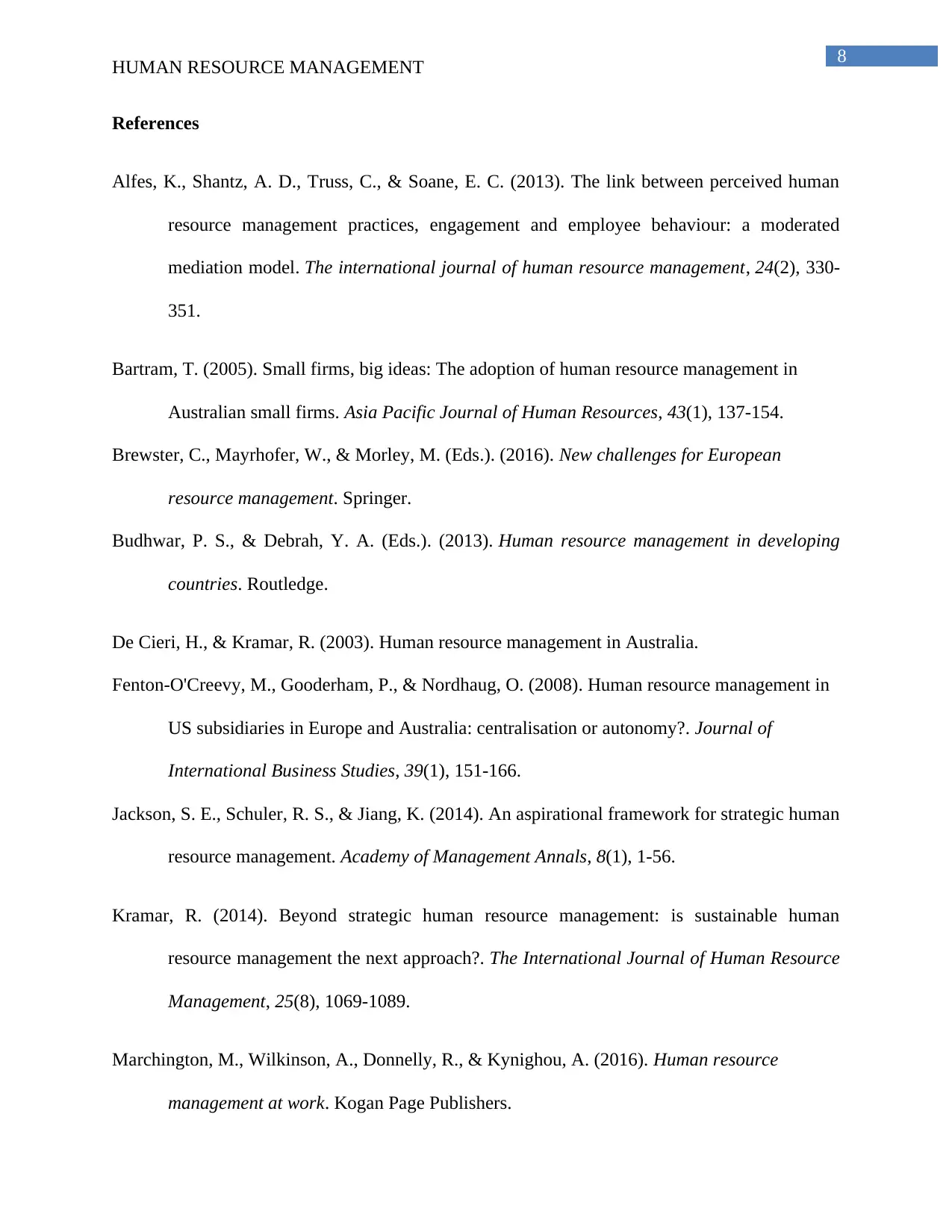
Alfes, K., Shantz, A. D., Truss, C., & Soane, E. C. (2013). The link between perceived human
resource management practices, engagement and employee behaviour: a moderated
mediation model. The international journal of human resource management, 24(2), 330-
351.
Bartram, T. (2005). Small firms, big ideas: The adoption of human resource management in
Australian small firms. Asia Pacific Journal of Human Resources, 43(1), 137-154.
Brewster, C., Mayrhofer, W., & Morley, M. (Eds.). (2016). New challenges for European
resource management. Springer.
Budhwar, P. S., & Debrah, Y. A. (Eds.). (2013). Human resource management in developing
countries. Routledge.
De Cieri, H., & Kramar, R. (2003). Human resource management in Australia.
Fenton-O'Creevy, M., Gooderham, P., & Nordhaug, O. (2008). Human resource management in
US subsidiaries in Europe and Australia: centralisation or autonomy?. Journal of
International Business Studies, 39(1), 151-166.
Jackson, S. E., Schuler, R. S., & Jiang, K. (2014). An aspirational framework for strategic human
resource management. Academy of Management Annals, 8(1), 1-56.
Kramar, R. (2014). Beyond strategic human resource management: is sustainable human
resource management the next approach?. The International Journal of Human Resource
Management, 25(8), 1069-1089.
Marchington, M., Wilkinson, A., Donnelly, R., & Kynighou, A. (2016). Human resource
management at work. Kogan Page Publishers.
HUMAN RESOURCE MANAGEMENT
References
Alfes, K., Shantz, A. D., Truss, C., & Soane, E. C. (2013). The link between perceived human
resource management practices, engagement and employee behaviour: a moderated
mediation model. The international journal of human resource management, 24(2), 330-
351.
Bartram, T. (2005). Small firms, big ideas: The adoption of human resource management in
Australian small firms. Asia Pacific Journal of Human Resources, 43(1), 137-154.
Brewster, C., Mayrhofer, W., & Morley, M. (Eds.). (2016). New challenges for European
resource management. Springer.
Budhwar, P. S., & Debrah, Y. A. (Eds.). (2013). Human resource management in developing
countries. Routledge.
De Cieri, H., & Kramar, R. (2003). Human resource management in Australia.
Fenton-O'Creevy, M., Gooderham, P., & Nordhaug, O. (2008). Human resource management in
US subsidiaries in Europe and Australia: centralisation or autonomy?. Journal of
International Business Studies, 39(1), 151-166.
Jackson, S. E., Schuler, R. S., & Jiang, K. (2014). An aspirational framework for strategic human
resource management. Academy of Management Annals, 8(1), 1-56.
Kramar, R. (2014). Beyond strategic human resource management: is sustainable human
resource management the next approach?. The International Journal of Human Resource
Management, 25(8), 1069-1089.
Marchington, M., Wilkinson, A., Donnelly, R., & Kynighou, A. (2016). Human resource
management at work. Kogan Page Publishers.
⊘ This is a preview!⊘
Do you want full access?
Subscribe today to unlock all pages.
Trusted by 1+ million students worldwide
9
HUMAN RESOURCE MANAGEMENT
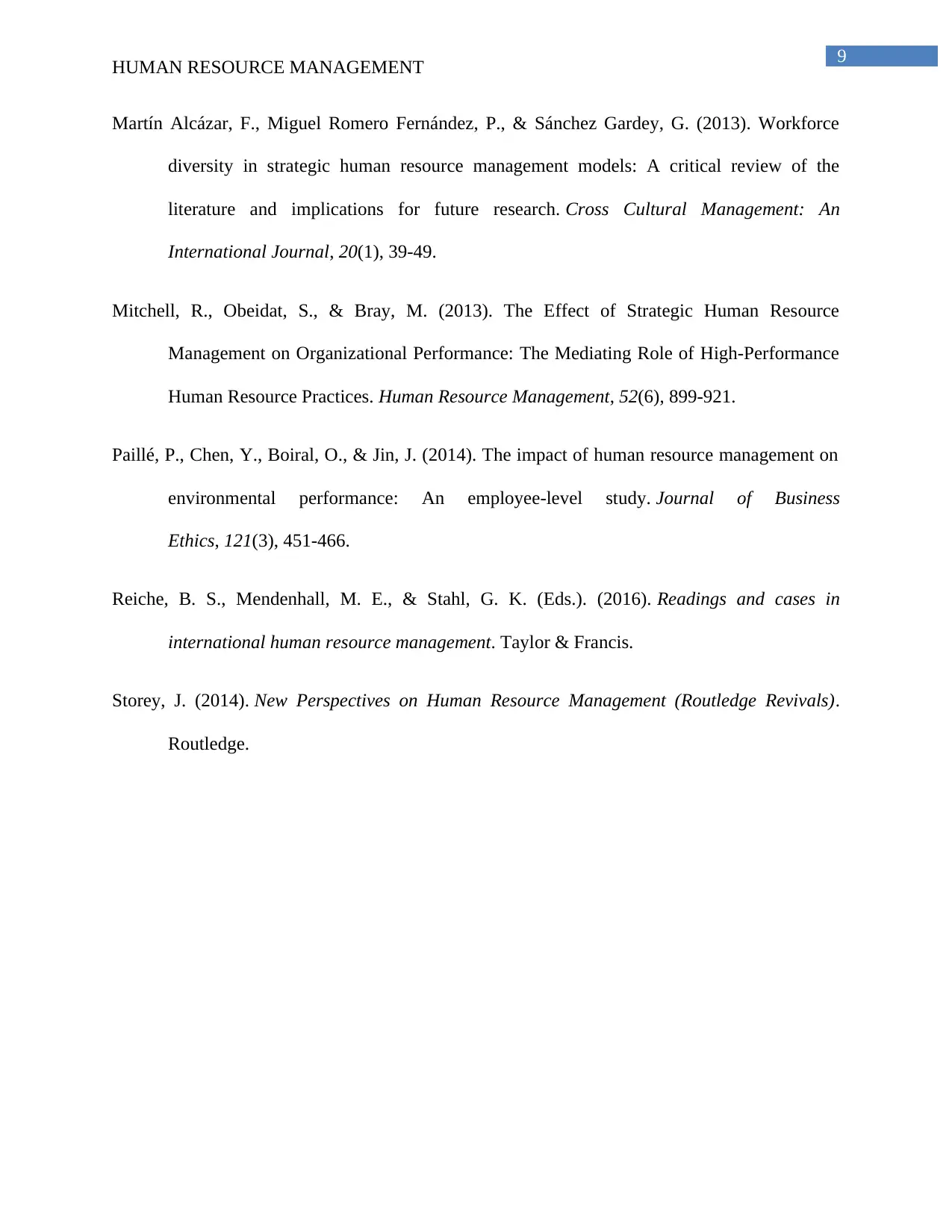
Martín Alcázar, F., Miguel Romero Fernández, P., & Sánchez Gardey, G. (2013). Workforce
diversity in strategic human resource management models: A critical review of the
literature and implications for future research. Cross Cultural Management: An
International Journal, 20(1), 39-49.
Mitchell, R., Obeidat, S., & Bray, M. (2013). The Effect of Strategic Human Resource
Management on Organizational Performance: The Mediating Role of High‐Performance
Human Resource Practices. Human Resource Management, 52(6), 899-921.
Paillé, P., Chen, Y., Boiral, O., & Jin, J. (2014). The impact of human resource management on
environmental performance: An employee-level study. Journal of Business
Ethics, 121(3), 451-466.
Reiche, B. S., Mendenhall, M. E., & Stahl, G. K. (Eds.). (2016). Readings and cases in
international human resource management. Taylor & Francis.
Storey, J. (2014). New Perspectives on Human Resource Management (Routledge Revivals).
Routledge.
HUMAN RESOURCE MANAGEMENT
Martín Alcázar, F., Miguel Romero Fernández, P., & Sánchez Gardey, G. (2013). Workforce
diversity in strategic human resource management models: A critical review of the
literature and implications for future research. Cross Cultural Management: An
International Journal, 20(1), 39-49.
Mitchell, R., Obeidat, S., & Bray, M. (2013). The Effect of Strategic Human Resource
Management on Organizational Performance: The Mediating Role of High‐Performance
Human Resource Practices. Human Resource Management, 52(6), 899-921.
Paillé, P., Chen, Y., Boiral, O., & Jin, J. (2014). The impact of human resource management on
environmental performance: An employee-level study. Journal of Business
Ethics, 121(3), 451-466.
Reiche, B. S., Mendenhall, M. E., & Stahl, G. K. (Eds.). (2016). Readings and cases in
international human resource management. Taylor & Francis.
Storey, J. (2014). New Perspectives on Human Resource Management (Routledge Revivals).
Routledge.

1 out of 10


Related Documents


Your All-in-One AI-Powered Toolkit for Academic Success.
+13062052269
info@desklib.com
Available 24*7 on WhatsApp / Email
![[object Object]](/_next/static/media/star-bottom.7253800d.svg)
Unlock your academic potential
Copyright © 2020–2026 A2Z Services. All Rights Reserved. Developed and managed by ZUCOL.