Human Resource Management Case Study: IRTC Manufacturing Report
VerifiedAdded on 2020/05/28
|12
|2519
|79
Report
AI Summary
This report presents a case study on Human Resource Management at IRTC Manufacturing Enterprises, focusing on the upgrade of a legacy billing system. The report explores the application of Earned Value Management (EVM) for project monitoring and control, emphasizing its role in managing costs and schedules. It identifies key roles within the project team, including business analysts, system developers, and team leaders, and defines the necessary skills for each role. The report details the process of assigning team members to roles based on their skill sets and experience, including justifications for these selections. It also addresses potential conflicts and problems encountered during the project, such as unclear responsibilities and salary demands, and proposes solutions for effective team management. The report concludes by highlighting the importance of EVM in evaluating project performance and ensuring successful project completion within the estimated timeframe and budget. The importance of communication and team collaboration is highlighted throughout the report.
Running head: HUMAN RESOURCE MANAGEMENT
Human Resource Management: Case Study of IRTC Manufacturing Enterprises
Name of the student:
Name of the university:
Human Resource Management: Case Study of IRTC Manufacturing Enterprises
Name of the student:
Name of the university:

Paraphrase This Document
Need a fresh take? Get an instant paraphrase of this document with our AI Paraphraser
1HUMAN RESOURCE MANAGEMENT
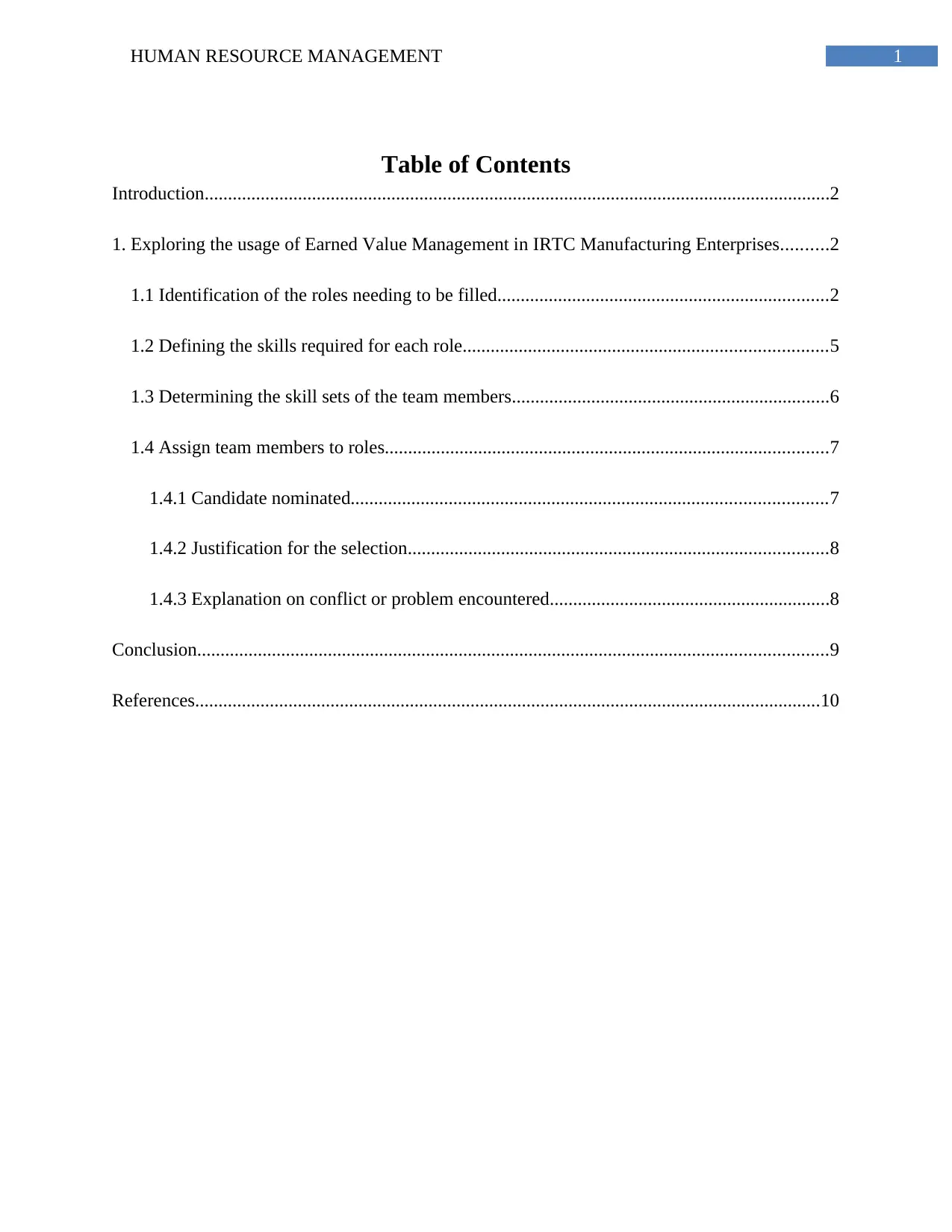
Table of Contents
Introduction......................................................................................................................................2
1. Exploring the usage of Earned Value Management in IRTC Manufacturing Enterprises..........2
1.1 Identification of the roles needing to be filled.......................................................................2
1.2 Defining the skills required for each role..............................................................................5
1.3 Determining the skill sets of the team members....................................................................6
1.4 Assign team members to roles...............................................................................................7
1.4.1 Candidate nominated......................................................................................................7
1.4.2 Justification for the selection..........................................................................................8
1.4.3 Explanation on conflict or problem encountered............................................................8
Conclusion.......................................................................................................................................9
References......................................................................................................................................10
Table of Contents
Introduction......................................................................................................................................2
1. Exploring the usage of Earned Value Management in IRTC Manufacturing Enterprises..........2
1.1 Identification of the roles needing to be filled.......................................................................2
1.2 Defining the skills required for each role..............................................................................5
1.3 Determining the skill sets of the team members....................................................................6
1.4 Assign team members to roles...............................................................................................7
1.4.1 Candidate nominated......................................................................................................7
1.4.2 Justification for the selection..........................................................................................8
1.4.3 Explanation on conflict or problem encountered............................................................8
Conclusion.......................................................................................................................................9
References......................................................................................................................................10
2HUMAN RESOURCE MANAGEMENT
Introduction
This report depicts the importance of developing legacy billing system in a company
named as IRTC Manufacturing Enterprise. However; the company already has a legacy billing
system but in order to gain competitive advantages and measurable revenue they are willing to
improve their existing system that has been originally installed 10 year ago. A team of 2 full time
employees are employed to upgrade the billing system and the total time considered for this
improvement is about 9-12 weeks. The aim of the company is to develop a new web based
version for their employees to reduce cost, increase the overall working efficiency.
In order to accomplish the project within estimated time and budget the roles and
responsibilities of the employees and project team members are required to be fulfilled
accordingly (Brewer, Wallin & Ashenbaum, 2014). The project manager is responsible to
control and monitor the entire project during the initiation and even after the completion of the
project. The roles of the project team members and their knowledge and skill set that are helpful
to meet the requirement of the system are also elaborated in this report.
1. Exploring the usage of Earned Value Management in IRTC Manufacturing
Enterprises
1.1 Identification of the roles needing to be filled
The aim of IRTC Manufacturing Enterprises is to provide a secured, efficient and
effective solution by upgrading their existing legacy billing system to the consumers. It has been
analyzed that, different components are there those are to be upgraded for improving the system
Introduction
This report depicts the importance of developing legacy billing system in a company
named as IRTC Manufacturing Enterprise. However; the company already has a legacy billing
system but in order to gain competitive advantages and measurable revenue they are willing to
improve their existing system that has been originally installed 10 year ago. A team of 2 full time
employees are employed to upgrade the billing system and the total time considered for this
improvement is about 9-12 weeks. The aim of the company is to develop a new web based
version for their employees to reduce cost, increase the overall working efficiency.
In order to accomplish the project within estimated time and budget the roles and
responsibilities of the employees and project team members are required to be fulfilled
accordingly (Brewer, Wallin & Ashenbaum, 2014). The project manager is responsible to
control and monitor the entire project during the initiation and even after the completion of the
project. The roles of the project team members and their knowledge and skill set that are helpful
to meet the requirement of the system are also elaborated in this report.
1. Exploring the usage of Earned Value Management in IRTC Manufacturing
Enterprises
1.1 Identification of the roles needing to be filled
The aim of IRTC Manufacturing Enterprises is to provide a secured, efficient and
effective solution by upgrading their existing legacy billing system to the consumers. It has been
analyzed that, different components are there those are to be upgraded for improving the system
⊘ This is a preview!⊘
Do you want full access?
Subscribe today to unlock all pages.

Trusted by 1+ million students worldwide
3HUMAN RESOURCE MANAGEMENT
(Hong & Kwon, 2012). In order to upgrade this system the roles those have been assigned are the
business analyst, system developers, system tester, system analyzer, team leader and the business
analysts. It is the responsibility of the project team leader to lead, guide and motivate the rest of
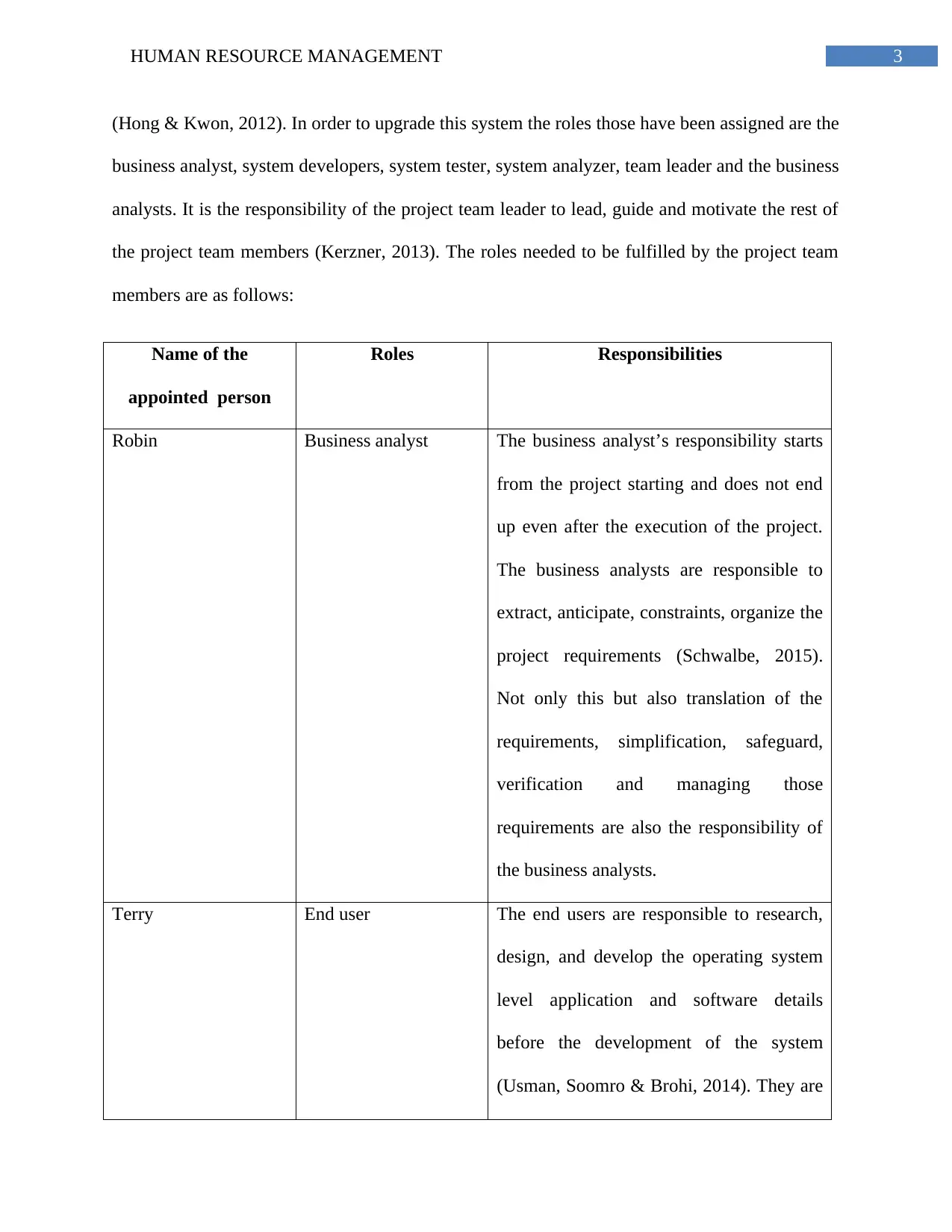
the project team members (Kerzner, 2013). The roles needed to be fulfilled by the project team
members are as follows:
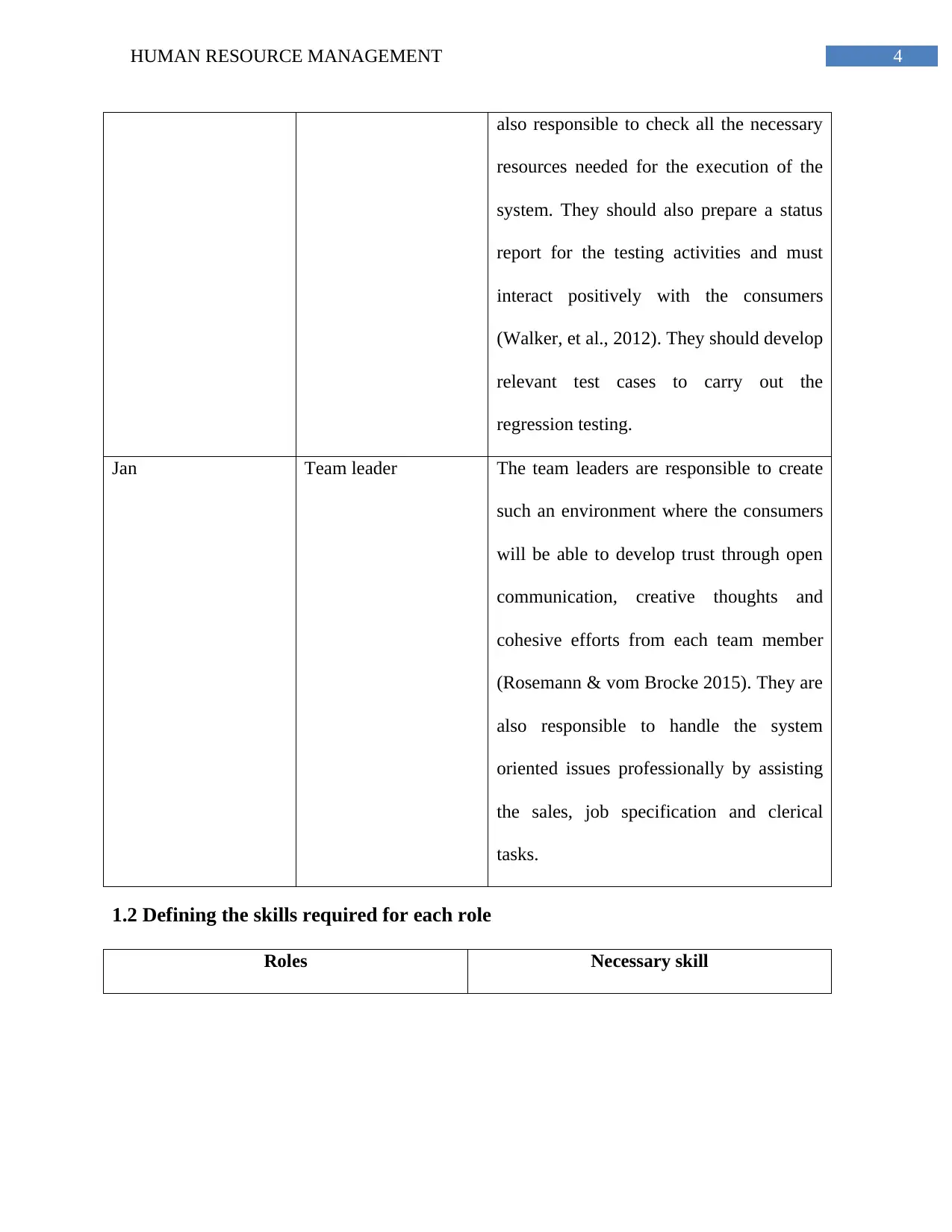
Name of the
appointed person
Roles Responsibilities
Robin Business analyst The business analyst’s responsibility starts
from the project starting and does not end
up even after the execution of the project.
The business analysts are responsible to
extract, anticipate, constraints, organize the
project requirements (Schwalbe, 2015).
Not only this but also translation of the
requirements, simplification, safeguard,
verification and managing those
requirements are also the responsibility of
the business analysts.
Terry End user The end users are responsible to research,
design, and develop the operating system
level application and software details
before the development of the system
(Usman, Soomro & Brohi, 2014). They are
(Hong & Kwon, 2012). In order to upgrade this system the roles those have been assigned are the
business analyst, system developers, system tester, system analyzer, team leader and the business
analysts. It is the responsibility of the project team leader to lead, guide and motivate the rest of
the project team members (Kerzner, 2013). The roles needed to be fulfilled by the project team
members are as follows:
Name of the
appointed person
Roles Responsibilities
Robin Business analyst The business analyst’s responsibility starts
from the project starting and does not end
up even after the execution of the project.
The business analysts are responsible to
extract, anticipate, constraints, organize the
project requirements (Schwalbe, 2015).
Not only this but also translation of the
requirements, simplification, safeguard,
verification and managing those
requirements are also the responsibility of
the business analysts.
Terry End user The end users are responsible to research,
design, and develop the operating system
level application and software details
before the development of the system
(Usman, Soomro & Brohi, 2014). They are
Paraphrase This Document
Need a fresh take? Get an instant paraphrase of this document with our AI Paraphraser
4HUMAN RESOURCE MANAGEMENT
also responsible to check all the necessary
resources needed for the execution of the
system. They should also prepare a status
report for the testing activities and must
interact positively with the consumers
(Walker, et al., 2012). They should develop
relevant test cases to carry out the
regression testing.
Jan Team leader The team leaders are responsible to create
such an environment where the consumers
will be able to develop trust through open
communication, creative thoughts and
cohesive efforts from each team member
(Rosemann & vom Brocke 2015). They are
also responsible to handle the system
oriented issues professionally by assisting
the sales, job specification and clerical
tasks.
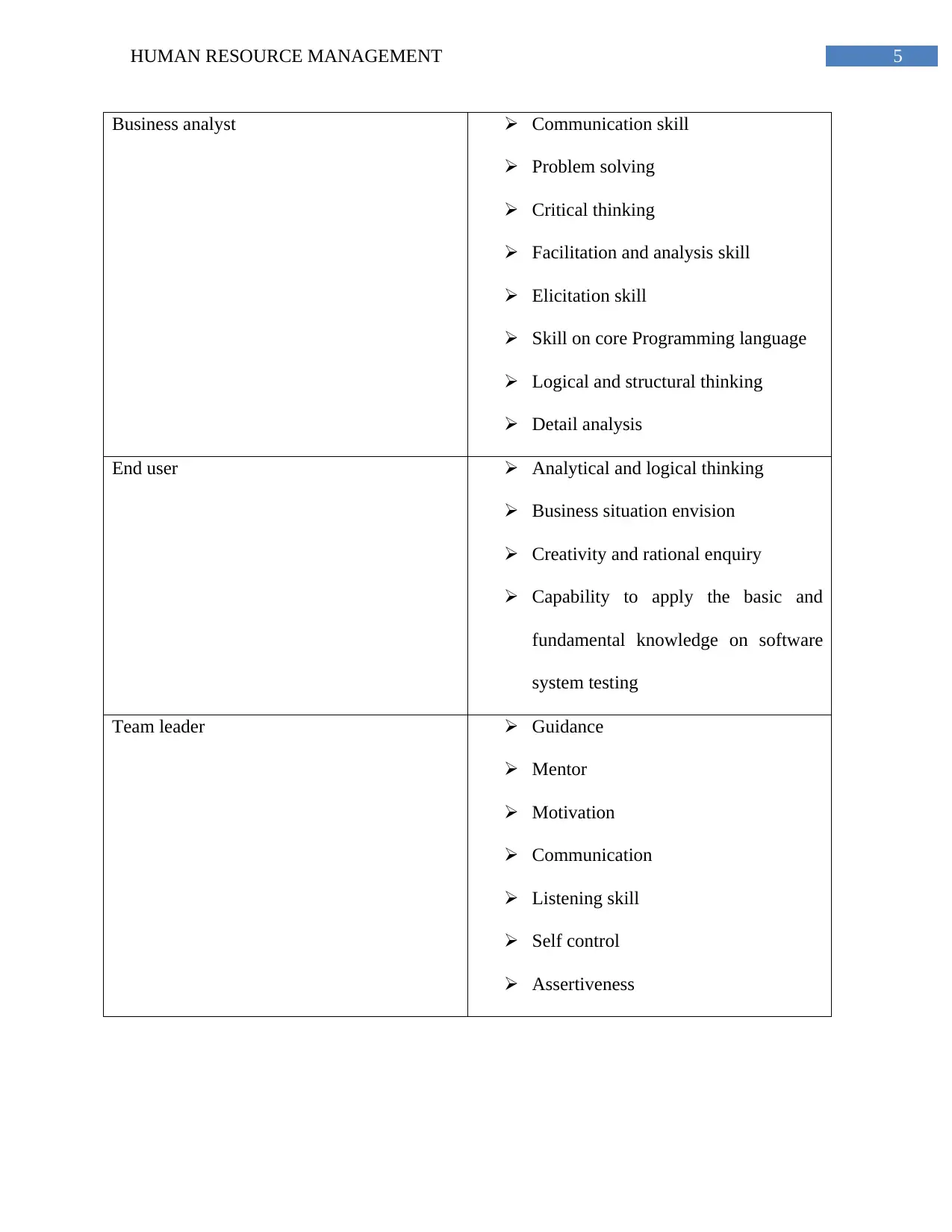
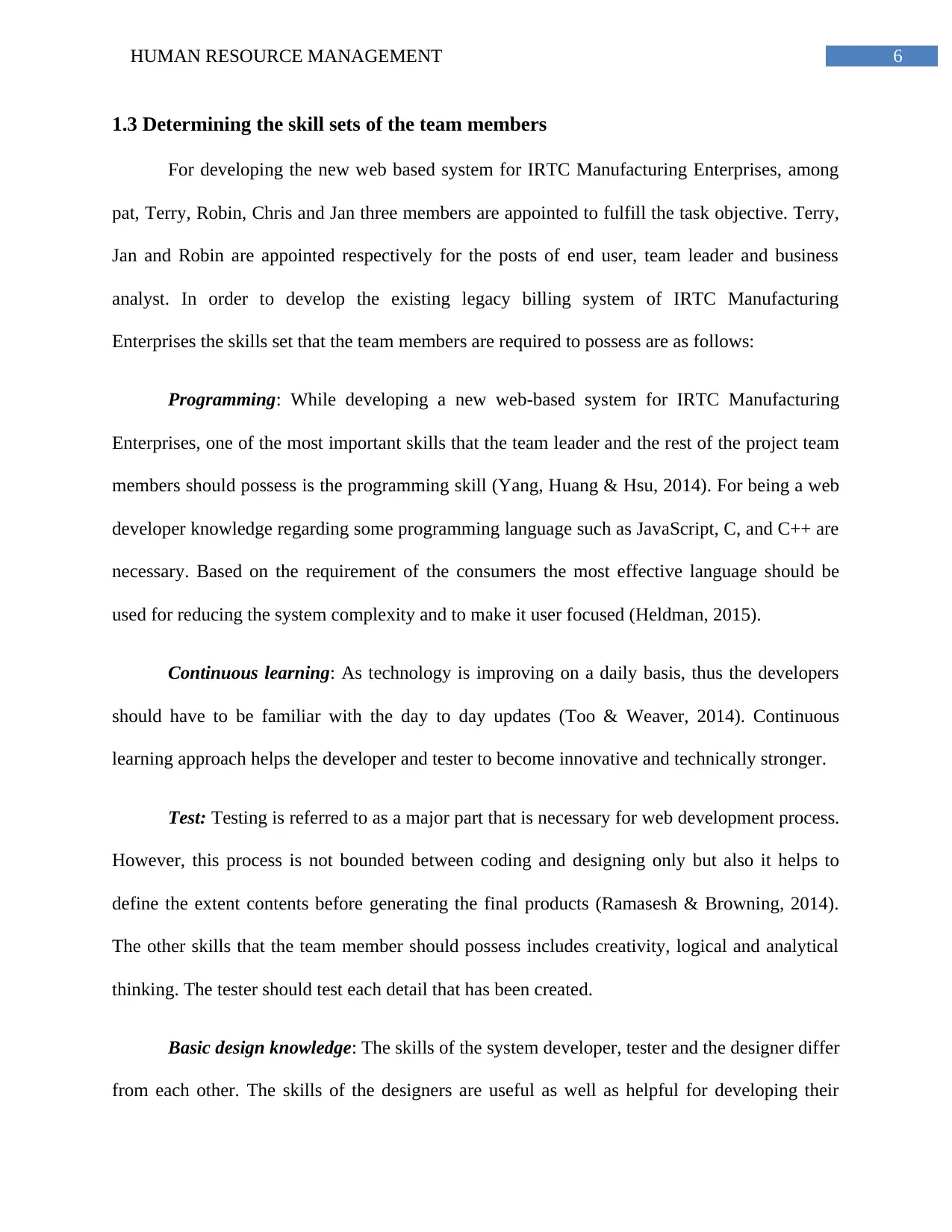
1.2 Defining the skills required for each role
Roles Necessary skill
also responsible to check all the necessary
resources needed for the execution of the
system. They should also prepare a status
report for the testing activities and must
interact positively with the consumers
(Walker, et al., 2012). They should develop
relevant test cases to carry out the
regression testing.
Jan Team leader The team leaders are responsible to create
such an environment where the consumers
will be able to develop trust through open
communication, creative thoughts and
cohesive efforts from each team member
(Rosemann & vom Brocke 2015). They are
also responsible to handle the system
oriented issues professionally by assisting
the sales, job specification and clerical
tasks.
1.2 Defining the skills required for each role
Roles Necessary skill
5HUMAN RESOURCE MANAGEMENT
Business analyst Communication skill
Problem solving
Critical thinking
Facilitation and analysis skill
Elicitation skill
Skill on core Programming language
Logical and structural thinking
Detail analysis
End user Analytical and logical thinking
Business situation envision
Creativity and rational enquiry
Capability to apply the basic and
fundamental knowledge on software
system testing
Team leader Guidance
Mentor
Motivation
Communication
Listening skill
Self control
Assertiveness
Business analyst Communication skill
Problem solving
Critical thinking
Facilitation and analysis skill
Elicitation skill
Skill on core Programming language
Logical and structural thinking
Detail analysis
End user Analytical and logical thinking
Business situation envision
Creativity and rational enquiry
Capability to apply the basic and
fundamental knowledge on software
system testing
Team leader Guidance
Mentor
Motivation
Communication
Listening skill
Self control
Assertiveness
⊘ This is a preview!⊘
Do you want full access?
Subscribe today to unlock all pages.
Trusted by 1+ million students worldwide
6HUMAN RESOURCE MANAGEMENT
1.3 Determining the skill sets of the team members
For developing the new web based system for IRTC Manufacturing Enterprises, among
pat, Terry, Robin, Chris and Jan three members are appointed to fulfill the task objective. Terry,
Jan and Robin are appointed respectively for the posts of end user, team leader and business
analyst. In order to develop the existing legacy billing system of IRTC Manufacturing
Enterprises the skills set that the team members are required to possess are as follows:
Programming: While developing a new web-based system for IRTC Manufacturing
Enterprises, one of the most important skills that the team leader and the rest of the project team
members should possess is the programming skill (Yang, Huang & Hsu, 2014). For being a web
developer knowledge regarding some programming language such as JavaScript, C, and C++ are
necessary. Based on the requirement of the consumers the most effective language should be
used for reducing the system complexity and to make it user focused (Heldman, 2015).
Continuous learning: As technology is improving on a daily basis, thus the developers
should have to be familiar with the day to day updates (Too & Weaver, 2014). Continuous
learning approach helps the developer and tester to become innovative and technically stronger.
Test: Testing is referred to as a major part that is necessary for web development process.
However, this process is not bounded between coding and designing only but also it helps to
define the extent contents before generating the final products (Ramasesh & Browning, 2014).
The other skills that the team member should possess includes creativity, logical and analytical
thinking. The tester should test each detail that has been created.
Basic design knowledge: The skills of the system developer, tester and the designer differ
from each other. The skills of the designers are useful as well as helpful for developing their
1.3 Determining the skill sets of the team members
For developing the new web based system for IRTC Manufacturing Enterprises, among
pat, Terry, Robin, Chris and Jan three members are appointed to fulfill the task objective. Terry,
Jan and Robin are appointed respectively for the posts of end user, team leader and business
analyst. In order to develop the existing legacy billing system of IRTC Manufacturing
Enterprises the skills set that the team members are required to possess are as follows:
Programming: While developing a new web-based system for IRTC Manufacturing
Enterprises, one of the most important skills that the team leader and the rest of the project team
members should possess is the programming skill (Yang, Huang & Hsu, 2014). For being a web
developer knowledge regarding some programming language such as JavaScript, C, and C++ are
necessary. Based on the requirement of the consumers the most effective language should be
used for reducing the system complexity and to make it user focused (Heldman, 2015).
Continuous learning: As technology is improving on a daily basis, thus the developers
should have to be familiar with the day to day updates (Too & Weaver, 2014). Continuous
learning approach helps the developer and tester to become innovative and technically stronger.
Test: Testing is referred to as a major part that is necessary for web development process.
However, this process is not bounded between coding and designing only but also it helps to
define the extent contents before generating the final products (Ramasesh & Browning, 2014).
The other skills that the team member should possess includes creativity, logical and analytical
thinking. The tester should test each detail that has been created.
Basic design knowledge: The skills of the system developer, tester and the designer differ
from each other. The skills of the designers are useful as well as helpful for developing their
Paraphrase This Document
Need a fresh take? Get an instant paraphrase of this document with our AI Paraphraser
7HUMAN RESOURCE MANAGEMENT
everyday working capability (Hunter, 2015). It helps to bring awareness development program.
The designers must have minimum knowledge regarding the graphics designing to make the
website more simple and creative at the same time. However, the designers must have proper
knowledge and skills regarding graphic design tool.
Resoluteness: Experiences can be gained from the previously mistakes and new trails.
Except doubting the design the designers should possess the skills for making trial with new
technologies.
Communication: Four different types of communication approaches are there those are
generally widely used by the team leaders and the project development team members. It is the
responsibility of the project manager to make the project team members connected to their job
roles professionally (Awan & Saeed, 2015). The four different communication approaches
include downward, upward, horizontal and open communication. However, the most effective
communication approach that the team leader and the project team members should use is the
open communication (Ramasesh & Browning, 2014). With the help of open communication the
project team members will be able to share their point of thoughts with the team leaders.
1.4 Assign team members to roles
1.4.1 Candidate nominated
Based on the skills and knowledge of the team members, the responsibilities are divided
and given to the team members. For successful completion of the project Jan is nominated as the
team leader.
everyday working capability (Hunter, 2015). It helps to bring awareness development program.
The designers must have minimum knowledge regarding the graphics designing to make the
website more simple and creative at the same time. However, the designers must have proper
knowledge and skills regarding graphic design tool.
Resoluteness: Experiences can be gained from the previously mistakes and new trails.
Except doubting the design the designers should possess the skills for making trial with new
technologies.
Communication: Four different types of communication approaches are there those are
generally widely used by the team leaders and the project development team members. It is the
responsibility of the project manager to make the project team members connected to their job
roles professionally (Awan & Saeed, 2015). The four different communication approaches
include downward, upward, horizontal and open communication. However, the most effective
communication approach that the team leader and the project team members should use is the
open communication (Ramasesh & Browning, 2014). With the help of open communication the
project team members will be able to share their point of thoughts with the team leaders.
1.4 Assign team members to roles
1.4.1 Candidate nominated
Based on the skills and knowledge of the team members, the responsibilities are divided
and given to the team members. For successful completion of the project Jan is nominated as the
team leader.
8HUMAN RESOURCE MANAGEMENT
1.4.2 Justification for the selection
From the analysis it has been found that, Jan is available to the project development for
16 hours per week with an investment of $115/hour. Though Jan is new in the IT application
department but previously she was appointed as a consultant and professionally worked on a
process reengineering project. That project deal with various billing functionalities as well. Not
only this but also Jan has also worked with the web version products for the vendors
competition. Thus, from her previous experience, skill and knowledge it can be said that she can
be appointed for the role of team leader. As her previous projects were successful thus it can also
be defined that she possesses professional communication skills, creativity and programming
skill as well. The rest of the members are nominated as the project team members due to lack
skill, knowledge. In addition to this, the other reasons those have been considered are their
demand for salary and time as well.
1.4.3 Explanation on conflict or problem encountered
Different types of organizational conflicts are there for which the organizational
structures are negatively impacted. The different types of conflicts include interpersonal conflict,
intrapersonal conflict, intra-group conflict and inter-group conflict (Awan & Saeed, 2015).
During the development of the system different types of problems have been encountered.
However; for this particular project the problems that has been encountered is the unclear
responsibility.
In the project initiation phase the experience of the participants rather project team
members were not at all clear thus, issues were highlighted on their interest domain (Joslin &
Muller, 2015). As initially their domain of interest was not absolutely clear thus, it was very
difficult to appoint them on the proper job role. On the other hand, due to their previous work
1.4.2 Justification for the selection
From the analysis it has been found that, Jan is available to the project development for
16 hours per week with an investment of $115/hour. Though Jan is new in the IT application
department but previously she was appointed as a consultant and professionally worked on a
process reengineering project. That project deal with various billing functionalities as well. Not
only this but also Jan has also worked with the web version products for the vendors
competition. Thus, from her previous experience, skill and knowledge it can be said that she can
be appointed for the role of team leader. As her previous projects were successful thus it can also
be defined that she possesses professional communication skills, creativity and programming
skill as well. The rest of the members are nominated as the project team members due to lack
skill, knowledge. In addition to this, the other reasons those have been considered are their
demand for salary and time as well.
1.4.3 Explanation on conflict or problem encountered
Different types of organizational conflicts are there for which the organizational
structures are negatively impacted. The different types of conflicts include interpersonal conflict,
intrapersonal conflict, intra-group conflict and inter-group conflict (Awan & Saeed, 2015).
During the development of the system different types of problems have been encountered.
However; for this particular project the problems that has been encountered is the unclear
responsibility.
In the project initiation phase the experience of the participants rather project team
members were not at all clear thus, issues were highlighted on their interest domain (Joslin &
Muller, 2015). As initially their domain of interest was not absolutely clear thus, it was very
difficult to appoint them on the proper job role. On the other hand, due to their previous work
⊘ This is a preview!⊘
Do you want full access?
Subscribe today to unlock all pages.
Trusted by 1+ million students worldwide
9HUMAN RESOURCE MANAGEMENT
experiences the demand of their salary and time availability was also very high. Considering the
existing operational and functional availability it is also determined that, some of the interested
participants are not even aware about the requirement of the company. Thus, during selecting the
team for full time employees their skills, knowledge, learning ability and previous experiences
are analyzed.
Conclusion
From the overall discussion it can be concluded that, the goal of IRTC Manufacturing
Enterprises is to explore the usage of the Earned Value Management system for monitoring and
controlling the cost and schedule of the employee’s performance. It has been defined that based
upon the skills and knowledge, the project team members should be appointed to their job roles.
Not only this but also, for measuring the performance of the project team members Earned Value
Management system act as a useful tool. In order to find out the variances of the project the
project manager uses EVM as a systematic analysis tool. Even for project forecasting, cost and
schedule control approach is used by the project managers. For reducing the work pressure from
the project team members based on their skills and knowledge proper work division are also
done that has been elaborated in this report. Three leading designations for this particular project
are assigned as the end users, business analyst and team leader. The role of the team leader is to
guide, motivate and control all the other project team members. In order to accomplish this
particular project, the roles and responsibilities of the project team members are illustrated in this
report.
experiences the demand of their salary and time availability was also very high. Considering the
existing operational and functional availability it is also determined that, some of the interested
participants are not even aware about the requirement of the company. Thus, during selecting the
team for full time employees their skills, knowledge, learning ability and previous experiences
are analyzed.
Conclusion
From the overall discussion it can be concluded that, the goal of IRTC Manufacturing
Enterprises is to explore the usage of the Earned Value Management system for monitoring and
controlling the cost and schedule of the employee’s performance. It has been defined that based
upon the skills and knowledge, the project team members should be appointed to their job roles.
Not only this but also, for measuring the performance of the project team members Earned Value
Management system act as a useful tool. In order to find out the variances of the project the
project manager uses EVM as a systematic analysis tool. Even for project forecasting, cost and
schedule control approach is used by the project managers. For reducing the work pressure from
the project team members based on their skills and knowledge proper work division are also
done that has been elaborated in this report. Three leading designations for this particular project
are assigned as the end users, business analyst and team leader. The role of the team leader is to
guide, motivate and control all the other project team members. In order to accomplish this
particular project, the roles and responsibilities of the project team members are illustrated in this
report.
Paraphrase This Document
Need a fresh take? Get an instant paraphrase of this document with our AI Paraphraser
10HUMAN RESOURCE MANAGEMENT
References
Awan, A. G., & Saeed, S. (2015). Conflict Management and Organizational Performance: A
Case Study of Askari Bank Ltd. Research Journal of Finance and Accounting, 6(11), 88-
102.
Brewer, B., Wallin, C., & Ashenbaum, B. (2014). Outsourcing the procurement function: Do
actions and results align with theory? Journal of Purchasing and Supply
Management, 20(3), 186-194.
Heldman, K. (2015). PMP project management professional exam deluxe study guide: updated
for the 2015 Exam. John Wiley & Sons.
Hong, P., & Kwon, H. B. (2012). Emerging issues of procurement management: a review and
prospect. International Journal of Procurement Management 4, 5(4), 452-469.
Hunter, J. (2015). Work Analysis and the Resolution of Organizational Conflict: Theoretical
Method, Measurement and Application. In Derailed Organizational Interventions for
Stress and Well-Being (pp. 253-259). Springer Netherlands.
Joslin, R., & Muller, R. (2015). Relationships between a project management methodology and
project success in different project governance contexts. International Journal of Project
Management, 33(6), 1377-1392.
Kerzner, H. (2013). Project management: a systems approach to planning, scheduling, and
controlling. John Wiley & Sons.
References
Awan, A. G., & Saeed, S. (2015). Conflict Management and Organizational Performance: A
Case Study of Askari Bank Ltd. Research Journal of Finance and Accounting, 6(11), 88-
102.
Brewer, B., Wallin, C., & Ashenbaum, B. (2014). Outsourcing the procurement function: Do
actions and results align with theory? Journal of Purchasing and Supply
Management, 20(3), 186-194.
Heldman, K. (2015). PMP project management professional exam deluxe study guide: updated
for the 2015 Exam. John Wiley & Sons.
Hong, P., & Kwon, H. B. (2012). Emerging issues of procurement management: a review and
prospect. International Journal of Procurement Management 4, 5(4), 452-469.
Hunter, J. (2015). Work Analysis and the Resolution of Organizational Conflict: Theoretical
Method, Measurement and Application. In Derailed Organizational Interventions for
Stress and Well-Being (pp. 253-259). Springer Netherlands.
Joslin, R., & Muller, R. (2015). Relationships between a project management methodology and
project success in different project governance contexts. International Journal of Project
Management, 33(6), 1377-1392.
Kerzner, H. (2013). Project management: a systems approach to planning, scheduling, and
controlling. John Wiley & Sons.
11HUMAN RESOURCE MANAGEMENT
Ramasesh, R. V., & Browning, T. R. (2014). A conceptual framework for tackling knowable
unknown unknowns in project management. Journal of Operations Management, 32(4),
190-204.
Rosemann, M., & vom Brocke, J. (2015). The six core elements of business process
management. In Handbook on business process management 1 (pp. 105-122). Springer
Berlin Heidelberg.
Schwalbe, K. (2015). Information technology project management. Cengage Learning.
Too, E. G., & Weaver, P. (2014). The management of project management: A conceptual
framework for project governance. International Journal of Project Management, 32(8),
1382-1394.
Usman, M., Soomro, T. R., & Brohi, M. N. (2014). Embedding project management into XP,
SCRUM and RUP. European Scientific Journal, ESJ, 10(15).
Walker, H., Miemczyk, J., Johnsen, T., & Spencer, R. (2012). Sustainable procurement: Past,
present and future. Journal of Purchasing and Supply Management, 18(4), 201-206.
Yang, L. R., Huang, C. F., & Hsu, T. J. (2014). Knowledge leadership to improve project and
organizational performance. International Journal of Project Management, 32(1), 40-53.
Ramasesh, R. V., & Browning, T. R. (2014). A conceptual framework for tackling knowable
unknown unknowns in project management. Journal of Operations Management, 32(4),
190-204.
Rosemann, M., & vom Brocke, J. (2015). The six core elements of business process
management. In Handbook on business process management 1 (pp. 105-122). Springer
Berlin Heidelberg.
Schwalbe, K. (2015). Information technology project management. Cengage Learning.
Too, E. G., & Weaver, P. (2014). The management of project management: A conceptual
framework for project governance. International Journal of Project Management, 32(8),
1382-1394.
Usman, M., Soomro, T. R., & Brohi, M. N. (2014). Embedding project management into XP,
SCRUM and RUP. European Scientific Journal, ESJ, 10(15).
Walker, H., Miemczyk, J., Johnsen, T., & Spencer, R. (2012). Sustainable procurement: Past,
present and future. Journal of Purchasing and Supply Management, 18(4), 201-206.
Yang, L. R., Huang, C. F., & Hsu, T. J. (2014). Knowledge leadership to improve project and
organizational performance. International Journal of Project Management, 32(1), 40-53.
⊘ This is a preview!⊘
Do you want full access?
Subscribe today to unlock all pages.
Trusted by 1+ million students worldwide

1 out of 12


Related Documents


Your All-in-One AI-Powered Toolkit for Academic Success.
+13062052269
info@desklib.com
Available 24*7 on WhatsApp / Email
![[object Object]](/_next/static/media/star-bottom.7253800d.svg)
Unlock your academic potential
Copyright © 2020–2026 A2Z Services. All Rights Reserved. Developed and managed by ZUCOL.