Woodhill College: 15 Principles of Effective HRM and Applications
VerifiedAdded on 2020/02/05
|18
|5882
|461
Report
AI Summary
This report comprehensively examines 15 key principles of effective human resource management (HRM) and their practical applications. It begins with an introduction to HRM and its significance in the modern business landscape, emphasizing the importance of attracting and retaining talented employees. The report is divided into three parts: recruitment and selection, employee performance, development, and reward, and employment relationships. Part 1 explores workforce planning, the role of the HR manager, and various recruitment and selection approaches, including in-house, outsourcing, and external methods, with a focus on the strengths and weaknesses of each approach. This section also includes a job advertisement example and specifications for an education coordinator role in the education sector. Part 2 delves into the differences between training and development, the importance of training programs, and approaches to flexibility. Part 3 discusses maintaining good employee relations and the influence of HR decisions, as well as key elements in employment legislation. The report concludes by summarizing the importance of the HRM principles discussed.

1
Principles of effective Human Resource Management and their Applications
Principles of effective Human Resource Management and their Applications

Paraphrase This Document
Need a fresh take? Get an instant paraphrase of this document with our AI Paraphraser
2
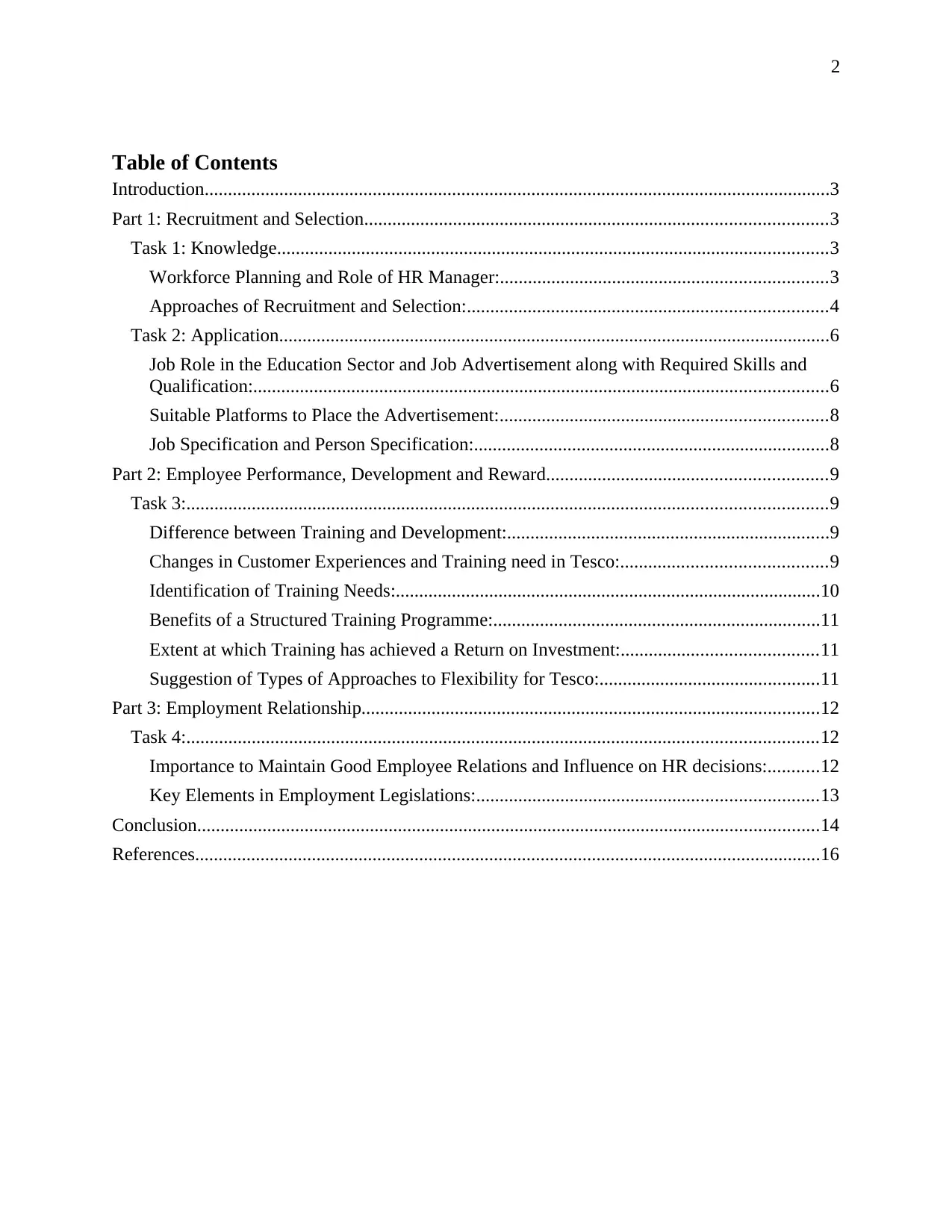
Table of Contents
Introduction......................................................................................................................................3
Part 1: Recruitment and Selection...................................................................................................3
Task 1: Knowledge......................................................................................................................3
Workforce Planning and Role of HR Manager:......................................................................3
Approaches of Recruitment and Selection:.............................................................................4
Task 2: Application......................................................................................................................6
Job Role in the Education Sector and Job Advertisement along with Required Skills and
Qualification:...........................................................................................................................6
Suitable Platforms to Place the Advertisement:......................................................................8
Job Specification and Person Specification:............................................................................8
Part 2: Employee Performance, Development and Reward............................................................9
Task 3:.........................................................................................................................................9
Difference between Training and Development:.....................................................................9
Changes in Customer Experiences and Training need in Tesco:............................................9
Identification of Training Needs:...........................................................................................10
Benefits of a Structured Training Programme:......................................................................11
Extent at which Training has achieved a Return on Investment:..........................................11
Suggestion of Types of Approaches to Flexibility for Tesco:...............................................11
Part 3: Employment Relationship..................................................................................................12
Task 4:.......................................................................................................................................12
Importance to Maintain Good Employee Relations and Influence on HR decisions:...........12
Key Elements in Employment Legislations:.........................................................................13
Conclusion.....................................................................................................................................14
References......................................................................................................................................16
Table of Contents
Introduction......................................................................................................................................3
Part 1: Recruitment and Selection...................................................................................................3
Task 1: Knowledge......................................................................................................................3
Workforce Planning and Role of HR Manager:......................................................................3
Approaches of Recruitment and Selection:.............................................................................4
Task 2: Application......................................................................................................................6
Job Role in the Education Sector and Job Advertisement along with Required Skills and
Qualification:...........................................................................................................................6
Suitable Platforms to Place the Advertisement:......................................................................8
Job Specification and Person Specification:............................................................................8
Part 2: Employee Performance, Development and Reward............................................................9
Task 3:.........................................................................................................................................9
Difference between Training and Development:.....................................................................9
Changes in Customer Experiences and Training need in Tesco:............................................9
Identification of Training Needs:...........................................................................................10
Benefits of a Structured Training Programme:......................................................................11
Extent at which Training has achieved a Return on Investment:..........................................11
Suggestion of Types of Approaches to Flexibility for Tesco:...............................................11
Part 3: Employment Relationship..................................................................................................12
Task 4:.......................................................................................................................................12
Importance to Maintain Good Employee Relations and Influence on HR decisions:...........12
Key Elements in Employment Legislations:.........................................................................13
Conclusion.....................................................................................................................................14
References......................................................................................................................................16
3
Introduction
In the present competitive era, human resource management has become one of the significant
concepts of the success of the business organisations in the global industry. According to French
and Goodman (2012), the concept of human resource management assists the business
organisations to develop skilled and knowledgeable workforce and employees in the organisation
to achieve organisational goals and objectives. In today’s scenario, it is imperative for the
managers to attract, recruit and retain talented people for the long term benefits of the business
firms. Currently, in this global world, due to the varied nature of people, management of man is
a critical and challenging task for the organisations. At the same time, Berman (2015) argued
that presently, most the organisations are highly emphasised on different approaches of
managing resources in the firm with talent and skills, which are appropriate to fulfil business
objectives.
This report explores the different principles of human resource management and their importance
in the business world to attract, recruit and retain the talented employees and how to develop
long term relationship with employee. There are three parts in the report. The first part explores
different recruitment and selection approaches with the strengths and weaknesses to attract the
most talented and skilled workforce and select the most adequate candidate as per the goals and
objectives of the company. Further, part 2 of the report presents the definition, purpose and
importance of training and development programmes to attain the company goals and objectives.
At the next move, part 3 of the report is valuable to understand the importance of maintaining
good relationship with the employees and different elements of employee legislations and its
impact on HR decisions.
Introduction
In the present competitive era, human resource management has become one of the significant
concepts of the success of the business organisations in the global industry. According to French
and Goodman (2012), the concept of human resource management assists the business
organisations to develop skilled and knowledgeable workforce and employees in the organisation
to achieve organisational goals and objectives. In today’s scenario, it is imperative for the
managers to attract, recruit and retain talented people for the long term benefits of the business
firms. Currently, in this global world, due to the varied nature of people, management of man is
a critical and challenging task for the organisations. At the same time, Berman (2015) argued
that presently, most the organisations are highly emphasised on different approaches of
managing resources in the firm with talent and skills, which are appropriate to fulfil business
objectives.
This report explores the different principles of human resource management and their importance
in the business world to attract, recruit and retain the talented employees and how to develop
long term relationship with employee. There are three parts in the report. The first part explores
different recruitment and selection approaches with the strengths and weaknesses to attract the
most talented and skilled workforce and select the most adequate candidate as per the goals and
objectives of the company. Further, part 2 of the report presents the definition, purpose and
importance of training and development programmes to attain the company goals and objectives.
At the next move, part 3 of the report is valuable to understand the importance of maintaining
good relationship with the employees and different elements of employee legislations and its
impact on HR decisions.
⊘ This is a preview!⊘
Do you want full access?
Subscribe today to unlock all pages.

Trusted by 1+ million students worldwide
4
Part 1: Recruitment and Selection
Task 1: Knowledge
Workforce Planning and Role of HR Manager:
According to the study of Curson, et al. (2010), workforce planning can be defined as the idea
which is basically used to analyse and determine the needs of the organisation and making the
employee’s skills, capabilities synchronised with those needs and requirements. According to the
given scenario of Woodhill College, the role of HR managers in the company is highly crucial.
As the college management did not have any innovative approach of HRM and they relied on the
traditional concept of single recruitment method and advertising process, there is a huge scope
for workforce planning (Williams, 2012).
In the firm, the role of HR manager is to anticipate the staffing and recruiting needs and
determining the different satrapies that should be implemented to fulfil those needs. Further, HR
manager also ensures that workforce planning will enable the employees to provide their
effective contribution towards goal accomplishments. In regards to Woodhill College, the
company need to recruit most talented and skilled people to manage the developing ambiance of
college and create a clear HR strategy for the fulfilment of further needs (Fadairo, 2013).
Different functions of HRM such as recruitment and selection, induction programmes, training
and development, compensation and benefits, etc. will help the firm to attract, retain and manage
a talented workforce and skills. In order to resolve the issues of Woodhill College, the HR
manager should adopt a different recruitment and selection approaches.
Approaches of Recruitment and Selection:
According to Jepsen and Grob (2015) in all the firm HR department and HR manager helps to
find a suitable person for a required job by detecting the skills and required qualities for that job.
The HR manager develops different strategies and implements different types of approaches to
inspect these factors within an individual, to boost and assist the person to focus on the
organisational goals and objectives. In Woodhill College, the HR manager should evaluate
Part 1: Recruitment and Selection
Task 1: Knowledge
Workforce Planning and Role of HR Manager:
According to the study of Curson, et al. (2010), workforce planning can be defined as the idea
which is basically used to analyse and determine the needs of the organisation and making the
employee’s skills, capabilities synchronised with those needs and requirements. According to the
given scenario of Woodhill College, the role of HR managers in the company is highly crucial.
As the college management did not have any innovative approach of HRM and they relied on the
traditional concept of single recruitment method and advertising process, there is a huge scope
for workforce planning (Williams, 2012).
In the firm, the role of HR manager is to anticipate the staffing and recruiting needs and
determining the different satrapies that should be implemented to fulfil those needs. Further, HR
manager also ensures that workforce planning will enable the employees to provide their
effective contribution towards goal accomplishments. In regards to Woodhill College, the
company need to recruit most talented and skilled people to manage the developing ambiance of
college and create a clear HR strategy for the fulfilment of further needs (Fadairo, 2013).
Different functions of HRM such as recruitment and selection, induction programmes, training
and development, compensation and benefits, etc. will help the firm to attract, retain and manage
a talented workforce and skills. In order to resolve the issues of Woodhill College, the HR
manager should adopt a different recruitment and selection approaches.
Approaches of Recruitment and Selection:
According to Jepsen and Grob (2015) in all the firm HR department and HR manager helps to
find a suitable person for a required job by detecting the skills and required qualities for that job.
The HR manager develops different strategies and implements different types of approaches to
inspect these factors within an individual, to boost and assist the person to focus on the
organisational goals and objectives. In Woodhill College, the HR manager should evaluate
Paraphrase This Document
Need a fresh take? Get an instant paraphrase of this document with our AI Paraphraser
5
different recruitment and selection approaches, which are as follows, in terms of strengths and
weaknesses:
In House Recruitment: This is an internal recruitment process in which the managers focus on
offering job opportunities to change the job position to the internal employees of the company.
This is one of the least expensive methods of recruitment and selection process. One of the major
strengths of this method is that it is less complicated for the recruiters because they have a
comprehensive review about the skills and capabilities of the internal employees of the firm and
they have a good knowledge of the company culture as well. For example, different business
firms such as Toyota, Wal-Mart, and McDonald’s provide internal job opportunities to the
available workforce and offer them a vacant job position in terms of getting promotions, which
eventually influences the morale of the current workforce (Derous and Fruyt, 2016). On the other
hand, the major weaknesses of this method are lack of competencies in internal staff members to
handle the new job position; it discourages competition in the firm and might create conflicts
among the employees (Goodman, 2012). In regards to Woodhill College, it is not a good choice
because as per the scenario, at the time of expansion, the college experiences high staff turnover
issue. At the same time for the expansion, there is a need to have competent staff members with
extraordinary skills to understand the needs and demands of the external world and innovative
education society.
Outsourcing: Another approach of recruitment and selection in the outsourcing. This approach
can be defined as the hiring employee from 3rd party to fulfil the job requirements on the contract
basis. Different manufacturing firms, which organise different plants and project in international
market, adopt outsourcing approach of recruitment to hire local workforce for a limited time
period (Amen, 2010). The strengths of this approach are cost saving methods, which focuses on
core business requirement and increases economies of scale as well. On the other hand, quality
risk, poor quality services and lack of competitive workforce are some weakness of this approach
(Karim, 2013). It is not useful for Woodhill College, as they need a permanent workforce for the
expansion of the business.
External Recruitment Approach: In this recruitment approach, the HR manager focuses on
filling the job vacancies in the company from any suitable candidate from outside (Berman,
different recruitment and selection approaches, which are as follows, in terms of strengths and
weaknesses:
In House Recruitment: This is an internal recruitment process in which the managers focus on
offering job opportunities to change the job position to the internal employees of the company.
This is one of the least expensive methods of recruitment and selection process. One of the major
strengths of this method is that it is less complicated for the recruiters because they have a
comprehensive review about the skills and capabilities of the internal employees of the firm and
they have a good knowledge of the company culture as well. For example, different business
firms such as Toyota, Wal-Mart, and McDonald’s provide internal job opportunities to the
available workforce and offer them a vacant job position in terms of getting promotions, which
eventually influences the morale of the current workforce (Derous and Fruyt, 2016). On the other
hand, the major weaknesses of this method are lack of competencies in internal staff members to
handle the new job position; it discourages competition in the firm and might create conflicts
among the employees (Goodman, 2012). In regards to Woodhill College, it is not a good choice
because as per the scenario, at the time of expansion, the college experiences high staff turnover
issue. At the same time for the expansion, there is a need to have competent staff members with
extraordinary skills to understand the needs and demands of the external world and innovative
education society.
Outsourcing: Another approach of recruitment and selection in the outsourcing. This approach
can be defined as the hiring employee from 3rd party to fulfil the job requirements on the contract
basis. Different manufacturing firms, which organise different plants and project in international
market, adopt outsourcing approach of recruitment to hire local workforce for a limited time
period (Amen, 2010). The strengths of this approach are cost saving methods, which focuses on
core business requirement and increases economies of scale as well. On the other hand, quality
risk, poor quality services and lack of competitive workforce are some weakness of this approach
(Karim, 2013). It is not useful for Woodhill College, as they need a permanent workforce for the
expansion of the business.
External Recruitment Approach: In this recruitment approach, the HR manager focuses on
filling the job vacancies in the company from any suitable candidate from outside (Berman,
6
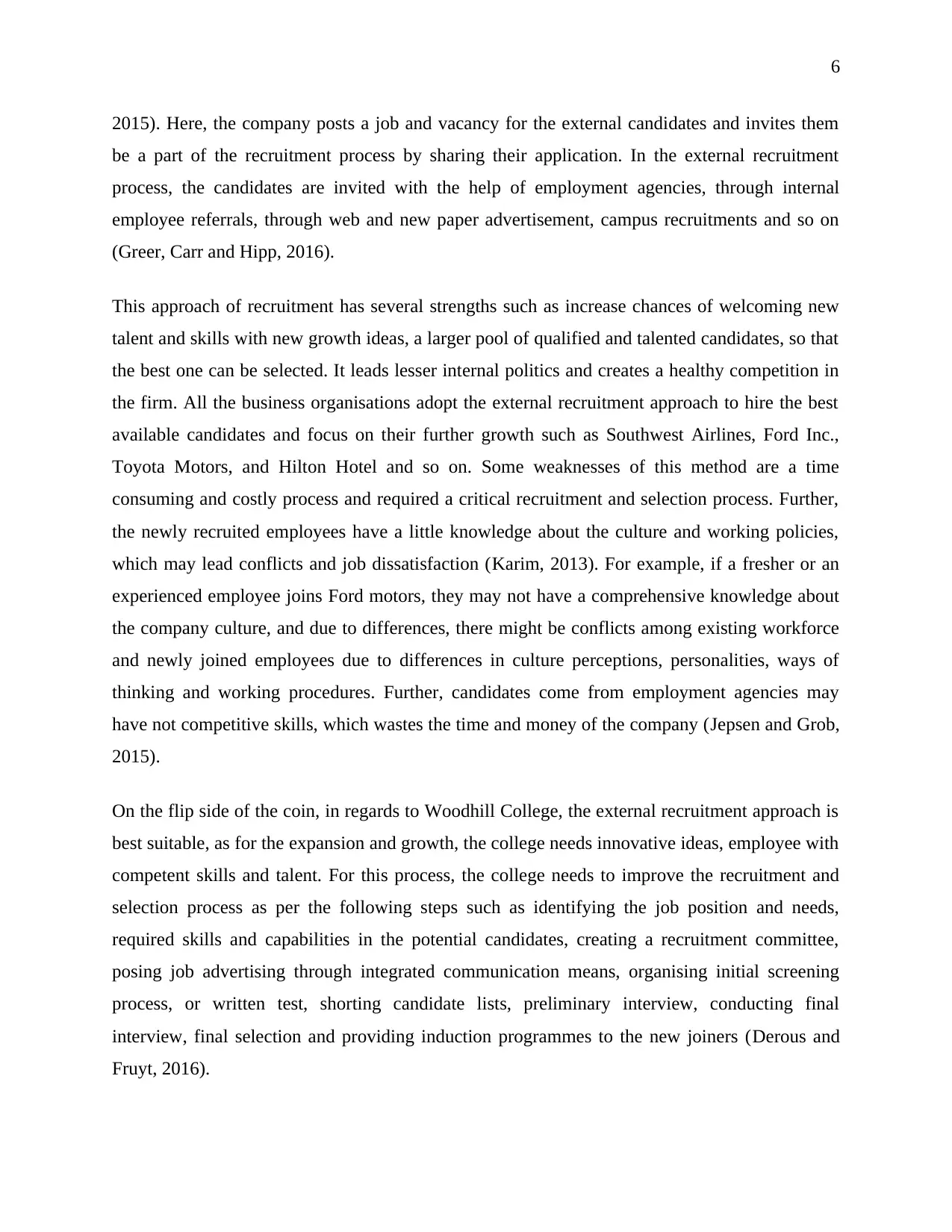
2015). Here, the company posts a job and vacancy for the external candidates and invites them
be a part of the recruitment process by sharing their application. In the external recruitment
process, the candidates are invited with the help of employment agencies, through internal
employee referrals, through web and new paper advertisement, campus recruitments and so on
(Greer, Carr and Hipp, 2016).
This approach of recruitment has several strengths such as increase chances of welcoming new
talent and skills with new growth ideas, a larger pool of qualified and talented candidates, so that
the best one can be selected. It leads lesser internal politics and creates a healthy competition in
the firm. All the business organisations adopt the external recruitment approach to hire the best
available candidates and focus on their further growth such as Southwest Airlines, Ford Inc.,
Toyota Motors, and Hilton Hotel and so on. Some weaknesses of this method are a time
consuming and costly process and required a critical recruitment and selection process. Further,
the newly recruited employees have a little knowledge about the culture and working policies,
which may lead conflicts and job dissatisfaction (Karim, 2013). For example, if a fresher or an
experienced employee joins Ford motors, they may not have a comprehensive knowledge about
the company culture, and due to differences, there might be conflicts among existing workforce
and newly joined employees due to differences in culture perceptions, personalities, ways of
thinking and working procedures. Further, candidates come from employment agencies may
have not competitive skills, which wastes the time and money of the company (Jepsen and Grob,
2015).
On the flip side of the coin, in regards to Woodhill College, the external recruitment approach is
best suitable, as for the expansion and growth, the college needs innovative ideas, employee with
competent skills and talent. For this process, the college needs to improve the recruitment and
selection process as per the following steps such as identifying the job position and needs,
required skills and capabilities in the potential candidates, creating a recruitment committee,
posing job advertising through integrated communication means, organising initial screening
process, or written test, shorting candidate lists, preliminary interview, conducting final
interview, final selection and providing induction programmes to the new joiners (Derous and
Fruyt, 2016).
2015). Here, the company posts a job and vacancy for the external candidates and invites them
be a part of the recruitment process by sharing their application. In the external recruitment
process, the candidates are invited with the help of employment agencies, through internal
employee referrals, through web and new paper advertisement, campus recruitments and so on
(Greer, Carr and Hipp, 2016).
This approach of recruitment has several strengths such as increase chances of welcoming new
talent and skills with new growth ideas, a larger pool of qualified and talented candidates, so that
the best one can be selected. It leads lesser internal politics and creates a healthy competition in
the firm. All the business organisations adopt the external recruitment approach to hire the best
available candidates and focus on their further growth such as Southwest Airlines, Ford Inc.,
Toyota Motors, and Hilton Hotel and so on. Some weaknesses of this method are a time
consuming and costly process and required a critical recruitment and selection process. Further,
the newly recruited employees have a little knowledge about the culture and working policies,
which may lead conflicts and job dissatisfaction (Karim, 2013). For example, if a fresher or an
experienced employee joins Ford motors, they may not have a comprehensive knowledge about
the company culture, and due to differences, there might be conflicts among existing workforce
and newly joined employees due to differences in culture perceptions, personalities, ways of
thinking and working procedures. Further, candidates come from employment agencies may
have not competitive skills, which wastes the time and money of the company (Jepsen and Grob,
2015).
On the flip side of the coin, in regards to Woodhill College, the external recruitment approach is
best suitable, as for the expansion and growth, the college needs innovative ideas, employee with
competent skills and talent. For this process, the college needs to improve the recruitment and
selection process as per the following steps such as identifying the job position and needs,
required skills and capabilities in the potential candidates, creating a recruitment committee,
posing job advertising through integrated communication means, organising initial screening
process, or written test, shorting candidate lists, preliminary interview, conducting final
interview, final selection and providing induction programmes to the new joiners (Derous and
Fruyt, 2016).
⊘ This is a preview!⊘
Do you want full access?
Subscribe today to unlock all pages.
Trusted by 1+ million students worldwide
7
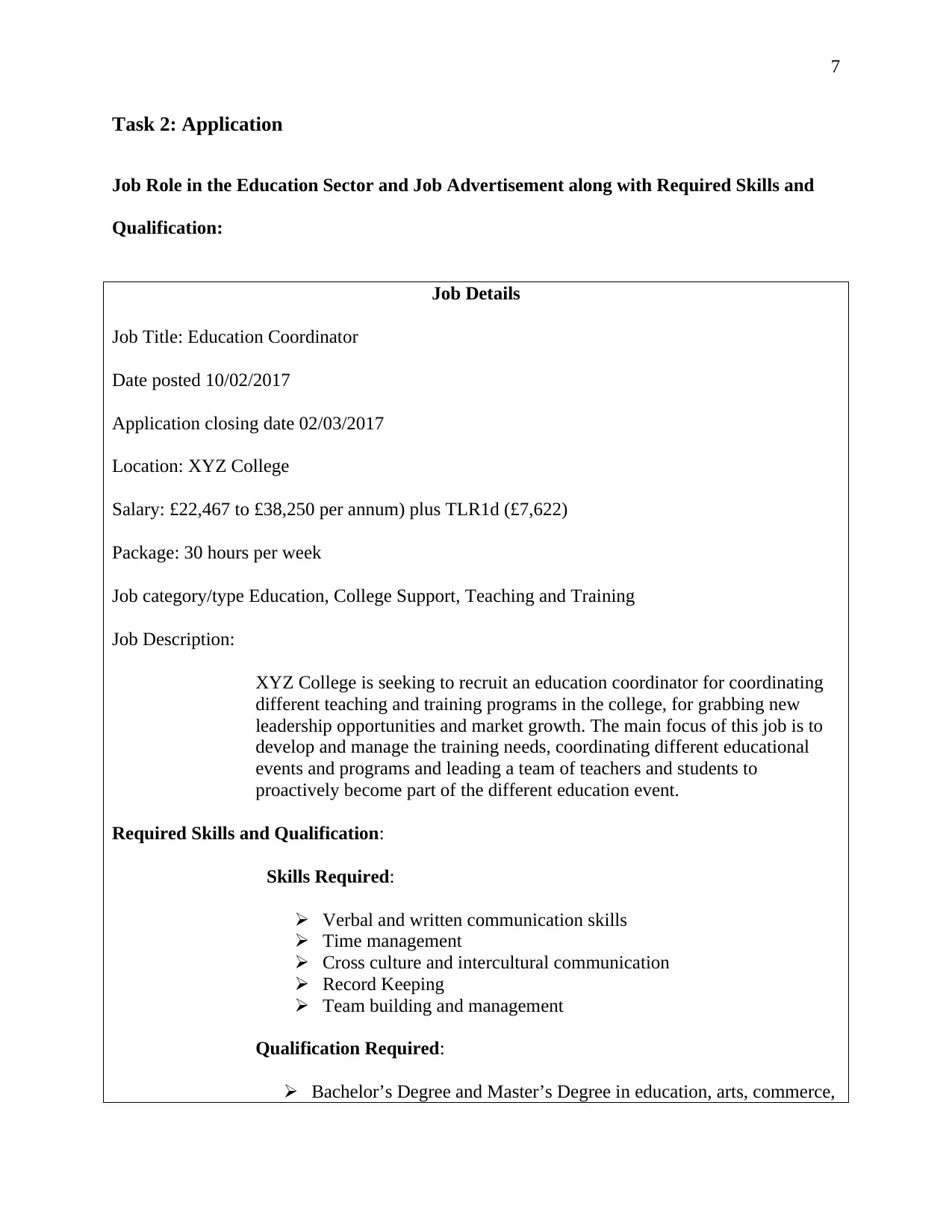
Task 2: Application
Job Role in the Education Sector and Job Advertisement along with Required Skills and
Qualification:
Job Details
Job Title: Education Coordinator
Date posted 10/02/2017
Application closing date 02/03/2017
Location: XYZ College
Salary: £22,467 to £38,250 per annum) plus TLR1d (£7,622)
Package: 30 hours per week
Job category/type Education, College Support, Teaching and Training
Job Description:
XYZ College is seeking to recruit an education coordinator for coordinating
different teaching and training programs in the college, for grabbing new
leadership opportunities and market growth. The main focus of this job is to
develop and manage the training needs, coordinating different educational
events and programs and leading a team of teachers and students to
proactively become part of the different education event.
Required Skills and Qualification:
Skills Required:
Verbal and written communication skills
Time management
Cross culture and intercultural communication
Record Keeping
Team building and management
Qualification Required:
Bachelor’s Degree and Master’s Degree in education, arts, commerce,
Task 2: Application
Job Role in the Education Sector and Job Advertisement along with Required Skills and
Qualification:
Job Details
Job Title: Education Coordinator
Date posted 10/02/2017
Application closing date 02/03/2017
Location: XYZ College
Salary: £22,467 to £38,250 per annum) plus TLR1d (£7,622)
Package: 30 hours per week
Job category/type Education, College Support, Teaching and Training
Job Description:
XYZ College is seeking to recruit an education coordinator for coordinating
different teaching and training programs in the college, for grabbing new
leadership opportunities and market growth. The main focus of this job is to
develop and manage the training needs, coordinating different educational
events and programs and leading a team of teachers and students to
proactively become part of the different education event.
Required Skills and Qualification:
Skills Required:
Verbal and written communication skills
Time management
Cross culture and intercultural communication
Record Keeping
Team building and management
Qualification Required:
Bachelor’s Degree and Master’s Degree in education, arts, commerce,
Paraphrase This Document
Need a fresh take? Get an instant paraphrase of this document with our AI Paraphraser
8
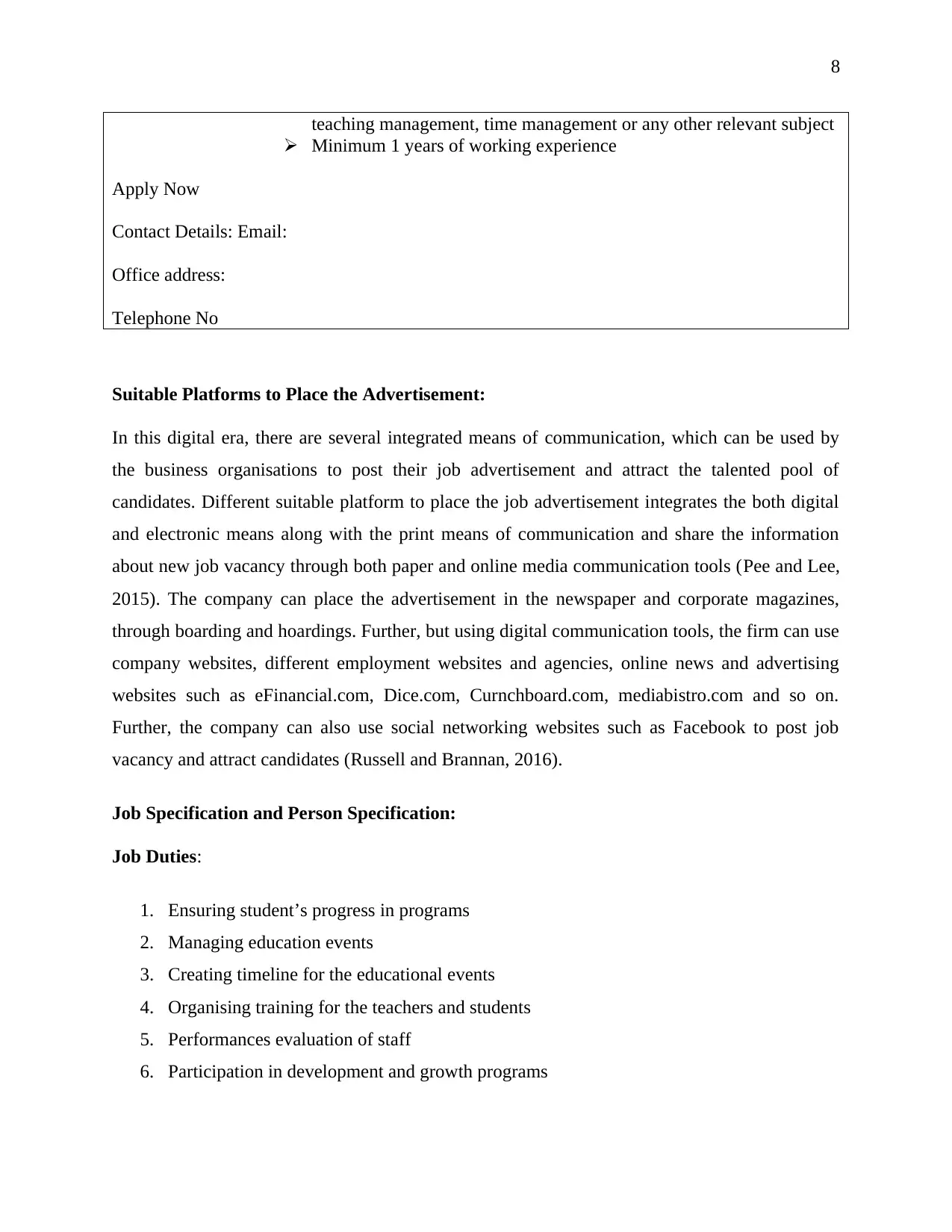
teaching management, time management or any other relevant subject
Minimum 1 years of working experience
Apply Now
Contact Details: Email:
Office address:
Telephone No
Suitable Platforms to Place the Advertisement:
In this digital era, there are several integrated means of communication, which can be used by
the business organisations to post their job advertisement and attract the talented pool of
candidates. Different suitable platform to place the job advertisement integrates the both digital
and electronic means along with the print means of communication and share the information
about new job vacancy through both paper and online media communication tools (Pee and Lee,
2015). The company can place the advertisement in the newspaper and corporate magazines,
through boarding and hoardings. Further, but using digital communication tools, the firm can use
company websites, different employment websites and agencies, online news and advertising
websites such as eFinancial.com, Dice.com, Curnchboard.com, mediabistro.com and so on.
Further, the company can also use social networking websites such as Facebook to post job
vacancy and attract candidates (Russell and Brannan, 2016).
Job Specification and Person Specification:
Job Duties:
1. Ensuring student’s progress in programs
2. Managing education events
3. Creating timeline for the educational events
4. Organising training for the teachers and students
5. Performances evaluation of staff
6. Participation in development and growth programs
teaching management, time management or any other relevant subject
Minimum 1 years of working experience
Apply Now
Contact Details: Email:
Office address:
Telephone No
Suitable Platforms to Place the Advertisement:
In this digital era, there are several integrated means of communication, which can be used by
the business organisations to post their job advertisement and attract the talented pool of
candidates. Different suitable platform to place the job advertisement integrates the both digital
and electronic means along with the print means of communication and share the information
about new job vacancy through both paper and online media communication tools (Pee and Lee,
2015). The company can place the advertisement in the newspaper and corporate magazines,
through boarding and hoardings. Further, but using digital communication tools, the firm can use
company websites, different employment websites and agencies, online news and advertising
websites such as eFinancial.com, Dice.com, Curnchboard.com, mediabistro.com and so on.
Further, the company can also use social networking websites such as Facebook to post job
vacancy and attract candidates (Russell and Brannan, 2016).
Job Specification and Person Specification:
Job Duties:
1. Ensuring student’s progress in programs
2. Managing education events
3. Creating timeline for the educational events
4. Organising training for the teachers and students
5. Performances evaluation of staff
6. Participation in development and growth programs
9
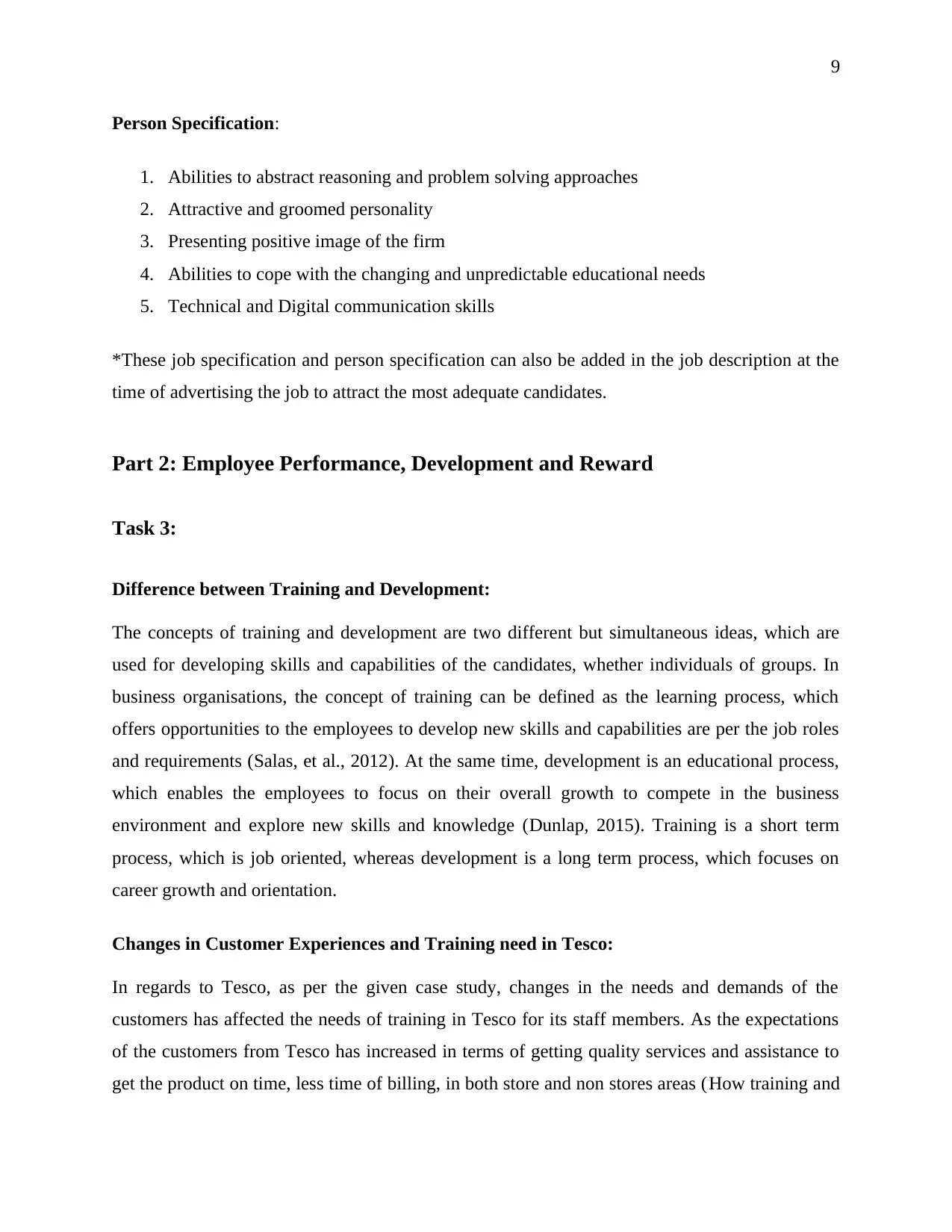
Person Specification:
1. Abilities to abstract reasoning and problem solving approaches
2. Attractive and groomed personality
3. Presenting positive image of the firm
4. Abilities to cope with the changing and unpredictable educational needs
5. Technical and Digital communication skills
*These job specification and person specification can also be added in the job description at the
time of advertising the job to attract the most adequate candidates.
Part 2: Employee Performance, Development and Reward
Task 3:
Difference between Training and Development:
The concepts of training and development are two different but simultaneous ideas, which are
used for developing skills and capabilities of the candidates, whether individuals of groups. In
business organisations, the concept of training can be defined as the learning process, which
offers opportunities to the employees to develop new skills and capabilities are per the job roles
and requirements (Salas, et al., 2012). At the same time, development is an educational process,
which enables the employees to focus on their overall growth to compete in the business
environment and explore new skills and knowledge (Dunlap, 2015). Training is a short term
process, which is job oriented, whereas development is a long term process, which focuses on
career growth and orientation.
Changes in Customer Experiences and Training need in Tesco:
In regards to Tesco, as per the given case study, changes in the needs and demands of the
customers has affected the needs of training in Tesco for its staff members. As the expectations
of the customers from Tesco has increased in terms of getting quality services and assistance to
get the product on time, less time of billing, in both store and non stores areas (How training and
Person Specification:
1. Abilities to abstract reasoning and problem solving approaches
2. Attractive and groomed personality
3. Presenting positive image of the firm
4. Abilities to cope with the changing and unpredictable educational needs
5. Technical and Digital communication skills
*These job specification and person specification can also be added in the job description at the
time of advertising the job to attract the most adequate candidates.
Part 2: Employee Performance, Development and Reward
Task 3:
Difference between Training and Development:
The concepts of training and development are two different but simultaneous ideas, which are
used for developing skills and capabilities of the candidates, whether individuals of groups. In
business organisations, the concept of training can be defined as the learning process, which
offers opportunities to the employees to develop new skills and capabilities are per the job roles
and requirements (Salas, et al., 2012). At the same time, development is an educational process,
which enables the employees to focus on their overall growth to compete in the business
environment and explore new skills and knowledge (Dunlap, 2015). Training is a short term
process, which is job oriented, whereas development is a long term process, which focuses on
career growth and orientation.
Changes in Customer Experiences and Training need in Tesco:
In regards to Tesco, as per the given case study, changes in the needs and demands of the
customers has affected the needs of training in Tesco for its staff members. As the expectations
of the customers from Tesco has increased in terms of getting quality services and assistance to
get the product on time, less time of billing, in both store and non stores areas (How training and
⊘ This is a preview!⊘
Do you want full access?
Subscribe today to unlock all pages.
Trusted by 1+ million students worldwide
10
development supports business growth: A Tesco Case Study, 2017). The customers want
assistance of knowledge and confident staff at the time of shopping, and getting after sale
services. Further, inspiring higher confidence of customers is the aim of Tesco, so it is important
or the firm to train the staff members to offer a pleasure and astonishing experience to the
customers during in store and online shopping (Samantara and Sharma, 2014).
Methods of Training in Tesco:
Tesco, as one of the leading retail companies in the global retail industry, has implemented both
on the job and off the job training methods. Both the methods have their benefits and drawback
for the firm, thus, Tesco has adopted both of these approaches to fulfil the weaknesses of each
other (Gulyás, 2007). Under on the job training method, employees get real life experience and
trained and advised by the senior and more experienced staff members to deal with the
unpredictable needs and demands of the customers. The major strengths of this method are its
simplest nature, economical and quick to resolve the customer's issue or any operational issues.
Dealing in a real life environment facilitates the employees to learn and develop their skills in a
diversified manner (Chung, Rutherford and Park, 2012). However, it has some weaknesses also
such as it is a rushed process, which create a disturbance in the work flow of the employees and
reduces the productivity as well. For example, a new trainee in the company has no skills to
handle the unexpected demands of the customers. During on the job training, his productivity
will reduce to serve other customers due to lack of competencies to handle the diversified needs
(Haelermans and Borghans, 2012).
Thus, to overcome all of these weaknesses, the company also offers off the job training to its
employees. For the new employees, off the job training is one of the best approaches in Tesco, as
it is highly productive to develop new skills of the employee, such as understanding about
cultural differences and personalities, communication, team building and so on (Chung,
Rutherford and Park, 2012). In this process training can be given to a large number of people
within less time by a mentor, experienced and qualified coach of an external trainer. In this
process, the main focus is to develop competent skills to fulfil job roles and responsibilities.
However, it is also not free from weaknesses such as no production during training, not effective
development supports business growth: A Tesco Case Study, 2017). The customers want
assistance of knowledge and confident staff at the time of shopping, and getting after sale
services. Further, inspiring higher confidence of customers is the aim of Tesco, so it is important
or the firm to train the staff members to offer a pleasure and astonishing experience to the
customers during in store and online shopping (Samantara and Sharma, 2014).
Methods of Training in Tesco:
Tesco, as one of the leading retail companies in the global retail industry, has implemented both
on the job and off the job training methods. Both the methods have their benefits and drawback
for the firm, thus, Tesco has adopted both of these approaches to fulfil the weaknesses of each
other (Gulyás, 2007). Under on the job training method, employees get real life experience and
trained and advised by the senior and more experienced staff members to deal with the
unpredictable needs and demands of the customers. The major strengths of this method are its
simplest nature, economical and quick to resolve the customer's issue or any operational issues.
Dealing in a real life environment facilitates the employees to learn and develop their skills in a
diversified manner (Chung, Rutherford and Park, 2012). However, it has some weaknesses also
such as it is a rushed process, which create a disturbance in the work flow of the employees and
reduces the productivity as well. For example, a new trainee in the company has no skills to
handle the unexpected demands of the customers. During on the job training, his productivity
will reduce to serve other customers due to lack of competencies to handle the diversified needs
(Haelermans and Borghans, 2012).
Thus, to overcome all of these weaknesses, the company also offers off the job training to its
employees. For the new employees, off the job training is one of the best approaches in Tesco, as
it is highly productive to develop new skills of the employee, such as understanding about
cultural differences and personalities, communication, team building and so on (Chung,
Rutherford and Park, 2012). In this process training can be given to a large number of people
within less time by a mentor, experienced and qualified coach of an external trainer. In this
process, the main focus is to develop competent skills to fulfil job roles and responsibilities.
However, it is also not free from weaknesses such as no production during training, not effective
Paraphrase This Document
Need a fresh take? Get an instant paraphrase of this document with our AI Paraphraser
11
like on the job training, lack of adequate feedback and real life understanding and so on ( Robson
and Mavin, 2014).
Identification of Training Needs:
In Tesco, training needs are identified through its workforce planning approaches. According to
the firm, opening new stores in the new location, require a trained staff to handle the diversified
needs of the customers at the store locations. For example, if the store is located at populated and
posh area, the staff should have competencies to sell a high portion of speciality good to the
higher premium segment. On the other hand, for non store and in store post, the employees
should have technical skills and knowledge, so they should be trained in such as manner
(Dunlap, 2015). Along with this, the company needs a flexible workforce to handle the
unpredictable and competitive demands, and requirement of the global customers, so they prefer
to provide training to the workforce.
Benefits of a Structured Training Programme:
The company has several benefits of having a structure training programmes. Tesco’s business
structure is very large as it has 280000 employees in the UK and 460000 in the global market. In
order to train the large number of employees within a less time, structured training programmes
are highly beneficial. It also facilitates the company to get measured outcome and consistency in
the growth and development of the employees. Under this, a positive structure feedback is
beneficial for the employees to increase their morale and confidence level (Samantara and
Sharma, 2014). On the basis of these structured programmes, the company also offers fair
appraisals and rewards to the workforce without any discrimination. It is also beneficial for the
manager to create a satisfied workforce (Salas, et al., 2012).
Extent at which Training has achieved a Return on Investment:
The company has achieved a high extent of return on investment in its structured training and
programmes. Through structured programmes, firm monitors the benefits of its investment of
time and money in the training programmes (Dunlap, 2015). It is because, the company follows
both formal and information approaches of getting feedback about the training and development
like on the job training, lack of adequate feedback and real life understanding and so on ( Robson
and Mavin, 2014).
Identification of Training Needs:
In Tesco, training needs are identified through its workforce planning approaches. According to
the firm, opening new stores in the new location, require a trained staff to handle the diversified
needs of the customers at the store locations. For example, if the store is located at populated and
posh area, the staff should have competencies to sell a high portion of speciality good to the
higher premium segment. On the other hand, for non store and in store post, the employees
should have technical skills and knowledge, so they should be trained in such as manner
(Dunlap, 2015). Along with this, the company needs a flexible workforce to handle the
unpredictable and competitive demands, and requirement of the global customers, so they prefer
to provide training to the workforce.
Benefits of a Structured Training Programme:
The company has several benefits of having a structure training programmes. Tesco’s business
structure is very large as it has 280000 employees in the UK and 460000 in the global market. In
order to train the large number of employees within a less time, structured training programmes
are highly beneficial. It also facilitates the company to get measured outcome and consistency in
the growth and development of the employees. Under this, a positive structure feedback is
beneficial for the employees to increase their morale and confidence level (Samantara and
Sharma, 2014). On the basis of these structured programmes, the company also offers fair
appraisals and rewards to the workforce without any discrimination. It is also beneficial for the
manager to create a satisfied workforce (Salas, et al., 2012).
Extent at which Training has achieved a Return on Investment:
The company has achieved a high extent of return on investment in its structured training and
programmes. Through structured programmes, firm monitors the benefits of its investment of
time and money in the training programmes (Dunlap, 2015). It is because, the company follows
both formal and information approaches of getting feedback about the training and development
12
session, and the high extent of positive feedbacks of the employees and their personal
development approaches shows that the company has achieved a high return on investment.
Suggestion of Types of Approaches to Flexibility for Tesco:
In order to aid the business expansion, the company needs a flexible and diversified workforce.
Thus, it is suggested the company to implement different types of flexibility arrangements, such
as functional, numerical, temporal and location. In functional, the firm should have a multi
skilled workforce, whereas in numerical, it should have a flexible workforce in terms of
seasonal, casual and fixed terms to handle the work pressure sand changes in the demands of the
customers in different seasons. Similarly, in temporal and location arrangements, the firm should
have part time, voluntary workers to mange zero hours arrangements from different locations
such as mobile, phone, tele-workers (Azizi and Liang, 2013).
Part 3: Employment Relationship
Task 4:
Importance to Maintain Good Employee Relations and Influence on HR decisions:
According to the study of Shin, Seo, Shapiro and Taylor (2015), in all the business firms,
developing employee relation integrates the body of work and different strategic activities which
are used to maintain a long term relationship between the employees and employers. This
relationship also assists in terms of satisfying the level of production, morale of the employees,
motivation and leading to a significant level. However, building an effective employee relation is
a challenging task as well as essential for the success of an organisation (Sen, 2013). Purposely,
maintaining good and healthy relationship with the employees is essential for the HR managers
and employers to avoid and resolve the problems and conflicts, which are directly related to the
workplace and organisational performances. In ITV, maintaining employee relations is important
for the long term and smooth functioning of the company. Good and strong relationship with the
employees facilitates ITV and its management to create a happy workplace for the employees
and increases their job satisfaction. Without having a happy and positive workplace, the workers
will not be able to be productive.
session, and the high extent of positive feedbacks of the employees and their personal
development approaches shows that the company has achieved a high return on investment.
Suggestion of Types of Approaches to Flexibility for Tesco:
In order to aid the business expansion, the company needs a flexible and diversified workforce.
Thus, it is suggested the company to implement different types of flexibility arrangements, such
as functional, numerical, temporal and location. In functional, the firm should have a multi
skilled workforce, whereas in numerical, it should have a flexible workforce in terms of
seasonal, casual and fixed terms to handle the work pressure sand changes in the demands of the
customers in different seasons. Similarly, in temporal and location arrangements, the firm should
have part time, voluntary workers to mange zero hours arrangements from different locations
such as mobile, phone, tele-workers (Azizi and Liang, 2013).
Part 3: Employment Relationship
Task 4:
Importance to Maintain Good Employee Relations and Influence on HR decisions:
According to the study of Shin, Seo, Shapiro and Taylor (2015), in all the business firms,
developing employee relation integrates the body of work and different strategic activities which
are used to maintain a long term relationship between the employees and employers. This
relationship also assists in terms of satisfying the level of production, morale of the employees,
motivation and leading to a significant level. However, building an effective employee relation is
a challenging task as well as essential for the success of an organisation (Sen, 2013). Purposely,
maintaining good and healthy relationship with the employees is essential for the HR managers
and employers to avoid and resolve the problems and conflicts, which are directly related to the
workplace and organisational performances. In ITV, maintaining employee relations is important
for the long term and smooth functioning of the company. Good and strong relationship with the
employees facilitates ITV and its management to create a happy workplace for the employees
and increases their job satisfaction. Without having a happy and positive workplace, the workers
will not be able to be productive.
⊘ This is a preview!⊘
Do you want full access?
Subscribe today to unlock all pages.
Trusted by 1+ million students worldwide

1 out of 18


Related Documents


Your All-in-One AI-Powered Toolkit for Academic Success.
+13062052269
info@desklib.com
Available 24*7 on WhatsApp / Email
![[object Object]](/_next/static/media/star-bottom.7253800d.svg)
Unlock your academic potential
Copyright © 2020–2025 A2Z Services. All Rights Reserved. Developed and managed by ZUCOL.