Human Resource Management Report: HRM Practices at Qbic Hotel
VerifiedAdded on 2020/01/28
|14
|4559
|74
Report
AI Summary
This report provides a detailed analysis of Human Resource Management (HRM) practices, focusing on a case study of Qbic Hotel. It differentiates between personnel management and HRM, outlining the functions of HRM in contributing to organizational goals. The report evaluates the roles and responsibilities of line managers in HRM and the impact of legal and regulatory frameworks. It further analyzes human resource planning, recruitment and selection processes, and their effectiveness. The report also explores motivational theories, reward systems, job evaluation, and performance monitoring methods. Finally, it examines employment cessation, exit procedures, and the relevant legal and regulatory frameworks. The report provides a thorough understanding of HRM principles and practices within the context of the Qbic Hotel.

Human Resource
Management
Management

Paraphrase This Document
Need a fresh take? Get an instant paraphrase of this document with our AI Paraphraser
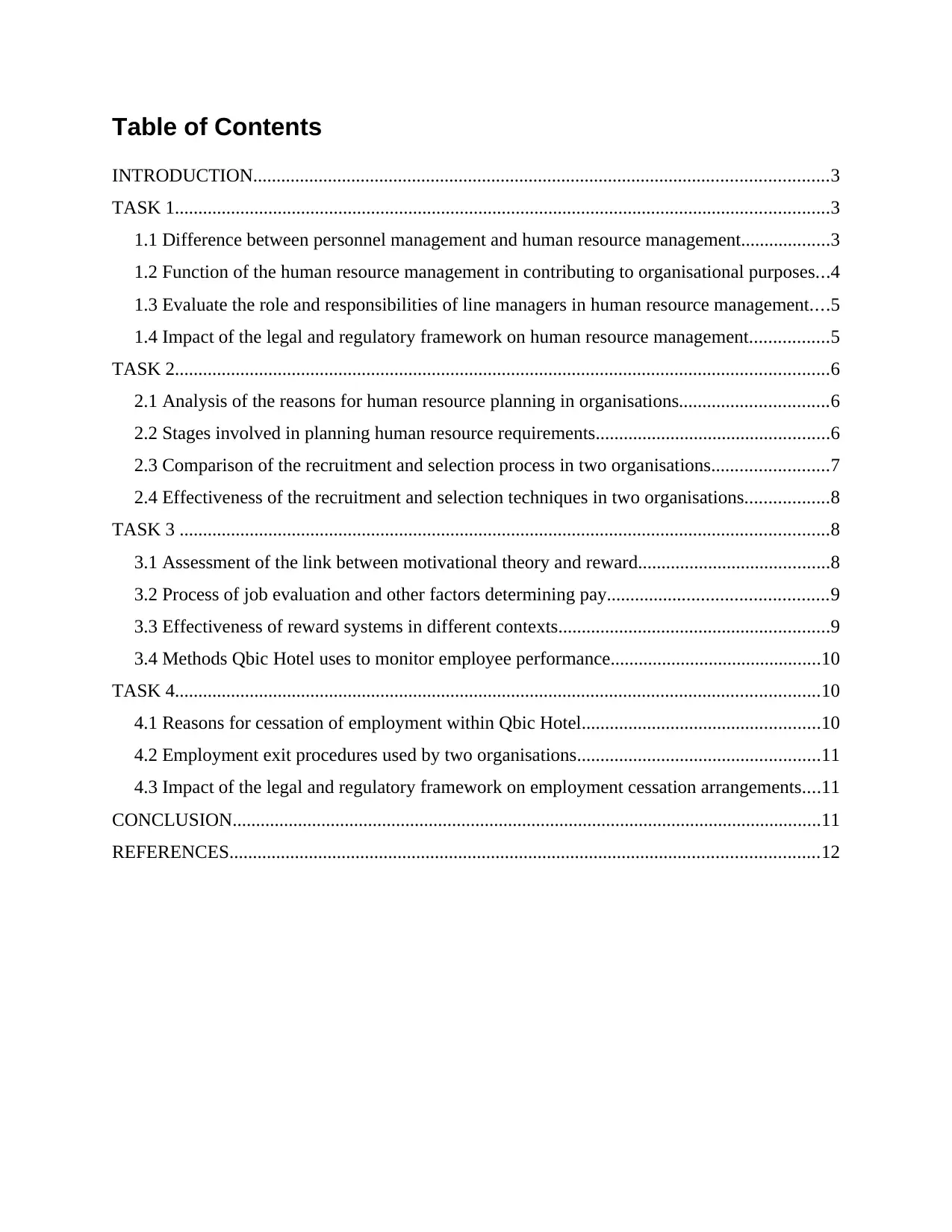
Table of Contents
INTRODUCTION...........................................................................................................................3
TASK 1............................................................................................................................................3
1.1 Difference between personnel management and human resource management...................3
1.2 Function of the human resource management in contributing to organisational purposes...4
1.3 Evaluate the role and responsibilities of line managers in human resource management....5
1.4 Impact of the legal and regulatory framework on human resource management.................5
TASK 2............................................................................................................................................6
2.1 Analysis of the reasons for human resource planning in organisations................................6
2.2 Stages involved in planning human resource requirements..................................................6
2.3 Comparison of the recruitment and selection process in two organisations.........................7
2.4 Effectiveness of the recruitment and selection techniques in two organisations..................8
TASK 3 ...........................................................................................................................................8
3.1 Assessment of the link between motivational theory and reward.........................................8
3.2 Process of job evaluation and other factors determining pay...............................................9
3.3 Effectiveness of reward systems in different contexts..........................................................9
3.4 Methods Qbic Hotel uses to monitor employee performance.............................................10
TASK 4..........................................................................................................................................10
4.1 Reasons for cessation of employment within Qbic Hotel...................................................10
4.2 Employment exit procedures used by two organisations....................................................11
4.3 Impact of the legal and regulatory framework on employment cessation arrangements....11
CONCLUSION..............................................................................................................................11
REFERENCES..............................................................................................................................12
INTRODUCTION...........................................................................................................................3
TASK 1............................................................................................................................................3
1.1 Difference between personnel management and human resource management...................3
1.2 Function of the human resource management in contributing to organisational purposes...4
1.3 Evaluate the role and responsibilities of line managers in human resource management....5
1.4 Impact of the legal and regulatory framework on human resource management.................5
TASK 2............................................................................................................................................6
2.1 Analysis of the reasons for human resource planning in organisations................................6
2.2 Stages involved in planning human resource requirements..................................................6
2.3 Comparison of the recruitment and selection process in two organisations.........................7
2.4 Effectiveness of the recruitment and selection techniques in two organisations..................8
TASK 3 ...........................................................................................................................................8
3.1 Assessment of the link between motivational theory and reward.........................................8
3.2 Process of job evaluation and other factors determining pay...............................................9
3.3 Effectiveness of reward systems in different contexts..........................................................9
3.4 Methods Qbic Hotel uses to monitor employee performance.............................................10
TASK 4..........................................................................................................................................10
4.1 Reasons for cessation of employment within Qbic Hotel...................................................10
4.2 Employment exit procedures used by two organisations....................................................11
4.3 Impact of the legal and regulatory framework on employment cessation arrangements....11
CONCLUSION..............................................................................................................................11
REFERENCES..............................................................................................................................12
INTRODUCTION
Human resource management is the core functional part of any entity. It deals with
managing human resources which means it manages work force of the cited entity. Human
Resource Management (HRM) is basically a term which is used to describe various functions of
a cited entity which are actually related with staffing, planning and organising. In this report, a
detailed differentiation between human resource management and personnel management is
made. Further, this report also mentions roles and responsibilities of human resource
management in contributing to organisational purposes (Armstrong and Taylor, 2014). Line
managers have various responsibilities in HRM, their role and importance in organisational
structure is clearly defined therein. Qbic Hotel is a small sized organisation because of its small
size structure it does not have any HR function. Chief Executive Officer of the cited entity deals
with the issues regarding HR herself. Qbic Hotel is situated at London and it provides
accommodation facility to its customers. In this report, the importance of Human Resource
Management for Qbic Hotel is described in a detailed way.
TASK 1
1.1 Difference between personnel management and human resource management
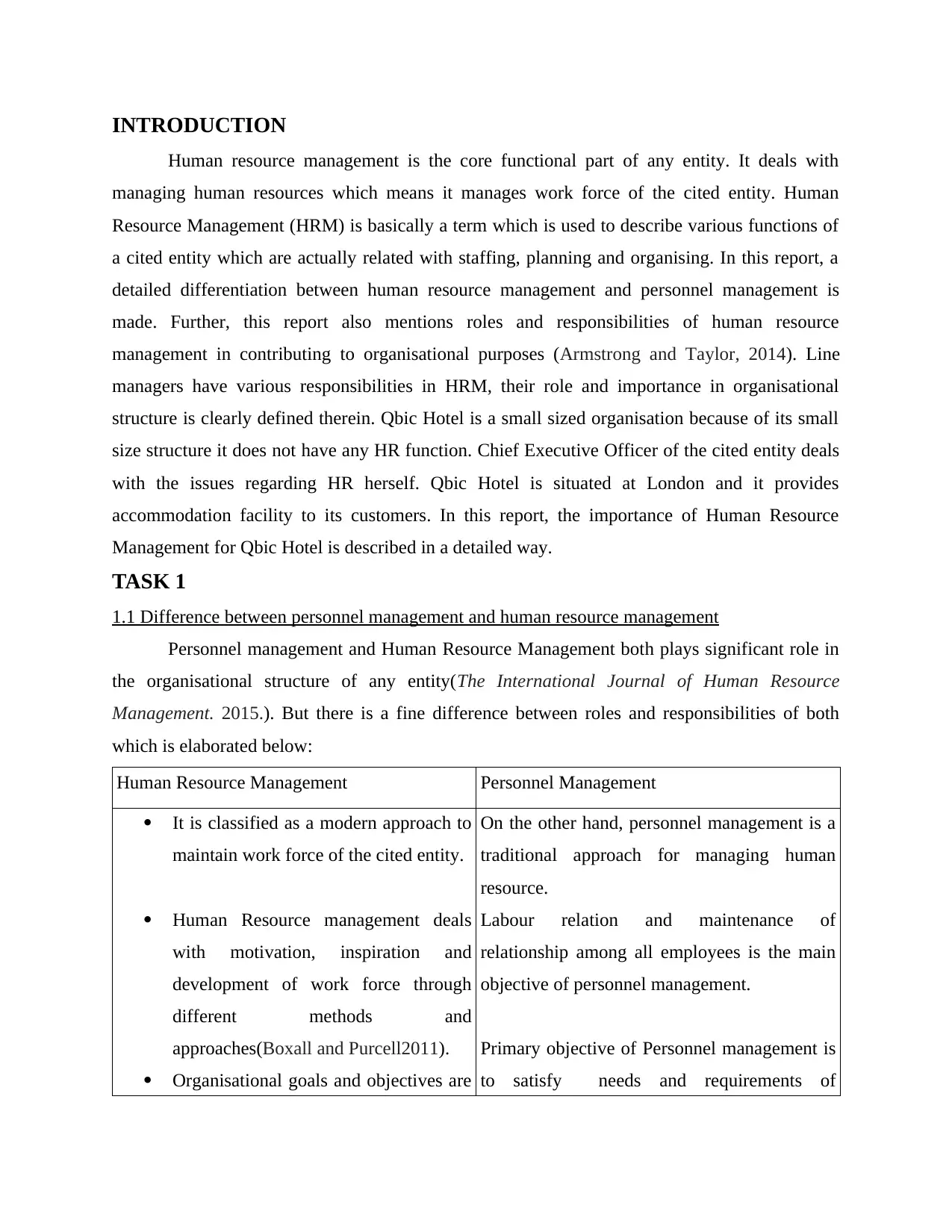
Personnel management and Human Resource Management both plays significant role in
the organisational structure of any entity(The International Journal of Human Resource
Management. 2015.). But there is a fine difference between roles and responsibilities of both
which is elaborated below:
Human Resource Management Personnel Management
It is classified as a modern approach to
maintain work force of the cited entity.
Human Resource management deals
with motivation, inspiration and
development of work force through
different methods and
approaches(Boxall and Purcell2011).
Organisational goals and objectives are
On the other hand, personnel management is a
traditional approach for managing human
resource.
Labour relation and maintenance of
relationship among all employees is the main
objective of personnel management.
Primary objective of Personnel management is
to satisfy needs and requirements of
Human resource management is the core functional part of any entity. It deals with
managing human resources which means it manages work force of the cited entity. Human
Resource Management (HRM) is basically a term which is used to describe various functions of
a cited entity which are actually related with staffing, planning and organising. In this report, a
detailed differentiation between human resource management and personnel management is
made. Further, this report also mentions roles and responsibilities of human resource
management in contributing to organisational purposes (Armstrong and Taylor, 2014). Line
managers have various responsibilities in HRM, their role and importance in organisational
structure is clearly defined therein. Qbic Hotel is a small sized organisation because of its small
size structure it does not have any HR function. Chief Executive Officer of the cited entity deals
with the issues regarding HR herself. Qbic Hotel is situated at London and it provides
accommodation facility to its customers. In this report, the importance of Human Resource
Management for Qbic Hotel is described in a detailed way.
TASK 1
1.1 Difference between personnel management and human resource management
Personnel management and Human Resource Management both plays significant role in
the organisational structure of any entity(The International Journal of Human Resource
Management. 2015.). But there is a fine difference between roles and responsibilities of both
which is elaborated below:
Human Resource Management Personnel Management
It is classified as a modern approach to
maintain work force of the cited entity.
Human Resource management deals
with motivation, inspiration and
development of work force through
different methods and
approaches(Boxall and Purcell2011).
Organisational goals and objectives are
On the other hand, personnel management is a
traditional approach for managing human
resource.
Labour relation and maintenance of
relationship among all employees is the main
objective of personnel management.
Primary objective of Personnel management is
to satisfy needs and requirements of
⊘ This is a preview!⊘
Do you want full access?
Subscribe today to unlock all pages.

Trusted by 1+ million students worldwide
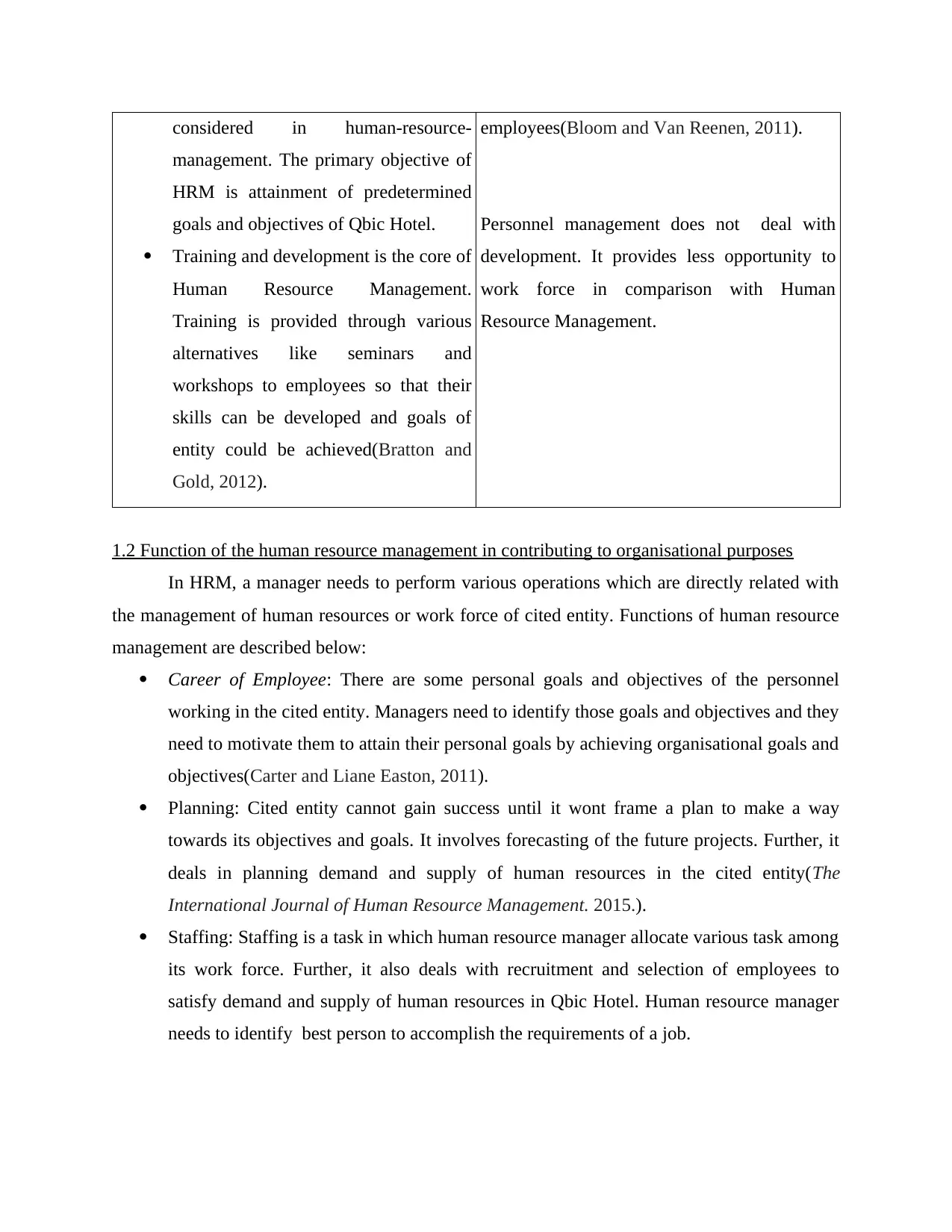
considered in human-resource-
management. The primary objective of
HRM is attainment of predetermined
goals and objectives of Qbic Hotel.
Training and development is the core of
Human Resource Management.
Training is provided through various
alternatives like seminars and
workshops to employees so that their
skills can be developed and goals of
entity could be achieved(Bratton and
Gold, 2012).
employees(Bloom and Van Reenen, 2011).
Personnel management does not deal with
development. It provides less opportunity to
work force in comparison with Human
Resource Management.
1.2 Function of the human resource management in contributing to organisational purposes
In HRM, a manager needs to perform various operations which are directly related with
the management of human resources or work force of cited entity. Functions of human resource
management are described below:
Career of Employee: There are some personal goals and objectives of the personnel
working in the cited entity. Managers need to identify those goals and objectives and they
need to motivate them to attain their personal goals by achieving organisational goals and
objectives(Carter and Liane Easton, 2011).
Planning: Cited entity cannot gain success until it wont frame a plan to make a way
towards its objectives and goals. It involves forecasting of the future projects. Further, it
deals in planning demand and supply of human resources in the cited entity(The
International Journal of Human Resource Management. 2015.).
Staffing: Staffing is a task in which human resource manager allocate various task among
its work force. Further, it also deals with recruitment and selection of employees to
satisfy demand and supply of human resources in Qbic Hotel. Human resource manager
needs to identify best person to accomplish the requirements of a job.
management. The primary objective of
HRM is attainment of predetermined
goals and objectives of Qbic Hotel.
Training and development is the core of
Human Resource Management.
Training is provided through various
alternatives like seminars and
workshops to employees so that their
skills can be developed and goals of
entity could be achieved(Bratton and
Gold, 2012).
employees(Bloom and Van Reenen, 2011).
Personnel management does not deal with
development. It provides less opportunity to
work force in comparison with Human
Resource Management.
1.2 Function of the human resource management in contributing to organisational purposes
In HRM, a manager needs to perform various operations which are directly related with
the management of human resources or work force of cited entity. Functions of human resource
management are described below:
Career of Employee: There are some personal goals and objectives of the personnel
working in the cited entity. Managers need to identify those goals and objectives and they
need to motivate them to attain their personal goals by achieving organisational goals and
objectives(Carter and Liane Easton, 2011).
Planning: Cited entity cannot gain success until it wont frame a plan to make a way
towards its objectives and goals. It involves forecasting of the future projects. Further, it
deals in planning demand and supply of human resources in the cited entity(The
International Journal of Human Resource Management. 2015.).
Staffing: Staffing is a task in which human resource manager allocate various task among
its work force. Further, it also deals with recruitment and selection of employees to
satisfy demand and supply of human resources in Qbic Hotel. Human resource manager
needs to identify best person to accomplish the requirements of a job.
Paraphrase This Document
Need a fresh take? Get an instant paraphrase of this document with our AI Paraphraser
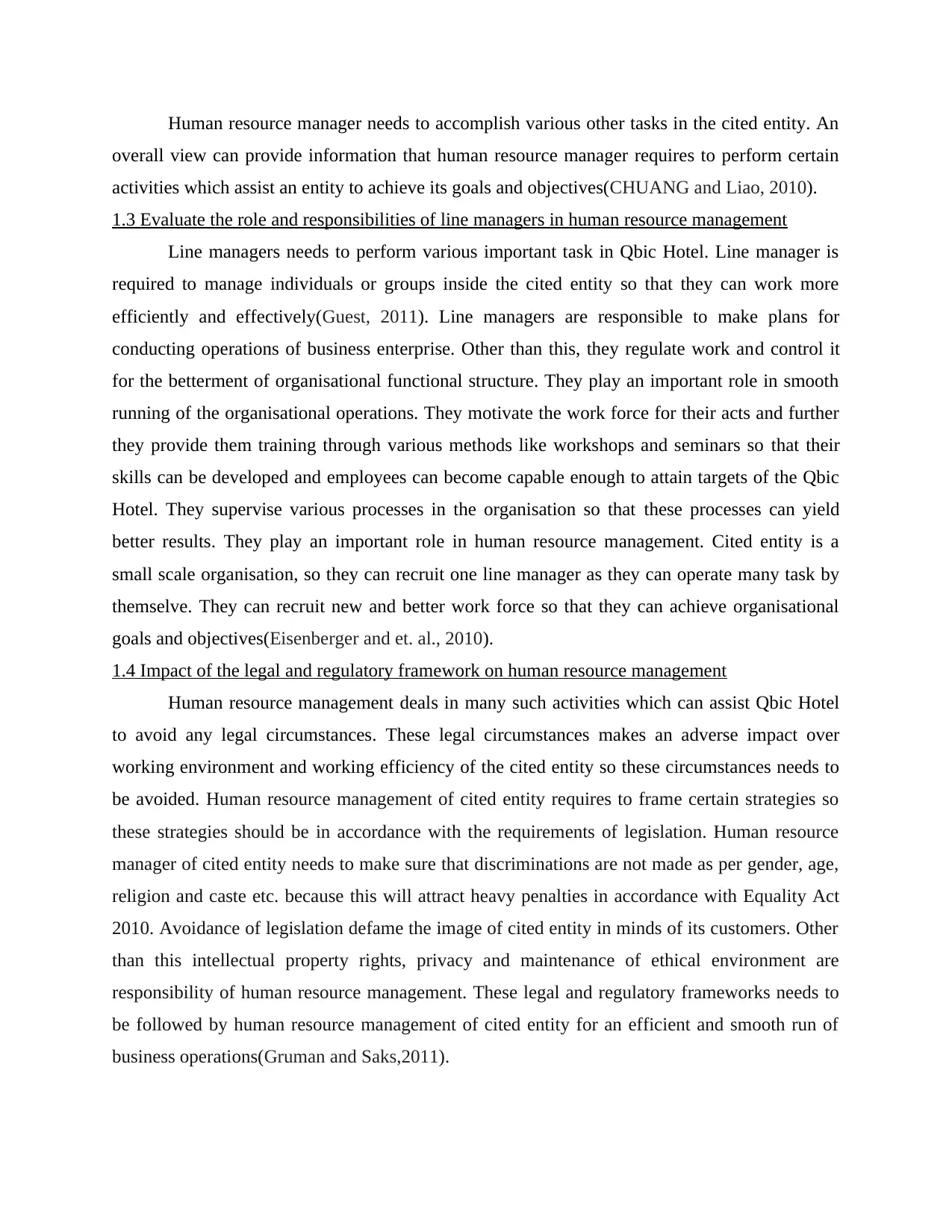
Human resource manager needs to accomplish various other tasks in the cited entity. An
overall view can provide information that human resource manager requires to perform certain
activities which assist an entity to achieve its goals and objectives(CHUANG and Liao, 2010).
1.3 Evaluate the role and responsibilities of line managers in human resource management
Line managers needs to perform various important task in Qbic Hotel. Line manager is
required to manage individuals or groups inside the cited entity so that they can work more
efficiently and effectively(Guest, 2011). Line managers are responsible to make plans for
conducting operations of business enterprise. Other than this, they regulate work and control it
for the betterment of organisational functional structure. They play an important role in smooth
running of the organisational operations. They motivate the work force for their acts and further
they provide them training through various methods like workshops and seminars so that their
skills can be developed and employees can become capable enough to attain targets of the Qbic
Hotel. They supervise various processes in the organisation so that these processes can yield
better results. They play an important role in human resource management. Cited entity is a
small scale organisation, so they can recruit one line manager as they can operate many task by
themselve. They can recruit new and better work force so that they can achieve organisational
goals and objectives(Eisenberger and et. al., 2010).
1.4 Impact of the legal and regulatory framework on human resource management
Human resource management deals in many such activities which can assist Qbic Hotel
to avoid any legal circumstances. These legal circumstances makes an adverse impact over
working environment and working efficiency of the cited entity so these circumstances needs to
be avoided. Human resource management of cited entity requires to frame certain strategies so
these strategies should be in accordance with the requirements of legislation. Human resource
manager of cited entity needs to make sure that discriminations are not made as per gender, age,
religion and caste etc. because this will attract heavy penalties in accordance with Equality Act
2010. Avoidance of legislation defame the image of cited entity in minds of its customers. Other
than this intellectual property rights, privacy and maintenance of ethical environment are
responsibility of human resource management. These legal and regulatory frameworks needs to
be followed by human resource management of cited entity for an efficient and smooth run of
business operations(Gruman and Saks,2011).
overall view can provide information that human resource manager requires to perform certain
activities which assist an entity to achieve its goals and objectives(CHUANG and Liao, 2010).
1.3 Evaluate the role and responsibilities of line managers in human resource management
Line managers needs to perform various important task in Qbic Hotel. Line manager is
required to manage individuals or groups inside the cited entity so that they can work more
efficiently and effectively(Guest, 2011). Line managers are responsible to make plans for
conducting operations of business enterprise. Other than this, they regulate work and control it
for the betterment of organisational functional structure. They play an important role in smooth
running of the organisational operations. They motivate the work force for their acts and further
they provide them training through various methods like workshops and seminars so that their
skills can be developed and employees can become capable enough to attain targets of the Qbic
Hotel. They supervise various processes in the organisation so that these processes can yield
better results. They play an important role in human resource management. Cited entity is a
small scale organisation, so they can recruit one line manager as they can operate many task by
themselve. They can recruit new and better work force so that they can achieve organisational
goals and objectives(Eisenberger and et. al., 2010).
1.4 Impact of the legal and regulatory framework on human resource management
Human resource management deals in many such activities which can assist Qbic Hotel
to avoid any legal circumstances. These legal circumstances makes an adverse impact over
working environment and working efficiency of the cited entity so these circumstances needs to
be avoided. Human resource management of cited entity requires to frame certain strategies so
these strategies should be in accordance with the requirements of legislation. Human resource
manager of cited entity needs to make sure that discriminations are not made as per gender, age,
religion and caste etc. because this will attract heavy penalties in accordance with Equality Act
2010. Avoidance of legislation defame the image of cited entity in minds of its customers. Other
than this intellectual property rights, privacy and maintenance of ethical environment are
responsibility of human resource management. These legal and regulatory frameworks needs to
be followed by human resource management of cited entity for an efficient and smooth run of
business operations(Gruman and Saks,2011).
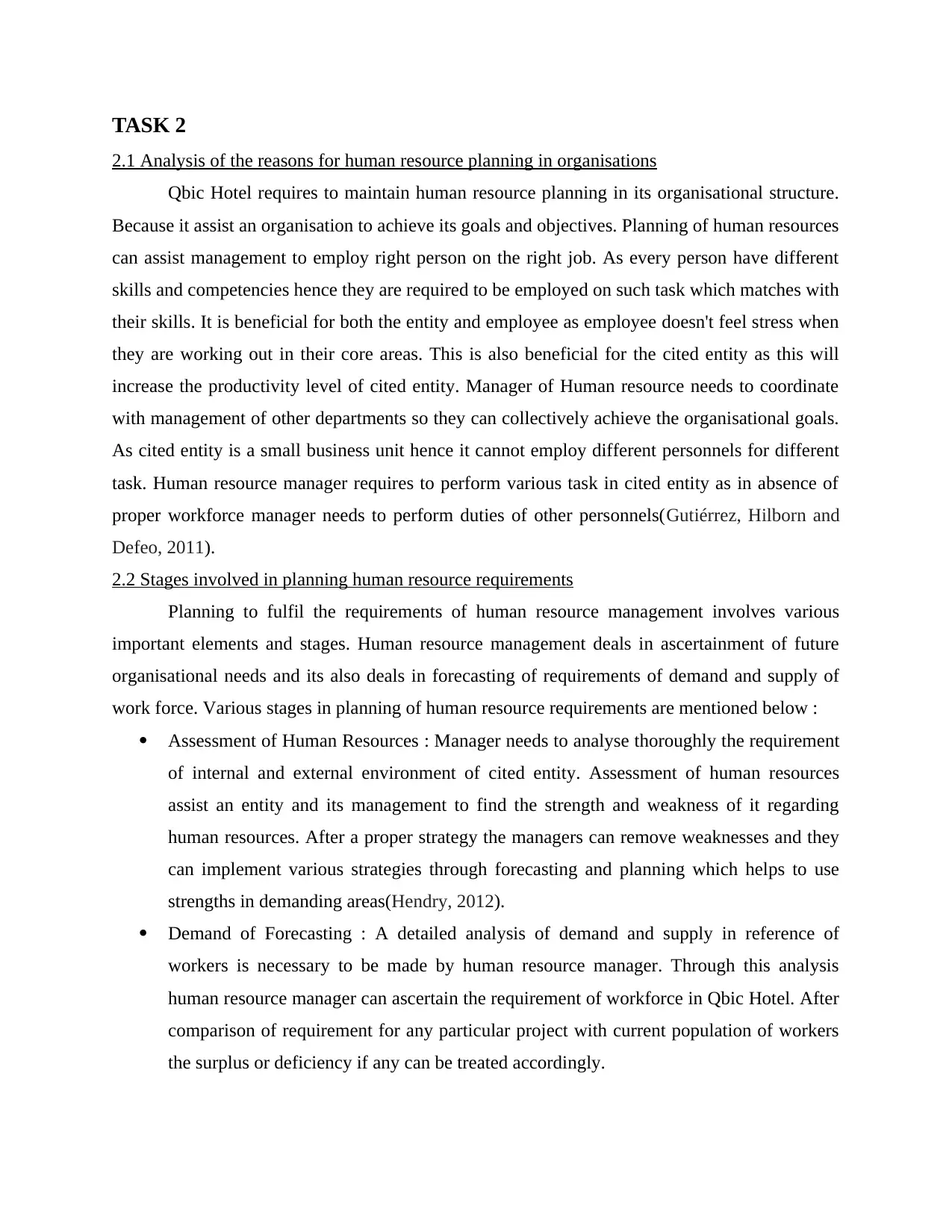
TASK 2
2.1 Analysis of the reasons for human resource planning in organisations
Qbic Hotel requires to maintain human resource planning in its organisational structure.
Because it assist an organisation to achieve its goals and objectives. Planning of human resources
can assist management to employ right person on the right job. As every person have different
skills and competencies hence they are required to be employed on such task which matches with
their skills. It is beneficial for both the entity and employee as employee doesn't feel stress when
they are working out in their core areas. This is also beneficial for the cited entity as this will
increase the productivity level of cited entity. Manager of Human resource needs to coordinate
with management of other departments so they can collectively achieve the organisational goals.
As cited entity is a small business unit hence it cannot employ different personnels for different
task. Human resource manager requires to perform various task in cited entity as in absence of
proper workforce manager needs to perform duties of other personnels(Gutiérrez, Hilborn and
Defeo, 2011).
2.2 Stages involved in planning human resource requirements
Planning to fulfil the requirements of human resource management involves various
important elements and stages. Human resource management deals in ascertainment of future
organisational needs and its also deals in forecasting of requirements of demand and supply of
work force. Various stages in planning of human resource requirements are mentioned below :
Assessment of Human Resources : Manager needs to analyse thoroughly the requirement
of internal and external environment of cited entity. Assessment of human resources
assist an entity and its management to find the strength and weakness of it regarding
human resources. After a proper strategy the managers can remove weaknesses and they
can implement various strategies through forecasting and planning which helps to use
strengths in demanding areas(Hendry, 2012).
Demand of Forecasting : A detailed analysis of demand and supply in reference of
workers is necessary to be made by human resource manager. Through this analysis
human resource manager can ascertain the requirement of workforce in Qbic Hotel. After
comparison of requirement for any particular project with current population of workers
the surplus or deficiency if any can be treated accordingly.
2.1 Analysis of the reasons for human resource planning in organisations
Qbic Hotel requires to maintain human resource planning in its organisational structure.
Because it assist an organisation to achieve its goals and objectives. Planning of human resources
can assist management to employ right person on the right job. As every person have different
skills and competencies hence they are required to be employed on such task which matches with
their skills. It is beneficial for both the entity and employee as employee doesn't feel stress when
they are working out in their core areas. This is also beneficial for the cited entity as this will
increase the productivity level of cited entity. Manager of Human resource needs to coordinate
with management of other departments so they can collectively achieve the organisational goals.
As cited entity is a small business unit hence it cannot employ different personnels for different
task. Human resource manager requires to perform various task in cited entity as in absence of
proper workforce manager needs to perform duties of other personnels(Gutiérrez, Hilborn and
Defeo, 2011).
2.2 Stages involved in planning human resource requirements
Planning to fulfil the requirements of human resource management involves various
important elements and stages. Human resource management deals in ascertainment of future
organisational needs and its also deals in forecasting of requirements of demand and supply of
work force. Various stages in planning of human resource requirements are mentioned below :
Assessment of Human Resources : Manager needs to analyse thoroughly the requirement
of internal and external environment of cited entity. Assessment of human resources
assist an entity and its management to find the strength and weakness of it regarding
human resources. After a proper strategy the managers can remove weaknesses and they
can implement various strategies through forecasting and planning which helps to use
strengths in demanding areas(Hendry, 2012).
Demand of Forecasting : A detailed analysis of demand and supply in reference of
workers is necessary to be made by human resource manager. Through this analysis
human resource manager can ascertain the requirement of workforce in Qbic Hotel. After
comparison of requirement for any particular project with current population of workers
the surplus or deficiency if any can be treated accordingly.
⊘ This is a preview!⊘
Do you want full access?
Subscribe today to unlock all pages.
Trusted by 1+ million students worldwide
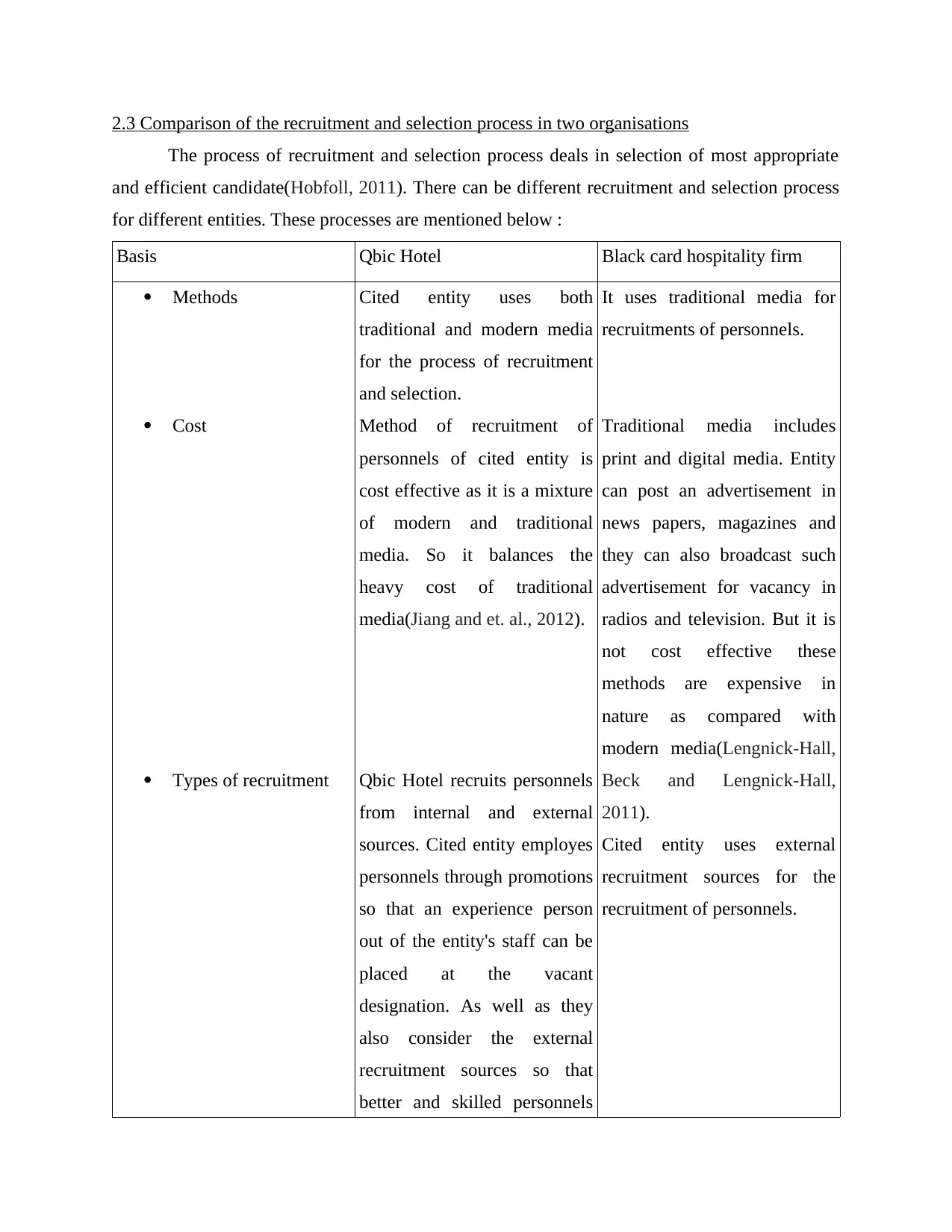
2.3 Comparison of the recruitment and selection process in two organisations
The process of recruitment and selection process deals in selection of most appropriate
and efficient candidate(Hobfoll, 2011). There can be different recruitment and selection process
for different entities. These processes are mentioned below :
Basis Qbic Hotel Black card hospitality firm
Methods
Cost
Types of recruitment
Cited entity uses both
traditional and modern media
for the process of recruitment
and selection.
Method of recruitment of
personnels of cited entity is
cost effective as it is a mixture
of modern and traditional
media. So it balances the
heavy cost of traditional
media(Jiang and et. al., 2012).
Qbic Hotel recruits personnels
from internal and external
sources. Cited entity employes
personnels through promotions
so that an experience person
out of the entity's staff can be
placed at the vacant
designation. As well as they
also consider the external
recruitment sources so that
better and skilled personnels
It uses traditional media for
recruitments of personnels.
Traditional media includes
print and digital media. Entity
can post an advertisement in
news papers, magazines and
they can also broadcast such
advertisement for vacancy in
radios and television. But it is
not cost effective these
methods are expensive in
nature as compared with
modern media(Lengnick-Hall,
Beck and Lengnick-Hall,
2011).
Cited entity uses external
recruitment sources for the
recruitment of personnels.
The process of recruitment and selection process deals in selection of most appropriate
and efficient candidate(Hobfoll, 2011). There can be different recruitment and selection process
for different entities. These processes are mentioned below :
Basis Qbic Hotel Black card hospitality firm
Methods
Cost
Types of recruitment
Cited entity uses both
traditional and modern media
for the process of recruitment
and selection.
Method of recruitment of
personnels of cited entity is
cost effective as it is a mixture
of modern and traditional
media. So it balances the
heavy cost of traditional
media(Jiang and et. al., 2012).
Qbic Hotel recruits personnels
from internal and external
sources. Cited entity employes
personnels through promotions
so that an experience person
out of the entity's staff can be
placed at the vacant
designation. As well as they
also consider the external
recruitment sources so that
better and skilled personnels
It uses traditional media for
recruitments of personnels.
Traditional media includes
print and digital media. Entity
can post an advertisement in
news papers, magazines and
they can also broadcast such
advertisement for vacancy in
radios and television. But it is
not cost effective these
methods are expensive in
nature as compared with
modern media(Lengnick-Hall,
Beck and Lengnick-Hall,
2011).
Cited entity uses external
recruitment sources for the
recruitment of personnels.
Paraphrase This Document
Need a fresh take? Get an instant paraphrase of this document with our AI Paraphraser
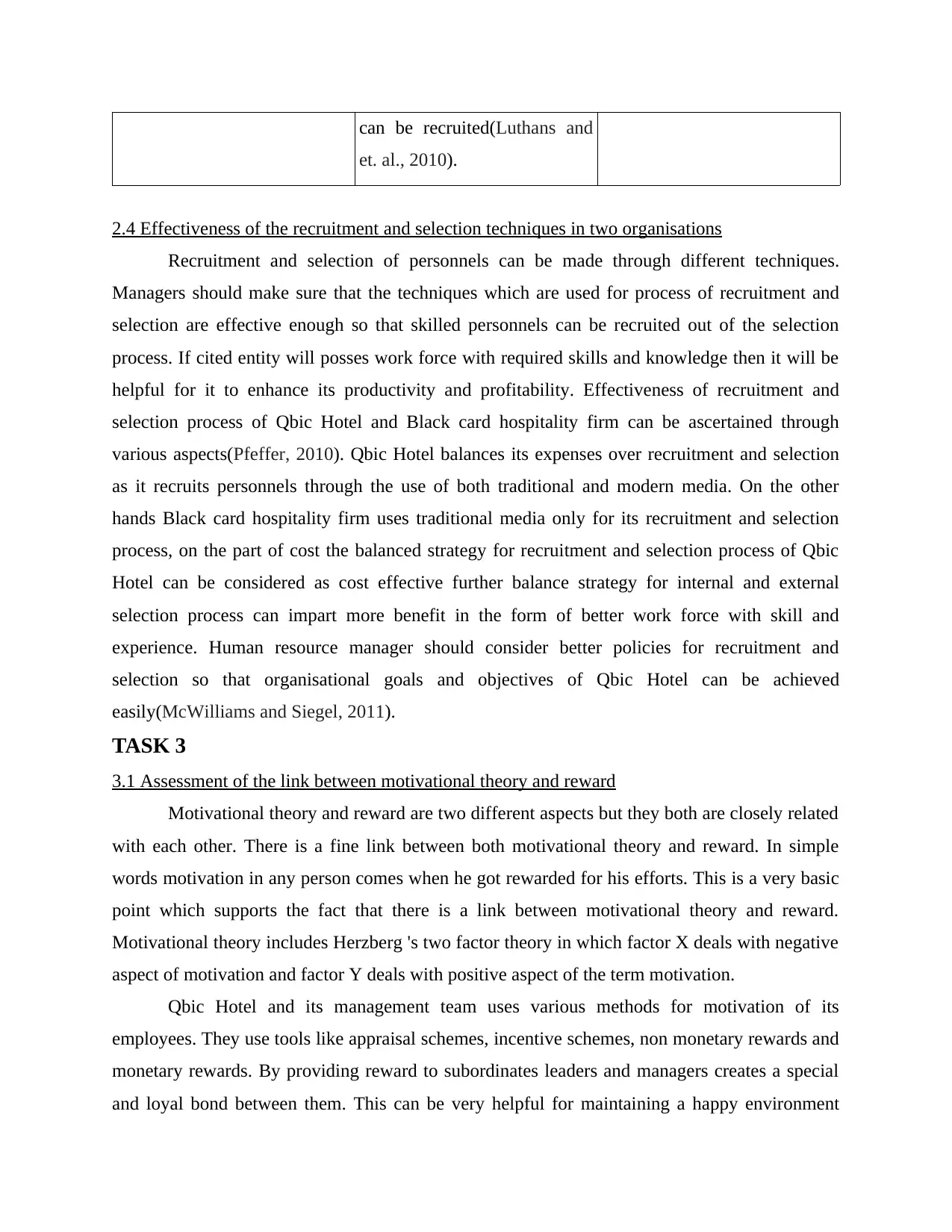
can be recruited(Luthans and
et. al., 2010).
2.4 Effectiveness of the recruitment and selection techniques in two organisations
Recruitment and selection of personnels can be made through different techniques.
Managers should make sure that the techniques which are used for process of recruitment and
selection are effective enough so that skilled personnels can be recruited out of the selection
process. If cited entity will posses work force with required skills and knowledge then it will be
helpful for it to enhance its productivity and profitability. Effectiveness of recruitment and
selection process of Qbic Hotel and Black card hospitality firm can be ascertained through
various aspects(Pfeffer, 2010). Qbic Hotel balances its expenses over recruitment and selection
as it recruits personnels through the use of both traditional and modern media. On the other
hands Black card hospitality firm uses traditional media only for its recruitment and selection
process, on the part of cost the balanced strategy for recruitment and selection process of Qbic
Hotel can be considered as cost effective further balance strategy for internal and external
selection process can impart more benefit in the form of better work force with skill and
experience. Human resource manager should consider better policies for recruitment and
selection so that organisational goals and objectives of Qbic Hotel can be achieved
easily(McWilliams and Siegel, 2011).
TASK 3
3.1 Assessment of the link between motivational theory and reward
Motivational theory and reward are two different aspects but they both are closely related
with each other. There is a fine link between both motivational theory and reward. In simple
words motivation in any person comes when he got rewarded for his efforts. This is a very basic
point which supports the fact that there is a link between motivational theory and reward.
Motivational theory includes Herzberg 's two factor theory in which factor X deals with negative
aspect of motivation and factor Y deals with positive aspect of the term motivation.
Qbic Hotel and its management team uses various methods for motivation of its
employees. They use tools like appraisal schemes, incentive schemes, non monetary rewards and
monetary rewards. By providing reward to subordinates leaders and managers creates a special
and loyal bond between them. This can be very helpful for maintaining a happy environment
et. al., 2010).
2.4 Effectiveness of the recruitment and selection techniques in two organisations
Recruitment and selection of personnels can be made through different techniques.
Managers should make sure that the techniques which are used for process of recruitment and
selection are effective enough so that skilled personnels can be recruited out of the selection
process. If cited entity will posses work force with required skills and knowledge then it will be
helpful for it to enhance its productivity and profitability. Effectiveness of recruitment and
selection process of Qbic Hotel and Black card hospitality firm can be ascertained through
various aspects(Pfeffer, 2010). Qbic Hotel balances its expenses over recruitment and selection
as it recruits personnels through the use of both traditional and modern media. On the other
hands Black card hospitality firm uses traditional media only for its recruitment and selection
process, on the part of cost the balanced strategy for recruitment and selection process of Qbic
Hotel can be considered as cost effective further balance strategy for internal and external
selection process can impart more benefit in the form of better work force with skill and
experience. Human resource manager should consider better policies for recruitment and
selection so that organisational goals and objectives of Qbic Hotel can be achieved
easily(McWilliams and Siegel, 2011).
TASK 3
3.1 Assessment of the link between motivational theory and reward
Motivational theory and reward are two different aspects but they both are closely related
with each other. There is a fine link between both motivational theory and reward. In simple
words motivation in any person comes when he got rewarded for his efforts. This is a very basic
point which supports the fact that there is a link between motivational theory and reward.
Motivational theory includes Herzberg 's two factor theory in which factor X deals with negative
aspect of motivation and factor Y deals with positive aspect of the term motivation.
Qbic Hotel and its management team uses various methods for motivation of its
employees. They use tools like appraisal schemes, incentive schemes, non monetary rewards and
monetary rewards. By providing reward to subordinates leaders and managers creates a special
and loyal bond between them. This can be very helpful for maintaining a happy environment
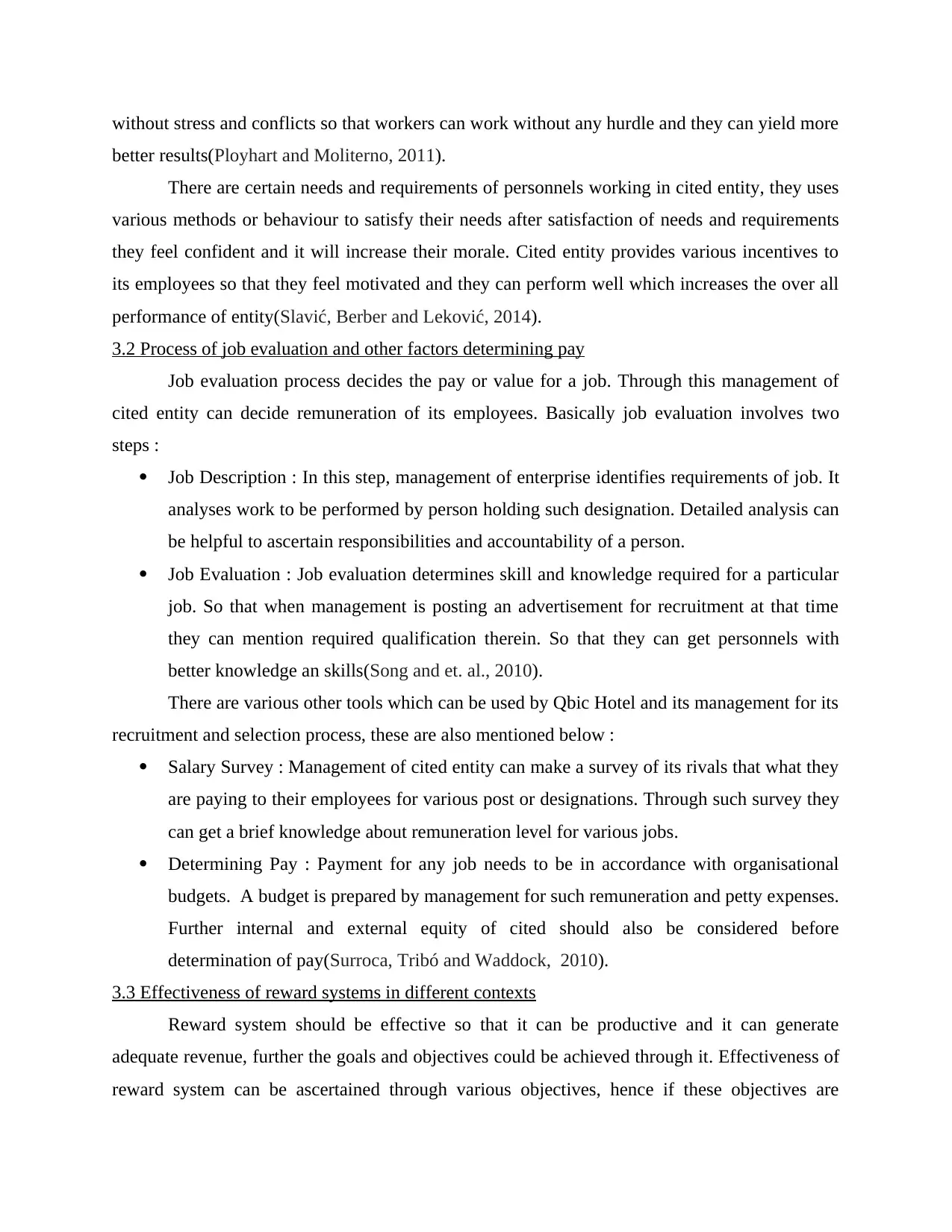
without stress and conflicts so that workers can work without any hurdle and they can yield more
better results(Ployhart and Moliterno, 2011).
There are certain needs and requirements of personnels working in cited entity, they uses
various methods or behaviour to satisfy their needs after satisfaction of needs and requirements
they feel confident and it will increase their morale. Cited entity provides various incentives to
its employees so that they feel motivated and they can perform well which increases the over all
performance of entity(Slavić, Berber and Leković, 2014).
3.2 Process of job evaluation and other factors determining pay
Job evaluation process decides the pay or value for a job. Through this management of
cited entity can decide remuneration of its employees. Basically job evaluation involves two
steps :
Job Description : In this step, management of enterprise identifies requirements of job. It
analyses work to be performed by person holding such designation. Detailed analysis can
be helpful to ascertain responsibilities and accountability of a person.
Job Evaluation : Job evaluation determines skill and knowledge required for a particular
job. So that when management is posting an advertisement for recruitment at that time
they can mention required qualification therein. So that they can get personnels with
better knowledge an skills(Song and et. al., 2010).
There are various other tools which can be used by Qbic Hotel and its management for its
recruitment and selection process, these are also mentioned below :
Salary Survey : Management of cited entity can make a survey of its rivals that what they
are paying to their employees for various post or designations. Through such survey they
can get a brief knowledge about remuneration level for various jobs.
Determining Pay : Payment for any job needs to be in accordance with organisational
budgets. A budget is prepared by management for such remuneration and petty expenses.
Further internal and external equity of cited should also be considered before
determination of pay(Surroca, Tribó and Waddock, 2010).
3.3 Effectiveness of reward systems in different contexts
Reward system should be effective so that it can be productive and it can generate
adequate revenue, further the goals and objectives could be achieved through it. Effectiveness of
reward system can be ascertained through various objectives, hence if these objectives are
better results(Ployhart and Moliterno, 2011).
There are certain needs and requirements of personnels working in cited entity, they uses
various methods or behaviour to satisfy their needs after satisfaction of needs and requirements
they feel confident and it will increase their morale. Cited entity provides various incentives to
its employees so that they feel motivated and they can perform well which increases the over all
performance of entity(Slavić, Berber and Leković, 2014).
3.2 Process of job evaluation and other factors determining pay
Job evaluation process decides the pay or value for a job. Through this management of
cited entity can decide remuneration of its employees. Basically job evaluation involves two
steps :
Job Description : In this step, management of enterprise identifies requirements of job. It
analyses work to be performed by person holding such designation. Detailed analysis can
be helpful to ascertain responsibilities and accountability of a person.
Job Evaluation : Job evaluation determines skill and knowledge required for a particular
job. So that when management is posting an advertisement for recruitment at that time
they can mention required qualification therein. So that they can get personnels with
better knowledge an skills(Song and et. al., 2010).
There are various other tools which can be used by Qbic Hotel and its management for its
recruitment and selection process, these are also mentioned below :
Salary Survey : Management of cited entity can make a survey of its rivals that what they
are paying to their employees for various post or designations. Through such survey they
can get a brief knowledge about remuneration level for various jobs.
Determining Pay : Payment for any job needs to be in accordance with organisational
budgets. A budget is prepared by management for such remuneration and petty expenses.
Further internal and external equity of cited should also be considered before
determination of pay(Surroca, Tribó and Waddock, 2010).
3.3 Effectiveness of reward systems in different contexts
Reward system should be effective so that it can be productive and it can generate
adequate revenue, further the goals and objectives could be achieved through it. Effectiveness of
reward system can be ascertained through various objectives, hence if these objectives are
⊘ This is a preview!⊘
Do you want full access?
Subscribe today to unlock all pages.
Trusted by 1+ million students worldwide
accomplished properly then reward system can be considered effective. These objectives are
mentioned below :
Rewarding the staff who are involved in various task so that those task can be performed
easily and on right time(The Best Ways to Reward Employees. 2017.).
If employees are working properly after the achievement of reward then it clearly shows
that they are now motivated and they can perform better than earlier
performance(Vörösmarty and et. al., 2010).
3.4 Methods Qbic Hotel uses to monitor employee performance
There are the several methods in the organisation to monitor employee performance
which can be described as below :
Punctuality : punctuality means employee may doing their work regularly basis or not .
He or she may arrived in the organisation on timely . If employee is doing regularly
unpunctual behaviour it may lead to affect goals and objectives of the whole organisation.
Carry out random checks : organisation may review actual performance of employee and
compared with standard performance and determined the efficiency of employee(7 Easy
Ways To Measure Employee Performance. 2014.).
Review personal presentation : organisation may check that employee may fulfil the
expectation which may be demanded(Weber and Fried, 2011).
Carry out a client survey : organisation carry survey or check out employees may
satisfied to customer with the services or product of the organisation.
TASK 4
4.1 Reasons for cessation of employment within Qbic Hotel
There can be several reasons for the cessation of employment within cited entity. Human
resource manager should control terminations and cessation because it increases labour turnover
of cited entity which ultimately defame the goodwill of it. Some reasons which induces
performance of employees within organisation and leads to cessation of his or her employment
are mentioned below :
Misconduct or violent behaviour of employee may lead to cessation of his employment.
As misconducts may cause heavy loss to small business organisation like Qbic Hotel.
Retrenchment is an another reason for cessation of employment as retrenchment may
cause due some reasons like employee who is at present working is not having that much
mentioned below :
Rewarding the staff who are involved in various task so that those task can be performed
easily and on right time(The Best Ways to Reward Employees. 2017.).
If employees are working properly after the achievement of reward then it clearly shows
that they are now motivated and they can perform better than earlier
performance(Vörösmarty and et. al., 2010).
3.4 Methods Qbic Hotel uses to monitor employee performance
There are the several methods in the organisation to monitor employee performance
which can be described as below :
Punctuality : punctuality means employee may doing their work regularly basis or not .
He or she may arrived in the organisation on timely . If employee is doing regularly
unpunctual behaviour it may lead to affect goals and objectives of the whole organisation.
Carry out random checks : organisation may review actual performance of employee and
compared with standard performance and determined the efficiency of employee(7 Easy
Ways To Measure Employee Performance. 2014.).
Review personal presentation : organisation may check that employee may fulfil the
expectation which may be demanded(Weber and Fried, 2011).
Carry out a client survey : organisation carry survey or check out employees may
satisfied to customer with the services or product of the organisation.
TASK 4
4.1 Reasons for cessation of employment within Qbic Hotel
There can be several reasons for the cessation of employment within cited entity. Human
resource manager should control terminations and cessation because it increases labour turnover
of cited entity which ultimately defame the goodwill of it. Some reasons which induces
performance of employees within organisation and leads to cessation of his or her employment
are mentioned below :
Misconduct or violent behaviour of employee may lead to cessation of his employment.
As misconducts may cause heavy loss to small business organisation like Qbic Hotel.
Retrenchment is an another reason for cessation of employment as retrenchment may
cause due some reasons like employee who is at present working is not having that much
Paraphrase This Document
Need a fresh take? Get an instant paraphrase of this document with our AI Paraphraser
of potential that he can handle his duties. Or may be completion of that task requires
special knowledge and skills(Wright and McMahan, 2011).
Merger or acquisition is an another factor which may cause to cessation of employment
of an employee.
4.2 Employment exit procedures used by two organisations
Organisations can have a exit procedure for those employees who wants to quite working
at cited entity. As labour turnover is one of the main issue which decreases value of cited entity
in front of its customers. Through maintaining an exit procedure management of cited entity can
make a control over labour turnover. Following is the exit procedure for two different entities :
Step 1 : First of all resignation should be handed over to personnel manager.
Step 2 : Then the employee requires to return all the belongings of company which he
have in his possession.
Step 3 : Line managers now should confirm that no any property which belongs to the
company is in possession of employee.
Step 4 : After confirmation of line manager, now manager of human resource department
requires to take an exit interview of such employee. This will allow management to get
knowledge about reasons for his resignation(Zott and Amit 2010).
4.3 Impact of the legal and regulatory framework on employment cessation arrangements
It has been evaluated that government of UK has implemented certain legal rules and
laws which affects the arrangements of employee cessation. Equality Act 2010 has certain rules
which support equality in organisation and reduces discrimination in organisation. Legislation
and laws mentioned in Equality Act, 2010 defines that discrimination on the basis of age, gender,
religion and caste etc. must be avoided so that working environment of any entity will remain
healthy and nobody gets exploited for the sake of his work(Armstrong and Taylor,2014).
CONCLUSION
From the above mentioned facts and concepts in relation with various theories
approaches it can concluded that human resource management is an important aspect for cited
entity for achievement of goals. In this above report a clear difference between personnel and
human-resource-management is made. Other than this various impacts of legal and regulatory
frameworks on employment cessation is also mentioned therein.
special knowledge and skills(Wright and McMahan, 2011).
Merger or acquisition is an another factor which may cause to cessation of employment
of an employee.
4.2 Employment exit procedures used by two organisations
Organisations can have a exit procedure for those employees who wants to quite working
at cited entity. As labour turnover is one of the main issue which decreases value of cited entity
in front of its customers. Through maintaining an exit procedure management of cited entity can
make a control over labour turnover. Following is the exit procedure for two different entities :
Step 1 : First of all resignation should be handed over to personnel manager.
Step 2 : Then the employee requires to return all the belongings of company which he
have in his possession.
Step 3 : Line managers now should confirm that no any property which belongs to the
company is in possession of employee.
Step 4 : After confirmation of line manager, now manager of human resource department
requires to take an exit interview of such employee. This will allow management to get
knowledge about reasons for his resignation(Zott and Amit 2010).
4.3 Impact of the legal and regulatory framework on employment cessation arrangements
It has been evaluated that government of UK has implemented certain legal rules and
laws which affects the arrangements of employee cessation. Equality Act 2010 has certain rules
which support equality in organisation and reduces discrimination in organisation. Legislation
and laws mentioned in Equality Act, 2010 defines that discrimination on the basis of age, gender,
religion and caste etc. must be avoided so that working environment of any entity will remain
healthy and nobody gets exploited for the sake of his work(Armstrong and Taylor,2014).
CONCLUSION
From the above mentioned facts and concepts in relation with various theories
approaches it can concluded that human resource management is an important aspect for cited
entity for achievement of goals. In this above report a clear difference between personnel and
human-resource-management is made. Other than this various impacts of legal and regulatory
frameworks on employment cessation is also mentioned therein.
REFERENCES
Books and Journals
Armstrong, M and Taylor, S., 2014. Armstrong's handbook of human resource management
practice. Kogan Page Publishers.
Bloom, N and Van Reenen, J., 2011. Human resource management and productivity. Handbook
of labor economics. 4.pp.1697-1767.
Boxall, P and Purcell, J., 2011. Strategy and human resource management. Palgrave Macmillan.
Bratton, J. and Gold, J., 2012. Human resource management: theory and practice. Palgrave
Macmillan.
Carter, C.R and Liane Easton, P., 2011. Sustainable supply chain management: evolution and
future directions. International journal of physical distribution & logistics management.
41(1). pp.46-62.
CHUANG, C.H and Liao, H.U.I., 2010. Strategic human resource management in service
context: Taking care of business by taking care of employees and customers. Personnel
Psychology. 63(1). pp.153-196.
Eisenberger, R and et. al., 2010. Leader–member exchange and affective organizational
commitment: The contribution of supervisor's organizational embodiment. Journal of
Applied Psychology. 95(6). p.1085.
Gruman, J.A and Saks, A.M., 2011. Performance management and employee engagement.
Human Resource Management Review. 21(2). pp.123-136.
Guest, D.E., 2011. Human resource management and performance: still searching for some
answers. Human resource management journal. 21(1). pp.3-13.
Gutiérrez, N.L., Hilborn, R and Defeo, O., 2011. Leadership, social capital and incentives
promote successful fisheries. Nature. 470(7334). pp.386-389.
Hendry, C., 2012. Human resource management. Routledge.
Hobfoll, S.E., 2011. Conservation of resource caravans and engaged settings. Journal of
occupational and organizational psychology. 84(1). pp.116-122.
Jiang, K and et. al., 2012. How does human resource management influence organizational
outcomes? A meta-analytic investigation of mediating mechanisms. Academy of
management Journal. 55(6). pp.1264-1294.
Lengnick-Hall, C.A., Beck, T.E and Lengnick-Hall, M.L., 2011. Developing a capacity for
organizational resilience through strategic human resource management. Human
Resource Management Review. 21(3). pp.243-255.
Luthans, F and et. al., 2010. The development and resulting performance impact of positive
psychological capital. Human resource development quarterly. 21(1). pp.41-67.
McWilliams, A and Siegel, D.S., 2011. Creating and capturing value: Strategic corporate social
responsibility, resource-based theory, and sustainable competitive advantage. Journal of
Management. 37(5). pp.1480-1495.
Pfeffer, J., 2010. Building sustainable organizations: The human factor. The Academy of
Management Perspectives. 24(1). pp.34-45.
Ployhart, R.E and Moliterno, T.P., 2011. Emergence of the human capital resource: A multilevel
model. Academy of Management Review. 36(1). pp.127-150.
Slavić, A., Berber, N and Leković, B., 2014. Performance management in international human
resource management: evidence from the CEE region. Serbian Journal of Management.
9(1).pp.45-58.
Books and Journals
Armstrong, M and Taylor, S., 2014. Armstrong's handbook of human resource management
practice. Kogan Page Publishers.
Bloom, N and Van Reenen, J., 2011. Human resource management and productivity. Handbook
of labor economics. 4.pp.1697-1767.
Boxall, P and Purcell, J., 2011. Strategy and human resource management. Palgrave Macmillan.
Bratton, J. and Gold, J., 2012. Human resource management: theory and practice. Palgrave
Macmillan.
Carter, C.R and Liane Easton, P., 2011. Sustainable supply chain management: evolution and
future directions. International journal of physical distribution & logistics management.
41(1). pp.46-62.
CHUANG, C.H and Liao, H.U.I., 2010. Strategic human resource management in service
context: Taking care of business by taking care of employees and customers. Personnel
Psychology. 63(1). pp.153-196.
Eisenberger, R and et. al., 2010. Leader–member exchange and affective organizational
commitment: The contribution of supervisor's organizational embodiment. Journal of
Applied Psychology. 95(6). p.1085.
Gruman, J.A and Saks, A.M., 2011. Performance management and employee engagement.
Human Resource Management Review. 21(2). pp.123-136.
Guest, D.E., 2011. Human resource management and performance: still searching for some
answers. Human resource management journal. 21(1). pp.3-13.
Gutiérrez, N.L., Hilborn, R and Defeo, O., 2011. Leadership, social capital and incentives
promote successful fisheries. Nature. 470(7334). pp.386-389.
Hendry, C., 2012. Human resource management. Routledge.
Hobfoll, S.E., 2011. Conservation of resource caravans and engaged settings. Journal of
occupational and organizational psychology. 84(1). pp.116-122.
Jiang, K and et. al., 2012. How does human resource management influence organizational
outcomes? A meta-analytic investigation of mediating mechanisms. Academy of
management Journal. 55(6). pp.1264-1294.
Lengnick-Hall, C.A., Beck, T.E and Lengnick-Hall, M.L., 2011. Developing a capacity for
organizational resilience through strategic human resource management. Human
Resource Management Review. 21(3). pp.243-255.
Luthans, F and et. al., 2010. The development and resulting performance impact of positive
psychological capital. Human resource development quarterly. 21(1). pp.41-67.
McWilliams, A and Siegel, D.S., 2011. Creating and capturing value: Strategic corporate social
responsibility, resource-based theory, and sustainable competitive advantage. Journal of
Management. 37(5). pp.1480-1495.
Pfeffer, J., 2010. Building sustainable organizations: The human factor. The Academy of
Management Perspectives. 24(1). pp.34-45.
Ployhart, R.E and Moliterno, T.P., 2011. Emergence of the human capital resource: A multilevel
model. Academy of Management Review. 36(1). pp.127-150.
Slavić, A., Berber, N and Leković, B., 2014. Performance management in international human
resource management: evidence from the CEE region. Serbian Journal of Management.
9(1).pp.45-58.
⊘ This is a preview!⊘
Do you want full access?
Subscribe today to unlock all pages.
Trusted by 1+ million students worldwide

1 out of 14


Related Documents


Your All-in-One AI-Powered Toolkit for Academic Success.
+13062052269
info@desklib.com
Available 24*7 on WhatsApp / Email
![[object Object]](/_next/static/media/star-bottom.7253800d.svg)
Unlock your academic potential
Copyright © 2020–2026 A2Z Services. All Rights Reserved. Developed and managed by ZUCOL.