Human Resource Management in Service Industries
VerifiedAdded on 2020/10/22
|12
|3546
|419
Report
AI Summary
This report delves into the significance of Human Resource Management (HRM) in the service industry, particularly within hospitality. It discusses the nature of hospitality products and services, factors influencing demand, customer profiles, and spending power. The report also outlines key stages in product and service development, features affecting customer perception, and various merchandising opportunities. Additionally, it evaluates different pricing methods and performance measures used by The Arch Hotel, providing insights into effective HRM practices that enhance customer satisfaction and business performance.

Human Resource Management
in Service Industries
in Service Industries

Paraphrase This Document
Need a fresh take? Get an instant paraphrase of this document with our AI Paraphraser
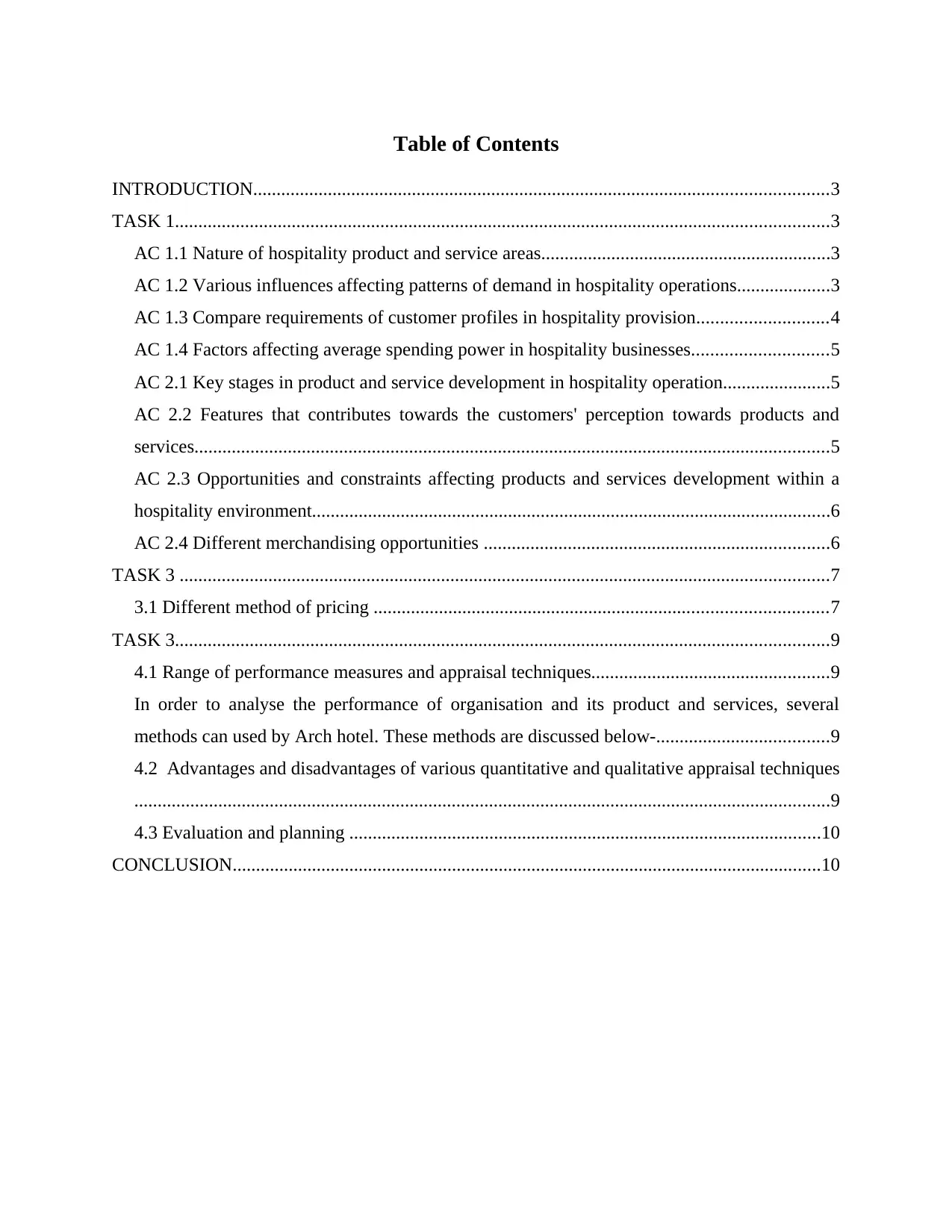
Table of Contents
INTRODUCTION...........................................................................................................................3
TASK 1............................................................................................................................................3
AC 1.1 Nature of hospitality product and service areas..............................................................3
AC 1.2 Various influences affecting patterns of demand in hospitality operations....................3
AC 1.3 Compare requirements of customer profiles in hospitality provision............................4
AC 1.4 Factors affecting average spending power in hospitality businesses.............................5
AC 2.1 Key stages in product and service development in hospitality operation.......................5
AC 2.2 Features that contributes towards the customers' perception towards products and
services........................................................................................................................................5
AC 2.3 Opportunities and constraints affecting products and services development within a
hospitality environment...............................................................................................................6
AC 2.4 Different merchandising opportunities ..........................................................................6
TASK 3 ...........................................................................................................................................7
3.1 Different method of pricing .................................................................................................7
TASK 3............................................................................................................................................9
4.1 Range of performance measures and appraisal techniques...................................................9
In order to analyse the performance of organisation and its product and services, several
methods can used by Arch hotel. These methods are discussed below-.....................................9
4.2 Advantages and disadvantages of various quantitative and qualitative appraisal techniques
.....................................................................................................................................................9
4.3 Evaluation and planning .....................................................................................................10
CONCLUSION..............................................................................................................................10
INTRODUCTION...........................................................................................................................3
TASK 1............................................................................................................................................3
AC 1.1 Nature of hospitality product and service areas..............................................................3
AC 1.2 Various influences affecting patterns of demand in hospitality operations....................3
AC 1.3 Compare requirements of customer profiles in hospitality provision............................4
AC 1.4 Factors affecting average spending power in hospitality businesses.............................5
AC 2.1 Key stages in product and service development in hospitality operation.......................5
AC 2.2 Features that contributes towards the customers' perception towards products and
services........................................................................................................................................5
AC 2.3 Opportunities and constraints affecting products and services development within a
hospitality environment...............................................................................................................6
AC 2.4 Different merchandising opportunities ..........................................................................6
TASK 3 ...........................................................................................................................................7
3.1 Different method of pricing .................................................................................................7
TASK 3............................................................................................................................................9
4.1 Range of performance measures and appraisal techniques...................................................9
In order to analyse the performance of organisation and its product and services, several
methods can used by Arch hotel. These methods are discussed below-.....................................9
4.2 Advantages and disadvantages of various quantitative and qualitative appraisal techniques
.....................................................................................................................................................9
4.3 Evaluation and planning .....................................................................................................10
CONCLUSION..............................................................................................................................10
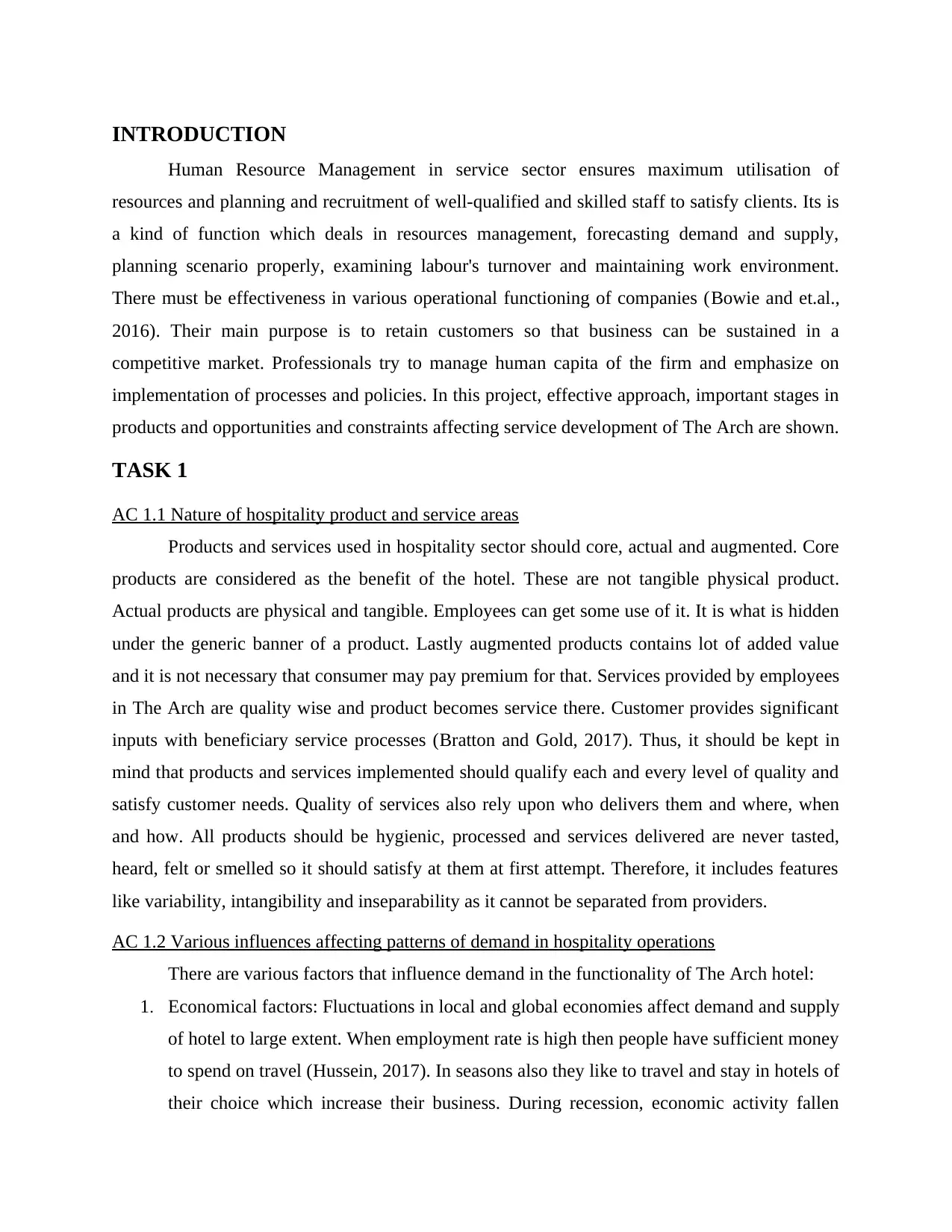
INTRODUCTION
Human Resource Management in service sector ensures maximum utilisation of
resources and planning and recruitment of well-qualified and skilled staff to satisfy clients. Its is
a kind of function which deals in resources management, forecasting demand and supply,
planning scenario properly, examining labour's turnover and maintaining work environment.
There must be effectiveness in various operational functioning of companies (Bowie and et.al.,
2016). Their main purpose is to retain customers so that business can be sustained in a
competitive market. Professionals try to manage human capita of the firm and emphasize on
implementation of processes and policies. In this project, effective approach, important stages in
products and opportunities and constraints affecting service development of The Arch are shown.
TASK 1
AC 1.1 Nature of hospitality product and service areas
Products and services used in hospitality sector should core, actual and augmented. Core
products are considered as the benefit of the hotel. These are not tangible physical product.
Actual products are physical and tangible. Employees can get some use of it. It is what is hidden
under the generic banner of a product. Lastly augmented products contains lot of added value
and it is not necessary that consumer may pay premium for that. Services provided by employees
in The Arch are quality wise and product becomes service there. Customer provides significant
inputs with beneficiary service processes (Bratton and Gold, 2017). Thus, it should be kept in
mind that products and services implemented should qualify each and every level of quality and
satisfy customer needs. Quality of services also rely upon who delivers them and where, when
and how. All products should be hygienic, processed and services delivered are never tasted,
heard, felt or smelled so it should satisfy at them at first attempt. Therefore, it includes features
like variability, intangibility and inseparability as it cannot be separated from providers.
AC 1.2 Various influences affecting patterns of demand in hospitality operations
There are various factors that influence demand in the functionality of The Arch hotel:
1. Economical factors: Fluctuations in local and global economies affect demand and supply
of hotel to large extent. When employment rate is high then people have sufficient money
to spend on travel (Hussein, 2017). In seasons also they like to travel and stay in hotels of
their choice which increase their business. During recession, economic activity fallen
Human Resource Management in service sector ensures maximum utilisation of
resources and planning and recruitment of well-qualified and skilled staff to satisfy clients. Its is
a kind of function which deals in resources management, forecasting demand and supply,
planning scenario properly, examining labour's turnover and maintaining work environment.
There must be effectiveness in various operational functioning of companies (Bowie and et.al.,
2016). Their main purpose is to retain customers so that business can be sustained in a
competitive market. Professionals try to manage human capita of the firm and emphasize on
implementation of processes and policies. In this project, effective approach, important stages in
products and opportunities and constraints affecting service development of The Arch are shown.
TASK 1
AC 1.1 Nature of hospitality product and service areas
Products and services used in hospitality sector should core, actual and augmented. Core
products are considered as the benefit of the hotel. These are not tangible physical product.
Actual products are physical and tangible. Employees can get some use of it. It is what is hidden
under the generic banner of a product. Lastly augmented products contains lot of added value
and it is not necessary that consumer may pay premium for that. Services provided by employees
in The Arch are quality wise and product becomes service there. Customer provides significant
inputs with beneficiary service processes (Bratton and Gold, 2017). Thus, it should be kept in
mind that products and services implemented should qualify each and every level of quality and
satisfy customer needs. Quality of services also rely upon who delivers them and where, when
and how. All products should be hygienic, processed and services delivered are never tasted,
heard, felt or smelled so it should satisfy at them at first attempt. Therefore, it includes features
like variability, intangibility and inseparability as it cannot be separated from providers.
AC 1.2 Various influences affecting patterns of demand in hospitality operations
There are various factors that influence demand in the functionality of The Arch hotel:
1. Economical factors: Fluctuations in local and global economies affect demand and supply
of hotel to large extent. When employment rate is high then people have sufficient money
to spend on travel (Hussein, 2017). In seasons also they like to travel and stay in hotels of
their choice which increase their business. During recession, economic activity fallen
⊘ This is a preview!⊘
Do you want full access?
Subscribe today to unlock all pages.

Trusted by 1+ million students worldwide
from some height and due to there was less spending from customer's side. But, now
world's economy is back on track and demand is increasing regarding hospitality
industries.
2. Geographical factors: Locations of people also have direct impact on this sector. The
Arch hotel is aware of all types of customs and traditions and so it is able to create
healthy relations with the customers (Brewster, Chung and Sparrow, 2016). Stable
geographical conditions leads to higher employment. This also requires trained staff who
can welcome all types of customers from different regions and nations.
3. Cultural Factors: every culture has its own strength and unique appeal. It is important for
organisation to know the importance of various cultures so that customers remain happy.
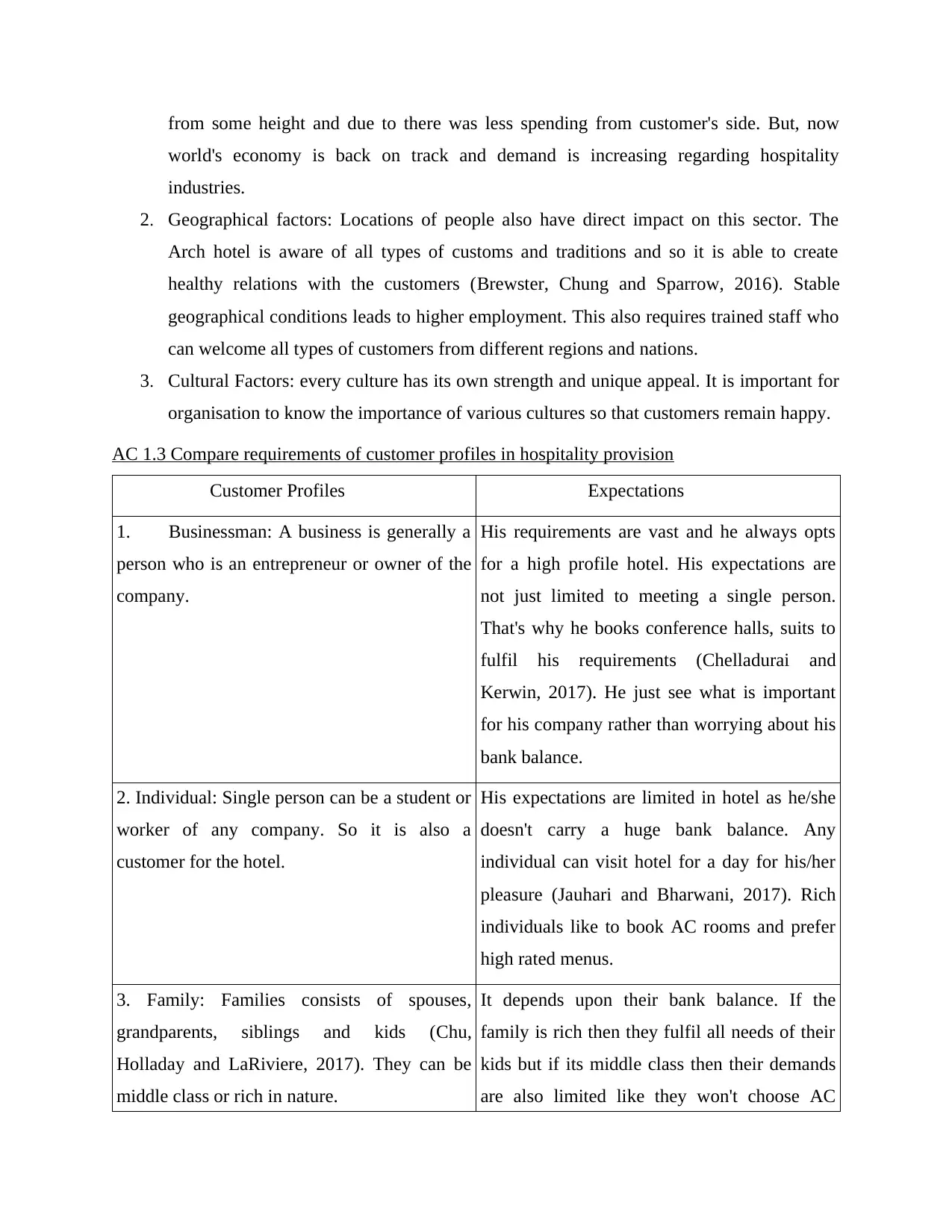
AC 1.3 Compare requirements of customer profiles in hospitality provision
Customer Profiles Expectations
1. Businessman: A business is generally a
person who is an entrepreneur or owner of the
company.
His requirements are vast and he always opts
for a high profile hotel. His expectations are
not just limited to meeting a single person.
That's why he books conference halls, suits to
fulfil his requirements (Chelladurai and
Kerwin, 2017). He just see what is important
for his company rather than worrying about his
bank balance.
2. Individual: Single person can be a student or
worker of any company. So it is also a
customer for the hotel.
His expectations are limited in hotel as he/she
doesn't carry a huge bank balance. Any
individual can visit hotel for a day for his/her
pleasure (Jauhari and Bharwani, 2017). Rich
individuals like to book AC rooms and prefer
high rated menus.
3. Family: Families consists of spouses,
grandparents, siblings and kids (Chu,
Holladay and LaRiviere, 2017). They can be
middle class or rich in nature.
It depends upon their bank balance. If the
family is rich then they fulfil all needs of their
kids but if its middle class then their demands
are also limited like they won't choose AC
world's economy is back on track and demand is increasing regarding hospitality
industries.
2. Geographical factors: Locations of people also have direct impact on this sector. The
Arch hotel is aware of all types of customs and traditions and so it is able to create
healthy relations with the customers (Brewster, Chung and Sparrow, 2016). Stable
geographical conditions leads to higher employment. This also requires trained staff who
can welcome all types of customers from different regions and nations.
3. Cultural Factors: every culture has its own strength and unique appeal. It is important for
organisation to know the importance of various cultures so that customers remain happy.
AC 1.3 Compare requirements of customer profiles in hospitality provision
Customer Profiles Expectations
1. Businessman: A business is generally a
person who is an entrepreneur or owner of the
company.
His requirements are vast and he always opts
for a high profile hotel. His expectations are
not just limited to meeting a single person.
That's why he books conference halls, suits to
fulfil his requirements (Chelladurai and
Kerwin, 2017). He just see what is important
for his company rather than worrying about his
bank balance.
2. Individual: Single person can be a student or
worker of any company. So it is also a
customer for the hotel.
His expectations are limited in hotel as he/she
doesn't carry a huge bank balance. Any
individual can visit hotel for a day for his/her
pleasure (Jauhari and Bharwani, 2017). Rich
individuals like to book AC rooms and prefer
high rated menus.
3. Family: Families consists of spouses,
grandparents, siblings and kids (Chu,
Holladay and LaRiviere, 2017). They can be
middle class or rich in nature.
It depends upon their bank balance. If the
family is rich then they fulfil all needs of their
kids but if its middle class then their demands
are also limited like they won't choose AC
Paraphrase This Document
Need a fresh take? Get an instant paraphrase of this document with our AI Paraphraser
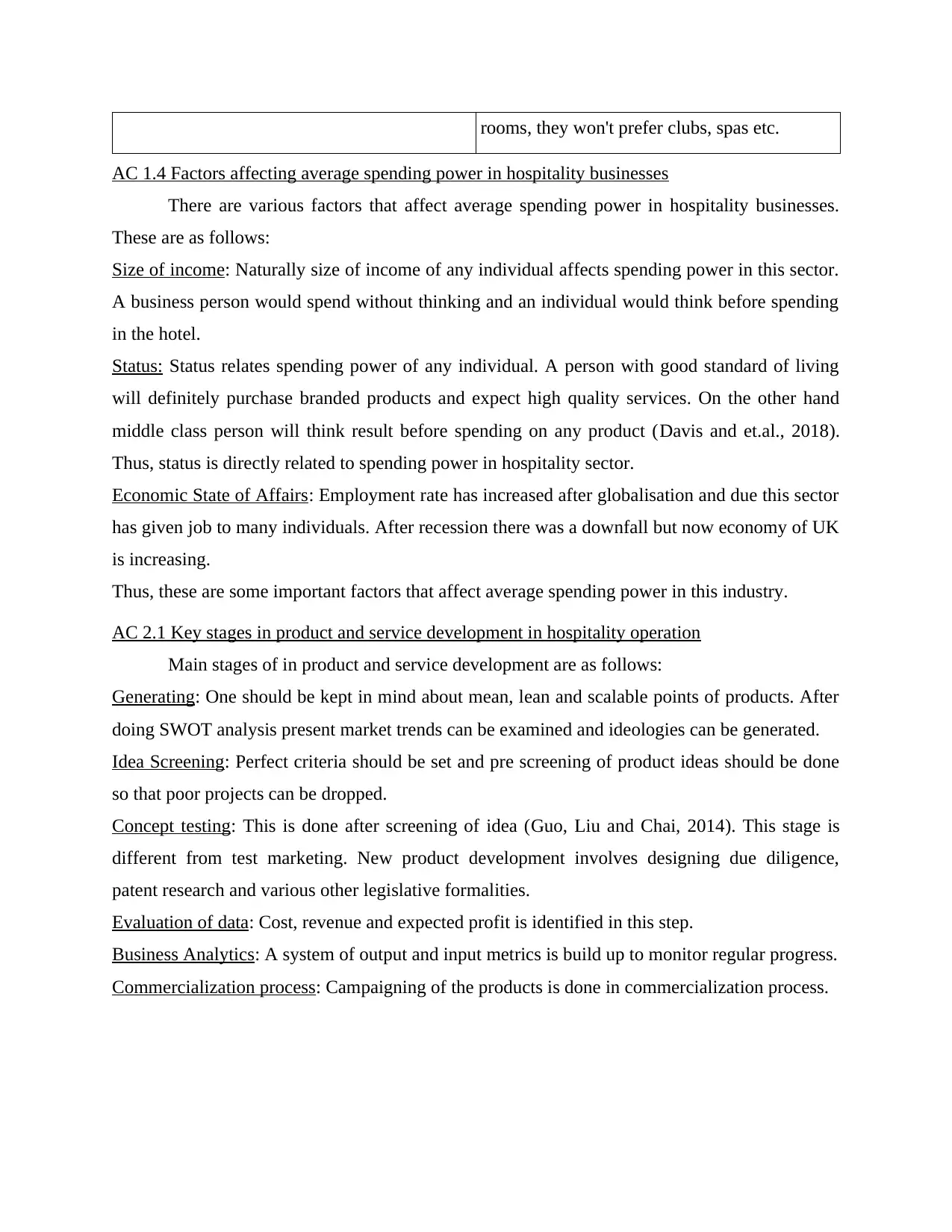
rooms, they won't prefer clubs, spas etc.
AC 1.4 Factors affecting average spending power in hospitality businesses
There are various factors that affect average spending power in hospitality businesses.
These are as follows:
Size of income: Naturally size of income of any individual affects spending power in this sector.
A business person would spend without thinking and an individual would think before spending
in the hotel.
Status: Status relates spending power of any individual. A person with good standard of living
will definitely purchase branded products and expect high quality services. On the other hand
middle class person will think result before spending on any product (Davis and et.al., 2018).
Thus, status is directly related to spending power in hospitality sector.
Economic State of Affairs: Employment rate has increased after globalisation and due this sector
has given job to many individuals. After recession there was a downfall but now economy of UK
is increasing.
Thus, these are some important factors that affect average spending power in this industry.
AC 2.1 Key stages in product and service development in hospitality operation
Main stages of in product and service development are as follows:
Generating: One should be kept in mind about mean, lean and scalable points of products. After
doing SWOT analysis present market trends can be examined and ideologies can be generated.
Idea Screening: Perfect criteria should be set and pre screening of product ideas should be done
so that poor projects can be dropped.
Concept testing: This is done after screening of idea (Guo, Liu and Chai, 2014). This stage is
different from test marketing. New product development involves designing due diligence,
patent research and various other legislative formalities.
Evaluation of data: Cost, revenue and expected profit is identified in this step.
Business Analytics: A system of output and input metrics is build up to monitor regular progress.
Commercialization process: Campaigning of the products is done in commercialization process.
AC 1.4 Factors affecting average spending power in hospitality businesses
There are various factors that affect average spending power in hospitality businesses.
These are as follows:
Size of income: Naturally size of income of any individual affects spending power in this sector.
A business person would spend without thinking and an individual would think before spending
in the hotel.
Status: Status relates spending power of any individual. A person with good standard of living
will definitely purchase branded products and expect high quality services. On the other hand
middle class person will think result before spending on any product (Davis and et.al., 2018).
Thus, status is directly related to spending power in hospitality sector.
Economic State of Affairs: Employment rate has increased after globalisation and due this sector
has given job to many individuals. After recession there was a downfall but now economy of UK
is increasing.
Thus, these are some important factors that affect average spending power in this industry.
AC 2.1 Key stages in product and service development in hospitality operation
Main stages of in product and service development are as follows:
Generating: One should be kept in mind about mean, lean and scalable points of products. After
doing SWOT analysis present market trends can be examined and ideologies can be generated.
Idea Screening: Perfect criteria should be set and pre screening of product ideas should be done
so that poor projects can be dropped.
Concept testing: This is done after screening of idea (Guo, Liu and Chai, 2014). This stage is
different from test marketing. New product development involves designing due diligence,
patent research and various other legislative formalities.
Evaluation of data: Cost, revenue and expected profit is identified in this step.
Business Analytics: A system of output and input metrics is build up to monitor regular progress.
Commercialization process: Campaigning of the products is done in commercialization process.
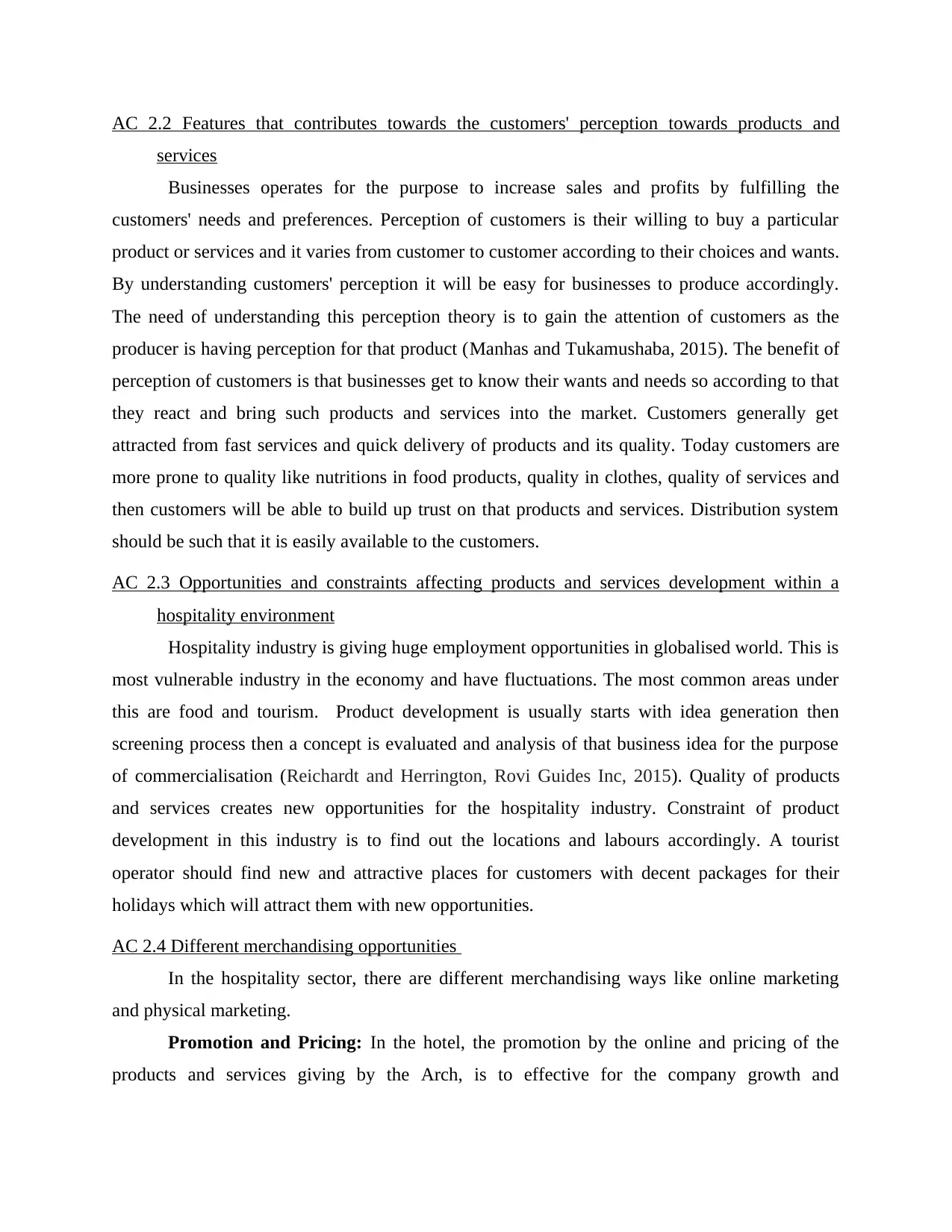
AC 2.2 Features that contributes towards the customers' perception towards products and
services
Businesses operates for the purpose to increase sales and profits by fulfilling the
customers' needs and preferences. Perception of customers is their willing to buy a particular
product or services and it varies from customer to customer according to their choices and wants.
By understanding customers' perception it will be easy for businesses to produce accordingly.
The need of understanding this perception theory is to gain the attention of customers as the
producer is having perception for that product (Manhas and Tukamushaba, 2015). The benefit of
perception of customers is that businesses get to know their wants and needs so according to that
they react and bring such products and services into the market. Customers generally get
attracted from fast services and quick delivery of products and its quality. Today customers are
more prone to quality like nutritions in food products, quality in clothes, quality of services and
then customers will be able to build up trust on that products and services. Distribution system
should be such that it is easily available to the customers.
AC 2.3 Opportunities and constraints affecting products and services development within a
hospitality environment
Hospitality industry is giving huge employment opportunities in globalised world. This is
most vulnerable industry in the economy and have fluctuations. The most common areas under
this are food and tourism. Product development is usually starts with idea generation then
screening process then a concept is evaluated and analysis of that business idea for the purpose
of commercialisation (Reichardt and Herrington, Rovi Guides Inc, 2015). Quality of products
and services creates new opportunities for the hospitality industry. Constraint of product
development in this industry is to find out the locations and labours accordingly. A tourist
operator should find new and attractive places for customers with decent packages for their
holidays which will attract them with new opportunities.
AC 2.4 Different merchandising opportunities
In the hospitality sector, there are different merchandising ways like online marketing
and physical marketing.
Promotion and Pricing: In the hotel, the promotion by the online and pricing of the
products and services giving by the Arch, is to effective for the company growth and
services
Businesses operates for the purpose to increase sales and profits by fulfilling the
customers' needs and preferences. Perception of customers is their willing to buy a particular
product or services and it varies from customer to customer according to their choices and wants.
By understanding customers' perception it will be easy for businesses to produce accordingly.
The need of understanding this perception theory is to gain the attention of customers as the
producer is having perception for that product (Manhas and Tukamushaba, 2015). The benefit of
perception of customers is that businesses get to know their wants and needs so according to that
they react and bring such products and services into the market. Customers generally get
attracted from fast services and quick delivery of products and its quality. Today customers are
more prone to quality like nutritions in food products, quality in clothes, quality of services and
then customers will be able to build up trust on that products and services. Distribution system
should be such that it is easily available to the customers.
AC 2.3 Opportunities and constraints affecting products and services development within a
hospitality environment
Hospitality industry is giving huge employment opportunities in globalised world. This is
most vulnerable industry in the economy and have fluctuations. The most common areas under
this are food and tourism. Product development is usually starts with idea generation then
screening process then a concept is evaluated and analysis of that business idea for the purpose
of commercialisation (Reichardt and Herrington, Rovi Guides Inc, 2015). Quality of products
and services creates new opportunities for the hospitality industry. Constraint of product
development in this industry is to find out the locations and labours accordingly. A tourist
operator should find new and attractive places for customers with decent packages for their
holidays which will attract them with new opportunities.
AC 2.4 Different merchandising opportunities
In the hospitality sector, there are different merchandising ways like online marketing
and physical marketing.
Promotion and Pricing: In the hotel, the promotion by the online and pricing of the
products and services giving by the Arch, is to effective for the company growth and
⊘ This is a preview!⊘
Do you want full access?
Subscribe today to unlock all pages.
Trusted by 1+ million students worldwide
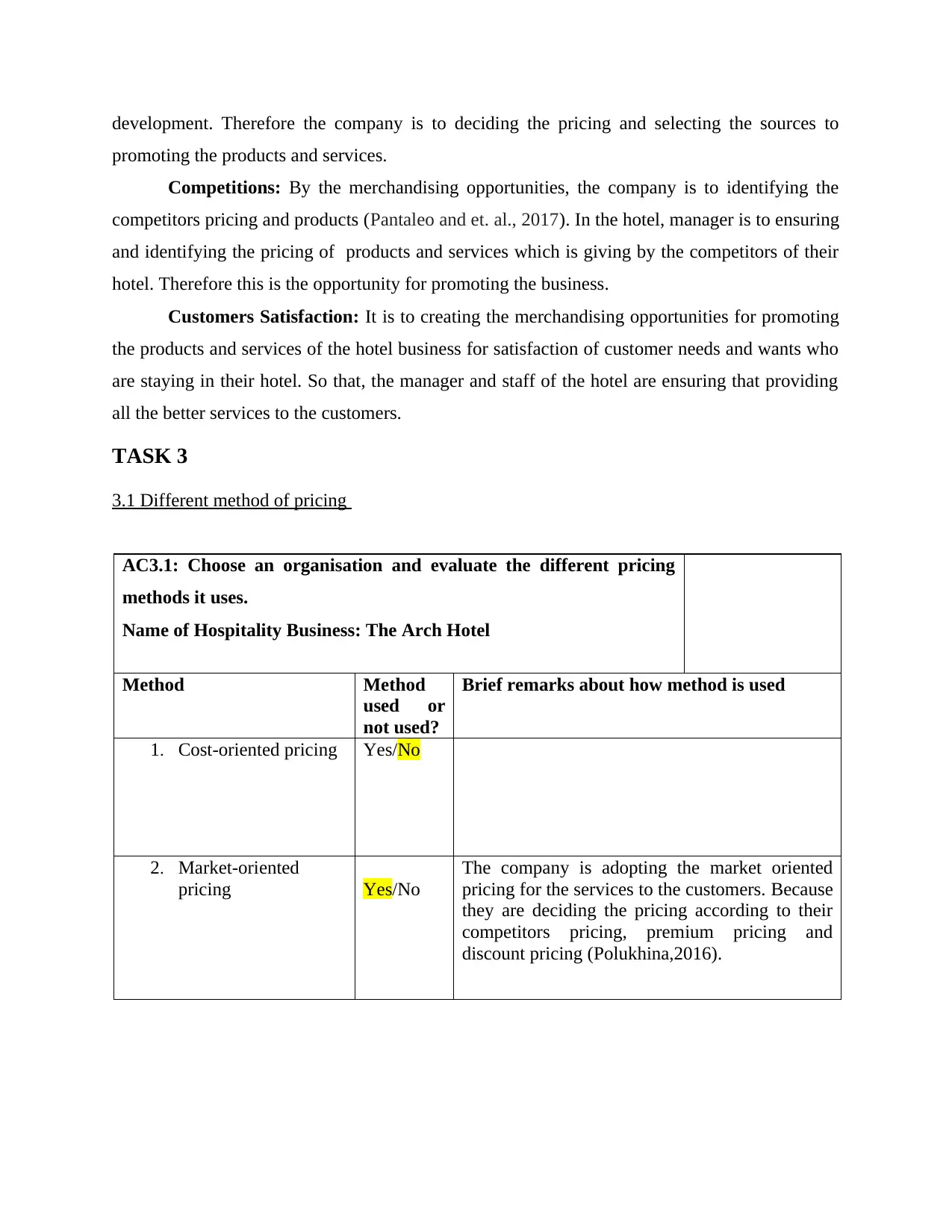
development. Therefore the company is to deciding the pricing and selecting the sources to
promoting the products and services.
Competitions: By the merchandising opportunities, the company is to identifying the
competitors pricing and products (Pantaleo and et. al., 2017). In the hotel, manager is to ensuring
and identifying the pricing of products and services which is giving by the competitors of their
hotel. Therefore this is the opportunity for promoting the business.
Customers Satisfaction: It is to creating the merchandising opportunities for promoting
the products and services of the hotel business for satisfaction of customer needs and wants who
are staying in their hotel. So that, the manager and staff of the hotel are ensuring that providing
all the better services to the customers.
TASK 3
3.1 Different method of pricing
AC3.1: Choose an organisation and evaluate the different pricing
methods it uses.
Name of Hospitality Business: The Arch Hotel
Method Method
used or
not used?
Brief remarks about how method is used
1. Cost-oriented pricing Yes/No
2. Market-oriented
pricing Yes/No
The company is adopting the market oriented
pricing for the services to the customers. Because
they are deciding the pricing according to their
competitors pricing, premium pricing and
discount pricing (Polukhina,2016).
promoting the products and services.
Competitions: By the merchandising opportunities, the company is to identifying the
competitors pricing and products (Pantaleo and et. al., 2017). In the hotel, manager is to ensuring
and identifying the pricing of products and services which is giving by the competitors of their
hotel. Therefore this is the opportunity for promoting the business.
Customers Satisfaction: It is to creating the merchandising opportunities for promoting
the products and services of the hotel business for satisfaction of customer needs and wants who
are staying in their hotel. So that, the manager and staff of the hotel are ensuring that providing
all the better services to the customers.
TASK 3
3.1 Different method of pricing
AC3.1: Choose an organisation and evaluate the different pricing
methods it uses.
Name of Hospitality Business: The Arch Hotel
Method Method
used or
not used?
Brief remarks about how method is used
1. Cost-oriented pricing Yes/No
2. Market-oriented
pricing Yes/No
The company is adopting the market oriented
pricing for the services to the customers. Because
they are deciding the pricing according to their
competitors pricing, premium pricing and
discount pricing (Polukhina,2016).
Paraphrase This Document
Need a fresh take? Get an instant paraphrase of this document with our AI Paraphraser
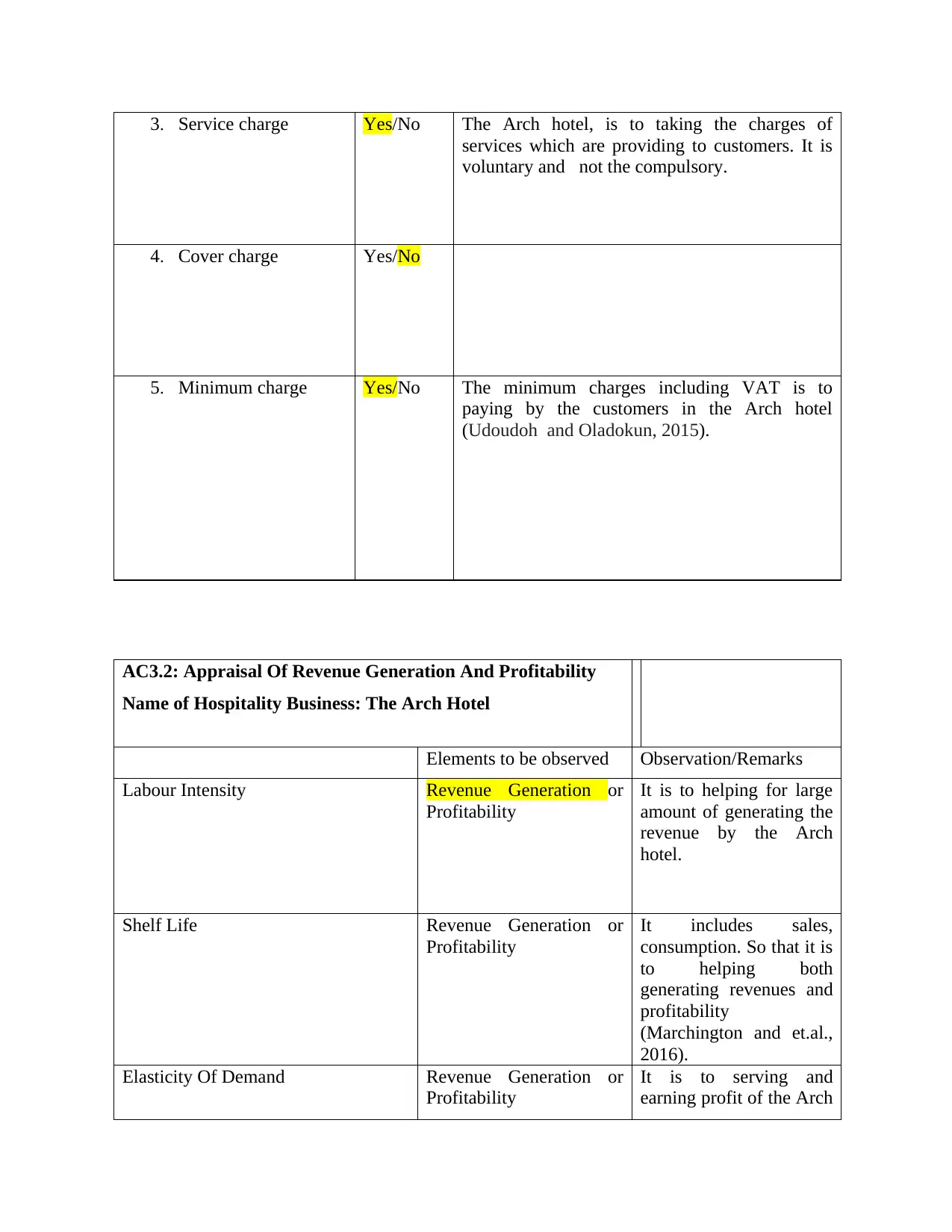
3. Service charge Yes/No The Arch hotel, is to taking the charges of
services which are providing to customers. It is
voluntary and not the compulsory.
4. Cover charge Yes/No
5. Minimum charge Yes/No The minimum charges including VAT is to
paying by the customers in the Arch hotel
(Udoudoh and Oladokun, 2015).
AC3.2: Appraisal Of Revenue Generation And Profitability
Name of Hospitality Business: The Arch Hotel
Elements to be observed Observation/Remarks
Labour Intensity Revenue Generation or
Profitability
It is to helping for large
amount of generating the
revenue by the Arch
hotel.
Shelf Life Revenue Generation or
Profitability
It includes sales,
consumption. So that it is
to helping both
generating revenues and
profitability
(Marchington and et.al.,
2016).
Elasticity Of Demand Revenue Generation or
Profitability
It is to serving and
earning profit of the Arch
services which are providing to customers. It is
voluntary and not the compulsory.
4. Cover charge Yes/No
5. Minimum charge Yes/No The minimum charges including VAT is to
paying by the customers in the Arch hotel
(Udoudoh and Oladokun, 2015).
AC3.2: Appraisal Of Revenue Generation And Profitability
Name of Hospitality Business: The Arch Hotel
Elements to be observed Observation/Remarks
Labour Intensity Revenue Generation or
Profitability
It is to helping for large
amount of generating the
revenue by the Arch
hotel.
Shelf Life Revenue Generation or
Profitability
It includes sales,
consumption. So that it is
to helping both
generating revenues and
profitability
(Marchington and et.al.,
2016).
Elasticity Of Demand Revenue Generation or
Profitability
It is to serving and
earning profit of the Arch
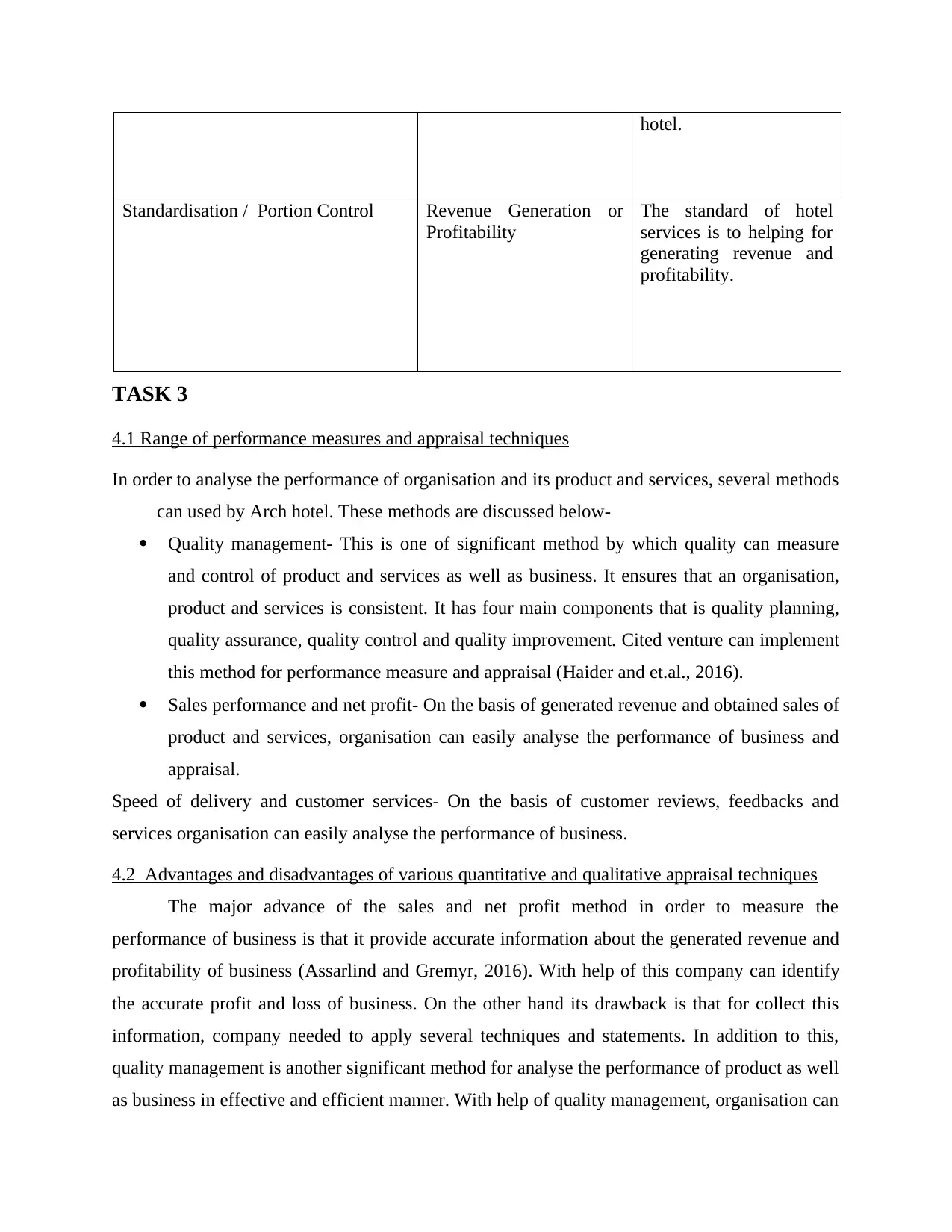
hotel.
Standardisation / Portion Control Revenue Generation or
Profitability
The standard of hotel
services is to helping for
generating revenue and
profitability.
TASK 3
4.1 Range of performance measures and appraisal techniques
In order to analyse the performance of organisation and its product and services, several methods
can used by Arch hotel. These methods are discussed below-
Quality management- This is one of significant method by which quality can measure
and control of product and services as well as business. It ensures that an organisation,
product and services is consistent. It has four main components that is quality planning,
quality assurance, quality control and quality improvement. Cited venture can implement
this method for performance measure and appraisal (Haider and et.al., 2016).
Sales performance and net profit- On the basis of generated revenue and obtained sales of
product and services, organisation can easily analyse the performance of business and
appraisal.
Speed of delivery and customer services- On the basis of customer reviews, feedbacks and
services organisation can easily analyse the performance of business.
4.2 Advantages and disadvantages of various quantitative and qualitative appraisal techniques
The major advance of the sales and net profit method in order to measure the
performance of business is that it provide accurate information about the generated revenue and
profitability of business (Assarlind and Gremyr, 2016). With help of this company can identify
the accurate profit and loss of business. On the other hand its drawback is that for collect this
information, company needed to apply several techniques and statements. In addition to this,
quality management is another significant method for analyse the performance of product as well
as business in effective and efficient manner. With help of quality management, organisation can
Standardisation / Portion Control Revenue Generation or
Profitability
The standard of hotel
services is to helping for
generating revenue and
profitability.
TASK 3
4.1 Range of performance measures and appraisal techniques
In order to analyse the performance of organisation and its product and services, several methods
can used by Arch hotel. These methods are discussed below-
Quality management- This is one of significant method by which quality can measure
and control of product and services as well as business. It ensures that an organisation,
product and services is consistent. It has four main components that is quality planning,
quality assurance, quality control and quality improvement. Cited venture can implement
this method for performance measure and appraisal (Haider and et.al., 2016).
Sales performance and net profit- On the basis of generated revenue and obtained sales of
product and services, organisation can easily analyse the performance of business and
appraisal.
Speed of delivery and customer services- On the basis of customer reviews, feedbacks and
services organisation can easily analyse the performance of business.
4.2 Advantages and disadvantages of various quantitative and qualitative appraisal techniques
The major advance of the sales and net profit method in order to measure the
performance of business is that it provide accurate information about the generated revenue and
profitability of business (Assarlind and Gremyr, 2016). With help of this company can identify
the accurate profit and loss of business. On the other hand its drawback is that for collect this
information, company needed to apply several techniques and statements. In addition to this,
quality management is another significant method for analyse the performance of product as well
as business in effective and efficient manner. With help of quality management, organisation can
⊘ This is a preview!⊘
Do you want full access?
Subscribe today to unlock all pages.
Trusted by 1+ million students worldwide
improve quality of services and deliver high quality of product and services in the market. With
help of the various techniques of quality management organisation can improve customer service
and attraction. With help of quality management technique, company profitability and revenue
can positively increase and its will help in create competitive advantage of the business. It helps
in attract new customer and develop strong brand image in the market. On the other hand its
disadvantage is that it is costly method as for improve quality company needed to various
equipment and strategy which is costly.
4.3 Evaluation and planning
With help of planning in the business, organisation can identify the future risk , profit and
requirement regarding material. With help of business analysis, evaluation and planning,
organisation can identify its existing buyers, available competitors in the market and future
requirement regarding business. With help of SWOT analysis organisation can easily analyse its
business and its existing condition in the market. With help of this method of business analysis,
business competency can also identify in effective and appropriate manner. With help of SWOT
analysis organisation can easily estimate its strength, weakness, opportunities and threats pf the
business. This will help in developing effective business strategies. Strategic planning is another
one of the significant aspect of the business analysis by which organisation can estimate the
existing performance and future requirement of business.
CONCLUSION
In this report, HRM being an integral part of almost all sort of organizations plays a vital
role in the service industry. The present report has also summarized such findings of HRM and
their existence in a chosen hospitality based organisation called The Arch by firstly identifying
its nature of services. This involved the evaluation of various demand patterns impacting on the
choices of consumers. Beside this, it has also identified those factors that are influencing the
spending power of customers associated with hospitality businesses along with the key stages of
development.
help of the various techniques of quality management organisation can improve customer service
and attraction. With help of quality management technique, company profitability and revenue
can positively increase and its will help in create competitive advantage of the business. It helps
in attract new customer and develop strong brand image in the market. On the other hand its
disadvantage is that it is costly method as for improve quality company needed to various
equipment and strategy which is costly.
4.3 Evaluation and planning
With help of planning in the business, organisation can identify the future risk , profit and
requirement regarding material. With help of business analysis, evaluation and planning,
organisation can identify its existing buyers, available competitors in the market and future
requirement regarding business. With help of SWOT analysis organisation can easily analyse its
business and its existing condition in the market. With help of this method of business analysis,
business competency can also identify in effective and appropriate manner. With help of SWOT
analysis organisation can easily estimate its strength, weakness, opportunities and threats pf the
business. This will help in developing effective business strategies. Strategic planning is another
one of the significant aspect of the business analysis by which organisation can estimate the
existing performance and future requirement of business.
CONCLUSION
In this report, HRM being an integral part of almost all sort of organizations plays a vital
role in the service industry. The present report has also summarized such findings of HRM and
their existence in a chosen hospitality based organisation called The Arch by firstly identifying
its nature of services. This involved the evaluation of various demand patterns impacting on the
choices of consumers. Beside this, it has also identified those factors that are influencing the
spending power of customers associated with hospitality businesses along with the key stages of
development.
Paraphrase This Document
Need a fresh take? Get an instant paraphrase of this document with our AI Paraphraser
REFERENCES:
Books and Journals
Bowie, D. and et.al., 2016. Hospitality marketing. Routledge.
Bratton, J. and Gold, J., 2017. Human resource management: theory and practice. Palgrave.
Brewster, C., Chung, C. and Sparrow, P., 2016. Globalizing human resource management.
Routledge.
Chelladurai, P. and Kerwin, S., 2017. Human resource management in sport and recreation.
Human Kinetics.
Chu, Y., Holladay, S. and LaRiviere, J., 2017. Pass-through from fossil fuel market prices to
procurement costs of the us power producers. Journal of Industrial Economics. 65. pp.842-
871.
Davis, B. and et.al., 2018. Food and beverage management. Routledge.
Garrido-Morgado, Á. and González-Benito, Ó., 2015. Merchandising at the point of sale:
differential effect of end of aisle and islands. BRQ Business Research Quarterly, 18(1),
pp.57-67.
Guo, Y., Liu, H. and Chai, Y., 2014. The embedding convergence of smart cities and tourism
internet of things in China: An advance perspective. Advances in Hospitality and Tourism
Research (AHTR). 2(1). pp.54-69.
Gupta, A., 2016. Customer service: A key differentiator in retailing. In Handbook of research on
strategic supply chain management in the retail industry (pp. 75-86). IGI Global.
Hussein, A.S., 2017. Effects of Brand Experience on Brand Loyalty in Indonesian Casual Dining
Restaurant: Roles of Customer Satisfaction and Brand of Origin. Tourism and hospitality
management. 24(1). pp.1-14.
Jauhari, V. and Bharwani, S., 2017. An exploratory study of competencies required to cocreate
memorable customer experiences in the hospitality industry. In Hospitality Marketing and
Consumer Behavior (pp. 159-185). Apple Academic Press.
Krampe, C., Strelow, E., Haas, A. and Kenning, P., 2018. The application of mobile fNIRS to
“shopper neuroscience”–first insights from a merchandising communication
study. European Journal of Marketing, 52(1/2), pp.244-259.
Books and Journals
Bowie, D. and et.al., 2016. Hospitality marketing. Routledge.
Bratton, J. and Gold, J., 2017. Human resource management: theory and practice. Palgrave.
Brewster, C., Chung, C. and Sparrow, P., 2016. Globalizing human resource management.
Routledge.
Chelladurai, P. and Kerwin, S., 2017. Human resource management in sport and recreation.
Human Kinetics.
Chu, Y., Holladay, S. and LaRiviere, J., 2017. Pass-through from fossil fuel market prices to
procurement costs of the us power producers. Journal of Industrial Economics. 65. pp.842-
871.
Davis, B. and et.al., 2018. Food and beverage management. Routledge.
Garrido-Morgado, Á. and González-Benito, Ó., 2015. Merchandising at the point of sale:
differential effect of end of aisle and islands. BRQ Business Research Quarterly, 18(1),
pp.57-67.
Guo, Y., Liu, H. and Chai, Y., 2014. The embedding convergence of smart cities and tourism
internet of things in China: An advance perspective. Advances in Hospitality and Tourism
Research (AHTR). 2(1). pp.54-69.
Gupta, A., 2016. Customer service: A key differentiator in retailing. In Handbook of research on
strategic supply chain management in the retail industry (pp. 75-86). IGI Global.
Hussein, A.S., 2017. Effects of Brand Experience on Brand Loyalty in Indonesian Casual Dining
Restaurant: Roles of Customer Satisfaction and Brand of Origin. Tourism and hospitality
management. 24(1). pp.1-14.
Jauhari, V. and Bharwani, S., 2017. An exploratory study of competencies required to cocreate
memorable customer experiences in the hospitality industry. In Hospitality Marketing and
Consumer Behavior (pp. 159-185). Apple Academic Press.
Krampe, C., Strelow, E., Haas, A. and Kenning, P., 2018. The application of mobile fNIRS to
“shopper neuroscience”–first insights from a merchandising communication
study. European Journal of Marketing, 52(1/2), pp.244-259.
Manhas, P.S. and Tukamushaba, E.K., 2015. Understanding service experience and its impact on
brand image in hospitality sector. International Journal of Hospitality Management. 45.
pp.77-87.
Marchington, M. and et.al., 2016. Human resource management at work. Kogan Page Publishers.
Pantaleo, A.M., Camporeale, S.M., Miliozzi, A., Russo, V., Shah, N. and Markides, C.N., 2017.
Novel hybrid CSP-biomass CHP for flexible generation: Thermo-economic analysis and
profitability assessment. Applied Energy, 204, pp.994-1006.
Polukhina, A., 2016. A cluster model of ethno-tourism organization in Russian regions.
Worldwide Hospitality and Tourism Themes. 8(3). pp.359-372.
Reichardt, M.S. and Herrington, W.B., Rovi Guides Inc, 2015. Systems and methods for
coordinating interactive and passive advertisement and merchandising opportunities. U.S.
Patent 9,118,958.
Udoudoh, F.P. and Oladokun, M.G., 2015. An application of cost-benefit appraisal technique in
sustainable urban infrastructure provision in Nigeria. PM World Journal.
brand image in hospitality sector. International Journal of Hospitality Management. 45.
pp.77-87.
Marchington, M. and et.al., 2016. Human resource management at work. Kogan Page Publishers.
Pantaleo, A.M., Camporeale, S.M., Miliozzi, A., Russo, V., Shah, N. and Markides, C.N., 2017.
Novel hybrid CSP-biomass CHP for flexible generation: Thermo-economic analysis and
profitability assessment. Applied Energy, 204, pp.994-1006.
Polukhina, A., 2016. A cluster model of ethno-tourism organization in Russian regions.
Worldwide Hospitality and Tourism Themes. 8(3). pp.359-372.
Reichardt, M.S. and Herrington, W.B., Rovi Guides Inc, 2015. Systems and methods for
coordinating interactive and passive advertisement and merchandising opportunities. U.S.
Patent 9,118,958.
Udoudoh, F.P. and Oladokun, M.G., 2015. An application of cost-benefit appraisal technique in
sustainable urban infrastructure provision in Nigeria. PM World Journal.
⊘ This is a preview!⊘
Do you want full access?
Subscribe today to unlock all pages.
Trusted by 1+ million students worldwide

1 out of 12


Related Documents


Your All-in-One AI-Powered Toolkit for Academic Success.
+13062052269
info@desklib.com
Available 24*7 on WhatsApp / Email
![[object Object]](/_next/static/media/star-bottom.7253800d.svg)
Unlock your academic potential
Copyright © 2020–2026 A2Z Services. All Rights Reserved. Developed and managed by ZUCOL.