Human Resource Management Metrics and Scorecard for Starbucks
VerifiedAdded on 2020/04/21
|4
|1504
|61
Report
AI Summary
This report provides an analysis of human resource metrics and strategies employed by Starbucks. It examines the company's HR deliverables, focusing on talent identification, training programs, and employee retention strategies, highlighting the importance of customer service and addressing competitive risks. The report further explores the alignment of HR systems, emphasizing the balance between internal and external factors, and the significance of aligning recruitment and retention rates. The implementation of a High-Performance Work System (HPWS) by Starbucks is evaluated, emphasizing its role in linking revenue activities, enhancing financial performance, and fostering internal commitment through feedback and empowerment. The impact of HR management on organizational performance, including customer loyalty and employee retention, is discussed, along with an assessment of HR efficiency and the role of the HR scorecard in value creation, strategic alignment, and communication. The report concludes by emphasizing how the HR scorecard enables Starbucks to monitor progress, communicate its strategy, and align individual goals with business objectives, ultimately enhancing employee and customer loyalty and brand value. The report also includes references to relevant academic sources.
Running head: HUMAN RESOURCE
Human Resource Metrics
Name of the Student:
Name of the University:
Author’s Note:
Human Resource Metrics
Name of the Student:
Name of the University:
Author’s Note:
Paraphrase This Document
Need a fresh take? Get an instant paraphrase of this document with our AI Paraphraser

2
HUMAN RESOURCE
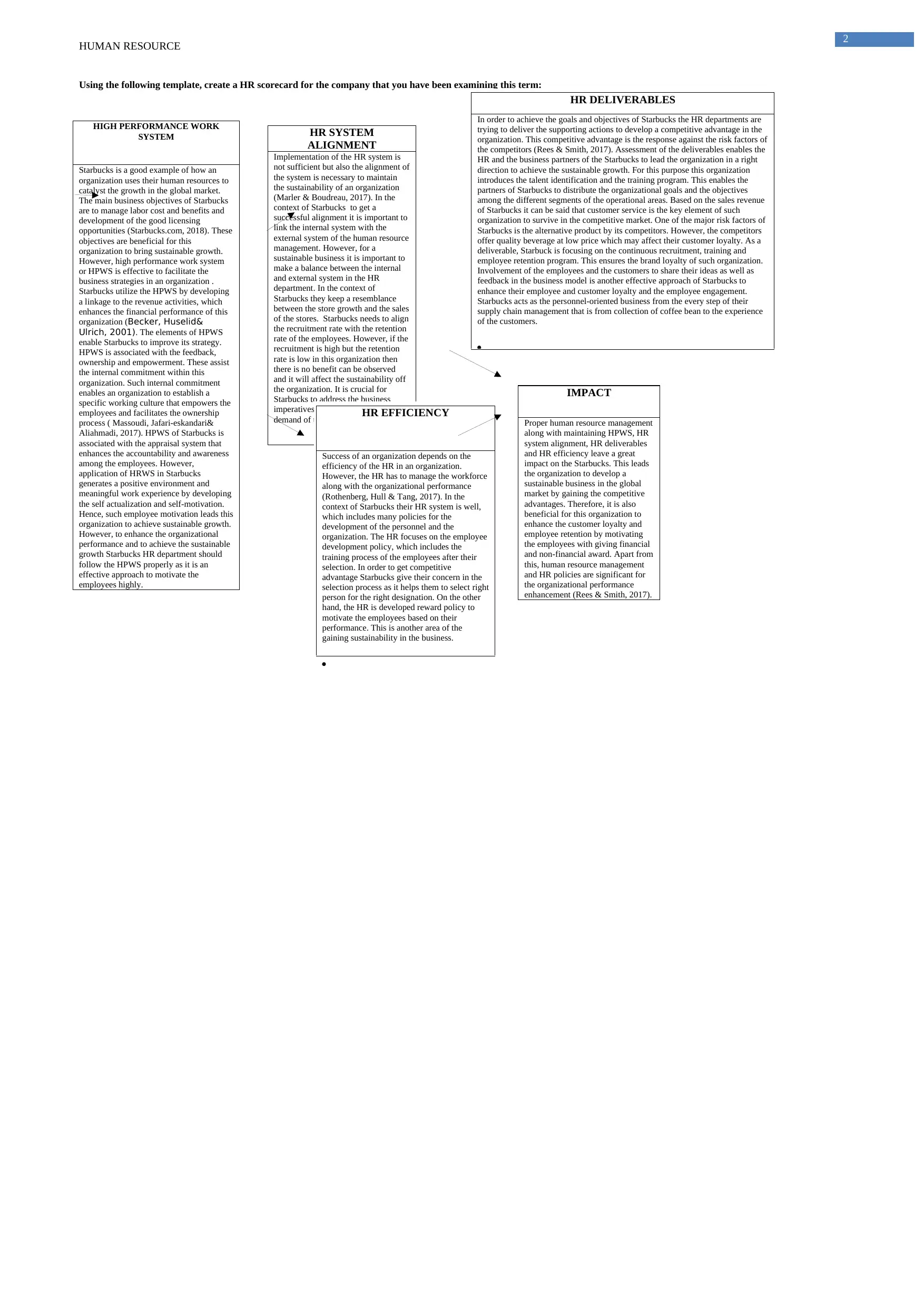
Using the following template, create a HR scorecard for the company that you have been examining this term:
HR SYSTEM
ALIGNMENT
Implementation of the HR system is
not sufficient but also the alignment of
the system is necessary to maintain
the sustainability of an organization
(Marler & Boudreau, 2017). In the
context of Starbucks to get a
successful alignment it is important to
link the internal system with the
external system of the human resource
management. However, for a
sustainable business it is important to
make a balance between the internal
and external system in the HR
department. In the context of
Starbucks they keep a resemblance
between the store growth and the sales
of the stores. Starbucks needs to align
the recruitment rate with the retention
rate of the employees. However, if the
recruitment is high but the retention
rate is low in this organization then
there is no benefit can be observed
and it will affect the sustainability off
the organization. It is crucial for
Starbucks to address the business
imperatives according to the changing
demand of the customers.
HR DELIVERABLES
In order to achieve the goals and objectives of Starbucks the HR departments are
trying to deliver the supporting actions to develop a competitive advantage in the
organization. This competitive advantage is the response against the risk factors of
the competitors (Rees & Smith, 2017). Assessment of the deliverables enables the
HR and the business partners of the Starbucks to lead the organization in a right
direction to achieve the sustainable growth. For this purpose this organization
introduces the talent identification and the training program. This enables the
partners of Starbucks to distribute the organizational goals and the objectives
among the different segments of the operational areas. Based on the sales revenue
of Starbucks it can be said that customer service is the key element of such
organization to survive in the competitive market. One of the major risk factors of
Starbucks is the alternative product by its competitors. However, the competitors
offer quality beverage at low price which may affect their customer loyalty. As a
deliverable, Starbuck is focusing on the continuous recruitment, training and
employee retention program. This ensures the brand loyalty of such organization.
Involvement of the employees and the customers to share their ideas as well as
feedback in the business model is another effective approach of Starbucks to
enhance their employee and customer loyalty and the employee engagement.
Starbucks acts as the personnel-oriented business from the every step of their
supply chain management that is from collection of coffee bean to the experience
of the customers.
HR EFFICIENCY
Success of an organization depends on the
efficiency of the HR in an organization.
However, the HR has to manage the workforce
along with the organizational performance
(Rothenberg, Hull & Tang, 2017). In the
context of Starbucks their HR system is well,
which includes many policies for the
development of the personnel and the
organization. The HR focuses on the employee
development policy, which includes the
training process of the employees after their
selection. In order to get competitive
advantage Starbucks give their concern in the
selection process as it helps them to select right
person for the right designation. On the other
hand, the HR is developed reward policy to
motivate the employees based on their
performance. This is another area of the
gaining sustainability in the business.
IMPACT
Proper human resource management
along with maintaining HPWS, HR
system alignment, HR deliverables
and HR efficiency leave a great
impact on the Starbucks. This leads
the organization to develop a
sustainable business in the global
market by gaining the competitive
advantages. Therefore, it is also
beneficial for this organization to
enhance the customer loyalty and
employee retention by motivating
the employees with giving financial
and non-financial award. Apart from
this, human resource management
and HR policies are significant for
the organizational performance
enhancement (Rees & Smith, 2017).
HIGH PERFORMANCE WORK
SYSTEM
Starbucks is a good example of how an
organization uses their human resources to
catalyst the growth in the global market.
The main business objectives of Starbucks
are to manage labor cost and benefits and
development of the good licensing
opportunities (Starbucks.com, 2018). These
objectives are beneficial for this
organization to bring sustainable growth.
However, high performance work system
or HPWS is effective to facilitate the
business strategies in an organization .
Starbucks utilize the HPWS by developing
a linkage to the revenue activities, which
enhances the financial performance of this
organization (Becker, Huselid&
Ulrich, 2001). The elements of HPWS
enable Starbucks to improve its strategy.
HPWS is associated with the feedback,
ownership and empowerment. These assist
the internal commitment within this
organization. Such internal commitment
enables an organization to establish a
specific working culture that empowers the
employees and facilitates the ownership
process ( Massoudi, Jafari-eskandari&
Aliahmadi, 2017). HPWS of Starbucks is
associated with the appraisal system that
enhances the accountability and awareness
among the employees. However,
application of HRWS in Starbucks
generates a positive environment and
meaningful work experience by developing
the self actualization and self-motivation.
Hence, such employee motivation leads this
organization to achieve sustainable growth.
However, to enhance the organizational
performance and to achieve the sustainable
growth Starbucks HR department should
follow the HPWS properly as it is an
effective approach to motivate the
employees highly.
HUMAN RESOURCE
Using the following template, create a HR scorecard for the company that you have been examining this term:
HR SYSTEM
ALIGNMENT
Implementation of the HR system is
not sufficient but also the alignment of
the system is necessary to maintain
the sustainability of an organization
(Marler & Boudreau, 2017). In the
context of Starbucks to get a
successful alignment it is important to
link the internal system with the
external system of the human resource
management. However, for a
sustainable business it is important to
make a balance between the internal
and external system in the HR
department. In the context of
Starbucks they keep a resemblance
between the store growth and the sales
of the stores. Starbucks needs to align
the recruitment rate with the retention
rate of the employees. However, if the
recruitment is high but the retention
rate is low in this organization then
there is no benefit can be observed
and it will affect the sustainability off
the organization. It is crucial for
Starbucks to address the business
imperatives according to the changing
demand of the customers.
HR DELIVERABLES
In order to achieve the goals and objectives of Starbucks the HR departments are
trying to deliver the supporting actions to develop a competitive advantage in the
organization. This competitive advantage is the response against the risk factors of
the competitors (Rees & Smith, 2017). Assessment of the deliverables enables the
HR and the business partners of the Starbucks to lead the organization in a right
direction to achieve the sustainable growth. For this purpose this organization
introduces the talent identification and the training program. This enables the
partners of Starbucks to distribute the organizational goals and the objectives
among the different segments of the operational areas. Based on the sales revenue
of Starbucks it can be said that customer service is the key element of such
organization to survive in the competitive market. One of the major risk factors of
Starbucks is the alternative product by its competitors. However, the competitors
offer quality beverage at low price which may affect their customer loyalty. As a
deliverable, Starbuck is focusing on the continuous recruitment, training and
employee retention program. This ensures the brand loyalty of such organization.
Involvement of the employees and the customers to share their ideas as well as
feedback in the business model is another effective approach of Starbucks to
enhance their employee and customer loyalty and the employee engagement.
Starbucks acts as the personnel-oriented business from the every step of their
supply chain management that is from collection of coffee bean to the experience
of the customers.
HR EFFICIENCY
Success of an organization depends on the
efficiency of the HR in an organization.
However, the HR has to manage the workforce
along with the organizational performance
(Rothenberg, Hull & Tang, 2017). In the
context of Starbucks their HR system is well,
which includes many policies for the
development of the personnel and the
organization. The HR focuses on the employee
development policy, which includes the
training process of the employees after their
selection. In order to get competitive
advantage Starbucks give their concern in the
selection process as it helps them to select right
person for the right designation. On the other
hand, the HR is developed reward policy to
motivate the employees based on their
performance. This is another area of the
gaining sustainability in the business.
IMPACT
Proper human resource management
along with maintaining HPWS, HR
system alignment, HR deliverables
and HR efficiency leave a great
impact on the Starbucks. This leads
the organization to develop a
sustainable business in the global
market by gaining the competitive
advantages. Therefore, it is also
beneficial for this organization to
enhance the customer loyalty and
employee retention by motivating
the employees with giving financial
and non-financial award. Apart from
this, human resource management
and HR policies are significant for
the organizational performance
enhancement (Rees & Smith, 2017).
HIGH PERFORMANCE WORK
SYSTEM
Starbucks is a good example of how an
organization uses their human resources to
catalyst the growth in the global market.
The main business objectives of Starbucks
are to manage labor cost and benefits and
development of the good licensing
opportunities (Starbucks.com, 2018). These
objectives are beneficial for this
organization to bring sustainable growth.
However, high performance work system
or HPWS is effective to facilitate the
business strategies in an organization .
Starbucks utilize the HPWS by developing
a linkage to the revenue activities, which
enhances the financial performance of this
organization (Becker, Huselid&
Ulrich, 2001). The elements of HPWS
enable Starbucks to improve its strategy.
HPWS is associated with the feedback,
ownership and empowerment. These assist
the internal commitment within this
organization. Such internal commitment
enables an organization to establish a
specific working culture that empowers the
employees and facilitates the ownership
process ( Massoudi, Jafari-eskandari&
Aliahmadi, 2017). HPWS of Starbucks is
associated with the appraisal system that
enhances the accountability and awareness
among the employees. However,
application of HRWS in Starbucks
generates a positive environment and
meaningful work experience by developing
the self actualization and self-motivation.
Hence, such employee motivation leads this
organization to achieve sustainable growth.
However, to enhance the organizational
performance and to achieve the sustainable
growth Starbucks HR department should
follow the HPWS properly as it is an
effective approach to motivate the
employees highly.

3
HUMAN RESOURCE
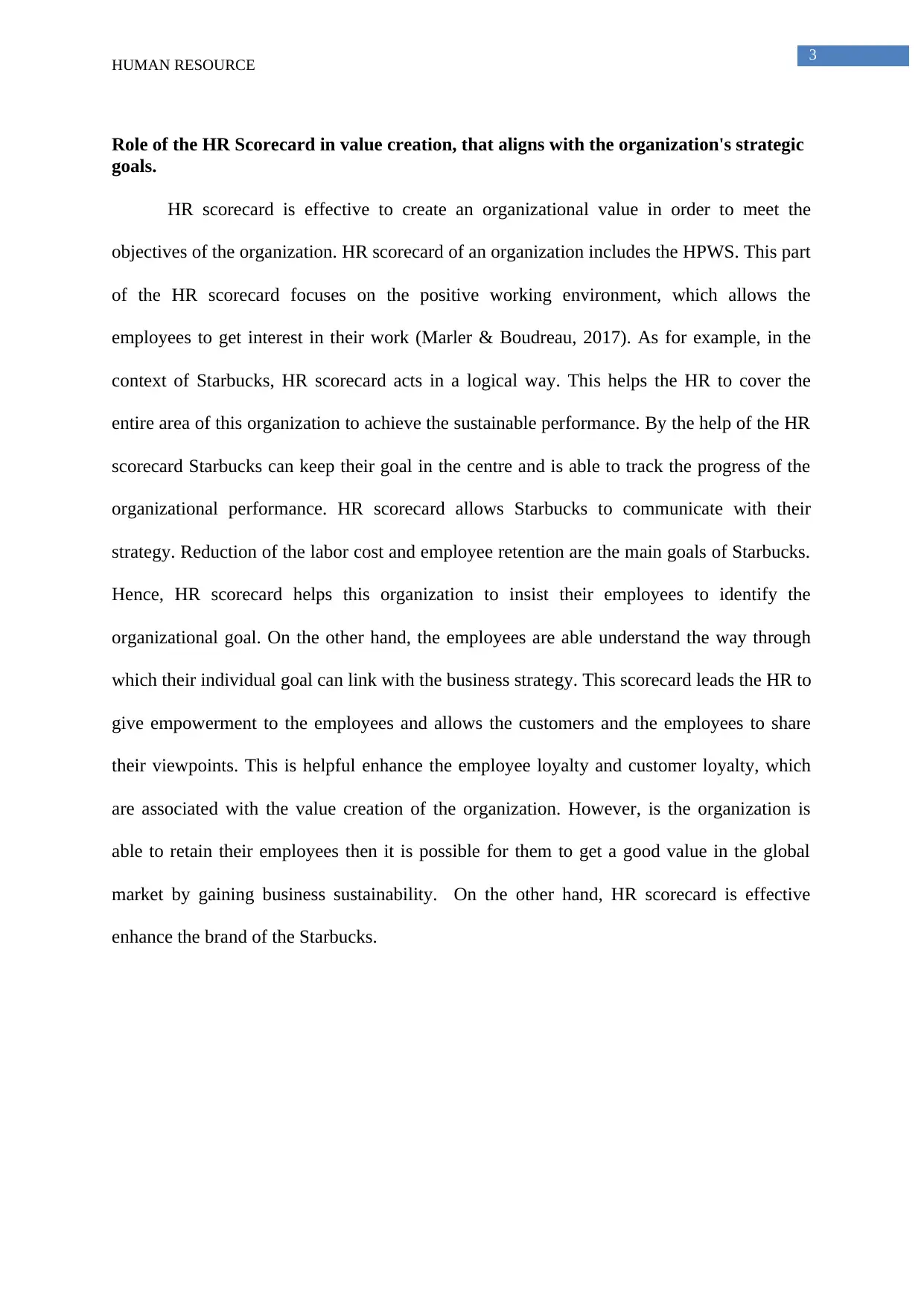
Role of the HR Scorecard in value creation, that aligns with the organization's strategic
goals.
HR scorecard is effective to create an organizational value in order to meet the
objectives of the organization. HR scorecard of an organization includes the HPWS. This part
of the HR scorecard focuses on the positive working environment, which allows the
employees to get interest in their work (Marler & Boudreau, 2017). As for example, in the
context of Starbucks, HR scorecard acts in a logical way. This helps the HR to cover the
entire area of this organization to achieve the sustainable performance. By the help of the HR
scorecard Starbucks can keep their goal in the centre and is able to track the progress of the
organizational performance. HR scorecard allows Starbucks to communicate with their
strategy. Reduction of the labor cost and employee retention are the main goals of Starbucks.
Hence, HR scorecard helps this organization to insist their employees to identify the
organizational goal. On the other hand, the employees are able understand the way through
which their individual goal can link with the business strategy. This scorecard leads the HR to
give empowerment to the employees and allows the customers and the employees to share
their viewpoints. This is helpful enhance the employee loyalty and customer loyalty, which
are associated with the value creation of the organization. However, is the organization is
able to retain their employees then it is possible for them to get a good value in the global
market by gaining business sustainability. On the other hand, HR scorecard is effective
enhance the brand of the Starbucks.
HUMAN RESOURCE
Role of the HR Scorecard in value creation, that aligns with the organization's strategic
goals.
HR scorecard is effective to create an organizational value in order to meet the
objectives of the organization. HR scorecard of an organization includes the HPWS. This part
of the HR scorecard focuses on the positive working environment, which allows the
employees to get interest in their work (Marler & Boudreau, 2017). As for example, in the
context of Starbucks, HR scorecard acts in a logical way. This helps the HR to cover the
entire area of this organization to achieve the sustainable performance. By the help of the HR
scorecard Starbucks can keep their goal in the centre and is able to track the progress of the
organizational performance. HR scorecard allows Starbucks to communicate with their
strategy. Reduction of the labor cost and employee retention are the main goals of Starbucks.
Hence, HR scorecard helps this organization to insist their employees to identify the
organizational goal. On the other hand, the employees are able understand the way through
which their individual goal can link with the business strategy. This scorecard leads the HR to
give empowerment to the employees and allows the customers and the employees to share
their viewpoints. This is helpful enhance the employee loyalty and customer loyalty, which
are associated with the value creation of the organization. However, is the organization is
able to retain their employees then it is possible for them to get a good value in the global
market by gaining business sustainability. On the other hand, HR scorecard is effective
enhance the brand of the Starbucks.
⊘ This is a preview!⊘
Do you want full access?
Subscribe today to unlock all pages.

Trusted by 1+ million students worldwide

4
HUMAN RESOURCE
References
Becker, B., Huselid, M. A., & Ulrich, D. (2001). The HR scorecard: Linking
people, strategy, and performance. Boston, MA: Harvard Business
School Press.
Marler, J.H. & Boudreau, J.W., (2017). An evidence-based review of HR Analytics. The
International Journal of Human Resource Management, 28(1), 3-26.
Massoudi, H. R., Jafari-eskandari, M., & Aliahmadi, A. (2017). REDUCTION IN THE
BALANCED SCORECARD PERFORMANCE MEASUREMENT SYSTEMS IN
MANUFACTURING ORGANIZATIONS BY PCA. Journal of Fundamental and
Applied Sciences, 9(1S), 291-316.
Rees, G., & Smith, P. (Eds.). (2017). Strategic human resource management: An
international perspective. Sage.
Rothenberg, S., Hull, C. E., & Tang, Z. (2017). The impact of human resource management
on corporate social performance strengths and concerns. Business & Society, 56(3),
391-418.
Starbucks.com. (2018). Starbucks. Retrieved 24 January 2018, from www.starbucks.com/
HUMAN RESOURCE
References
Becker, B., Huselid, M. A., & Ulrich, D. (2001). The HR scorecard: Linking
people, strategy, and performance. Boston, MA: Harvard Business
School Press.
Marler, J.H. & Boudreau, J.W., (2017). An evidence-based review of HR Analytics. The
International Journal of Human Resource Management, 28(1), 3-26.
Massoudi, H. R., Jafari-eskandari, M., & Aliahmadi, A. (2017). REDUCTION IN THE
BALANCED SCORECARD PERFORMANCE MEASUREMENT SYSTEMS IN
MANUFACTURING ORGANIZATIONS BY PCA. Journal of Fundamental and
Applied Sciences, 9(1S), 291-316.
Rees, G., & Smith, P. (Eds.). (2017). Strategic human resource management: An
international perspective. Sage.
Rothenberg, S., Hull, C. E., & Tang, Z. (2017). The impact of human resource management
on corporate social performance strengths and concerns. Business & Society, 56(3),
391-418.
Starbucks.com. (2018). Starbucks. Retrieved 24 January 2018, from www.starbucks.com/
1 out of 4
Related Documents
Your All-in-One AI-Powered Toolkit for Academic Success.
+13062052269
info@desklib.com
Available 24*7 on WhatsApp / Email
Unlock your academic potential
Copyright © 2020–2025 A2Z Services. All Rights Reserved. Developed and managed by ZUCOL.