Human Resource Development Report: Learning and Training Analysis
VerifiedAdded on 2020/06/06
|12
|3797
|314
Report
AI Summary
This report provides a comprehensive analysis of human resource development (HRD) practices, focusing on learning styles, training methods, and competency development within Sun Court Ltd. The report begins by comparing different learning styles, including David Kolb's model, Honey and Mumford, and cognitive learning theory, highlighting their roles in skill acquisition. It then explores the importance of the learning curve and knowledge transfer, examining how these elements contribute to employee satisfaction and operational efficiency. The report further assesses the contribution of various learning models and theories in planning and designing effective learning events. It also compares the training needs of employees at different levels, evaluating the advantages and disadvantages of different training methods, such as on-the-job and mixed training approaches. A systematic approach to planning training and development events is outlined, emphasizing the importance of setting company aims, assessing training needs, and designing and executing training programs. The report concludes with an evaluation of training events, examining the role of government in training and lifelong learning, the development of the competency movement, and the contribution of contemporary training initiatives in HRD. This report aims to provide insights into effective HRD strategies and their practical application within an organization.

Human Resource
Development
Development

Paraphrase This Document
Need a fresh take? Get an instant paraphrase of this document with our AI Paraphraser

Table of Contents
INTRODUCTION...........................................................................................................................1
TASK 1 ...........................................................................................................................................1
1.1 Comparison between different learning styles......................................................................1
1.2 Role of learning curve & the importance of transferring learning........................................2
1.3 Assessment of the contribution of learning models and theories in planning and designing
a learning event...........................................................................................................................3
TASK 2 ...........................................................................................................................................4
2.1 Comparison among training needs of employees at different levels....................................4
2.2 The advantages and disadvantages of training methods......................................................4
2.3 Systematic approaches to plan a training and development event........................................5
TASK 3 ..........................................................................................................................................6
3.1 Preparation of an evaluation..................................................................................................6
3.2 Evaluation of the training event............................................................................................6
3.3 Reviewing the success of evaluation method........................................................................7
TASK 4 ...........................................................................................................................................7
4.1 Role of government in training and life long learning..........................................................7
4.2 Development of competency movement and its impact on private and public sector..........8
4.3 Contribution of contemporary training initiatives in human resources development.........8
CONCLUSION ...............................................................................................................................9
REFERENCES..............................................................................................................................10
INTRODUCTION...........................................................................................................................1
TASK 1 ...........................................................................................................................................1
1.1 Comparison between different learning styles......................................................................1
1.2 Role of learning curve & the importance of transferring learning........................................2
1.3 Assessment of the contribution of learning models and theories in planning and designing
a learning event...........................................................................................................................3
TASK 2 ...........................................................................................................................................4
2.1 Comparison among training needs of employees at different levels....................................4
2.2 The advantages and disadvantages of training methods......................................................4
2.3 Systematic approaches to plan a training and development event........................................5
TASK 3 ..........................................................................................................................................6
3.1 Preparation of an evaluation..................................................................................................6
3.2 Evaluation of the training event............................................................................................6
3.3 Reviewing the success of evaluation method........................................................................7
TASK 4 ...........................................................................................................................................7
4.1 Role of government in training and life long learning..........................................................7
4.2 Development of competency movement and its impact on private and public sector..........8
4.3 Contribution of contemporary training initiatives in human resources development.........8
CONCLUSION ...............................................................................................................................9
REFERENCES..............................................................................................................................10
INTRODUCTION
Human resource development is a vast concept, which plays most essential role at work
place. This concept s widely concern on providing education and training to their employees in
order to developing skills and knowledge (Bamberger, Biron and Meshoulam, 2014). Sun Court
Ltd. Is the chosen company for this particular research and the company deals in property
management firm. This report contents the study about different learning styles, their role and
importance of transferring learning. different needs of training, advantages and disadvantage of
various training methods, suitable techniques of learning styles will also be discussed in detailed
manner. Development of competency movement and its impact on public and private sector will
also be explained in effective and efficient manner.
TASK 1
1.1 Comparison between different learning styles.
Learning styles can be described as a way in which people acquire various skills and
capabilities. In this modern era competition is so high, so it is required for each business
organisation to develop various rules and policies in order to gain high competitive edge. People
react differently on different situations and their reaction is based on their behaviour. Manager
and higher authority of Sun Court Ltd apply different learning styles in order to improving skills
and ability of employees at work place. There are various learning styles in which some are
evaluated as under:
David Kolb's model:
This can be considered as the most effective model of leadership style as this model
includes different internal aspects of learning along with the VARK model. In this model various
processing and perception are taken into proper consideration. This model is categorised among
four major stages, which are as under:
In this model experience can be considered as the firs teacher of each individual.
In the second stage assessment of experience is taken into proper consideration.
In the third stage experience can be considered as the example while facing similar kind
of situation (Barney, Ketchen and Wright, 2011). The final stage is related with active experimentation, as the pas experience is turned as
an effective theory which can be applied by individual in their future learning.
1
Human resource development is a vast concept, which plays most essential role at work
place. This concept s widely concern on providing education and training to their employees in
order to developing skills and knowledge (Bamberger, Biron and Meshoulam, 2014). Sun Court
Ltd. Is the chosen company for this particular research and the company deals in property
management firm. This report contents the study about different learning styles, their role and
importance of transferring learning. different needs of training, advantages and disadvantage of
various training methods, suitable techniques of learning styles will also be discussed in detailed
manner. Development of competency movement and its impact on public and private sector will
also be explained in effective and efficient manner.
TASK 1
1.1 Comparison between different learning styles.
Learning styles can be described as a way in which people acquire various skills and
capabilities. In this modern era competition is so high, so it is required for each business
organisation to develop various rules and policies in order to gain high competitive edge. People
react differently on different situations and their reaction is based on their behaviour. Manager
and higher authority of Sun Court Ltd apply different learning styles in order to improving skills
and ability of employees at work place. There are various learning styles in which some are
evaluated as under:
David Kolb's model:
This can be considered as the most effective model of leadership style as this model
includes different internal aspects of learning along with the VARK model. In this model various
processing and perception are taken into proper consideration. This model is categorised among
four major stages, which are as under:
In this model experience can be considered as the firs teacher of each individual.
In the second stage assessment of experience is taken into proper consideration.
In the third stage experience can be considered as the example while facing similar kind
of situation (Barney, Ketchen and Wright, 2011). The final stage is related with active experimentation, as the pas experience is turned as
an effective theory which can be applied by individual in their future learning.
1
⊘ This is a preview!⊘
Do you want full access?
Subscribe today to unlock all pages.

Trusted by 1+ million students worldwide
Honey and Mumford: This model is propounded just for overcoming the weaknesses of Kolb's
model. This model also consist four major stages in which first stage occurs when an individual
is exposed to any situation and then people communicate about their views on the same
circumstance. This stage is widely concern on evaluation of the situation. Each individual
employ their objectives and goals which are accumulated by the experience and in this the next
step which are taken by individual are designed.
Cognitive learning theory: This theory is based on observation, assumption and perception. As
per this theory brain can be considered as the most incredible part through which each individual
can process any data or information. This theory implies that manager can analyse the behaviour
and mentality of individual through applying diverse method of learning.
1.2 Role of learning curve & the importance of transferring learning.
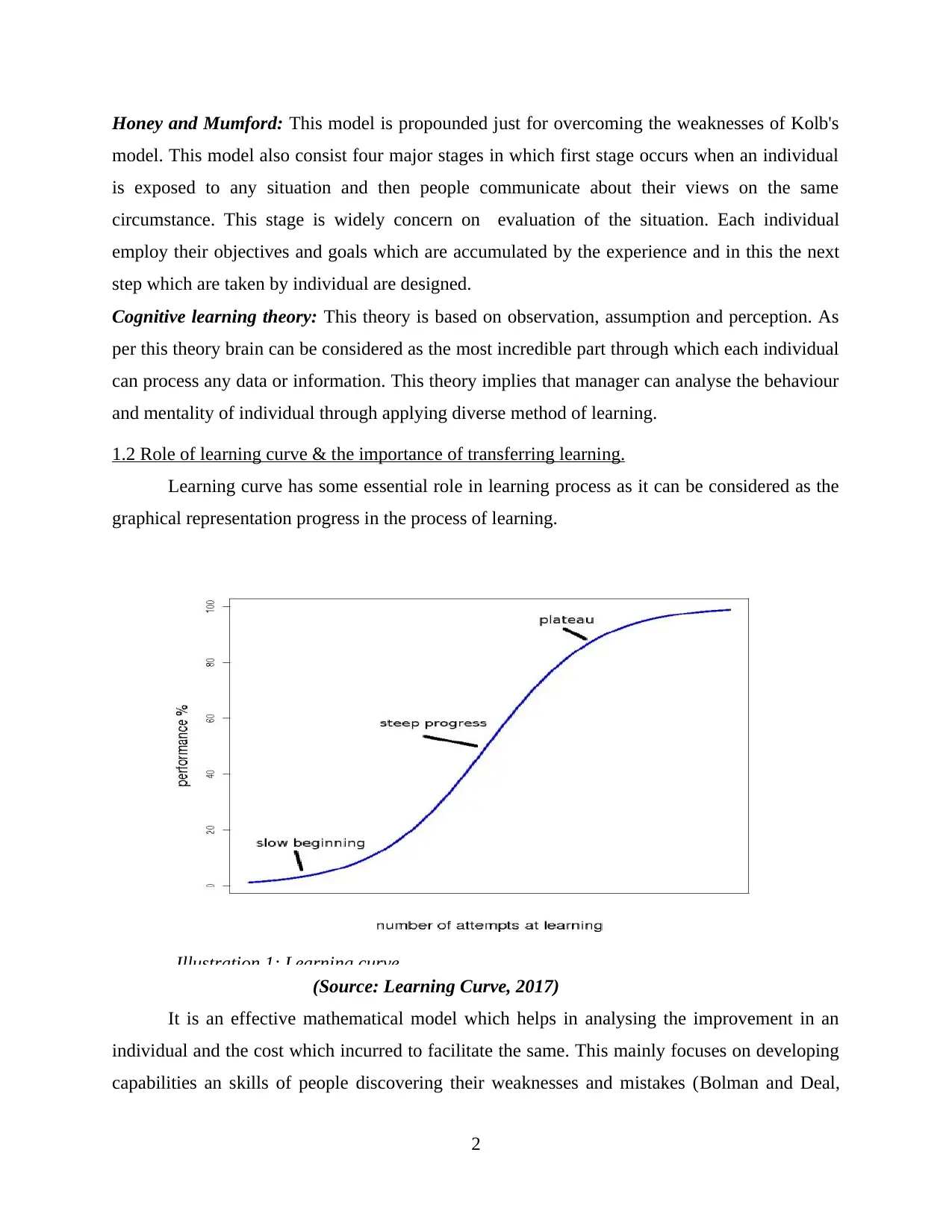
Learning curve has some essential role in learning process as it can be considered as the
graphical representation progress in the process of learning.
(Source: Learning Curve, 2017)
It is an effective mathematical model which helps in analysing the improvement in an
individual and the cost which incurred to facilitate the same. This mainly focuses on developing
capabilities an skills of people discovering their weaknesses and mistakes (Bolman and Deal,
2
Illustration 1: Learning curve
model. This model also consist four major stages in which first stage occurs when an individual
is exposed to any situation and then people communicate about their views on the same
circumstance. This stage is widely concern on evaluation of the situation. Each individual
employ their objectives and goals which are accumulated by the experience and in this the next
step which are taken by individual are designed.
Cognitive learning theory: This theory is based on observation, assumption and perception. As
per this theory brain can be considered as the most incredible part through which each individual
can process any data or information. This theory implies that manager can analyse the behaviour
and mentality of individual through applying diverse method of learning.
1.2 Role of learning curve & the importance of transferring learning.
Learning curve has some essential role in learning process as it can be considered as the
graphical representation progress in the process of learning.
(Source: Learning Curve, 2017)
It is an effective mathematical model which helps in analysing the improvement in an
individual and the cost which incurred to facilitate the same. This mainly focuses on developing
capabilities an skills of people discovering their weaknesses and mistakes (Bolman and Deal,
2
Illustration 1: Learning curve
Paraphrase This Document
Need a fresh take? Get an instant paraphrase of this document with our AI Paraphraser
2017). The manager and higher authority of Sun Court Ltd. Apply various learning styles in
respect to attaining high growth and objectives through developing their performance and
productivity. In an organisation learning curve is used by employer in order to analyse
performance and growth of learners. Which is a graphical representation which states the
relationship between time spend and the given duration of time which is given by firm to their
employees.
Importance of transfer learning at workplace described as below:
Employees satisfaction: With the help of effective learning process employees sharpening their
skills and their satisfaction level will increased (Boxall and Purcell, 2011).
Value addition: Incorporation of training session at work place helps in creating value for
company. This consist the result through enhancing the performance of employees.
Operational efficiency: With the help of developing skills and ability an individual can perform
with more passion and contribute their best efforts in improving organisational performance.
1.3 Assessment of the contribution of learning models and theories in planning and designing a
learning event.
Learning models consist as crucial elements of firm which can be performed by managers
in order to developing organisational performance. The models and theories are helpful in
providing proper assistance to managers. The performance of individual can be analysed through
mathematical graphs and the major focused area of each business organisation is to providing
proper training function to their employees in respect to enhancing their skills and ability to
perform any task. It is the major responsibility of manager is to select the most suitable learning
theory for attempting various requirements and circumstance of firm.
Relation between theories and models of learning:
In an organisation managers plays effective role in adopting significant model and theory
of learning in order to developing skills and knowledge of employees at work place. The
manager of Sun Court Ltd. Is mainly concern on applying most suitable tool and techniques for
developing the ability of employees for performing any task (Bray and et. al., 2012). It is too
challenging for managers to select a particular learning style as all of them has its own goals and
objectives. The combination of different learning styles will help in planning and designing
impressive training and development events for new and existing employees. Sun Court Ltd. Is
3
respect to attaining high growth and objectives through developing their performance and
productivity. In an organisation learning curve is used by employer in order to analyse
performance and growth of learners. Which is a graphical representation which states the
relationship between time spend and the given duration of time which is given by firm to their
employees.
Importance of transfer learning at workplace described as below:
Employees satisfaction: With the help of effective learning process employees sharpening their
skills and their satisfaction level will increased (Boxall and Purcell, 2011).
Value addition: Incorporation of training session at work place helps in creating value for
company. This consist the result through enhancing the performance of employees.
Operational efficiency: With the help of developing skills and ability an individual can perform
with more passion and contribute their best efforts in improving organisational performance.
1.3 Assessment of the contribution of learning models and theories in planning and designing a
learning event.
Learning models consist as crucial elements of firm which can be performed by managers
in order to developing organisational performance. The models and theories are helpful in
providing proper assistance to managers. The performance of individual can be analysed through
mathematical graphs and the major focused area of each business organisation is to providing
proper training function to their employees in respect to enhancing their skills and ability to
perform any task. It is the major responsibility of manager is to select the most suitable learning
theory for attempting various requirements and circumstance of firm.
Relation between theories and models of learning:
In an organisation managers plays effective role in adopting significant model and theory
of learning in order to developing skills and knowledge of employees at work place. The
manager of Sun Court Ltd. Is mainly concern on applying most suitable tool and techniques for
developing the ability of employees for performing any task (Bray and et. al., 2012). It is too
challenging for managers to select a particular learning style as all of them has its own goals and
objectives. The combination of different learning styles will help in planning and designing
impressive training and development events for new and existing employees. Sun Court Ltd. Is
3
widely focused on developing the skills of employees such as the ability of decision making,
leadership, technical skills, teamwork, efficiency, increasing responsibilities and many other.
TASK 2
2.1 Comparison among training needs of employees at different levels.
In this modern competitive era training is required for each business organisation as it
helps in developing the skills and ability of employees at work place. In Sun Court Ltd the staff
member operating at various levels and have different needs of training as per the requirement of
department (Brewster and Hegewisch, 2017). The whole work of organisation is categorised
among three different levels, people 'R' Us have to explicate the program of development which
relicts all the three levels in to proper consideration, the need of training in different levels are
determined as below: Top level management: This level involves the senior authority and managers of Sun
Court Ltd. This section of firm perform the responsibility of designing the policies and
programs for organisation and employees. In this department training is required for
creating proper understanding of organisational environment as the higher authority is
responsible for formulating goals and objectives of firm. Middle level management: In this section managers and supervisors are involved, the
major task which is performed by them is to execute the policies in to proper and well
planned manner. Training is required is this section as to improving the skills or
managers in order to creating an effective plan in which all business activities are
accumulated in well planned manner.
Lower level management: In this employees and lower level staff are involved. In this
department on the job training is provided by the company in order to getting things done
on effective and efficient direction.
2.2 The advantages and disadvantages of training methods.
The training methods can be considered as the approaches by which the skills and ability
of employees are enhanced (Yuan and Yu, 2012). Training methods has some advantages and
disadvantage, the Sun Court Ltd. Use various training methods which are described as under:
Training
methods
Advantages Disadvantages
4
leadership, technical skills, teamwork, efficiency, increasing responsibilities and many other.
TASK 2
2.1 Comparison among training needs of employees at different levels.
In this modern competitive era training is required for each business organisation as it
helps in developing the skills and ability of employees at work place. In Sun Court Ltd the staff
member operating at various levels and have different needs of training as per the requirement of
department (Brewster and Hegewisch, 2017). The whole work of organisation is categorised
among three different levels, people 'R' Us have to explicate the program of development which
relicts all the three levels in to proper consideration, the need of training in different levels are
determined as below: Top level management: This level involves the senior authority and managers of Sun
Court Ltd. This section of firm perform the responsibility of designing the policies and
programs for organisation and employees. In this department training is required for
creating proper understanding of organisational environment as the higher authority is
responsible for formulating goals and objectives of firm. Middle level management: In this section managers and supervisors are involved, the
major task which is performed by them is to execute the policies in to proper and well
planned manner. Training is required is this section as to improving the skills or
managers in order to creating an effective plan in which all business activities are
accumulated in well planned manner.
Lower level management: In this employees and lower level staff are involved. In this
department on the job training is provided by the company in order to getting things done
on effective and efficient direction.
2.2 The advantages and disadvantages of training methods.
The training methods can be considered as the approaches by which the skills and ability
of employees are enhanced (Yuan and Yu, 2012). Training methods has some advantages and
disadvantage, the Sun Court Ltd. Use various training methods which are described as under:
Training
methods
Advantages Disadvantages
4
⊘ This is a preview!⊘
Do you want full access?
Subscribe today to unlock all pages.
Trusted by 1+ million students worldwide
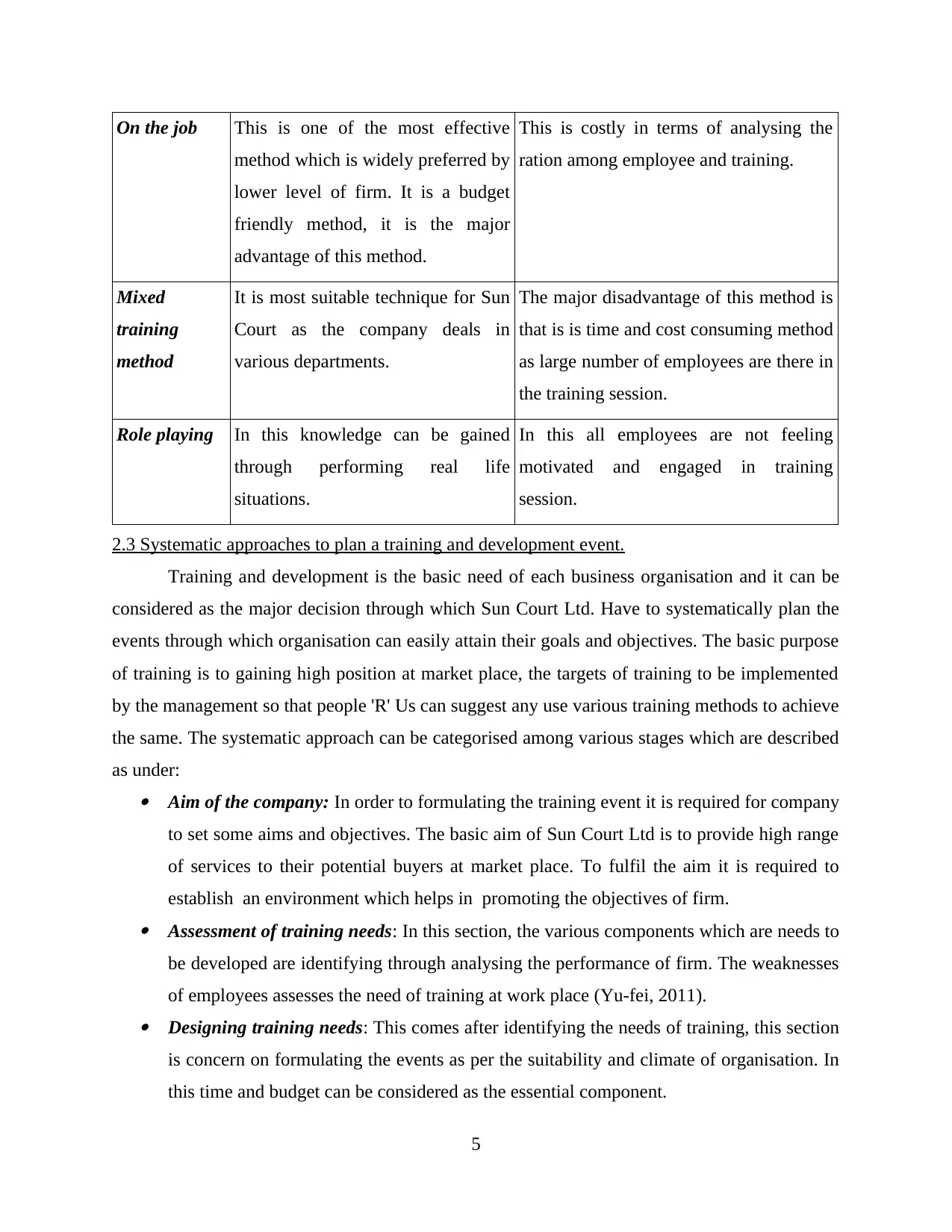
On the job This is one of the most effective
method which is widely preferred by
lower level of firm. It is a budget
friendly method, it is the major
advantage of this method.
This is costly in terms of analysing the
ration among employee and training.
Mixed
training
method
It is most suitable technique for Sun
Court as the company deals in
various departments.
The major disadvantage of this method is
that is is time and cost consuming method
as large number of employees are there in
the training session.
Role playing In this knowledge can be gained
through performing real life
situations.
In this all employees are not feeling
motivated and engaged in training
session.
2.3 Systematic approaches to plan a training and development event.
Training and development is the basic need of each business organisation and it can be
considered as the major decision through which Sun Court Ltd. Have to systematically plan the
events through which organisation can easily attain their goals and objectives. The basic purpose
of training is to gaining high position at market place, the targets of training to be implemented
by the management so that people 'R' Us can suggest any use various training methods to achieve
the same. The systematic approach can be categorised among various stages which are described
as under: Aim of the company: In order to formulating the training event it is required for company
to set some aims and objectives. The basic aim of Sun Court Ltd is to provide high range
of services to their potential buyers at market place. To fulfil the aim it is required to
establish an environment which helps in promoting the objectives of firm. Assessment of training needs: In this section, the various components which are needs to
be developed are identifying through analysing the performance of firm. The weaknesses
of employees assesses the need of training at work place (Yu-fei, 2011). Designing training needs: This comes after identifying the needs of training, this section
is concern on formulating the events as per the suitability and climate of organisation. In
this time and budget can be considered as the essential component.
5
method which is widely preferred by
lower level of firm. It is a budget
friendly method, it is the major
advantage of this method.
This is costly in terms of analysing the
ration among employee and training.
Mixed
training
method
It is most suitable technique for Sun
Court as the company deals in
various departments.
The major disadvantage of this method is
that is is time and cost consuming method
as large number of employees are there in
the training session.
Role playing In this knowledge can be gained
through performing real life
situations.
In this all employees are not feeling
motivated and engaged in training
session.
2.3 Systematic approaches to plan a training and development event.
Training and development is the basic need of each business organisation and it can be
considered as the major decision through which Sun Court Ltd. Have to systematically plan the
events through which organisation can easily attain their goals and objectives. The basic purpose
of training is to gaining high position at market place, the targets of training to be implemented
by the management so that people 'R' Us can suggest any use various training methods to achieve
the same. The systematic approach can be categorised among various stages which are described
as under: Aim of the company: In order to formulating the training event it is required for company
to set some aims and objectives. The basic aim of Sun Court Ltd is to provide high range
of services to their potential buyers at market place. To fulfil the aim it is required to
establish an environment which helps in promoting the objectives of firm. Assessment of training needs: In this section, the various components which are needs to
be developed are identifying through analysing the performance of firm. The weaknesses
of employees assesses the need of training at work place (Yu-fei, 2011). Designing training needs: This comes after identifying the needs of training, this section
is concern on formulating the events as per the suitability and climate of organisation. In
this time and budget can be considered as the essential component.
5
Paraphrase This Document
Need a fresh take? Get an instant paraphrase of this document with our AI Paraphraser
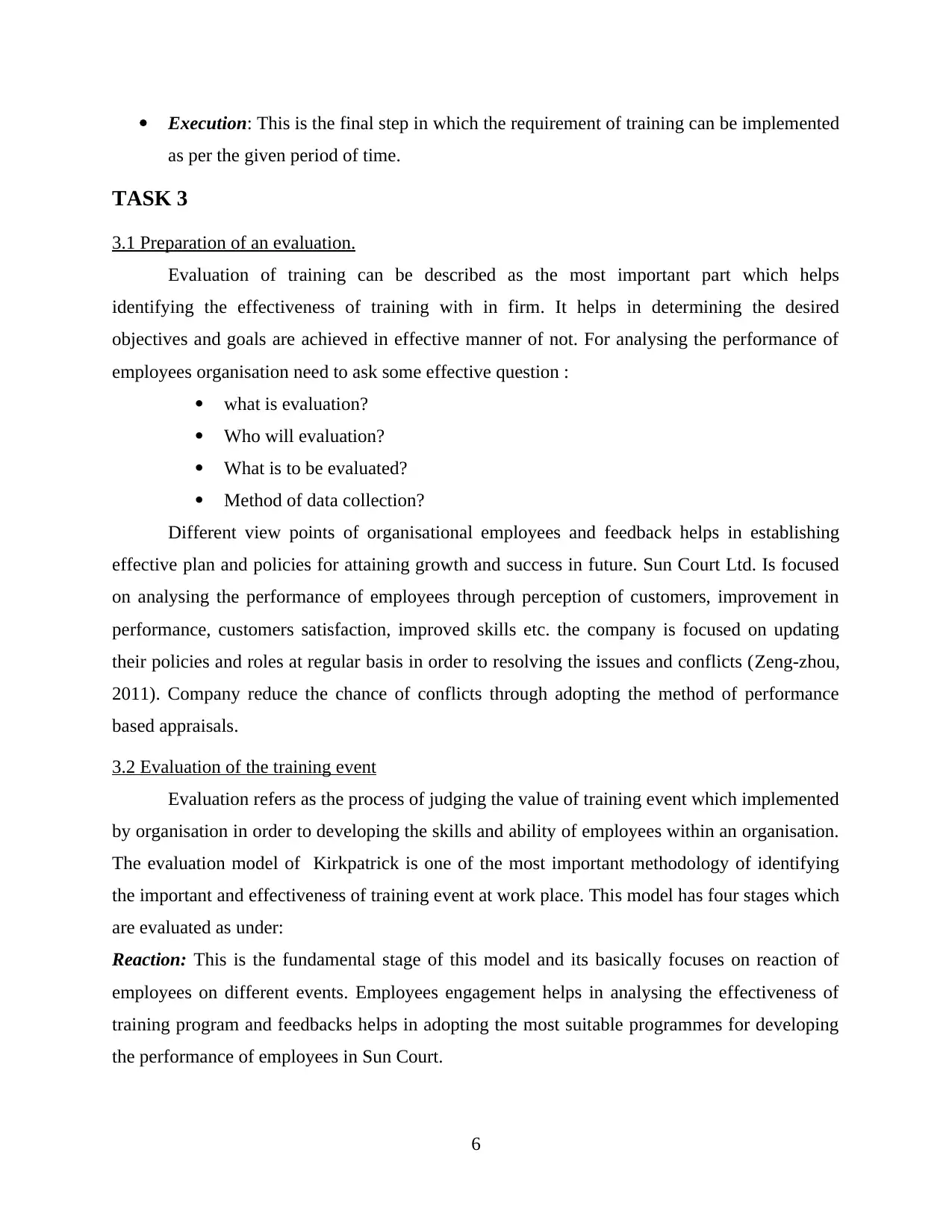
Execution: This is the final step in which the requirement of training can be implemented
as per the given period of time.
TASK 3
3.1 Preparation of an evaluation.
Evaluation of training can be described as the most important part which helps
identifying the effectiveness of training with in firm. It helps in determining the desired
objectives and goals are achieved in effective manner of not. For analysing the performance of
employees organisation need to ask some effective question :
what is evaluation?
Who will evaluation?
What is to be evaluated?
Method of data collection?
Different view points of organisational employees and feedback helps in establishing
effective plan and policies for attaining growth and success in future. Sun Court Ltd. Is focused
on analysing the performance of employees through perception of customers, improvement in
performance, customers satisfaction, improved skills etc. the company is focused on updating
their policies and roles at regular basis in order to resolving the issues and conflicts (Zeng-zhou,
2011). Company reduce the chance of conflicts through adopting the method of performance
based appraisals.
3.2 Evaluation of the training event
Evaluation refers as the process of judging the value of training event which implemented
by organisation in order to developing the skills and ability of employees within an organisation.
The evaluation model of Kirkpatrick is one of the most important methodology of identifying
the important and effectiveness of training event at work place. This model has four stages which
are evaluated as under:
Reaction: This is the fundamental stage of this model and its basically focuses on reaction of
employees on different events. Employees engagement helps in analysing the effectiveness of
training program and feedbacks helps in adopting the most suitable programmes for developing
the performance of employees in Sun Court.
6
as per the given period of time.
TASK 3
3.1 Preparation of an evaluation.
Evaluation of training can be described as the most important part which helps
identifying the effectiveness of training with in firm. It helps in determining the desired
objectives and goals are achieved in effective manner of not. For analysing the performance of
employees organisation need to ask some effective question :
what is evaluation?
Who will evaluation?
What is to be evaluated?
Method of data collection?
Different view points of organisational employees and feedback helps in establishing
effective plan and policies for attaining growth and success in future. Sun Court Ltd. Is focused
on analysing the performance of employees through perception of customers, improvement in
performance, customers satisfaction, improved skills etc. the company is focused on updating
their policies and roles at regular basis in order to resolving the issues and conflicts (Zeng-zhou,
2011). Company reduce the chance of conflicts through adopting the method of performance
based appraisals.
3.2 Evaluation of the training event
Evaluation refers as the process of judging the value of training event which implemented
by organisation in order to developing the skills and ability of employees within an organisation.
The evaluation model of Kirkpatrick is one of the most important methodology of identifying
the important and effectiveness of training event at work place. This model has four stages which
are evaluated as under:
Reaction: This is the fundamental stage of this model and its basically focuses on reaction of
employees on different events. Employees engagement helps in analysing the effectiveness of
training program and feedbacks helps in adopting the most suitable programmes for developing
the performance of employees in Sun Court.
6
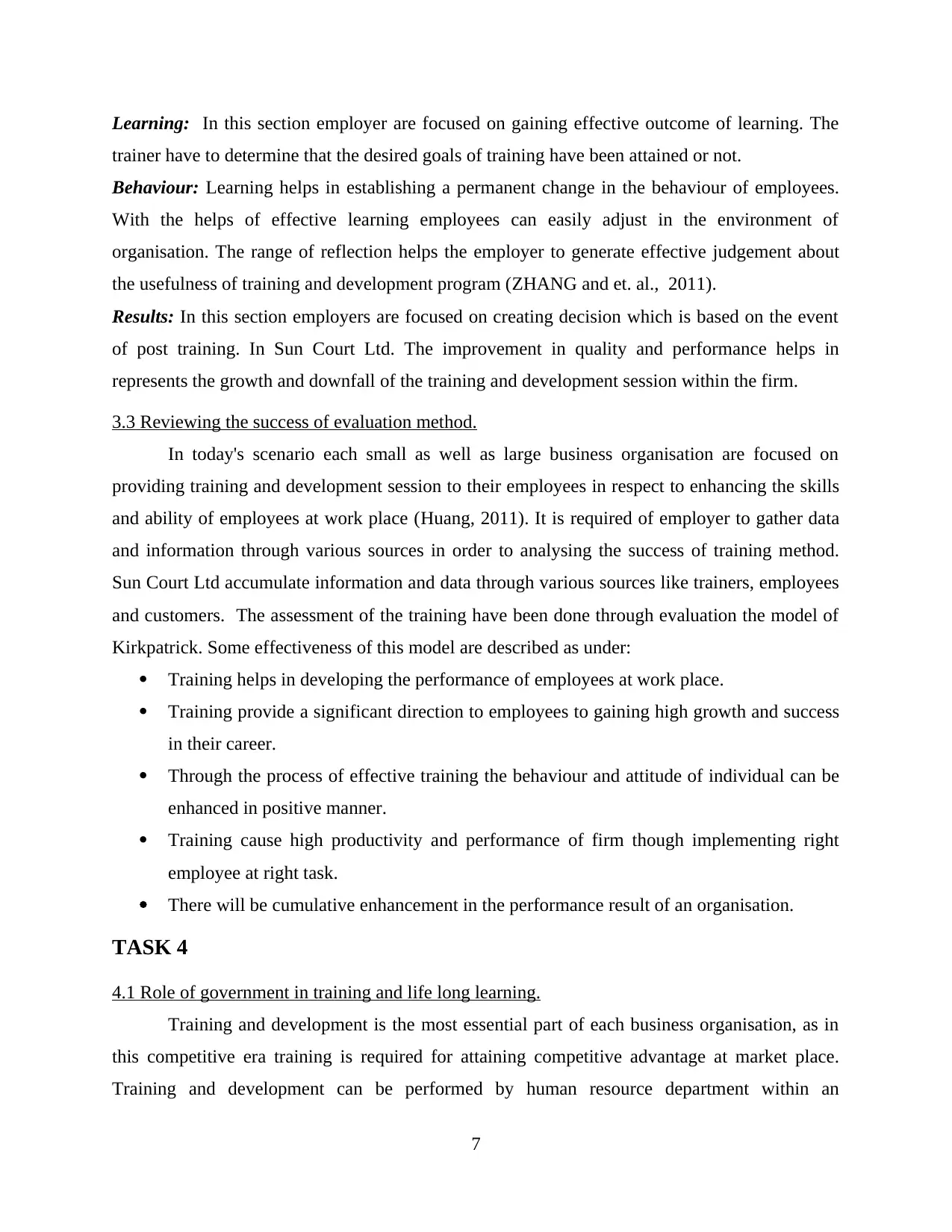
Learning: In this section employer are focused on gaining effective outcome of learning. The
trainer have to determine that the desired goals of training have been attained or not.
Behaviour: Learning helps in establishing a permanent change in the behaviour of employees.
With the helps of effective learning employees can easily adjust in the environment of
organisation. The range of reflection helps the employer to generate effective judgement about
the usefulness of training and development program (ZHANG and et. al., 2011).
Results: In this section employers are focused on creating decision which is based on the event
of post training. In Sun Court Ltd. The improvement in quality and performance helps in
represents the growth and downfall of the training and development session within the firm.
3.3 Reviewing the success of evaluation method.
In today's scenario each small as well as large business organisation are focused on
providing training and development session to their employees in respect to enhancing the skills
and ability of employees at work place (Huang, 2011). It is required of employer to gather data
and information through various sources in order to analysing the success of training method.
Sun Court Ltd accumulate information and data through various sources like trainers, employees
and customers. The assessment of the training have been done through evaluation the model of
Kirkpatrick. Some effectiveness of this model are described as under:
Training helps in developing the performance of employees at work place.
Training provide a significant direction to employees to gaining high growth and success
in their career.
Through the process of effective training the behaviour and attitude of individual can be
enhanced in positive manner.
Training cause high productivity and performance of firm though implementing right
employee at right task.
There will be cumulative enhancement in the performance result of an organisation.
TASK 4
4.1 Role of government in training and life long learning.
Training and development is the most essential part of each business organisation, as in
this competitive era training is required for attaining competitive advantage at market place.
Training and development can be performed by human resource department within an
7
trainer have to determine that the desired goals of training have been attained or not.
Behaviour: Learning helps in establishing a permanent change in the behaviour of employees.
With the helps of effective learning employees can easily adjust in the environment of
organisation. The range of reflection helps the employer to generate effective judgement about
the usefulness of training and development program (ZHANG and et. al., 2011).
Results: In this section employers are focused on creating decision which is based on the event
of post training. In Sun Court Ltd. The improvement in quality and performance helps in
represents the growth and downfall of the training and development session within the firm.
3.3 Reviewing the success of evaluation method.
In today's scenario each small as well as large business organisation are focused on
providing training and development session to their employees in respect to enhancing the skills
and ability of employees at work place (Huang, 2011). It is required of employer to gather data
and information through various sources in order to analysing the success of training method.
Sun Court Ltd accumulate information and data through various sources like trainers, employees
and customers. The assessment of the training have been done through evaluation the model of
Kirkpatrick. Some effectiveness of this model are described as under:
Training helps in developing the performance of employees at work place.
Training provide a significant direction to employees to gaining high growth and success
in their career.
Through the process of effective training the behaviour and attitude of individual can be
enhanced in positive manner.
Training cause high productivity and performance of firm though implementing right
employee at right task.
There will be cumulative enhancement in the performance result of an organisation.
TASK 4
4.1 Role of government in training and life long learning.
Training and development is the most essential part of each business organisation, as in
this competitive era training is required for attaining competitive advantage at market place.
Training and development can be performed by human resource department within an
7
⊘ This is a preview!⊘
Do you want full access?
Subscribe today to unlock all pages.
Trusted by 1+ million students worldwide
organisation. It helps in providing professional and personal development to each individual who
are contributing their significant efforts at work place. The government of United Kingdom
provide significant support to the training and life long learning in a firm. Government is also
focused on promoting youth or people for contributing their best efforts in growth of economy.
Government assist some laws and legislations which helps in promoting learning and training
within country (Jian-hua, and Ruo-gang, 2012). Government provide some effective acts such as
no discrimination and employment act, equality act, performance management act etc. in order to
promoting life long learning within an organisation.
4.2 Development of competency movement and its impact on private and public sector.
Competency movement can be considered as the most effective movement which focuses
on identifying the performance gap among two business firm. In this competitive world private
sector is more concern on investing high amount in attaining higher position at market place. The
most recent conference on competency was held in the year of 1998 which experienced a
presence of approximate 600 delegates from public as well as private sector. The management
consist the link between performance management and competency management. Competency
can be considered as the skills and ability of an individual to perform any task and duty which
are assigned by the organisation in order to attaining desired goals and objectives. As a private
company Sun Court Ltd have implemented competency management in their culture and
working environment. The training programs are formulated for bridge the gap between
employees performance within a firm. The manager of firm are widely focused on establishing
an effective working environment in order to enhancing the performance of employees at work
place.
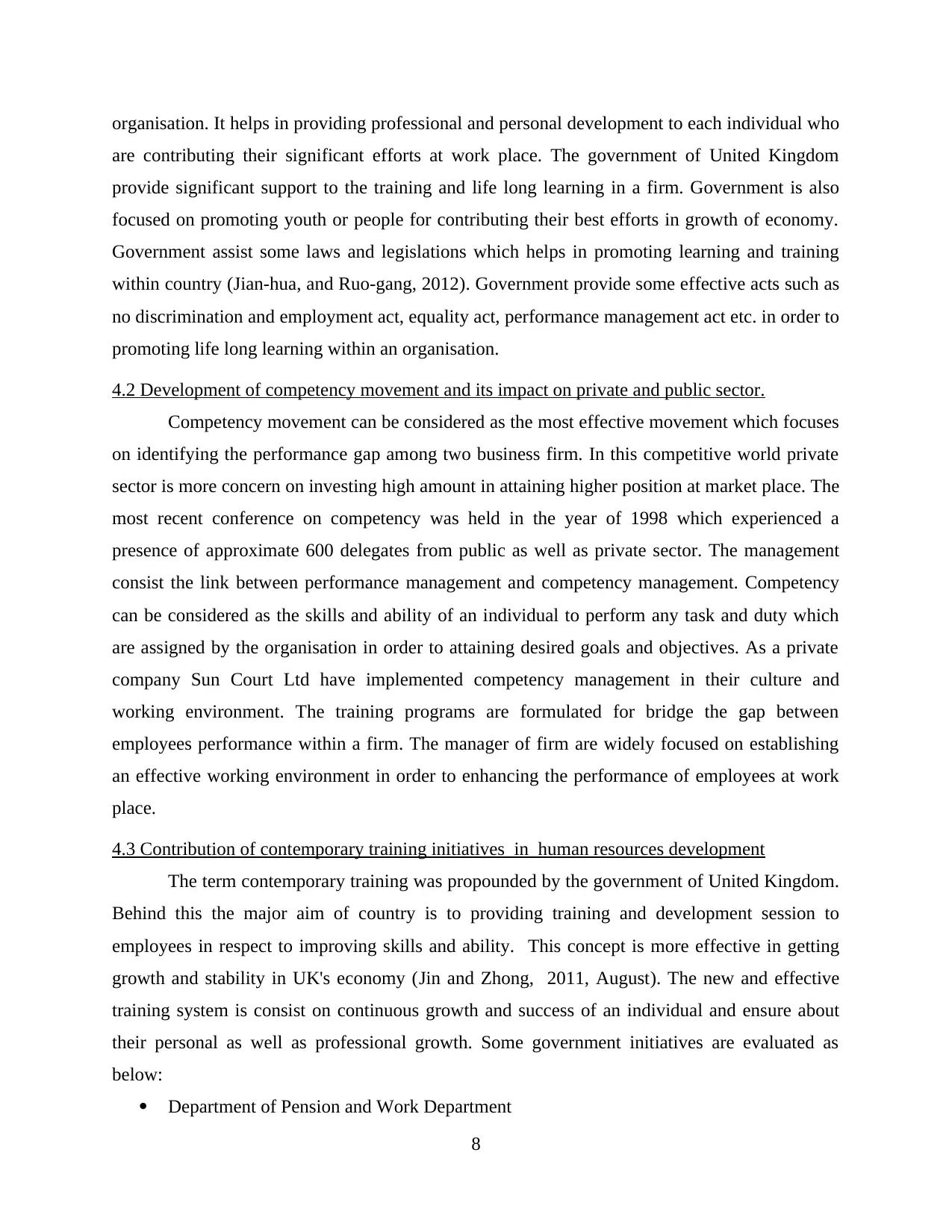
4.3 Contribution of contemporary training initiatives in human resources development
The term contemporary training was propounded by the government of United Kingdom.
Behind this the major aim of country is to providing training and development session to
employees in respect to improving skills and ability. This concept is more effective in getting
growth and stability in UK's economy (Jin and Zhong, 2011, August). The new and effective
training system is consist on continuous growth and success of an individual and ensure about
their personal as well as professional growth. Some government initiatives are evaluated as
below:
Department of Pension and Work Department
8
are contributing their significant efforts at work place. The government of United Kingdom
provide significant support to the training and life long learning in a firm. Government is also
focused on promoting youth or people for contributing their best efforts in growth of economy.
Government assist some laws and legislations which helps in promoting learning and training
within country (Jian-hua, and Ruo-gang, 2012). Government provide some effective acts such as
no discrimination and employment act, equality act, performance management act etc. in order to
promoting life long learning within an organisation.
4.2 Development of competency movement and its impact on private and public sector.
Competency movement can be considered as the most effective movement which focuses
on identifying the performance gap among two business firm. In this competitive world private
sector is more concern on investing high amount in attaining higher position at market place. The
most recent conference on competency was held in the year of 1998 which experienced a
presence of approximate 600 delegates from public as well as private sector. The management
consist the link between performance management and competency management. Competency
can be considered as the skills and ability of an individual to perform any task and duty which
are assigned by the organisation in order to attaining desired goals and objectives. As a private
company Sun Court Ltd have implemented competency management in their culture and
working environment. The training programs are formulated for bridge the gap between
employees performance within a firm. The manager of firm are widely focused on establishing
an effective working environment in order to enhancing the performance of employees at work
place.
4.3 Contribution of contemporary training initiatives in human resources development
The term contemporary training was propounded by the government of United Kingdom.
Behind this the major aim of country is to providing training and development session to
employees in respect to improving skills and ability. This concept is more effective in getting
growth and stability in UK's economy (Jin and Zhong, 2011, August). The new and effective
training system is consist on continuous growth and success of an individual and ensure about
their personal as well as professional growth. Some government initiatives are evaluated as
below:
Department of Pension and Work Department
8
Paraphrase This Document
Need a fresh take? Get an instant paraphrase of this document with our AI Paraphraser
Department of Health and safety
Department of Education
with the help of this type of formulation, government have also introduced some initiatives,
which are described as below:
Funds and capital to the small business organisation.
Provide business to capable people.
Distributing education among people in order to developing skills and ability.
Providing assurance about healthy work practices.
CONCLUSION
As per the above mention report it has been concluded that training is required for each
business sector in order to providing proper guidance about the organisational work and
activities to their new and existing employees. Human resource can be considered as one of the
most crucial component of any business organisation. Managers plays essential role at work
place through managing all resource and assigning different role and responsibilities to their new
and existing employees as per their skills and ability to perform any task and duty.
9
Department of Education
with the help of this type of formulation, government have also introduced some initiatives,
which are described as below:
Funds and capital to the small business organisation.
Provide business to capable people.
Distributing education among people in order to developing skills and ability.
Providing assurance about healthy work practices.
CONCLUSION
As per the above mention report it has been concluded that training is required for each
business sector in order to providing proper guidance about the organisational work and
activities to their new and existing employees. Human resource can be considered as one of the
most crucial component of any business organisation. Managers plays essential role at work
place through managing all resource and assigning different role and responsibilities to their new
and existing employees as per their skills and ability to perform any task and duty.
9
REFERENCES
Books and journal
Bamberger, P. A., Biron, M. and Meshoulam, I., 2014. Human resource strategy: Formulation,
implementation, and impact. Routledge.
Barney, J. B., Ketchen Jr, D. J. and Wright, M., 2011. The future of resource-based theory:
revitalization or decline?. Journal of management. 37(5). pp.1299-1315.
Bolman, L. G. and Deal, T. E., 2017. Reframing organizations: Artistry, choice, and leadership.
John Wiley & Sons.
Boxall, P. and Purcell, J., 2011.Strategy and human resource management. Palgrave Macmillan.
Bray, F. and et. al., 2012. Global cancer transitions according to the Human Development Index
(2008–2030): a population-based study. The lancet oncology. 13(8). pp.790-801.
Brewster, C. and Hegewisch, A. eds., 2017. Policy and Practice in European Human Resource
Management: The Price Waterhouse Cranfield Survey. Taylor & Francis.
Huang, X., 2011. Corporate control by Chinese MNCs over their foreign subsidiaries:
Combining institutional and resource-based perspectives. Labour & Industry: a journal
of the social and economic relations of work, 22(1-2), pp.169-191.
Jian-hua, G. A. O. and Ruo-gang, H. U .A. N. G., 2012. Analysis on resources allocation of
diseases prevention and control in Beijing different functional areas [J]. Soft Science of
Health, 10, p.011.
Jin, J. and Zhong, Z. D., 2011, August. Study on Competence Model of Human Resources
Managers in Chinese Family Enterprises. In Management and Service Science (MASS),
2011 International Conference on (pp. 1-6). IEEE.
Yu-fei, W. U., 2011. A CASE STUDY ON LINLI GYPSUM DEPOSIT: INVESTING AND
FINANCING ENVIRONMENT OF RESOURCES INDUSTRY. Resources &
Industries, p.S1.
Yuan, Y. and Yu, D., 2012. Literature Review of Community Indicators Research and Its
Applications in Planning. Urban Planning International. 2. p.006.
Zeng-zhou, H. O. U., 2011. Evaluation of Coordination Degree Between Ecological
Environment and Economic Development of Dongying City [J]. China Population,
Resources and Environment. 7. p.029.
ZHANG, Z. and et. al., 2011. Evaluation of coordinated development degree of urban human
settlement environment and economic development——A case of Urumqi [J]. Journal
of Arid Land Resources and Environment. 7. p.005.
Online
Learning Theories, 2017. [Online]. Available through:
<http://thepeakperformancecenter.com/educational-learning/learning/theories/>.
Learning Curves, 2015. [Online]. Available through:
<http://profhimes.blogspot.in/2015/08/learning-curves.html>.
10
Books and journal
Bamberger, P. A., Biron, M. and Meshoulam, I., 2014. Human resource strategy: Formulation,
implementation, and impact. Routledge.
Barney, J. B., Ketchen Jr, D. J. and Wright, M., 2011. The future of resource-based theory:
revitalization or decline?. Journal of management. 37(5). pp.1299-1315.
Bolman, L. G. and Deal, T. E., 2017. Reframing organizations: Artistry, choice, and leadership.
John Wiley & Sons.
Boxall, P. and Purcell, J., 2011.Strategy and human resource management. Palgrave Macmillan.
Bray, F. and et. al., 2012. Global cancer transitions according to the Human Development Index
(2008–2030): a population-based study. The lancet oncology. 13(8). pp.790-801.
Brewster, C. and Hegewisch, A. eds., 2017. Policy and Practice in European Human Resource
Management: The Price Waterhouse Cranfield Survey. Taylor & Francis.
Huang, X., 2011. Corporate control by Chinese MNCs over their foreign subsidiaries:
Combining institutional and resource-based perspectives. Labour & Industry: a journal
of the social and economic relations of work, 22(1-2), pp.169-191.
Jian-hua, G. A. O. and Ruo-gang, H. U .A. N. G., 2012. Analysis on resources allocation of
diseases prevention and control in Beijing different functional areas [J]. Soft Science of
Health, 10, p.011.
Jin, J. and Zhong, Z. D., 2011, August. Study on Competence Model of Human Resources
Managers in Chinese Family Enterprises. In Management and Service Science (MASS),
2011 International Conference on (pp. 1-6). IEEE.
Yu-fei, W. U., 2011. A CASE STUDY ON LINLI GYPSUM DEPOSIT: INVESTING AND
FINANCING ENVIRONMENT OF RESOURCES INDUSTRY. Resources &
Industries, p.S1.
Yuan, Y. and Yu, D., 2012. Literature Review of Community Indicators Research and Its
Applications in Planning. Urban Planning International. 2. p.006.
Zeng-zhou, H. O. U., 2011. Evaluation of Coordination Degree Between Ecological
Environment and Economic Development of Dongying City [J]. China Population,
Resources and Environment. 7. p.029.
ZHANG, Z. and et. al., 2011. Evaluation of coordinated development degree of urban human
settlement environment and economic development——A case of Urumqi [J]. Journal
of Arid Land Resources and Environment. 7. p.005.
Online
Learning Theories, 2017. [Online]. Available through:
<http://thepeakperformancecenter.com/educational-learning/learning/theories/>.
Learning Curves, 2015. [Online]. Available through:
<http://profhimes.blogspot.in/2015/08/learning-curves.html>.
10
⊘ This is a preview!⊘
Do you want full access?
Subscribe today to unlock all pages.
Trusted by 1+ million students worldwide

1 out of 12


Related Documents


Your All-in-One AI-Powered Toolkit for Academic Success.
+13062052269
info@desklib.com
Available 24*7 on WhatsApp / Email
![[object Object]](/_next/static/media/star-bottom.7253800d.svg)
Unlock your academic potential
Copyright © 2020–2026 A2Z Services. All Rights Reserved. Developed and managed by ZUCOL.