Human Resource Development: Learning, Training and Evaluation
VerifiedAdded on 2020/02/12
|16
|3723
|146
Report
AI Summary
This report delves into the realm of Human Resource Development (HRD), focusing on learning styles, training methods, and evaluation techniques. It begins by comparing different learning styles, including Kolb's and VARK models, and discusses the significance of the learning curve in employee progress. The report then explores the impact of learning theories and styles on employee performance and the importance of training needs analysis. It examines the pros and cons of various training methods and outlines a systematic approach to training and development planning. The evaluation section covers different methodologies and assessment techniques, while also touching upon the auditing of evaluation accomplishments. Finally, the report discusses government contributions to HRD and the competency movement, including UK government coaching initiatives.

Lavinia Popescu Student ID:12636
Human Resource Development
Human Resource Development

Paraphrase This Document
Need a fresh take? Get an instant paraphrase of this document with our AI Paraphraser
Table of Contents
Introduction .....................................................................................................................................3
L01 ..................................................................................................................................................3
1.1 Comparison of different learning styles.....................................................................................3
1.2 Learning curve with its significance..........................................................................................4
1.3 Grant while planning and designing .........................................................................................5
LO2 .................................................................................................................................................6
2.1 Training needs............................................................................................................................6
2.2 Pros and Cons of training methods............................................................................................7
2.3 Training and development plan.................................................................................................8
LO3 .................................................................................................................................................8
3.1 Evaluation..................................................................................................................................8
3.2 Assessment...............................................................................................................................10
3.3 Auditing accomplishment of evaluation methodology............................................................13
LO4 ...............................................................................................................................................14
4.1 Government's contributions.....................................................................................................14
4.2 Competency movement and its development .........................................................................14
4.3 UK Government's coaching drives..........................................................................................15
Conclusion.....................................................................................................................................15
Reference list and bibliography.....................................................................................................16
Introduction .....................................................................................................................................3
L01 ..................................................................................................................................................3
1.1 Comparison of different learning styles.....................................................................................3
1.2 Learning curve with its significance..........................................................................................4
1.3 Grant while planning and designing .........................................................................................5
LO2 .................................................................................................................................................6
2.1 Training needs............................................................................................................................6
2.2 Pros and Cons of training methods............................................................................................7
2.3 Training and development plan.................................................................................................8
LO3 .................................................................................................................................................8
3.1 Evaluation..................................................................................................................................8
3.2 Assessment...............................................................................................................................10
3.3 Auditing accomplishment of evaluation methodology............................................................13
LO4 ...............................................................................................................................................14
4.1 Government's contributions.....................................................................................................14
4.2 Competency movement and its development .........................................................................14
4.3 UK Government's coaching drives..........................................................................................15
Conclusion.....................................................................................................................................15
Reference list and bibliography.....................................................................................................16
Introduction
The following assignment is based on the human resource development that concentrates on the
understanding of the styles of learning that would help the staffs of the organization to provide
quality work in the organization. It also focuses on the training and development of the
employees in the origination that would further increase the scope of a better work being
performed by the people working in the job sector. It is to be observed that the development of
the human resource in any organization is a very important thing to do. It is because it is the
human resource on which the entire working in the organization depends on. The working of the
human resource in the organization signifies the amount of fresh work that is being done. It is the
work that enhances the reputation and the status of the organization. The assignment also
concentrates on the planning of the training processes and the skills that would help the
organization to perform in a right manner. It further put emphasis on the government led skills
development that would help to build the employees in the organization to produce productive
work in the organization. Therefore, it could be clearly stated that the better the human resource
in an organization the more productive work could be performed by the organization to build a
good reputation in the market.
L01
1.1 Comparison of different learning styles
There are different learning styles that are available for the employees and the organization could
follow such as:
Kolb learning style: that focuses on the four factors that includes the planning of the work
that is followed by the doing of the work, the reflection that is received from the work
and the conclusion of the work.
VAK model is another type of learning style that includes factors such as visual, auditory
and kinesthetic styles that would help the employees to perform well in the organization
by following the styles that are described.
The following assignment is based on the human resource development that concentrates on the
understanding of the styles of learning that would help the staffs of the organization to provide
quality work in the organization. It also focuses on the training and development of the
employees in the origination that would further increase the scope of a better work being
performed by the people working in the job sector. It is to be observed that the development of
the human resource in any organization is a very important thing to do. It is because it is the
human resource on which the entire working in the organization depends on. The working of the
human resource in the organization signifies the amount of fresh work that is being done. It is the
work that enhances the reputation and the status of the organization. The assignment also
concentrates on the planning of the training processes and the skills that would help the
organization to perform in a right manner. It further put emphasis on the government led skills
development that would help to build the employees in the organization to produce productive
work in the organization. Therefore, it could be clearly stated that the better the human resource
in an organization the more productive work could be performed by the organization to build a
good reputation in the market.
L01
1.1 Comparison of different learning styles
There are different learning styles that are available for the employees and the organization could
follow such as:
Kolb learning style: that focuses on the four factors that includes the planning of the work
that is followed by the doing of the work, the reflection that is received from the work
and the conclusion of the work.
VAK model is another type of learning style that includes factors such as visual, auditory
and kinesthetic styles that would help the employees to perform well in the organization
by following the styles that are described.
⊘ This is a preview!⊘
Do you want full access?
Subscribe today to unlock all pages.

Trusted by 1+ million students worldwide

The learning style of honey and Mumford that reflects on the learning style that was
described by Kolb and which is widely used in the organizations of UK.
Following these learning styles would help the employees to perform quality work in the work
place that would further help the organization to earn the maximum return of scales. This would
further help the organization to develop a good human resource in the work sector.
The following comparative table shows the basic differences between two learning styles that is
Kolb and VARK
Kolb's learning style VARK(Visual, auditory, read/write and
kinaesthetic)
This learning style is based on a four stage
model proposed by Kolb.
The Kolb's learning style consists of two
variables that is choice and conflicts.
Such type of learning method is applicable in
situations where brainstorming or excessive
thinking is required.
The VARK model consists of four different
learning styles.
This learning style has applications in various
modes or situations of need.
On the other hand, this style helps individuals
in developing particular understanding through
either single mode or multiple modes.
1.2 Learning curve with its significance
The learning curve is referred to a graphical representation that indicates the learning experience
of the individual that helps the individual to understand the progress report of the individual. It
could be understood in two ways that includes the time period of learning of the individual or
when a similar job is performed by the individual.
The importance of the learning curve in the work place is as follows:
Make the employee aware of the progress report of the work that he is performing in the
organization
described by Kolb and which is widely used in the organizations of UK.
Following these learning styles would help the employees to perform quality work in the work
place that would further help the organization to earn the maximum return of scales. This would
further help the organization to develop a good human resource in the work sector.
The following comparative table shows the basic differences between two learning styles that is
Kolb and VARK
Kolb's learning style VARK(Visual, auditory, read/write and
kinaesthetic)
This learning style is based on a four stage
model proposed by Kolb.
The Kolb's learning style consists of two
variables that is choice and conflicts.
Such type of learning method is applicable in
situations where brainstorming or excessive
thinking is required.
The VARK model consists of four different
learning styles.
This learning style has applications in various
modes or situations of need.
On the other hand, this style helps individuals
in developing particular understanding through
either single mode or multiple modes.
1.2 Learning curve with its significance
The learning curve is referred to a graphical representation that indicates the learning experience
of the individual that helps the individual to understand the progress report of the individual. It
could be understood in two ways that includes the time period of learning of the individual or
when a similar job is performed by the individual.
The importance of the learning curve in the work place is as follows:
Make the employee aware of the progress report of the work that he is performing in the
organization
Paraphrase This Document
Need a fresh take? Get an instant paraphrase of this document with our AI Paraphraser
Assurance of the employee that whether the employee is depleting in the working or the
quality of the working is increasing
Helps to judge the working of the employee in the organization by the management
The progress report helps to understand the increase and the decrease quality of the work that is
performed by the employee in the organization. Moreover, it helps the organization to make the
correct judgment of the employee’s work by noticing the progress report of the work that is
being performed by him in the organization. It is with the increase of the quality of the work of
the employee in the organization, it would help the employee to earn the profit by making a
promotion in the organization. On the other hand, it would further help the employee to gain the
confidence to do the work in a more appropriate manner.
Learning curve helps in understanding the improvement or deterioration that has taken place in
an individual's learning and working capabilities. The learning curve helps organization to detect
whether its work force is learning or not.
Every business organization must have a working culture that believes in transfer and exchange
of knowledge and skills. This importance is felt when employees or working individuals are less
enthusiastic or motivated towards meeting organization's expectations. There are different types
of transfer inside the workplace atmosphere and these are:
Positive: When one individual's skills and capabilities help in developing other person's
learning then it is a pro-active or positive transfer.
Negative: This type of transfer is not mutually productive i.e. the skills of one person
doesn't contribute to learning of other individual.
For an organization to meet its objectives and goals, mutual understanding between employees is
necessary. Positive transfer of learning helps in meeting these attributes smoothly.
1.3 Grant while planning and designing
The contribution that the learning theories and styles have on the employees in the work place is
that the employees tend to adopt the correct form of working in the organization that enables the
employees to perform quality work in the organization. Moreover, it further encourages the
quality of the working is increasing
Helps to judge the working of the employee in the organization by the management
The progress report helps to understand the increase and the decrease quality of the work that is
performed by the employee in the organization. Moreover, it helps the organization to make the
correct judgment of the employee’s work by noticing the progress report of the work that is
being performed by him in the organization. It is with the increase of the quality of the work of
the employee in the organization, it would help the employee to earn the profit by making a
promotion in the organization. On the other hand, it would further help the employee to gain the
confidence to do the work in a more appropriate manner.
Learning curve helps in understanding the improvement or deterioration that has taken place in
an individual's learning and working capabilities. The learning curve helps organization to detect
whether its work force is learning or not.
Every business organization must have a working culture that believes in transfer and exchange
of knowledge and skills. This importance is felt when employees or working individuals are less
enthusiastic or motivated towards meeting organization's expectations. There are different types
of transfer inside the workplace atmosphere and these are:
Positive: When one individual's skills and capabilities help in developing other person's
learning then it is a pro-active or positive transfer.
Negative: This type of transfer is not mutually productive i.e. the skills of one person
doesn't contribute to learning of other individual.
For an organization to meet its objectives and goals, mutual understanding between employees is
necessary. Positive transfer of learning helps in meeting these attributes smoothly.
1.3 Grant while planning and designing
The contribution that the learning theories and styles have on the employees in the work place is
that the employees tend to adopt the correct form of working in the organization that enables the
employees to perform quality work in the organization. Moreover, it further encourages the
employees to work in the organization with full potential such that the employees could provide
their best they can to produce productive result in the organization. It also helps the employees to
gain proper knowledge of the work in the organization and increases the [potential work balance
of the employees in the organization.
The theories and the learning styles provides a good contribution to the employees working in
the organization it is because the employees could develop the knowledge of the work in a better
way such that it would enhance the working of the employees in the organization.
The design of a learning event involves various dimensional aspects which needs to be evaluated
by organization. Learning styles and theories are like inputs to this designing process. When
company identifies that specific group of individuals lack in certain skill or area of knowledge
then, a need is generated. Learning theories help in collecting alternatives and eliminating
barriers to development. The major advantage which is gained through knowledge of these
theories and styles is proper allocation of resources.
LO2
2.1 Training needs
Organisations have to recognise specific training requirements of employees at various levels so
that productivity would not be compromised. Therefore, the training events are set up by the
organizations in a planned manner so that it would benefit the organization to make progress in
the working such that it would help the organization to attain the goal for its future in less time.
The training needs for the staffs are required to train them with the appropriate working style
such that their interest for the work remains and help the organization to enable proper skilled
labors to work for the organization (Knowles, 2014, p.78).
Assuming the top managerial level the staffs that are associated in the managerial level are
required to be trained in such a way such that the management of the organization could be done
in a proper manner. It is because the employees working under the management and the
employees would report about their difficulties to the management. Therefore, it would be the
duty of the management to understand the problems that are being faced by the employees
their best they can to produce productive result in the organization. It also helps the employees to
gain proper knowledge of the work in the organization and increases the [potential work balance
of the employees in the organization.
The theories and the learning styles provides a good contribution to the employees working in
the organization it is because the employees could develop the knowledge of the work in a better
way such that it would enhance the working of the employees in the organization.
The design of a learning event involves various dimensional aspects which needs to be evaluated
by organization. Learning styles and theories are like inputs to this designing process. When
company identifies that specific group of individuals lack in certain skill or area of knowledge
then, a need is generated. Learning theories help in collecting alternatives and eliminating
barriers to development. The major advantage which is gained through knowledge of these
theories and styles is proper allocation of resources.
LO2
2.1 Training needs
Organisations have to recognise specific training requirements of employees at various levels so
that productivity would not be compromised. Therefore, the training events are set up by the
organizations in a planned manner so that it would benefit the organization to make progress in
the working such that it would help the organization to attain the goal for its future in less time.
The training needs for the staffs are required to train them with the appropriate working style
such that their interest for the work remains and help the organization to enable proper skilled
labors to work for the organization (Knowles, 2014, p.78).
Assuming the top managerial level the staffs that are associated in the managerial level are
required to be trained in such a way such that the management of the organization could be done
in a proper manner. It is because the employees working under the management and the
employees would report about their difficulties to the management. Therefore, it would be the
duty of the management to understand the problems that are being faced by the employees
⊘ This is a preview!⊘
Do you want full access?
Subscribe today to unlock all pages.
Trusted by 1+ million students worldwide
working in the organization. On the other hand, assuming the lower section of the organization
where the basic staffs are working, the training is to be provided to them so that the employees
could learn to manage time in the work that is done by them. Apart from that it would also help
them to take proper decision of the work. This would increase the potential and confidence of the
employees to work with effectiveness so that proper result could be initiated from the employees
working in the organization (Budhwar, 2013, p.24).
2.2 Pros and Cons of training methods
Every process or decision has certain positive and negative attributes. Simultaneously, training
methods also have some. It is because the training helps to develop more knowledge and skills
for the employees working in the organization. That helps the employees to produce productive
work in the organization that would create the best benefit for the organization. It is to be
observed that the organization provides training to the em0ployees for their own benefit. It is
because the organization would itself get higher competitive advantage with the development of
skilled labors in the organization (Ulrich, 2013, p.6).
Therefore, the advantages of the training involve the employees to learn new things in the work
place that would help them to work in a more potential and correct manner. It would further help
them to develop knowledge and skills that would guide them in their future to obtain promotion
in the organization. This would further create a benefit for the organization to increase its
liability to obtain their future goals in less time and increase the scope for the growth possibilities
in the market. This also helps the organization to build a good reputation in the market by having
skilled employees working in the organization. Whereas, the disadvantages that are associated
with the training of the employees is that it is time consuming and it stops the actual working of
the organization. It is because the more emphasis is given on the employees to train them with
better knowledge and skills. Hence, there cause a delay in the daily working of the work by the
employees as the employees gets engaged in the training process (Renwick, 2013, p.14).
2.3 Training and development plan
The systematic approach of the planning of training event is associated with the several
processes that include the following:
where the basic staffs are working, the training is to be provided to them so that the employees
could learn to manage time in the work that is done by them. Apart from that it would also help
them to take proper decision of the work. This would increase the potential and confidence of the
employees to work with effectiveness so that proper result could be initiated from the employees
working in the organization (Budhwar, 2013, p.24).
2.2 Pros and Cons of training methods
Every process or decision has certain positive and negative attributes. Simultaneously, training
methods also have some. It is because the training helps to develop more knowledge and skills
for the employees working in the organization. That helps the employees to produce productive
work in the organization that would create the best benefit for the organization. It is to be
observed that the organization provides training to the em0ployees for their own benefit. It is
because the organization would itself get higher competitive advantage with the development of
skilled labors in the organization (Ulrich, 2013, p.6).
Therefore, the advantages of the training involve the employees to learn new things in the work
place that would help them to work in a more potential and correct manner. It would further help
them to develop knowledge and skills that would guide them in their future to obtain promotion
in the organization. This would further create a benefit for the organization to increase its
liability to obtain their future goals in less time and increase the scope for the growth possibilities
in the market. This also helps the organization to build a good reputation in the market by having
skilled employees working in the organization. Whereas, the disadvantages that are associated
with the training of the employees is that it is time consuming and it stops the actual working of
the organization. It is because the more emphasis is given on the employees to train them with
better knowledge and skills. Hence, there cause a delay in the daily working of the work by the
employees as the employees gets engaged in the training process (Renwick, 2013, p.14).
2.3 Training and development plan
The systematic approach of the planning of training event is associated with the several
processes that include the following:
Paraphrase This Document
Need a fresh take? Get an instant paraphrase of this document with our AI Paraphraser
Analyzing: it refers to the analysis that the organization makes upon the performance of the
employees. That helps the organization to decide upon the type of training that the organization
should impart to its employees for better future result in the organization.
Design: it refers to the designing of the time schedule as in what time and how much time would
be given to the employees for training. It also involves the designing of the event of training in
the organization.
Development: it refers to the development of the plan that is associated with the training of the
employees that includes the place and the number of employees who would be trained for further
progress in their work.
Implementation: this refers to the implementation of the plan that is developed by the
organization for imparting training to the employees in the organization (Dipboye, 2013, p.67).
LO3
3.1 Evaluation
The training that is imparted to the employees in the organizations based on suitable techniques.
Therefore, it is important for the organization to adopt a suitable technique for training its
employees. The technique that the organization could adopt is on the job training and technology
based training.
In the on the job training it would consume less time it is because the employees would be
trained in the office and during the office hours. Moreover, it would be flexible for the
organization to provide such a training to the employees as it would help the organization to
obtain the work from the employees while they are being trained in the office (MacArthur, 2014,
p.469). Moreover, the technology based training would help the employees to become
technology prone that would further make the working easier for the employees as it would fetch
them to put less energy. It is because all the work would be done in the computers using proper
technology software.
employees. That helps the organization to decide upon the type of training that the organization
should impart to its employees for better future result in the organization.
Design: it refers to the designing of the time schedule as in what time and how much time would
be given to the employees for training. It also involves the designing of the event of training in
the organization.
Development: it refers to the development of the plan that is associated with the training of the
employees that includes the place and the number of employees who would be trained for further
progress in their work.
Implementation: this refers to the implementation of the plan that is developed by the
organization for imparting training to the employees in the organization (Dipboye, 2013, p.67).
LO3
3.1 Evaluation
The training that is imparted to the employees in the organizations based on suitable techniques.
Therefore, it is important for the organization to adopt a suitable technique for training its
employees. The technique that the organization could adopt is on the job training and technology
based training.
In the on the job training it would consume less time it is because the employees would be
trained in the office and during the office hours. Moreover, it would be flexible for the
organization to provide such a training to the employees as it would help the organization to
obtain the work from the employees while they are being trained in the office (MacArthur, 2014,
p.469). Moreover, the technology based training would help the employees to become
technology prone that would further make the working easier for the employees as it would fetch
them to put less energy. It is because all the work would be done in the computers using proper
technology software.
There are two types of evaluation i.e. process and outcome. The first type helps in recognizing
where improvements can be applied in the entire training process and better results are gained.
On the other hand, latter one that is evaluation of outcomes which can be reactions and
behaviour of employees once the training is complete.
Following evaluation technique is a feedback form that shall help in getting better knowledge of
the workshop.
Feedback and Evaluation Form
1) Did you attend any sort of training before?
Yes
No
2) If Yes, then did this workshop help you in meeting expectation standards like before?
Quite likely
Very likely
Not at all
Moderately
2)How would you rate your experience during this training session?
Satisfactory
Highly satisfying
Neutral
Poor
Very poor
3) Did the lecturers and trainers meet your expectations?
where improvements can be applied in the entire training process and better results are gained.
On the other hand, latter one that is evaluation of outcomes which can be reactions and
behaviour of employees once the training is complete.
Following evaluation technique is a feedback form that shall help in getting better knowledge of
the workshop.
Feedback and Evaluation Form
1) Did you attend any sort of training before?
Yes
No
2) If Yes, then did this workshop help you in meeting expectation standards like before?
Quite likely
Very likely
Not at all
Moderately
2)How would you rate your experience during this training session?
Satisfactory
Highly satisfying
Neutral
Poor
Very poor
3) Did the lecturers and trainers meet your expectations?
⊘ This is a preview!⊘
Do you want full access?
Subscribe today to unlock all pages.
Trusted by 1+ million students worldwide
Yes
No
4) Was the learning style implied in the workshop effective enough to gain appropriate
knowledge?
Likely
Highly Likely
Not at all
Moderately
5) Please provide your recommendations and complaints
_____________________________________________________________________
3.2 Assessment
In the training event the technology based training would be the best method that the
organization should adopt to impart training to its employees. It is because through techno based
training the organization would be able to clearly communicate the basic terms and the methods
that the employees are suppose to know and learn. Moreover, the use of video clips and audio
presentation would help the organization to impart clear understanding of the work that the
employees are suppose to do in the organization. On the other hand, it is to be observed that from
the verbal way of expressing it is easier to catch up with the audio and video presentation.
Therefore, the organization should adopt both the audio as well as video presentation to impart
training to the employees in the organization.
The above designed feedback form was circulated amongst 30 individuals that had attended the
training. Following results were obtained from this evaluation technique
No
4) Was the learning style implied in the workshop effective enough to gain appropriate
knowledge?
Likely
Highly Likely
Not at all
Moderately
5) Please provide your recommendations and complaints
_____________________________________________________________________
3.2 Assessment
In the training event the technology based training would be the best method that the
organization should adopt to impart training to its employees. It is because through techno based
training the organization would be able to clearly communicate the basic terms and the methods
that the employees are suppose to know and learn. Moreover, the use of video clips and audio
presentation would help the organization to impart clear understanding of the work that the
employees are suppose to do in the organization. On the other hand, it is to be observed that from
the verbal way of expressing it is easier to catch up with the audio and video presentation.
Therefore, the organization should adopt both the audio as well as video presentation to impart
training to the employees in the organization.
The above designed feedback form was circulated amongst 30 individuals that had attended the
training. Following results were obtained from this evaluation technique
Paraphrase This Document
Need a fresh take? Get an instant paraphrase of this document with our AI Paraphraser
Did you attend any sort of training before?
Response
acquired
Yes 25
No 5
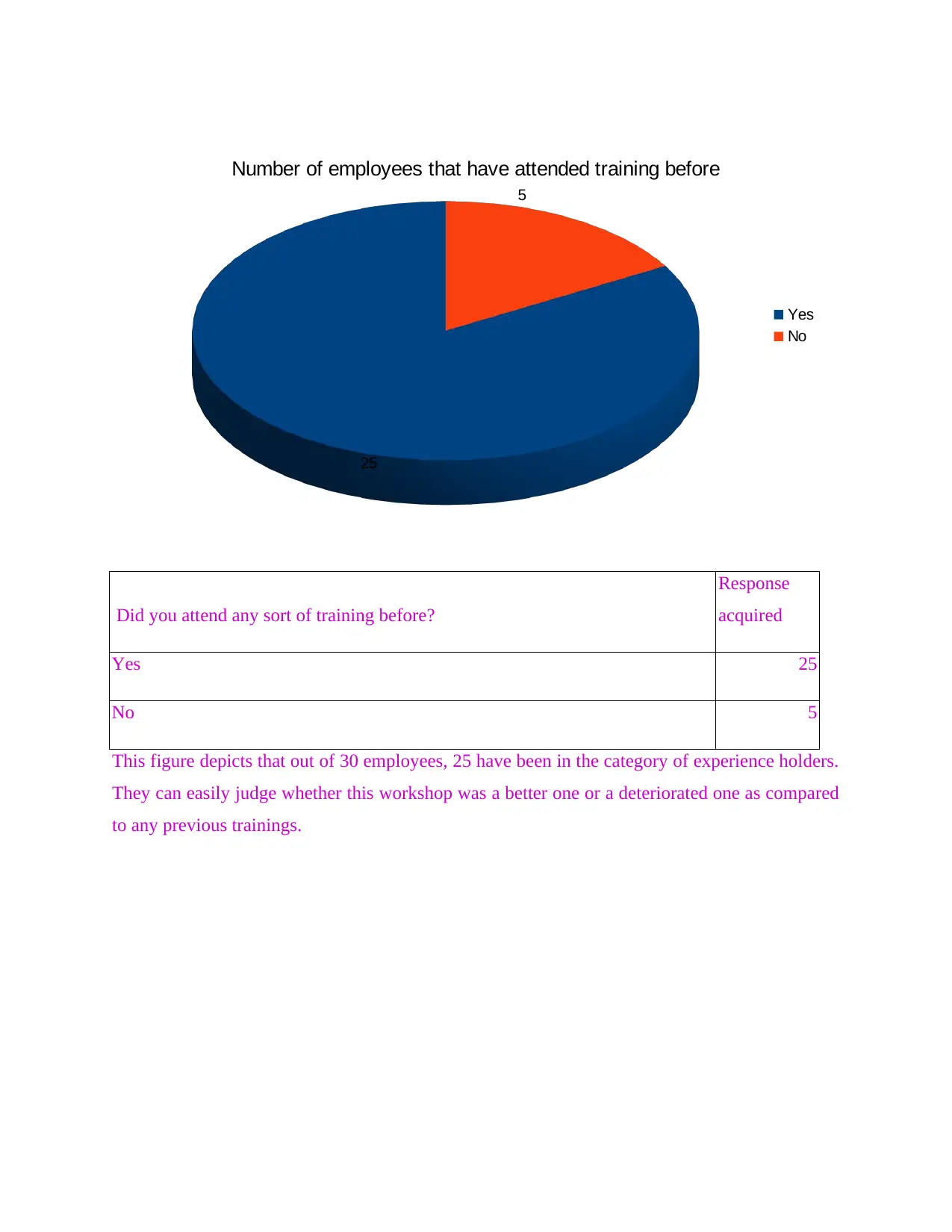
This figure depicts that out of 30 employees, 25 have been in the category of experience holders.
They can easily judge whether this workshop was a better one or a deteriorated one as compared
to any previous trainings.
25
5
Number of employees that have attended training before
Yes
No
Response
acquired
Yes 25
No 5
This figure depicts that out of 30 employees, 25 have been in the category of experience holders.
They can easily judge whether this workshop was a better one or a deteriorated one as compared
to any previous trainings.
25
5
Number of employees that have attended training before
Yes
No
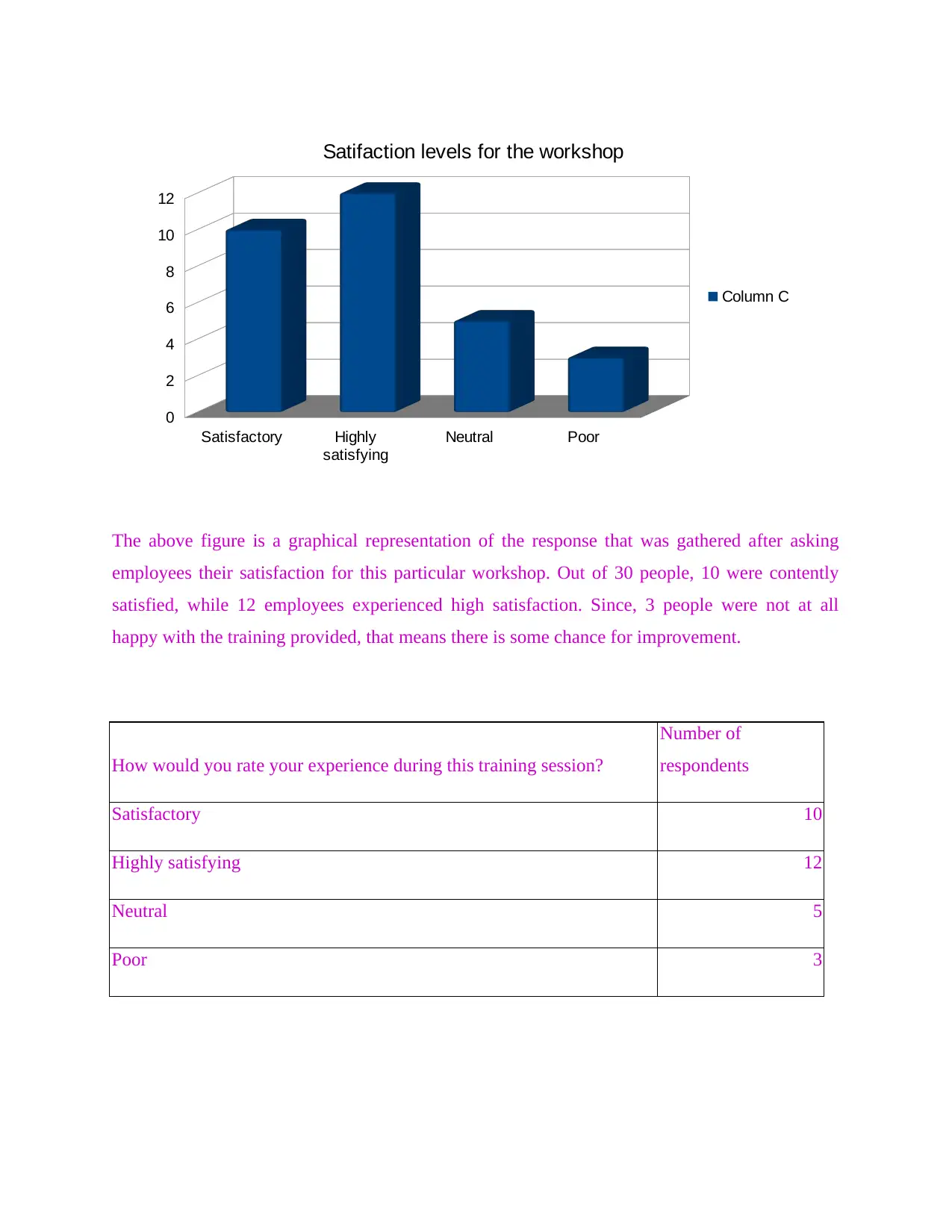
The above figure is a graphical representation of the response that was gathered after asking
employees their satisfaction for this particular workshop. Out of 30 people, 10 were contently
satisfied, while 12 employees experienced high satisfaction. Since, 3 people were not at all
happy with the training provided, that means there is some chance for improvement.
How would you rate your experience during this training session?
Number of
respondents
Satisfactory 10
Highly satisfying 12
Neutral 5
Poor 3
Satisfactory Highly
satisfying
Neutral Poor
0
2
4
6
8
10
12
Satifaction levels for the workshop
Column C
employees their satisfaction for this particular workshop. Out of 30 people, 10 were contently
satisfied, while 12 employees experienced high satisfaction. Since, 3 people were not at all
happy with the training provided, that means there is some chance for improvement.
How would you rate your experience during this training session?
Number of
respondents
Satisfactory 10
Highly satisfying 12
Neutral 5
Poor 3
Satisfactory Highly
satisfying
Neutral Poor
0
2
4
6
8
10
12
Satifaction levels for the workshop
Column C
⊘ This is a preview!⊘
Do you want full access?
Subscribe today to unlock all pages.
Trusted by 1+ million students worldwide

1 out of 16


Related Documents


Your All-in-One AI-Powered Toolkit for Academic Success.
+13062052269
info@desklib.com
Available 24*7 on WhatsApp / Email
![[object Object]](/_next/static/media/star-bottom.7253800d.svg)
Unlock your academic potential
Copyright © 2020–2026 A2Z Services. All Rights Reserved. Developed and managed by ZUCOL.