Human Resource Management Report: HRM in Organizations
VerifiedAdded on 2019/12/28
|13
|4116
|273
Report
AI Summary
This report provides a comprehensive overview of Human Resource Management (HRM), differentiating it from personnel management and outlining key HRM functions like recruitment, training, and motivation. It explores the role of line managers, the importance of human resource planning, and the stages involved. The report further analyzes the recruitment and selection processes of Marks & Spencer and Transport for London, evaluating the effectiveness of their techniques. It also delves into motivational theories, reward management, and methods for monitoring employee performance. Finally, the report discusses reasons for employment cessation and compares exit procedures used by the two organizations, considering the impact of legal and regulatory frameworks. The report covers various topics like recruitment, selection, motivation, and employee management and provides a complete guide to HRM.

HUMAN RESOURCE
MANAGEMENT
MANAGEMENT

Paraphrase This Document
Need a fresh take? Get an instant paraphrase of this document with our AI Paraphraser
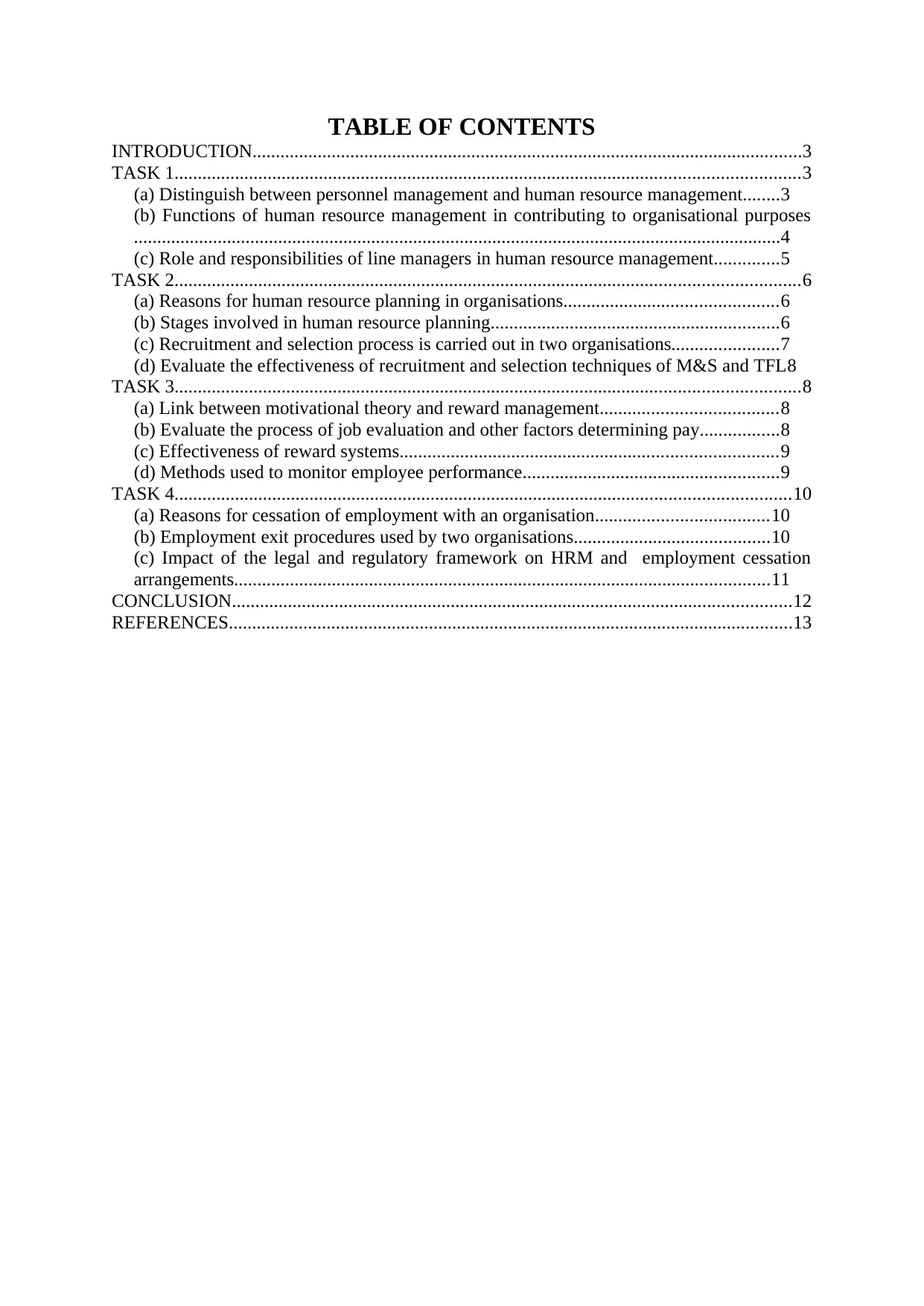
TABLE OF CONTENTS
INTRODUCTION......................................................................................................................3
TASK 1......................................................................................................................................3
(a) Distinguish between personnel management and human resource management........3
(b) Functions of human resource management in contributing to organisational purposes
...........................................................................................................................................4
(c) Role and responsibilities of line managers in human resource management..............5
TASK 2......................................................................................................................................6
(a) Reasons for human resource planning in organisations..............................................6
(b) Stages involved in human resource planning..............................................................6
(c) Recruitment and selection process is carried out in two organisations.......................7
(d) Evaluate the effectiveness of recruitment and selection techniques of M&S and TFL8
TASK 3......................................................................................................................................8
(a) Link between motivational theory and reward management......................................8
(b) Evaluate the process of job evaluation and other factors determining pay.................8
(c) Effectiveness of reward systems.................................................................................9
(d) Methods used to monitor employee performance.......................................................9
TASK 4....................................................................................................................................10
(a) Reasons for cessation of employment with an organisation.....................................10
(b) Employment exit procedures used by two organisations..........................................10
(c) Impact of the legal and regulatory framework on HRM and employment cessation
arrangements...................................................................................................................11
CONCLUSION........................................................................................................................12
REFERENCES.........................................................................................................................13
INTRODUCTION......................................................................................................................3
TASK 1......................................................................................................................................3
(a) Distinguish between personnel management and human resource management........3
(b) Functions of human resource management in contributing to organisational purposes
...........................................................................................................................................4
(c) Role and responsibilities of line managers in human resource management..............5
TASK 2......................................................................................................................................6
(a) Reasons for human resource planning in organisations..............................................6
(b) Stages involved in human resource planning..............................................................6
(c) Recruitment and selection process is carried out in two organisations.......................7
(d) Evaluate the effectiveness of recruitment and selection techniques of M&S and TFL8
TASK 3......................................................................................................................................8
(a) Link between motivational theory and reward management......................................8
(b) Evaluate the process of job evaluation and other factors determining pay.................8
(c) Effectiveness of reward systems.................................................................................9
(d) Methods used to monitor employee performance.......................................................9
TASK 4....................................................................................................................................10
(a) Reasons for cessation of employment with an organisation.....................................10
(b) Employment exit procedures used by two organisations..........................................10
(c) Impact of the legal and regulatory framework on HRM and employment cessation
arrangements...................................................................................................................11
CONCLUSION........................................................................................................................12
REFERENCES.........................................................................................................................13
INTRODUCTION
Human Resource Management (HRM) is an integral part of an organisation. It has
varieties of activities to perform and that are recruitment, training & development and
performance appraisal. It also maximizes the availability of manpower resources for future
needs. An organisation’s competency would lie upon HRM practices and policies to
contribute in growth and profitability in terms of quantity and quality. It emphasizes on the
implementation of various strategic tools and applications for corporate growth, value and
culture. On the other hand, personnel management is an administrative record keeping
function to keep the track record of equitable terms and conditions of business. The report
herewith provides a broad spectrum of Human Resources Management. It also gives an
understanding of the differences between Personnel Management and HRM.
TASK 1
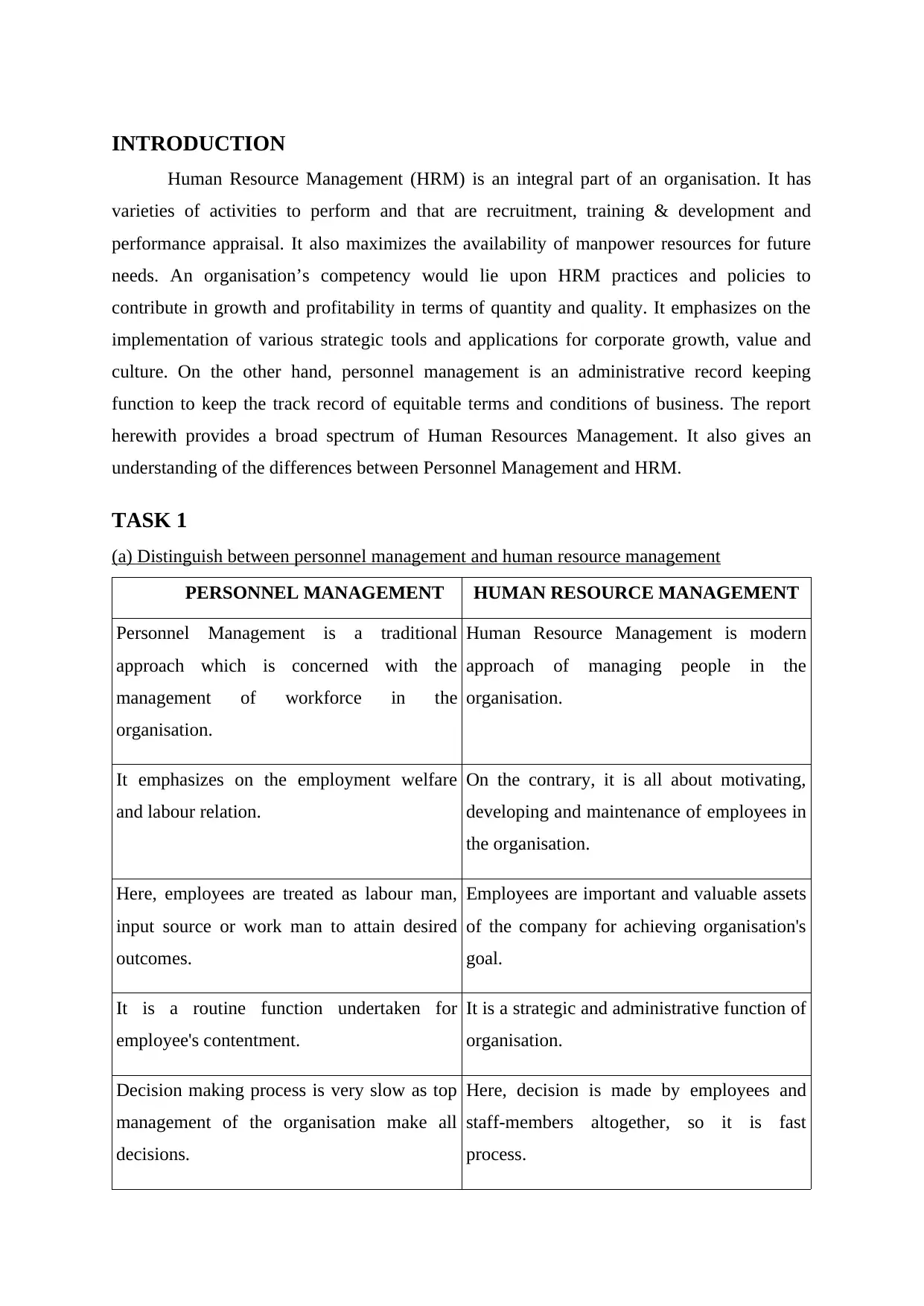
(a) Distinguish between personnel management and human resource management
PERSONNEL MANAGEMENT HUMAN RESOURCE MANAGEMENT
Personnel Management is a traditional
approach which is concerned with the
management of workforce in the
organisation.
Human Resource Management is modern
approach of managing people in the
organisation.
It emphasizes on the employment welfare
and labour relation.
On the contrary, it is all about motivating,
developing and maintenance of employees in
the organisation.
Here, employees are treated as labour man,
input source or work man to attain desired
outcomes.
Employees are important and valuable assets
of the company for achieving organisation's
goal.
It is a routine function undertaken for
employee's contentment.
It is a strategic and administrative function of
organisation.
Decision making process is very slow as top
management of the organisation make all
decisions.
Here, decision is made by employees and
staff-members altogether, so it is fast
process.
Human Resource Management (HRM) is an integral part of an organisation. It has
varieties of activities to perform and that are recruitment, training & development and
performance appraisal. It also maximizes the availability of manpower resources for future
needs. An organisation’s competency would lie upon HRM practices and policies to
contribute in growth and profitability in terms of quantity and quality. It emphasizes on the
implementation of various strategic tools and applications for corporate growth, value and
culture. On the other hand, personnel management is an administrative record keeping
function to keep the track record of equitable terms and conditions of business. The report
herewith provides a broad spectrum of Human Resources Management. It also gives an
understanding of the differences between Personnel Management and HRM.
TASK 1
(a) Distinguish between personnel management and human resource management
PERSONNEL MANAGEMENT HUMAN RESOURCE MANAGEMENT
Personnel Management is a traditional
approach which is concerned with the
management of workforce in the
organisation.
Human Resource Management is modern
approach of managing people in the
organisation.
It emphasizes on the employment welfare
and labour relation.
On the contrary, it is all about motivating,
developing and maintenance of employees in
the organisation.
Here, employees are treated as labour man,
input source or work man to attain desired
outcomes.
Employees are important and valuable assets
of the company for achieving organisation's
goal.
It is a routine function undertaken for
employee's contentment.
It is a strategic and administrative function of
organisation.
Decision making process is very slow as top
management of the organisation make all
decisions.
Here, decision is made by employees and
staff-members altogether, so it is fast
process.
⊘ This is a preview!⊘
Do you want full access?
Subscribe today to unlock all pages.

Trusted by 1+ million students worldwide
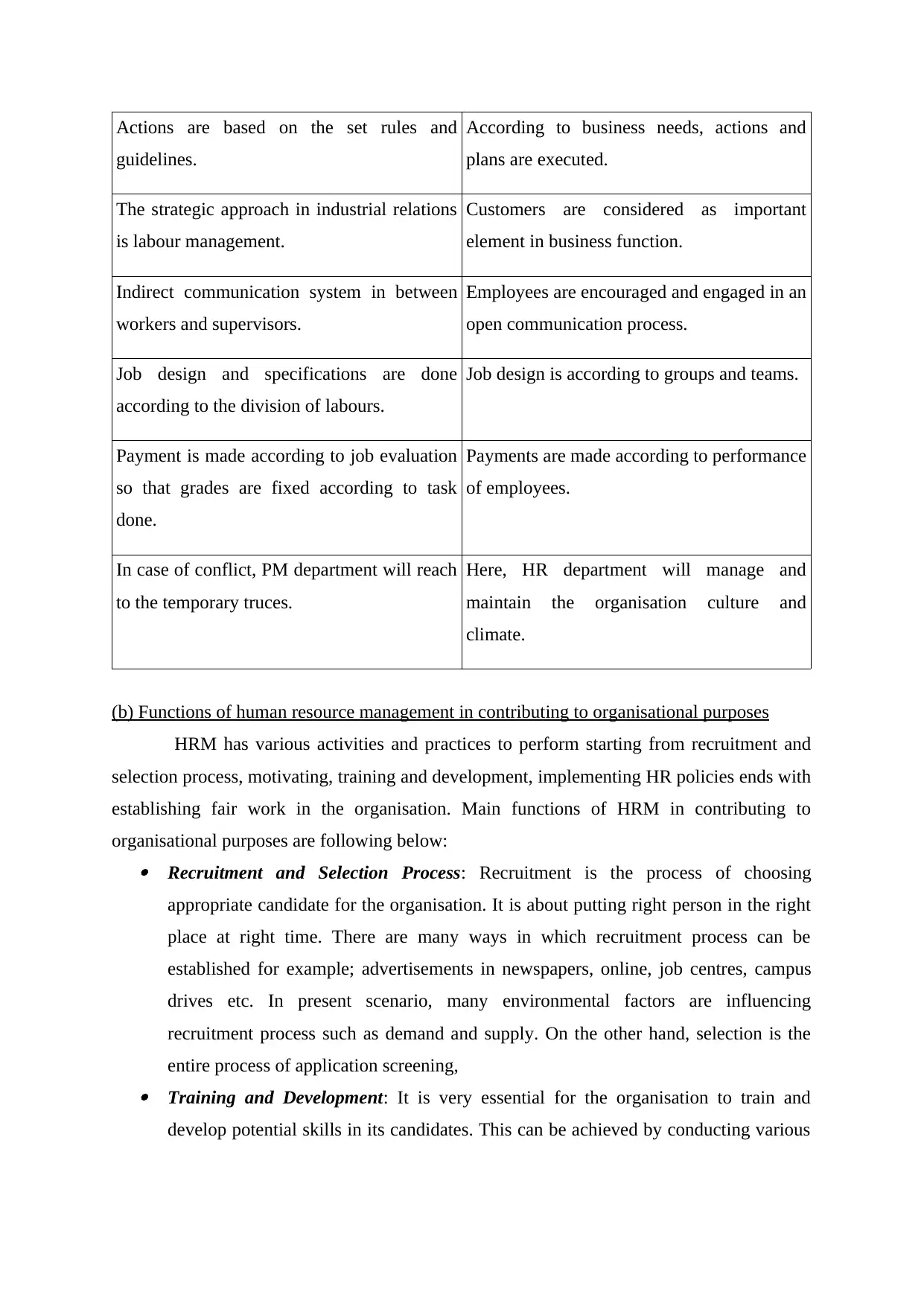
Actions are based on the set rules and
guidelines.
According to business needs, actions and
plans are executed.
The strategic approach in industrial relations
is labour management.
Customers are considered as important
element in business function.
Indirect communication system in between
workers and supervisors.
Employees are encouraged and engaged in an
open communication process.
Job design and specifications are done
according to the division of labours.
Job design is according to groups and teams.
Payment is made according to job evaluation
so that grades are fixed according to task
done.
Payments are made according to performance
of employees.
In case of conflict, PM department will reach
to the temporary truces.
Here, HR department will manage and
maintain the organisation culture and
climate.
(b) Functions of human resource management in contributing to organisational purposes
HRM has various activities and practices to perform starting from recruitment and
selection process, motivating, training and development, implementing HR policies ends with
establishing fair work in the organisation. Main functions of HRM in contributing to
organisational purposes are following below: Recruitment and Selection Process: Recruitment is the process of choosing
appropriate candidate for the organisation. It is about putting right person in the right
place at right time. There are many ways in which recruitment process can be
established for example; advertisements in newspapers, online, job centres, campus
drives etc. In present scenario, many environmental factors are influencing
recruitment process such as demand and supply. On the other hand, selection is the
entire process of application screening, Training and Development: It is very essential for the organisation to train and
develop potential skills in its candidates. This can be achieved by conducting various
guidelines.
According to business needs, actions and
plans are executed.
The strategic approach in industrial relations
is labour management.
Customers are considered as important
element in business function.
Indirect communication system in between
workers and supervisors.
Employees are encouraged and engaged in an
open communication process.
Job design and specifications are done
according to the division of labours.
Job design is according to groups and teams.
Payment is made according to job evaluation
so that grades are fixed according to task
done.
Payments are made according to performance
of employees.
In case of conflict, PM department will reach
to the temporary truces.
Here, HR department will manage and
maintain the organisation culture and
climate.
(b) Functions of human resource management in contributing to organisational purposes
HRM has various activities and practices to perform starting from recruitment and
selection process, motivating, training and development, implementing HR policies ends with
establishing fair work in the organisation. Main functions of HRM in contributing to
organisational purposes are following below: Recruitment and Selection Process: Recruitment is the process of choosing
appropriate candidate for the organisation. It is about putting right person in the right
place at right time. There are many ways in which recruitment process can be
established for example; advertisements in newspapers, online, job centres, campus
drives etc. In present scenario, many environmental factors are influencing
recruitment process such as demand and supply. On the other hand, selection is the
entire process of application screening, Training and Development: It is very essential for the organisation to train and
develop potential skills in its candidates. This can be achieved by conducting various
Paraphrase This Document
Need a fresh take? Get an instant paraphrase of this document with our AI Paraphraser
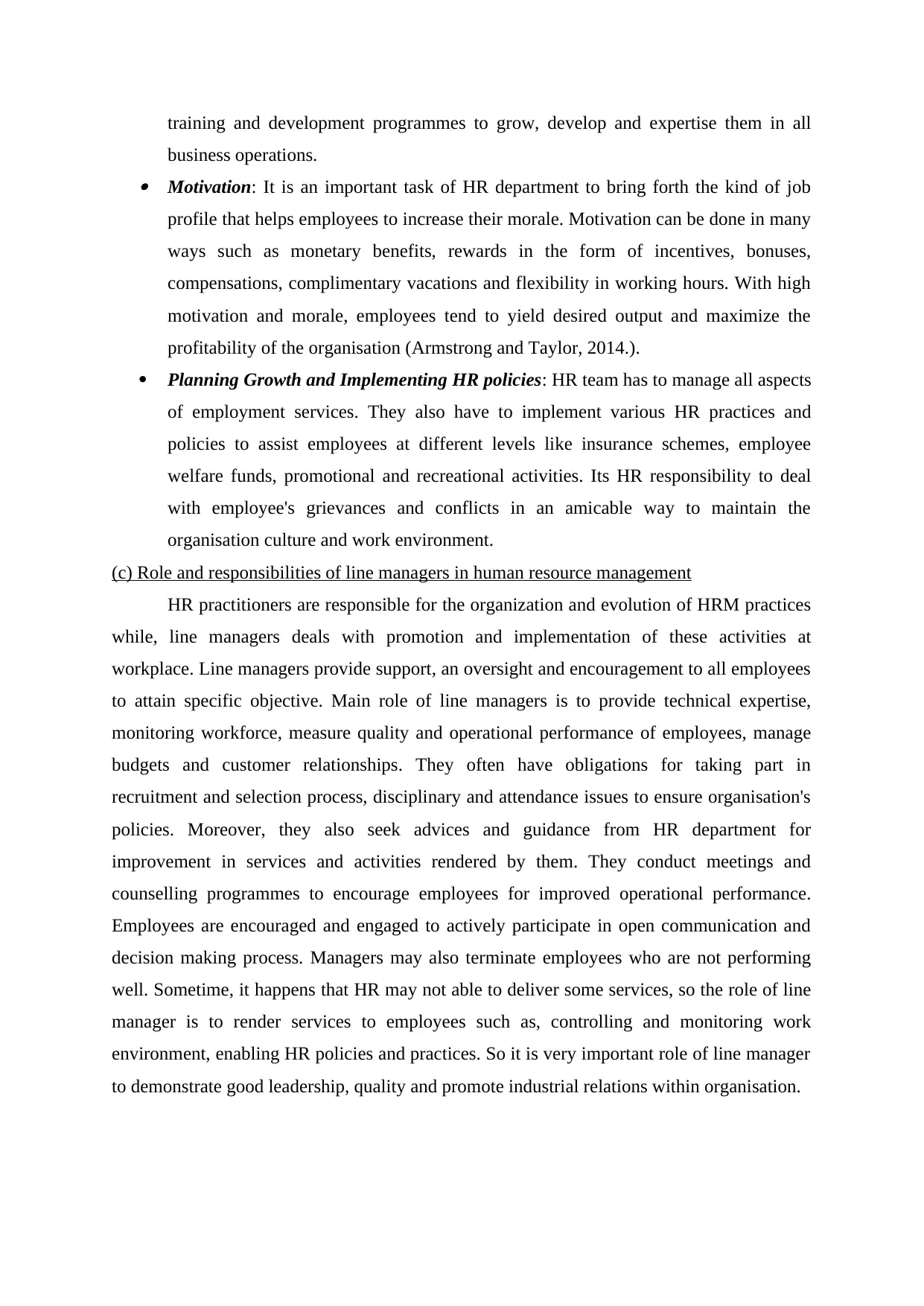
training and development programmes to grow, develop and expertise them in all
business operations. Motivation: It is an important task of HR department to bring forth the kind of job
profile that helps employees to increase their morale. Motivation can be done in many
ways such as monetary benefits, rewards in the form of incentives, bonuses,
compensations, complimentary vacations and flexibility in working hours. With high
motivation and morale, employees tend to yield desired output and maximize the
profitability of the organisation (Armstrong and Taylor, 2014.).
Planning Growth and Implementing HR policies: HR team has to manage all aspects
of employment services. They also have to implement various HR practices and
policies to assist employees at different levels like insurance schemes, employee
welfare funds, promotional and recreational activities. Its HR responsibility to deal
with employee's grievances and conflicts in an amicable way to maintain the
organisation culture and work environment.
(c) Role and responsibilities of line managers in human resource management
HR practitioners are responsible for the organization and evolution of HRM practices
while, line managers deals with promotion and implementation of these activities at
workplace. Line managers provide support, an oversight and encouragement to all employees
to attain specific objective. Main role of line managers is to provide technical expertise,
monitoring workforce, measure quality and operational performance of employees, manage
budgets and customer relationships. They often have obligations for taking part in
recruitment and selection process, disciplinary and attendance issues to ensure organisation's
policies. Moreover, they also seek advices and guidance from HR department for
improvement in services and activities rendered by them. They conduct meetings and
counselling programmes to encourage employees for improved operational performance.
Employees are encouraged and engaged to actively participate in open communication and
decision making process. Managers may also terminate employees who are not performing
well. Sometime, it happens that HR may not able to deliver some services, so the role of line
manager is to render services to employees such as, controlling and monitoring work
environment, enabling HR policies and practices. So it is very important role of line manager
to demonstrate good leadership, quality and promote industrial relations within organisation.
business operations. Motivation: It is an important task of HR department to bring forth the kind of job
profile that helps employees to increase their morale. Motivation can be done in many
ways such as monetary benefits, rewards in the form of incentives, bonuses,
compensations, complimentary vacations and flexibility in working hours. With high
motivation and morale, employees tend to yield desired output and maximize the
profitability of the organisation (Armstrong and Taylor, 2014.).
Planning Growth and Implementing HR policies: HR team has to manage all aspects
of employment services. They also have to implement various HR practices and
policies to assist employees at different levels like insurance schemes, employee
welfare funds, promotional and recreational activities. Its HR responsibility to deal
with employee's grievances and conflicts in an amicable way to maintain the
organisation culture and work environment.
(c) Role and responsibilities of line managers in human resource management
HR practitioners are responsible for the organization and evolution of HRM practices
while, line managers deals with promotion and implementation of these activities at
workplace. Line managers provide support, an oversight and encouragement to all employees
to attain specific objective. Main role of line managers is to provide technical expertise,
monitoring workforce, measure quality and operational performance of employees, manage
budgets and customer relationships. They often have obligations for taking part in
recruitment and selection process, disciplinary and attendance issues to ensure organisation's
policies. Moreover, they also seek advices and guidance from HR department for
improvement in services and activities rendered by them. They conduct meetings and
counselling programmes to encourage employees for improved operational performance.
Employees are encouraged and engaged to actively participate in open communication and
decision making process. Managers may also terminate employees who are not performing
well. Sometime, it happens that HR may not able to deliver some services, so the role of line
manager is to render services to employees such as, controlling and monitoring work
environment, enabling HR policies and practices. So it is very important role of line manager
to demonstrate good leadership, quality and promote industrial relations within organisation.
TASK 2
(a) Reasons for human resource planning in organisations
Effective HR planning helps the organisation to work efficiently and achieve success
in competitive business world. It is also responsible for sound decision making process and
proper career planning for employees. Some key points of Human Resource Planning (HRP)
are stated below: Future Manpower needs: HRP ensures the future availability of workforce in an
organisation to perform organisational activities and functions. It is responsible for
demand and supply of human resources for upcoming needs, to make an access to
skilled, qualified and talented candidates in the organisation. Coping with Change : It is also essential to face the changes in internal and external
environment which can be measure through PESTEL (Political, Economical, Social,
Technological, Environmental and Legal forces) analysis for instance; seasonal
fluctuations, voluntary quits and discharges etc. These factors can cause declination in
the workflow of the organisation so, it is necessary to cope up with these changes. Recruitment of People: Large number of talented employees are recruited and
selected on the basis of their qualifications, knowledge and skills. In case of shortage
of employees, the responsibility of HR department is to ensure constant supply of
workers to fill job vacancies. Restructuring work process: HRP has to restructure the entire work process
according to volatility in market. There are various organisational strategies and
policies to re-exercise with new schemes and guidelines. It also help organisation to
avoid obsolete working style and techniques.
Utilization of Human Resources: HR department organises various training and
development programmes to acquire successful utilization of manpower in an
efficient way. It emphasizes on optimal utilization of workforce to minimise the total
cost of production.
(b) Stages involved in human resource planning
HRP is the process of assessing future business operations, manpower needs and
estimation of demand and supply in the organisation. It broadly consists of four phases which
are stated as below: Assessment of Human Resources: Available human resources are analysed in terms
of their performance, quality and potential with the assessment of environmental
(a) Reasons for human resource planning in organisations
Effective HR planning helps the organisation to work efficiently and achieve success
in competitive business world. It is also responsible for sound decision making process and
proper career planning for employees. Some key points of Human Resource Planning (HRP)
are stated below: Future Manpower needs: HRP ensures the future availability of workforce in an
organisation to perform organisational activities and functions. It is responsible for
demand and supply of human resources for upcoming needs, to make an access to
skilled, qualified and talented candidates in the organisation. Coping with Change : It is also essential to face the changes in internal and external
environment which can be measure through PESTEL (Political, Economical, Social,
Technological, Environmental and Legal forces) analysis for instance; seasonal
fluctuations, voluntary quits and discharges etc. These factors can cause declination in
the workflow of the organisation so, it is necessary to cope up with these changes. Recruitment of People: Large number of talented employees are recruited and
selected on the basis of their qualifications, knowledge and skills. In case of shortage
of employees, the responsibility of HR department is to ensure constant supply of
workers to fill job vacancies. Restructuring work process: HRP has to restructure the entire work process
according to volatility in market. There are various organisational strategies and
policies to re-exercise with new schemes and guidelines. It also help organisation to
avoid obsolete working style and techniques.
Utilization of Human Resources: HR department organises various training and
development programmes to acquire successful utilization of manpower in an
efficient way. It emphasizes on optimal utilization of workforce to minimise the total
cost of production.
(b) Stages involved in human resource planning
HRP is the process of assessing future business operations, manpower needs and
estimation of demand and supply in the organisation. It broadly consists of four phases which
are stated as below: Assessment of Human Resources: Available human resources are analysed in terms
of their performance, quality and potential with the assessment of environmental
⊘ This is a preview!⊘
Do you want full access?
Subscribe today to unlock all pages.
Trusted by 1+ million students worldwide
analysis (PEST analysis). So that, it would be easy task for HR department to bring
out internal strengths and weaknesses, opportunities and threats of the organisation. Forecasting: HR manager will estimate the demand and supply of manpower.
Demand forecasting determines the future needs for workforce in terms of quantity
and quality. On the other hand, supply forecasting analyse the current human
resources accessible in the organisation using internal sources like transfer, job
enlargement and promotions. Estimating Gaps: There should not be mismatched approach in the demand and
supply of human resources in the organisation. Deficit in HR represents the number of
employees to be recruited whereas, surplus of HR tends to remove and terminate
employees.(Armstrong and Taylor, 2014)
Action Plan: Action plans consist of various HR activities such as recruitment,
selection, placement, training and development of employees. HR planning should
match the status of HR objectives and goals. Every time, it should be in the updated
form in order to improve performance of employees.
(c) Recruitment and selection process is carried out in two organisations
Marks and Spencer is the largest multinational retail chain of the UK which has
expanded its retail unit across the world. It is committed to provide equal opportunity and
peaceful environment to its employees.
Common recruitments practices are online advertisements, online job portals, private
agencies, job fairs and educational institutes.
Many intellectual tests are conducted like aptitude, competency and fluency test in
local languages which are also examined in interviews (Werner and DeSimone, 2011)
M&S conducts special training programmes to raise awareness among workers.
It also brings out potential talent within employees to comply with laws and
guidelines.
On the contrary, Transport for London (TFL) has robust process to be followed by
HRM to serve the public in an efficient way. TFL is a small local government organisation of
London which manages transport services over there.
It has very systematic procedure of promotion and selection criteria of job vacancies.
Advertisement can be done by local newspapers and templates which are limited to
the domain of London.
Give equal opportunities to workers regardless of discrimination.
out internal strengths and weaknesses, opportunities and threats of the organisation. Forecasting: HR manager will estimate the demand and supply of manpower.
Demand forecasting determines the future needs for workforce in terms of quantity
and quality. On the other hand, supply forecasting analyse the current human
resources accessible in the organisation using internal sources like transfer, job
enlargement and promotions. Estimating Gaps: There should not be mismatched approach in the demand and
supply of human resources in the organisation. Deficit in HR represents the number of
employees to be recruited whereas, surplus of HR tends to remove and terminate
employees.(Armstrong and Taylor, 2014)
Action Plan: Action plans consist of various HR activities such as recruitment,
selection, placement, training and development of employees. HR planning should
match the status of HR objectives and goals. Every time, it should be in the updated
form in order to improve performance of employees.
(c) Recruitment and selection process is carried out in two organisations
Marks and Spencer is the largest multinational retail chain of the UK which has
expanded its retail unit across the world. It is committed to provide equal opportunity and
peaceful environment to its employees.
Common recruitments practices are online advertisements, online job portals, private
agencies, job fairs and educational institutes.
Many intellectual tests are conducted like aptitude, competency and fluency test in
local languages which are also examined in interviews (Werner and DeSimone, 2011)
M&S conducts special training programmes to raise awareness among workers.
It also brings out potential talent within employees to comply with laws and
guidelines.
On the contrary, Transport for London (TFL) has robust process to be followed by
HRM to serve the public in an efficient way. TFL is a small local government organisation of
London which manages transport services over there.
It has very systematic procedure of promotion and selection criteria of job vacancies.
Advertisement can be done by local newspapers and templates which are limited to
the domain of London.
Give equal opportunities to workers regardless of discrimination.
Paraphrase This Document
Need a fresh take? Get an instant paraphrase of this document with our AI Paraphraser
Selection criteria are different from M&S as it emphasizes more on physical and
intellectual ability to face any diverse situation.
There are job assessment centres through which workers can assess any enquiries.
(d) Evaluate the effectiveness of recruitment and selection techniques of M&S and TFL
Marks and Spencer recruit its candidates via online job portals and telephonic
conversations. Its recruitment process is comparatively easier as it provides an access to its
website through which it chooses appropriate candidates for specific department. It also has
link with private agencies and consultant firms in order to promote job vacancies. In this
case, many cream students are filtered initially in recruitment process from huge crowd. So,
this process is beneficial for M&S as it helps them to find right candidate for company. This
process is somewhat not appropriate for people who have not availability of internet or any
communication source (Noe, 2013).
On the contrary, TFL prefers educational institutes and campus drives for recruitment
process and also ensures that the best candidate is being selected. It becomes easy for TFL to
train and develop its employees according to specific job profiles are so enthusiastic to learn
and grow. But it is preferable to select experienced persons as they have better knowledge of
work structure and would easily cope with the work environment.
TASK 3
(a) Link between motivational theory and reward management
M&S pay its employees according to their job performance and efforts put by them.
On excellent performance, they are promised to provide extra incentives, bonuses,
compensations, fringe benefits, gift cards and vouchers. Moreover, they get 20% discounts on
M&S products. It is the best way to motivate employees, to bring out potential skills and
make them work harder. Furthermore, it is not the money only that increases the morale of
employees. Other than monetary rewards, it is also necessary to fulfil all basic needs and
expectations of employees, develop their career with high morale in terms of recognition,
appreciation, promotions, responsibilities, advancement and personal growth (Dwivedi,
2009).
(b) Evaluate the process of job evaluation and other factors determining pay
M&S initiated many tailor made development programmes for growth of employees
and encourage them to actively participate in an open communication at every level of
business hierarchy. Performance appraisal process is essential in the organisation to make
employees work harder according to their potential and skills. In every 12 months, M&S
intellectual ability to face any diverse situation.
There are job assessment centres through which workers can assess any enquiries.
(d) Evaluate the effectiveness of recruitment and selection techniques of M&S and TFL
Marks and Spencer recruit its candidates via online job portals and telephonic
conversations. Its recruitment process is comparatively easier as it provides an access to its
website through which it chooses appropriate candidates for specific department. It also has
link with private agencies and consultant firms in order to promote job vacancies. In this
case, many cream students are filtered initially in recruitment process from huge crowd. So,
this process is beneficial for M&S as it helps them to find right candidate for company. This
process is somewhat not appropriate for people who have not availability of internet or any
communication source (Noe, 2013).
On the contrary, TFL prefers educational institutes and campus drives for recruitment
process and also ensures that the best candidate is being selected. It becomes easy for TFL to
train and develop its employees according to specific job profiles are so enthusiastic to learn
and grow. But it is preferable to select experienced persons as they have better knowledge of
work structure and would easily cope with the work environment.
TASK 3
(a) Link between motivational theory and reward management
M&S pay its employees according to their job performance and efforts put by them.
On excellent performance, they are promised to provide extra incentives, bonuses,
compensations, fringe benefits, gift cards and vouchers. Moreover, they get 20% discounts on
M&S products. It is the best way to motivate employees, to bring out potential skills and
make them work harder. Furthermore, it is not the money only that increases the morale of
employees. Other than monetary rewards, it is also necessary to fulfil all basic needs and
expectations of employees, develop their career with high morale in terms of recognition,
appreciation, promotions, responsibilities, advancement and personal growth (Dwivedi,
2009).
(b) Evaluate the process of job evaluation and other factors determining pay
M&S initiated many tailor made development programmes for growth of employees
and encourage them to actively participate in an open communication at every level of
business hierarchy. Performance appraisal process is essential in the organisation to make
employees work harder according to their potential and skills. In every 12 months, M&S
conducts appraisal programmes and discussed with whole team members, suggestions and
feedbacks are taken by workers in order to improve appraisal system. A critical review plan is
made by HR department to measure the effectiveness of production. M&S has made specific
criteria for pay-scale according to job specifications of employees. But, many times company
is not able to fulfil all demands and necessities of workers due to volatility in market,
recession or occupational hazards. So, it has to accumulate some extra fund in its reserves to
meet the emergencies.
(c) Effectiveness of reward systems
Effectiveness of reward systems should be evidence based. Every organisation has
different perspective for reward systems and approach to implement it. Multinational
companies have different work environment, reward management and economical status. For
instance, Marks and Spencer has large union of workers worldwide, it has weekly and
monthly payment modes with overtime pay and fringe benefits. It has distributed set of pay
scale on the basis of age and skills of employees (Guest, 2012). Apart from that, public sector
organisations also have unique work environment and numerous ways to rate performance. In
case of TFL, it provides several benefits to its employees, like basic salary with annual
increment, paid sick leaves, paternity and maternity leaves, annual promotions and vacation
compensations etc. The kind of reward system may vary; it can be in the form of shares or
stock. The frequency with which rewards are given may vary according to organisation
(Tulgan, 2010).
(d) Methods used to monitor employee performance
There are numerous effective measures to monitor performance of employees against
desired objectives. Organisations choose the most effective and simpler techniques to monitor
performance. Some of them are following below: Performance Reviews: Many organisations have standardized performance review
worksheets and self- monitoring tools for employees to keep track of their own
performance. Managers can use checklists and activity logs Employees have to meet
their organisational goal and deadline laid out in projects. Peer Appraisals: Team members often have feedbacks and opinions about their
colleagues. Appraisals can be tracked on database over multiple periods of time; peers
also give opinions about their behaviour in workplace.
feedbacks are taken by workers in order to improve appraisal system. A critical review plan is
made by HR department to measure the effectiveness of production. M&S has made specific
criteria for pay-scale according to job specifications of employees. But, many times company
is not able to fulfil all demands and necessities of workers due to volatility in market,
recession or occupational hazards. So, it has to accumulate some extra fund in its reserves to
meet the emergencies.
(c) Effectiveness of reward systems
Effectiveness of reward systems should be evidence based. Every organisation has
different perspective for reward systems and approach to implement it. Multinational
companies have different work environment, reward management and economical status. For
instance, Marks and Spencer has large union of workers worldwide, it has weekly and
monthly payment modes with overtime pay and fringe benefits. It has distributed set of pay
scale on the basis of age and skills of employees (Guest, 2012). Apart from that, public sector
organisations also have unique work environment and numerous ways to rate performance. In
case of TFL, it provides several benefits to its employees, like basic salary with annual
increment, paid sick leaves, paternity and maternity leaves, annual promotions and vacation
compensations etc. The kind of reward system may vary; it can be in the form of shares or
stock. The frequency with which rewards are given may vary according to organisation
(Tulgan, 2010).
(d) Methods used to monitor employee performance
There are numerous effective measures to monitor performance of employees against
desired objectives. Organisations choose the most effective and simpler techniques to monitor
performance. Some of them are following below: Performance Reviews: Many organisations have standardized performance review
worksheets and self- monitoring tools for employees to keep track of their own
performance. Managers can use checklists and activity logs Employees have to meet
their organisational goal and deadline laid out in projects. Peer Appraisals: Team members often have feedbacks and opinions about their
colleagues. Appraisals can be tracked on database over multiple periods of time; peers
also give opinions about their behaviour in workplace.
⊘ This is a preview!⊘
Do you want full access?
Subscribe today to unlock all pages.
Trusted by 1+ million students worldwide
Report back: Here, employees report back about their performance to the
management. Employee is evident to his own performance in the organisation. Observation: It is a planned approach by HR department in order to watch their
employees without letting them know. Its complete watch of employees whether they
are contributing to team or offering help to them.
360 degree Feedback: It is a direct process of feedback in which employees receive
confidential feedbacks from people around them that is subordinates, peers,
supervisors and direct reports. Moreover, they also get feedbacks from external
sources, such as customers and shareholders.
TASK 4
(a) Reasons for cessation of employment with an organisation
There are many reasons for cessation of employment with an organisation. Some of
them are stated below:
Due to unsatisfactory working conditions and inappropriate management style.
Damaging company's property or misconduct.
Violation of company's policy and norms.
At the ending of their working life, they may think of retirement. In return, they
receive many benefits such as pension fund and lump-sum payout.
Many employees left their job or resign as they are transferred to another business
which may not be suitable for them.
There may be family issues and health problems which force them to leave their job.
Employees are terminated; if they breach their contract or there may be criminal, and
harassment case on them.
(b) Employment exit procedures used by two organisations
If any employee is leaving the organisation then, he has to follow certain steps in
order to complete the exit procedure. With this reference, examples are Marks and Spencer
and Transport for London (TFL).
Exit procedure in Marks and Spencer
Employee has to give written notice, a termination form to the manager of M&S.
After the notice has been sent, he should meet to HR to discuss the implications of
departure.
Then employee has to handover all relevant documents left over with him to his
manager.
management. Employee is evident to his own performance in the organisation. Observation: It is a planned approach by HR department in order to watch their
employees without letting them know. Its complete watch of employees whether they
are contributing to team or offering help to them.
360 degree Feedback: It is a direct process of feedback in which employees receive
confidential feedbacks from people around them that is subordinates, peers,
supervisors and direct reports. Moreover, they also get feedbacks from external
sources, such as customers and shareholders.
TASK 4
(a) Reasons for cessation of employment with an organisation
There are many reasons for cessation of employment with an organisation. Some of
them are stated below:
Due to unsatisfactory working conditions and inappropriate management style.
Damaging company's property or misconduct.
Violation of company's policy and norms.
At the ending of their working life, they may think of retirement. In return, they
receive many benefits such as pension fund and lump-sum payout.
Many employees left their job or resign as they are transferred to another business
which may not be suitable for them.
There may be family issues and health problems which force them to leave their job.
Employees are terminated; if they breach their contract or there may be criminal, and
harassment case on them.
(b) Employment exit procedures used by two organisations
If any employee is leaving the organisation then, he has to follow certain steps in
order to complete the exit procedure. With this reference, examples are Marks and Spencer
and Transport for London (TFL).
Exit procedure in Marks and Spencer
Employee has to give written notice, a termination form to the manager of M&S.
After the notice has been sent, he should meet to HR to discuss the implications of
departure.
Then employee has to handover all relevant documents left over with him to his
manager.
Paraphrase This Document
Need a fresh take? Get an instant paraphrase of this document with our AI Paraphraser
IT head is responsible for termination of its terminal or account on M&S portal and
also have to keep track of data held in user's account. At last, final exit interview is organised to get all positive and negative feedbacks
about company.
Exit Procedure in TFL
Employee who is thinking of leaving TFL has to give written notice in the form of
application to the manager.
Then, HR department will organise an exit interview for that employee and enclosed a
questionnaire to be filled.
HR manager need to send a confirm service form to the employee.
Finally, an interview is conducted by HR department.
(c) Impact of the legal and regulatory framework on HRM and employment cessation
arrangements
HRM is complying with all employment, health and safety legislation to maintain a
good rapport between employees and employers. Many HR practices such as recruitment
process, labour relations and cessation pertain to international laws. Employees have to
follow various legal and regulatory acts (Smith and Baker, 2015).
Issues like discrimination, legal working ages, and payment of income, safe working
conditions and duty of care are involved by the legislation.
It is not easy task for HR to terminate any employee; he has to go through all rules
and regulations before ceasing that employee.
According to organisation's norms and principles, HR can take immediate steps.
Moreover, if there is no valid reason for termination of employee then, it will become
illegal case.
Equal pay act 1970 protest against discrimination among employees in terms of
gender.
National minimum wage rate act 1988 supports that each employee should get
minimum wage rate per hour (Statutes and Kidner, 2015).
Employment right law 1996 depicts that all important terms of contract must be in
writing and should avail to employee within two months of joining. Also employees
are obliged to follow all legal aspects of the organisation.
also have to keep track of data held in user's account. At last, final exit interview is organised to get all positive and negative feedbacks
about company.
Exit Procedure in TFL
Employee who is thinking of leaving TFL has to give written notice in the form of
application to the manager.
Then, HR department will organise an exit interview for that employee and enclosed a
questionnaire to be filled.
HR manager need to send a confirm service form to the employee.
Finally, an interview is conducted by HR department.
(c) Impact of the legal and regulatory framework on HRM and employment cessation
arrangements
HRM is complying with all employment, health and safety legislation to maintain a
good rapport between employees and employers. Many HR practices such as recruitment
process, labour relations and cessation pertain to international laws. Employees have to
follow various legal and regulatory acts (Smith and Baker, 2015).
Issues like discrimination, legal working ages, and payment of income, safe working
conditions and duty of care are involved by the legislation.
It is not easy task for HR to terminate any employee; he has to go through all rules
and regulations before ceasing that employee.
According to organisation's norms and principles, HR can take immediate steps.
Moreover, if there is no valid reason for termination of employee then, it will become
illegal case.
Equal pay act 1970 protest against discrimination among employees in terms of
gender.
National minimum wage rate act 1988 supports that each employee should get
minimum wage rate per hour (Statutes and Kidner, 2015).
Employment right law 1996 depicts that all important terms of contract must be in
writing and should avail to employee within two months of joining. Also employees
are obliged to follow all legal aspects of the organisation.
CONCLUSION
Human Resource Management has vital role in the management of employees in the
organisation. It looks after the people working in the workplace. HR department manages the
difficulties faced by employees and helps them to enhance improvement in operational
performance. There are various factors according to which the job performance is evaluated
such as employee's qualifications, skills and competency. Hence, HR is responsible for all
functions including resourcing, development and growth of employees, reward systems,
legislations and industrial relations within business.
Human Resource Management has vital role in the management of employees in the
organisation. It looks after the people working in the workplace. HR department manages the
difficulties faced by employees and helps them to enhance improvement in operational
performance. There are various factors according to which the job performance is evaluated
such as employee's qualifications, skills and competency. Hence, HR is responsible for all
functions including resourcing, development and growth of employees, reward systems,
legislations and industrial relations within business.
⊘ This is a preview!⊘
Do you want full access?
Subscribe today to unlock all pages.
Trusted by 1+ million students worldwide

1 out of 13


Related Documents


Your All-in-One AI-Powered Toolkit for Academic Success.
+13062052269
info@desklib.com
Available 24*7 on WhatsApp / Email
![[object Object]](/_next/static/media/star-bottom.7253800d.svg)
Unlock your academic potential
Copyright © 2020–2026 A2Z Services. All Rights Reserved. Developed and managed by ZUCOL.