Human Resource Report: Organization and HR Strategy and Practices
VerifiedAdded on 2023/01/11
|13
|4034
|88
Report
AI Summary
This report analyzes the role of Human Resources (HR) within an organization, using Heritage Textile as a case study. It begins with an introduction to HR functions, emphasizing its impact on productivity and organizational objectives. The main body delves into factors affecting organizations and HR, comparing PESTLE and SWOT analyses. It explores the impact of political, economic, socio-cultural, and technological factors on HR functions. The report also examines organizational and HR strategies, discussing key forces influencing the HR agenda and the stages of strategy formation and implementation, including the roles of HR in business planning and ethics. Furthermore, the report addresses change management, analyzing business performance tools and the HR's role in change management, including the sources of business data and the areas of focus. The conclusion summarizes the key findings, and references are provided. The report highlights the importance of HR in aligning with company objectives and adapting to external changes to achieve sustainable growth.

Human Resource
1
1

Paraphrase This Document
Need a fresh take? Get an instant paraphrase of this document with our AI Paraphraser
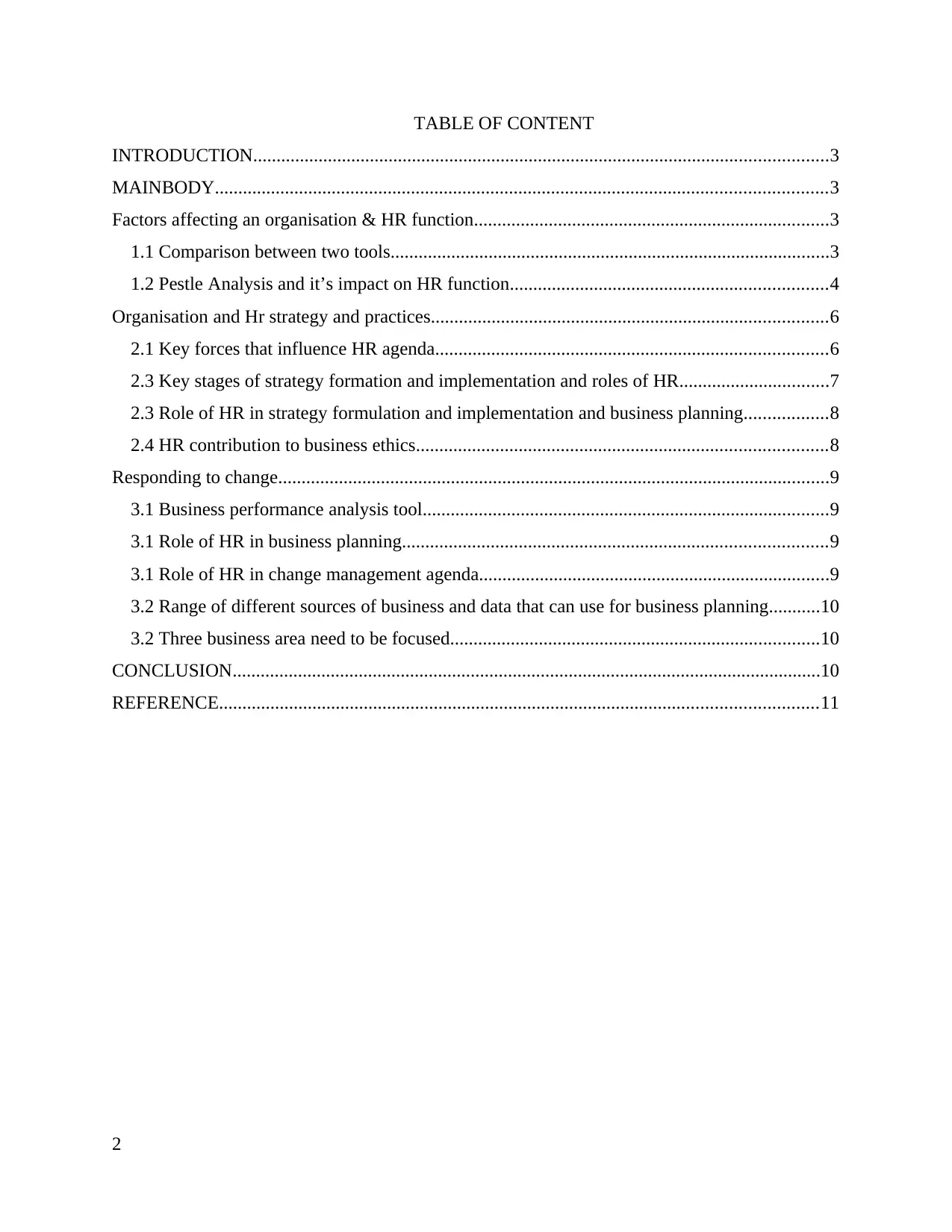
TABLE OF CONTENT
INTRODUCTION...........................................................................................................................3
MAINBODY...................................................................................................................................3
Factors affecting an organisation & HR function............................................................................3
1.1 Comparison between two tools..............................................................................................3
1.2 Pestle Analysis and it’s impact on HR function....................................................................4
Organisation and Hr strategy and practices.....................................................................................6
2.1 Key forces that influence HR agenda....................................................................................6
2.3 Key stages of strategy formation and implementation and roles of HR................................7
2.3 Role of HR in strategy formulation and implementation and business planning..................8
2.4 HR contribution to business ethics........................................................................................8
Responding to change......................................................................................................................9
3.1 Business performance analysis tool.......................................................................................9
3.1 Role of HR in business planning...........................................................................................9
3.1 Role of HR in change management agenda...........................................................................9
3.2 Range of different sources of business and data that can use for business planning...........10
3.2 Three business area need to be focused...............................................................................10
CONCLUSION..............................................................................................................................10
REFERENCE................................................................................................................................11
2
INTRODUCTION...........................................................................................................................3
MAINBODY...................................................................................................................................3
Factors affecting an organisation & HR function............................................................................3
1.1 Comparison between two tools..............................................................................................3
1.2 Pestle Analysis and it’s impact on HR function....................................................................4
Organisation and Hr strategy and practices.....................................................................................6
2.1 Key forces that influence HR agenda....................................................................................6
2.3 Key stages of strategy formation and implementation and roles of HR................................7
2.3 Role of HR in strategy formulation and implementation and business planning..................8
2.4 HR contribution to business ethics........................................................................................8
Responding to change......................................................................................................................9
3.1 Business performance analysis tool.......................................................................................9
3.1 Role of HR in business planning...........................................................................................9
3.1 Role of HR in change management agenda...........................................................................9
3.2 Range of different sources of business and data that can use for business planning...........10
3.2 Three business area need to be focused...............................................................................10
CONCLUSION..............................................................................................................................10
REFERENCE................................................................................................................................11
2
INTRODUCTION
Human resource is a person who manage group of people or employee in the company
and involves number of operations i.e. recruiting, firing, training and motivating employee in the
organization. The main aim of the human resource to leads high productivity in the employees
working so that easy to meet organization’s objectives over the time. Human resource handles
numerous functions of the business effectively. To understand role of HR has an example of
Heritage Textile organization which has specialization in handicraft textiles. Organization offers
wide variety products i.e. textile and handicraft items to the customer. The report includes
different factors that impacts on an organization’s business and it’s HR function.
MAINBODY
Factors affecting an organisation & HR function
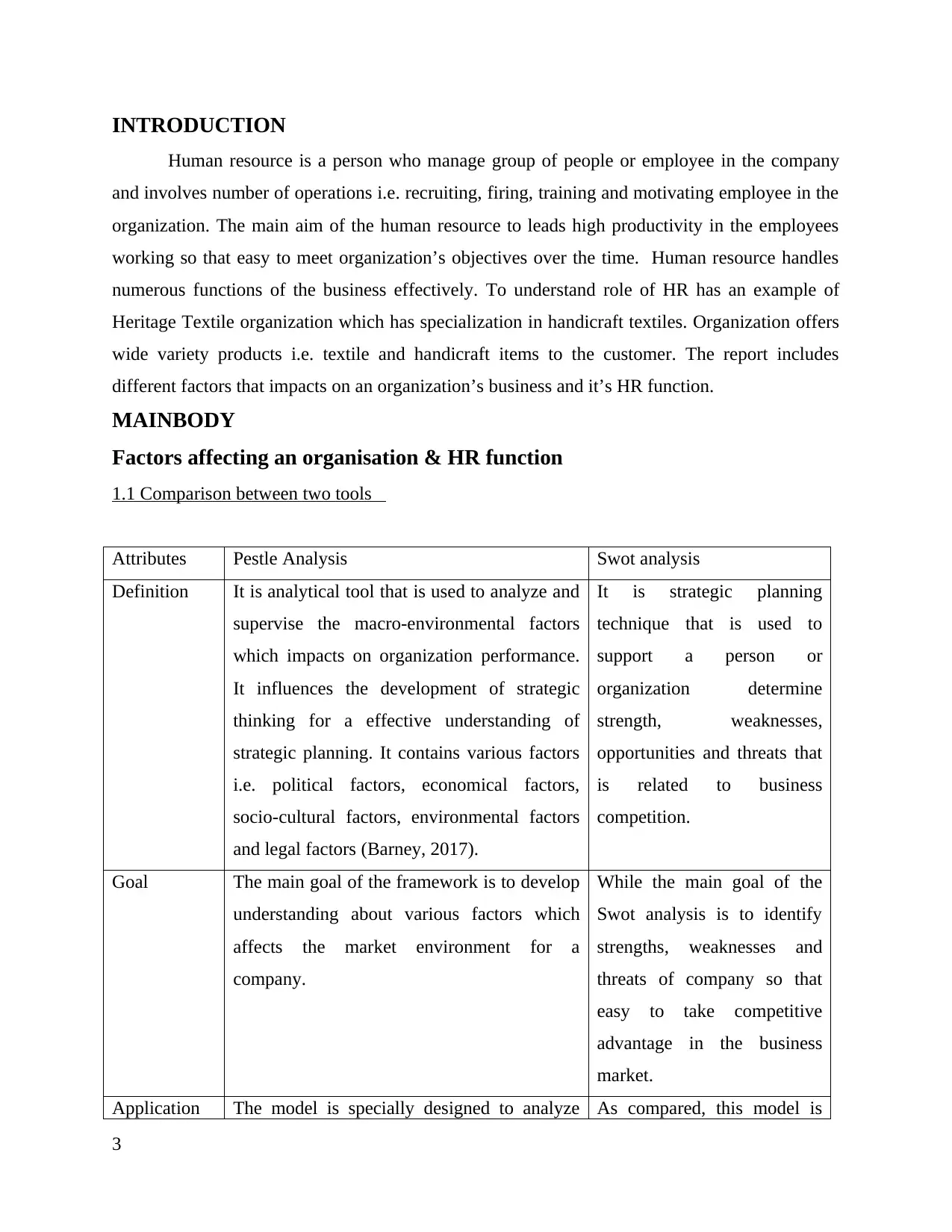
1.1 Comparison between two tools
Attributes Pestle Analysis Swot analysis
Definition It is analytical tool that is used to analyze and
supervise the macro-environmental factors
which impacts on organization performance.
It influences the development of strategic
thinking for a effective understanding of
strategic planning. It contains various factors
i.e. political factors, economical factors,
socio-cultural factors, environmental factors
and legal factors (Barney, 2017).
It is strategic planning
technique that is used to
support a person or
organization determine
strength, weaknesses,
opportunities and threats that
is related to business
competition.
Goal The main goal of the framework is to develop
understanding about various factors which
affects the market environment for a
company.
While the main goal of the
Swot analysis is to identify
strengths, weaknesses and
threats of company so that
easy to take competitive
advantage in the business
market.
Application The model is specially designed to analyze As compared, this model is
3
Human resource is a person who manage group of people or employee in the company
and involves number of operations i.e. recruiting, firing, training and motivating employee in the
organization. The main aim of the human resource to leads high productivity in the employees
working so that easy to meet organization’s objectives over the time. Human resource handles
numerous functions of the business effectively. To understand role of HR has an example of
Heritage Textile organization which has specialization in handicraft textiles. Organization offers
wide variety products i.e. textile and handicraft items to the customer. The report includes
different factors that impacts on an organization’s business and it’s HR function.
MAINBODY
Factors affecting an organisation & HR function
1.1 Comparison between two tools
Attributes Pestle Analysis Swot analysis
Definition It is analytical tool that is used to analyze and
supervise the macro-environmental factors
which impacts on organization performance.
It influences the development of strategic
thinking for a effective understanding of
strategic planning. It contains various factors
i.e. political factors, economical factors,
socio-cultural factors, environmental factors
and legal factors (Barney, 2017).
It is strategic planning
technique that is used to
support a person or
organization determine
strength, weaknesses,
opportunities and threats that
is related to business
competition.
Goal The main goal of the framework is to develop
understanding about various factors which
affects the market environment for a
company.
While the main goal of the
Swot analysis is to identify
strengths, weaknesses and
threats of company so that
easy to take competitive
advantage in the business
market.
Application The model is specially designed to analyze As compared, this model is
3
⊘ This is a preview!⊘
Do you want full access?
Subscribe today to unlock all pages.

Trusted by 1+ million students worldwide
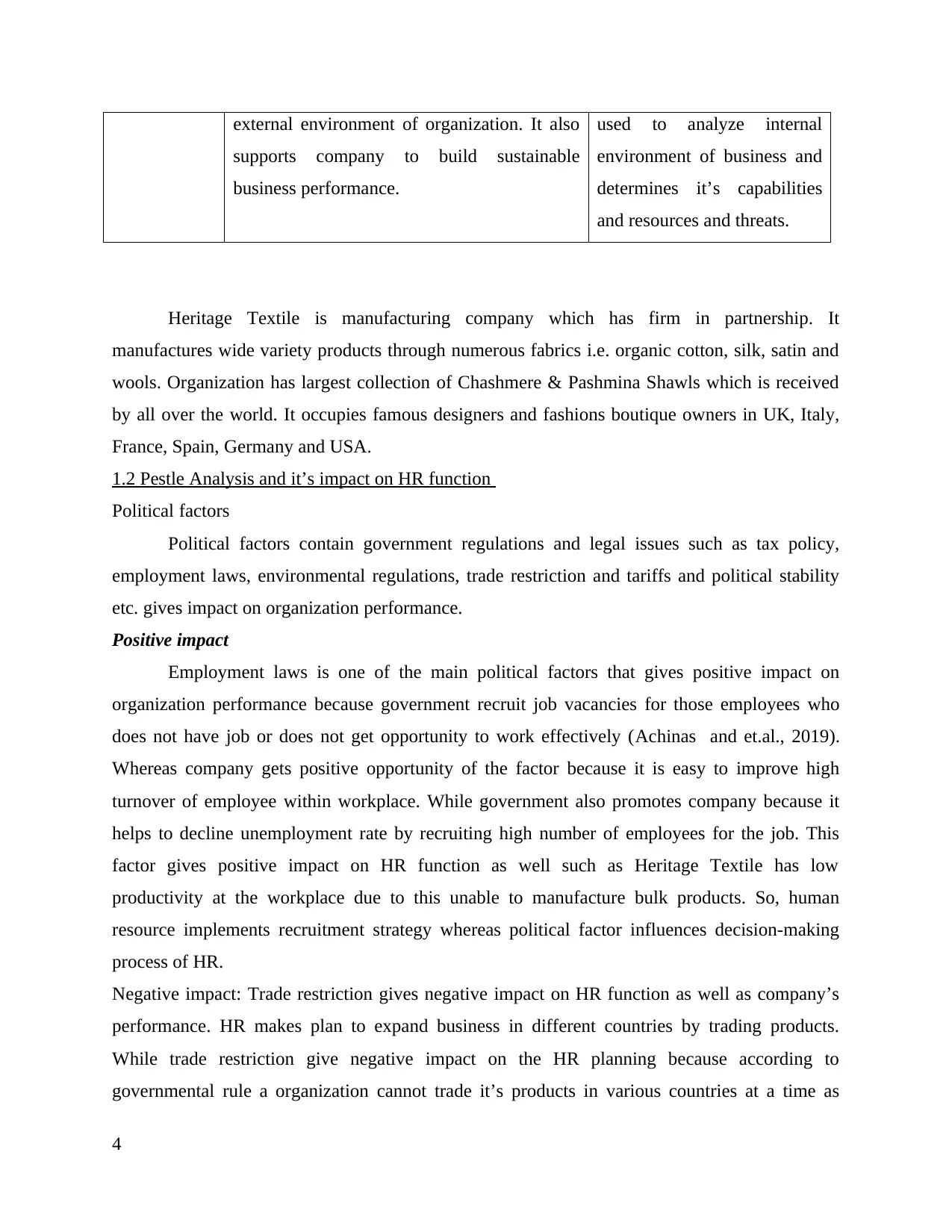
external environment of organization. It also
supports company to build sustainable
business performance.
used to analyze internal
environment of business and
determines it’s capabilities
and resources and threats.
Heritage Textile is manufacturing company which has firm in partnership. It
manufactures wide variety products through numerous fabrics i.e. organic cotton, silk, satin and
wools. Organization has largest collection of Chashmere & Pashmina Shawls which is received
by all over the world. It occupies famous designers and fashions boutique owners in UK, Italy,
France, Spain, Germany and USA.
1.2 Pestle Analysis and it’s impact on HR function
Political factors
Political factors contain government regulations and legal issues such as tax policy,
employment laws, environmental regulations, trade restriction and tariffs and political stability
etc. gives impact on organization performance.
Positive impact
Employment laws is one of the main political factors that gives positive impact on
organization performance because government recruit job vacancies for those employees who
does not have job or does not get opportunity to work effectively (Achinas and et.al., 2019).
Whereas company gets positive opportunity of the factor because it is easy to improve high
turnover of employee within workplace. While government also promotes company because it
helps to decline unemployment rate by recruiting high number of employees for the job. This
factor gives positive impact on HR function as well such as Heritage Textile has low
productivity at the workplace due to this unable to manufacture bulk products. So, human
resource implements recruitment strategy whereas political factor influences decision-making
process of HR.
Negative impact: Trade restriction gives negative impact on HR function as well as company’s
performance. HR makes plan to expand business in different countries by trading products.
While trade restriction give negative impact on the HR planning because according to
governmental rule a organization cannot trade it’s products in various countries at a time as
4
supports company to build sustainable
business performance.
used to analyze internal
environment of business and
determines it’s capabilities
and resources and threats.
Heritage Textile is manufacturing company which has firm in partnership. It
manufactures wide variety products through numerous fabrics i.e. organic cotton, silk, satin and
wools. Organization has largest collection of Chashmere & Pashmina Shawls which is received
by all over the world. It occupies famous designers and fashions boutique owners in UK, Italy,
France, Spain, Germany and USA.
1.2 Pestle Analysis and it’s impact on HR function
Political factors
Political factors contain government regulations and legal issues such as tax policy,
employment laws, environmental regulations, trade restriction and tariffs and political stability
etc. gives impact on organization performance.
Positive impact
Employment laws is one of the main political factors that gives positive impact on
organization performance because government recruit job vacancies for those employees who
does not have job or does not get opportunity to work effectively (Achinas and et.al., 2019).
Whereas company gets positive opportunity of the factor because it is easy to improve high
turnover of employee within workplace. While government also promotes company because it
helps to decline unemployment rate by recruiting high number of employees for the job. This
factor gives positive impact on HR function as well such as Heritage Textile has low
productivity at the workplace due to this unable to manufacture bulk products. So, human
resource implements recruitment strategy whereas political factor influences decision-making
process of HR.
Negative impact: Trade restriction gives negative impact on HR function as well as company’s
performance. HR makes plan to expand business in different countries by trading products.
While trade restriction give negative impact on the HR planning because according to
governmental rule a organization cannot trade it’s products in various countries at a time as
4
Paraphrase This Document
Need a fresh take? Get an instant paraphrase of this document with our AI Paraphraser
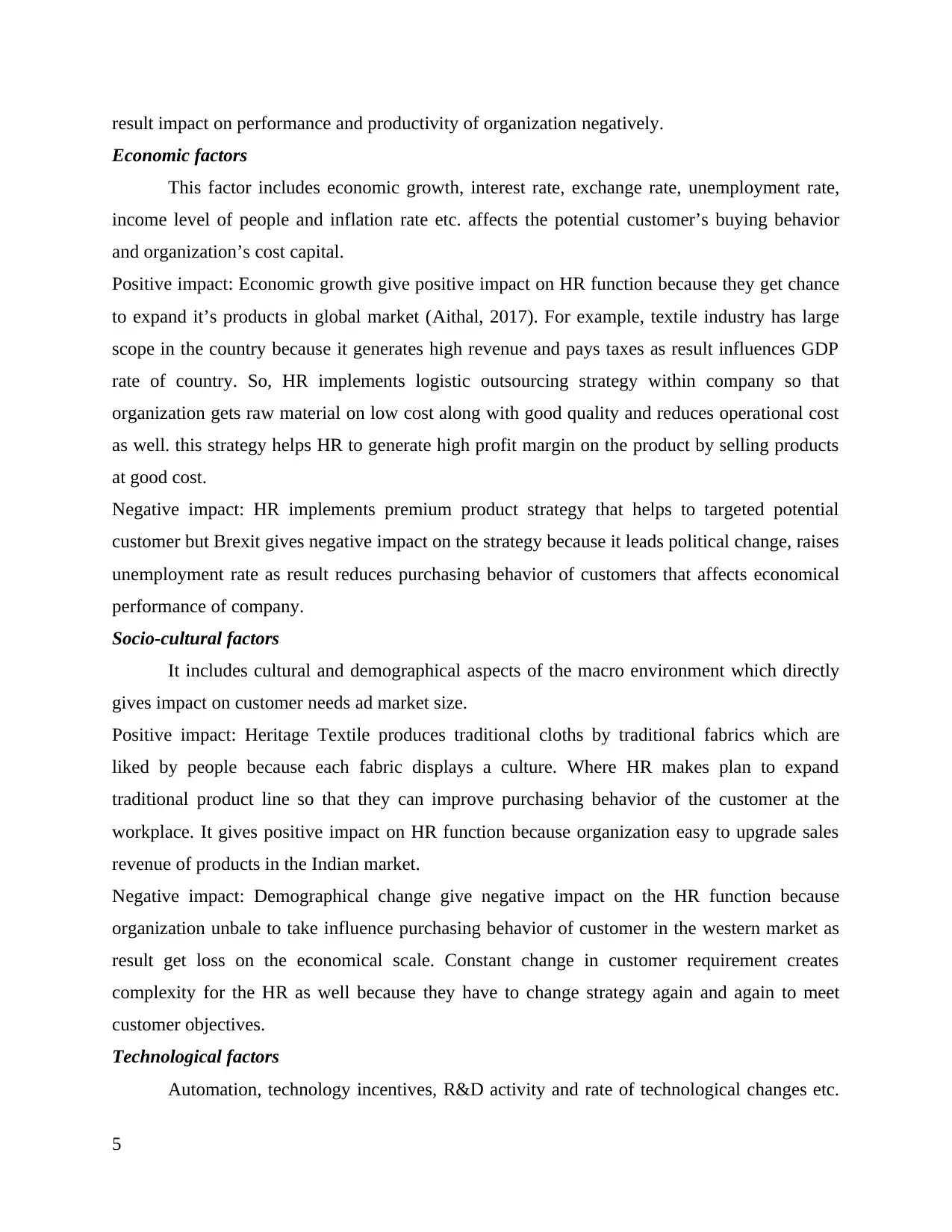
result impact on performance and productivity of organization negatively.
Economic factors
This factor includes economic growth, interest rate, exchange rate, unemployment rate,
income level of people and inflation rate etc. affects the potential customer’s buying behavior
and organization’s cost capital.
Positive impact: Economic growth give positive impact on HR function because they get chance
to expand it’s products in global market (Aithal, 2017). For example, textile industry has large
scope in the country because it generates high revenue and pays taxes as result influences GDP
rate of country. So, HR implements logistic outsourcing strategy within company so that
organization gets raw material on low cost along with good quality and reduces operational cost
as well. this strategy helps HR to generate high profit margin on the product by selling products
at good cost.
Negative impact: HR implements premium product strategy that helps to targeted potential
customer but Brexit gives negative impact on the strategy because it leads political change, raises
unemployment rate as result reduces purchasing behavior of customers that affects economical
performance of company.
Socio-cultural factors
It includes cultural and demographical aspects of the macro environment which directly
gives impact on customer needs ad market size.
Positive impact: Heritage Textile produces traditional cloths by traditional fabrics which are
liked by people because each fabric displays a culture. Where HR makes plan to expand
traditional product line so that they can improve purchasing behavior of the customer at the
workplace. It gives positive impact on HR function because organization easy to upgrade sales
revenue of products in the Indian market.
Negative impact: Demographical change give negative impact on the HR function because
organization unbale to take influence purchasing behavior of customer in the western market as
result get loss on the economical scale. Constant change in customer requirement creates
complexity for the HR as well because they have to change strategy again and again to meet
customer objectives.
Technological factors
Automation, technology incentives, R&D activity and rate of technological changes etc.
5
Economic factors
This factor includes economic growth, interest rate, exchange rate, unemployment rate,
income level of people and inflation rate etc. affects the potential customer’s buying behavior
and organization’s cost capital.
Positive impact: Economic growth give positive impact on HR function because they get chance
to expand it’s products in global market (Aithal, 2017). For example, textile industry has large
scope in the country because it generates high revenue and pays taxes as result influences GDP
rate of country. So, HR implements logistic outsourcing strategy within company so that
organization gets raw material on low cost along with good quality and reduces operational cost
as well. this strategy helps HR to generate high profit margin on the product by selling products
at good cost.
Negative impact: HR implements premium product strategy that helps to targeted potential
customer but Brexit gives negative impact on the strategy because it leads political change, raises
unemployment rate as result reduces purchasing behavior of customers that affects economical
performance of company.
Socio-cultural factors
It includes cultural and demographical aspects of the macro environment which directly
gives impact on customer needs ad market size.
Positive impact: Heritage Textile produces traditional cloths by traditional fabrics which are
liked by people because each fabric displays a culture. Where HR makes plan to expand
traditional product line so that they can improve purchasing behavior of the customer at the
workplace. It gives positive impact on HR function because organization easy to upgrade sales
revenue of products in the Indian market.
Negative impact: Demographical change give negative impact on the HR function because
organization unbale to take influence purchasing behavior of customer in the western market as
result get loss on the economical scale. Constant change in customer requirement creates
complexity for the HR as well because they have to change strategy again and again to meet
customer objectives.
Technological factors
Automation, technology incentives, R&D activity and rate of technological changes etc.
5
are technological factors which gives impact on the HR function as well as organization
performance.
Positive impact: HR applies automation technology strategy within workplace that gives
positive impact on the organization performance because it gets high productivity of products
without human error and influences working efficiency of labor at the workplace. It causes HR
enable to booming sales in the textile industries (Düerkop and Huth, 2017).
Negative impact: Automation of technology enhances cost rate of products as result gets
financial loss in the company. It also impacts employee productivity in the working place as
well.
Organisation and Hr strategy and practices
2.1 Key forces that influence HR agenda
There are various internal as well as external forces that impact on HR agenda such as
supply and demand, employment rate, economic condition, availability of labour within market
and technological changes. Continuous changes in different external environment enforce HR of
heritage Textile to effectively change its agenda so that company can grow and sustainable in
market. HR agenda of Heritage Textile is to maximum utilisation of employee capabilities and
skills so that company can easily achieve its objectives. HR strategy and agenda should be
aligned with company objective and its various stakeholders such as customers, employee,
investors and shareholders (Guest, Panayotopoulou and Chytiri, 2017). HR need to have
sufficient knowledge about social and environment responsibilities so that scare and limited
resource of country can be effectively utilised for growth and expansion of business. Strategic
thinking and planning, enhancement in employee’s productivity, digital HR and increase in
brand image of company are some of the key agenda of HR of heritage textile that are affected
by various ever changing factors. HR had to plan for employees benefit on basis of external
factors such as social preference, economic condition to enhance their performance. Employment
law need to be made as per government policies to ensure effective operation of business and
achievement of objectives.
2.3 Key stages of strategy formation and implementation and roles of HR
Strategy formulation refer to future plan that helps company to accept different changes
that are happening in external environment so that company can gain competitive advantages and
6
performance.
Positive impact: HR applies automation technology strategy within workplace that gives
positive impact on the organization performance because it gets high productivity of products
without human error and influences working efficiency of labor at the workplace. It causes HR
enable to booming sales in the textile industries (Düerkop and Huth, 2017).
Negative impact: Automation of technology enhances cost rate of products as result gets
financial loss in the company. It also impacts employee productivity in the working place as
well.
Organisation and Hr strategy and practices
2.1 Key forces that influence HR agenda
There are various internal as well as external forces that impact on HR agenda such as
supply and demand, employment rate, economic condition, availability of labour within market
and technological changes. Continuous changes in different external environment enforce HR of
heritage Textile to effectively change its agenda so that company can grow and sustainable in
market. HR agenda of Heritage Textile is to maximum utilisation of employee capabilities and
skills so that company can easily achieve its objectives. HR strategy and agenda should be
aligned with company objective and its various stakeholders such as customers, employee,
investors and shareholders (Guest, Panayotopoulou and Chytiri, 2017). HR need to have
sufficient knowledge about social and environment responsibilities so that scare and limited
resource of country can be effectively utilised for growth and expansion of business. Strategic
thinking and planning, enhancement in employee’s productivity, digital HR and increase in
brand image of company are some of the key agenda of HR of heritage textile that are affected
by various ever changing factors. HR had to plan for employees benefit on basis of external
factors such as social preference, economic condition to enhance their performance. Employment
law need to be made as per government policies to ensure effective operation of business and
achievement of objectives.
2.3 Key stages of strategy formation and implementation and roles of HR
Strategy formulation refer to future plan that helps company to accept different changes
that are happening in external environment so that company can gain competitive advantages and
6
⊘ This is a preview!⊘
Do you want full access?
Subscribe today to unlock all pages.
Trusted by 1+ million students worldwide
expand its market share. There are key stages of strategy formation and implementation can eb
explained through two models such as:
Review mission, vision and objective of company: HR manager of Heritage textile need to
formulate mission and vision of company as per external environment in order to provide
guideline to employees to work in definite manner (Bisharat and et.al., 2017).
Evaluation of external environment: HR manager need to analysis various factors that can
impact on HR strategies of firm such as economic factors, social preference and organisational
culture or structure.
Review and Update strategic goals: HR manager need to review its strategies goals to
effectively manage different employees that are working within organisation and then finally set
best available option as main objective of heritage textile.
Various steps are planned to achieve desired result: At this stage HR manager need to be
plans various steps and task need to be performed by each and every individual so that particular
goal can be achieved (Ardito and Petruzzelli, 2017). HR manager clearly define roles and
responsibilities of each employees in Heritage Textile so that task can be accomplished within
limited time and cost.
Develop an annual action plan or strategies: The next steps that need to be taken by HR
manager is arrangement of various resource, technologies that are need for effective
implementation of strategies.
Execution Review: At this HR manager need to analysis and review its execution plan as per set
standard and principle to get desired outcome.
Another model that can be used to explained key stages of strategy formation and
implementation is Mckinsey 7S model that has seven elements such as:
Strategy: HR manager of Heritage textile formulate various strategies of company so that it can
maximise input and minimise cost of production through effective utilisation of resources.
Structure: HR is also responsible for defining clear organisation structure and interrelationship
between employees so that task can be completed within limited time frame (Meyer and Xin ,
2018).
Style: It refer to styles of top management or the way manager will motivate employees to work
hard so that company can gain competitive advantages. HR manager of Heritage encourages
7
explained through two models such as:
Review mission, vision and objective of company: HR manager of Heritage textile need to
formulate mission and vision of company as per external environment in order to provide
guideline to employees to work in definite manner (Bisharat and et.al., 2017).
Evaluation of external environment: HR manager need to analysis various factors that can
impact on HR strategies of firm such as economic factors, social preference and organisational
culture or structure.
Review and Update strategic goals: HR manager need to review its strategies goals to
effectively manage different employees that are working within organisation and then finally set
best available option as main objective of heritage textile.
Various steps are planned to achieve desired result: At this stage HR manager need to be
plans various steps and task need to be performed by each and every individual so that particular
goal can be achieved (Ardito and Petruzzelli, 2017). HR manager clearly define roles and
responsibilities of each employees in Heritage Textile so that task can be accomplished within
limited time and cost.
Develop an annual action plan or strategies: The next steps that need to be taken by HR
manager is arrangement of various resource, technologies that are need for effective
implementation of strategies.
Execution Review: At this HR manager need to analysis and review its execution plan as per set
standard and principle to get desired outcome.
Another model that can be used to explained key stages of strategy formation and
implementation is Mckinsey 7S model that has seven elements such as:
Strategy: HR manager of Heritage textile formulate various strategies of company so that it can
maximise input and minimise cost of production through effective utilisation of resources.
Structure: HR is also responsible for defining clear organisation structure and interrelationship
between employees so that task can be completed within limited time frame (Meyer and Xin ,
2018).
Style: It refer to styles of top management or the way manager will motivate employees to work
hard so that company can gain competitive advantages. HR manager of Heritage encourages
7
Paraphrase This Document
Need a fresh take? Get an instant paraphrase of this document with our AI Paraphraser
view of employees, takes continuous feedback and reward employees that have work hard in
previous year.
Skills: It also identity number of people having particular skills and knowledge at the same time
evaluated various skills that need to be developed so that best outcome can be gained.
Staff: HR manager of Heritage also decided number of employees present and are needed to
perform specific task and responsibilities at the same time make decision regarding methods to
be used to motivate employees (Martin and et.al., 2016).
System: It is another stage in strategy and formation implementation that explains the way
company will conduct it various process so that task can be completed within limited time and
cost.
Shared Value: HR manager of Heritage ensured that ethics, values, principle are followed
employees of company so that best services can be delivered to customers (Mayrhofer and
Brewster, 2017).
2.3 Role of HR in strategy formulation and implementation and business planning
Thus, from above analysis it can be stated that HR of Heritage textile plays important role
in planning, implementation and business planning. Such as provide good working to
employees, definite organisational structure so that they can easily communicate with each other
(Pak and et.al., 2019). It plan in advance the ways strategy to be implemented change need to be
brought and employees need to be motivate to work hard for desired objectives.
1. HR manager of Heritage textile through defining definite organisational structure, task
that need to be performed by particular individual so that overall objectives can be
achieved.
2. Operation roles of HR to arrange resources, distribute task that need to be performed by
employees so that no confusion can be created.
3. Hired and retained employees that are highly skill and qualified so that need overall
objectives of company can be attained.
4. HR manager through providing proper system and procedure that need to be followed
by particular individual is able to make effective utilisation of skills and capabilities of
different individual.
5. HR manager play important roles in implementation of various strategy and business
plan as it reduce conflict and coordinate individual to work as team for desired goals.
8
previous year.
Skills: It also identity number of people having particular skills and knowledge at the same time
evaluated various skills that need to be developed so that best outcome can be gained.
Staff: HR manager of Heritage also decided number of employees present and are needed to
perform specific task and responsibilities at the same time make decision regarding methods to
be used to motivate employees (Martin and et.al., 2016).
System: It is another stage in strategy and formation implementation that explains the way
company will conduct it various process so that task can be completed within limited time and
cost.
Shared Value: HR manager of Heritage ensured that ethics, values, principle are followed
employees of company so that best services can be delivered to customers (Mayrhofer and
Brewster, 2017).
2.3 Role of HR in strategy formulation and implementation and business planning
Thus, from above analysis it can be stated that HR of Heritage textile plays important role
in planning, implementation and business planning. Such as provide good working to
employees, definite organisational structure so that they can easily communicate with each other
(Pak and et.al., 2019). It plan in advance the ways strategy to be implemented change need to be
brought and employees need to be motivate to work hard for desired objectives.
1. HR manager of Heritage textile through defining definite organisational structure, task
that need to be performed by particular individual so that overall objectives can be
achieved.
2. Operation roles of HR to arrange resources, distribute task that need to be performed by
employees so that no confusion can be created.
3. Hired and retained employees that are highly skill and qualified so that need overall
objectives of company can be attained.
4. HR manager through providing proper system and procedure that need to be followed
by particular individual is able to make effective utilisation of skills and capabilities of
different individual.
5. HR manager play important roles in implementation of various strategy and business
plan as it reduce conflict and coordinate individual to work as team for desired goals.
8
6. It arranges sufficient resources for employees so that they can easily perform task and
responsibilities for achievement of common goals.
7. Organise training and development program for employees so that no confusion can
be created in future circumstances.
8. Therefore it planned in advance various strategies to influenced individual to work hard
so that Heritage textile can grow and expand its business.
9. HR perform all the function for growth and expansion of enterprise and effective
coordination of various individual towards common goals.
2.4 HR contribution to business ethics
HR manager of heritage textile by continuous monitoring and evaluating performance of
employees, set standard and ethics that need to be followed by each individual for smooth
operation of enterprise. HR manager does not discriminate between employees by providing
equal opportunities to all employees thus incorporate ethics and values to motivate employees
and deliver qualitative services to customers (Čuhlová and Yar, 2018). For Examples HR
manager of heritage take decision that are good for both employer, employees and people that
are living in society therefore follow Utilitarianism approach of ethics. HR manager does not
discriminate among employees so that they can be motivated and influence to work hard. It also
helps in effective coordination and provides good working hours so that more employees can like
to come at offices. It is also necessary for building strong brand image of Heritage textile in
competitive market for long term growth and survival of enterprise. Equality and diversity and
follow of ethical practices is also important for HR manager to retained high skilled and
qualified employees within organisation.
Implementation of Business ethics by HR manager is necessary for satisfaction of employees
needs, retention of employee’s loyalty and better services to customers. Ethical practices help in
building strong brand image and profit margin of enterprise in competitive market. HR manager
by following ethical practice can contribute towards effective growth and success of enterprise
by fulfilling needs of both employees and customers. Therefore it is necessary for HR manager
to follow ethical practices to retain employees satisfaction level, motivation and high morale for
better services to customers.
9
responsibilities for achievement of common goals.
7. Organise training and development program for employees so that no confusion can
be created in future circumstances.
8. Therefore it planned in advance various strategies to influenced individual to work hard
so that Heritage textile can grow and expand its business.
9. HR perform all the function for growth and expansion of enterprise and effective
coordination of various individual towards common goals.
2.4 HR contribution to business ethics
HR manager of heritage textile by continuous monitoring and evaluating performance of
employees, set standard and ethics that need to be followed by each individual for smooth
operation of enterprise. HR manager does not discriminate between employees by providing
equal opportunities to all employees thus incorporate ethics and values to motivate employees
and deliver qualitative services to customers (Čuhlová and Yar, 2018). For Examples HR
manager of heritage take decision that are good for both employer, employees and people that
are living in society therefore follow Utilitarianism approach of ethics. HR manager does not
discriminate among employees so that they can be motivated and influence to work hard. It also
helps in effective coordination and provides good working hours so that more employees can like
to come at offices. It is also necessary for building strong brand image of Heritage textile in
competitive market for long term growth and survival of enterprise. Equality and diversity and
follow of ethical practices is also important for HR manager to retained high skilled and
qualified employees within organisation.
Implementation of Business ethics by HR manager is necessary for satisfaction of employees
needs, retention of employee’s loyalty and better services to customers. Ethical practices help in
building strong brand image and profit margin of enterprise in competitive market. HR manager
by following ethical practice can contribute towards effective growth and success of enterprise
by fulfilling needs of both employees and customers. Therefore it is necessary for HR manager
to follow ethical practices to retain employees satisfaction level, motivation and high morale for
better services to customers.
9
⊘ This is a preview!⊘
Do you want full access?
Subscribe today to unlock all pages.
Trusted by 1+ million students worldwide
Responding to change
3.1 Business performance analysis tool
Evaluation of business performance helps in effective formulation of strategies and plan
so that company can expand its market share. Triple model bottom states that companies need to
steps for social and environmental protection as similar they do to earn profitability (Zehir and
et.al., 2016). Triple bottom model can be used to evaluate performance of business in the
industry such as
Profit: Heritage textile earn large amount of profitability and sales volume by meeting needs and
preference of customers and manufacturing innovating , qualitative product for better health and
safety.
People: HR manager of heritage textile is highly dedicated and committed to provide good
working environment to employees, ensure better health and safety of people. Company has set
its priority to make maximum effort to satisfied needs and preference of each individual that are
living in society to build strong brand image.
Planet: Company has also taken steps to protect environment by effectively utilising resource
and reducing amount of wastage production. It also uses innovative technologies to maximum
utilise available resource within limited time and effort so that qualitative products can be render
to large number of customers (Hewett, Shantz and Mundy, 2019). Such steps taken by Heritage
textile helps in meeting need of customers and expansion of business across industry.
3.1 Role of HR in business planning
HR plays an important role in business planning by effectively analysing various
resource, skills, employees it will require to manufacture particular types of products and
services. Motivate and influence employees to accept various changes of external environment
so that maximum output can be gained. It plans for growth and development of employee’s skill
so that they can easily perform various function and activities to achieve predetermined goals.
3.1 Role of HR in change management agenda
HR manager of heritage textile also helps in effective change management agenda by
motivating employees to accept change. For example: HR manager arrange various resource,
technologies that are needed by employees to effectively perform different function so that
change agenda can be achieved (Pak and et.al., 2019). Setting objective and strategies of change
10
3.1 Business performance analysis tool
Evaluation of business performance helps in effective formulation of strategies and plan
so that company can expand its market share. Triple model bottom states that companies need to
steps for social and environmental protection as similar they do to earn profitability (Zehir and
et.al., 2016). Triple bottom model can be used to evaluate performance of business in the
industry such as
Profit: Heritage textile earn large amount of profitability and sales volume by meeting needs and
preference of customers and manufacturing innovating , qualitative product for better health and
safety.
People: HR manager of heritage textile is highly dedicated and committed to provide good
working environment to employees, ensure better health and safety of people. Company has set
its priority to make maximum effort to satisfied needs and preference of each individual that are
living in society to build strong brand image.
Planet: Company has also taken steps to protect environment by effectively utilising resource
and reducing amount of wastage production. It also uses innovative technologies to maximum
utilise available resource within limited time and effort so that qualitative products can be render
to large number of customers (Hewett, Shantz and Mundy, 2019). Such steps taken by Heritage
textile helps in meeting need of customers and expansion of business across industry.
3.1 Role of HR in business planning
HR plays an important role in business planning by effectively analysing various
resource, skills, employees it will require to manufacture particular types of products and
services. Motivate and influence employees to accept various changes of external environment
so that maximum output can be gained. It plans for growth and development of employee’s skill
so that they can easily perform various function and activities to achieve predetermined goals.
3.1 Role of HR in change management agenda
HR manager of heritage textile also helps in effective change management agenda by
motivating employees to accept change. For example: HR manager arrange various resource,
technologies that are needed by employees to effectively perform different function so that
change agenda can be achieved (Pak and et.al., 2019). Setting objective and strategies of change
10
Paraphrase This Document
Need a fresh take? Get an instant paraphrase of this document with our AI Paraphraser
management agenda and assignment of duties to employees so that change can be easily
accepted and company can gain competitive advantages.
3.2 Range of different sources of business and data that can use for business planning
Various source can be used to collect accurate and appropriate information for effective
planning of business such as qualitative and quantitative. Or primary and secondary such as
Primary data is collected by firm through personally asking individual about specific topic
whereas secondary data are collected by use of magazines, newspaper for effective planning of
business (Čuhlová and Yar, 2018). HR manager collect qualitative data through use of
information technologies and continuously analysing performance of individual to formulate
effective strategies. Retention of employees, employment turnover and number of absenteeism
are some of the quantitative data that help HR manager to plan for growth and development of
employees. Take feedback from employees, customers is another method of collection of data by
HR manager of heritage textile for effective business planning.
3.2 Three business area need to be focused
Heritage textile need to improve human resource department, marketing and customer
care services so that it can earn large amount of profitability. Company need to hire and recruit
talent and skilled employees so that better and qualitative after sales services can be provided to
large number of customers. HR need to improve its training and development program so that
employees are educated to handle customers, make research and effectively influence customers.
Customer care services of heritage textile is not good so HR need to plans effective strategies so
that customers can be provide qualitative services (Bisharat and et.al., 2017). Ineffective
marketing strategy of Heritage textile has reduced sales volume and profitability so HR need to
indentify various challenges that are faced by marketing team member in promotion of products.
CONCLUSION
It has been concluded key stages in strategy formulation and implementation and
different roles of human resource. HR’s contribution to business ethics and accountability can be
summarized in report.it evaluated business performance and the role of HR in business planning
and change management agenda in the report. The brief study has been provided understanding
about business environment through analytical tools and it’s impact on HR function in it.
11
accepted and company can gain competitive advantages.
3.2 Range of different sources of business and data that can use for business planning
Various source can be used to collect accurate and appropriate information for effective
planning of business such as qualitative and quantitative. Or primary and secondary such as
Primary data is collected by firm through personally asking individual about specific topic
whereas secondary data are collected by use of magazines, newspaper for effective planning of
business (Čuhlová and Yar, 2018). HR manager collect qualitative data through use of
information technologies and continuously analysing performance of individual to formulate
effective strategies. Retention of employees, employment turnover and number of absenteeism
are some of the quantitative data that help HR manager to plan for growth and development of
employees. Take feedback from employees, customers is another method of collection of data by
HR manager of heritage textile for effective business planning.
3.2 Three business area need to be focused
Heritage textile need to improve human resource department, marketing and customer
care services so that it can earn large amount of profitability. Company need to hire and recruit
talent and skilled employees so that better and qualitative after sales services can be provided to
large number of customers. HR need to improve its training and development program so that
employees are educated to handle customers, make research and effectively influence customers.
Customer care services of heritage textile is not good so HR need to plans effective strategies so
that customers can be provide qualitative services (Bisharat and et.al., 2017). Ineffective
marketing strategy of Heritage textile has reduced sales volume and profitability so HR need to
indentify various challenges that are faced by marketing team member in promotion of products.
CONCLUSION
It has been concluded key stages in strategy formulation and implementation and
different roles of human resource. HR’s contribution to business ethics and accountability can be
summarized in report.it evaluated business performance and the role of HR in business planning
and change management agenda in the report. The brief study has been provided understanding
about business environment through analytical tools and it’s impact on HR function in it.
11
REFERENCE
Books and journals
Ardito, L. and Petruzzelli, A. M., 2017. Breadth of external knowledge sourcing and product
innovation: the moderating role of strategic human resource practices. European
Management Journal, 35(2). pp.261-272.
Bisharat, H and et.al., 2017. The effect of human resource management practices on
organizational commitment in chain pharmacies in Jordan. International Journal of
Business and Management, 12(1). pp.50-67.
Čuhlová, R. and Yar, M. I., 2018. Role of intercultural training in a process of human resource
internationalization. Acta Academica Karviniensia, 18(3). pp.15-26.
Guest, D., Panayotopoulou, L. and Chytiri, A. P., 2017. Human Resource Management and
Performance-The causal relationship revisited with a longitudinal study.
Hewett, R., Shantz, A. and Mundy, J., 2019. Information, beliefs, and motivation: The
antecedents to human resource attributions. Journal of Organizational Behavior, 40(5).
pp.570-586.
Martin, G and et.al., 2016. Corporate governance and strategic human resource management:
Four archetypes and proposals for a new approach to corporate sustainability. European
Management Journal, 34(1). pp.22-35.
Mayrhofer, W. and Brewster, C., 2017, July. European human resource management:
Researching developments over time. In Human Resources, Labour Relations and
Organizations (pp. 10-42). Nomos Verlagsgesellschaft mbH & Co. KG.
Meyer, K. E. and Xin, K. R., 2018. Managing talent in emerging economy multinationals:
Integrating strategic management and human resource management. The International
Journal of Human Resource Management, 29(11). pp.1827-1855.
Pak, K. and et.al., 2019. Human Resource Management and the ability, motivation and
opportunity to continue working: A review of quantitative studies. Human Resource
Management Review, 29(3). pp.336-352.
Zehir, C. and et.al., 2016. Strategic human resource management and firm performance: The
mediating role of entrepreneurial orientation. Procedia-Social and Behavioral
Sciences, 235. pp.372-381.
Achinas, S and et.al., 2019. A PESTLE Analysis of Biofuels Energy Industry in
Europe. Sustainability. 11(21). p.5981.
Aithal, P.S., 2017. ABCD Analysis as Research Methodology in Company Case
Studies. International Journal of Management, Technology, and Social Sciences
(IJMTS). 2(2). pp.40-54.
Barney, T.Y., 2017. Marketing Practices in National Junior College Athletic Association Men's
Basketball Programs: Swot and Pestle Analyses (Doctoral dissertation, University of
Georgia).
Düerkop, S. and Huth, M., 2017. Transportation under Threat–A PESTLE Analysis for Critical
Logistical Infrastructures. ICTA2017, p.14.
12
Books and journals
Ardito, L. and Petruzzelli, A. M., 2017. Breadth of external knowledge sourcing and product
innovation: the moderating role of strategic human resource practices. European
Management Journal, 35(2). pp.261-272.
Bisharat, H and et.al., 2017. The effect of human resource management practices on
organizational commitment in chain pharmacies in Jordan. International Journal of
Business and Management, 12(1). pp.50-67.
Čuhlová, R. and Yar, M. I., 2018. Role of intercultural training in a process of human resource
internationalization. Acta Academica Karviniensia, 18(3). pp.15-26.
Guest, D., Panayotopoulou, L. and Chytiri, A. P., 2017. Human Resource Management and
Performance-The causal relationship revisited with a longitudinal study.
Hewett, R., Shantz, A. and Mundy, J., 2019. Information, beliefs, and motivation: The
antecedents to human resource attributions. Journal of Organizational Behavior, 40(5).
pp.570-586.
Martin, G and et.al., 2016. Corporate governance and strategic human resource management:
Four archetypes and proposals for a new approach to corporate sustainability. European
Management Journal, 34(1). pp.22-35.
Mayrhofer, W. and Brewster, C., 2017, July. European human resource management:
Researching developments over time. In Human Resources, Labour Relations and
Organizations (pp. 10-42). Nomos Verlagsgesellschaft mbH & Co. KG.
Meyer, K. E. and Xin, K. R., 2018. Managing talent in emerging economy multinationals:
Integrating strategic management and human resource management. The International
Journal of Human Resource Management, 29(11). pp.1827-1855.
Pak, K. and et.al., 2019. Human Resource Management and the ability, motivation and
opportunity to continue working: A review of quantitative studies. Human Resource
Management Review, 29(3). pp.336-352.
Zehir, C. and et.al., 2016. Strategic human resource management and firm performance: The
mediating role of entrepreneurial orientation. Procedia-Social and Behavioral
Sciences, 235. pp.372-381.
Achinas, S and et.al., 2019. A PESTLE Analysis of Biofuels Energy Industry in
Europe. Sustainability. 11(21). p.5981.
Aithal, P.S., 2017. ABCD Analysis as Research Methodology in Company Case
Studies. International Journal of Management, Technology, and Social Sciences
(IJMTS). 2(2). pp.40-54.
Barney, T.Y., 2017. Marketing Practices in National Junior College Athletic Association Men's
Basketball Programs: Swot and Pestle Analyses (Doctoral dissertation, University of
Georgia).
Düerkop, S. and Huth, M., 2017. Transportation under Threat–A PESTLE Analysis for Critical
Logistical Infrastructures. ICTA2017, p.14.
12
⊘ This is a preview!⊘
Do you want full access?
Subscribe today to unlock all pages.
Trusted by 1+ million students worldwide

1 out of 13


Related Documents


Your All-in-One AI-Powered Toolkit for Academic Success.
+13062052269
info@desklib.com
Available 24*7 on WhatsApp / Email
![[object Object]](/_next/static/media/star-bottom.7253800d.svg)
Unlock your academic potential
Copyright © 2020–2026 A2Z Services. All Rights Reserved. Developed and managed by ZUCOL.