Business Report on HRM: Work-Life Balance and Gender Inequality
VerifiedAdded on 2023/06/03
|12
|3252
|230
Report
AI Summary
This business report examines the contemporary news story concerning inflexible working hours for men and its detrimental impact on women's careers. The report begins with an executive summary and an introduction to the topic, highlighting the rise of flexible workplaces and the need to accommodate changing human resource dynamics. It then summarizes the news article, emphasizing how traditional work structures limit men's ability to support their families, thereby hindering women's career advancement. The report identifies key human resource issues, including work-life balance, lack of gender balance in benefits, and the need for effective human resource planning to address gender gaps. Drawing on various theories and frameworks, the report analyzes the impact of societal stereotypes and inflexible work environments. Finally, the report offers actionable recommendations, such as developing employee-related policies, building men's capacity to support women's aspirations, and aligning work arrangements with employee needs. The report concludes by emphasizing the importance of flexible work arrangements and gender equality in fostering a supportive and productive work environment.
Running head: HUMAN RESOURCE MANAGEMENT 1
Human resource Management
Student’s Name
University
Human resource Management
Student’s Name
University

Paraphrase This Document
Need a fresh take? Get an instant paraphrase of this document with our AI Paraphraser
HUMAN RESOURCE MANAGEMENT 2
Executive Summary
Flexible work places have been recent development in the field of human resource
management since they allow employees to meet their professional and personal needs easily.
Such strategies have been driven by the changing nature of human resources and the need to
accommodate differences in the population. (Eacott, 2018) story gives an overview of human
resource issues that revolve around work-life balance. This report analyses human resources
issues in the story and presents recommendations for adressing such issues in organizations.
Executive Summary
Flexible work places have been recent development in the field of human resource
management since they allow employees to meet their professional and personal needs easily.
Such strategies have been driven by the changing nature of human resources and the need to
accommodate differences in the population. (Eacott, 2018) story gives an overview of human
resource issues that revolve around work-life balance. This report analyses human resources
issues in the story and presents recommendations for adressing such issues in organizations.
HUMAN RESOURCE MANAGEMENT 3
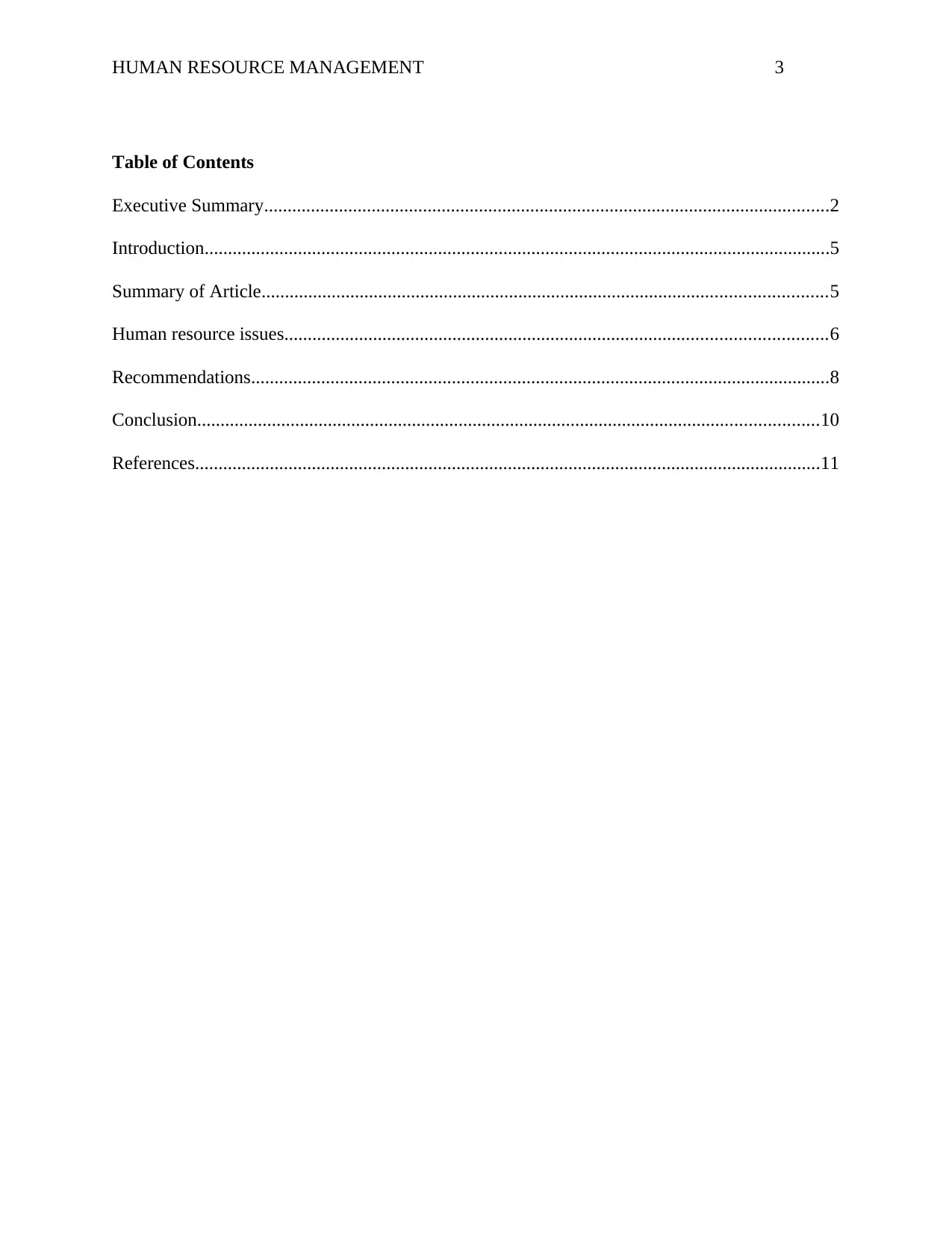
Table of Contents
Executive Summary.........................................................................................................................2
Introduction......................................................................................................................................5
Summary of Article.........................................................................................................................5
Human resource issues....................................................................................................................6
Recommendations............................................................................................................................8
Conclusion.....................................................................................................................................10
References......................................................................................................................................11
Table of Contents
Executive Summary.........................................................................................................................2
Introduction......................................................................................................................................5
Summary of Article.........................................................................................................................5
Human resource issues....................................................................................................................6
Recommendations............................................................................................................................8
Conclusion.....................................................................................................................................10
References......................................................................................................................................11
⊘ This is a preview!⊘
Do you want full access?
Subscribe today to unlock all pages.

Trusted by 1+ million students worldwide
HUMAN RESOURCE MANAGEMENT 4
Human Resource Management
Introduction
The rise of flexible workplace came as a result of the need to accommodate women in the
workplace that allow them to balance between their lives as mothers and at the same time as
career people at work (Kumari & Pradhan, 2014). The biological nature of women allowed them
to qualify for the work-life benefit which came as a result of the effects of affirmative and the
increasing number of women in the workforce (Kvande, 2012; Jery & Souai, 2014)). In the
current twenty-first century, women have steadily risen to management positions since the
workplace recognizes and allows them to work and be mothers at the same time. However,
Shoss, Witt, & Vera (2012) add that, as the society advances and keeps on allowing women to
penetrate the workplace, new challenges of women being home managers emerge challenging
their success and limiting their careers since men do not enjoy similar opportunities with them
when they need to step in and assist in taking care of the family. According to Saridakis, Lai, &
Cooper (2016), the inflexible nature of the workplace on men limits the career of women since
they spend more time at home than on their careers. This report analyses the article to present
human resource issues and recommendations for addressing the concerns.
Summary of Article
From the article women’s careers seem to be limited by the inflexible nature of men’s
work in most organizations. despite the fact that there have been calls for work flexibility for
men, most organizations have failed to implement this policy making it difficult for men to flex
their work and step in for their wives when it comes to taking care of kids. According to the
testimonies of a few beneficiaries of the flexible workplace like Rick Breumelholf and Graham
Human Resource Management
Introduction
The rise of flexible workplace came as a result of the need to accommodate women in the
workplace that allow them to balance between their lives as mothers and at the same time as
career people at work (Kumari & Pradhan, 2014). The biological nature of women allowed them
to qualify for the work-life benefit which came as a result of the effects of affirmative and the
increasing number of women in the workforce (Kvande, 2012; Jery & Souai, 2014)). In the
current twenty-first century, women have steadily risen to management positions since the
workplace recognizes and allows them to work and be mothers at the same time. However,
Shoss, Witt, & Vera (2012) add that, as the society advances and keeps on allowing women to
penetrate the workplace, new challenges of women being home managers emerge challenging
their success and limiting their careers since men do not enjoy similar opportunities with them
when they need to step in and assist in taking care of the family. According to Saridakis, Lai, &
Cooper (2016), the inflexible nature of the workplace on men limits the career of women since
they spend more time at home than on their careers. This report analyses the article to present
human resource issues and recommendations for addressing the concerns.
Summary of Article
From the article women’s careers seem to be limited by the inflexible nature of men’s
work in most organizations. despite the fact that there have been calls for work flexibility for
men, most organizations have failed to implement this policy making it difficult for men to flex
their work and step in for their wives when it comes to taking care of kids. According to the
testimonies of a few beneficiaries of the flexible workplace like Rick Breumelholf and Graham
Paraphrase This Document
Need a fresh take? Get an instant paraphrase of this document with our AI Paraphraser
HUMAN RESOURCE MANAGEMENT 5
Eacolt, it is challenging for most men to utilize the work-life balances due to the stereotyped
nature of the society. People view men who are primary cares of children as lacking something
in their life since the society still sees it as a woman’s role (Eacott, 2018; Korff, Biemann, &
Voelpel, 2016).
According to the author, the gender pay gap between men and women can be addressed if
the nature of men’s work becomes more flexible allowing them to spend time with their family
to allow women to work in higher management opportunities (Delmott, Winne, & Sels, 2012).
This means that the existing pay gap in most countries can only be addressed if the workplace is
flexible for both men and women allowing them to decide on who stays at home and who goes to
work. Croonen, Grünhagen, & Wollan (2015) suggest that balancing benefits for men and
women is the only way for addressing the gender parities at the workplace. By giving men
similar conditions at work, it allows people the opportunity to address any work-related issues in
the organization.
Human resource issues
One of the issues in the story is work and life balance which allows employees to balance
between individual needs and time allocated for them at work. This is the strategic role that
HRM plays in an organization by ensuring that employees are motivated through creating
conditions that increase retention and flexibility at work (Stones, 2017). This approach mainly
focusses on areas of personal interests, social life and family needs. The functional flexibility
model suggests that structures need to be put in place to address flexible issues within the
organization to create a better workplace (Boushey, 2016). Three mediators of gender, family
characteristic and time spent at work shape the work-life balance requirements for the individual.
This means that employee time is divided equally between their work and personal life. From
Eacolt, it is challenging for most men to utilize the work-life balances due to the stereotyped
nature of the society. People view men who are primary cares of children as lacking something
in their life since the society still sees it as a woman’s role (Eacott, 2018; Korff, Biemann, &
Voelpel, 2016).
According to the author, the gender pay gap between men and women can be addressed if
the nature of men’s work becomes more flexible allowing them to spend time with their family
to allow women to work in higher management opportunities (Delmott, Winne, & Sels, 2012).
This means that the existing pay gap in most countries can only be addressed if the workplace is
flexible for both men and women allowing them to decide on who stays at home and who goes to
work. Croonen, Grünhagen, & Wollan (2015) suggest that balancing benefits for men and
women is the only way for addressing the gender parities at the workplace. By giving men
similar conditions at work, it allows people the opportunity to address any work-related issues in
the organization.
Human resource issues
One of the issues in the story is work and life balance which allows employees to balance
between individual needs and time allocated for them at work. This is the strategic role that
HRM plays in an organization by ensuring that employees are motivated through creating
conditions that increase retention and flexibility at work (Stones, 2017). This approach mainly
focusses on areas of personal interests, social life and family needs. The functional flexibility
model suggests that structures need to be put in place to address flexible issues within the
organization to create a better workplace (Boushey, 2016). Three mediators of gender, family
characteristic and time spent at work shape the work-life balance requirements for the individual.
This means that employee time is divided equally between their work and personal life. From
HUMAN RESOURCE MANAGEMENT 6
Maslow’s theory, people have needs that are to be met in order of their importance
(Nuangjamnong & Maj, 2017). Since work provides for basic needs and safety that arises from
income but at the same time allows them to belong to a societal group that boosts their self-
esteem (Alterman, Luckhaupt, Dahlhamer, Ward, & Calvert, 2013). In most organizations,
women enjoy this privilege especially mothers who are allowed to work part-time so that they
can address their life needs. On the other hand, men enjoy less work-life balance privileges since
most organizations have not embraced this approach (Akhter, Malik, Khwaja, & Mehmood,
2018). This allows people to pursue personal aspirations like raising children and progressing in
education which makes them more satisfied with their work.
Another issue noted in the story is the lack of gender balance on issues that relate to
employee benefits. From the study, there is a difference between male and female differences
when it comes to work and life balance related issues (Ford, Heinen, & Langkamer, 2013).
According to Stones (2017), organizations need to be structures in place for addressing cross-
cultural issues that affect gendered aspects of employee management. From a human needs point
of view, there are gender differences between men and women which have to be considered
when planning for human resource needs. Since the society is patriarchal in nature, caregiving
roles are treated as feminine roles which makes it difficult for some organizations to work on
gender-related issues. Reynolds (2015) adds that in most organizations, work-life policies mostly
affect women since men are not keen on taking such privileges. This is because the society by
nature is stratified along gender lines making it difficult for men to claim some benefits that will
lead to career progression of men. The difference in sexes at work makes it difficult for men to
step aside and allow women to prosper in their career. This means that there is limited support
Maslow’s theory, people have needs that are to be met in order of their importance
(Nuangjamnong & Maj, 2017). Since work provides for basic needs and safety that arises from
income but at the same time allows them to belong to a societal group that boosts their self-
esteem (Alterman, Luckhaupt, Dahlhamer, Ward, & Calvert, 2013). In most organizations,
women enjoy this privilege especially mothers who are allowed to work part-time so that they
can address their life needs. On the other hand, men enjoy less work-life balance privileges since
most organizations have not embraced this approach (Akhter, Malik, Khwaja, & Mehmood,
2018). This allows people to pursue personal aspirations like raising children and progressing in
education which makes them more satisfied with their work.
Another issue noted in the story is the lack of gender balance on issues that relate to
employee benefits. From the study, there is a difference between male and female differences
when it comes to work and life balance related issues (Ford, Heinen, & Langkamer, 2013).
According to Stones (2017), organizations need to be structures in place for addressing cross-
cultural issues that affect gendered aspects of employee management. From a human needs point
of view, there are gender differences between men and women which have to be considered
when planning for human resource needs. Since the society is patriarchal in nature, caregiving
roles are treated as feminine roles which makes it difficult for some organizations to work on
gender-related issues. Reynolds (2015) adds that in most organizations, work-life policies mostly
affect women since men are not keen on taking such privileges. This is because the society by
nature is stratified along gender lines making it difficult for men to claim some benefits that will
lead to career progression of men. The difference in sexes at work makes it difficult for men to
step aside and allow women to prosper in their career. This means that there is limited support
⊘ This is a preview!⊘
Do you want full access?
Subscribe today to unlock all pages.
Trusted by 1+ million students worldwide
HUMAN RESOURCE MANAGEMENT 7
for the career success of women through work-life balance benefits directed at men who are
willing to support their women.
Lastly, human resource planning needs to be used to balance the workforce in the
organization to assist bridge the gender gap and at the same time create conditions for women to
prosper (Stones, 2017). The role of human resource is to meet the strategic needs of the
organization through aligning employees to organizational goals. This entails planning for future
human needs of the organization and at the same time increasing employee development for
succession. Since the human resource plays a strategic function, managers need to plan for their
employees so that the organization can get the required needs. This is because gender differences
are inherent in the social structure of the society. According to Colgan (2017) argues that
affirmative action and other gender approaches only create opportunities for women but do not
address the barriers that women face at the workplace. The reason why most women have failed
to advance and attain high career goals is that there are no support structures in the society that
allow them to advance their careers (Stones, 2017). For example, good paying jobs are not part-
time related because they require personal presence all through. For example, management
positions have annual leaves but are limited since managers have to be present in the
organization the whole time. According to Eacott (2018) suggests that the gender differences in
pay are at 14.6% in Australia and cannot decrease any further than that unless the structural
differences between men and women are addressed. These differences keep women down and
deny them the ability to progress in their careers.
Recommendations
One way of achieving work-life balance in the organization is developing employee-
related policies that guide the way how strategic human resource management objectives can be
for the career success of women through work-life balance benefits directed at men who are
willing to support their women.
Lastly, human resource planning needs to be used to balance the workforce in the
organization to assist bridge the gender gap and at the same time create conditions for women to
prosper (Stones, 2017). The role of human resource is to meet the strategic needs of the
organization through aligning employees to organizational goals. This entails planning for future
human needs of the organization and at the same time increasing employee development for
succession. Since the human resource plays a strategic function, managers need to plan for their
employees so that the organization can get the required needs. This is because gender differences
are inherent in the social structure of the society. According to Colgan (2017) argues that
affirmative action and other gender approaches only create opportunities for women but do not
address the barriers that women face at the workplace. The reason why most women have failed
to advance and attain high career goals is that there are no support structures in the society that
allow them to advance their careers (Stones, 2017). For example, good paying jobs are not part-
time related because they require personal presence all through. For example, management
positions have annual leaves but are limited since managers have to be present in the
organization the whole time. According to Eacott (2018) suggests that the gender differences in
pay are at 14.6% in Australia and cannot decrease any further than that unless the structural
differences between men and women are addressed. These differences keep women down and
deny them the ability to progress in their careers.
Recommendations
One way of achieving work-life balance in the organization is developing employee-
related policies that guide the way how strategic human resource management objectives can be
Paraphrase This Document
Need a fresh take? Get an instant paraphrase of this document with our AI Paraphraser
HUMAN RESOURCE MANAGEMENT 8
met. Stones (2017), suggests that the strategic role of human resource systems is to work on
employee performance through creating motivating conditions for employee performance. The
fact that there is a gender conflict in work-life balance means that structures have to be put in
place to address such concerns. Such policies create conditions in which men and women
benefits from such needs and at the same time allows them to understand the requirements that
they obtain from the organization (Malik, McKie, Beattie, & Hogg, 2012; Bal & Lange, 2014).
These policies can be cemented by developing work-life balance practices through reduced
working hours. Strategies like job sharing, part-time work, compressed work periods
telecommunicating, on-site child care facility and parental leave can be used by organizations to
achieve the policy. Such strategies create conditions for other men who are willing to support
women advance their careers by taking the caring role for children. Once structures have been
put in place, it becomes easy for men and women to
Since the society is patriarchal and full of stereotypes, Sullivan & Smithson (2013)
suggest that there is need to build the capacity of men to make them understand the benefits of
supporting women aspirations and participating in their life. This means that men need to be
made to understand how they can support women in achieving their careers as seen in the story.
The two fathers Rick Breumelholf and Graham Eacolt have made huge strides in their life but the
society still has difficulties understanding their work and life balance. Grzywacz & Carlson
(2017) add that this means that there is the need for greater insights to be developed in couples to
ensure that they learn how to support their partners in progressing their careers. By supporting
each other, organizations can have opportunities for both men and women to progress without
having to affirmatively support women who are tied down by the patriarchal society.
met. Stones (2017), suggests that the strategic role of human resource systems is to work on
employee performance through creating motivating conditions for employee performance. The
fact that there is a gender conflict in work-life balance means that structures have to be put in
place to address such concerns. Such policies create conditions in which men and women
benefits from such needs and at the same time allows them to understand the requirements that
they obtain from the organization (Malik, McKie, Beattie, & Hogg, 2012; Bal & Lange, 2014).
These policies can be cemented by developing work-life balance practices through reduced
working hours. Strategies like job sharing, part-time work, compressed work periods
telecommunicating, on-site child care facility and parental leave can be used by organizations to
achieve the policy. Such strategies create conditions for other men who are willing to support
women advance their careers by taking the caring role for children. Once structures have been
put in place, it becomes easy for men and women to
Since the society is patriarchal and full of stereotypes, Sullivan & Smithson (2013)
suggest that there is need to build the capacity of men to make them understand the benefits of
supporting women aspirations and participating in their life. This means that men need to be
made to understand how they can support women in achieving their careers as seen in the story.
The two fathers Rick Breumelholf and Graham Eacolt have made huge strides in their life but the
society still has difficulties understanding their work and life balance. Grzywacz & Carlson
(2017) add that this means that there is the need for greater insights to be developed in couples to
ensure that they learn how to support their partners in progressing their careers. By supporting
each other, organizations can have opportunities for both men and women to progress without
having to affirmatively support women who are tied down by the patriarchal society.
HUMAN RESOURCE MANAGEMENT 9
Lastly, there is the need for organizations to understand the needs of their employees and
align work arrangements according to the needs of such employees. The functional flexible
approach requires the organization to align personal and professional needs so that an employee
can balance them out to avoid stress and burnouts. To meet the strategic needs of the
organization, the human resource system must have a plan for organizing employee needs since
they inform their motivation and performance. Despite having work and life balance initiatives in
organizations, there is the need for employers to understand the varying needs of employees and
put a proper structure in place. For example, married men and women will require better
arrangements than having general work-life balance practices (Smith, 2013). This means that
organizations have to review their policies and develop these programs based on the needs of
employees so that they can address any challenges that such employees can face. For example,
married women will have more challenges as compared to unmarried women. Therefore, Warren
(2014) suggests that organizations have to work with career developments needs of employees so
that their specific needs can be addressed. This strategy works better than initiatives focusing on
giving women soft spots in their careers. Such strategies have not been effective since they fail to
address latent factors that inhibit the progress of women.
Conclusion
Work-life balance issues in organizations have been seen as feministic approaches that
seek to support women in their careers. This is seen as a strategic of human resource systems of
motivating employees and making satisfied with their work (El-Ghalayini, 2017). Therefore
organizations have to put structures in place that support men who are willing to work on flexible
work so that they can support women to grow their careers. This is the only way that gender
differences can be achieved since women have to find conditions that allow them to advance in
Lastly, there is the need for organizations to understand the needs of their employees and
align work arrangements according to the needs of such employees. The functional flexible
approach requires the organization to align personal and professional needs so that an employee
can balance them out to avoid stress and burnouts. To meet the strategic needs of the
organization, the human resource system must have a plan for organizing employee needs since
they inform their motivation and performance. Despite having work and life balance initiatives in
organizations, there is the need for employers to understand the varying needs of employees and
put a proper structure in place. For example, married men and women will require better
arrangements than having general work-life balance practices (Smith, 2013). This means that
organizations have to review their policies and develop these programs based on the needs of
employees so that they can address any challenges that such employees can face. For example,
married women will have more challenges as compared to unmarried women. Therefore, Warren
(2014) suggests that organizations have to work with career developments needs of employees so
that their specific needs can be addressed. This strategy works better than initiatives focusing on
giving women soft spots in their careers. Such strategies have not been effective since they fail to
address latent factors that inhibit the progress of women.
Conclusion
Work-life balance issues in organizations have been seen as feministic approaches that
seek to support women in their careers. This is seen as a strategic of human resource systems of
motivating employees and making satisfied with their work (El-Ghalayini, 2017). Therefore
organizations have to put structures in place that support men who are willing to work on flexible
work so that they can support women to grow their careers. This is the only way that gender
differences can be achieved since women have to find conditions that allow them to advance in
⊘ This is a preview!⊘
Do you want full access?
Subscribe today to unlock all pages.
Trusted by 1+ million students worldwide
HUMAN RESOURCE MANAGEMENT 10
their careers. Therefore, work-life balance initiatives need to be put in place at the organizational
level rather than industry level. This can then be broken down to a personal level if there are
specific employee needs that have to be met at an individual. By incorporating personal work-
life balance requirements in organizations, it becomes easy to support men and women who are
inhibited by personal lives to progress.
their careers. Therefore, work-life balance initiatives need to be put in place at the organizational
level rather than industry level. This can then be broken down to a personal level if there are
specific employee needs that have to be met at an individual. By incorporating personal work-
life balance requirements in organizations, it becomes easy to support men and women who are
inhibited by personal lives to progress.
Paraphrase This Document
Need a fresh take? Get an instant paraphrase of this document with our AI Paraphraser
HUMAN RESOURCE MANAGEMENT 11
References
Akhter, S., Malik, M. F., Khwaja, M. G., & Mehmood, S. (2018). Flexible HRM Practices and
Employee Retention: Developing and Testing of an Integrated Model. International
Journal of Modern Management Sciences, 7(1), 13-27.
Alterman, T., Luckhaupt, S., Dahlhamer, J., Ward, B., & Calvert, G. (2013). Job insecurity,
work-family imbalance, and hostile work environment: Prevalence data from the 2010
National Health Interview Survey. American Journal of Industrial Medicine, 56(6), 660–
669.
Bal, M., & Lange, A. H. (2014). From flexibility human resource management to employee
engagement and perceived job performance across the lifespan: A multisample study.
Journal of Occupational and Organizational Psychology, 88(1).
Boushey, H. (2016). Finding time: the economics of work-life conflict. Cambridge: Harvard
University Press.
Colgan, F. C. (2017). Equality and diversity policies and practices at work: lesbian, gay and
bisexual workers. Equal Opportunities International, 26(6), 590-609.
Croonen, E. P., Grünhagen, M., & Wollan, M. L. (2015). , best practice, or stuck in the middle?
The impact of unit ownership on unit HR performance in franchise systems.
International Entrepreneurship and Management Journal, 5(3).
Delmott, J., Winne, S., & Sels, L. (2012). rd an assessment of perceived HRM system strength:
Scale development and validation. The International Journal of Human Resource
Management, 23(7), 1481-1506.
Eacott, A. (2018, August 30). Concerns inflexible working hours for men could be damaging
women's careers. ABC News.
El-Ghalayini, Y. (2017). Human Resource Management Practices and Organizational
Performance in Public Sector Organization. Journal of Business Studies Quarterly, 8(3).
Ford, M. T., Heinen, B. A., & Langkamer, K. L. (2013). Work and family satisfaction and
conflict: A meta-analysis of cross-domain relations. Journal of Applied Psychology,
92(1), 57-80.
Grzywacz, J., & Carlson, D. (2017). ‘Conceptualizing work-life balance mplications for practice
and research. Advances in Developing Human Resources, 9, 455-471.
Jery, H., & Souaï, S. (2014). Strategic Human Resource Management and Performance : The
Contigency Aprroach Case of Tunisia. nternational Journal of Humanities and Social
Scienc, 4(6), 282-292.
References
Akhter, S., Malik, M. F., Khwaja, M. G., & Mehmood, S. (2018). Flexible HRM Practices and
Employee Retention: Developing and Testing of an Integrated Model. International
Journal of Modern Management Sciences, 7(1), 13-27.
Alterman, T., Luckhaupt, S., Dahlhamer, J., Ward, B., & Calvert, G. (2013). Job insecurity,
work-family imbalance, and hostile work environment: Prevalence data from the 2010
National Health Interview Survey. American Journal of Industrial Medicine, 56(6), 660–
669.
Bal, M., & Lange, A. H. (2014). From flexibility human resource management to employee
engagement and perceived job performance across the lifespan: A multisample study.
Journal of Occupational and Organizational Psychology, 88(1).
Boushey, H. (2016). Finding time: the economics of work-life conflict. Cambridge: Harvard
University Press.
Colgan, F. C. (2017). Equality and diversity policies and practices at work: lesbian, gay and
bisexual workers. Equal Opportunities International, 26(6), 590-609.
Croonen, E. P., Grünhagen, M., & Wollan, M. L. (2015). , best practice, or stuck in the middle?
The impact of unit ownership on unit HR performance in franchise systems.
International Entrepreneurship and Management Journal, 5(3).
Delmott, J., Winne, S., & Sels, L. (2012). rd an assessment of perceived HRM system strength:
Scale development and validation. The International Journal of Human Resource
Management, 23(7), 1481-1506.
Eacott, A. (2018, August 30). Concerns inflexible working hours for men could be damaging
women's careers. ABC News.
El-Ghalayini, Y. (2017). Human Resource Management Practices and Organizational
Performance in Public Sector Organization. Journal of Business Studies Quarterly, 8(3).
Ford, M. T., Heinen, B. A., & Langkamer, K. L. (2013). Work and family satisfaction and
conflict: A meta-analysis of cross-domain relations. Journal of Applied Psychology,
92(1), 57-80.
Grzywacz, J., & Carlson, D. (2017). ‘Conceptualizing work-life balance mplications for practice
and research. Advances in Developing Human Resources, 9, 455-471.
Jery, H., & Souaï, S. (2014). Strategic Human Resource Management and Performance : The
Contigency Aprroach Case of Tunisia. nternational Journal of Humanities and Social
Scienc, 4(6), 282-292.
HUMAN RESOURCE MANAGEMENT 12
Korff, J., Biemann, T., & Voelpel, S. C. (2016). Human resource management systems and work
attitudes: The mediating role of future time perspective. Journal of Organizational
Behavior., 4(3).
Kumari, I. G., & Pradhan, R. K. (2014). Human Resource Flexibility and Organizational
Effectiveness: Role of Organizational Citienship Behaviour and Employee Intent to Stay.
International Journal of Business and Management Invention, 3(11), 43-51.
Kvande, E. (2012). Work-Life Balance for Fathers in Globalized Knowledge Work. Some
Insights from the Norwegian Context. Gender, Work & Organization, 16, 58-72.
Malik, F., McKie., L., Beattie, R., & Hogg, G. (2012). ‘A Toolkit to Support Human Resource
Practice. Personnel Review, 39(3), 287-307.
Nuangjamnong, C., & Maj, S. P. (2017). Strategic Human Resource Management in
International Organizations. Modern Applied Science, 11(5).
Raymond, J. S. (2017). Human Resource Management (9th ed.). London: Wiley.
Reynolds, J. (2015). In the Face of Conflict: Work-Life Conflict and Desired Work Hour
Adjustments. Journal of Marriage and Family, 67(5), 1313-1331.
Saridakis, G., Lai, Y., & Cooper, C. L. (2016). ring the relationship between HRM and firm
performance: A meta-analysis of longitudinal studies. Human Resource Management
Review, 10(4), 1-13.
Shoss, M. K., Witt, L. A., & Vera, D. (2012). When does adaptive performance lead to higher
task performance. Journal of Organizational Behaviour, 33, 910-924.
Smith, J. (2013, April 18). 8 Ways To Achieve Better Work-Life Balance. Forbes .
Sullivan, C., & Smithson, J. (2013). Perspectives of homeworkers and their partners on working
flexibility and gender equity. The International Journal of Human Resource
Management, 18, 448-461.
Warren, T. (2014). Working part-time: achieving a successful ‘work-balance. The British
Journal of Sociology, 55(1), 99-122.
Korff, J., Biemann, T., & Voelpel, S. C. (2016). Human resource management systems and work
attitudes: The mediating role of future time perspective. Journal of Organizational
Behavior., 4(3).
Kumari, I. G., & Pradhan, R. K. (2014). Human Resource Flexibility and Organizational
Effectiveness: Role of Organizational Citienship Behaviour and Employee Intent to Stay.
International Journal of Business and Management Invention, 3(11), 43-51.
Kvande, E. (2012). Work-Life Balance for Fathers in Globalized Knowledge Work. Some
Insights from the Norwegian Context. Gender, Work & Organization, 16, 58-72.
Malik, F., McKie., L., Beattie, R., & Hogg, G. (2012). ‘A Toolkit to Support Human Resource
Practice. Personnel Review, 39(3), 287-307.
Nuangjamnong, C., & Maj, S. P. (2017). Strategic Human Resource Management in
International Organizations. Modern Applied Science, 11(5).
Raymond, J. S. (2017). Human Resource Management (9th ed.). London: Wiley.
Reynolds, J. (2015). In the Face of Conflict: Work-Life Conflict and Desired Work Hour
Adjustments. Journal of Marriage and Family, 67(5), 1313-1331.
Saridakis, G., Lai, Y., & Cooper, C. L. (2016). ring the relationship between HRM and firm
performance: A meta-analysis of longitudinal studies. Human Resource Management
Review, 10(4), 1-13.
Shoss, M. K., Witt, L. A., & Vera, D. (2012). When does adaptive performance lead to higher
task performance. Journal of Organizational Behaviour, 33, 910-924.
Smith, J. (2013, April 18). 8 Ways To Achieve Better Work-Life Balance. Forbes .
Sullivan, C., & Smithson, J. (2013). Perspectives of homeworkers and their partners on working
flexibility and gender equity. The International Journal of Human Resource
Management, 18, 448-461.
Warren, T. (2014). Working part-time: achieving a successful ‘work-balance. The British
Journal of Sociology, 55(1), 99-122.
⊘ This is a preview!⊘
Do you want full access?
Subscribe today to unlock all pages.
Trusted by 1+ million students worldwide

1 out of 12


Related Documents


Your All-in-One AI-Powered Toolkit for Academic Success.
+13062052269
info@desklib.com
Available 24*7 on WhatsApp / Email
![[object Object]](/_next/static/media/star-bottom.7253800d.svg)
Unlock your academic potential
Copyright © 2020–2026 A2Z Services. All Rights Reserved. Developed and managed by ZUCOL.