Human Resource Management: Research Report on HRM Practices
VerifiedAdded on 2023/06/09
|13
|3179
|320
Report
AI Summary
This report is a comprehensive analysis of Human Resource Management (HRM), encompassing various aspects of the research process. It begins with an overview of research approaches, differentiating between qualitative and quantitative methodologies, and their respective applications. The report then delves into the critical stages of the research process, followed by a discussion on converting raw data into meaningful management information. It also addresses the limitations of both qualitative and quantitative research methods. Furthermore, the report reviews information sources relevant to HR practices, providing insights into conducting investigations and analyzing different information sources. It concludes with recommendations for innovative HRM practices, focusing on stakeholder mapping, needs, and interests within business organizations. The report emphasizes the importance of aligning HR strategies with organizational goals and fostering a supportive work environment.

qwertyuiopasdfghjklzxcvbnmqw
ertyuiopasdfghjklzxcvbnmqwert
yuiopasdfghjklzxcvbnmqwertyui
opasdfghjklzxcvbnmqwertyuiop
asdfghjklzxcvbnmqwertyuiopasd
fghjklzxcvbnmqwertyuiopasdfgh
jklzxcvbnmqwertyuiopasdfghjkl
zxcvbnmqwertyuiopasdfghjklzxc
vbnmqwertyuiopasdfghjklzxcvb
nmqwertyuiopasdfghjklzxcvbnm
qwertyuiopasdfghjklzxcvbnmqw
ertyuiopasdfghjklzxcvbnmqwert
yuiopasdfghjklzxcvbnmqwertyui
opasdfghjklzxcvbnmqwertyuiop
asdfghjklzxcvbnmqwertyuiopasd
fghjklzxcvbnmqwertyuiopasdfgh
jklzxcvbnmrtyuiopasdfghjklzxcv
Human Resource Management
[Pick the date]
ertyuiopasdfghjklzxcvbnmqwert
yuiopasdfghjklzxcvbnmqwertyui
opasdfghjklzxcvbnmqwertyuiop
asdfghjklzxcvbnmqwertyuiopasd
fghjklzxcvbnmqwertyuiopasdfgh
jklzxcvbnmqwertyuiopasdfghjkl
zxcvbnmqwertyuiopasdfghjklzxc
vbnmqwertyuiopasdfghjklzxcvb
nmqwertyuiopasdfghjklzxcvbnm
qwertyuiopasdfghjklzxcvbnmqw
ertyuiopasdfghjklzxcvbnmqwert
yuiopasdfghjklzxcvbnmqwertyui
opasdfghjklzxcvbnmqwertyuiop
asdfghjklzxcvbnmqwertyuiopasd
fghjklzxcvbnmqwertyuiopasdfgh
jklzxcvbnmrtyuiopasdfghjklzxcv
Human Resource Management
[Pick the date]

Paraphrase This Document
Need a fresh take? Get an instant paraphrase of this document with our AI Paraphraser
Human Resource Management
Table of Contents
Research process and different research approaches.................................................................2
Stages in the Research process...............................................................................................2
The range of research methodologies.....................................................................................2
Applications of Qualitative Methods......................................................................................3
Applications of Quantitative Methods....................................................................................3
Converting raw data into meaningful management information............................................3
Limitations of quantitative and qualitative research methods................................................4
A review of information sources of HR practice.......................................................................4
HR practice for investigation..................................................................................................4
Review of the different information sources relevant area of HR/business practice.............5
Conclusions and Evaluate options for change...........................................................................6
Conclusions from the review..................................................................................................6
Recommendations..................................................................................................................7
HR issues on Business Organizations........................................................................................8
Stakeholders Mapping............................................................................................................8
Stakeholders Interest..............................................................................................................9
Stakeholders Need..................................................................................................................9
HR issue, strategy, and practice which influence stakeholders interest...............................10
Bibliography.............................................................................................................................11
1
Table of Contents
Research process and different research approaches.................................................................2
Stages in the Research process...............................................................................................2
The range of research methodologies.....................................................................................2
Applications of Qualitative Methods......................................................................................3
Applications of Quantitative Methods....................................................................................3
Converting raw data into meaningful management information............................................3
Limitations of quantitative and qualitative research methods................................................4
A review of information sources of HR practice.......................................................................4
HR practice for investigation..................................................................................................4
Review of the different information sources relevant area of HR/business practice.............5
Conclusions and Evaluate options for change...........................................................................6
Conclusions from the review..................................................................................................6
Recommendations..................................................................................................................7
HR issues on Business Organizations........................................................................................8
Stakeholders Mapping............................................................................................................8
Stakeholders Interest..............................................................................................................9
Stakeholders Need..................................................................................................................9
HR issue, strategy, and practice which influence stakeholders interest...............................10
Bibliography.............................................................................................................................11
1
Human Resource Management
Research process and different research approaches
Stages in the Research process
Stage 1:- Expressing the problem in Marketing Research
Stage 2:- Techniques of Review
Stage 3:- Research Technique
Stage 4:- Study Design
Stage 5:- Data gathering method
Stage 6:- Illustration Design
Stage 7:- Information Gathering
Stage 8:- Study and Explanation
Stage 9:- The report for Advertising Research1
The range of research methodologies
Qualitative or quantitative is a range of research methodologies. The range of methods will
depend upon the research objective or goal and accessible resources. Qualitative researchers
use a range of methods and tools2. There are a number of exceptional textbooks. The most
popular methods are:
Semi-organized interviews
In-depth interviews
Motivation groups
Ethnography
1 K. Gerrish, A, Lacey and D. Cormack The research process in nursing, U.S, John Wiley &
Sons 2010, p. 160.
2 E. Kazdin (1st ed.), Single-case research designs: Methods for clinical and applied settings,
England, Oxford University Press, 2010, p.110.
2
Research process and different research approaches
Stages in the Research process
Stage 1:- Expressing the problem in Marketing Research
Stage 2:- Techniques of Review
Stage 3:- Research Technique
Stage 4:- Study Design
Stage 5:- Data gathering method
Stage 6:- Illustration Design
Stage 7:- Information Gathering
Stage 8:- Study and Explanation
Stage 9:- The report for Advertising Research1
The range of research methodologies
Qualitative or quantitative is a range of research methodologies. The range of methods will
depend upon the research objective or goal and accessible resources. Qualitative researchers
use a range of methods and tools2. There are a number of exceptional textbooks. The most
popular methods are:
Semi-organized interviews
In-depth interviews
Motivation groups
Ethnography
1 K. Gerrish, A, Lacey and D. Cormack The research process in nursing, U.S, John Wiley &
Sons 2010, p. 160.
2 E. Kazdin (1st ed.), Single-case research designs: Methods for clinical and applied settings,
England, Oxford University Press, 2010, p.110.
2
⊘ This is a preview!⊘
Do you want full access?
Subscribe today to unlock all pages.

Trusted by 1+ million students worldwide
Human Resource Management
Applications of Qualitative Methods
Formative evaluations: - Informative evaluations, Qualitative research technique can
be employed. The goal is to define the background and situation for a new
intervention or treatment. Qualitative data can be gathered from the target audience to
better recognize their profiles, needs, and motivation.
Process evaluations: - To research and monitor service delivery is a necessary factor
of STI treatment. Qualitative methods can accomplish a quantitative method by using
a multi-indicator approach to monitor the three questions mostly asked in process
delivery3.
Applications of Quantitative Methods
Project Management: - In project management, quantitative methods have found
wide applications. This method is used for optimizing the distribution of manpower,
materials, equipment’s, money and time.
Manufacturing planning and development: - Defining the scope and place of new
production services is a multifaceted problem. Quantitative techniques help in
calculating many proposals of costs, timing, place, and accessibility of transportation4.
Converting raw data into meaningful management information
1. Assemble only valuable data: - Firstly take a step back before collecting data and
analyze that this data can be converted into information which will help in making
choices that will recover services and decrease costs.
2. Use Logical Tools: - Use those tools that will help to analyze the data and
information. Export only that data which is important and useful. To convert data into
information we can use Excel’s pivot table. Software or enterprise systems can be
designed to evaluate data.
3 C Corduneanu, "Discrete qualitative inequalities and applications", in Nonlinear Analysis:
Theory, Methods & Applications, vol. 25, 1995, 933-939.
4 H Wang, "Methods and Applications of Quantitative Linguistics", in Journal of
Quantitative Linguistics, Vol. 21, 2014, No. 4, 377-382.
3
Applications of Qualitative Methods
Formative evaluations: - Informative evaluations, Qualitative research technique can
be employed. The goal is to define the background and situation for a new
intervention or treatment. Qualitative data can be gathered from the target audience to
better recognize their profiles, needs, and motivation.
Process evaluations: - To research and monitor service delivery is a necessary factor
of STI treatment. Qualitative methods can accomplish a quantitative method by using
a multi-indicator approach to monitor the three questions mostly asked in process
delivery3.
Applications of Quantitative Methods
Project Management: - In project management, quantitative methods have found
wide applications. This method is used for optimizing the distribution of manpower,
materials, equipment’s, money and time.
Manufacturing planning and development: - Defining the scope and place of new
production services is a multifaceted problem. Quantitative techniques help in
calculating many proposals of costs, timing, place, and accessibility of transportation4.
Converting raw data into meaningful management information
1. Assemble only valuable data: - Firstly take a step back before collecting data and
analyze that this data can be converted into information which will help in making
choices that will recover services and decrease costs.
2. Use Logical Tools: - Use those tools that will help to analyze the data and
information. Export only that data which is important and useful. To convert data into
information we can use Excel’s pivot table. Software or enterprise systems can be
designed to evaluate data.
3 C Corduneanu, "Discrete qualitative inequalities and applications", in Nonlinear Analysis:
Theory, Methods & Applications, vol. 25, 1995, 933-939.
4 H Wang, "Methods and Applications of Quantitative Linguistics", in Journal of
Quantitative Linguistics, Vol. 21, 2014, No. 4, 377-382.
3
Paraphrase This Document
Need a fresh take? Get an instant paraphrase of this document with our AI Paraphraser
Human Resource Management
3. Convert data into information: - Information is formed when we manipulate data,
analyze, trending it over time, applying knowledge and information to convert that
figures into information that can be used to make a decision5.
Limitations of quantitative and qualitative research methods
The absence of resources for statistics gathering: - One of the major limitations of
the research instrument is the absence of resources for statistics gathering. Due to lack
of resources, the large-scale research turns into impossible6.
Exclusive and time-wasting: - Quantitative and qualitative research is hard,
exclusive and requires a lot of intervals to complete. This type of inquiry is scheduled
specifically in demand to safeguard complete randomization and correct description
of control groups7.
A review of information sources of HR practice
HR practice for investigation
1. Interview the right candidate at the right time: - To determine the facts of any
employee misbehavior allegation human resource (HR) or the professional allocated
to do the investigation. Human resources must also regulate if there are interviews and
any witnesses.
2. Describe to the person why he’s being interviewed: - Before the interview starts,
the employee conducting the interview first need to inform the interviewee why he or
5 S. Kalpakjian, S. Vijai Sekar, and R. Schmid (7th ed.), Manufacturing engineering and
technology. London, Pearson, 2014, p.60.
6 Thieberger, "Space-charge limitations for different injection schemes at the Brookhaven
relativistic heavy-ion accelerator complex", in Nuclear Instruments and Methods in Physics
Research Section A: Accelerators, Spectrometers, Detectors and Associated Equipment, vol.
404, 1998, No. 1, pp. 25-28.
7 K. Denzin, The research act: A theoretical introduction to sociological methods. U.K.,
Routledge, 2017, p. 56.
4
3. Convert data into information: - Information is formed when we manipulate data,
analyze, trending it over time, applying knowledge and information to convert that
figures into information that can be used to make a decision5.
Limitations of quantitative and qualitative research methods
The absence of resources for statistics gathering: - One of the major limitations of
the research instrument is the absence of resources for statistics gathering. Due to lack
of resources, the large-scale research turns into impossible6.
Exclusive and time-wasting: - Quantitative and qualitative research is hard,
exclusive and requires a lot of intervals to complete. This type of inquiry is scheduled
specifically in demand to safeguard complete randomization and correct description
of control groups7.
A review of information sources of HR practice
HR practice for investigation
1. Interview the right candidate at the right time: - To determine the facts of any
employee misbehavior allegation human resource (HR) or the professional allocated
to do the investigation. Human resources must also regulate if there are interviews and
any witnesses.
2. Describe to the person why he’s being interviewed: - Before the interview starts,
the employee conducting the interview first need to inform the interviewee why he or
5 S. Kalpakjian, S. Vijai Sekar, and R. Schmid (7th ed.), Manufacturing engineering and
technology. London, Pearson, 2014, p.60.
6 Thieberger, "Space-charge limitations for different injection schemes at the Brookhaven
relativistic heavy-ion accelerator complex", in Nuclear Instruments and Methods in Physics
Research Section A: Accelerators, Spectrometers, Detectors and Associated Equipment, vol.
404, 1998, No. 1, pp. 25-28.
7 K. Denzin, The research act: A theoretical introduction to sociological methods. U.K.,
Routledge, 2017, p. 56.
4
Human Resource Management
she is being interviewed. It is important to recall that a workplace investigation
interview is a fact-finding.
3. Follow company procedures for interview: - Every company has its own HR
policies that clearly define the workplace investigation protocol. For an investigation
interview, these guidelines will specify requirements8.
4. Use standard interview procedures and questions: - In a workplace investigation,
the process of the interview must be balanced. Using a process validates to the
interviewees that a structured process is in place for the organization to cope up with
these situations in a fair and credible way9.
Review of the different information sources relevant area of HR/business practice
In a review of (Wright, et al. 2018), has been concerned with monitoring the connection
between HR practices and company performance. The research is using data from 45
business units. The result specifies that HR performs compare with previous and upcoming
working performance10.
The report is concerned about that the ascriptions that employees make about the reasons why
management adopts the HR practices. Human Resource has consequences for their attitudes
and behaviors, and finally, group performance. These attitudes have been shared within
8 Doyle, A., Learn about the Steps in the Job Interview Process, 2018,
https://www.thebalancecareers.com/steps-in-the-job-interview-process-2061363, (accessed
24 July 2018)
9 D. Muller, ‘6 Essential Best Practices for Workplace Investigation Interviews’,
https://hracuity.com/blog/6-essential-best-practices-workplace-investigation-interviews,
(accessed 21 July 2018)
10 M. Wright, et al., ‘The Relationship between HR Practices and Firm Performance:
Examining Causal Order’, https://digitalcommons.ilr.cornell.edu/cgi/viewcontent.cgi?
referer=https://scholar.google.co.in/&httpsredir=1&article=1012&context=cahrswp,
(accessed 21 July 2018)
5
she is being interviewed. It is important to recall that a workplace investigation
interview is a fact-finding.
3. Follow company procedures for interview: - Every company has its own HR
policies that clearly define the workplace investigation protocol. For an investigation
interview, these guidelines will specify requirements8.
4. Use standard interview procedures and questions: - In a workplace investigation,
the process of the interview must be balanced. Using a process validates to the
interviewees that a structured process is in place for the organization to cope up with
these situations in a fair and credible way9.
Review of the different information sources relevant area of HR/business practice
In a review of (Wright, et al. 2018), has been concerned with monitoring the connection
between HR practices and company performance. The research is using data from 45
business units. The result specifies that HR performs compare with previous and upcoming
working performance10.
The report is concerned about that the ascriptions that employees make about the reasons why
management adopts the HR practices. Human Resource has consequences for their attitudes
and behaviors, and finally, group performance. These attitudes have been shared within
8 Doyle, A., Learn about the Steps in the Job Interview Process, 2018,
https://www.thebalancecareers.com/steps-in-the-job-interview-process-2061363, (accessed
24 July 2018)
9 D. Muller, ‘6 Essential Best Practices for Workplace Investigation Interviews’,
https://hracuity.com/blog/6-essential-best-practices-workplace-investigation-interviews,
(accessed 21 July 2018)
10 M. Wright, et al., ‘The Relationship between HR Practices and Firm Performance:
Examining Causal Order’, https://digitalcommons.ilr.cornell.edu/cgi/viewcontent.cgi?
referer=https://scholar.google.co.in/&httpsredir=1&article=1012&context=cahrswp,
(accessed 21 July 2018)
5
⊘ This is a preview!⊘
Do you want full access?
Subscribe today to unlock all pages.
Trusted by 1+ million students worldwide
Human Resource Management
groups and that they are related to citizenship of organization behaviors and satisfaction to
the individual11.
The paper discusses the impact of bundles of HR practices on trust in the working
environment, satisfaction for job, obligation, and apparent company performance. The result
supports the hypothesis that HR practices are an influential factor in trust and organizational
performance12.
The article examines the link between worker satisfaction with HR Practices and their
dedication to the company. The paper focuses on recently collected information to examine
links for three units of employees: specialists, line managers, and labors. These findings give
a challenge to the model of HRM and have implications for those looking to design
practices13.
Conclusions and Evaluate options for change
Conclusions from the review
From the above review, it is concluded that HRM determines the needs of business and
development of employees in the organization. The organization totally depends on its
employees because they contribute their skills to achieve its business goal or objective. In an
organization, everyone has a different role to play. Human Resource (HR) focuses on helping
employees to work together in a group. Employees planning are also part of this review,
11 "Best Practices for Employers", in Eeoc.gov, , 2018,
<https://www.eeoc.gov/eeoc/initiatives/e-race/bestpractices-employers.cfm> [accessed 22
July 2018].
12 "Best Practices for Employers", in Eeoc.gov, , 2018,
<https://www.eeoc.gov/eeoc/initiatives/e-race/bestpractices-employers.cfm> [accessed 22
July 2018].
13 "Best Practices for Employers", in Eeoc.gov, , 2018,
<https://www.eeoc.gov/eeoc/initiatives/e-race/bestpractices-employers.cfm> [accessed 22
July 2018].
6
groups and that they are related to citizenship of organization behaviors and satisfaction to
the individual11.
The paper discusses the impact of bundles of HR practices on trust in the working
environment, satisfaction for job, obligation, and apparent company performance. The result
supports the hypothesis that HR practices are an influential factor in trust and organizational
performance12.
The article examines the link between worker satisfaction with HR Practices and their
dedication to the company. The paper focuses on recently collected information to examine
links for three units of employees: specialists, line managers, and labors. These findings give
a challenge to the model of HRM and have implications for those looking to design
practices13.
Conclusions and Evaluate options for change
Conclusions from the review
From the above review, it is concluded that HRM determines the needs of business and
development of employees in the organization. The organization totally depends on its
employees because they contribute their skills to achieve its business goal or objective. In an
organization, everyone has a different role to play. Human Resource (HR) focuses on helping
employees to work together in a group. Employees planning are also part of this review,
11 "Best Practices for Employers", in Eeoc.gov, , 2018,
<https://www.eeoc.gov/eeoc/initiatives/e-race/bestpractices-employers.cfm> [accessed 22
July 2018].
12 "Best Practices for Employers", in Eeoc.gov, , 2018,
<https://www.eeoc.gov/eeoc/initiatives/e-race/bestpractices-employers.cfm> [accessed 22
July 2018].
13 "Best Practices for Employers", in Eeoc.gov, , 2018,
<https://www.eeoc.gov/eeoc/initiatives/e-race/bestpractices-employers.cfm> [accessed 22
July 2018].
6
Paraphrase This Document
Need a fresh take? Get an instant paraphrase of this document with our AI Paraphraser
Human Resource Management
which emphasis on long-term wants through the organization. Personal development training
plans enable every employee to improve by both professionally and personally within the
business of the organization. Human Resource (HR) practices help to create a different and
necessary competitive advantage through selecting and emerging highly inspired and skilled
staff that are able to perform and achieve at high levels14.
Recommendations
It is recommended that the convergence of new and innovative HR practices will
benefit the organization to become more modest in the global market. To sustain and
move forward in the business environment all organizations need to adopt these
innovative practices for this sector.
Secondly, organizations need to redesign the motivation practices more and more. So
that innovative motivation Human Resource practices encourage the financial
performance of the company and employees efficiency. If they will not follow then it
will be difficult to achieve the targets of employee’s retention.
Choosing candidates for training in an organization it is important for the senior
employee has skill and knowledge. This will improve overall effectiveness in working
for an organization.
Organizations should apply innovative performance management practices at a higher
level so that to develop HR practices.
Security-related issues also need to be focused more on organizations so that the
employees can concentrate on their performance.
The organization can introduce innovative HR practices like they can add activities
such as play management games, diverse selection policies, transparency in HR
system, quicker promotions, encourage lower managers to participate, continuous and
effective training, etc. The reason behind the introduction of these practices is the
changing business environment and global competition.
Ideas from employees working there in the organization should also be welcomed so
that the actual implementation can be possible15.
14 Shodh Ganga, ‘Conclusions and Recommendations’,
http://shodhganga.inflibnet.ac.in/bitstream/10603/39118/13/13_chapter%205.pdf, (accessed
21 July 2018)
7
which emphasis on long-term wants through the organization. Personal development training
plans enable every employee to improve by both professionally and personally within the
business of the organization. Human Resource (HR) practices help to create a different and
necessary competitive advantage through selecting and emerging highly inspired and skilled
staff that are able to perform and achieve at high levels14.
Recommendations
It is recommended that the convergence of new and innovative HR practices will
benefit the organization to become more modest in the global market. To sustain and
move forward in the business environment all organizations need to adopt these
innovative practices for this sector.
Secondly, organizations need to redesign the motivation practices more and more. So
that innovative motivation Human Resource practices encourage the financial
performance of the company and employees efficiency. If they will not follow then it
will be difficult to achieve the targets of employee’s retention.
Choosing candidates for training in an organization it is important for the senior
employee has skill and knowledge. This will improve overall effectiveness in working
for an organization.
Organizations should apply innovative performance management practices at a higher
level so that to develop HR practices.
Security-related issues also need to be focused more on organizations so that the
employees can concentrate on their performance.
The organization can introduce innovative HR practices like they can add activities
such as play management games, diverse selection policies, transparency in HR
system, quicker promotions, encourage lower managers to participate, continuous and
effective training, etc. The reason behind the introduction of these practices is the
changing business environment and global competition.
Ideas from employees working there in the organization should also be welcomed so
that the actual implementation can be possible15.
14 Shodh Ganga, ‘Conclusions and Recommendations’,
http://shodhganga.inflibnet.ac.in/bitstream/10603/39118/13/13_chapter%205.pdf, (accessed
21 July 2018)
7
Human Resource Management
HR issues on Business Organizations
Stakeholders Mapping
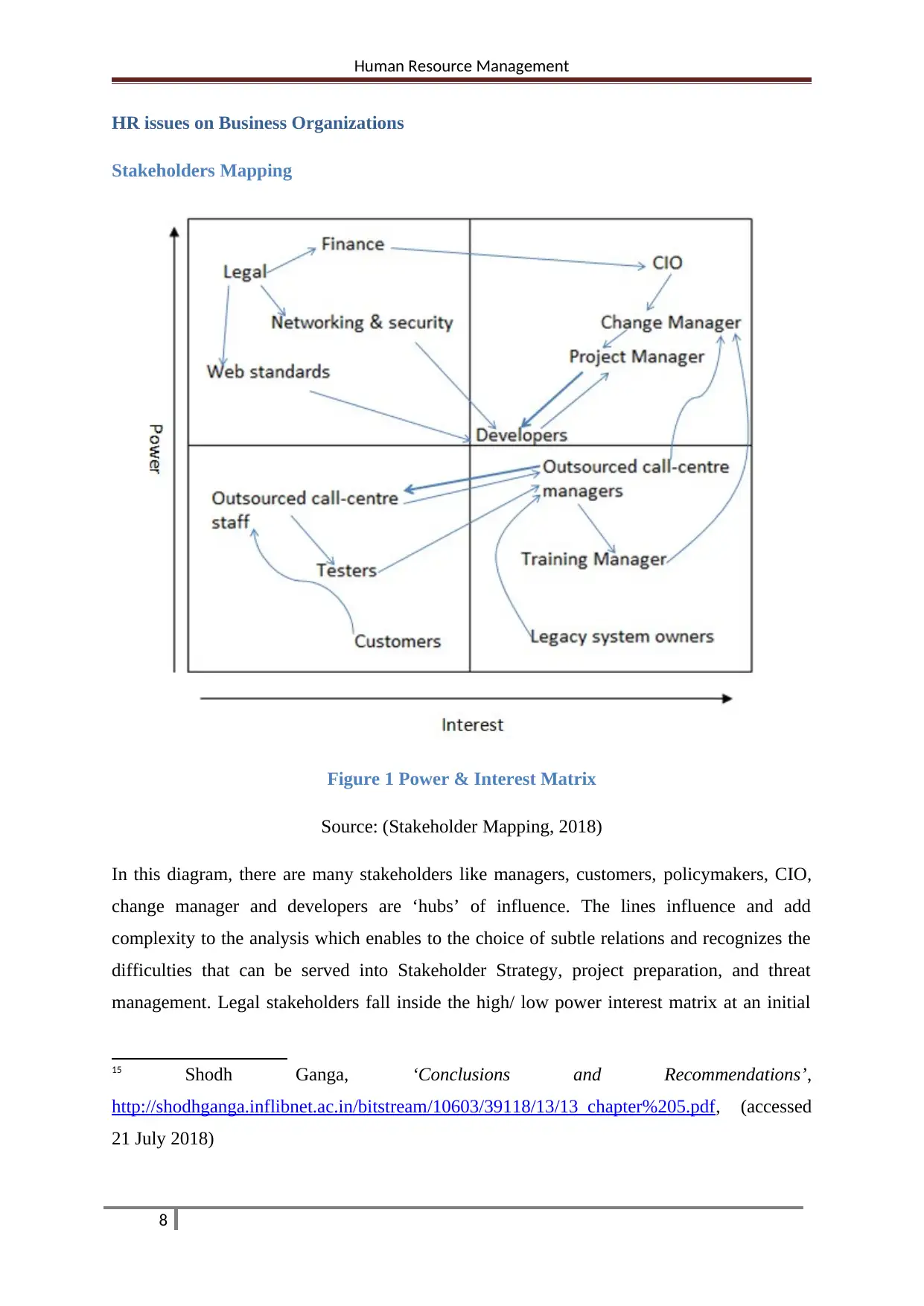
Figure 1 Power & Interest Matrix
Source: (Stakeholder Mapping, 2018)
In this diagram, there are many stakeholders like managers, customers, policymakers, CIO,
change manager and developers are ‘hubs’ of influence. The lines influence and add
complexity to the analysis which enables to the choice of subtle relations and recognizes the
difficulties that can be served into Stakeholder Strategy, project preparation, and threat
management. Legal stakeholders fall inside the high/ low power interest matrix at an initial
15 Shodh Ganga, ‘Conclusions and Recommendations’,
http://shodhganga.inflibnet.ac.in/bitstream/10603/39118/13/13_chapter%205.pdf, (accessed
21 July 2018)
8
HR issues on Business Organizations
Stakeholders Mapping
Figure 1 Power & Interest Matrix
Source: (Stakeholder Mapping, 2018)
In this diagram, there are many stakeholders like managers, customers, policymakers, CIO,
change manager and developers are ‘hubs’ of influence. The lines influence and add
complexity to the analysis which enables to the choice of subtle relations and recognizes the
difficulties that can be served into Stakeholder Strategy, project preparation, and threat
management. Legal stakeholders fall inside the high/ low power interest matrix at an initial
15 Shodh Ganga, ‘Conclusions and Recommendations’,
http://shodhganga.inflibnet.ac.in/bitstream/10603/39118/13/13_chapter%205.pdf, (accessed
21 July 2018)
8
⊘ This is a preview!⊘
Do you want full access?
Subscribe today to unlock all pages.
Trusted by 1+ million students worldwide
Human Resource Management
level. The project manager needs to be active in advance to identify when the legal needs to
be involved and engaging with them16.
Stakeholders Interest
Representatives: - Central and state-owned governments, associates of assembly, etc.
familiarise and permit laws and control resources.
Resident panel associates: - Board members have the control to provide licenses and
rules that can be an essential and unsafe element17.
Strategy makers: - Strategy makers need no authorized control they are consultants
to those who have actual command. Policymaker ideas and concepts are followed
seriously.
Public leaders: - Community leaders are appreciated for their position of
management in a specific population.
Stakeholders Need
Actual Needs: - These are those that lie behind any supposed needs. These needs are
trained by the situation in which people live.
Apparent Needs: - These requirements are based on person consciousness that
somewhat is wrong, something is missing behind, that modifications can be made,
business, market opportunities, and investment can be made.
Expressed Needs: - These needs are developed from perceived needs. The
communicated need is to safeguard the worker against pollution. The inquiry into the
predictable task or services in terms of working scenarios takes place.
16 "Stakeholder Mapping", in Stakeholdermap.com, , 2018,
<https://www.stakeholdermap.com/> [accessed 22 July 2018].
17 "Chapter 7. Encouraging Involvement in Community Work | Section 8. Identifying and
Analyzing Stakeholders and Their Interests | Main Section | Community Tool Box", in
Ctb.ku.edu, , 2018, <https://ctb.ku.edu/en/table-of-contents/participation/encouraging-
involvement/identify-stakeholders/main> [accessed 22 July 2018].
9
level. The project manager needs to be active in advance to identify when the legal needs to
be involved and engaging with them16.
Stakeholders Interest
Representatives: - Central and state-owned governments, associates of assembly, etc.
familiarise and permit laws and control resources.
Resident panel associates: - Board members have the control to provide licenses and
rules that can be an essential and unsafe element17.
Strategy makers: - Strategy makers need no authorized control they are consultants
to those who have actual command. Policymaker ideas and concepts are followed
seriously.
Public leaders: - Community leaders are appreciated for their position of
management in a specific population.
Stakeholders Need
Actual Needs: - These are those that lie behind any supposed needs. These needs are
trained by the situation in which people live.
Apparent Needs: - These requirements are based on person consciousness that
somewhat is wrong, something is missing behind, that modifications can be made,
business, market opportunities, and investment can be made.
Expressed Needs: - These needs are developed from perceived needs. The
communicated need is to safeguard the worker against pollution. The inquiry into the
predictable task or services in terms of working scenarios takes place.
16 "Stakeholder Mapping", in Stakeholdermap.com, , 2018,
<https://www.stakeholdermap.com/> [accessed 22 July 2018].
17 "Chapter 7. Encouraging Involvement in Community Work | Section 8. Identifying and
Analyzing Stakeholders and Their Interests | Main Section | Community Tool Box", in
Ctb.ku.edu, , 2018, <https://ctb.ku.edu/en/table-of-contents/participation/encouraging-
involvement/identify-stakeholders/main> [accessed 22 July 2018].
9
Paraphrase This Document
Need a fresh take? Get an instant paraphrase of this document with our AI Paraphraser
Human Resource Management
Retained Needs: - These needs are selected from the expressed needs. The retained
stakeholder’s aims are to understand the operational concept from the system
perspective18.
HR issue, strategy, and practice which influence stakeholders interest
Change Management: - Change management is the issue of HR professional training
and development of an organization. Change management signifies a specific
challenge for stakeholders. HR professional training and development is the reason
behind the foremost issue an HR continues to challenge to help businesses grow.
Therefore a deepened focus on development and training required to improve added
capabilities to deal with change management.
Leadership Development: - The main HR strategy influence on stakeholder’s
interest in leadership development. Stakeholders are forced to deliver the essential
structures, procedure, equipment, and steps to view to make the top collection out of it
and motivate the upcoming leaders of the association.
HR effectiveness measurement: - Stakeholders also need to control results in terms
of deal management and in also in relation with a positive influence on business. To
regulate HR practices effectiveness is the starting of HR’s role as a managerial
purpose to view the HR group as a true practice partner within the organization19.
18 Akyra Strategy and development, Retained HR Services, 2018,
https://www.akyra.com.au/retained-hr-services, (accessed 24 July 2018).
19 Innovative Employee Solutions, Measuring Your HR Effectiveness Is a Powerful Tool for
Growth, 2016, https://www.innovativeemployeesolutions.com/blog/measuring-your-hr-
effectiveness-is-a-powerful-tool-for-growth/, (accessed 24 July 2018).
10
Retained Needs: - These needs are selected from the expressed needs. The retained
stakeholder’s aims are to understand the operational concept from the system
perspective18.
HR issue, strategy, and practice which influence stakeholders interest
Change Management: - Change management is the issue of HR professional training
and development of an organization. Change management signifies a specific
challenge for stakeholders. HR professional training and development is the reason
behind the foremost issue an HR continues to challenge to help businesses grow.
Therefore a deepened focus on development and training required to improve added
capabilities to deal with change management.
Leadership Development: - The main HR strategy influence on stakeholder’s
interest in leadership development. Stakeholders are forced to deliver the essential
structures, procedure, equipment, and steps to view to make the top collection out of it
and motivate the upcoming leaders of the association.
HR effectiveness measurement: - Stakeholders also need to control results in terms
of deal management and in also in relation with a positive influence on business. To
regulate HR practices effectiveness is the starting of HR’s role as a managerial
purpose to view the HR group as a true practice partner within the organization19.
18 Akyra Strategy and development, Retained HR Services, 2018,
https://www.akyra.com.au/retained-hr-services, (accessed 24 July 2018).
19 Innovative Employee Solutions, Measuring Your HR Effectiveness Is a Powerful Tool for
Growth, 2016, https://www.innovativeemployeesolutions.com/blog/measuring-your-hr-
effectiveness-is-a-powerful-tool-for-growth/, (accessed 24 July 2018).
10
Human Resource Management
Bibliography
"Best Practices for Employers". in, 2018,
<https://www.eeoc.gov/eeoc/initiatives/e-race/bestpractices-employers.cfm> [accessed 22
July 2018].
"Stakeholder Mapping". in, 2018, <https://www.stakeholdermap.com/> [accessed 22 July
2018].
A. Doyle, Learn about the Steps in the Job Interview Process, 2018,
https://www.thebalancecareers.com/steps-in-the-job-interview-process-2061363, (accessed
24 July 2018).
Akyra Strategy and development, Retained HR Services, 2018,
https://www.akyra.com.au/retained-hr-services, (accessed 24 July 2018).
Corduneanu, C, "Discrete qualitative inequalities and applications." Nonlinear Analysis:
Theory, Methods & Applications, 25, 1995, 933-939.
Denzin, N.K., The research act: A theoretical introduction to sociological methods. U.K.,
Routledge, 2017.
Gerrish, K., A. Lacey and D. Cormack, The research process in nursing, U.S, John Wiley &
Sons 2010.
Innovative Employee Solutions, Measuring Your HR Effectiveness Is a Powerful Tool for
Growth, 2016, https://www.innovativeemployeesolutions.com/blog/measuring-your-hr-
effectiveness-is-a-powerful-tool-for-growth/, (accessed 24 July 2018).
Kalpakjian, S. S. Vijai Sekar, and R. Schmid (7th ed.) Manufacturing engineering and
technology. London, Pearson, 2014.
Kazdin, A. E. (1st ed.), Single-case research designs: Methods for clinical and applied
settings, England, Oxford University Press, 2010.
McMillan, J. H. and S. Schumacher (7th ed.), Research in Education: Evidence-Based
Inquiry, MyEducationLab Series. London, Pearson, 2010, p. 120.
11
Bibliography
"Best Practices for Employers". in, 2018,
<https://www.eeoc.gov/eeoc/initiatives/e-race/bestpractices-employers.cfm> [accessed 22
July 2018].
"Stakeholder Mapping". in, 2018, <https://www.stakeholdermap.com/> [accessed 22 July
2018].
A. Doyle, Learn about the Steps in the Job Interview Process, 2018,
https://www.thebalancecareers.com/steps-in-the-job-interview-process-2061363, (accessed
24 July 2018).
Akyra Strategy and development, Retained HR Services, 2018,
https://www.akyra.com.au/retained-hr-services, (accessed 24 July 2018).
Corduneanu, C, "Discrete qualitative inequalities and applications." Nonlinear Analysis:
Theory, Methods & Applications, 25, 1995, 933-939.
Denzin, N.K., The research act: A theoretical introduction to sociological methods. U.K.,
Routledge, 2017.
Gerrish, K., A. Lacey and D. Cormack, The research process in nursing, U.S, John Wiley &
Sons 2010.
Innovative Employee Solutions, Measuring Your HR Effectiveness Is a Powerful Tool for
Growth, 2016, https://www.innovativeemployeesolutions.com/blog/measuring-your-hr-
effectiveness-is-a-powerful-tool-for-growth/, (accessed 24 July 2018).
Kalpakjian, S. S. Vijai Sekar, and R. Schmid (7th ed.) Manufacturing engineering and
technology. London, Pearson, 2014.
Kazdin, A. E. (1st ed.), Single-case research designs: Methods for clinical and applied
settings, England, Oxford University Press, 2010.
McMillan, J. H. and S. Schumacher (7th ed.), Research in Education: Evidence-Based
Inquiry, MyEducationLab Series. London, Pearson, 2010, p. 120.
11
⊘ This is a preview!⊘
Do you want full access?
Subscribe today to unlock all pages.
Trusted by 1+ million students worldwide

1 out of 13


Related Documents


Your All-in-One AI-Powered Toolkit for Academic Success.
+13062052269
info@desklib.com
Available 24*7 on WhatsApp / Email
![[object Object]](/_next/static/media/star-bottom.7253800d.svg)
Unlock your academic potential
Copyright © 2020–2025 A2Z Services. All Rights Reserved. Developed and managed by ZUCOL.