Human Resource Management Report: Unilever's HRM Analysis
VerifiedAdded on 2021/10/08
|28
|7398
|82
Report
AI Summary
This report provides a comprehensive analysis of Human Resource Management (HRM) practices at Unilever, a global consumer goods company. The report begins with an executive summary and an introduction highlighting the importance of effective HRM in organizational success. It then provides a detailed background of Unilever, including its mission, vision, and business strategies, emphasizing its focus on customer satisfaction and market penetration. The report delves into organizational affairs, conducting an internal analysis using the SWOT framework to identify strengths, weaknesses, opportunities, and threats related to Unilever's HRM. External factors, including political, environmental, social, technological, economic, and legal aspects, are also considered. The analysis identifies key HRM issues, such as lack of communication, and proposes solutions, including best practice and best-fit approaches, strategic frameworks, and motivational theories. Recommendations are provided to improve HRM practices, focusing on enhancing communication, employee engagement, and overall organizational effectiveness. The report concludes by summarizing the findings and reinforcing the importance of effective HRM in achieving organizational goals.
Running head: HUMAN RESOURCE MANAGEMENT
Human Resource Management
Name of Student
Name of University
Author Note
Human Resource Management
Name of Student
Name of University
Author Note

Paraphrase This Document
Need a fresh take? Get an instant paraphrase of this document with our AI Paraphraser
1HUMAN RESOURCE MANAGEMENT
Executive Summary
The primary purpose of implementing HRM strategies and practices within an organizational
scenario is to take care of the recruitment and staff management issues. In this regard, it is to be
mentioned that in order to maintain effective functioning of the organization, implementing and
practicing efficient HRM strategies is highly important. Moreover, it has been monitored that
effective HRM strategies and practices are helpful in addressing the expectations of the
employees. Adopting and practicing efficient HRM strategies help an organization to increase
organizational productivity. However, it has been monitored that as a result of inefficient HRM
policies the employees became demotivated or less productive. In addition to this, various
internal as well as external elements play important role in deciding employee satisfaction and
effective organizational functioning. The present report hence will focus on the HRM issue that
has been monitored in Unilever. Along with analyzing the factors and elements that play
influential role in the HRM strategy, recommendations have also been made to solve these issue.
Executive Summary
The primary purpose of implementing HRM strategies and practices within an organizational
scenario is to take care of the recruitment and staff management issues. In this regard, it is to be
mentioned that in order to maintain effective functioning of the organization, implementing and
practicing efficient HRM strategies is highly important. Moreover, it has been monitored that
effective HRM strategies and practices are helpful in addressing the expectations of the
employees. Adopting and practicing efficient HRM strategies help an organization to increase
organizational productivity. However, it has been monitored that as a result of inefficient HRM
policies the employees became demotivated or less productive. In addition to this, various
internal as well as external elements play important role in deciding employee satisfaction and
effective organizational functioning. The present report hence will focus on the HRM issue that
has been monitored in Unilever. Along with analyzing the factors and elements that play
influential role in the HRM strategy, recommendations have also been made to solve these issue.
2HUMAN RESOURCE MANAGEMENT
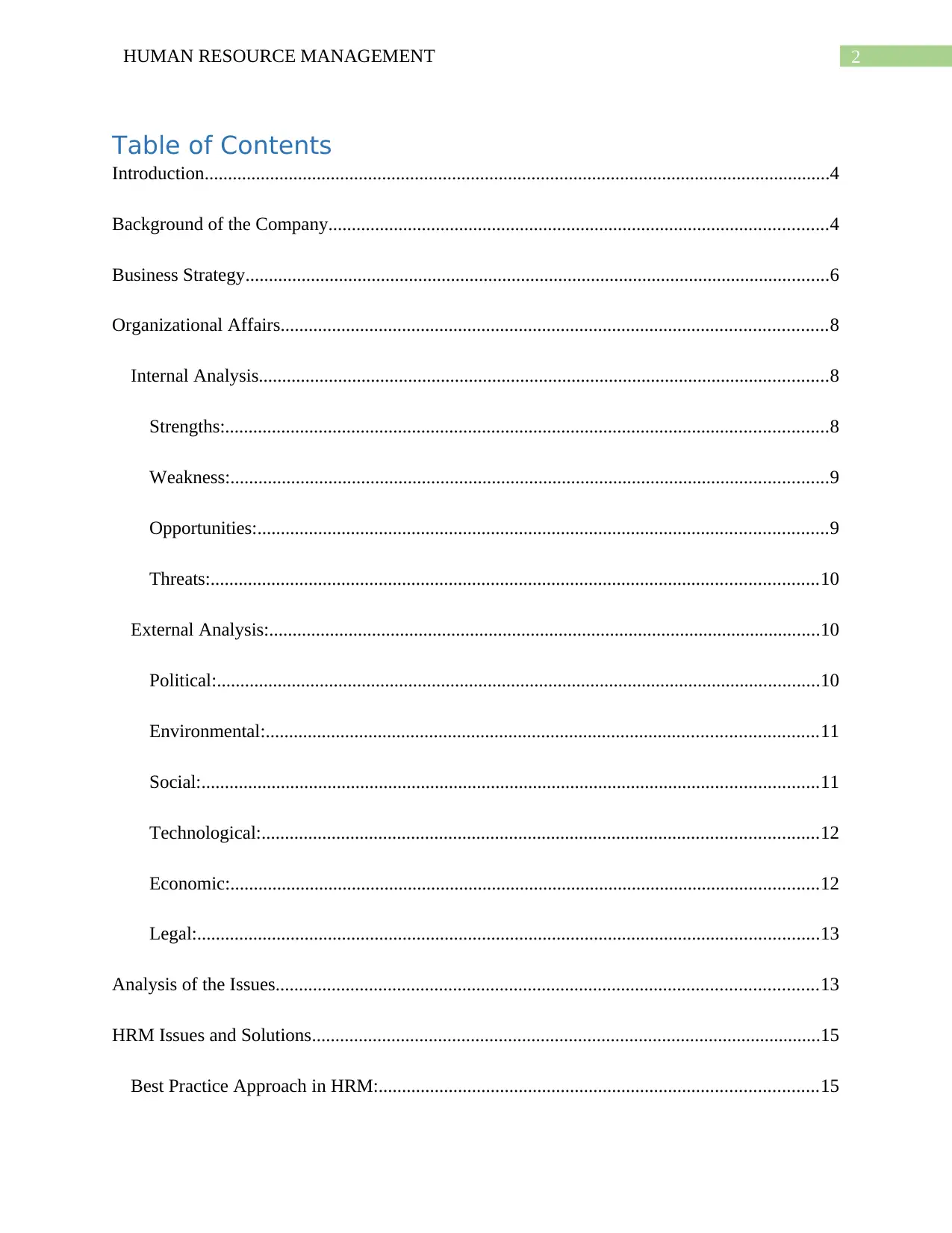
Table of Contents
Introduction......................................................................................................................................4
Background of the Company...........................................................................................................4
Business Strategy.............................................................................................................................6
Organizational Affairs.....................................................................................................................8
Internal Analysis..........................................................................................................................8
Strengths:.................................................................................................................................8
Weakness:................................................................................................................................9
Opportunities:..........................................................................................................................9
Threats:..................................................................................................................................10
External Analysis:......................................................................................................................10
Political:.................................................................................................................................10
Environmental:......................................................................................................................11
Social:....................................................................................................................................11
Technological:.......................................................................................................................12
Economic:..............................................................................................................................12
Legal:.....................................................................................................................................13
Analysis of the Issues....................................................................................................................13
HRM Issues and Solutions.............................................................................................................15
Best Practice Approach in HRM:..............................................................................................15
Table of Contents
Introduction......................................................................................................................................4
Background of the Company...........................................................................................................4
Business Strategy.............................................................................................................................6
Organizational Affairs.....................................................................................................................8
Internal Analysis..........................................................................................................................8
Strengths:.................................................................................................................................8
Weakness:................................................................................................................................9
Opportunities:..........................................................................................................................9
Threats:..................................................................................................................................10
External Analysis:......................................................................................................................10
Political:.................................................................................................................................10
Environmental:......................................................................................................................11
Social:....................................................................................................................................11
Technological:.......................................................................................................................12
Economic:..............................................................................................................................12
Legal:.....................................................................................................................................13
Analysis of the Issues....................................................................................................................13
HRM Issues and Solutions.............................................................................................................15
Best Practice Approach in HRM:..............................................................................................15
⊘ This is a preview!⊘
Do you want full access?
Subscribe today to unlock all pages.

Trusted by 1+ million students worldwide
3HUMAN RESOURCE MANAGEMENT
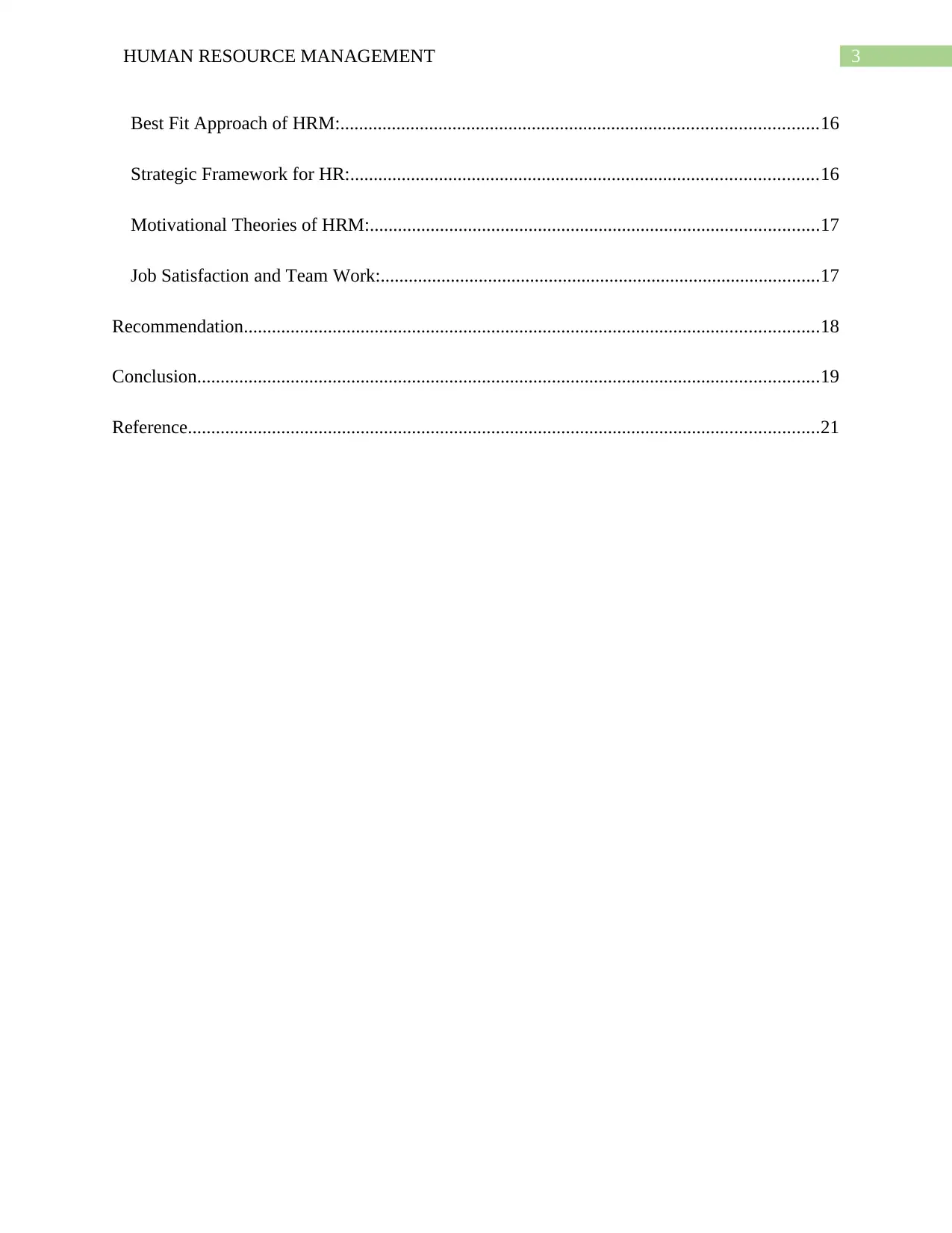
Best Fit Approach of HRM:......................................................................................................16
Strategic Framework for HR:....................................................................................................16
Motivational Theories of HRM:................................................................................................17
Job Satisfaction and Team Work:..............................................................................................17
Recommendation...........................................................................................................................18
Conclusion.....................................................................................................................................19
Reference.......................................................................................................................................21
Best Fit Approach of HRM:......................................................................................................16
Strategic Framework for HR:....................................................................................................16
Motivational Theories of HRM:................................................................................................17
Job Satisfaction and Team Work:..............................................................................................17
Recommendation...........................................................................................................................18
Conclusion.....................................................................................................................................19
Reference.......................................................................................................................................21
Paraphrase This Document
Need a fresh take? Get an instant paraphrase of this document with our AI Paraphraser
4HUMAN RESOURCE MANAGEMENT
Introduction
In the present business context the process of adopting effective and efficient human
resource management is highly important. It is to be monitored that by employing effective
human resource management an organization can easily maintain the growth as well as increase
the overall productivity. Hence, it can easily be understood that in order to run effectively and
gain competitive advantage an organization needs to take up effective human resource strategies
that are not only helpful in retaining and motivating the employees, but also is helpful in gaining
a competitive edge over other organizations. In addition to this, it has monitored that the human
resource practices such as sufficient compensation, developmental programs and wellness
programs help an organization to motivate the employees to a great extent. Moreover, by taking
up effective HRM strategies the organizations are able to establish harmonious organizational
culture. As a result it has been monitored that the organizations are seeking for implanting
effective HRM strategies that will be helpful in the recruitment, training and retention process of
the staffs. However, it has also been monitored that organizations often face severe issues as a
result of lack of effective HRM strategies. The report hence will focus on the HRM issues that
have been faced by Unilever. Along with that the strategies and possible solutions have also been
provided.
Background of the Company
Unilever is a globally recognized organization that deals primarily in consumer goods.
The organization is a British-Dutch company which has headquarter in London. Unilever is
considered as one of the biggest and globally recognized organization. Over the year the
company has made significant expansion in the global market. The company is primarily
Introduction
In the present business context the process of adopting effective and efficient human
resource management is highly important. It is to be monitored that by employing effective
human resource management an organization can easily maintain the growth as well as increase
the overall productivity. Hence, it can easily be understood that in order to run effectively and
gain competitive advantage an organization needs to take up effective human resource strategies
that are not only helpful in retaining and motivating the employees, but also is helpful in gaining
a competitive edge over other organizations. In addition to this, it has monitored that the human
resource practices such as sufficient compensation, developmental programs and wellness
programs help an organization to motivate the employees to a great extent. Moreover, by taking
up effective HRM strategies the organizations are able to establish harmonious organizational
culture. As a result it has been monitored that the organizations are seeking for implanting
effective HRM strategies that will be helpful in the recruitment, training and retention process of
the staffs. However, it has also been monitored that organizations often face severe issues as a
result of lack of effective HRM strategies. The report hence will focus on the HRM issues that
have been faced by Unilever. Along with that the strategies and possible solutions have also been
provided.
Background of the Company
Unilever is a globally recognized organization that deals primarily in consumer goods.
The organization is a British-Dutch company which has headquarter in London. Unilever is
considered as one of the biggest and globally recognized organization. Over the year the
company has made significant expansion in the global market. The company is primarily
5HUMAN RESOURCE MANAGEMENT
manufacturing food and beverages, personal hygiene and care products, home care products and
cleaning agents (Shukla, 2014). Moreover, the company owns around 400 brands under their
business. Along with that it is also to be mentioned that the organization has made its expansion
200 countries.
The mission statement of the organization specifies the companies aim at achieving
global success. Moreover, the vision statement of the organization also specify the aim of
making sustainable living. In addition to this, the vision statement of the organization also
specifies the company’s belief for long term sustenance and business growth. In addition to this,
the vision statement of the organization also emphasizes on the long term environmental
sustenance (Long, Ajagbe & Kowang, 2014). To explain it furthermore it can be said that the
organization aims at sustainable living and that is regarded as the core component of their vision
statement. By analyzing the vision statement it can be understood that the organization is willing
towards making effective changes in their products so that it can keep up with the demands of
the changing market. In addition to this, the vision statement of the organization also mentions
the aim of long term sustenance in the global market.
The mission statement of Unilever emphasizes the importance of adding vitality to the
daily life of their consumers. As the organization is a giant manufacturer of food and beverage
items as well as personal care products, the company looks forward to meet the nutritional and
hygiene needs of the consumers. The mission statement specifies that the brand also wishes to
take care of the needs to feel good and add vitality to lives (Bos‐Nehles, Van Riemsdijk &
Looise, 2013). The important elements of the mission statement of Unilever is to add vitality to
the lives of the consumers, providing them with their nutritional, hygienic and personal care
needs. In addition to this the mission statement also aims at adding feel good and look good
manufacturing food and beverages, personal hygiene and care products, home care products and
cleaning agents (Shukla, 2014). Moreover, the company owns around 400 brands under their
business. Along with that it is also to be mentioned that the organization has made its expansion
200 countries.
The mission statement of the organization specifies the companies aim at achieving
global success. Moreover, the vision statement of the organization also specify the aim of
making sustainable living. In addition to this, the vision statement of the organization also
specifies the company’s belief for long term sustenance and business growth. In addition to this,
the vision statement of the organization also emphasizes on the long term environmental
sustenance (Long, Ajagbe & Kowang, 2014). To explain it furthermore it can be said that the
organization aims at sustainable living and that is regarded as the core component of their vision
statement. By analyzing the vision statement it can be understood that the organization is willing
towards making effective changes in their products so that it can keep up with the demands of
the changing market. In addition to this, the vision statement of the organization also mentions
the aim of long term sustenance in the global market.
The mission statement of Unilever emphasizes the importance of adding vitality to the
daily life of their consumers. As the organization is a giant manufacturer of food and beverage
items as well as personal care products, the company looks forward to meet the nutritional and
hygiene needs of the consumers. The mission statement specifies that the brand also wishes to
take care of the needs to feel good and add vitality to lives (Bos‐Nehles, Van Riemsdijk &
Looise, 2013). The important elements of the mission statement of Unilever is to add vitality to
the lives of the consumers, providing them with their nutritional, hygienic and personal care
needs. In addition to this the mission statement also aims at adding feel good and look good
⊘ This is a preview!⊘
Do you want full access?
Subscribe today to unlock all pages.
Trusted by 1+ million students worldwide
6HUMAN RESOURCE MANAGEMENT
factors to their products. It can easily be understood that by focusing on the feel and look good
factors in their products, the company is aiming at grabbing the attention of the consumers who
wish to look good and feel good.
Business Strategy
By analyzing the mission and vision statement of the organization, it can be understood
that the primary aim of the organization is to cater to the needs of the consumers present in the
global market. In this regard, a detailed analysis of the organizational strategy can also be done.
The primary aspect of the organizational strategy is gaining competitive advantage in the global
market by ensuring customer satisfaction. Hence, it can easily be understood that the
organization is considering consumers as their primary stakeholders of the organization
(Hauptmann & Steger, 2013). In addition to this, it is also to be mentioned that the strategic
lookout of the organization also emphasizes on the developmental needs of the employees. The
mission statement rightly focuses on the demand of the consumers and is willing to change their
product accordingly. Hence, it can easily be understood that the organization is also willing to
take up training and developmental program for the employees. Moreover, it can easily
understandable that the organizational strategy of Unilever is also efficiently linked with the
mission and vision statement of the organization.
Another important organizational strategy that the company has taken up is market
penetration. In order to ensure growth in the global market, the organization aims at global
market penetration. The growth strategy of the organization is to make major expansion in the
global market. Moreover, it can be understood that the growth strategy of the organization
focuses not only capturing the global market but also coming up with new products that are
suitable for individual market. The organizational strategy also includes the importance of
factors to their products. It can easily be understood that by focusing on the feel and look good
factors in their products, the company is aiming at grabbing the attention of the consumers who
wish to look good and feel good.
Business Strategy
By analyzing the mission and vision statement of the organization, it can be understood
that the primary aim of the organization is to cater to the needs of the consumers present in the
global market. In this regard, a detailed analysis of the organizational strategy can also be done.
The primary aspect of the organizational strategy is gaining competitive advantage in the global
market by ensuring customer satisfaction. Hence, it can easily be understood that the
organization is considering consumers as their primary stakeholders of the organization
(Hauptmann & Steger, 2013). In addition to this, it is also to be mentioned that the strategic
lookout of the organization also emphasizes on the developmental needs of the employees. The
mission statement rightly focuses on the demand of the consumers and is willing to change their
product accordingly. Hence, it can easily be understood that the organization is also willing to
take up training and developmental program for the employees. Moreover, it can easily
understandable that the organizational strategy of Unilever is also efficiently linked with the
mission and vision statement of the organization.
Another important organizational strategy that the company has taken up is market
penetration. In order to ensure growth in the global market, the organization aims at global
market penetration. The growth strategy of the organization is to make major expansion in the
global market. Moreover, it can be understood that the growth strategy of the organization
focuses not only capturing the global market but also coming up with new products that are
suitable for individual market. The organizational strategy also includes the importance of
Paraphrase This Document
Need a fresh take? Get an instant paraphrase of this document with our AI Paraphraser
7HUMAN RESOURCE MANAGEMENT
product development (Nankervis et al., 2016). The growth strategy of Unilever incorporates
product development as an effective growth strategy. It has been monitored that the organization
aims at introducing new products that are suitable for the market demands. In addition to this, the
organization also focuses on the process of developing the existing products. In addition to this,
the organization has also taken up strategies to ensure product diversification. In order to grow in
the global market, the company has employed effective strategies of diversifying their products.
It has been noticed that at present the organization primarily specializes in the consumer goods
(Belizon, Gunnigle & Morley, 2013). The company also has to face tough competition in the
global market in this section. The expansion strategy of the organization hence also is focusing
on the product diversification and expanding in manufacturing few luxury good items as well.
Another important business strategy that has been taken up by the organization is
development of the market. By analyzing the organizational framework it can be understood that
the organization has adopted the market development strategy as a supporting strategy of the
market penetration framework. In order to expand to a global market and maintain a steady
growth the organization has taken up market development strategy. By adopting this intense
growth strategy the organization is aiming at entering into a new market. To elaborate it
furthermore it can be said that the organization aims at focusing at a new marketing segment. As
it can be understood that the organization has already made a significant global expansion.
Hence, in order to support the process of expansion Unilever has adopted the market
development strategy in order to focus into a particular marketing segment. However, it can be
said that the company has already made significant presence in majority consumer goods
(Correia, Cunha & Scholten, 2013). Hence, it can be said that the organization has taken up the
strategy of market development as a supporting strategy to their intensive growth strategies. In
product development (Nankervis et al., 2016). The growth strategy of Unilever incorporates
product development as an effective growth strategy. It has been monitored that the organization
aims at introducing new products that are suitable for the market demands. In addition to this, the
organization also focuses on the process of developing the existing products. In addition to this,
the organization has also taken up strategies to ensure product diversification. In order to grow in
the global market, the company has employed effective strategies of diversifying their products.
It has been noticed that at present the organization primarily specializes in the consumer goods
(Belizon, Gunnigle & Morley, 2013). The company also has to face tough competition in the
global market in this section. The expansion strategy of the organization hence also is focusing
on the product diversification and expanding in manufacturing few luxury good items as well.
Another important business strategy that has been taken up by the organization is
development of the market. By analyzing the organizational framework it can be understood that
the organization has adopted the market development strategy as a supporting strategy of the
market penetration framework. In order to expand to a global market and maintain a steady
growth the organization has taken up market development strategy. By adopting this intense
growth strategy the organization is aiming at entering into a new market. To elaborate it
furthermore it can be said that the organization aims at focusing at a new marketing segment. As
it can be understood that the organization has already made a significant global expansion.
Hence, in order to support the process of expansion Unilever has adopted the market
development strategy in order to focus into a particular marketing segment. However, it can be
said that the company has already made significant presence in majority consumer goods
(Correia, Cunha & Scholten, 2013). Hence, it can be said that the organization has taken up the
strategy of market development as a supporting strategy to their intensive growth strategies. In

8HUMAN RESOURCE MANAGEMENT
this regard, it can also be said adopting these intensive growth strategies and their successful
implementation is highly dependent on the HRM practices that he organization is taking up. In
order to ensure successful implementation of these intensive marketing and growth strategies,
Unilever needs to promote and practice organizational communication at the very initial steps.
The employees need to be aware of the company’s organizational strategies and goals in order be
more productive. In addition to this, the process of organizational communication is also
important in order to ensure inputs from the employees (Gurkov & Settles, 2013). It can be
understood that by adopting the methods of inclusion, the organization will be able to enforce
better strategies within the organizational scenario. Hence, by encouraging the employees to
share their views and ideas regarding these intense growth strategies, Unilever can successfully
implement the market development strategy as well as the strategy of market penetration.
Organizational Affairs
In order to identify and analyze the HRM issue that the organization is facing, a thorough
analysis of the internal as well as external environment has to be done. Moreover, the present
HRM issue are to be analyzed based upon the internal and external analysis (Aklamanu, Degbey
& Tarba, 2016). In this regard it can be said that the company is facing significant problems as a
result of ineffective HRM strategies. To analyze the internal factors that are affecting the HRM
strategies of the organization, SWOT analysis has to be done.
Internal Analysis
Strengths:
It can be noticed that the primary aim of the company is to manufacture diverse and
upgraded products to the consumers. Hence, it can easily be understood that the organizational
this regard, it can also be said adopting these intensive growth strategies and their successful
implementation is highly dependent on the HRM practices that he organization is taking up. In
order to ensure successful implementation of these intensive marketing and growth strategies,
Unilever needs to promote and practice organizational communication at the very initial steps.
The employees need to be aware of the company’s organizational strategies and goals in order be
more productive. In addition to this, the process of organizational communication is also
important in order to ensure inputs from the employees (Gurkov & Settles, 2013). It can be
understood that by adopting the methods of inclusion, the organization will be able to enforce
better strategies within the organizational scenario. Hence, by encouraging the employees to
share their views and ideas regarding these intense growth strategies, Unilever can successfully
implement the market development strategy as well as the strategy of market penetration.
Organizational Affairs
In order to identify and analyze the HRM issue that the organization is facing, a thorough
analysis of the internal as well as external environment has to be done. Moreover, the present
HRM issue are to be analyzed based upon the internal and external analysis (Aklamanu, Degbey
& Tarba, 2016). In this regard it can be said that the company is facing significant problems as a
result of ineffective HRM strategies. To analyze the internal factors that are affecting the HRM
strategies of the organization, SWOT analysis has to be done.
Internal Analysis
Strengths:
It can be noticed that the primary aim of the company is to manufacture diverse and
upgraded products to the consumers. Hence, it can easily be understood that the organizational
⊘ This is a preview!⊘
Do you want full access?
Subscribe today to unlock all pages.
Trusted by 1+ million students worldwide
9HUMAN RESOURCE MANAGEMENT
strategy primarily focuses on the customers and regard them as their primary stakeholders.
Hence, it can easily be understood that the HRM policies that the organization has taken up is
focused on the stakeholders as well. To elaborate it furthermore it can be said that the HRM
policies that has been taken up by the organization have been decided keeping in mind the
market demands (Festing et al., 2013). The company hence has come up with extensive training
and development programs to keep the employees updated about the latest technological
advancements. In addition to this the organization has also taken up policies to provide effective
benefits to the employees. The company has taken up employee friendly strategies. It has come
up with sufficient compensation for the employees along with health benefits and other effective
programs.
Weakness:
The major weakness of the HRM policies of Unilever is the lack of communication
amongst the employees and the leaders of the organization. It has been monitored that although
the organization has taken up effective strategies to train and provide benefits, it lacks in
organizational communication. As a result, the employees often are not aware of the
organizational aims and the change strategies. This has also created adverse effects on the
production of the employees as well as the organization (Ngo, Jiang & Loi, 2014). Moreover, it
can be said that due to lack of communication can lead to organizational turmoil many a times.
Moreover, it is to be mentioned that the lack of communication is also resulting into
demotivation amongst the employees of Unilever.
strategy primarily focuses on the customers and regard them as their primary stakeholders.
Hence, it can easily be understood that the HRM policies that the organization has taken up is
focused on the stakeholders as well. To elaborate it furthermore it can be said that the HRM
policies that has been taken up by the organization have been decided keeping in mind the
market demands (Festing et al., 2013). The company hence has come up with extensive training
and development programs to keep the employees updated about the latest technological
advancements. In addition to this the organization has also taken up policies to provide effective
benefits to the employees. The company has taken up employee friendly strategies. It has come
up with sufficient compensation for the employees along with health benefits and other effective
programs.
Weakness:
The major weakness of the HRM policies of Unilever is the lack of communication
amongst the employees and the leaders of the organization. It has been monitored that although
the organization has taken up effective strategies to train and provide benefits, it lacks in
organizational communication. As a result, the employees often are not aware of the
organizational aims and the change strategies. This has also created adverse effects on the
production of the employees as well as the organization (Ngo, Jiang & Loi, 2014). Moreover, it
can be said that due to lack of communication can lead to organizational turmoil many a times.
Moreover, it is to be mentioned that the lack of communication is also resulting into
demotivation amongst the employees of Unilever.
Paraphrase This Document
Need a fresh take? Get an instant paraphrase of this document with our AI Paraphraser
10HUMAN RESOURCE MANAGEMENT
Opportunities:
By analyzing the growth strategies and organizational aim it can be understood that the
organization aims at product diversification and capturing new market. Moreover, the company
has training and developmental policies that are highly effective in increasing productivity of the
organization (Banerji, 2013). In addition to this, it can be said that being a giant producer of
consumer goods, the organization has significant market presence. As a result larger number of
workforces are attracted towards the organization.
Threats:
In order to analyze the possible threats of the strategies that have been taken up by the
organization, it can be understood that the presence of high competition is affecting the
organization to a great extent (Gurkov, 2013). Moreover, it can be understood that the process of
maintaining the position in the global market, the organization needs to take up effective
strategies. As a result of the growing market and industries, employee retention has also become
a significant issue.
In addition to the analysis of internal strengths and weaknesses of the organization, a
detailed analysis of the external elements has also to be done in order to identify the reasons
behind the present HRM issues that the organization is witnessing. In this regard the political,
environmental, social, technological, economic and legal aspects of the organizational strategies
are to be analyzed.
Opportunities:
By analyzing the growth strategies and organizational aim it can be understood that the
organization aims at product diversification and capturing new market. Moreover, the company
has training and developmental policies that are highly effective in increasing productivity of the
organization (Banerji, 2013). In addition to this, it can be said that being a giant producer of
consumer goods, the organization has significant market presence. As a result larger number of
workforces are attracted towards the organization.
Threats:
In order to analyze the possible threats of the strategies that have been taken up by the
organization, it can be understood that the presence of high competition is affecting the
organization to a great extent (Gurkov, 2013). Moreover, it can be understood that the process of
maintaining the position in the global market, the organization needs to take up effective
strategies. As a result of the growing market and industries, employee retention has also become
a significant issue.
In addition to the analysis of internal strengths and weaknesses of the organization, a
detailed analysis of the external elements has also to be done in order to identify the reasons
behind the present HRM issues that the organization is witnessing. In this regard the political,
environmental, social, technological, economic and legal aspects of the organizational strategies
are to be analyzed.
11HUMAN RESOURCE MANAGEMENT
External Analysis:
Political:
It can be noticed that political situation of a country play important role in deciding
organizational strategies and effective implementation of them. In the context of the HRM
policies that have been taken up by the organization, it can be said that Unilever should be aware
and abide by the political situation of the host countries. It has been monitored that the political
turbulence of any country can create significant impacts on the process of employee recruitment
and retention policies. In addition to this, it can be said that due to the political turmoil within a
country, the employees might get affected. Political issues have significant impacts on the lives
of the common people (Rok & Mulej, 2014). As a result, the employees often are demotivated to
perform within an organizational scenario. In addition to this, any political turmoil in the external
environment affects the organizational environment as well. It can be noticed that the rise of
organizational politics and consequent conflict affects the productivity of the employees to a
great extent. Often it has been noticed that as a result of the organizational conflict, the HRM
policies get highly affected.
Environmental:
The primary focus of the effective HRM policies are to ensure the overall wellbeing of
the organization. In addition to this, it can also be said that the HRM strategies are affected as a
resulted of the environmental issues. It can easily be understood that in order to ensure long term
sustenance, organizations need to adopt policies and frameworks that are helpful in maintaining
the environmental sustenance as well (Mehta & Chugan, 2015). It has been monitored that the
external environment affects the organizational environment and production to a great extent.
Moreover, it has been monitored that the external environment and climate plays important roles
External Analysis:
Political:
It can be noticed that political situation of a country play important role in deciding
organizational strategies and effective implementation of them. In the context of the HRM
policies that have been taken up by the organization, it can be said that Unilever should be aware
and abide by the political situation of the host countries. It has been monitored that the political
turbulence of any country can create significant impacts on the process of employee recruitment
and retention policies. In addition to this, it can be said that due to the political turmoil within a
country, the employees might get affected. Political issues have significant impacts on the lives
of the common people (Rok & Mulej, 2014). As a result, the employees often are demotivated to
perform within an organizational scenario. In addition to this, any political turmoil in the external
environment affects the organizational environment as well. It can be noticed that the rise of
organizational politics and consequent conflict affects the productivity of the employees to a
great extent. Often it has been noticed that as a result of the organizational conflict, the HRM
policies get highly affected.
Environmental:
The primary focus of the effective HRM policies are to ensure the overall wellbeing of
the organization. In addition to this, it can also be said that the HRM strategies are affected as a
resulted of the environmental issues. It can easily be understood that in order to ensure long term
sustenance, organizations need to adopt policies and frameworks that are helpful in maintaining
the environmental sustenance as well (Mehta & Chugan, 2015). It has been monitored that the
external environment affects the organizational environment and production to a great extent.
Moreover, it has been monitored that the external environment and climate plays important roles
⊘ This is a preview!⊘
Do you want full access?
Subscribe today to unlock all pages.
Trusted by 1+ million students worldwide

1 out of 28


Related Documents


Your All-in-One AI-Powered Toolkit for Academic Success.
+13062052269
info@desklib.com
Available 24*7 on WhatsApp / Email
![[object Object]](/_next/static/media/star-bottom.7253800d.svg)
Unlock your academic potential
Copyright © 2020–2026 A2Z Services. All Rights Reserved. Developed and managed by ZUCOL.