Human Services: Mission, Vision, Values, and Ethics Report on Turnover
VerifiedAdded on 2023/05/31
|8
|1622
|467
Report
AI Summary
This report addresses the critical issue of employee turnover within the human services sector. It begins by outlining a mission, vision, and values statement for an agency named SERVICE INDUSTRY, designed to mitigate turnover rates. The mission focuses on employee and client care, while the vision emphasizes equitable treatment to foster loyalty. An ethical statement is developed, encompassing uniform treatment, financial ethics, and considerations for employees facing substance abuse or mental health challenges. The report then delves into theoretical applications, including the importance of personal value systems, interpersonal effectiveness skills, multicultural competence, and professional ethics in reducing turnover. The report emphasizes the need for cultural awareness, self-assessment, and adherence to professional conduct. References to key studies support the analysis, providing a comprehensive overview of strategies to improve employee retention in human services.
Running head: HUMAN SERVICES
HUMAN SERVICES
Name of the Student
Name of University
Author’s Note
HUMAN SERVICES
Name of the Student
Name of University
Author’s Note
Paraphrase This Document
Need a fresh take? Get an instant paraphrase of this document with our AI Paraphraser

1HUMAN SERVICES
Employee turnover is a serious issue for organizations nowadays. The rate of
employee turnover helps an organization to know the reasons which lead to employee turnover
(Cohen, Blake & Goodman, 2016). This organization would create a mission, vision and value
statement for an agency named SERVICE INDUSTRY which is responsible for addressing
employee turnover rate.
The mission of the agency: the mission of agency would be to give proper attention to
employees along with the clients; the employees would be provided achievable targets which can
help them to achieve them and contribute to the betterment of the company.
The vision of the agency: the vision of the agency would be to treat employees equally
irrespective of their cast, religion, status and many more in order to win the loyalty and honesty
of the employees (Hom et al., 2017). As a result help them in working hard to make the company
achieve its goals.
Ethical statement of the organization: the ethical statement of the organization would
be such that it covers all the ethical issues faced by employees which results in a turnover of the
employees. These statements include
Uniform treatment: uniform treatment to all the employees is an important example
of the ethical statement (Kovner et al., 2014). Every business owner weather big pr
small should treat their employees with equal respect irrespective of their race,
religion, caste, culture and many more. Every employee should be provided with
equal chances to perform well and get promoted. Uniform treatment to every
employee is one of the ways by which an organization can decrease the rate of
Employee turnover is a serious issue for organizations nowadays. The rate of
employee turnover helps an organization to know the reasons which lead to employee turnover
(Cohen, Blake & Goodman, 2016). This organization would create a mission, vision and value
statement for an agency named SERVICE INDUSTRY which is responsible for addressing
employee turnover rate.
The mission of the agency: the mission of agency would be to give proper attention to
employees along with the clients; the employees would be provided achievable targets which can
help them to achieve them and contribute to the betterment of the company.
The vision of the agency: the vision of the agency would be to treat employees equally
irrespective of their cast, religion, status and many more in order to win the loyalty and honesty
of the employees (Hom et al., 2017). As a result help them in working hard to make the company
achieve its goals.
Ethical statement of the organization: the ethical statement of the organization would
be such that it covers all the ethical issues faced by employees which results in a turnover of the
employees. These statements include
Uniform treatment: uniform treatment to all the employees is an important example
of the ethical statement (Kovner et al., 2014). Every business owner weather big pr
small should treat their employees with equal respect irrespective of their race,
religion, caste, culture and many more. Every employee should be provided with
equal chances to perform well and get promoted. Uniform treatment to every
employee is one of the ways by which an organization can decrease the rate of

2HUMAN SERVICES
employee turnover (Roche et al., 2015). If employees are treated with equal respect
they would feel interested in working in the organization with utmost loyalty.
Financial ethics: the owners of the business must run a clean operation when it
comes to finances, investing as well as expanding the company nationally or
internationally. Organizations should not bribe the state legislators for credit son tax
or some special privileges (Alam, 2015). The organization should not involve in
any sort of insider trading. The knowledge of insider trading is a must for every
employee; it helps them to know if their organization is running a clean business.
Any employee would not like to work with a company that is involved in anything
illegal. This would as a result increase the rate of employee turnover.
Considerations: the organization’s ethics must also include taking care of
employees with or without substance abuse problems or mental illness like alcohol
or drug dependency (Katsikea, Theodosiou & Morgan, 2015). The organization
should never support their ill deeds but help them to overcome these issues and lead
a better life. This would win the honesty and loyalty of the employees towards the
organization and help to reduce employee turnover rate.
Theoretical applications
Personal value systems: every employee should be suggested to have their own personal
value system. These values would help them giving a structure as well as purpose (Lee et al.,
2015). The principles help the employees to determine what holds value and what is important to
them. Setting principles would help the employees to stay focused and as a result decrease the
rate of employee turnover. The principles would help the employees to take better choices, help
employee turnover (Roche et al., 2015). If employees are treated with equal respect
they would feel interested in working in the organization with utmost loyalty.
Financial ethics: the owners of the business must run a clean operation when it
comes to finances, investing as well as expanding the company nationally or
internationally. Organizations should not bribe the state legislators for credit son tax
or some special privileges (Alam, 2015). The organization should not involve in
any sort of insider trading. The knowledge of insider trading is a must for every
employee; it helps them to know if their organization is running a clean business.
Any employee would not like to work with a company that is involved in anything
illegal. This would as a result increase the rate of employee turnover.
Considerations: the organization’s ethics must also include taking care of
employees with or without substance abuse problems or mental illness like alcohol
or drug dependency (Katsikea, Theodosiou & Morgan, 2015). The organization
should never support their ill deeds but help them to overcome these issues and lead
a better life. This would win the honesty and loyalty of the employees towards the
organization and help to reduce employee turnover rate.
Theoretical applications
Personal value systems: every employee should be suggested to have their own personal
value system. These values would help them giving a structure as well as purpose (Lee et al.,
2015). The principles help the employees to determine what holds value and what is important to
them. Setting principles would help the employees to stay focused and as a result decrease the
rate of employee turnover. The principles would help the employees to take better choices, help
⊘ This is a preview!⊘
Do you want full access?
Subscribe today to unlock all pages.

Trusted by 1+ million students worldwide

3HUMAN SERVICES
them in making solid reasoning as well as responsible. The values improve the quality of life of
the employees which automatically provides them job satisfaction.
Interpersonal effectiveness: interpersonal effectiveness skills are one of the factors that
have a great impact on the everyday life of an employee. It encourages an employee to manage
conversations and improve their social life. These skills help employees not to react in an
impulsive manner and let their emotions to dedicate their course of interactions (Bilau et al.,
2015). These skills help employees to foster a better relationship with people around them and
eliminate their subconscious attempts to do something illegal. This as a result helps the
employees to stay more dedicated to their work along with maintaining a better relationship with
their co workers and reduces the turnover rate of employees.
Multicultural competence: staying multicultural competent needs constant work,
development and study. Development of cultural competence can be considered a process. There
are numerous ways by which employees can increase their capacity which would help them to be
effective (Kovner et al., 2014). The ways by which multicultural competence can be improved in
order to reduce employee turnover rate are as follows
Increasing the culture as well as global knowledge: the employees should be
aware of the current events taking place in the organization. Suppose, there are
numerous people who belong to different cultural groups and work in the same
organization. Gaining knowledge regarding their cultures the multicultural
competence of an employee. It is very important to know regarding the people
around them, this increases social interaction among employees as well as increases
them in making solid reasoning as well as responsible. The values improve the quality of life of
the employees which automatically provides them job satisfaction.
Interpersonal effectiveness: interpersonal effectiveness skills are one of the factors that
have a great impact on the everyday life of an employee. It encourages an employee to manage
conversations and improve their social life. These skills help employees not to react in an
impulsive manner and let their emotions to dedicate their course of interactions (Bilau et al.,
2015). These skills help employees to foster a better relationship with people around them and
eliminate their subconscious attempts to do something illegal. This as a result helps the
employees to stay more dedicated to their work along with maintaining a better relationship with
their co workers and reduces the turnover rate of employees.
Multicultural competence: staying multicultural competent needs constant work,
development and study. Development of cultural competence can be considered a process. There
are numerous ways by which employees can increase their capacity which would help them to be
effective (Kovner et al., 2014). The ways by which multicultural competence can be improved in
order to reduce employee turnover rate are as follows
Increasing the culture as well as global knowledge: the employees should be
aware of the current events taking place in the organization. Suppose, there are
numerous people who belong to different cultural groups and work in the same
organization. Gaining knowledge regarding their cultures the multicultural
competence of an employee. It is very important to know regarding the people
around them, this increases social interaction among employees as well as increases
Paraphrase This Document
Need a fresh take? Get an instant paraphrase of this document with our AI Paraphraser

4HUMAN SERVICES
the interest of employees to work in an organization. This as a result decreases the
rate of employee turnover.
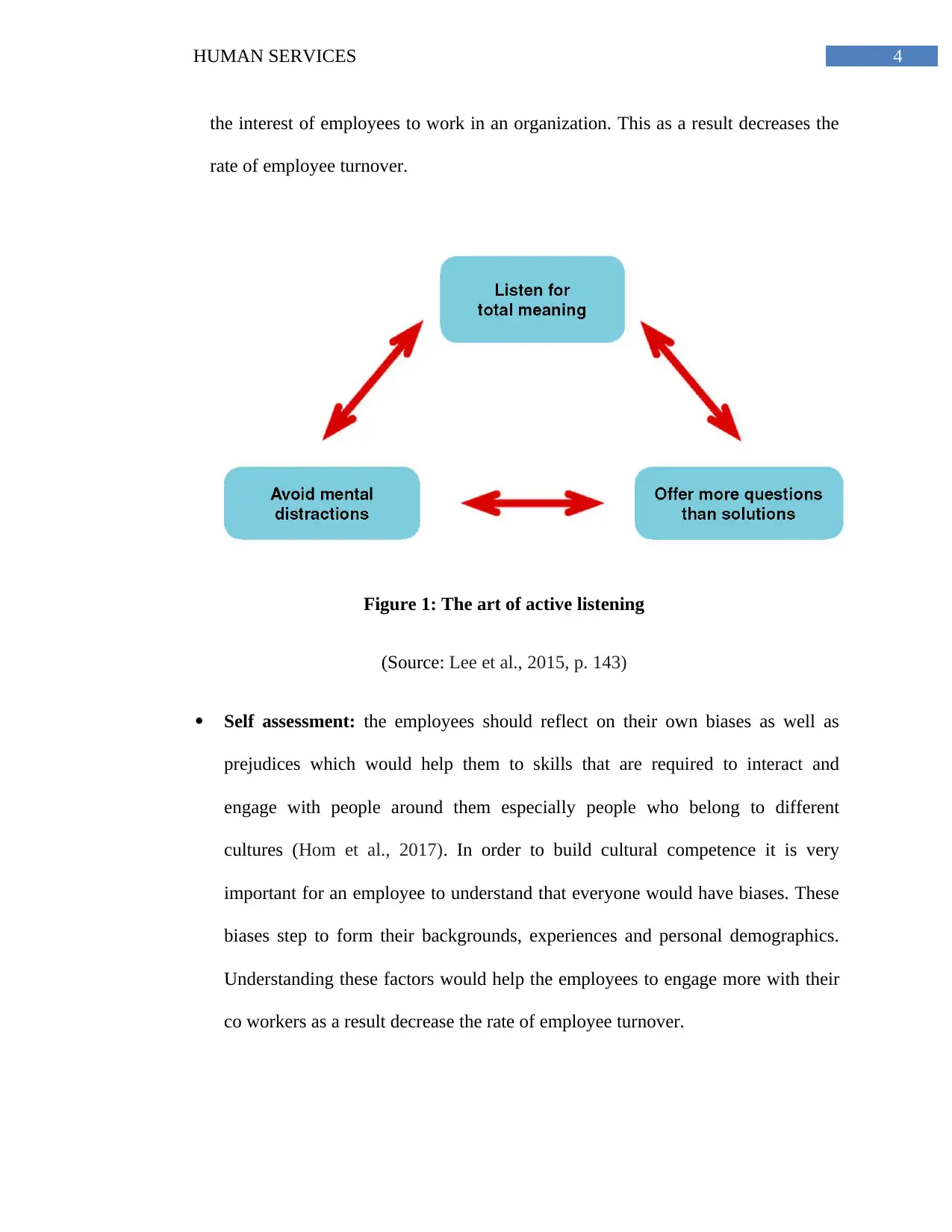
Figure 1: The art of active listening
(Source: Lee et al., 2015, p. 143)
Self assessment: the employees should reflect on their own biases as well as
prejudices which would help them to skills that are required to interact and
engage with people around them especially people who belong to different
cultures (Hom et al., 2017). In order to build cultural competence it is very
important for an employee to understand that everyone would have biases. These
biases step to form their backgrounds, experiences and personal demographics.
Understanding these factors would help the employees to engage more with their
co workers as a result decrease the rate of employee turnover.
the interest of employees to work in an organization. This as a result decreases the
rate of employee turnover.
Figure 1: The art of active listening
(Source: Lee et al., 2015, p. 143)
Self assessment: the employees should reflect on their own biases as well as
prejudices which would help them to skills that are required to interact and
engage with people around them especially people who belong to different
cultures (Hom et al., 2017). In order to build cultural competence it is very
important for an employee to understand that everyone would have biases. These
biases step to form their backgrounds, experiences and personal demographics.
Understanding these factors would help the employees to engage more with their
co workers as a result decrease the rate of employee turnover.

5HUMAN SERVICES
Professional ethics: professional ethics govern the behavior of a person in a particular
environment of business. Similar to values, these ethics provide rules and regulations to an
employee regarding how they should behave towards other employees and institution in a
working environment. Some universal principals of professional ethics include trustworthiness,
honesty, loyalty, respect to the law and respect for others, accountability, avoiding any harm to
others and many more (Cohen, Blake & Goodman, 2016). When an employee stays in a
disciplined environment and is made to believe that the employee important for the organization,
he would be more dedicated towards the organization. This as a result would decrease the rate of
employee turnover.
Professional ethics: professional ethics govern the behavior of a person in a particular
environment of business. Similar to values, these ethics provide rules and regulations to an
employee regarding how they should behave towards other employees and institution in a
working environment. Some universal principals of professional ethics include trustworthiness,
honesty, loyalty, respect to the law and respect for others, accountability, avoiding any harm to
others and many more (Cohen, Blake & Goodman, 2016). When an employee stays in a
disciplined environment and is made to believe that the employee important for the organization,
he would be more dedicated towards the organization. This as a result would decrease the rate of
employee turnover.
⊘ This is a preview!⊘
Do you want full access?
Subscribe today to unlock all pages.

Trusted by 1+ million students worldwide

6HUMAN SERVICES
References
Alam, S. M. T. (2015). Factors affecting job satisfaction, motivation and turnover rate of medical
promotion officer (MPO) in the pharmaceutical industry: a study based in Khulna
city. Asian Business Review, 1(2), 126-131.
Bilau, A. A., Ajagbe, A. M., Sholanke, A. B., & Sani, T. A. (2015). Impact of employee turnover
in small and medium construction firms: A literature review. International Journal of
Engineering Research & Technology (IJERT), 4(2), 977-984.
Cohen, G., Blake, R. S., & Goodman, D. (2016). Does turnover intention matter? Evaluating the
usefulness of turnover intention rate as a predictor of actual turnover rate. Review of
Public Personnel Administration, 36(3), 240-263.
Hom, P. W., Lee, T. W., Shaw, J. D., & Hausknecht, J. P. (2017). One hundred years of
employee turnover theory and research. Journal of Applied Psychology, 102(3), 530.
Katsikea, E., Theodosiou, M., & Morgan, R. E. (2015). Why people quit: Explaining employee
turnover intentions among export sales managers. International Business Review, 24(3),
367-379.
Kovner, C. T., Brewer, C. S., Fatehi, F., & Jun, J. (2014). What does the nurse turnover rate
mean and what is the rate?. Policy, Politics, & Nursing Practice, 15(3-4), 64-71.
Lee, T. W., Hom, P. W., Eberly, M. B., Junchao (Jason) Li, & Mitchell, T. R. (2017). On the
next decade of research in voluntary employee turnover. Academy of Management
Perspectives, 31(3), 201-221.
References
Alam, S. M. T. (2015). Factors affecting job satisfaction, motivation and turnover rate of medical
promotion officer (MPO) in the pharmaceutical industry: a study based in Khulna
city. Asian Business Review, 1(2), 126-131.
Bilau, A. A., Ajagbe, A. M., Sholanke, A. B., & Sani, T. A. (2015). Impact of employee turnover
in small and medium construction firms: A literature review. International Journal of
Engineering Research & Technology (IJERT), 4(2), 977-984.
Cohen, G., Blake, R. S., & Goodman, D. (2016). Does turnover intention matter? Evaluating the
usefulness of turnover intention rate as a predictor of actual turnover rate. Review of
Public Personnel Administration, 36(3), 240-263.
Hom, P. W., Lee, T. W., Shaw, J. D., & Hausknecht, J. P. (2017). One hundred years of
employee turnover theory and research. Journal of Applied Psychology, 102(3), 530.
Katsikea, E., Theodosiou, M., & Morgan, R. E. (2015). Why people quit: Explaining employee
turnover intentions among export sales managers. International Business Review, 24(3),
367-379.
Kovner, C. T., Brewer, C. S., Fatehi, F., & Jun, J. (2014). What does the nurse turnover rate
mean and what is the rate?. Policy, Politics, & Nursing Practice, 15(3-4), 64-71.
Lee, T. W., Hom, P. W., Eberly, M. B., Junchao (Jason) Li, & Mitchell, T. R. (2017). On the
next decade of research in voluntary employee turnover. Academy of Management
Perspectives, 31(3), 201-221.
Paraphrase This Document
Need a fresh take? Get an instant paraphrase of this document with our AI Paraphraser

7HUMAN SERVICES
Roche, M. A., Duffield, C. M., Homer, C., Buchan, J., & Dimitrelis, S. (2015). The rate and cost
of nurse turnover in Australia. Collegian, 22(4), 353-358.
Roche, M. A., Duffield, C. M., Homer, C., Buchan, J., & Dimitrelis, S. (2015). The rate and cost
of nurse turnover in Australia. Collegian, 22(4), 353-358.
1 out of 8
Related Documents
Your All-in-One AI-Powered Toolkit for Academic Success.
+13062052269
info@desklib.com
Available 24*7 on WhatsApp / Email
Unlock your academic potential
Copyright © 2020–2025 A2Z Services. All Rights Reserved. Developed and managed by ZUCOL.