Age Estimation Techniques for Human Skeletons: A Comprehensive Guide

Verified

Added on  2022/10/07

|8
|1444
|254
Report
AI Summary
This report provides an overview of the methods used to determine the age of human skeletons, a crucial aspect of both forensic science and archaeology. It emphasizes the importance of age estimation in reconstructing individual profiles and understanding demographics. The report explores various techniques, including the analysis of skeletal development, morphological modifications, and the use of medical imaging such as CT scans and radiographs. It highlights the pubic symphysis as a key indicator and discusses the significance of considering factors like bone development, fusion rates, and the presence or absence of teeth. The report also touches upon the role of carbon dating and the limitations and ethical considerations involved in forensic investigations. It concludes by emphasizing the need for a multidisciplinary approach and the continuous evolution of age estimation techniques, while also acknowledging the influence of factors such as sexual dimorphism, genetics, and environmental influences on bone development.

Document Page
Running head: LESSON 0
HOW TO AGE THE HUMAN SKELETON
AUGUST 9, 2019
STUDENT DETAILS:
tabler-icon-diamond-filled.svg

Paraphrase This Document

Need a fresh take? Get an instant paraphrase of this document with our AI Paraphraser
Document Page
LESSON 1
Contents
Introduction.................................................................................................................................................2
How to determine age of human skeleton?..................................................................................................2
Conclusion...................................................................................................................................................4
References...................................................................................................................................................6
Document Page
LESSON 2
Introduction
The age estimation is the vital constraint in forensic context as well as
archaeological context. The age at death evaluation is very necessary for rebuilding the true
profile. Consequently, it increases the chance of recognizing the leftovers. The assessment of the
age in archaeological collection from the particular sites provides the significant data on
demographics of the inhabitants. In addition, the age estimation in living is the popular problem
because of the relocation crisis, which occurs in various parts of a world. The age estimation of
dead can be approached through the skeletal. The new techniques as well as the medical images
like magnetic resonance image, CT scan as well as radiograph, are establishing to become useful
means for the modern inhabitants data. The age estimation depended on pubic symphysis puts
focus upon altering characteristics found on as well as surrounding face of pubic symphysis. In
the following parts, the process of determining the age of skeleton is discussed and examined.
How to determine age of human skeleton?
The age estimation at death in individual skeletal leftovers is depended on the
gross morphological modifications, which take place through the development, and ultimately,
disintegration of skeleton. In general, the pubic symphysis is considered as the most consistent
sign of the age at death in individual skeletal leftovers. The morphological modifications are
studied by various researchers. These morphological modifications take place through the life of
person. Various standards for assessing the age at death have been established (Seok, et. al,
2016).
Document Page
LESSON 3
In addition, the skeletal age estimation of young as well as sub adult people is the
task that is executed by forensic anthropologist in living as well as dead people (Miranker,
2016). The well-described chronology of developmental milestone that young skeleton
experiences from a point of ossification throughout to the accomplishment of maturity has
resulted in the wide-ranging sources of chronological along with modern data that has led to
creation of the norms of aging, which may be utilized in the evaluation of natural age. Besides,
the advancements in the biochemical technologies have permitted to open the new approaches
for the estimation of age, which may be applied to the range related to all age. The person age
remains the sub area of forensic science, which is continually enhancing with the ever-evolving
areas of the application (Skeleton Keys, 2011). On the other hand, the technological potential
requires to always be considered in against of the limitation as well as ethical consideration
before embarking on the forensic investigation. The research on the estimation of age would be
challenging as well as engaging experts from various disciplines, be it the physical science,
ethics, sociology, psychology, and even laws, for certain period to come (San-Millán, Rissech &
Turbón, 2017).
The skeleton is not just considered as the remainder of the life once lived.
However, it can also be the long-run blueprint as well as the history of the life. In forensics as
well as archaeology, defining the skeleton’s age is one of the first stages in recreating not just the
life but also death for discovering the answer. However, the main question is that how to
determine age of the skeleton? Even though the science may not get the actual age from the
skeletons, however the estimated age can be assesses. In addition, the Carbon-14 or radio Carbon
testing is extensively utilized through the world for testing remnant as well as bones in spite of
disagreements in relation to the accuracy. However, when the way is not available, then in this
tabler-icon-diamond-filled.svg

Paraphrase This Document

Need a fresh take? Get an instant paraphrase of this document with our AI Paraphraser
Document Page
LESSON 4
situation the assessment of the skeletons is the method utilized (Liversidge, Buckberry &
Marquez-Grant, 2015).
Moreover, there are 2 ages determined at the time of assessment, the age at time of
death as well as the complete age. For determination of age of skeleton, the skeleton and remains
around it should be observed. The first step would be to take decision if the skeletons are of
animal or person; then look to development as well as breakdown to decide the estimated age.
Further, it is required to measure skeleton. If missing bones make it not possible to assess the
complete height, then the femur or bone of thighs should be used. The thighs bone is longest
bone in a body of person. In a view of the fact that the femur frames regarding one quarter of
complete length of body, this can be utilized for the rough calculation (Goliath, Stewart & Stout,
2016).
Additionally, the process of determination of the skeleton’s gender can be helpful
in the process of aging. Some point on the head, along with the width of hips, may be utilized
distinguishing the men from women. The sexual category of the prepubescent children can be
not possible to settle on. It is require conducting the study of skull of the bones. Further, it is also
required to verify the teeth of skeleton or absence of the teeth. In a case while the skeletons have
wisdom teeth, the people were past the age of eighteen. In a case when there is loss of the
important bone, then it points the more developed age. The permanent teeth in the skull of
children states that the individual arrived at late childhood. It is required to look for the
thickening of the skeletons. The bones also combine as one as the people age. The X-ray makes
growth plates as well as the fusion’s rate clearly noticeable (Devlin‐Durante, et. al, 2016).
Conclusion
Document Page
LESSON 5
As per the above discussion, it can be concluded that all the processes of age
estimation results in the construction of the age estimation, which may be utilized for the purpose
of recognition. However, due consideration should be provided to the elements, which can affect
the evaluation of the age, like degree of difference maturation between sexual categories, the
influence of hereditary as well as the environmental elements on the development of bones, and
the significance of inhabitants specificity while implementing the standards of references .
Document Page
LESSON 6
References
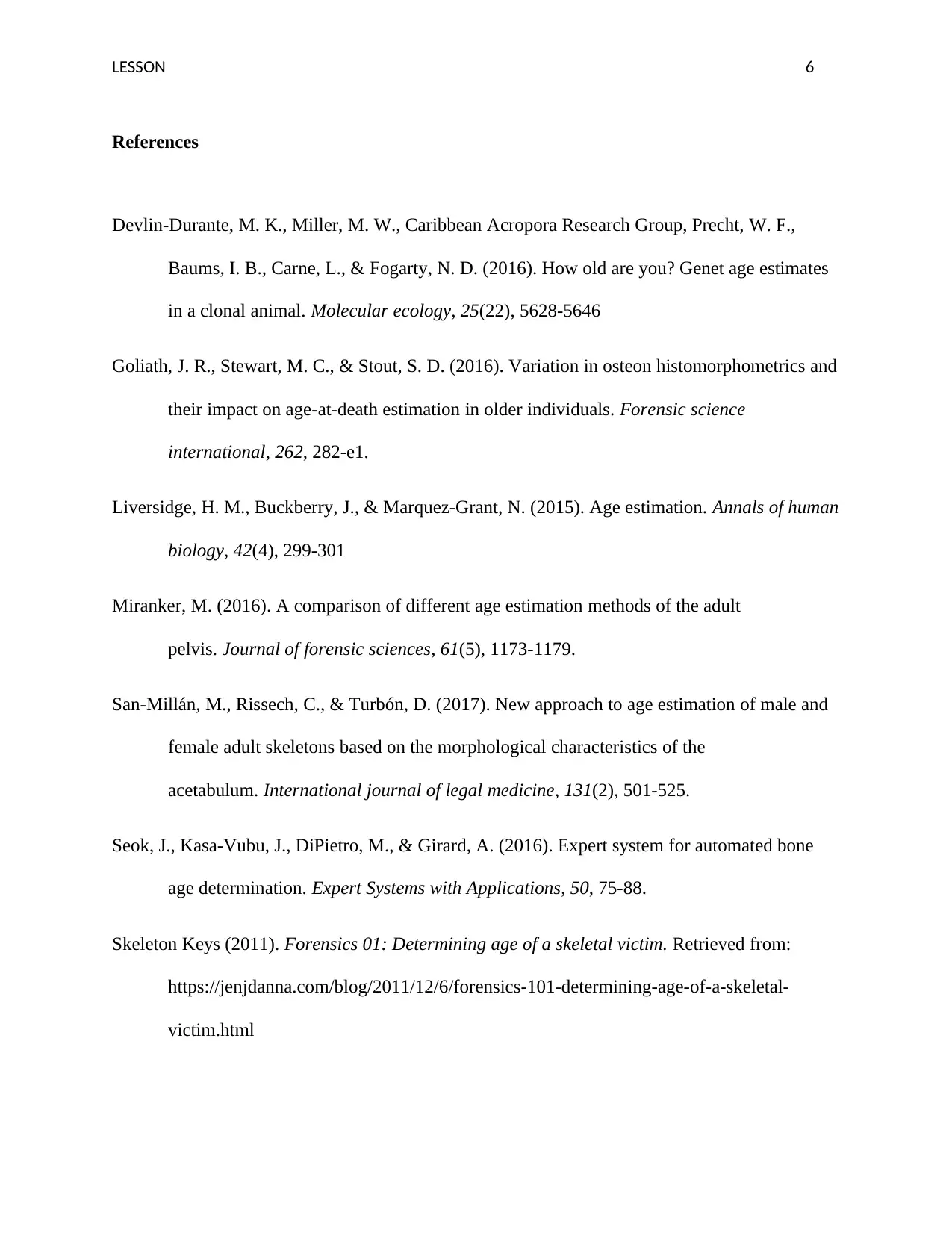
Devlin‐Durante, M. K., Miller, M. W., Caribbean Acropora Research Group, Precht, W. F.,
Baums, I. B., Carne, L., & Fogarty, N. D. (2016). How old are you? Genet age estimates
in a clonal animal. Molecular ecology, 25(22), 5628-5646
Goliath, J. R., Stewart, M. C., & Stout, S. D. (2016). Variation in osteon histomorphometrics and
their impact on age-at-death estimation in older individuals. Forensic science
international, 262, 282-e1.
Liversidge, H. M., Buckberry, J., & Marquez-Grant, N. (2015). Age estimation. Annals of human
biology, 42(4), 299-301
Miranker, M. (2016). A comparison of different age estimation methods of the adult
pelvis. Journal of forensic sciences, 61(5), 1173-1179.
San-Millán, M., Rissech, C., & Turbón, D. (2017). New approach to age estimation of male and
female adult skeletons based on the morphological characteristics of the
acetabulum. International journal of legal medicine, 131(2), 501-525.
Seok, J., Kasa-Vubu, J., DiPietro, M., & Girard, A. (2016). Expert system for automated bone
age determination. Expert Systems with Applications, 50, 75-88.
Skeleton Keys (2011). Forensics 01: Determining age of a skeletal victim. Retrieved from:
https://jenjdanna.com/blog/2011/12/6/forensics-101-determining-age-of-a-skeletal-
victim.html
tabler-icon-diamond-filled.svg

Paraphrase This Document

Need a fresh take? Get an instant paraphrase of this document with our AI Paraphraser
Document Page
LESSON 7
chevron_up_icon
1 out of 8
circle_padding
hide_on_mobile
zoom_out_icon
[object Object]