Analysis of Hume's Problem of Induction and Potential Solutions
VerifiedAdded on 2022/08/29
|6
|1256
|35
Essay
AI Summary
This essay critically examines David Hume's problem of induction as presented in "An Enquiry Concerning Human Understanding." The student argues against Hume's skeptical solution, focusing on the importance of causation and the limitations of human knowledge. The essay provides an overview of Hume's views on induction, cause and effect, and the justification of inductive assumptions. It then presents a counter-argument based on the Personalist Bayesian framework and the significance of experience in forming beliefs, suggesting that Hume's skepticism can be overcome. The student concludes that Hume's skeptical solutions are not appropriate and offers an argumentative structure to support their proposed solutions to the problem of induction.
Running head: HUME’S PHILOSOPHY
HUME’S PHILOSOPHY
Name of the Student
Name of the University
Author Note
HUME’S PHILOSOPHY
Name of the Student
Name of the University
Author Note
Paraphrase This Document
Need a fresh take? Get an instant paraphrase of this document with our AI Paraphraser

1HUME’S PHILOSOPHY
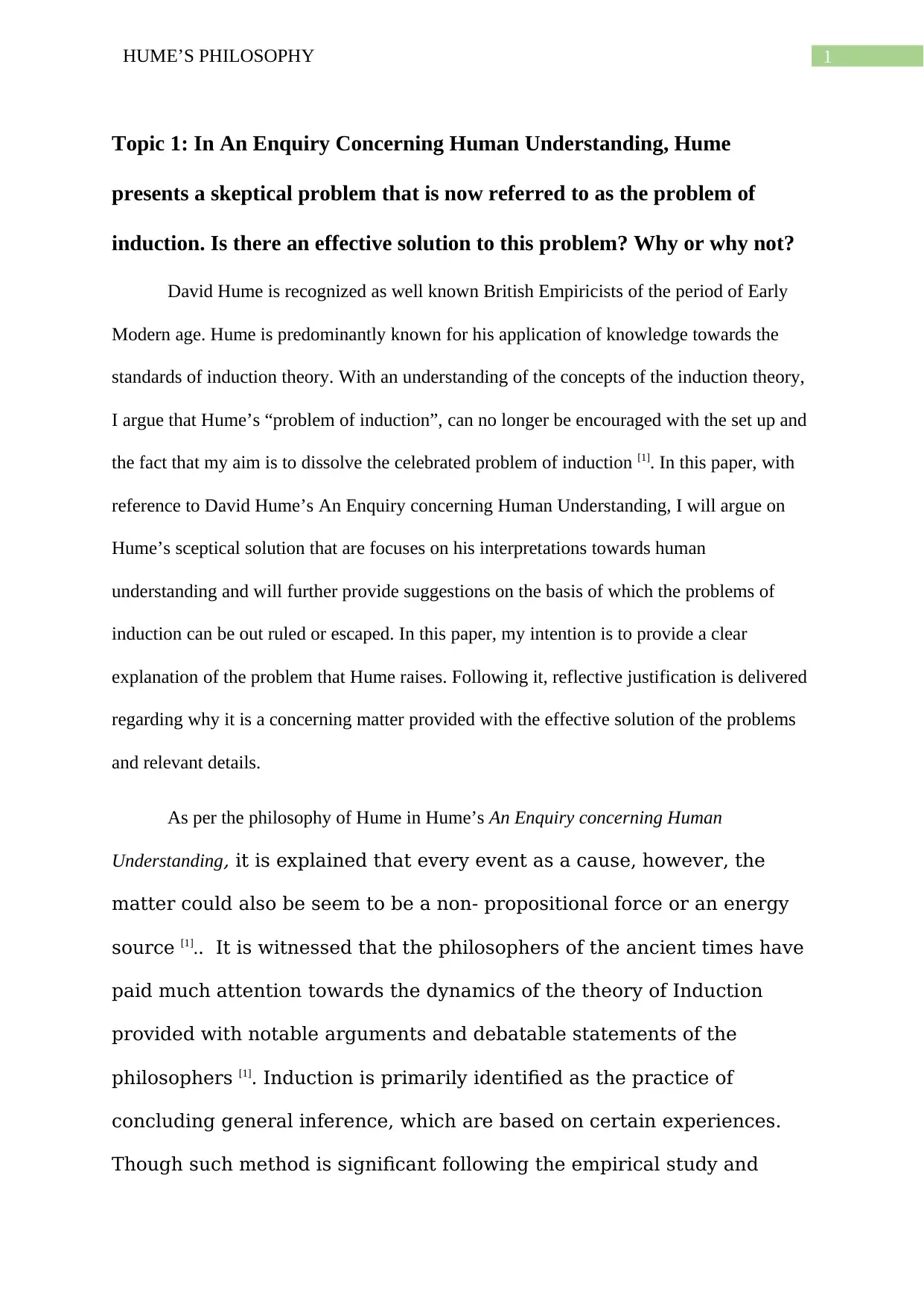
Topic 1: In An Enquiry Concerning Human Understanding, Hume
presents a skeptical problem that is now referred to as the problem of
induction. Is there an effective solution to this problem? Why or why not?
David Hume is recognized as well known British Empiricists of the period of Early
Modern age. Hume is predominantly known for his application of knowledge towards the
standards of induction theory. With an understanding of the concepts of the induction theory,
I argue that Hume’s “problem of induction”, can no longer be encouraged with the set up and
the fact that my aim is to dissolve the celebrated problem of induction [1]. In this paper, with
reference to David Hume’s An Enquiry concerning Human Understanding, I will argue on
Hume’s sceptical solution that are focuses on his interpretations towards human
understanding and will further provide suggestions on the basis of which the problems of
induction can be out ruled or escaped. In this paper, my intention is to provide a clear
explanation of the problem that Hume raises. Following it, reflective justification is delivered
regarding why it is a concerning matter provided with the effective solution of the problems
and relevant details.
As per the philosophy of Hume in Hume’s An Enquiry concerning Human
Understanding, it is explained that every event as a cause, however, the
matter could also be seem to be a non- propositional force or an energy
source [1].. It is witnessed that the philosophers of the ancient times have
paid much attention towards the dynamics of the theory of Induction
provided with notable arguments and debatable statements of the
philosophers [1]. Induction is primarily identified as the practice of
concluding general inference, which are based on certain experiences.
Though such method is significant following the empirical study and
Topic 1: In An Enquiry Concerning Human Understanding, Hume
presents a skeptical problem that is now referred to as the problem of
induction. Is there an effective solution to this problem? Why or why not?
David Hume is recognized as well known British Empiricists of the period of Early
Modern age. Hume is predominantly known for his application of knowledge towards the
standards of induction theory. With an understanding of the concepts of the induction theory,
I argue that Hume’s “problem of induction”, can no longer be encouraged with the set up and
the fact that my aim is to dissolve the celebrated problem of induction [1]. In this paper, with
reference to David Hume’s An Enquiry concerning Human Understanding, I will argue on
Hume’s sceptical solution that are focuses on his interpretations towards human
understanding and will further provide suggestions on the basis of which the problems of
induction can be out ruled or escaped. In this paper, my intention is to provide a clear
explanation of the problem that Hume raises. Following it, reflective justification is delivered
regarding why it is a concerning matter provided with the effective solution of the problems
and relevant details.
As per the philosophy of Hume in Hume’s An Enquiry concerning Human
Understanding, it is explained that every event as a cause, however, the
matter could also be seem to be a non- propositional force or an energy
source [1].. It is witnessed that the philosophers of the ancient times have
paid much attention towards the dynamics of the theory of Induction
provided with notable arguments and debatable statements of the
philosophers [1]. Induction is primarily identified as the practice of
concluding general inference, which are based on certain experiences.
Though such method is significant following the empirical study and

2HUME’S PHILOSOPHY
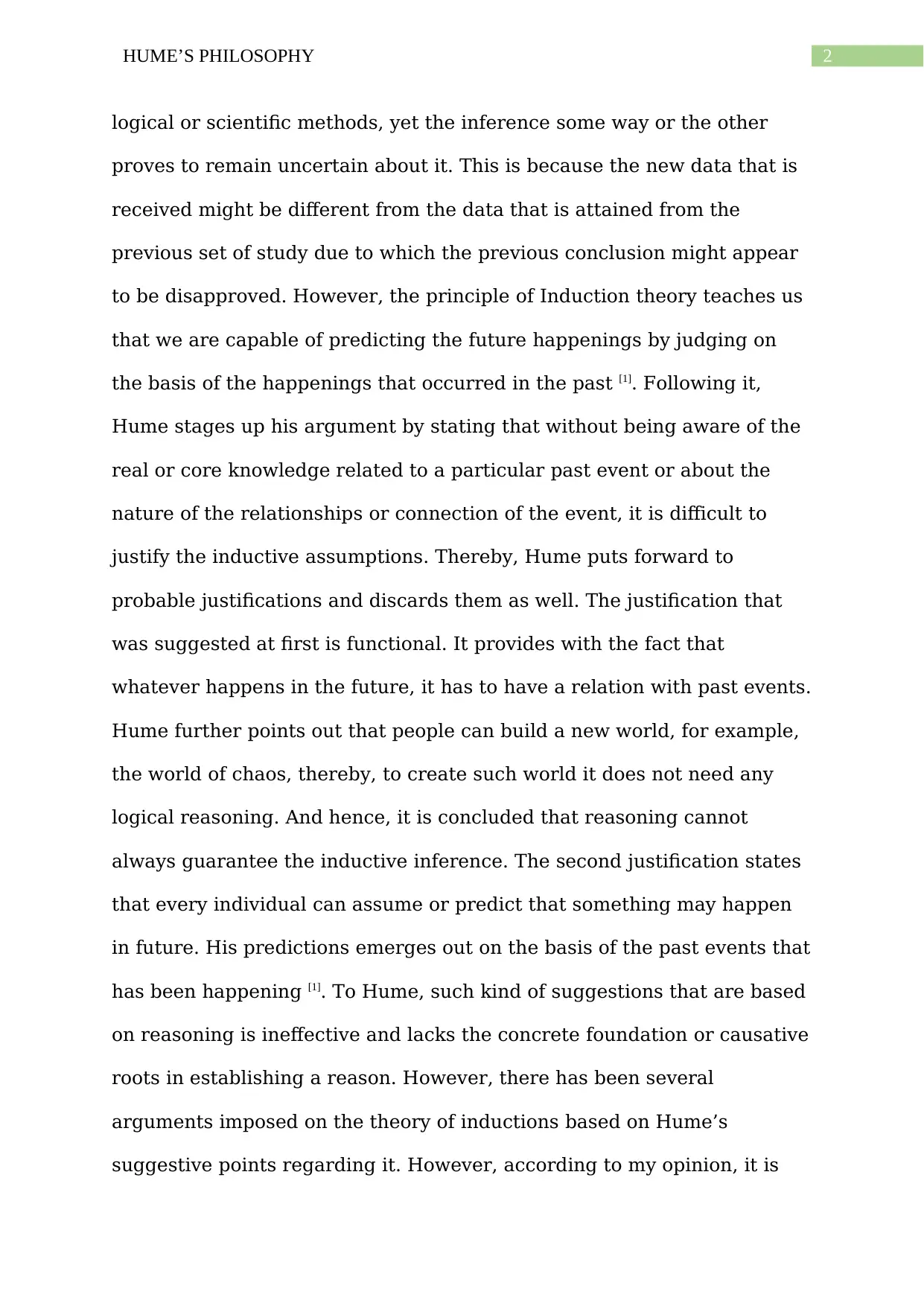
logical or scientific methods, yet the inference some way or the other
proves to remain uncertain about it. This is because the new data that is
received might be different from the data that is attained from the
previous set of study due to which the previous conclusion might appear
to be disapproved. However, the principle of Induction theory teaches us
that we are capable of predicting the future happenings by judging on
the basis of the happenings that occurred in the past [1]. Following it,
Hume stages up his argument by stating that without being aware of the
real or core knowledge related to a particular past event or about the
nature of the relationships or connection of the event, it is difficult to
justify the inductive assumptions. Thereby, Hume puts forward to
probable justifications and discards them as well. The justification that
was suggested at first is functional. It provides with the fact that
whatever happens in the future, it has to have a relation with past events.
Hume further points out that people can build a new world, for example,
the world of chaos, thereby, to create such world it does not need any
logical reasoning. And hence, it is concluded that reasoning cannot
always guarantee the inductive inference. The second justification states
that every individual can assume or predict that something may happen
in future. His predictions emerges out on the basis of the past events that
has been happening [1]. To Hume, such kind of suggestions that are based
on reasoning is ineffective and lacks the concrete foundation or causative
roots in establishing a reason. However, there has been several
arguments imposed on the theory of inductions based on Hume’s
suggestive points regarding it. However, according to my opinion, it is
logical or scientific methods, yet the inference some way or the other
proves to remain uncertain about it. This is because the new data that is
received might be different from the data that is attained from the
previous set of study due to which the previous conclusion might appear
to be disapproved. However, the principle of Induction theory teaches us
that we are capable of predicting the future happenings by judging on
the basis of the happenings that occurred in the past [1]. Following it,
Hume stages up his argument by stating that without being aware of the
real or core knowledge related to a particular past event or about the
nature of the relationships or connection of the event, it is difficult to
justify the inductive assumptions. Thereby, Hume puts forward to
probable justifications and discards them as well. The justification that
was suggested at first is functional. It provides with the fact that
whatever happens in the future, it has to have a relation with past events.
Hume further points out that people can build a new world, for example,
the world of chaos, thereby, to create such world it does not need any
logical reasoning. And hence, it is concluded that reasoning cannot
always guarantee the inductive inference. The second justification states
that every individual can assume or predict that something may happen
in future. His predictions emerges out on the basis of the past events that
has been happening [1]. To Hume, such kind of suggestions that are based
on reasoning is ineffective and lacks the concrete foundation or causative
roots in establishing a reason. However, there has been several
arguments imposed on the theory of inductions based on Hume’s
suggestive points regarding it. However, according to my opinion, it is
⊘ This is a preview!⊘
Do you want full access?
Subscribe today to unlock all pages.

Trusted by 1+ million students worldwide

3HUME’S PHILOSOPHY
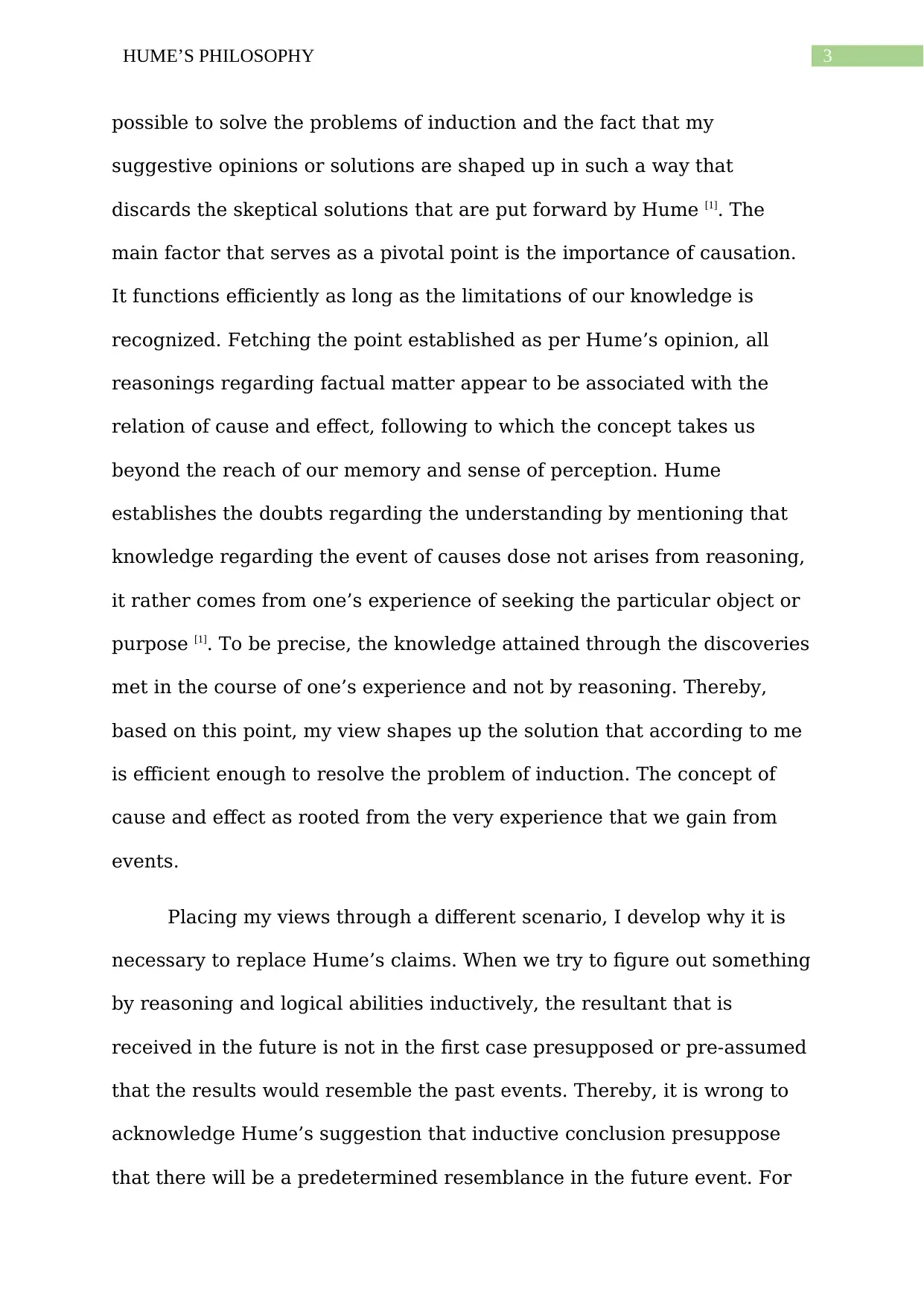
possible to solve the problems of induction and the fact that my
suggestive opinions or solutions are shaped up in such a way that
discards the skeptical solutions that are put forward by Hume [1]. The
main factor that serves as a pivotal point is the importance of causation.
It functions efficiently as long as the limitations of our knowledge is
recognized. Fetching the point established as per Hume’s opinion, all
reasonings regarding factual matter appear to be associated with the
relation of cause and effect, following to which the concept takes us
beyond the reach of our memory and sense of perception. Hume
establishes the doubts regarding the understanding by mentioning that
knowledge regarding the event of causes dose not arises from reasoning,
it rather comes from one’s experience of seeking the particular object or
purpose [1]. To be precise, the knowledge attained through the discoveries
met in the course of one’s experience and not by reasoning. Thereby,
based on this point, my view shapes up the solution that according to me
is efficient enough to resolve the problem of induction. The concept of
cause and effect as rooted from the very experience that we gain from
events.
Placing my views through a different scenario, I develop why it is
necessary to replace Hume’s claims. When we try to figure out something
by reasoning and logical abilities inductively, the resultant that is
received in the future is not in the first case presupposed or pre-assumed
that the results would resemble the past events. Thereby, it is wrong to
acknowledge Hume’s suggestion that inductive conclusion presuppose
that there will be a predetermined resemblance in the future event. For
possible to solve the problems of induction and the fact that my
suggestive opinions or solutions are shaped up in such a way that
discards the skeptical solutions that are put forward by Hume [1]. The
main factor that serves as a pivotal point is the importance of causation.
It functions efficiently as long as the limitations of our knowledge is
recognized. Fetching the point established as per Hume’s opinion, all
reasonings regarding factual matter appear to be associated with the
relation of cause and effect, following to which the concept takes us
beyond the reach of our memory and sense of perception. Hume
establishes the doubts regarding the understanding by mentioning that
knowledge regarding the event of causes dose not arises from reasoning,
it rather comes from one’s experience of seeking the particular object or
purpose [1]. To be precise, the knowledge attained through the discoveries
met in the course of one’s experience and not by reasoning. Thereby,
based on this point, my view shapes up the solution that according to me
is efficient enough to resolve the problem of induction. The concept of
cause and effect as rooted from the very experience that we gain from
events.
Placing my views through a different scenario, I develop why it is
necessary to replace Hume’s claims. When we try to figure out something
by reasoning and logical abilities inductively, the resultant that is
received in the future is not in the first case presupposed or pre-assumed
that the results would resemble the past events. Thereby, it is wrong to
acknowledge Hume’s suggestion that inductive conclusion presuppose
that there will be a predetermined resemblance in the future event. For
Paraphrase This Document
Need a fresh take? Get an instant paraphrase of this document with our AI Paraphraser

4HUME’S PHILOSOPHY
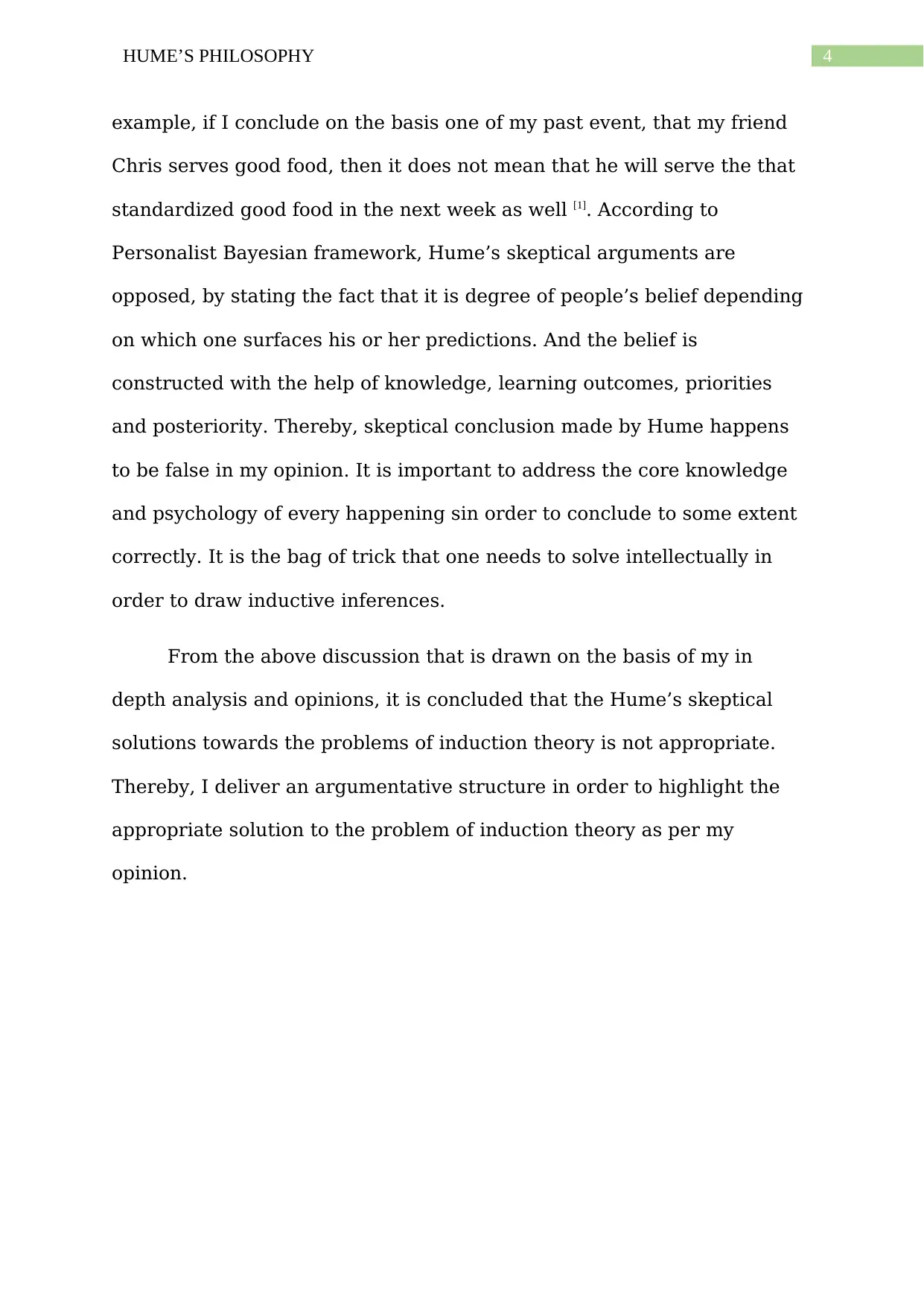
example, if I conclude on the basis one of my past event, that my friend
Chris serves good food, then it does not mean that he will serve the that
standardized good food in the next week as well [1]. According to
Personalist Bayesian framework, Hume’s skeptical arguments are
opposed, by stating the fact that it is degree of people’s belief depending
on which one surfaces his or her predictions. And the belief is
constructed with the help of knowledge, learning outcomes, priorities
and posteriority. Thereby, skeptical conclusion made by Hume happens
to be false in my opinion. It is important to address the core knowledge
and psychology of every happening sin order to conclude to some extent
correctly. It is the bag of trick that one needs to solve intellectually in
order to draw inductive inferences.
From the above discussion that is drawn on the basis of my in
depth analysis and opinions, it is concluded that the Hume’s skeptical
solutions towards the problems of induction theory is not appropriate.
Thereby, I deliver an argumentative structure in order to highlight the
appropriate solution to the problem of induction theory as per my
opinion.
example, if I conclude on the basis one of my past event, that my friend
Chris serves good food, then it does not mean that he will serve the that
standardized good food in the next week as well [1]. According to
Personalist Bayesian framework, Hume’s skeptical arguments are
opposed, by stating the fact that it is degree of people’s belief depending
on which one surfaces his or her predictions. And the belief is
constructed with the help of knowledge, learning outcomes, priorities
and posteriority. Thereby, skeptical conclusion made by Hume happens
to be false in my opinion. It is important to address the core knowledge
and psychology of every happening sin order to conclude to some extent
correctly. It is the bag of trick that one needs to solve intellectually in
order to draw inductive inferences.
From the above discussion that is drawn on the basis of my in
depth analysis and opinions, it is concluded that the Hume’s skeptical
solutions towards the problems of induction theory is not appropriate.
Thereby, I deliver an argumentative structure in order to highlight the
appropriate solution to the problem of induction theory as per my
opinion.

5HUME’S PHILOSOPHY
References:
1. Hume D. An enquiry concerning human understanding. InSeven masterpieces of philosophy
2016 Jun 3 (pp. 191-284). Routledge.
References:
1. Hume D. An enquiry concerning human understanding. InSeven masterpieces of philosophy
2016 Jun 3 (pp. 191-284). Routledge.
⊘ This is a preview!⊘
Do you want full access?
Subscribe today to unlock all pages.

Trusted by 1+ million students worldwide
1 out of 6
Related Documents
Your All-in-One AI-Powered Toolkit for Academic Success.
+13062052269
info@desklib.com
Available 24*7 on WhatsApp / Email
Unlock your academic potential
Copyright © 2020–2025 A2Z Services. All Rights Reserved. Developed and managed by ZUCOL.