CQUniversity LAWS11057 Assignment 1: Humzy-Hancock Case Analysis

Verified

Added on  2023/01/17

|7
|1673
|97
Homework Assignment
AI Summary
This assignment analyzes the Humzy-Hancock case, focusing on academic misconduct allegations against a law student. The case involves questions of collaboration, plagiarism, and inadequate referencing. The assignment details the facts, legal issues, laws applied, and the judge's reasoning, including the use of Griffith Law School's Assessment Policy and Procedures. The outcome of the case was a ruling of not guilty on plagiarism, with the court determining the student's actions as poor work rather than intentional misconduct. The assignment also includes a two-paragraph reflection on the case, emphasizing the importance of correct referencing, adherence to university policies, and academic integrity for law students and future legal professionals, highlighting the impact of the case on the student's understanding of these principles. The student also reflects on the importance of the case in the context of their studies and future legal career.
Document Page
STUDENT NO. S0179085
LAWS11057: INTRODUCTION
TO LAW ASSIGNMENT 1
tabler-icon-diamond-filled.svg

Paraphrase This Document

Need a fresh take? Get an instant paraphrase of this document with our AI Paraphraser
Document Page
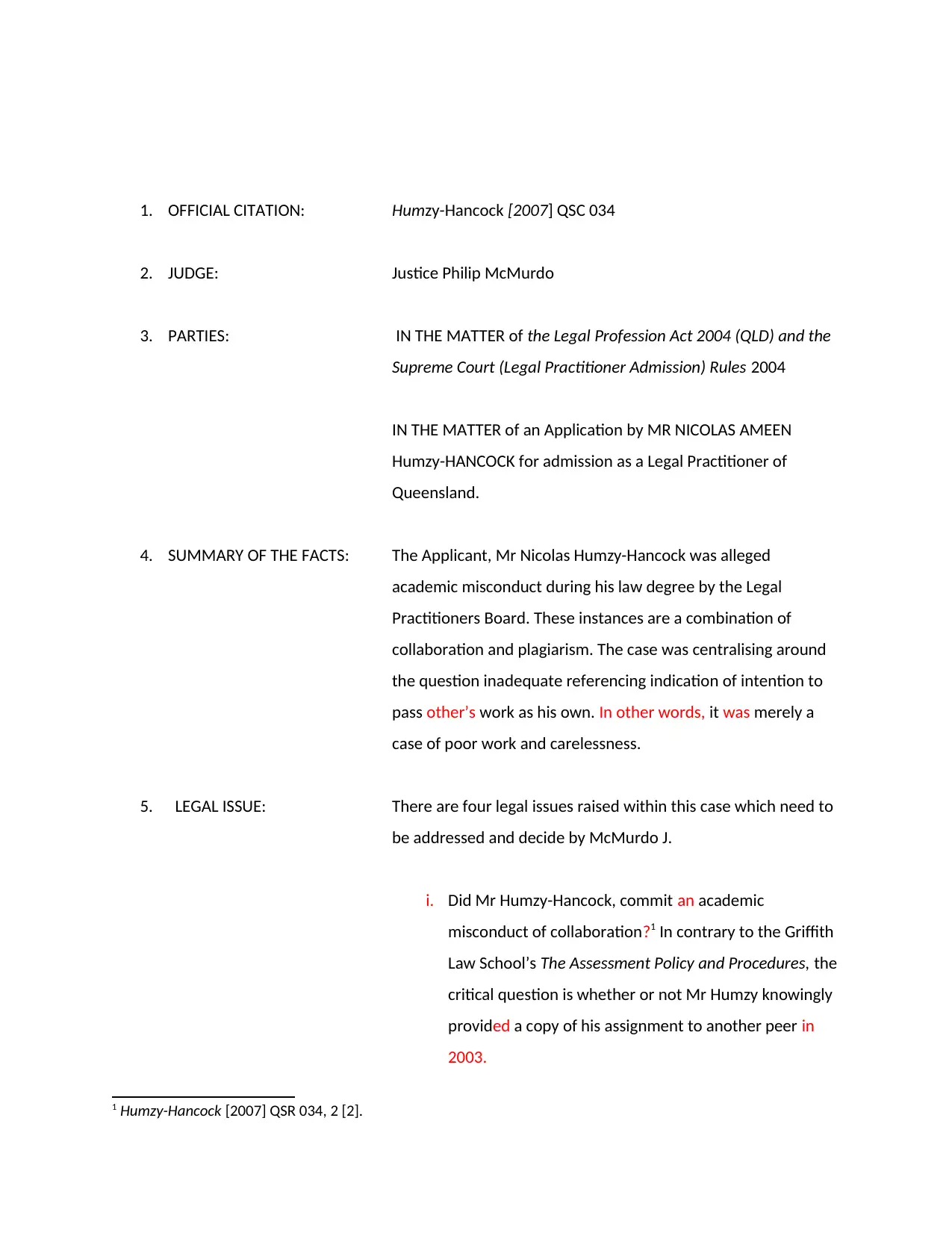
1. OFFICIAL CITATION: Humzy-Hancock [2007] QSC 034
2. JUDGE: Justice Philip McMurdo
3. PARTIES: IN THE MATTER of the Legal Profession Act 2004 (QLD) and the
Supreme Court (Legal Practitioner Admission) Rules 2004
IN THE MATTER of an Application by MR NICOLAS AMEEN
Humzy-HANCOCK for admission as a Legal Practitioner of
Queensland.
4. SUMMARY OF THE FACTS: The Applicant, Mr Nicolas Humzy-Hancock was alleged
academic misconduct during his law degree by the Legal
Practitioners Board. These instances are a combination of
collaboration and plagiarism. The case was centralising around
the question inadequate referencing indication of intention to
pass other’s work as his own. In other words, it was merely a
case of poor work and carelessness.
5. LEGAL ISSUE: There are four legal issues raised within this case which need to
be addressed and decide by McMurdo J.
i. Did Mr Humzy-Hancock, commit an academic
misconduct of collaboration?1 In contrary to the Griffith
Law School’s The Assessment Policy and Procedures, the
critical question is whether or not Mr Humzy knowingly
provided a copy of his assignment to another peer in
2003.
1 Humzy-Hancock [2007] QSR 034, 2 [2].
Document Page
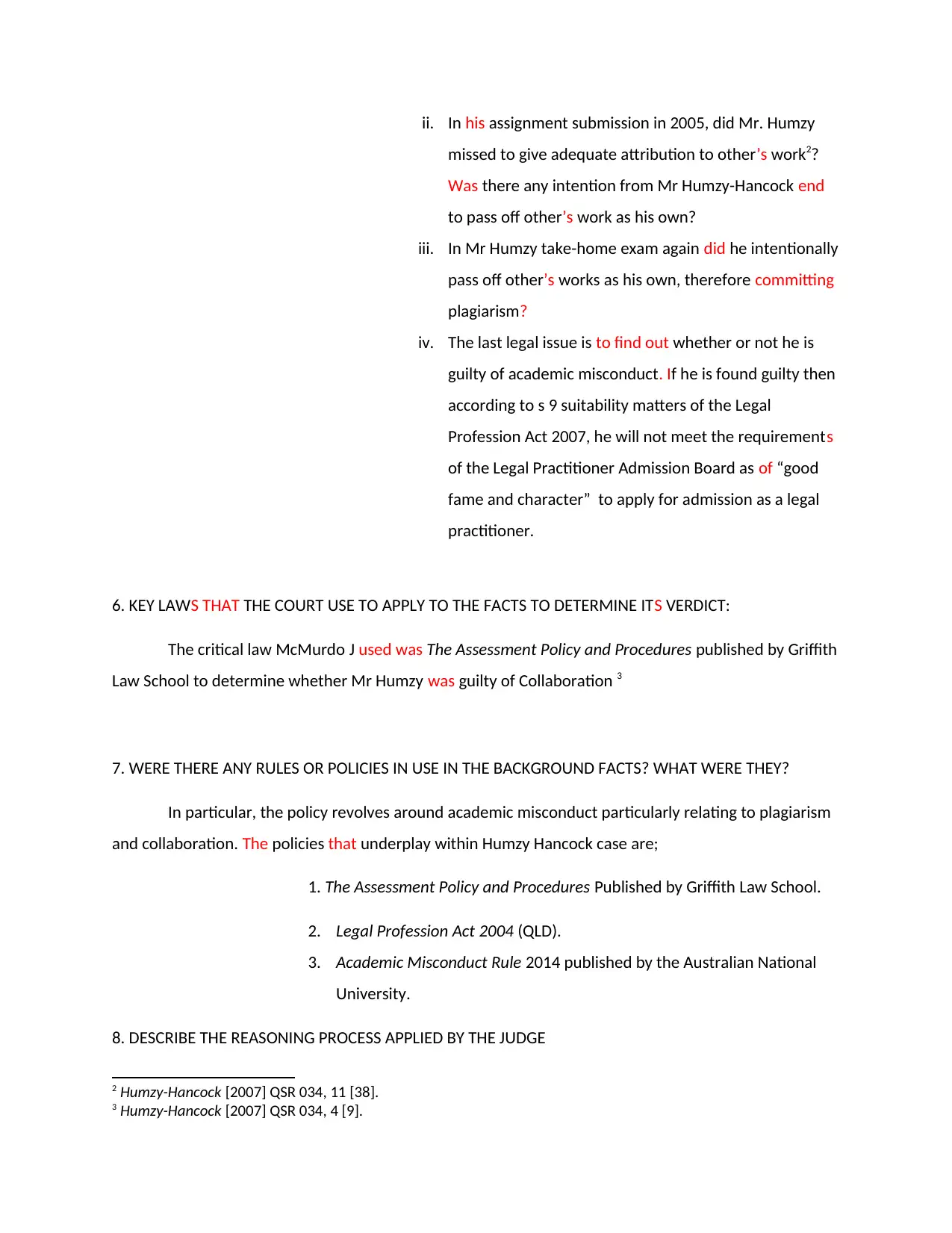
ii. In his assignment submission in 2005, did Mr. Humzy
missed to give adequate attribution to other’s work2?
Was there any intention from Mr Humzy-Hancock end
to pass off other’s work as his own?
iii. In Mr Humzy take-home exam again did he intentionally
pass off other’s works as his own, therefore committing
plagiarism?
iv. The last legal issue is to find out whether or not he is
guilty of academic misconduct. If he is found guilty then
according to s 9 suitability matters of the Legal
Profession Act 2007, he will not meet the requirements
of the Legal Practitioner Admission Board as of “good
fame and character” to apply for admission as a legal
practitioner.
6. KEY LAWS THAT THE COURT USE TO APPLY TO THE FACTS TO DETERMINE ITS VERDICT:
The critical law McMurdo J used was The Assessment Policy and Procedures published by Griffith
Law School to determine whether Mr Humzy was guilty of Collaboration 3
7. WERE THERE ANY RULES OR POLICIES IN USE IN THE BACKGROUND FACTS? WHAT WERE THEY?
In particular, the policy revolves around academic misconduct particularly relating to plagiarism
and collaboration. The policies that underplay within Humzy Hancock case are;
1. The Assessment Policy and Procedures Published by Griffith Law School.
2. Legal Profession Act 2004 (QLD).
3. Academic Misconduct Rule 2014 published by the Australian National
University.
8. DESCRIBE THE REASONING PROCESS APPLIED BY THE JUDGE
2 Humzy-Hancock [2007] QSR 034, 11 [38].
3 Humzy-Hancock [2007] QSR 034, 4 [9].
Document Page
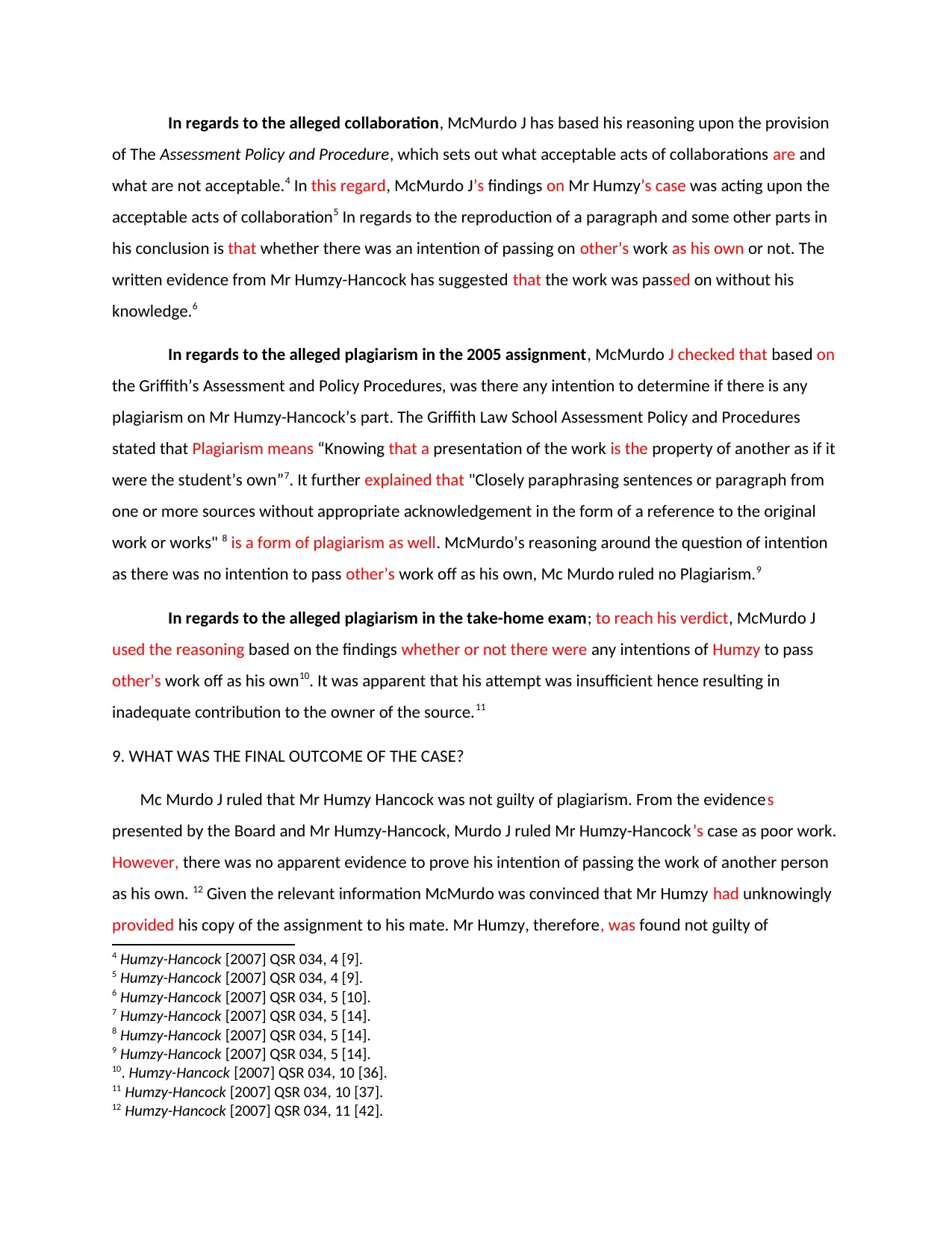
In regards to the alleged collaboration, McMurdo J has based his reasoning upon the provision
of The Assessment Policy and Procedure, which sets out what acceptable acts of collaborations are and
what are not acceptable.4 In this regard, McMurdo J’s findings on Mr Humzy’s case was acting upon the
acceptable acts of collaboration5 In regards to the reproduction of a paragraph and some other parts in
his conclusion is that whether there was an intention of passing on other’s work as his own or not. The
written evidence from Mr Humzy-Hancock has suggested that the work was passed on without his
knowledge.6
In regards to the alleged plagiarism in the 2005 assignment, McMurdo J checked that based on
the Griffith’s Assessment and Policy Procedures, was there any intention to determine if there is any
plagiarism on Mr Humzy-Hancock’s part. The Griffith Law School Assessment Policy and Procedures
stated that Plagiarism means “Knowing that a presentation of the work is the property of another as if it
were the student’s own”7. It further explained that "Closely paraphrasing sentences or paragraph from
one or more sources without appropriate acknowledgement in the form of a reference to the original
work or works" 8 is a form of plagiarism as well. McMurdo’s reasoning around the question of intention
as there was no intention to pass other’s work off as his own, Mc Murdo ruled no Plagiarism.9
In regards to the alleged plagiarism in the take-home exam; to reach his verdict, McMurdo J
used the reasoning based on the findings whether or not there were any intentions of Humzy to pass
other’s work off as his own10. It was apparent that his attempt was insufficient hence resulting in
inadequate contribution to the owner of the source.11
9. WHAT WAS THE FINAL OUTCOME OF THE CASE?
Mc Murdo J ruled that Mr Humzy Hancock was not guilty of plagiarism. From the evidences
presented by the Board and Mr Humzy-Hancock, Murdo J ruled Mr Humzy-Hancock’s case as poor work.
However, there was no apparent evidence to prove his intention of passing the work of another person
as his own. 12 Given the relevant information McMurdo was convinced that Mr Humzy had unknowingly
provided his copy of the assignment to his mate. Mr Humzy, therefore, was found not guilty of
4 Humzy-Hancock [2007] QSR 034, 4 [9].
5 Humzy-Hancock [2007] QSR 034, 4 [9].
6 Humzy-Hancock [2007] QSR 034, 5 [10].
7 Humzy-Hancock [2007] QSR 034, 5 [14].
8 Humzy-Hancock [2007] QSR 034, 5 [14].
9 Humzy-Hancock [2007] QSR 034, 5 [14].
10. Humzy-Hancock [2007] QSR 034, 10 [36].
11 Humzy-Hancock [2007] QSR 034, 10 [37].
12 Humzy-Hancock [2007] QSR 034, 11 [42].
tabler-icon-diamond-filled.svg

Paraphrase This Document

Need a fresh take? Get an instant paraphrase of this document with our AI Paraphraser
Document Page
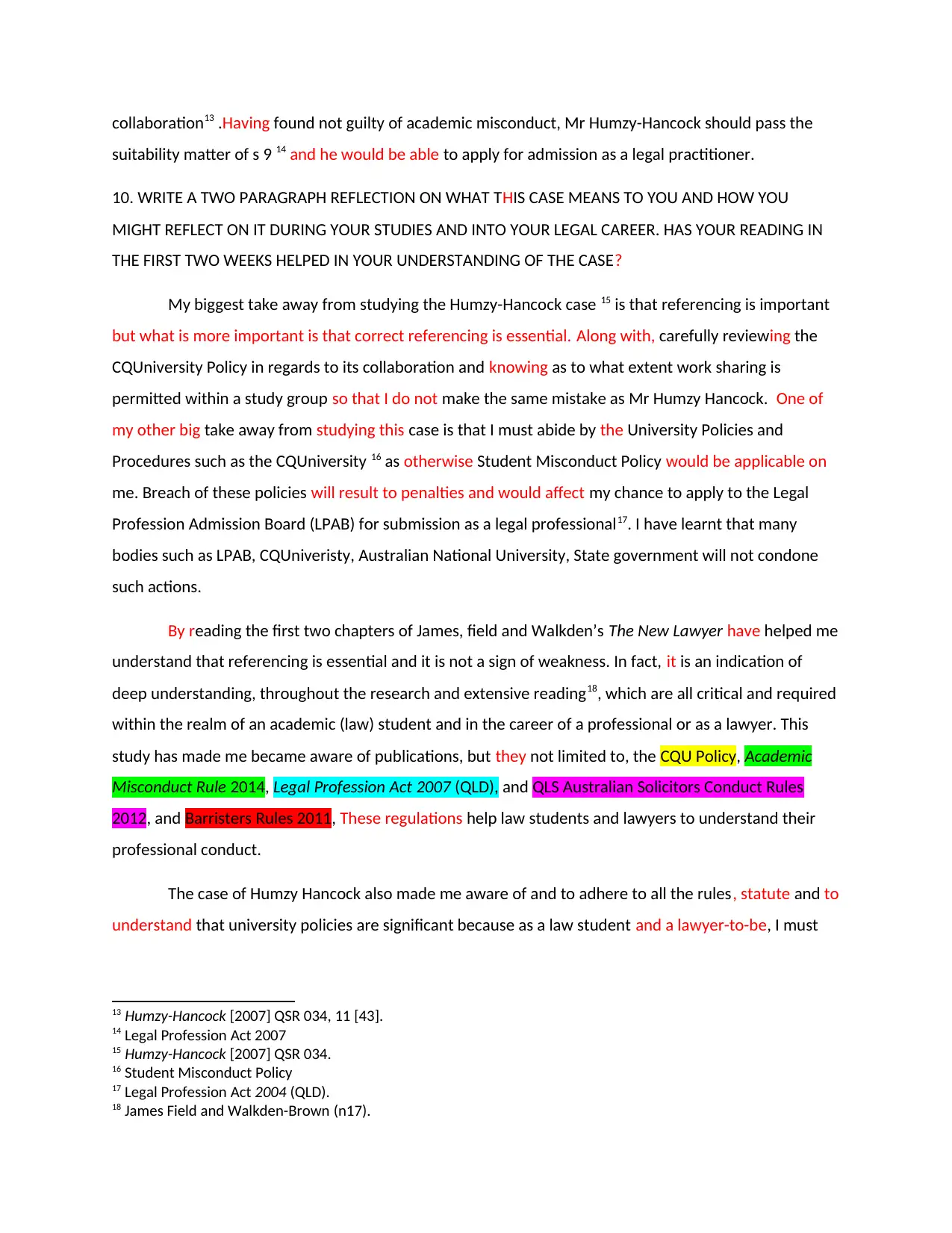
collaboration13 .Having found not guilty of academic misconduct, Mr Humzy-Hancock should pass the
suitability matter of s 9 14 and he would be able to apply for admission as a legal practitioner.
10. WRITE A TWO PARAGRAPH REFLECTION ON WHAT THIS CASE MEANS TO YOU AND HOW YOU
MIGHT REFLECT ON IT DURING YOUR STUDIES AND INTO YOUR LEGAL CAREER. HAS YOUR READING IN
THE FIRST TWO WEEKS HELPED IN YOUR UNDERSTANDING OF THE CASE?
My biggest take away from studying the Humzy-Hancock case 15 is that referencing is important
but what is more important is that correct referencing is essential. Along with, carefully reviewing the
CQUniversity Policy in regards to its collaboration and knowing as to what extent work sharing is
permitted within a study group so that I do not make the same mistake as Mr Humzy Hancock. One of
my other big take away from studying this case is that I must abide by the University Policies and
Procedures such as the CQUniversity 16 as otherwise Student Misconduct Policy would be applicable on
me. Breach of these policies will result to penalties and would affect my chance to apply to the Legal
Profession Admission Board (LPAB) for submission as a legal professional17. I have learnt that many
bodies such as LPAB, CQUniveristy, Australian National University, State government will not condone
such actions.
By reading the first two chapters of James, field and Walkden’s The New Lawyer have helped me
understand that referencing is essential and it is not a sign of weakness. In fact, it is an indication of
deep understanding, throughout the research and extensive reading18, which are all critical and required
within the realm of an academic (law) student and in the career of a professional or as a lawyer. This
study has made me became aware of publications, but they not limited to, the CQU Policy, Academic
Misconduct Rule 2014, Legal Profession Act 2007 (QLD), and QLS Australian Solicitors Conduct Rules
2012, and Barristers Rules 2011, These regulations help law students and lawyers to understand their
professional conduct.
The case of Humzy Hancock also made me aware of and to adhere to all the rules, statute and to
understand that university policies are significant because as a law student and a lawyer-to-be, I must
13 Humzy-Hancock [2007] QSR 034, 11 [43].
14 Legal Profession Act 2007
15 Humzy-Hancock [2007] QSR 034.
16 Student Misconduct Policy
17 Legal Profession Act 2004 (QLD).
18 James Field and Walkden-Brown (n17).
Document Page
act highly in line with the academic integrity19 and my professional identity20, which are essential when I
apply for admission as a legal practitioner21.
19 James Field and Walkden-Brown, The New Lawyer (John Wiley & Sons Brisbane, 1st ed, 2019) 38 (The new
Lawyer’).
20 Ibid 36.
21 Ibid 38.
Document Page
Bibliographies
A. Articles/Books Reports
James Field and Walkden-Brown, The New Lawyer (John Wiley & Sons Brisbane, 1st ed, 2019) 38
B. Cases
Re Humzy-Hancock [2007] QSR 034
Legislation
Legal Profession Act 2004 (QLD)
Legal Profession Act 2007
Student Misconduct Policy
chevron_up_icon
1 out of 7
circle_padding
hide_on_mobile
zoom_out_icon
[object Object]