Hybrid Distribution Channels: Strategies, Conflicts, and Performance

Verified

Added on  2023/06/03

|4
|803
|428
Essay
AI Summary
This essay explores the concept of hybrid distribution channels, which involve using multiple channels for communication, marketing, and distribution within a firm. The adoption of hybrid strategies is driven by dynamic market conditions and changing customer buying behavior. The essay discusses the benefits of hybrid distribution, such as meeting customer expectations, expanding product range, and improving competitive positioning. However, it also acknowledges the potential disadvantages, including increased channel conflict and costs. Effective management and control systems are crucial for maximizing the benefits of hybrid distribution and optimizing productivity. The essay references various sources to support its analysis of hybrid distribution channels and their impact on channel performance and satisfaction.
Document Page
Running head: HYBRID DISTRIBUTION CHANNELS
Hybrid distribution channels
Name of the student
Name of the university
tabler-icon-diamond-filled.svg

Paraphrase This Document

Need a fresh take? Get an instant paraphrase of this document with our AI Paraphraser
Document Page
1HYBRID DISTRIBUTION CHANNELS
Question 1
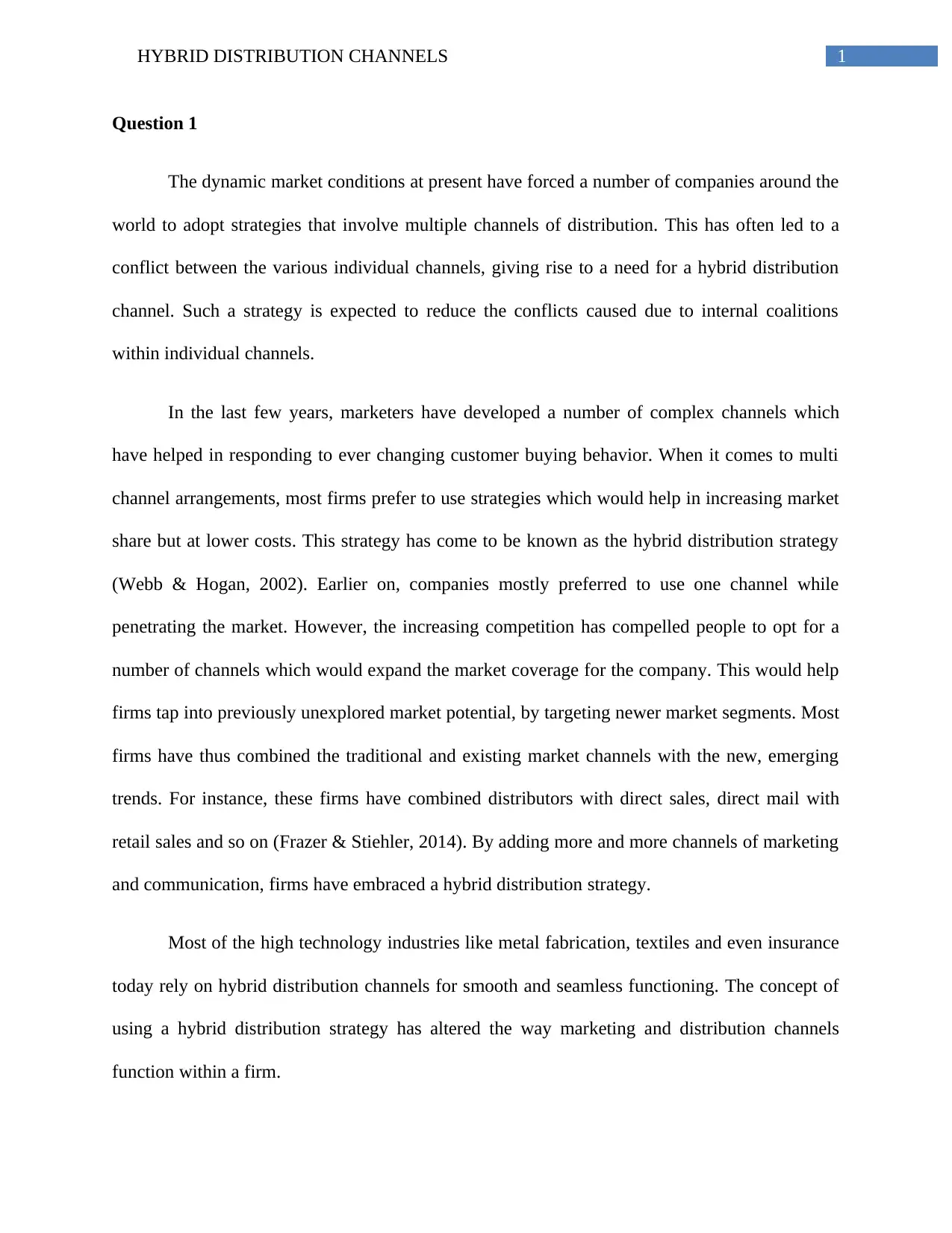
The dynamic market conditions at present have forced a number of companies around the
world to adopt strategies that involve multiple channels of distribution. This has often led to a
conflict between the various individual channels, giving rise to a need for a hybrid distribution
channel. Such a strategy is expected to reduce the conflicts caused due to internal coalitions
within individual channels.
In the last few years, marketers have developed a number of complex channels which
have helped in responding to ever changing customer buying behavior. When it comes to multi
channel arrangements, most firms prefer to use strategies which would help in increasing market
share but at lower costs. This strategy has come to be known as the hybrid distribution strategy
(Webb & Hogan, 2002). Earlier on, companies mostly preferred to use one channel while
penetrating the market. However, the increasing competition has compelled people to opt for a
number of channels which would expand the market coverage for the company. This would help
firms tap into previously unexplored market potential, by targeting newer market segments. Most
firms have thus combined the traditional and existing market channels with the new, emerging
trends. For instance, these firms have combined distributors with direct sales, direct mail with
retail sales and so on (Frazer & Stiehler, 2014). By adding more and more channels of marketing
and communication, firms have embraced a hybrid distribution strategy.
Most of the high technology industries like metal fabrication, textiles and even insurance
today rely on hybrid distribution channels for smooth and seamless functioning. The concept of
using a hybrid distribution strategy has altered the way marketing and distribution channels
function within a firm.
Document Page
2HYBRID DISTRIBUTION CHANNELS
Question 2
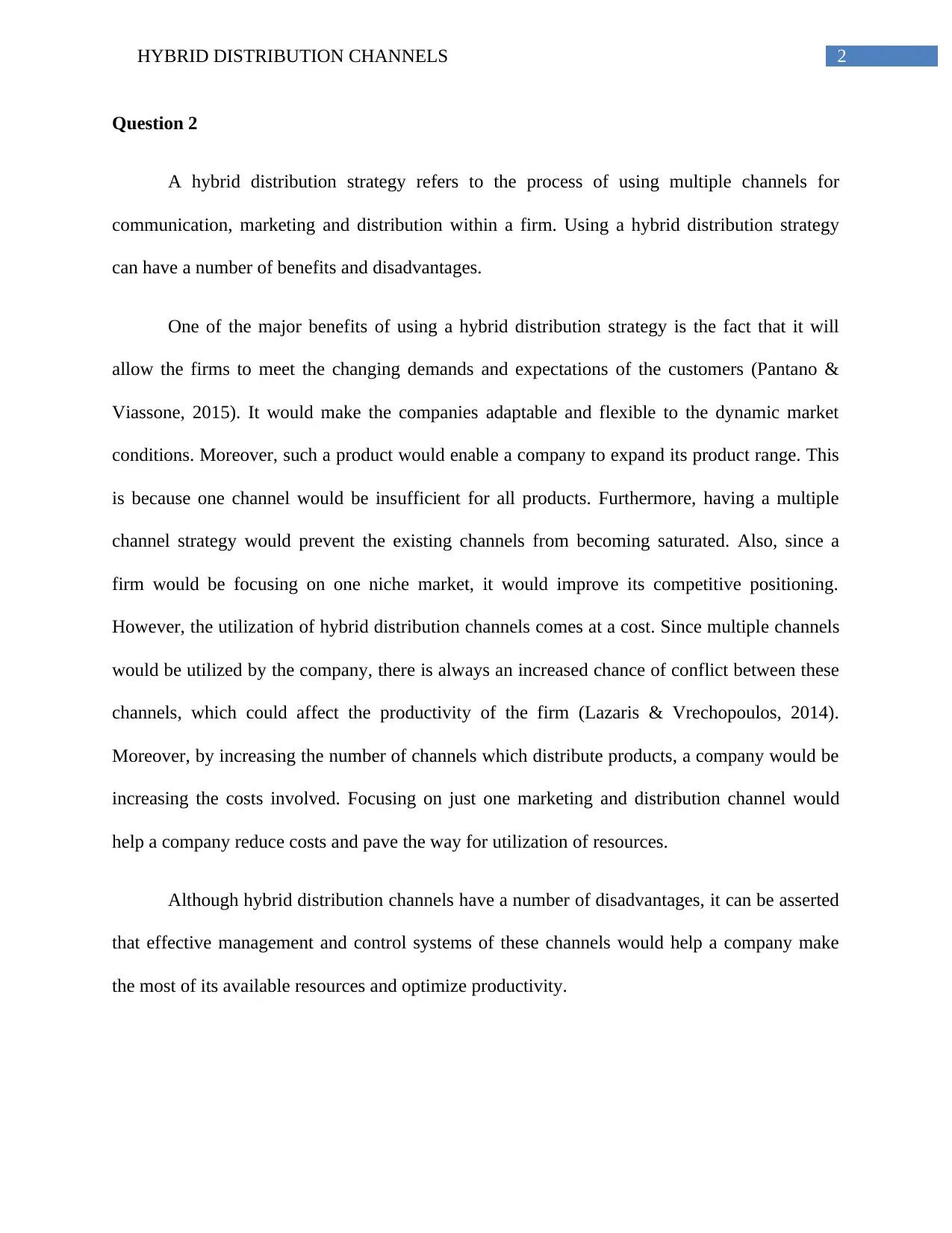
A hybrid distribution strategy refers to the process of using multiple channels for
communication, marketing and distribution within a firm. Using a hybrid distribution strategy
can have a number of benefits and disadvantages.
One of the major benefits of using a hybrid distribution strategy is the fact that it will
allow the firms to meet the changing demands and expectations of the customers (Pantano &
Viassone, 2015). It would make the companies adaptable and flexible to the dynamic market
conditions. Moreover, such a product would enable a company to expand its product range. This
is because one channel would be insufficient for all products. Furthermore, having a multiple
channel strategy would prevent the existing channels from becoming saturated. Also, since a
firm would be focusing on one niche market, it would improve its competitive positioning.
However, the utilization of hybrid distribution channels comes at a cost. Since multiple channels
would be utilized by the company, there is always an increased chance of conflict between these
channels, which could affect the productivity of the firm (Lazaris & Vrechopoulos, 2014).
Moreover, by increasing the number of channels which distribute products, a company would be
increasing the costs involved. Focusing on just one marketing and distribution channel would
help a company reduce costs and pave the way for utilization of resources.
Although hybrid distribution channels have a number of disadvantages, it can be asserted
that effective management and control systems of these channels would help a company make
the most of its available resources and optimize productivity.
Document Page
3HYBRID DISTRIBUTION CHANNELS
References:
Frazer, M., & Stiehler, B. E. (2014, January). Omnichannel retailing: The merging of the online
and off-line environment. In Global Conference on Business & Finance Proceedings,
9(1), p. 655. Institute for Business & Finance Research.
Lazaris, C., & Vrechopoulos, A. (2014, June). From multi-channel to “omnichannel” retailing:
review of the literature and calls for research. In 2nd International Conference on
Contemporary Marketing Issues,(ICCMI) (pp. 18-20).
Pantano, E., & Viassone, M. (2015). Engaging consumers on new integrated multichannel retail
settings: Challenges for retailers. Journal of Retailing and Consumer Services, 25, 106-
114.
Webb, K. L., & Hogan, J. E. (2002). Hybrid channel conflict: causes and effects on channel
performance. Journal of Business & Industrial Marketing, 17(5), 338-356.
chevron_up_icon
1 out of 4
circle_padding
hide_on_mobile
zoom_out_icon
[object Object]