Mechanical Engineering: Hydrogen Combustion Engine Literature Review

Verified

Added on  2021/02/19

|9
|597
|126
Report
AI Summary
This report presents a comprehensive literature review on hydrogen combustion engines, focusing on their performance and the use of alternative fuels. The study explores the advantages of hydrogen, such as high flame propagation rates and reduced emissions, making it a suitable alternative to gasoline. The report includes a comparison of hydrogen's combustion properties with other fuels like methane and gasoline, highlighting its high autoignition temperature and wide flammability range. The methodology section outlines the approach used for the project, and the conclusion summarizes the key findings. The report emphasizes the potential of hydrogen as a stand-alone fuel option in SI engines and discusses the implications of its unique characteristics for engine design and efficiency. The analysis is based on various journal articles and research papers, providing a detailed understanding of the subject.

Document Page
tabler-icon-diamond-filled.svg

Paraphrase This Document

Need a fresh take? Get an instant paraphrase of this document with our AI Paraphraser
Document Page
Document Page
CHAPTER 2: LITERATURE REVIEW AND METHODOLOGY
1.1 Introduction
This chapter provides a discussion of literature sources related to the performance of
internal combustion engines. It will also describe different sources which are used for the review
purpose. Further the chapter will also include the critical discussion of literature sources. The
chapter also consist of project methodology used for accomplishment of the project. The last
section of the chapter will be conclusion. The conclusion provides summary of the key findings
and issues obtained from the discussion and the chapter.
1.2 Literature sources
For completion of this section of the study different journals and articles have been
reviewed. The literature sources are searched from the search engines with specific keywords
such as performance of combustion engine, alternative fuel sources and comparison of hydrogen
based combustion engines. The literature sources which are reviewed in this chapter have
common structure and consist of various segments such as abstract, discussion and results. The
segmented structure of the literature sources has helped to effectively analyse all sources and
their key findings.
1.3 Literature review
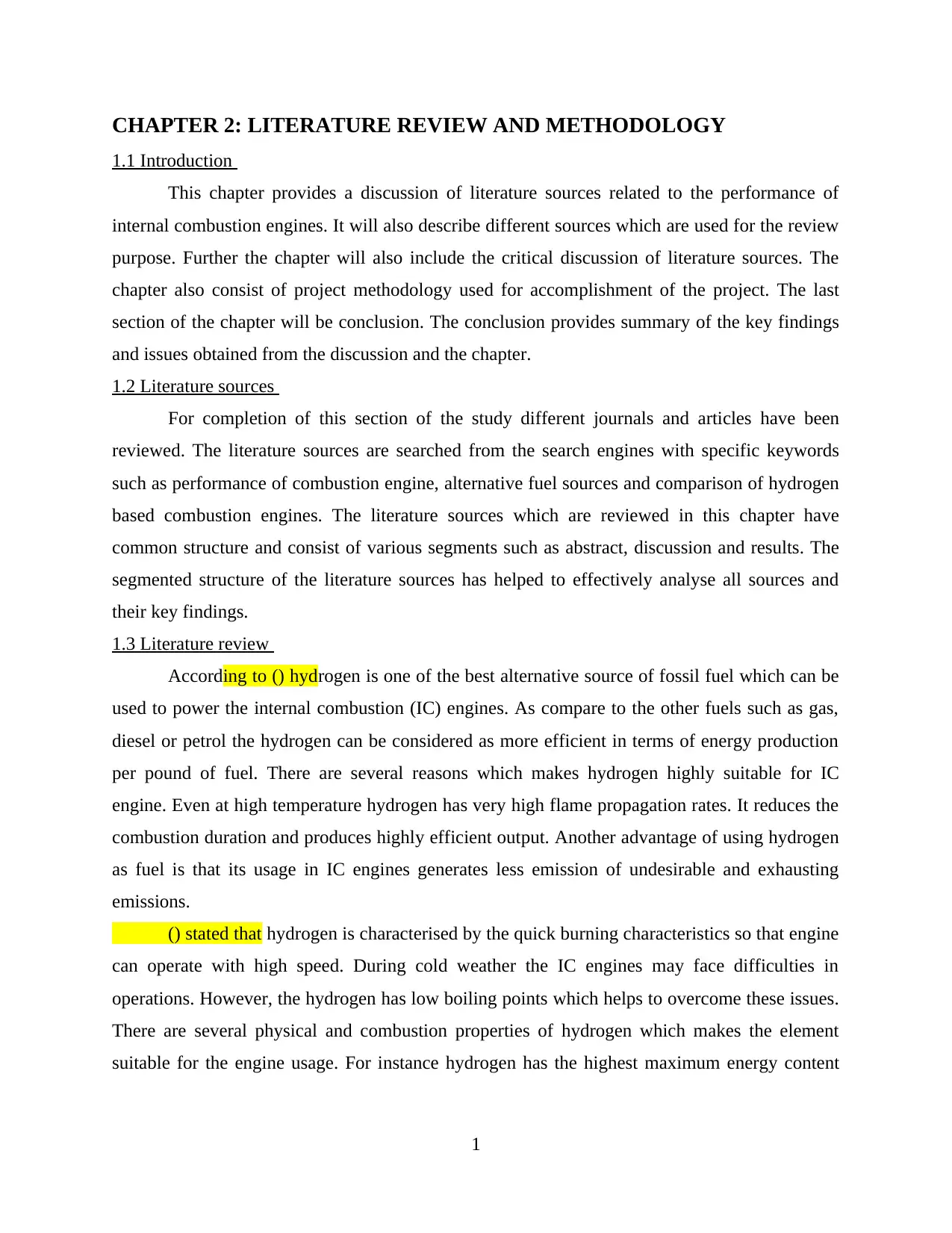
According to () hydrogen is one of the best alternative source of fossil fuel which can be
used to power the internal combustion (IC) engines. As compare to the other fuels such as gas,
diesel or petrol the hydrogen can be considered as more efficient in terms of energy production
per pound of fuel. There are several reasons which makes hydrogen highly suitable for IC
engine. Even at high temperature hydrogen has very high flame propagation rates. It reduces the
combustion duration and produces highly efficient output. Another advantage of using hydrogen
as fuel is that its usage in IC engines generates less emission of undesirable and exhausting
emissions.
() stated that hydrogen is characterised by the quick burning characteristics so that engine
can operate with high speed. During cold weather the IC engines may face difficulties in
operations. However, the hydrogen has low boiling points which helps to overcome these issues.
There are several physical and combustion properties of hydrogen which makes the element
suitable for the engine usage. For instance hydrogen has the highest maximum energy content
1
Document Page
per unit mass and gives three times higher heating value as compare to gasoline which is most
common form of fuel used presently in IC engines.
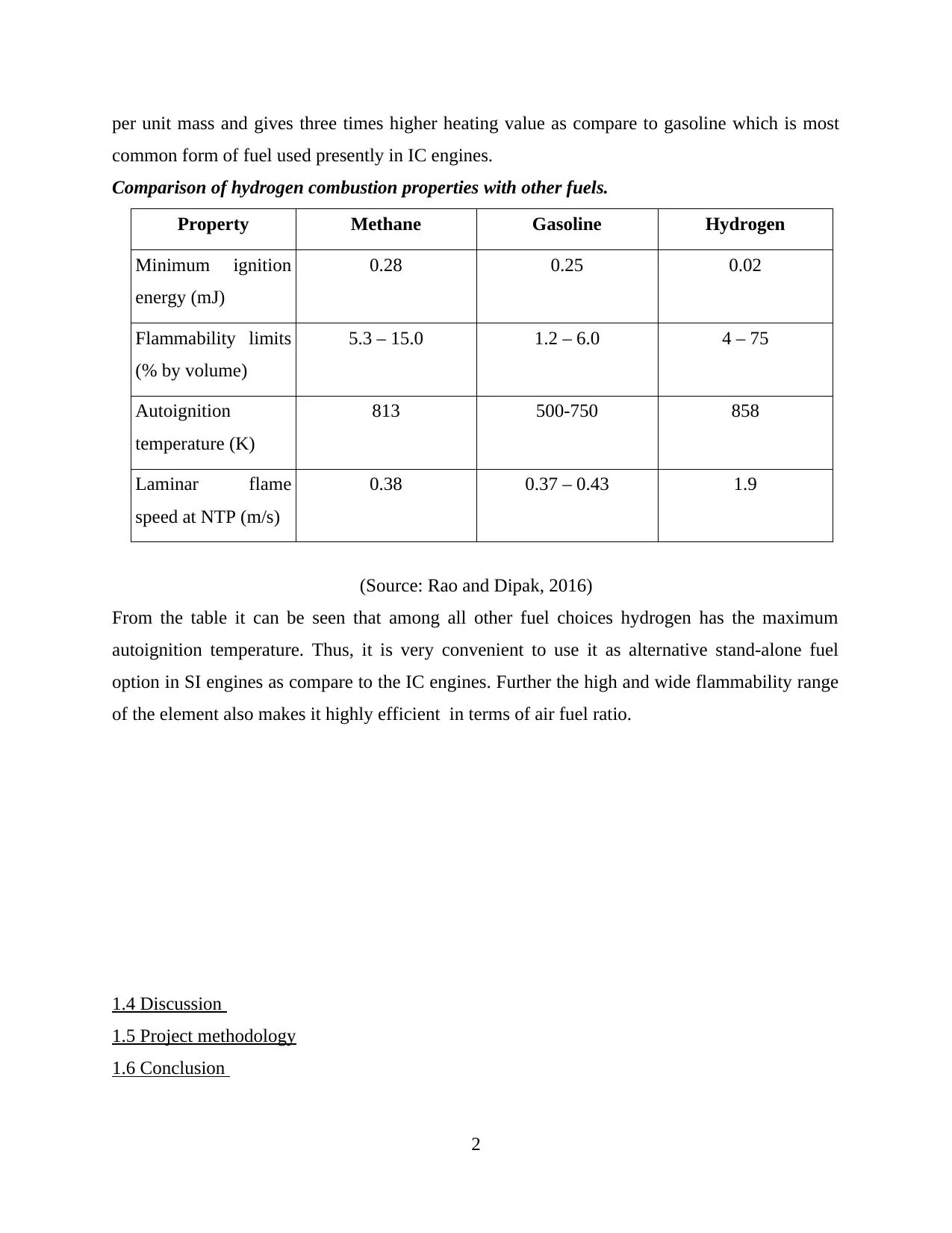
Comparison of hydrogen combustion properties with other fuels.
Property Methane Gasoline Hydrogen
Minimum ignition
energy (mJ)
0.28 0.25 0.02
Flammability limits
(% by volume)
5.3 – 15.0 1.2 – 6.0 4 – 75
Autoignition
temperature (K)
813 500-750 858
Laminar flame
speed at NTP (m/s)
0.38 0.37 – 0.43 1.9
(Source: Rao and Dipak, 2016)
From the table it can be seen that among all other fuel choices hydrogen has the maximum
autoignition temperature. Thus, it is very convenient to use it as alternative stand-alone fuel
option in SI engines as compare to the IC engines. Further the high and wide flammability range
of the element also makes it highly efficient in terms of air fuel ratio.
1.4 Discussion
1.5 Project methodology
1.6 Conclusion
2
tabler-icon-diamond-filled.svg

Paraphrase This Document

Need a fresh take? Get an instant paraphrase of this document with our AI Paraphraser
Document Page
3
Document Page
4
Document Page
5
tabler-icon-diamond-filled.svg

Paraphrase This Document

Need a fresh take? Get an instant paraphrase of this document with our AI Paraphraser
Document Page
6
Document Page
7
chevron_up_icon
1 out of 9
circle_padding
hide_on_mobile
zoom_out_icon
[object Object]