Analysis of a Public Health Policy: Hygiene and Sanitation Report
VerifiedAdded on 2023/01/16
|11
|3712
|98
Report
AI Summary
This report examines a public health policy centered on hygiene and sanitation. It begins with an introduction highlighting the significance of sanitation and hygiene for health, development, and survival, and describes the challenges many countries face in providing appropriate sanitation to their populations. The report then outlines the specific hygiene and sanitation policy, emphasizing its role in addressing issues like the spread of infection and communicable diseases. It discusses the importance of the policy in preventing diseases such as HIV, respiratory infections, and cholera. The report also explores the implementation of the policy, including measures to ensure food safety, access to safe drinking water, and waste management. It addresses critical health issues related to poor sanitation and hygiene, such as diarrhea, arsenicosis, cholera, fluorosis, and HIV/AIDS, emphasizing the economic and social benefits of improved sanitation. The report concludes by stressing the importance of the policy in protecting health, extending life spans, and providing economic benefits, highlighting the role of education and awareness in promoting healthy hygiene practices and safe water supply.

Public Health Policy and Society
1
1

Paraphrase This Document
Need a fresh take? Get an instant paraphrase of this document with our AI Paraphraser
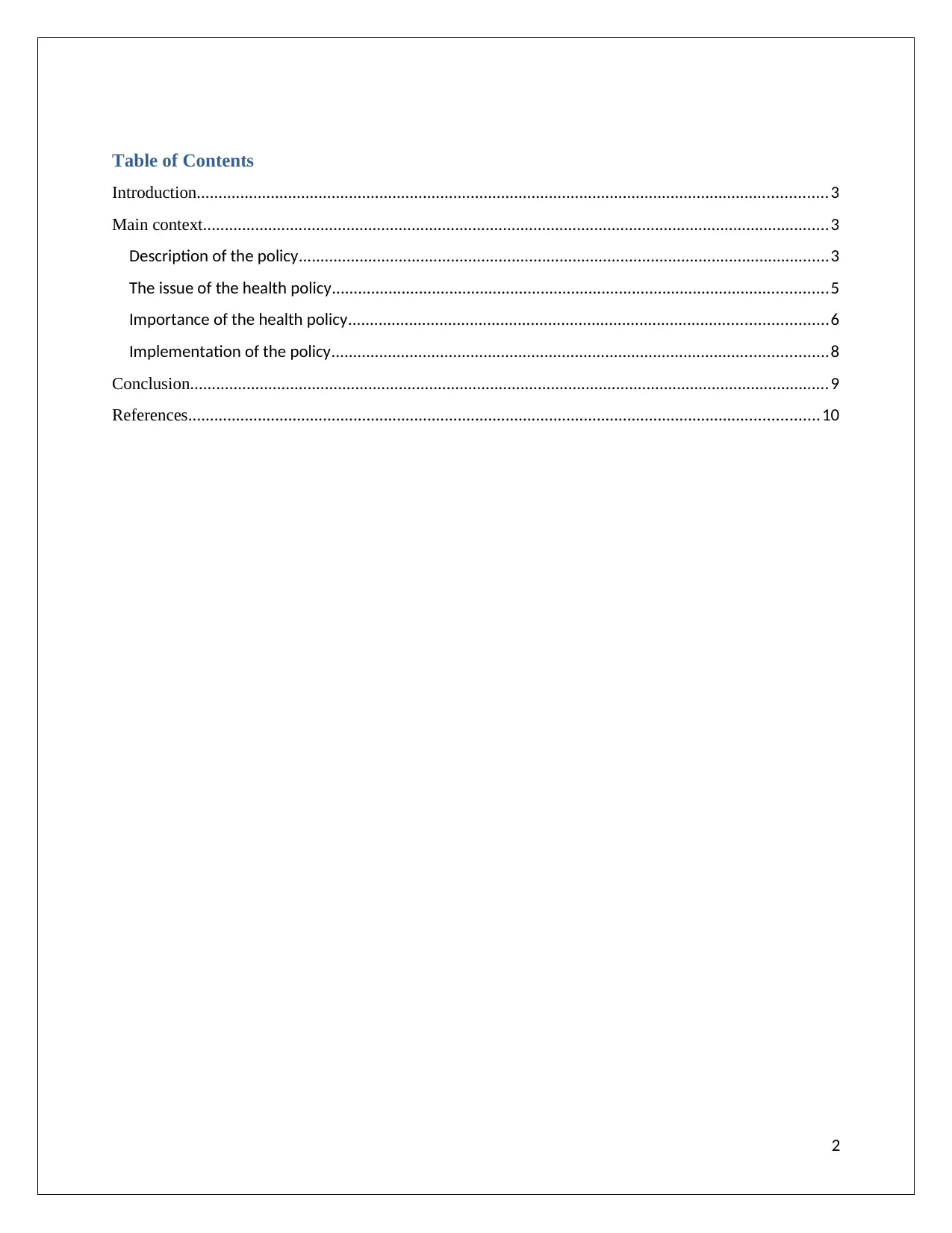
Table of Contents
Introduction.................................................................................................................................................3
Main context................................................................................................................................................3
Description of the policy..........................................................................................................................3
The issue of the health policy..................................................................................................................5
Importance of the health policy..............................................................................................................6
Implementation of the policy..................................................................................................................8
Conclusion...................................................................................................................................................9
References.................................................................................................................................................10
2
Introduction.................................................................................................................................................3
Main context................................................................................................................................................3
Description of the policy..........................................................................................................................3
The issue of the health policy..................................................................................................................5
Importance of the health policy..............................................................................................................6
Implementation of the policy..................................................................................................................8
Conclusion...................................................................................................................................................9
References.................................................................................................................................................10
2
Introduction
Sanitation and hygiene are considered to very critical for health, development, and survival. It
has been found that most of the countries are facing challenges in providing appropriate
sanitation to their entire population. The risk of hygiene, sanitation, and water-related diseases
has been increased in many countries. According to a survey almost 2.4 billion people
throughout the world are struggling in having basic sanitation which is almost 32% of the entire
population of the world. Basic sanitation can be described as getting access to enabling the safe
disposal of human waste (Adams, 2009). Also, hygienic conditions need to be maintained by
following services like a collection of garbage, management of industrial or hazardous waste and
disposal of wastewater and treatment. Sanitation is considered to be the effective tools and
actions that help in keeping the environment healthy. There are few things that can be included
in it like, toilets or latrines management tools for managing waste, preparation of food, washing
stations, effective draining, and another mechanism. Hygiene is about setting a personal practice
that helps in contributing good health and that includes cutting nails/hairs and bathing and
washing hands. The single most important activity is hand-washing and that can help in
preventing disease. The different terms of sanitation and hygiene can be different things to
different people. Usually, sanitation refers to the management of human excreta, while the term
hygiene refers to the measures/behaviours, including but beyond the management faeces. It is
being used for breaching the chain of contamination transmission in the community and home. It
is thinking of most of the people that hygiene means hand washing, that is correct but it is not
limited to hand washing only. Hygiene and sanitation are related and both effective tools and
effective behaviours need to be taught to people for protecting their health (Angelakis, 2014).
Main context
Description of the policy
The health policy which is going to be implemented is hygiene and sanitation policy. The policy
will help to address issues such as spread of infection and communicable disease
(Beyene&Hailu, 2013). There are some important points on which the policy is being developed
are tidiness, cleanliness, a factor of hygiene, proper disposal of human urine and faeces and some
other. Hygiene and sanitation policy is considered to be very important for the society and at the
3
Sanitation and hygiene are considered to very critical for health, development, and survival. It
has been found that most of the countries are facing challenges in providing appropriate
sanitation to their entire population. The risk of hygiene, sanitation, and water-related diseases
has been increased in many countries. According to a survey almost 2.4 billion people
throughout the world are struggling in having basic sanitation which is almost 32% of the entire
population of the world. Basic sanitation can be described as getting access to enabling the safe
disposal of human waste (Adams, 2009). Also, hygienic conditions need to be maintained by
following services like a collection of garbage, management of industrial or hazardous waste and
disposal of wastewater and treatment. Sanitation is considered to be the effective tools and
actions that help in keeping the environment healthy. There are few things that can be included
in it like, toilets or latrines management tools for managing waste, preparation of food, washing
stations, effective draining, and another mechanism. Hygiene is about setting a personal practice
that helps in contributing good health and that includes cutting nails/hairs and bathing and
washing hands. The single most important activity is hand-washing and that can help in
preventing disease. The different terms of sanitation and hygiene can be different things to
different people. Usually, sanitation refers to the management of human excreta, while the term
hygiene refers to the measures/behaviours, including but beyond the management faeces. It is
being used for breaching the chain of contamination transmission in the community and home. It
is thinking of most of the people that hygiene means hand washing, that is correct but it is not
limited to hand washing only. Hygiene and sanitation are related and both effective tools and
effective behaviours need to be taught to people for protecting their health (Angelakis, 2014).
Main context
Description of the policy
The health policy which is going to be implemented is hygiene and sanitation policy. The policy
will help to address issues such as spread of infection and communicable disease
(Beyene&Hailu, 2013). There are some important points on which the policy is being developed
are tidiness, cleanliness, a factor of hygiene, proper disposal of human urine and faeces and some
other. Hygiene and sanitation policy is considered to be very important for the society and at the
3
⊘ This is a preview!⊘
Do you want full access?
Subscribe today to unlock all pages.

Trusted by 1+ million students worldwide
same time, it is also useful for all people in general as it provides them with the accurate
approach for fighting with such disease like HIV, respiratory infection, cholera, and others. The
primary base is being provided by the hygiene and sanitation policy for general people to fight
with a different type of spreadable disease and also helps in preventing the spread of
communicable diseases (Macdonald, 2005). The policy will help in recognizing the hygiene and
health behavior and practice can also be started with individuals. Implementation of Sanitation
and hygiene policy will ensure food safety, hygiene, use of safe drinking water, improved
housing, and waste management. It can also help in encouraging communities to take
accountability for improving the sanitary condition of their instant environment. All individual
must be able to live with dignity within an environment of sanitary and hygiene as a basic human
right. Sanitation and hygiene policy ensure that all communities and households understand their
health and human environment (Biswal, 2015).
This policy also adopts practices and attitudes that sustain and creates such an environment.
Everyone is aware that it is a need for an improved environment of hygiene and sanitation to the
society but the available recourses are limited. Sanitation and hygiene policy also focus on
mobilizing all available resources -individual and community, private and public -searching
healthy environment for all. It is important to provide a sanitary and hygiene environment to all
individuals that contain the quality of life with dignity (Boylan, 2008). The purpose of Sanitation
and hygiene policy is to create an environment in which all individuals will be motivated for
improving environmental sanitation and hygienic behaviours. It has been found that most of the
people visit hospitals because of preventable diseases. Most of these illnesses are related to
sanitation and hygiene. This policy not only helps in improving health but also generates
considerable socio-economic benefit in regards to a better living environment and also focus on
the dignity of citizens, mainly children, and woman. The policy can help in making households
aware with their informed choices about sanitation technology as there is a requirement of a
provision for healthier information about alternative technology and corresponding management
requirements of them and costs. Sanitation and hygiene policy focus on protecting human health
by providing health environment so that the transmission of diseases can be stopped. Sanitation
has become a key for environment protection. The purpose of the policy is to make people aware
of the risk associated with sanitation and hygiene. The policy also focuses on providing
4
approach for fighting with such disease like HIV, respiratory infection, cholera, and others. The
primary base is being provided by the hygiene and sanitation policy for general people to fight
with a different type of spreadable disease and also helps in preventing the spread of
communicable diseases (Macdonald, 2005). The policy will help in recognizing the hygiene and
health behavior and practice can also be started with individuals. Implementation of Sanitation
and hygiene policy will ensure food safety, hygiene, use of safe drinking water, improved
housing, and waste management. It can also help in encouraging communities to take
accountability for improving the sanitary condition of their instant environment. All individual
must be able to live with dignity within an environment of sanitary and hygiene as a basic human
right. Sanitation and hygiene policy ensure that all communities and households understand their
health and human environment (Biswal, 2015).
This policy also adopts practices and attitudes that sustain and creates such an environment.
Everyone is aware that it is a need for an improved environment of hygiene and sanitation to the
society but the available recourses are limited. Sanitation and hygiene policy also focus on
mobilizing all available resources -individual and community, private and public -searching
healthy environment for all. It is important to provide a sanitary and hygiene environment to all
individuals that contain the quality of life with dignity (Boylan, 2008). The purpose of Sanitation
and hygiene policy is to create an environment in which all individuals will be motivated for
improving environmental sanitation and hygienic behaviours. It has been found that most of the
people visit hospitals because of preventable diseases. Most of these illnesses are related to
sanitation and hygiene. This policy not only helps in improving health but also generates
considerable socio-economic benefit in regards to a better living environment and also focus on
the dignity of citizens, mainly children, and woman. The policy can help in making households
aware with their informed choices about sanitation technology as there is a requirement of a
provision for healthier information about alternative technology and corresponding management
requirements of them and costs. Sanitation and hygiene policy focus on protecting human health
by providing health environment so that the transmission of diseases can be stopped. Sanitation
has become a key for environment protection. The purpose of the policy is to make people aware
of the risk associated with sanitation and hygiene. The policy also focuses on providing
4
Paraphrase This Document
Need a fresh take? Get an instant paraphrase of this document with our AI Paraphraser
information regarding the process that helps in preventing communicable disease (Coussens,
2009).
The issue of the health policy
There are multiple health issues that have been addressed by Sanitation and hygiene policy.
Access to poor drinking water and poor hygiene practice can lead to disability or ill health. Most
of the urban dwellers have accessed pipe drinking water which can be considered as improved
drinking water. Though the quality of the water remains poor and most of the urban which have
been living in developing countries are still getting affected at one time or another by illness
associated with insufficient access of the safe drinking water and improved sanitation (Cumming
&Cairncross, 2016). According to a survey, more than 500000 people die every year because of
diarrhoea, dysentery, polio, typhoid and cholera and all of these diseases are associated with
contaminated drinking water. Even the cost associated with waterborne diseases like malaria and
warm infection is more than one-third of the income of poor households. It is considered being
the most important public health issue that is directly associated with water sanitation. There is a
simple way to minimize the risk of diarrhoea and that is washing hands soap and water. The
other way is providing facilities of sanitation, it is considered to be a key for preventing
waterborne diseases (Hansen &Møller, 2009). The cause of diarrhoea is a variety of micro-
organism including bacteria, viruses, and protozoans. It may lead a person to lose both
electrolytes and water that can take to dehydration and in rare cases, to death. Children can easily
get affected by diarrhoea and around 90% of death cases are of children. Arsenicosis is the
second health issue that is addressed in the Sanitation and hygiene policy. Low concentration of
arsenic in drinking water for a long time can cause skin keratosis that can lead to skin cancer,
cancer in lungs, kidney, and bladder.
Arsenic poisoning putting millions of people in danger as they depend on water supplies that are
polluted with arsenic and there is no safe water alternative available to them. Most of them are
unaware of the issue. Cholera disease is also one of those health issues that have been addressed
under the Sanitation and hygiene policy. It is considered to be an infectious disease that causes
severe watery diarrhoea and can take to dehydration and in some cases to death if untreated. The
cause of cholera is contaminated food and water with bacteria known as Vibrio cholera
5
2009).
The issue of the health policy
There are multiple health issues that have been addressed by Sanitation and hygiene policy.
Access to poor drinking water and poor hygiene practice can lead to disability or ill health. Most
of the urban dwellers have accessed pipe drinking water which can be considered as improved
drinking water. Though the quality of the water remains poor and most of the urban which have
been living in developing countries are still getting affected at one time or another by illness
associated with insufficient access of the safe drinking water and improved sanitation (Cumming
&Cairncross, 2016). According to a survey, more than 500000 people die every year because of
diarrhoea, dysentery, polio, typhoid and cholera and all of these diseases are associated with
contaminated drinking water. Even the cost associated with waterborne diseases like malaria and
warm infection is more than one-third of the income of poor households. It is considered being
the most important public health issue that is directly associated with water sanitation. There is a
simple way to minimize the risk of diarrhoea and that is washing hands soap and water. The
other way is providing facilities of sanitation, it is considered to be a key for preventing
waterborne diseases (Hansen &Møller, 2009). The cause of diarrhoea is a variety of micro-
organism including bacteria, viruses, and protozoans. It may lead a person to lose both
electrolytes and water that can take to dehydration and in rare cases, to death. Children can easily
get affected by diarrhoea and around 90% of death cases are of children. Arsenicosis is the
second health issue that is addressed in the Sanitation and hygiene policy. Low concentration of
arsenic in drinking water for a long time can cause skin keratosis that can lead to skin cancer,
cancer in lungs, kidney, and bladder.
Arsenic poisoning putting millions of people in danger as they depend on water supplies that are
polluted with arsenic and there is no safe water alternative available to them. Most of them are
unaware of the issue. Cholera disease is also one of those health issues that have been addressed
under the Sanitation and hygiene policy. It is considered to be an infectious disease that causes
severe watery diarrhoea and can take to dehydration and in some cases to death if untreated. The
cause of cholera is contaminated food and water with bacteria known as Vibrio cholera
5
(Hubbard, Lockhart, Gelting& Bertrand, 2013). It can be prevented through the access of
sanitation, safe drinking water, and good hygiene behaviour. Fluorosis generally caused by high
level of fluoride in the local water supply. Fluoride generally occurred in the groundwater.
People with fluorosis face unusual high resistance of dental cavities. Fluoride can help in
preventing the cavities but for that, it needs to be into public water supplies at a defined level.
Fluorosis considered being a serious bone disease that causes because of the high concentration
of fluoride going on naturally in groundwater. HIV/AIDS is one of the most important issues of
sanitation and hygiene policy (Koutroulis, 2009). The opportunistic infection of HIV/AIDS can
be prevented with the hygienic environment, adequate sanitation, and clean water. It can also
increase the quality of life of people who are living with this disease. People with AIDS are more
likely to be affected with water-related diseases than other healthy individuals and these diseases
make them sicker than other people who have a healthy immune system.
Importance of the health policy
Sanitation protects health, extends life span and provides economic benefits. Sanitation is an
important aspect of community well-being. The health policy is employed as a way to treat
human excreta to protect human health and the environment. Improved access to sanitation is
when human excreta can be separated from human contact in a hygienic way. Sanitation is
important to reduce human exposure to pathogens. The infected individuals excrete pathogens
and if the excreta not properly treated then will pose a threat to human health. The pathogens
may also enter the human body when pathogen contaminated food and water is consumed
(Lankester, 2013). The drinking water should be free from any faecal contamination. Sanitation
system prevents the transmission of disease by providing a clean environment. Sanitation can
reduce diarrhoea which is a major cause of malnutrition in children. Diseases like , , , , and are
easily transmitted in communities that have low sanitation. Water is considered to be the basic
necessity and significant resource to sustain life. The decrease in the quality of water can lead to
an increase in health risk as well as the ecosystem. Hygiene, clean drinking water and sanitation
play a significant role in maintaining health.
The health policy will provide significant information and create awareness among people about
the importance of sanitation and hygiene. Contaminated water can cause several water-borne
6
sanitation, safe drinking water, and good hygiene behaviour. Fluorosis generally caused by high
level of fluoride in the local water supply. Fluoride generally occurred in the groundwater.
People with fluorosis face unusual high resistance of dental cavities. Fluoride can help in
preventing the cavities but for that, it needs to be into public water supplies at a defined level.
Fluorosis considered being a serious bone disease that causes because of the high concentration
of fluoride going on naturally in groundwater. HIV/AIDS is one of the most important issues of
sanitation and hygiene policy (Koutroulis, 2009). The opportunistic infection of HIV/AIDS can
be prevented with the hygienic environment, adequate sanitation, and clean water. It can also
increase the quality of life of people who are living with this disease. People with AIDS are more
likely to be affected with water-related diseases than other healthy individuals and these diseases
make them sicker than other people who have a healthy immune system.
Importance of the health policy
Sanitation protects health, extends life span and provides economic benefits. Sanitation is an
important aspect of community well-being. The health policy is employed as a way to treat
human excreta to protect human health and the environment. Improved access to sanitation is
when human excreta can be separated from human contact in a hygienic way. Sanitation is
important to reduce human exposure to pathogens. The infected individuals excrete pathogens
and if the excreta not properly treated then will pose a threat to human health. The pathogens
may also enter the human body when pathogen contaminated food and water is consumed
(Lankester, 2013). The drinking water should be free from any faecal contamination. Sanitation
system prevents the transmission of disease by providing a clean environment. Sanitation can
reduce diarrhoea which is a major cause of malnutrition in children. Diseases like , , , , and are
easily transmitted in communities that have low sanitation. Water is considered to be the basic
necessity and significant resource to sustain life. The decrease in the quality of water can lead to
an increase in health risk as well as the ecosystem. Hygiene, clean drinking water and sanitation
play a significant role in maintaining health.
The health policy will provide significant information and create awareness among people about
the importance of sanitation and hygiene. Contaminated water can cause several water-borne
6
⊘ This is a preview!⊘
Do you want full access?
Subscribe today to unlock all pages.
Trusted by 1+ million students worldwide
infections such as diarrhoea and increases the spread of mosquitos’ epidemics. Access to good
sanitation and safe drinking water is crucial for the family well being. Thus, it results in
controlling diseases and boosting child health. It is being seen that a healthy child has better
retaining and learning the ability. Girls face many problems for inappropriate sanitation
measures and they avoid to go to schools. Sanitation contributes to the economic and social
development of the community (Macdonald, 2010). However, good sanitation and clean drinking
water cannot prevent infections if good hygiene is not being practised. It is being found that an
increase in the population imposes a major impact on the capacity to provide effective sanitation
measures and clean drinking water. Hand washing with hand wash or soap can decrease in the
change of occurring diarrhoea as it is the second leading cause of death amongst children below
five years old. Appropriate hand washing practices can also decrease the chance of occurring
other diseases such as scabies, trachoma, pneumonia, eye and skin infections. The health policy
will help to address major concerns that are considered to be very much important for the welfare
of society.
More than one billion people lack access to quality water and more than three billion do not get
adequate sanitation facilities. The health policy would focus on promoting healthy hygiene
practices and safe water supply. Access to sanitation and safe water is considered to be the
human right. The enhancement of knowledge and awareness among people can assist to deal
with the issue. The government of the countries will also focus on improving sanitation for the
people of the community (Lloyd, 2010). The health policy will play a significant role in
addressing the issue of sanitation and water coverage. The policy would recognize the
significance of regular exchange information between water supply and sanitation sector in order
to ensure appropriate development of the society. There should be no discrimination in providing
facilities to people within the community.
The policy will ensure that the members of the community are participating in the programs in
order to understand the issue and current situation. Hygiene promotion can be done by
maintaining a relationship with the people. The policy would clearly show the risk factors and
how they can be overcome. It would be encouraged to establish access to sanitation and safe
water within society. The human resources such as volunteers, delegates and staffs should be
employed in the area of sanitation and water. The immediate response would be made to
7
sanitation and safe drinking water is crucial for the family well being. Thus, it results in
controlling diseases and boosting child health. It is being seen that a healthy child has better
retaining and learning the ability. Girls face many problems for inappropriate sanitation
measures and they avoid to go to schools. Sanitation contributes to the economic and social
development of the community (Macdonald, 2010). However, good sanitation and clean drinking
water cannot prevent infections if good hygiene is not being practised. It is being found that an
increase in the population imposes a major impact on the capacity to provide effective sanitation
measures and clean drinking water. Hand washing with hand wash or soap can decrease in the
change of occurring diarrhoea as it is the second leading cause of death amongst children below
five years old. Appropriate hand washing practices can also decrease the chance of occurring
other diseases such as scabies, trachoma, pneumonia, eye and skin infections. The health policy
will help to address major concerns that are considered to be very much important for the welfare
of society.
More than one billion people lack access to quality water and more than three billion do not get
adequate sanitation facilities. The health policy would focus on promoting healthy hygiene
practices and safe water supply. Access to sanitation and safe water is considered to be the
human right. The enhancement of knowledge and awareness among people can assist to deal
with the issue. The government of the countries will also focus on improving sanitation for the
people of the community (Lloyd, 2010). The health policy will play a significant role in
addressing the issue of sanitation and water coverage. The policy would recognize the
significance of regular exchange information between water supply and sanitation sector in order
to ensure appropriate development of the society. There should be no discrimination in providing
facilities to people within the community.
The policy will ensure that the members of the community are participating in the programs in
order to understand the issue and current situation. Hygiene promotion can be done by
maintaining a relationship with the people. The policy would clearly show the risk factors and
how they can be overcome. It would be encouraged to establish access to sanitation and safe
water within society. The human resources such as volunteers, delegates and staffs should be
employed in the area of sanitation and water. The immediate response would be made to
7
Paraphrase This Document
Need a fresh take? Get an instant paraphrase of this document with our AI Paraphraser
disasters and emergencies which need sanitation and water interventions (Sim& McKee, 2011).
The implementation of sanitation and water operations aims to integrate all the related sectors
such as food security, health programmes, AIDS/HIV, disaster preparedness and organizational
development. Sustainable access to sanitation and water and consistent and correct practice of
hygiene behaviours are significant whether in school, public, healthcare settings or household.
The policy will address the human right to access to adequate safe water supply and sanitation
for all the people within the community. The policy will also coordinate organizations,
government and international organizations in order to ensure appropriate implementation of
strategies. The policy would provide maximum benefit to the people by ensuring hygiene and
decreasing diseases.
Implementation of the policy
The health policy can be implemented by the efforts of the people and carrying out the works
within a specific framework. The policy will ensure that families would get access to basic
sanitation, safe drinking water, information on hand washing and awareness about the significant
concepts and topics. The learning environments and healthcare facilities should also ensure that
they have adequate sanitation and drinking water facilities. The cross-cutting and operational
programming capacities would be carried out for ensuring quality hand wash among children at
the regional and national level. The policy will be carried out with the right people who will be
employed at the right time and right place (Mehta & Mehta, 2013). The management team will
be responsible for the accountability of the work processes. The staffs will be equipped with
different skills and knowledge enabling them to achieve the objectives.
The services of outside companies, consultants and agencies will also support the processes. The
main areas which would be focused on are wash programming, climate change resilience, result
based management risk-informed planning, working with private sectors and public financing.
Apart from this, the collaboration initiative will be carried out in different fields such as
education areas, technical areas, nutrition and health and non-government organizations.
Training will be provided to the staffs in order to enhance their knowledge and skills
(Munamati, Nhapi&Misi, 2015). Partnering effectively with other organizations will assist to
expand the network as per the needs of the people. The focus would be on leveraging resources,
8
The implementation of sanitation and water operations aims to integrate all the related sectors
such as food security, health programmes, AIDS/HIV, disaster preparedness and organizational
development. Sustainable access to sanitation and water and consistent and correct practice of
hygiene behaviours are significant whether in school, public, healthcare settings or household.
The policy will address the human right to access to adequate safe water supply and sanitation
for all the people within the community. The policy will also coordinate organizations,
government and international organizations in order to ensure appropriate implementation of
strategies. The policy would provide maximum benefit to the people by ensuring hygiene and
decreasing diseases.
Implementation of the policy
The health policy can be implemented by the efforts of the people and carrying out the works
within a specific framework. The policy will ensure that families would get access to basic
sanitation, safe drinking water, information on hand washing and awareness about the significant
concepts and topics. The learning environments and healthcare facilities should also ensure that
they have adequate sanitation and drinking water facilities. The cross-cutting and operational
programming capacities would be carried out for ensuring quality hand wash among children at
the regional and national level. The policy will be carried out with the right people who will be
employed at the right time and right place (Mehta & Mehta, 2013). The management team will
be responsible for the accountability of the work processes. The staffs will be equipped with
different skills and knowledge enabling them to achieve the objectives.
The services of outside companies, consultants and agencies will also support the processes. The
main areas which would be focused on are wash programming, climate change resilience, result
based management risk-informed planning, working with private sectors and public financing.
Apart from this, the collaboration initiative will be carried out in different fields such as
education areas, technical areas, nutrition and health and non-government organizations.
Training will be provided to the staffs in order to enhance their knowledge and skills
(Munamati, Nhapi&Misi, 2015). Partnering effectively with other organizations will assist to
expand the network as per the needs of the people. The focus would be on leveraging resources,
8
networks, social movements and capacities. Apart from this, a strong relationship will also be
made with state and national government in order to ensure that all people should get access to
sanitation and fresh water.
The policy would focus on significant strategies that are considered to be important for the
development of society. New technologies, business models and approached need to be
developed for ensuring sustainable wash. The financial resources can be leveraged by brokering
and encouraging innovative financing models. The capacities of both national and local business
will be developed for providing adequate products and services. Awareness should be created
among people about how they should drink safe water and sanitation (Wilkinson & Marmot,
2003). Funds will be collected from donations and government in order to run the policy. The
knowledge management system can be developed for sharing best practices and innovations
from the experience in nations all around the world. A framework would be created within which
the work will be carried out. The needs of the people will be determined on the basis of which
the services would be provided in an effective manner.
Conclusion
The sanitation and hygiene policy will be implemented for ensuring adequate sanitation and
hygiene. It is very much important that each and every individual should get access to safe water
and sanitation facilities. It is considered to be a major concern because many people suffer from
diseases because of inadequate sanitation and hygiene. The main implementation of the policy is
to address the following issue by improving the quality of life. The management team will be
responsible to carry out the operations in an effective manner. Lack of adequate facilities,
education and awareness are the major reasons which create problems for the people within the
community. Government and other organizations will also support the implementation process of
the policy.
9
made with state and national government in order to ensure that all people should get access to
sanitation and fresh water.
The policy would focus on significant strategies that are considered to be important for the
development of society. New technologies, business models and approached need to be
developed for ensuring sustainable wash. The financial resources can be leveraged by brokering
and encouraging innovative financing models. The capacities of both national and local business
will be developed for providing adequate products and services. Awareness should be created
among people about how they should drink safe water and sanitation (Wilkinson & Marmot,
2003). Funds will be collected from donations and government in order to run the policy. The
knowledge management system can be developed for sharing best practices and innovations
from the experience in nations all around the world. A framework would be created within which
the work will be carried out. The needs of the people will be determined on the basis of which
the services would be provided in an effective manner.
Conclusion
The sanitation and hygiene policy will be implemented for ensuring adequate sanitation and
hygiene. It is very much important that each and every individual should get access to safe water
and sanitation facilities. It is considered to be a major concern because many people suffer from
diseases because of inadequate sanitation and hygiene. The main implementation of the policy is
to address the following issue by improving the quality of life. The management team will be
responsible to carry out the operations in an effective manner. Lack of adequate facilities,
education and awareness are the major reasons which create problems for the people within the
community. Government and other organizations will also support the implementation process of
the policy.
9
⊘ This is a preview!⊘
Do you want full access?
Subscribe today to unlock all pages.
Trusted by 1+ million students worldwide
References
Adams, J. (2009). Water, sanitation and hygiene standards for schools in low-cost settings (3rd
ed.). Geneva, Switzerland: World Health Organization.
Angelakis, A. (2014). Evolution of Water Supply Through the Millennia (5th ed.). United States:
IWA Publishing.
Beyene, H., &Hailu, D. (2013).Assessment of knowledge, attitude and practice regarding water,
sanitation and hygiene for people living with HIV/AIDS. Journal Of Water, Sanitation And
Hygiene For Development, 3(1), 81-85. doi: 10.2166/washdev.2013.022
Biswal, S. (2015).Crofelemer: In HIV Associated Diarrhea and Secretory Diarrhea - A Patent
Perspective. Recent Patents On Anti-Infective Drug Discovery, 9(2), 136-143. doi:
10.2174/1574891x10666150408153356
Boylan, M. (2008). International Public Health Policy and Ethics (3rd ed.). Dordrecht: Springer
Netherlands.
Coussens, C. (2009). Global environmental health (5th ed.). Washington, D.C.: National
Academies Press.
Cumming, O., &Cairncross, S. (2016). Can water, sanitation and hygiene help eliminate
stunting? Current evidence and policy implications. Maternal & Child Nutrition, 12(7), 91-
105. doi: 10.1111/mcn.12258
Hansen, F., &Møller, K. (2009). Arsenic Contents of Human Organs after Fatal Poisoning with
Arsenic Trioxide and other Arsenical Compounds, with some Remarks on the
Manifestations of Arsenic Poisoning. ActaPharmacologicaEtToxicologica, 5(2), 135-152.
doi: 10.1111/j.1600-0773.1949.tb03380.x
Hubbard, B., Lockhart, G., Gelting, R., & Bertrand, F. (2013).Development of Haiti's rural
water, sanitation and hygiene workforce. Journal Of Water, Sanitation And Hygiene For
Development, 4(1), 159-163. doi: 10.2166/washdev.2013.089
10
Adams, J. (2009). Water, sanitation and hygiene standards for schools in low-cost settings (3rd
ed.). Geneva, Switzerland: World Health Organization.
Angelakis, A. (2014). Evolution of Water Supply Through the Millennia (5th ed.). United States:
IWA Publishing.
Beyene, H., &Hailu, D. (2013).Assessment of knowledge, attitude and practice regarding water,
sanitation and hygiene for people living with HIV/AIDS. Journal Of Water, Sanitation And
Hygiene For Development, 3(1), 81-85. doi: 10.2166/washdev.2013.022
Biswal, S. (2015).Crofelemer: In HIV Associated Diarrhea and Secretory Diarrhea - A Patent
Perspective. Recent Patents On Anti-Infective Drug Discovery, 9(2), 136-143. doi:
10.2174/1574891x10666150408153356
Boylan, M. (2008). International Public Health Policy and Ethics (3rd ed.). Dordrecht: Springer
Netherlands.
Coussens, C. (2009). Global environmental health (5th ed.). Washington, D.C.: National
Academies Press.
Cumming, O., &Cairncross, S. (2016). Can water, sanitation and hygiene help eliminate
stunting? Current evidence and policy implications. Maternal & Child Nutrition, 12(7), 91-
105. doi: 10.1111/mcn.12258
Hansen, F., &Møller, K. (2009). Arsenic Contents of Human Organs after Fatal Poisoning with
Arsenic Trioxide and other Arsenical Compounds, with some Remarks on the
Manifestations of Arsenic Poisoning. ActaPharmacologicaEtToxicologica, 5(2), 135-152.
doi: 10.1111/j.1600-0773.1949.tb03380.x
Hubbard, B., Lockhart, G., Gelting, R., & Bertrand, F. (2013).Development of Haiti's rural
water, sanitation and hygiene workforce. Journal Of Water, Sanitation And Hygiene For
Development, 4(1), 159-163. doi: 10.2166/washdev.2013.089
10
Paraphrase This Document
Need a fresh take? Get an instant paraphrase of this document with our AI Paraphraser
Koutroulis, G. (2009). Public health metaphors in Australian policy on asylum
seekers. Australian And New Zealand Journal Of Public Health, 33(1), 47-50. doi:
10.1111/j.1753-6405.2009.00337.x
Lankester, E. (2013). Cholera (4th ed.). Australia: Theclassics Us.
Lloyd, P. (2010). Public health and national health policy. Australian Journal Of Public
Health, 18(4), 357-358. doi: 10.1111/j.1753-6405.1994.tb00264.x
Macdonald, J. (2005). Environments for health : a salutogenic approach (2nd ed.). London:
Earthscan.
Macdonald, J. (2010). Health equity and the social determinants of health in Australia: Paper in
themed section: Population Health in the 21st Century. Bryant, Toba and Raphael,
Dennis. Social Alternatives, 29(2), 34-40.
Mehta, M., & Mehta, D. (2013). City sanitation ladder: moving from household to citywide
sanitation assessment. Journal Of Water, Sanitation And Hygiene For Development, 3(4),
481-488. doi: 10.2166/washdev.2013.134
Munamati, M., Nhapi, I., &Misi, S. (2015). Monitoring sanitation performance: unpacking the
figures on sanitation coverage. Journal Of Water, Sanitation And Hygiene For
Development, 5(3), 341-350. doi: 10.2166/washdev.2015.180
Sim, F., & McKee, M. (2011). Issues in public health (4th ed.). Maidenhead: McGraw-Hill/Open
University Press.
Wilkinson, R., & Marmot, M. (2003). Social determinants of health: The solid facts (2nd ed.).
Denmark: Copenhagen: Centre for Urban Health, World Health Organisation.
11
seekers. Australian And New Zealand Journal Of Public Health, 33(1), 47-50. doi:
10.1111/j.1753-6405.2009.00337.x
Lankester, E. (2013). Cholera (4th ed.). Australia: Theclassics Us.
Lloyd, P. (2010). Public health and national health policy. Australian Journal Of Public
Health, 18(4), 357-358. doi: 10.1111/j.1753-6405.1994.tb00264.x
Macdonald, J. (2005). Environments for health : a salutogenic approach (2nd ed.). London:
Earthscan.
Macdonald, J. (2010). Health equity and the social determinants of health in Australia: Paper in
themed section: Population Health in the 21st Century. Bryant, Toba and Raphael,
Dennis. Social Alternatives, 29(2), 34-40.
Mehta, M., & Mehta, D. (2013). City sanitation ladder: moving from household to citywide
sanitation assessment. Journal Of Water, Sanitation And Hygiene For Development, 3(4),
481-488. doi: 10.2166/washdev.2013.134
Munamati, M., Nhapi, I., &Misi, S. (2015). Monitoring sanitation performance: unpacking the
figures on sanitation coverage. Journal Of Water, Sanitation And Hygiene For
Development, 5(3), 341-350. doi: 10.2166/washdev.2015.180
Sim, F., & McKee, M. (2011). Issues in public health (4th ed.). Maidenhead: McGraw-Hill/Open
University Press.
Wilkinson, R., & Marmot, M. (2003). Social determinants of health: The solid facts (2nd ed.).
Denmark: Copenhagen: Centre for Urban Health, World Health Organisation.
11

1 out of 11


Related Documents


Your All-in-One AI-Powered Toolkit for Academic Success.
+13062052269
info@desklib.com
Available 24*7 on WhatsApp / Email
![[object Object]](/_next/static/media/star-bottom.7253800d.svg)
Unlock your academic potential
Copyright © 2020–2026 A2Z Services. All Rights Reserved. Developed and managed by ZUCOL.