Research in Health: Comparing Saline Solutions for Pediatric AR
VerifiedAdded on 2023/04/12
|7
|2032
|358
Project
AI Summary
This research proposal outlines a study to compare the effectiveness of hypertonic saline solution versus normal saline solution in children with seasonal allergic rhinitis (AR). The proposal includes an introduction to AR and its impact on children, a background literature review highlighting previous studies on saline nasal irrigation, and a defined study aim. The proposed methods involve a prospective, randomized, single-blinded trial with children aged 5-9 years, recruited based on specific inclusion and exclusion criteria. Data collection will encompass rhinoscopy, oropharyngeal inspection, tympanometry, and allergy assessments, utilizing both subjective (nasal symptoms) and objective data. The study aims to evaluate clinical outcomes after a 4-week intervention period, comparing saline, hypertonic solution, and a no-treatment control group. Ethical considerations and data collection procedures are also detailed. Desklib provides access to this and other solved assignments.
Research in Health
1
1

Paraphrase This Document
Need a fresh take? Get an instant paraphrase of this document with our AI Paraphraser
Title: Comparative evaluation of hypertonic solution and normal solution in children with
seasonal allergic rhinitis.
Introduction:
Allergic rhinitis (AR) is one of the most commonly occurring diseases in children. It affects
approximately 40 % of the children. Severe AR affects quality of life of children which
impact sleep, eating behaviour, social acceptance and school productivity. AR is associated
with comorbidities like acute otitis media, otitis media with effusion and tonsil hypertrophy.
Finally, AR leads to the development to asthma in children. However, immunotherapy
associated with AR and asthma is difficult to administer to children in comparison to the
adults. In such scenario, nasal irrigation can be useful for cleaning the airways and facilitating
nasal drainage. Nasal irrigation has been proved useful for relieving symptoms of AR in the
children (Kakli and Riley, 2016). However, is has not been clearly mentioned whether saline
or hypertonic solution would be more useful in relieving symptoms of AR in children.
Moreover, effect of nasal drainage on the comorbidities of AR has not been clearly
established (Wallace and Dykewicz, 2017). Hence, this study is aimed to evaluate the
comparative effect of hypertonic solution and saline on the seasonal rhinitis in the children.
Background:
Satdhabudha and Poachanukoon (2012) conducted randomised double-blind controlled trial
to compare effect of hypertonic solution and normal saline solution on the AR. In this study,
81 children were enrolled with nasal score >4. Nasal clearance was measured using nasal
saccharine clearance time which was estimated prior to and post nasal irrigation. A seven-
point Likert scale was used for assessing satisfaction level. Both nasal clearance time and
quality of life improvement were found in the children who received nasal irrigation using
hypertonic saline solution. In this study, secondary outcomes like breathing activity, itching
and dilution of mucus plugs were improved after nasal irrigation with hypertonic solution.
An open-label randomised controlled trial was conducted by Malizia et al. (2017).
Comparative effect of hypertonic solution and saline solution on AR was evaluated on 36
children for the duration of 21- days. Different parameters like nasal cytology count, sleep
quality and quality of life were evaluated in this study. Instruments like the five-symptom
score and the Pittsburg sleep quality index, paediatric rhino- conjunctivitis quality of life
questionnaire were used for assessment of these parameters. Post 21 days use of hypertonic
solution for nasal irrigation, improvement in all these parameters were observed in
2
seasonal allergic rhinitis.
Introduction:
Allergic rhinitis (AR) is one of the most commonly occurring diseases in children. It affects
approximately 40 % of the children. Severe AR affects quality of life of children which
impact sleep, eating behaviour, social acceptance and school productivity. AR is associated
with comorbidities like acute otitis media, otitis media with effusion and tonsil hypertrophy.
Finally, AR leads to the development to asthma in children. However, immunotherapy
associated with AR and asthma is difficult to administer to children in comparison to the
adults. In such scenario, nasal irrigation can be useful for cleaning the airways and facilitating
nasal drainage. Nasal irrigation has been proved useful for relieving symptoms of AR in the
children (Kakli and Riley, 2016). However, is has not been clearly mentioned whether saline
or hypertonic solution would be more useful in relieving symptoms of AR in children.
Moreover, effect of nasal drainage on the comorbidities of AR has not been clearly
established (Wallace and Dykewicz, 2017). Hence, this study is aimed to evaluate the
comparative effect of hypertonic solution and saline on the seasonal rhinitis in the children.
Background:
Satdhabudha and Poachanukoon (2012) conducted randomised double-blind controlled trial
to compare effect of hypertonic solution and normal saline solution on the AR. In this study,
81 children were enrolled with nasal score >4. Nasal clearance was measured using nasal
saccharine clearance time which was estimated prior to and post nasal irrigation. A seven-
point Likert scale was used for assessing satisfaction level. Both nasal clearance time and
quality of life improvement were found in the children who received nasal irrigation using
hypertonic saline solution. In this study, secondary outcomes like breathing activity, itching
and dilution of mucus plugs were improved after nasal irrigation with hypertonic solution.
An open-label randomised controlled trial was conducted by Malizia et al. (2017).
Comparative effect of hypertonic solution and saline solution on AR was evaluated on 36
children for the duration of 21- days. Different parameters like nasal cytology count, sleep
quality and quality of life were evaluated in this study. Instruments like the five-symptom
score and the Pittsburg sleep quality index, paediatric rhino- conjunctivitis quality of life
questionnaire were used for assessment of these parameters. Post 21 days use of hypertonic
solution for nasal irrigation, improvement in all these parameters were observed in
2
comparison to the normal saline. Marchisio et al. (2012) demonstrated more effectiveness of
hypertonic solution over normal saline solution for the management of seasonal AR in
children. Randomised controlled trial was conducted on 240 children with seasonal AR.
Outcome measures like nasal symptoms (rhinorrhea, itching, sneezing, nasal obstruction),
swelling of turbinates, adenoid hypertrophy or middle ear effusion were assessed at the end
of 4 weeks of intervention as compared to the baseline.
Hong et al. (2014) conducted retrospective case control study to evaluate compliance and
efficacy of nasal irrigation on clinical outcome of chronic rhinosinusitis (CRS) in 77 children.
Compliance was found to be more in children with age group 6 – 8 years in comparison to the
younger children. Nasal clinical symptom and Lund Mackay CT scores were evaluated in this
study. Since, children in both good compliance and poor compliance exhibited similar effect
on nasal clinical symptom and Lund Mackay CT scores; normal saline was recommended
over the hypertonic saline for children with AR. However, previous studies including studies
conducted by (Satdhabudha and Poachanukoon, 2012; Malizia et al. 2017; Marchisio et al.
2012) reported that hypertonic solution should be used over normal saline for children with
AR.
Kanjanawasee et al.(2017) carried out systematic literature search for comparing
effectiveness of hypertonic solution and normal saline in children with AR. Kanjanawasee et
al.(2017) reported that basic research favours hypertonic solution and clinical research
favours normal saline solution for the management of AR in the children. However, authors
concluded that hypertonic solution is more clinically useful as comparison to the normal
saline solution. Hypertonic solution is associated with minor adverse effects as compared to
the normal saline; however, there is no difference in quality of life between hypertonic and
normal saline solution.
Gutiérrez-Cardona et al. (2017) conducted systematic literature review and concluded that
nasal saline douching exhibits positive effect by potentiating effect of AR medications and
improving quality of life of AR children.
Aim:
Aim of this study is to evaluate effect of hypertonic solution in comparison to the normal
saline in children with seasonal allergic rhinitis.
Proposed methods:
3
hypertonic solution over normal saline solution for the management of seasonal AR in
children. Randomised controlled trial was conducted on 240 children with seasonal AR.
Outcome measures like nasal symptoms (rhinorrhea, itching, sneezing, nasal obstruction),
swelling of turbinates, adenoid hypertrophy or middle ear effusion were assessed at the end
of 4 weeks of intervention as compared to the baseline.
Hong et al. (2014) conducted retrospective case control study to evaluate compliance and
efficacy of nasal irrigation on clinical outcome of chronic rhinosinusitis (CRS) in 77 children.
Compliance was found to be more in children with age group 6 – 8 years in comparison to the
younger children. Nasal clinical symptom and Lund Mackay CT scores were evaluated in this
study. Since, children in both good compliance and poor compliance exhibited similar effect
on nasal clinical symptom and Lund Mackay CT scores; normal saline was recommended
over the hypertonic saline for children with AR. However, previous studies including studies
conducted by (Satdhabudha and Poachanukoon, 2012; Malizia et al. 2017; Marchisio et al.
2012) reported that hypertonic solution should be used over normal saline for children with
AR.
Kanjanawasee et al.(2017) carried out systematic literature search for comparing
effectiveness of hypertonic solution and normal saline in children with AR. Kanjanawasee et
al.(2017) reported that basic research favours hypertonic solution and clinical research
favours normal saline solution for the management of AR in the children. However, authors
concluded that hypertonic solution is more clinically useful as comparison to the normal
saline solution. Hypertonic solution is associated with minor adverse effects as compared to
the normal saline; however, there is no difference in quality of life between hypertonic and
normal saline solution.
Gutiérrez-Cardona et al. (2017) conducted systematic literature review and concluded that
nasal saline douching exhibits positive effect by potentiating effect of AR medications and
improving quality of life of AR children.
Aim:
Aim of this study is to evaluate effect of hypertonic solution in comparison to the normal
saline in children with seasonal allergic rhinitis.
Proposed methods:
3
⊘ This is a preview!⊘
Do you want full access?
Subscribe today to unlock all pages.

Trusted by 1+ million students worldwide
For this study, proposed study method will be prospective, randomised and single blinded.
Study will be blinded to investigator and not the patients. Prospective and randomised trial is
the ‘gold standard’ method for obtaining the relevant clinical data. Randomised studies are
useful in reducing the variability in the baseline data of the participants at the start of the
study. Prospective studies are the studies which are useful in establishing relationship
between the exposure and clinical outcome (Creswell, 2013; Leavy; 2017). In this study also,
relationship will be established between the hypertonic and saline administration and clinical
outcome in AR patients. Prospective randomised studies are useful as evidence-based
practice and can be useful in establishing change in the existing clinical practice (Creswell,
2013; Leavy; 2017). In randomised procedure, participants will be assigned to control and
intervention group. In intervention group participants will be administered with hypotonic
solution or saline solution. In control group, participants will left untreated. Clinical effect in
both the groups will be evaluated at the end of the intervention duration. This study will be
blinded to the investigator which would be helpful in reducing bias in outcome of the study.
Participants will be selected during the duration of maximum circulation of grass pollen
grains which is one of the prominent risk factors of AR. Maximum circulation of pollen
grains would produce more robust AR in children. Hence, intervention effect can be
evaluated effectively. Participants will be recruited from the outpatient department of allergic
clinic of two paediatric hospitals. Ethical approval will be taken from the Human Ethical
Committee for human trials and study will be conducted according to the Good Clinical
Practices. Written consent will be taken from the parents or official guardian of the children.
Moreover, detailed procedure related to trial will be explained to the parents and official
guardian prior to recruitment in the study (Edmonds and Kennedy, 2016). Provision will be
made for the participants to withdraw from the study at any time point. This study will be
conducted as single blinded study because it will be impractical to prepare placebo for this
study.
Study population:
In this study children in the age group 5 – 9 years will be recruited. Consecutive sampling
design will be implemented for the recruitment of the participants. Consecutive sampling will
be useful in the recruitment of the representative participants from the specific population. In
this study, recited participants will be representatives of the AR patients. Consecutive
sampling will be more appropriate fort this study because recruited participants will meet all
4
Study will be blinded to investigator and not the patients. Prospective and randomised trial is
the ‘gold standard’ method for obtaining the relevant clinical data. Randomised studies are
useful in reducing the variability in the baseline data of the participants at the start of the
study. Prospective studies are the studies which are useful in establishing relationship
between the exposure and clinical outcome (Creswell, 2013; Leavy; 2017). In this study also,
relationship will be established between the hypertonic and saline administration and clinical
outcome in AR patients. Prospective randomised studies are useful as evidence-based
practice and can be useful in establishing change in the existing clinical practice (Creswell,
2013; Leavy; 2017). In randomised procedure, participants will be assigned to control and
intervention group. In intervention group participants will be administered with hypotonic
solution or saline solution. In control group, participants will left untreated. Clinical effect in
both the groups will be evaluated at the end of the intervention duration. This study will be
blinded to the investigator which would be helpful in reducing bias in outcome of the study.
Participants will be selected during the duration of maximum circulation of grass pollen
grains which is one of the prominent risk factors of AR. Maximum circulation of pollen
grains would produce more robust AR in children. Hence, intervention effect can be
evaluated effectively. Participants will be recruited from the outpatient department of allergic
clinic of two paediatric hospitals. Ethical approval will be taken from the Human Ethical
Committee for human trials and study will be conducted according to the Good Clinical
Practices. Written consent will be taken from the parents or official guardian of the children.
Moreover, detailed procedure related to trial will be explained to the parents and official
guardian prior to recruitment in the study (Edmonds and Kennedy, 2016). Provision will be
made for the participants to withdraw from the study at any time point. This study will be
conducted as single blinded study because it will be impractical to prepare placebo for this
study.
Study population:
In this study children in the age group 5 – 9 years will be recruited. Consecutive sampling
design will be implemented for the recruitment of the participants. Consecutive sampling will
be useful in the recruitment of the representative participants from the specific population. In
this study, recited participants will be representatives of the AR patients. Consecutive
sampling will be more appropriate fort this study because recruited participants will meet all
4
Paraphrase This Document
Need a fresh take? Get an instant paraphrase of this document with our AI Paraphraser
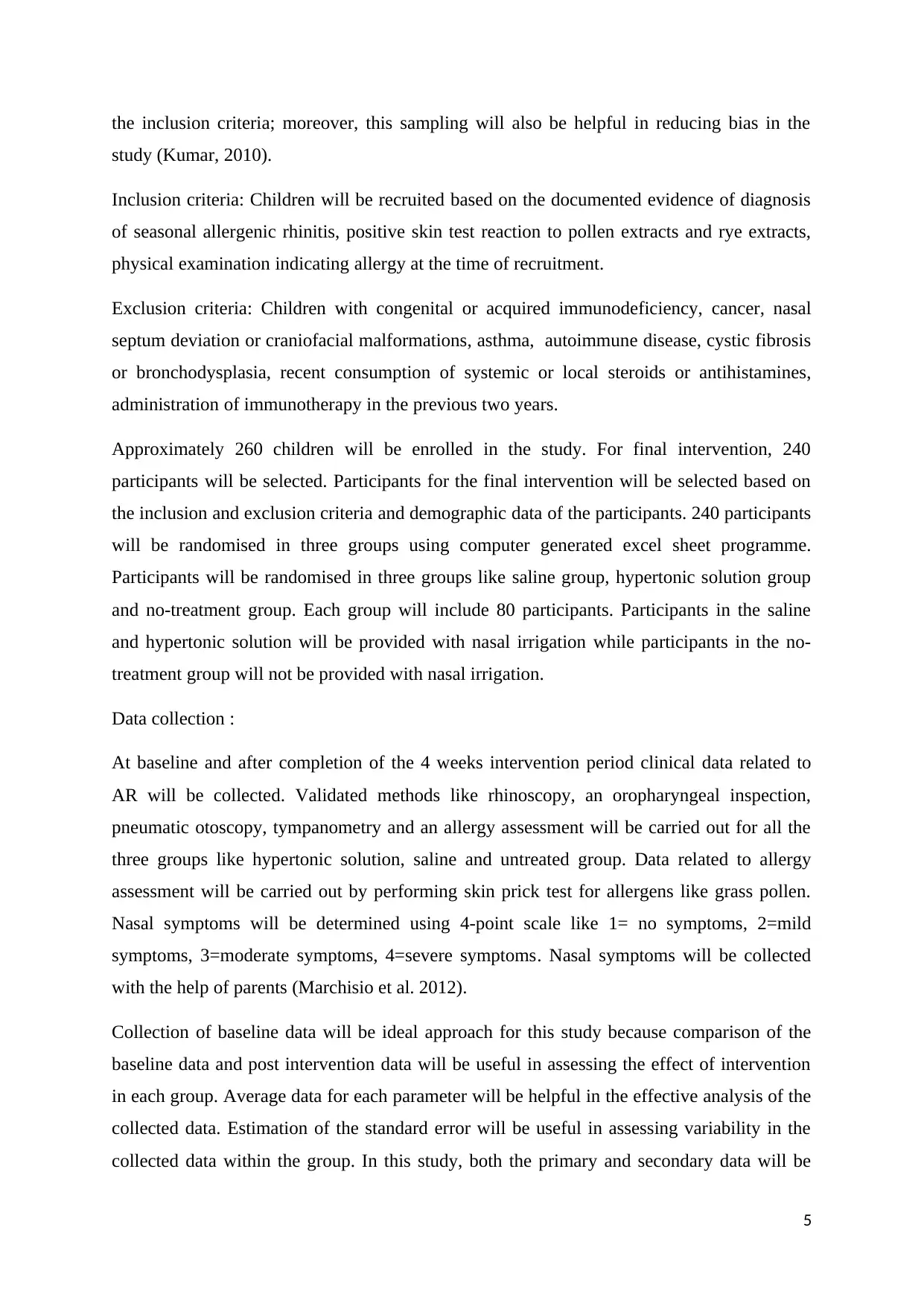
the inclusion criteria; moreover, this sampling will also be helpful in reducing bias in the
study (Kumar, 2010).
Inclusion criteria: Children will be recruited based on the documented evidence of diagnosis
of seasonal allergenic rhinitis, positive skin test reaction to pollen extracts and rye extracts,
physical examination indicating allergy at the time of recruitment.
Exclusion criteria: Children with congenital or acquired immunodeficiency, cancer, nasal
septum deviation or craniofacial malformations, asthma, autoimmune disease, cystic fibrosis
or bronchodysplasia, recent consumption of systemic or local steroids or antihistamines,
administration of immunotherapy in the previous two years.
Approximately 260 children will be enrolled in the study. For final intervention, 240
participants will be selected. Participants for the final intervention will be selected based on
the inclusion and exclusion criteria and demographic data of the participants. 240 participants
will be randomised in three groups using computer generated excel sheet programme.
Participants will be randomised in three groups like saline group, hypertonic solution group
and no-treatment group. Each group will include 80 participants. Participants in the saline
and hypertonic solution will be provided with nasal irrigation while participants in the no-
treatment group will not be provided with nasal irrigation.
Data collection :
At baseline and after completion of the 4 weeks intervention period clinical data related to
AR will be collected. Validated methods like rhinoscopy, an oropharyngeal inspection,
pneumatic otoscopy, tympanometry and an allergy assessment will be carried out for all the
three groups like hypertonic solution, saline and untreated group. Data related to allergy
assessment will be carried out by performing skin prick test for allergens like grass pollen.
Nasal symptoms will be determined using 4-point scale like 1= no symptoms, 2=mild
symptoms, 3=moderate symptoms, 4=severe symptoms. Nasal symptoms will be collected
with the help of parents (Marchisio et al. 2012).
Collection of baseline data will be ideal approach for this study because comparison of the
baseline data and post intervention data will be useful in assessing the effect of intervention
in each group. Average data for each parameter will be helpful in the effective analysis of the
collected data. Estimation of the standard error will be useful in assessing variability in the
collected data within the group. In this study, both the primary and secondary data will be
5
study (Kumar, 2010).
Inclusion criteria: Children will be recruited based on the documented evidence of diagnosis
of seasonal allergenic rhinitis, positive skin test reaction to pollen extracts and rye extracts,
physical examination indicating allergy at the time of recruitment.
Exclusion criteria: Children with congenital or acquired immunodeficiency, cancer, nasal
septum deviation or craniofacial malformations, asthma, autoimmune disease, cystic fibrosis
or bronchodysplasia, recent consumption of systemic or local steroids or antihistamines,
administration of immunotherapy in the previous two years.
Approximately 260 children will be enrolled in the study. For final intervention, 240
participants will be selected. Participants for the final intervention will be selected based on
the inclusion and exclusion criteria and demographic data of the participants. 240 participants
will be randomised in three groups using computer generated excel sheet programme.
Participants will be randomised in three groups like saline group, hypertonic solution group
and no-treatment group. Each group will include 80 participants. Participants in the saline
and hypertonic solution will be provided with nasal irrigation while participants in the no-
treatment group will not be provided with nasal irrigation.
Data collection :
At baseline and after completion of the 4 weeks intervention period clinical data related to
AR will be collected. Validated methods like rhinoscopy, an oropharyngeal inspection,
pneumatic otoscopy, tympanometry and an allergy assessment will be carried out for all the
three groups like hypertonic solution, saline and untreated group. Data related to allergy
assessment will be carried out by performing skin prick test for allergens like grass pollen.
Nasal symptoms will be determined using 4-point scale like 1= no symptoms, 2=mild
symptoms, 3=moderate symptoms, 4=severe symptoms. Nasal symptoms will be collected
with the help of parents (Marchisio et al. 2012).
Collection of baseline data will be ideal approach for this study because comparison of the
baseline data and post intervention data will be useful in assessing the effect of intervention
in each group. Average data for each parameter will be helpful in the effective analysis of the
collected data. Estimation of the standard error will be useful in assessing variability in the
collected data within the group. In this study, both the primary and secondary data will be
5
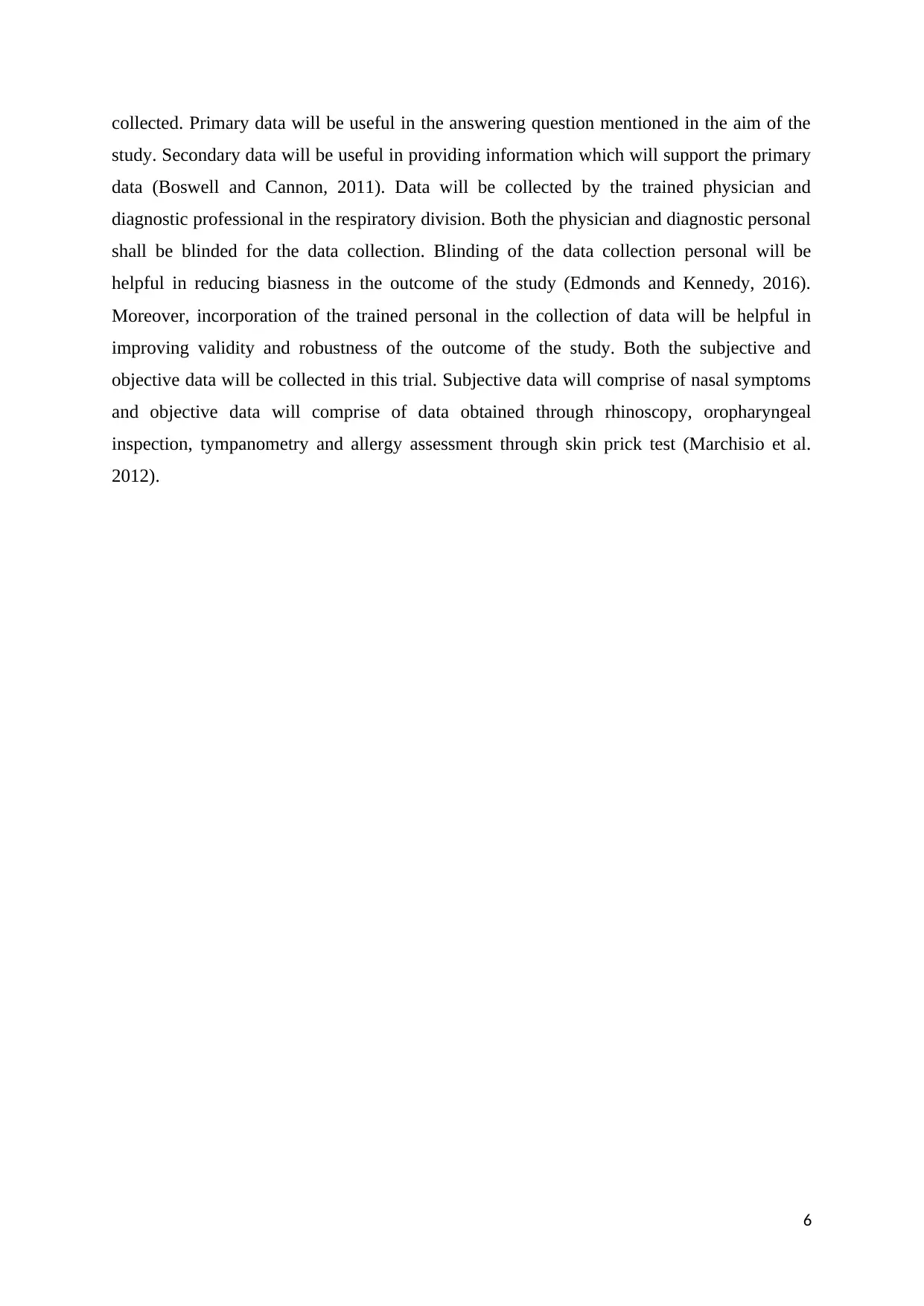
collected. Primary data will be useful in the answering question mentioned in the aim of the
study. Secondary data will be useful in providing information which will support the primary
data (Boswell and Cannon, 2011). Data will be collected by the trained physician and
diagnostic professional in the respiratory division. Both the physician and diagnostic personal
shall be blinded for the data collection. Blinding of the data collection personal will be
helpful in reducing biasness in the outcome of the study (Edmonds and Kennedy, 2016).
Moreover, incorporation of the trained personal in the collection of data will be helpful in
improving validity and robustness of the outcome of the study. Both the subjective and
objective data will be collected in this trial. Subjective data will comprise of nasal symptoms
and objective data will comprise of data obtained through rhinoscopy, oropharyngeal
inspection, tympanometry and allergy assessment through skin prick test (Marchisio et al.
2012).
6
study. Secondary data will be useful in providing information which will support the primary
data (Boswell and Cannon, 2011). Data will be collected by the trained physician and
diagnostic professional in the respiratory division. Both the physician and diagnostic personal
shall be blinded for the data collection. Blinding of the data collection personal will be
helpful in reducing biasness in the outcome of the study (Edmonds and Kennedy, 2016).
Moreover, incorporation of the trained personal in the collection of data will be helpful in
improving validity and robustness of the outcome of the study. Both the subjective and
objective data will be collected in this trial. Subjective data will comprise of nasal symptoms
and objective data will comprise of data obtained through rhinoscopy, oropharyngeal
inspection, tympanometry and allergy assessment through skin prick test (Marchisio et al.
2012).
6
⊘ This is a preview!⊘
Do you want full access?
Subscribe today to unlock all pages.
Trusted by 1+ million students worldwide
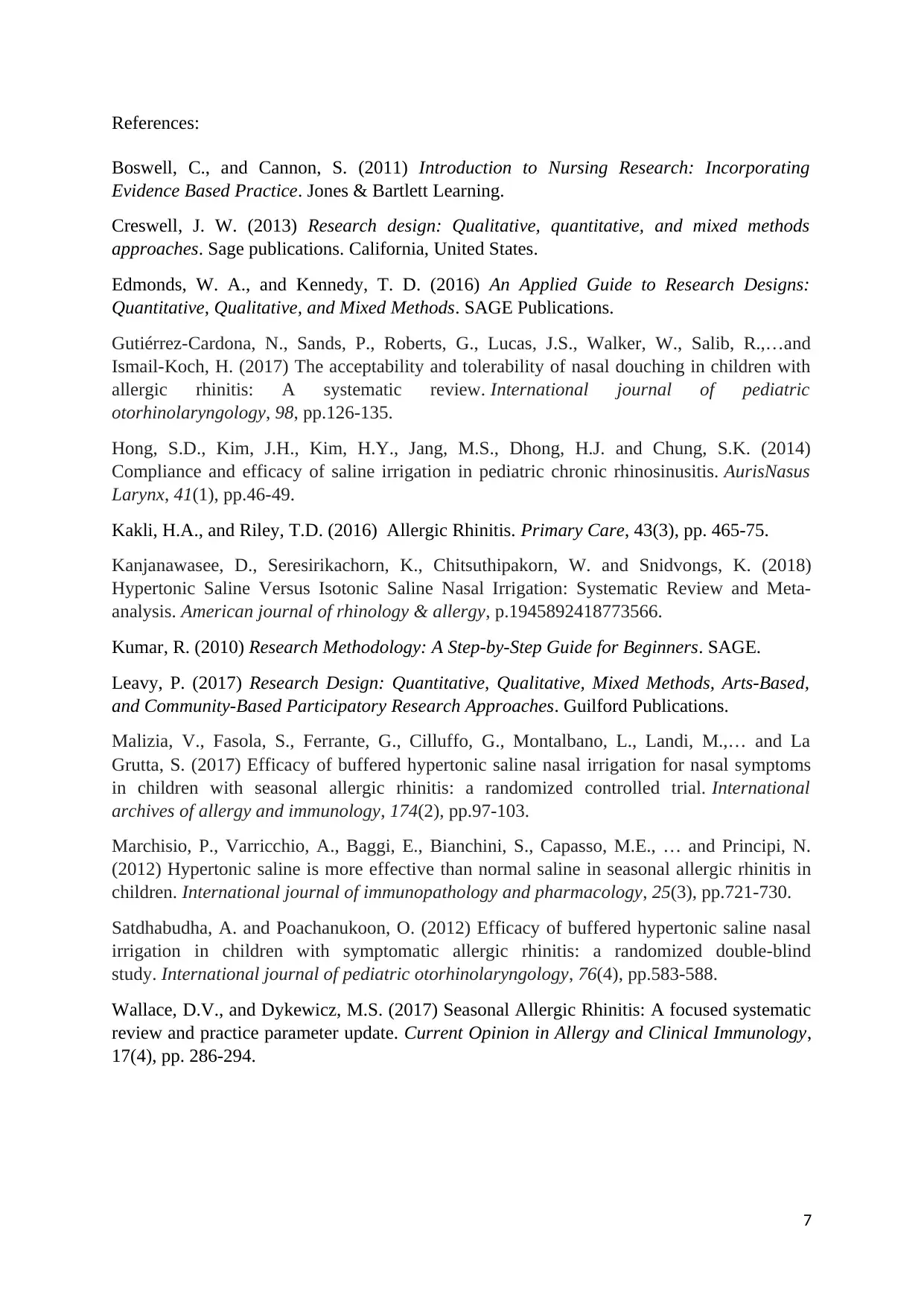
References:
Boswell, C., and Cannon, S. (2011) Introduction to Nursing Research: Incorporating
Evidence Based Practice. Jones & Bartlett Learning.
Creswell, J. W. (2013) Research design: Qualitative, quantitative, and mixed methods
approaches. Sage publications. California, United States.
Edmonds, W. A., and Kennedy, T. D. (2016) An Applied Guide to Research Designs:
Quantitative, Qualitative, and Mixed Methods. SAGE Publications.
Gutiérrez-Cardona, N., Sands, P., Roberts, G., Lucas, J.S., Walker, W., Salib, R.,…and
Ismail-Koch, H. (2017) The acceptability and tolerability of nasal douching in children with
allergic rhinitis: A systematic review. International journal of pediatric
otorhinolaryngology, 98, pp.126-135.
Hong, S.D., Kim, J.H., Kim, H.Y., Jang, M.S., Dhong, H.J. and Chung, S.K. (2014)
Compliance and efficacy of saline irrigation in pediatric chronic rhinosinusitis. AurisNasus
Larynx, 41(1), pp.46-49.
Kakli, H.A., and Riley, T.D. (2016) Allergic Rhinitis. Primary Care, 43(3), pp. 465-75.
Kanjanawasee, D., Seresirikachorn, K., Chitsuthipakorn, W. and Snidvongs, K. (2018)
Hypertonic Saline Versus Isotonic Saline Nasal Irrigation: Systematic Review and Meta-
analysis. American journal of rhinology & allergy, p.1945892418773566.
Kumar, R. (2010) Research Methodology: A Step-by-Step Guide for Beginners. SAGE.
Leavy, P. (2017) Research Design: Quantitative, Qualitative, Mixed Methods, Arts-Based,
and Community-Based Participatory Research Approaches. Guilford Publications.
Malizia, V., Fasola, S., Ferrante, G., Cilluffo, G., Montalbano, L., Landi, M.,… and La
Grutta, S. (2017) Efficacy of buffered hypertonic saline nasal irrigation for nasal symptoms
in children with seasonal allergic rhinitis: a randomized controlled trial. International
archives of allergy and immunology, 174(2), pp.97-103.
Marchisio, P., Varricchio, A., Baggi, E., Bianchini, S., Capasso, M.E., … and Principi, N.
(2012) Hypertonic saline is more effective than normal saline in seasonal allergic rhinitis in
children. International journal of immunopathology and pharmacology, 25(3), pp.721-730.
Satdhabudha, A. and Poachanukoon, O. (2012) Efficacy of buffered hypertonic saline nasal
irrigation in children with symptomatic allergic rhinitis: a randomized double-blind
study. International journal of pediatric otorhinolaryngology, 76(4), pp.583-588.
Wallace, D.V., and Dykewicz, M.S. (2017) Seasonal Allergic Rhinitis: A focused systematic
review and practice parameter update. Current Opinion in Allergy and Clinical Immunology,
17(4), pp. 286-294.
7
Boswell, C., and Cannon, S. (2011) Introduction to Nursing Research: Incorporating
Evidence Based Practice. Jones & Bartlett Learning.
Creswell, J. W. (2013) Research design: Qualitative, quantitative, and mixed methods
approaches. Sage publications. California, United States.
Edmonds, W. A., and Kennedy, T. D. (2016) An Applied Guide to Research Designs:
Quantitative, Qualitative, and Mixed Methods. SAGE Publications.
Gutiérrez-Cardona, N., Sands, P., Roberts, G., Lucas, J.S., Walker, W., Salib, R.,…and
Ismail-Koch, H. (2017) The acceptability and tolerability of nasal douching in children with
allergic rhinitis: A systematic review. International journal of pediatric
otorhinolaryngology, 98, pp.126-135.
Hong, S.D., Kim, J.H., Kim, H.Y., Jang, M.S., Dhong, H.J. and Chung, S.K. (2014)
Compliance and efficacy of saline irrigation in pediatric chronic rhinosinusitis. AurisNasus
Larynx, 41(1), pp.46-49.
Kakli, H.A., and Riley, T.D. (2016) Allergic Rhinitis. Primary Care, 43(3), pp. 465-75.
Kanjanawasee, D., Seresirikachorn, K., Chitsuthipakorn, W. and Snidvongs, K. (2018)
Hypertonic Saline Versus Isotonic Saline Nasal Irrigation: Systematic Review and Meta-
analysis. American journal of rhinology & allergy, p.1945892418773566.
Kumar, R. (2010) Research Methodology: A Step-by-Step Guide for Beginners. SAGE.
Leavy, P. (2017) Research Design: Quantitative, Qualitative, Mixed Methods, Arts-Based,
and Community-Based Participatory Research Approaches. Guilford Publications.
Malizia, V., Fasola, S., Ferrante, G., Cilluffo, G., Montalbano, L., Landi, M.,… and La
Grutta, S. (2017) Efficacy of buffered hypertonic saline nasal irrigation for nasal symptoms
in children with seasonal allergic rhinitis: a randomized controlled trial. International
archives of allergy and immunology, 174(2), pp.97-103.
Marchisio, P., Varricchio, A., Baggi, E., Bianchini, S., Capasso, M.E., … and Principi, N.
(2012) Hypertonic saline is more effective than normal saline in seasonal allergic rhinitis in
children. International journal of immunopathology and pharmacology, 25(3), pp.721-730.
Satdhabudha, A. and Poachanukoon, O. (2012) Efficacy of buffered hypertonic saline nasal
irrigation in children with symptomatic allergic rhinitis: a randomized double-blind
study. International journal of pediatric otorhinolaryngology, 76(4), pp.583-588.
Wallace, D.V., and Dykewicz, M.S. (2017) Seasonal Allergic Rhinitis: A focused systematic
review and practice parameter update. Current Opinion in Allergy and Clinical Immunology,
17(4), pp. 286-294.
7

1 out of 7


Your All-in-One AI-Powered Toolkit for Academic Success.
+13062052269
info@desklib.com
Available 24*7 on WhatsApp / Email
![[object Object]](/_next/static/media/star-bottom.7253800d.svg)
Unlock your academic potential
Copyright © 2020–2026 A2Z Services. All Rights Reserved. Developed and managed by ZUCOL.