Final Project Report: Developing Hypoglycemia Educational Package
VerifiedAdded on 2023/06/03
|22
|5007
|330
Report
AI Summary
This final project report details the development and evaluation of an educational package designed for diabetic patients, specifically those on oral hypoglycemic agents or insulin therapy, to reduce the incidence of hypoglycemia. The project aimed to educate patients on the signs, symptoms, and management of hypoglycemia through an educational pamphlet. The methodology involved recruiting patients, distributing the pamphlet, and assessing their understanding using a teach-back method and a follow-up survey. The report includes a discussion of the project's background, objectives, methods, and results. The findings, based on survey responses and the teach-back method, indicate that the educational material was effective in improving patient knowledge of hypoglycemia symptoms, causes, and management strategies. The results are presented graphically, showing the patients' ability to identify symptoms and management strategies. The report concludes with recommendations for future improvements and the implications of this educational approach for healthcare management.
Running head: FINAL PROJECT REPORT
FINAL PROJECT REPORT
Name of the Student
Name of the university
Author’s note
FINAL PROJECT REPORT
Name of the Student
Name of the university
Author’s note

Paraphrase This Document
Need a fresh take? Get an instant paraphrase of this document with our AI Paraphraser
1FINAL PROJECT REPORT
Introduction
Hypoglycemia is a condition that is caused by low blood sugar level than the
standardvalue ,less than 70 mg/dL (3.9 mmol/L). Hypoglycemia is often related to the treatment
of diabetes. Attempts made at intensive glycemic control increases the risk of the hypoglycemia.
A six fold augmentation I the death due to diabetes is caused in patients experiencing severe
hypoglycemia (Kalra et al., 2013). Related episodes can lead to the impairment of the counter
regulatory system and the development of hypoglycemia unawareness. Worsening of the
hypoglycemia includes symptom like confusion, abnormal behavior, inability to complete the
tasks, visual disturbances like blurred vision, seizures and lack of consciousness. It is found to
increase the chance of cardiovascular functions, loss of vision, the death of the retinal cells
(Rehni et al, 2015). Hence there is an urgent need for examining the clinical spectrum and the
burden of the hypoglycemia such that adequate control measure can be taken against this life
threatening health care complications (Kalra et al., 2013). Hence the main aim and the objective
of the project is to develop an educational package for the diabetic patient, who are on oral
hypoglycemic agents or the insulin therapy for reducing the incidence of the hypoglycemia by
the education of the signs and the symptom of hypoglycemia.
This final assessment will report on the project as a whole, objective of the project, the
methodology of the project, the rationale for choosing the topic. The report will give a vivid
description of how the educational package will be provided followed to the patients followed by
the evaluation of the educational program by using a teach-back method and a survey conducted
with the patients. The survey results will be followed by a discussion of the findings obtained
Introduction
Hypoglycemia is a condition that is caused by low blood sugar level than the
standardvalue ,less than 70 mg/dL (3.9 mmol/L). Hypoglycemia is often related to the treatment
of diabetes. Attempts made at intensive glycemic control increases the risk of the hypoglycemia.
A six fold augmentation I the death due to diabetes is caused in patients experiencing severe
hypoglycemia (Kalra et al., 2013). Related episodes can lead to the impairment of the counter
regulatory system and the development of hypoglycemia unawareness. Worsening of the
hypoglycemia includes symptom like confusion, abnormal behavior, inability to complete the
tasks, visual disturbances like blurred vision, seizures and lack of consciousness. It is found to
increase the chance of cardiovascular functions, loss of vision, the death of the retinal cells
(Rehni et al, 2015). Hence there is an urgent need for examining the clinical spectrum and the
burden of the hypoglycemia such that adequate control measure can be taken against this life
threatening health care complications (Kalra et al., 2013). Hence the main aim and the objective
of the project is to develop an educational package for the diabetic patient, who are on oral
hypoglycemic agents or the insulin therapy for reducing the incidence of the hypoglycemia by
the education of the signs and the symptom of hypoglycemia.
This final assessment will report on the project as a whole, objective of the project, the
methodology of the project, the rationale for choosing the topic. The report will give a vivid
description of how the educational package will be provided followed to the patients followed by
the evaluation of the educational program by using a teach-back method and a survey conducted
with the patients. The survey results will be followed by a discussion of the findings obtained
2FINAL PROJECT REPORT
from the graphs. Finally this would also provide with some possible set of future
recommendations.
Project background
The main aim of the project is to introduce an educational pamphlet for the diabetic
patients who are on insulin therapy or oral hypoglycemic agent by educating the patients with the
necessary signs and symptoms and the management of hypoglycemia. Hypoglycemia can be an
alarming situation for the patients and the resulting fear of the subsequent episodes of
hypoglycemia symptoms might increase the anti- hyperglycemic medication, ultimately limiting
the therapeutic goals (Hulkower, Pollack &Zonszein, 2014). Many patients does not grasp the
fatal consequences of the hypoglycemia on the vascular health and the health care providers
should not assume that the patient has been well educated on the pathophysiology of the
diabetes. In most of the cases, people who are in extreme control of diabetes focus mainly on the
diabetes control but necessarily does not emphasize on hypoglycemia. Hence, it is necessary to
educate the patients regarding some of the fundamental concepts of diabetes like carbohydrates
taken, the role of the hormones in regulating the blood sugar level in the body, by educating
them about the potential clinical manifestations and blood glucose level that can be considered to
be diabetic (Centrella-Nigro& Alexander, 2017). Furthermore, most of the educational materials
providedin the health care sector consisted of fact sheets, limiting the ability of the consumers to
access the range of information. It is again necessary to educate the patients about the risk factors
of hypoglycemia, such as the consumption of the antidiabetogenic agents, alcohol intake without
food, improper diet and diet (Tan& Flanagan, 2013). Hence the educational pamphlets are ideal
to provide the correct amount of evidence based information in a simpler way to the audience.
from the graphs. Finally this would also provide with some possible set of future
recommendations.
Project background
The main aim of the project is to introduce an educational pamphlet for the diabetic
patients who are on insulin therapy or oral hypoglycemic agent by educating the patients with the
necessary signs and symptoms and the management of hypoglycemia. Hypoglycemia can be an
alarming situation for the patients and the resulting fear of the subsequent episodes of
hypoglycemia symptoms might increase the anti- hyperglycemic medication, ultimately limiting
the therapeutic goals (Hulkower, Pollack &Zonszein, 2014). Many patients does not grasp the
fatal consequences of the hypoglycemia on the vascular health and the health care providers
should not assume that the patient has been well educated on the pathophysiology of the
diabetes. In most of the cases, people who are in extreme control of diabetes focus mainly on the
diabetes control but necessarily does not emphasize on hypoglycemia. Hence, it is necessary to
educate the patients regarding some of the fundamental concepts of diabetes like carbohydrates
taken, the role of the hormones in regulating the blood sugar level in the body, by educating
them about the potential clinical manifestations and blood glucose level that can be considered to
be diabetic (Centrella-Nigro& Alexander, 2017). Furthermore, most of the educational materials
providedin the health care sector consisted of fact sheets, limiting the ability of the consumers to
access the range of information. It is again necessary to educate the patients about the risk factors
of hypoglycemia, such as the consumption of the antidiabetogenic agents, alcohol intake without
food, improper diet and diet (Tan& Flanagan, 2013). Hence the educational pamphlets are ideal
to provide the correct amount of evidence based information in a simpler way to the audience.
⊘ This is a preview!⊘
Do you want full access?
Subscribe today to unlock all pages.

Trusted by 1+ million students worldwide
3FINAL PROJECT REPORT
Finally, a teach back method and a survey will be conducted for understanding the perception of
the patients and to understand whether the education had been fruitful or not.
Objectives
To teach the selected diabetic patient by using the educational pamphlet
To evaluate the patient understanding by a teach back method and a survey conducted after 6
months.
Methods
The patients for whom the pamphletwill be designed, will be recruited from among the
outpatients at the () hospital, present in the metropolitan area of Singapore. The inclusion criteria
for the study consisted of patients diagnosed as type 2 diabetes, receiving drug or insulin
therapy .for the diabetes, between the age 40-70 years and have HbA1c of less than 8. The
diabetic care managers were asked to educate the eligible patients, about hypoglycemia and 17
patients were selected for the conduction of the survey. A teach back method for evaluating the
quality of the teaching provided.
The patient education handouts contained important health messages for the
hypoglycemia, difference between hypoglycemia and hyperglycemia, the causes and the risk
factors for developing hypoglycemia, the potential blood glucose level indicating towards
hypoglycemia (Chow et al., 2018). The information hand-out for the patients also contained
information about the management of hypoglycemia, including the regular monitoring of the
Finally, a teach back method and a survey will be conducted for understanding the perception of
the patients and to understand whether the education had been fruitful or not.
Objectives
To teach the selected diabetic patient by using the educational pamphlet
To evaluate the patient understanding by a teach back method and a survey conducted after 6
months.
Methods
The patients for whom the pamphletwill be designed, will be recruited from among the
outpatients at the () hospital, present in the metropolitan area of Singapore. The inclusion criteria
for the study consisted of patients diagnosed as type 2 diabetes, receiving drug or insulin
therapy .for the diabetes, between the age 40-70 years and have HbA1c of less than 8. The
diabetic care managers were asked to educate the eligible patients, about hypoglycemia and 17
patients were selected for the conduction of the survey. A teach back method for evaluating the
quality of the teaching provided.
The patient education handouts contained important health messages for the
hypoglycemia, difference between hypoglycemia and hyperglycemia, the causes and the risk
factors for developing hypoglycemia, the potential blood glucose level indicating towards
hypoglycemia (Chow et al., 2018). The information hand-out for the patients also contained
information about the management of hypoglycemia, including the regular monitoring of the
Paraphrase This Document
Need a fresh take? Get an instant paraphrase of this document with our AI Paraphraser
4FINAL PROJECT REPORT
blood glucose level, adhering to the dietary guidelines. Importantly, the information pamphlet
also contained information about the important associated condition of hypoglycemia including
to obesity, lipidemia, hypertension and cardiovascular diseases (Dendy et al., 2015).All the
information provided in the educational pamphlet are evidence based information extracted from
scientific articles and relevant websites.
After the educational pamphlet has been distributed to the participants and explained via
the diabetic care managers, a teach-back method was used to check and evaluate the patient’s
understanding after the education sessions.A teach back method has been used by the diabetic
care educator to have an understanding whether the pamphlets had been useful to the diabetic
care patients or not (Peter et al., 2015). A teach back is way of confirming that the educator had
explained to the patient what is important and in a manner that is easily understood by the
patient. The understanding of the patient is confirmed when the patient explains it back in their
own words to the educator. A teach back methods assists the clinician to identify theexplanation
and the various communication strategies, that are mostly understood by the patient
(Gibbs,Trotta&Overbeck, 2014).
Before the conduction of the teach-back method, all the patients who had been selected
for the teaching had been educated about the importance of the remaining updated about
hypoglycemic conditions.The teach back session lasted for 60 minutes and the educational
sessions was administered in a private room. In this method the researcher assessed he baseline
understanding of the patient about hypoglycemia. The questions asked were mainly based on
what has been educated by the pamphlet.
blood glucose level, adhering to the dietary guidelines. Importantly, the information pamphlet
also contained information about the important associated condition of hypoglycemia including
to obesity, lipidemia, hypertension and cardiovascular diseases (Dendy et al., 2015).All the
information provided in the educational pamphlet are evidence based information extracted from
scientific articles and relevant websites.
After the educational pamphlet has been distributed to the participants and explained via
the diabetic care managers, a teach-back method was used to check and evaluate the patient’s
understanding after the education sessions.A teach back method has been used by the diabetic
care educator to have an understanding whether the pamphlets had been useful to the diabetic
care patients or not (Peter et al., 2015). A teach back is way of confirming that the educator had
explained to the patient what is important and in a manner that is easily understood by the
patient. The understanding of the patient is confirmed when the patient explains it back in their
own words to the educator. A teach back methods assists the clinician to identify theexplanation
and the various communication strategies, that are mostly understood by the patient
(Gibbs,Trotta&Overbeck, 2014).
Before the conduction of the teach-back method, all the patients who had been selected
for the teaching had been educated about the importance of the remaining updated about
hypoglycemic conditions.The teach back session lasted for 60 minutes and the educational
sessions was administered in a private room. In this method the researcher assessed he baseline
understanding of the patient about hypoglycemia. The questions asked were mainly based on
what has been educated by the pamphlet.
5FINAL PROJECT REPORT
Two questions were asked in the teach-back method for understanding the knowledge of
the patients:-
What are the symptoms of hypoglycemia?
What are the causes of hypoglycemia?
How can we manage hypoglycemia?
Simple question sin English language were asked to the patients. Medical jargons, vague
terms and terms having different lay and medical terms were avoided in the process. After the
response from the patients, we had cross validated their answers by repeating the same answers.
For example, “I always ask the patient to repeat the same thing that I have explained to them.”.
The answers were correct or incorrect, the researcher explained the issue to the participants once
again.
After the conduction of the teach-back process, the emails of the participants were
collected. After a six months follow up a survey was conducted on the same 18 participants for
evaluating the efficacy of the educational material in fostering the control of the hypoglycemia.
The online survey link was sent to the same participants via email. The survey contained 7
closed ended questions related to the education resources that has been provided to the patient.
The online survey was conducted by using the “survey monkey”, an online survey tool.
Closed ended questions were prepared related the information provided in the pamphlet
and relevant topic. 7 multiple choice questions, each of the questions with three choices were
prepared using the “survey monkey”. Survey monkey is an online survey development cloud-
based software, which was founded by the Ryan Finley and Chris Finley in the year 1992.
Two questions were asked in the teach-back method for understanding the knowledge of
the patients:-
What are the symptoms of hypoglycemia?
What are the causes of hypoglycemia?
How can we manage hypoglycemia?
Simple question sin English language were asked to the patients. Medical jargons, vague
terms and terms having different lay and medical terms were avoided in the process. After the
response from the patients, we had cross validated their answers by repeating the same answers.
For example, “I always ask the patient to repeat the same thing that I have explained to them.”.
The answers were correct or incorrect, the researcher explained the issue to the participants once
again.
After the conduction of the teach-back process, the emails of the participants were
collected. After a six months follow up a survey was conducted on the same 18 participants for
evaluating the efficacy of the educational material in fostering the control of the hypoglycemia.
The online survey link was sent to the same participants via email. The survey contained 7
closed ended questions related to the education resources that has been provided to the patient.
The online survey was conducted by using the “survey monkey”, an online survey tool.
Closed ended questions were prepared related the information provided in the pamphlet
and relevant topic. 7 multiple choice questions, each of the questions with three choices were
prepared using the “survey monkey”. Survey monkey is an online survey development cloud-
based software, which was founded by the Ryan Finley and Chris Finley in the year 1992.
⊘ This is a preview!⊘
Do you want full access?
Subscribe today to unlock all pages.
Trusted by 1+ million students worldwide
6FINAL PROJECT REPORT
Privacy and confidentiality was maintained as none of the details of the participants were
collected and only the responses were recorded. Results were obtained as per the responses given
by the patients. It was made sure that these responses will not be considered in any other future
studies.
Results and findings
Data analysis was performed as per the graphs obtained from the survey conducted with
the help of the survey monkey. We had approached 25 patients of whom 20 patients consented to
take part in the survey and the teach-back method. The teach-back method was conducted for
about 60 minutes, where we had asked three primary questions to the participants.
Documentation of the teaching encounter by using the teach back method was done by the use of
a progress note in the interdisciplinary education records. The issues like- unable to answer
properly, unwillingness to change behaviors, refusal of teaching). In order to standardize the
teach back validation process, we have created aperformance checklist for analyzing the
performance behavior.
As per the responses obtained from the teach-method, 14 out of the 18 patient, who had
received the teaching by using the educational pamphlet could answer to all the questions.
For the first question, 80 % of the patients could answer the symptoms of hypoglycemia,
which proves that most of the patients could be educated about the signs and the symptoms of
hypoglycemia. One of the patient had responded that- " You feel nauseated and lightheaded" .
Four of the other patients had stated that in severe cases they had faced some difficulty in
speech.Two of the patients had responded that they also had difficulty in he auditory sensation,
which the of course could not be related the signs and the symptoms of hypoglycemia.
Privacy and confidentiality was maintained as none of the details of the participants were
collected and only the responses were recorded. Results were obtained as per the responses given
by the patients. It was made sure that these responses will not be considered in any other future
studies.
Results and findings
Data analysis was performed as per the graphs obtained from the survey conducted with
the help of the survey monkey. We had approached 25 patients of whom 20 patients consented to
take part in the survey and the teach-back method. The teach-back method was conducted for
about 60 minutes, where we had asked three primary questions to the participants.
Documentation of the teaching encounter by using the teach back method was done by the use of
a progress note in the interdisciplinary education records. The issues like- unable to answer
properly, unwillingness to change behaviors, refusal of teaching). In order to standardize the
teach back validation process, we have created aperformance checklist for analyzing the
performance behavior.
As per the responses obtained from the teach-method, 14 out of the 18 patient, who had
received the teaching by using the educational pamphlet could answer to all the questions.
For the first question, 80 % of the patients could answer the symptoms of hypoglycemia,
which proves that most of the patients could be educated about the signs and the symptoms of
hypoglycemia. One of the patient had responded that- " You feel nauseated and lightheaded" .
Four of the other patients had stated that in severe cases they had faced some difficulty in
speech.Two of the patients had responded that they also had difficulty in he auditory sensation,
which the of course could not be related the signs and the symptoms of hypoglycemia.
Paraphrase This Document
Need a fresh take? Get an instant paraphrase of this document with our AI Paraphraser
7FINAL PROJECT REPORT
For the second question, about the causes of hypoglycemia, five of the patients stated
that they had experienced hypoglycemia, while in insulin therapy. While most of the patients
have stated that they had experienced hypoglycemia, after they had skipped meals or had been
under prolonged fasting.
On asking about the strategies regarding the management of the diabetic level, most of
the patients have stated that prior to this teaching, most of them were not aware of hypoglycemia.
14 out of the 18 patients could actually state the strategies for controlling hypoglycemia.
Some of the possible responses has been provided by the patient’s are-
“We need to take up enough carbs, so that we don’t feel nauseated”
“We need to check the blood glucose level regularly and keep a record of the findings”
“We should go to the doctor for a regular follow up”.
The graphs shown below indicates the responses of the participants based on the survey
taken after a six months of follow up.
Question 1.
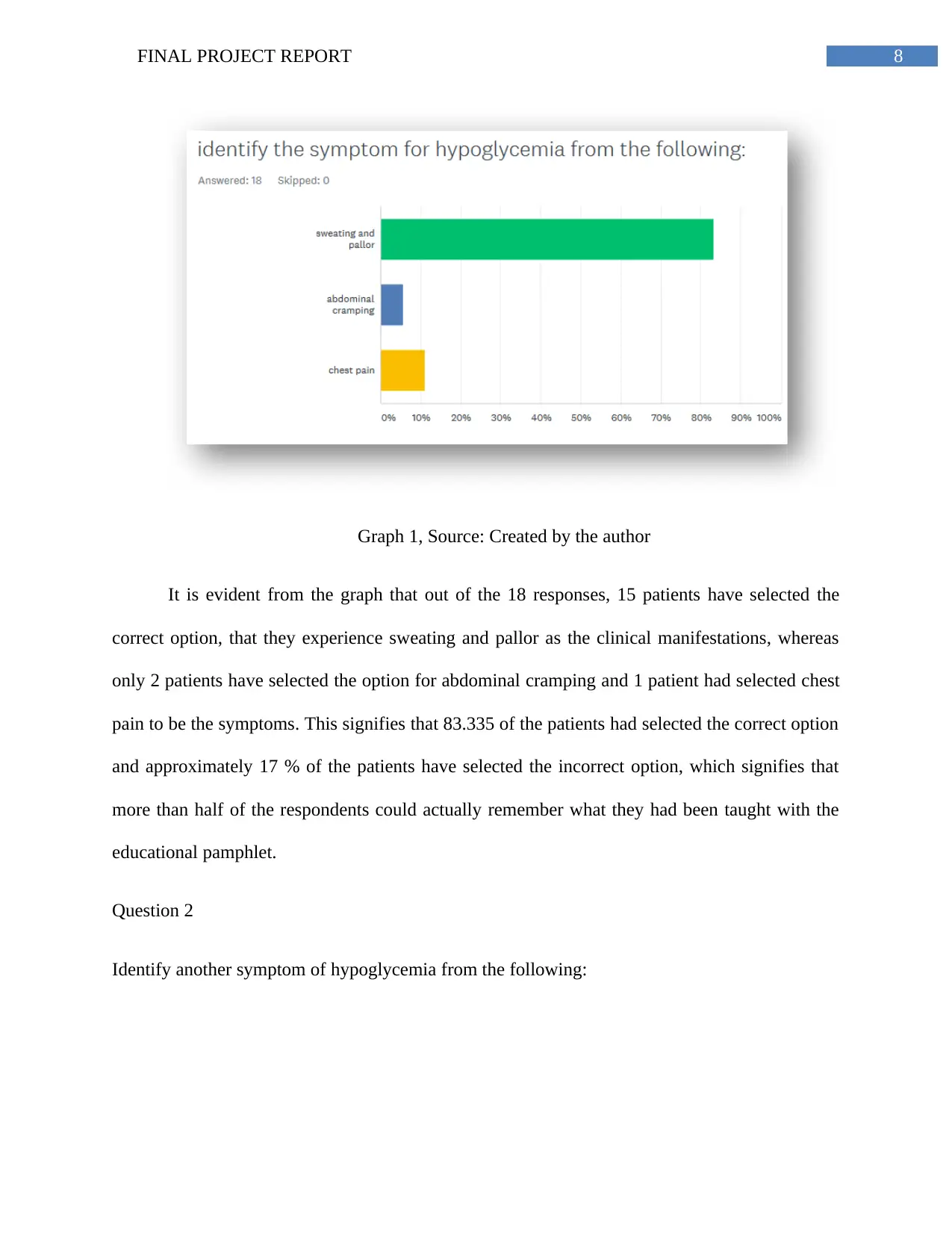
Identify the symptoms of hypoglycemia from the following options:-
For the second question, about the causes of hypoglycemia, five of the patients stated
that they had experienced hypoglycemia, while in insulin therapy. While most of the patients
have stated that they had experienced hypoglycemia, after they had skipped meals or had been
under prolonged fasting.
On asking about the strategies regarding the management of the diabetic level, most of
the patients have stated that prior to this teaching, most of them were not aware of hypoglycemia.
14 out of the 18 patients could actually state the strategies for controlling hypoglycemia.
Some of the possible responses has been provided by the patient’s are-
“We need to take up enough carbs, so that we don’t feel nauseated”
“We need to check the blood glucose level regularly and keep a record of the findings”
“We should go to the doctor for a regular follow up”.
The graphs shown below indicates the responses of the participants based on the survey
taken after a six months of follow up.
Question 1.
Identify the symptoms of hypoglycemia from the following options:-
8FINAL PROJECT REPORT
Graph 1, Source: Created by the author
It is evident from the graph that out of the 18 responses, 15 patients have selected the
correct option, that they experience sweating and pallor as the clinical manifestations, whereas
only 2 patients have selected the option for abdominal cramping and 1 patient had selected chest
pain to be the symptoms. This signifies that 83.335 of the patients had selected the correct option
and approximately 17 % of the patients have selected the incorrect option, which signifies that
more than half of the respondents could actually remember what they had been taught with the
educational pamphlet.
Question 2
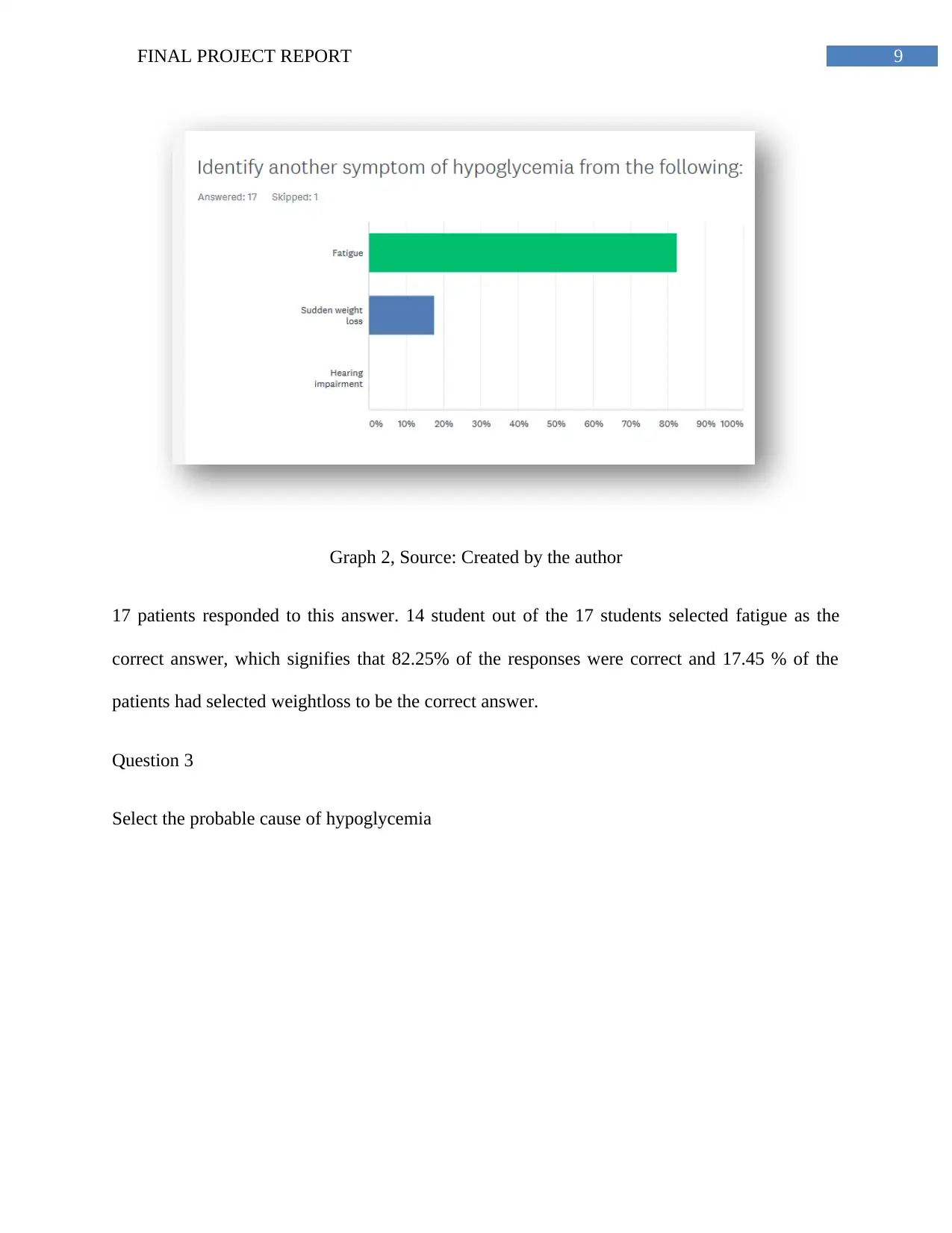
Identify another symptom of hypoglycemia from the following:
Graph 1, Source: Created by the author
It is evident from the graph that out of the 18 responses, 15 patients have selected the
correct option, that they experience sweating and pallor as the clinical manifestations, whereas
only 2 patients have selected the option for abdominal cramping and 1 patient had selected chest
pain to be the symptoms. This signifies that 83.335 of the patients had selected the correct option
and approximately 17 % of the patients have selected the incorrect option, which signifies that
more than half of the respondents could actually remember what they had been taught with the
educational pamphlet.
Question 2
Identify another symptom of hypoglycemia from the following:
⊘ This is a preview!⊘
Do you want full access?
Subscribe today to unlock all pages.
Trusted by 1+ million students worldwide
9FINAL PROJECT REPORT
Graph 2, Source: Created by the author
17 patients responded to this answer. 14 student out of the 17 students selected fatigue as the
correct answer, which signifies that 82.25% of the responses were correct and 17.45 % of the
patients had selected weightloss to be the correct answer.
Question 3
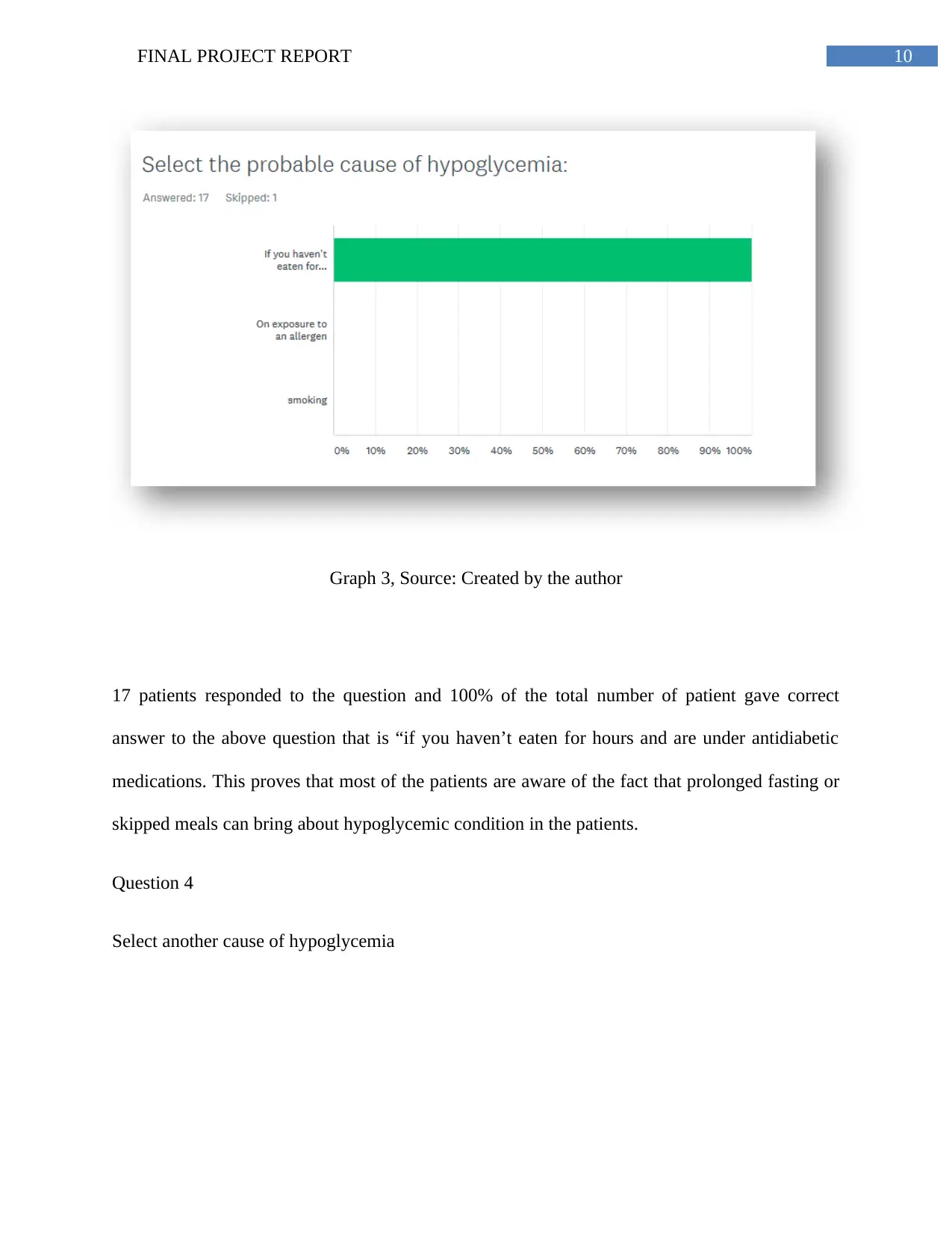
Select the probable cause of hypoglycemia
Graph 2, Source: Created by the author
17 patients responded to this answer. 14 student out of the 17 students selected fatigue as the
correct answer, which signifies that 82.25% of the responses were correct and 17.45 % of the
patients had selected weightloss to be the correct answer.
Question 3
Select the probable cause of hypoglycemia
Paraphrase This Document
Need a fresh take? Get an instant paraphrase of this document with our AI Paraphraser
10FINAL PROJECT REPORT
Graph 3, Source: Created by the author
17 patients responded to the question and 100% of the total number of patient gave correct
answer to the above question that is “if you haven’t eaten for hours and are under antidiabetic
medications. This proves that most of the patients are aware of the fact that prolonged fasting or
skipped meals can bring about hypoglycemic condition in the patients.
Question 4
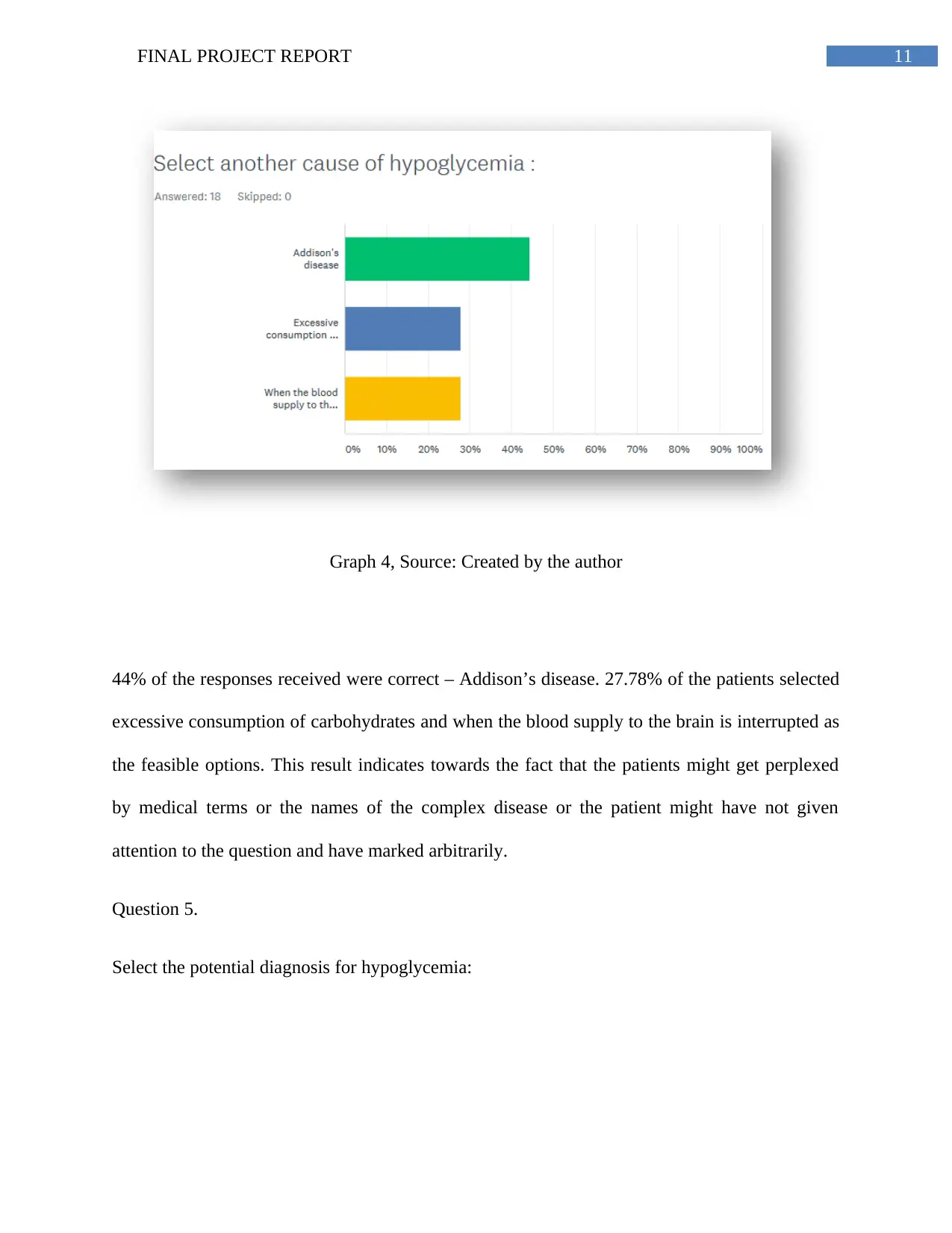
Select another cause of hypoglycemia
Graph 3, Source: Created by the author
17 patients responded to the question and 100% of the total number of patient gave correct
answer to the above question that is “if you haven’t eaten for hours and are under antidiabetic
medications. This proves that most of the patients are aware of the fact that prolonged fasting or
skipped meals can bring about hypoglycemic condition in the patients.
Question 4
Select another cause of hypoglycemia
11FINAL PROJECT REPORT
Graph 4, Source: Created by the author
44% of the responses received were correct – Addison’s disease. 27.78% of the patients selected
excessive consumption of carbohydrates and when the blood supply to the brain is interrupted as
the feasible options. This result indicates towards the fact that the patients might get perplexed
by medical terms or the names of the complex disease or the patient might have not given
attention to the question and have marked arbitrarily.
Question 5.
Select the potential diagnosis for hypoglycemia:
Graph 4, Source: Created by the author
44% of the responses received were correct – Addison’s disease. 27.78% of the patients selected
excessive consumption of carbohydrates and when the blood supply to the brain is interrupted as
the feasible options. This result indicates towards the fact that the patients might get perplexed
by medical terms or the names of the complex disease or the patient might have not given
attention to the question and have marked arbitrarily.
Question 5.
Select the potential diagnosis for hypoglycemia:
⊘ This is a preview!⊘
Do you want full access?
Subscribe today to unlock all pages.
Trusted by 1+ million students worldwide

1 out of 22


Related Documents


Your All-in-One AI-Powered Toolkit for Academic Success.
+13062052269
info@desklib.com
Available 24*7 on WhatsApp / Email
![[object Object]](/_next/static/media/star-bottom.7253800d.svg)
Unlock your academic potential
Copyright © 2020–2026 A2Z Services. All Rights Reserved. Developed and managed by ZUCOL.