Grand Canyon University: Literacy Observation - I Do, We Do, You Do

Verified

Added on  2022/11/18

|4
|764
|451
Homework Assignment
AI Summary
This assignment is a comprehensive analysis of the I Do, We Do, You Do teaching model, focusing on literacy concepts and classroom dynamics. The first part details the observed literacy standards-based concept, emphasizing the inclusion of parents, the importance of higher grades, and the introduction of new topics to enhance student understanding. It explores direct instruction methods, guided practice, and independent work, along with materials and resources used. Differentiation strategies, such as flexible-pace learning and the use of verbal and digital resources, are discussed. The assignment identifies gaps in the lesson, including racial and physical fitness disparities. Part two delves into teacher collaboration, highlighting instructional methods like visualization and cooperative learning, and discussion techniques such as Stoplight and Snowball discussions. It emphasizes the importance of student segregation based on merits and class strength, and methods for accommodating atypical students. The final part reflects on the effectiveness of the teaching model, the helpfulness of mentors, and the importance of adapting to progressive educational methods to improve literacy. The student expresses a commitment to specializing in this area to spread literacy effectively.
Document Page
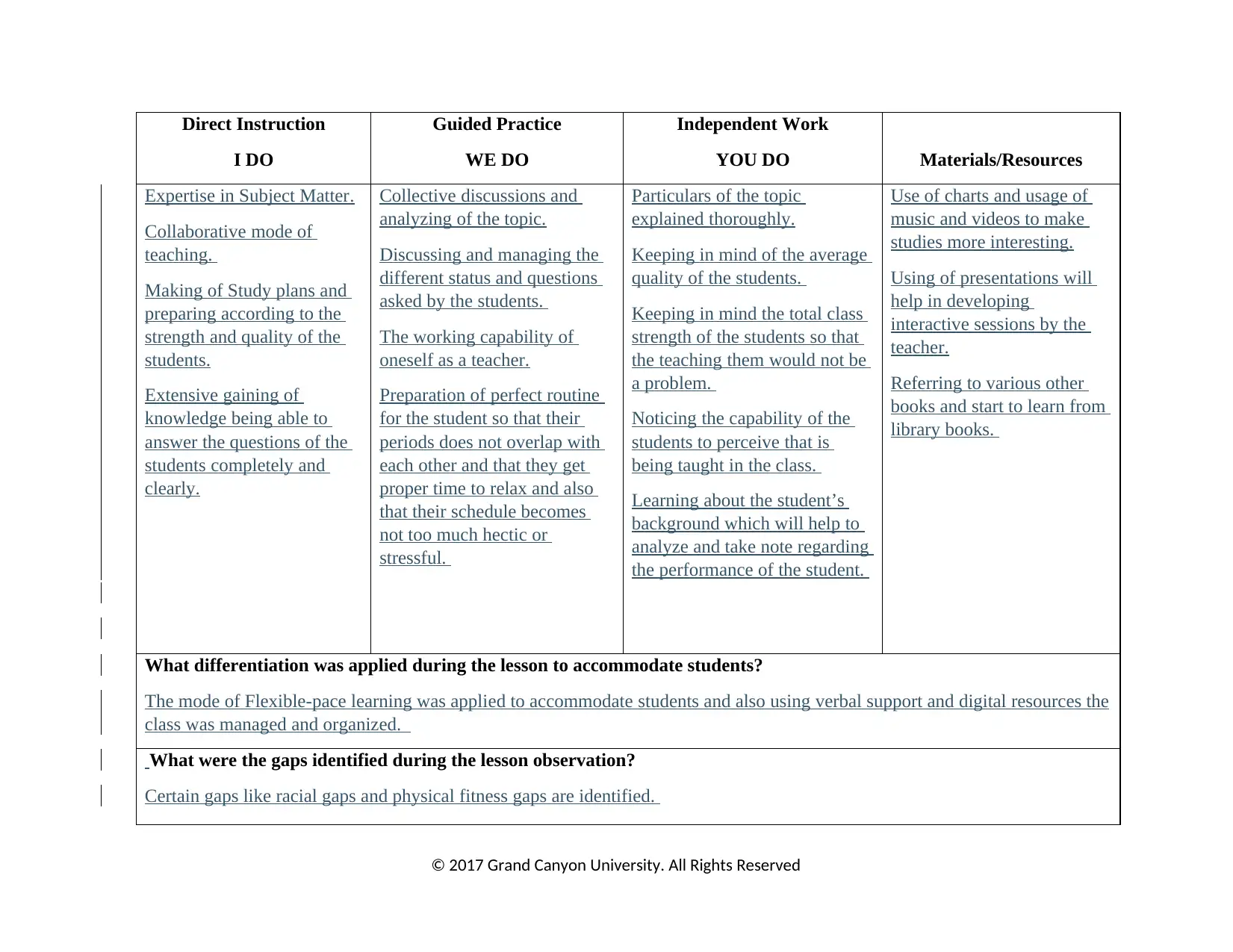
I Do, We Do, You Do Template
Part 1: I Do, We Do, You Do Observation
Describe the literacy standards-based concept that was introduced:
.Inclusion of Parents in the process: If parents are included in the teaching process then the Students can easily understand
their studies, along with the parents will have the knowledge regarding their ward’s capability and progress.
Adding higher grades compared to lower grades: Addition of Higher grades than lower grades in elementary schools will
encourage and will also motivate the students.
Introduction of New Topics: Introducing new topics in the syllabus and also including various different and then merging them
into the topic help students to perceive their studies better and the ideas will be explained clearer.
© 2017 Grand Canyon University. All Rights Reserved
tabler-icon-diamond-filled.svg

Paraphrase This Document

Need a fresh take? Get an instant paraphrase of this document with our AI Paraphraser
Document Page
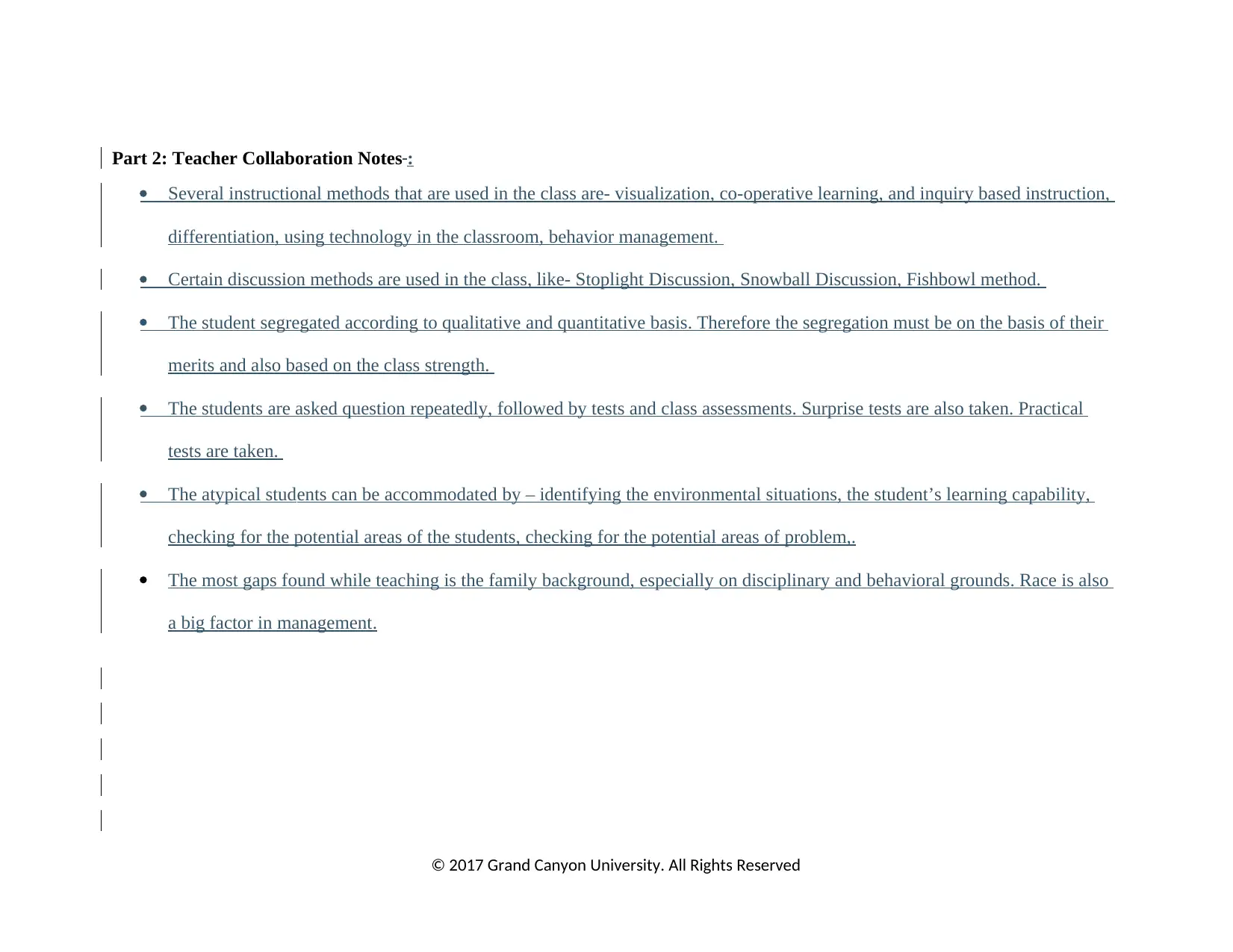
Direct Instruction
I DO
Guided Practice
WE DO
Independent Work
YOU DO Materials/Resources
Expertise in Subject Matter.
Collaborative mode of
teaching.
Making of Study plans and
preparing according to the
strength and quality of the
students.
Extensive gaining of
knowledge being able to
answer the questions of the
students completely and
clearly.
Collective discussions and
analyzing of the topic.
Discussing and managing the
different status and questions
asked by the students.
The working capability of
oneself as a teacher.
Preparation of perfect routine
for the student so that their
periods does not overlap with
each other and that they get
proper time to relax and also
that their schedule becomes
not too much hectic or
stressful.
Particulars of the topic
explained thoroughly.
Keeping in mind of the average
quality of the students.
Keeping in mind the total class
strength of the students so that
the teaching them would not be
a problem.
Noticing the capability of the
students to perceive that is
being taught in the class.
Learning about the student’s
background which will help to
analyze and take note regarding
the performance of the student.
Use of charts and usage of
music and videos to make
studies more interesting.
Using of presentations will
help in developing
interactive sessions by the
teacher.
Referring to various other
books and start to learn from
library books.
What differentiation was applied during the lesson to accommodate students?
The mode of Flexible-pace learning was applied to accommodate students and also using verbal support and digital resources the
class was managed and organized.
What were the gaps identified during the lesson observation?
Certain gaps like racial gaps and physical fitness gaps are identified.
© 2017 Grand Canyon University. All Rights Reserved
Document Page
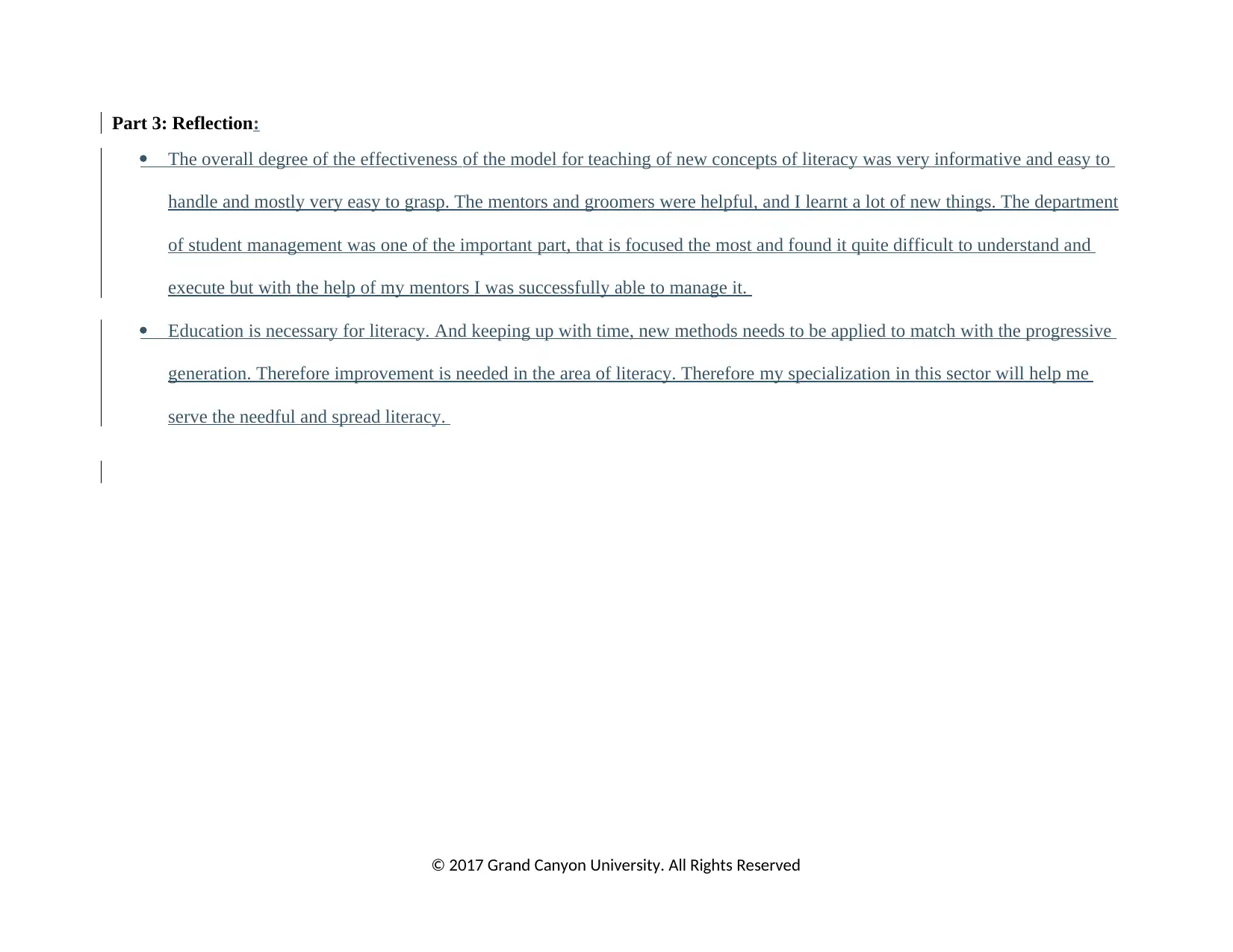
Part 2: Teacher Collaboration Notes :
Several instructional methods that are used in the class are- visualization, co-operative learning, and inquiry based instruction,
differentiation, using technology in the classroom, behavior management.
Certain discussion methods are used in the class, like- Stoplight Discussion, Snowball Discussion, Fishbowl method.
The student segregated according to qualitative and quantitative basis. Therefore the segregation must be on the basis of their
merits and also based on the class strength.
The students are asked question repeatedly, followed by tests and class assessments. Surprise tests are also taken. Practical
tests are taken.
The atypical students can be accommodated by identifying the environmental situations, the student’s learning capability,
checking for the potential areas of the students, checking for the potential areas of problem,.
The most gaps found while teaching is the family background, especially on disciplinary and behavioral grounds. Race is also
a big factor in management.
© 2017 Grand Canyon University. All Rights Reserved
Document Page
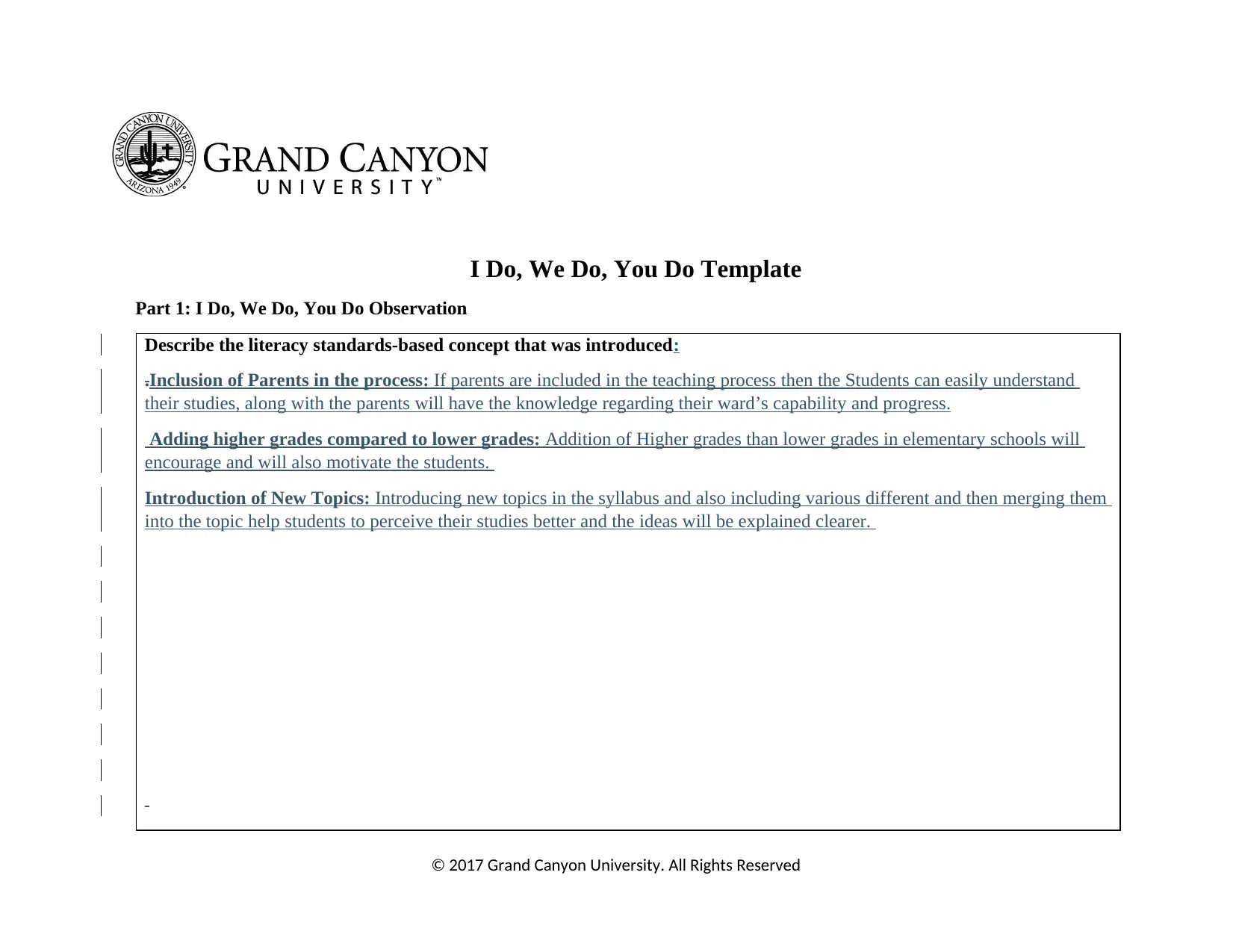
Part 3: Reflection:
The overall degree of the effectiveness of the model for teaching of new concepts of literacy was very informative and easy to
handle and mostly very easy to grasp. The mentors and groomers were helpful, and I learnt a lot of new things. The department
of student management was one of the important part, that is focused the most and found it quite difficult to understand and
execute but with the help of my mentors I was successfully able to manage it.
Education is necessary for literacy. And keeping up with time, new methods needs to be applied to match with the progressive
generation. Therefore improvement is needed in the area of literacy. Therefore my specialization in this sector will help me
serve the needful and spread literacy.
© 2017 Grand Canyon University. All Rights Reserved
chevron_up_icon
1 out of 4
circle_padding
hide_on_mobile
zoom_out_icon
[object Object]