Case Study Analysis: I.M.A.G.E. Sales Planning and Operations

Verified

Added on  2022/08/10

|3
|503
|281
Case Study
AI Summary
This document presents an analysis of the I.M.A.G.E. case study, focusing on sales planning and operations. The analysis covers the incentives provided, the strengths and weaknesses of the Reynolds system, and potential areas for improvement. The study examines the effectiveness of the sales program, highlighting concerns such as the impact of consistent winners and the lack of formal performance appraisals. It discusses how the company utilizes data for shipment schedules and sales territory comparisons, while also pointing out the limitations of not using regression equations for incentive calculations. Furthermore, it compares the company's approach to sales force management with that of other organizations, emphasizing the importance of personal evaluation and transparency. The document provides insights into how the company could optimize its sales strategies and improve overall performance.
Document Page
Case study: I.M.A.G.E
SALES PLANNING
AND
OPERATIONS
tabler-icon-diamond-filled.svg

Paraphrase This Document

Need a fresh take? Get an instant paraphrase of this document with our AI Paraphraser
Document Page
1
Case study: I.M.A.G.E
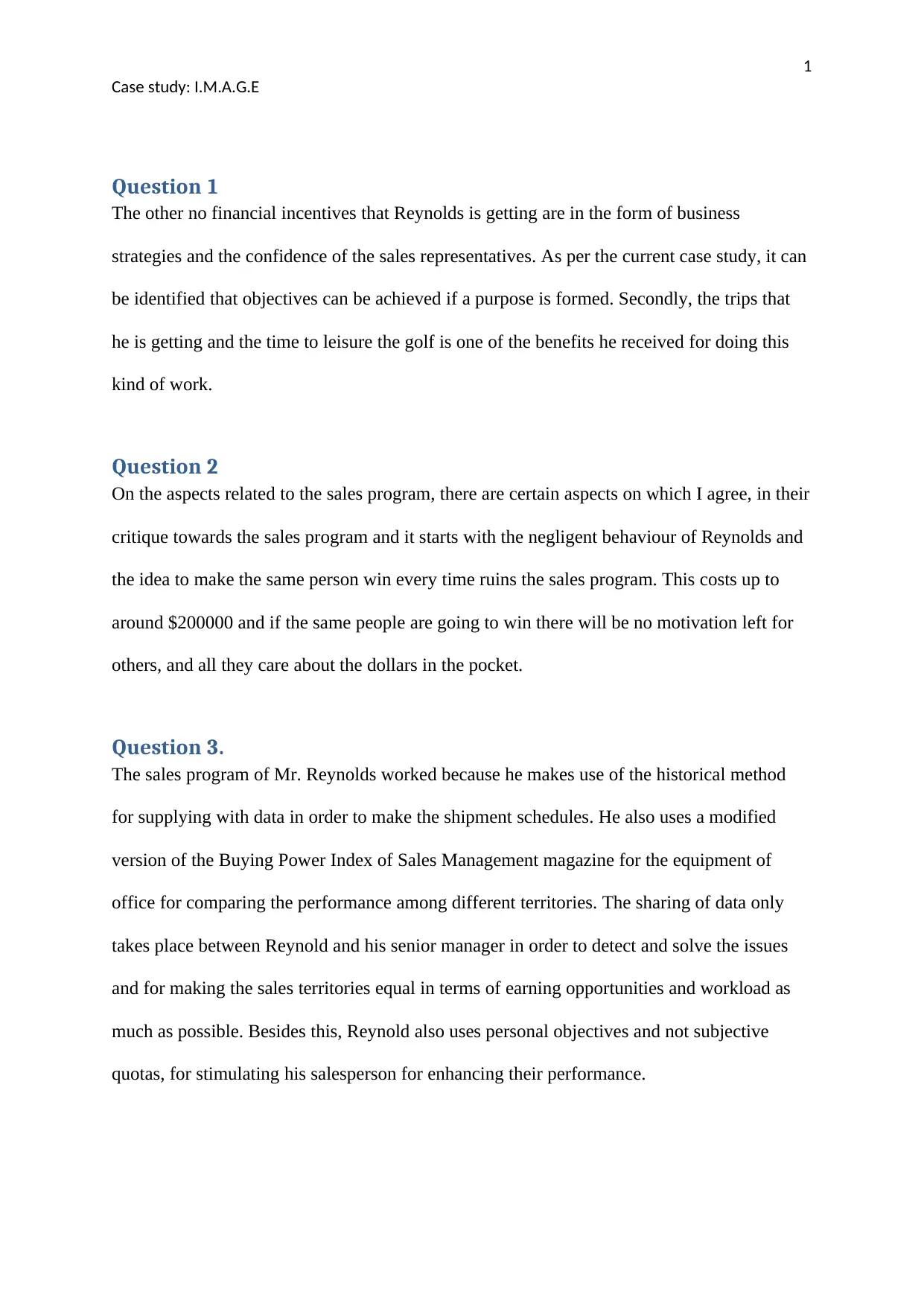
Question 1
The other no financial incentives that Reynolds is getting are in the form of business
strategies and the confidence of the sales representatives. As per the current case study, it can
be identified that objectives can be achieved if a purpose is formed. Secondly, the trips that
he is getting and the time to leisure the golf is one of the benefits he received for doing this
kind of work.
Question 2
On the aspects related to the sales program, there are certain aspects on which I agree, in their
critique towards the sales program and it starts with the negligent behaviour of Reynolds and
the idea to make the same person win every time ruins the sales program. This costs up to
around $200000 and if the same people are going to win there will be no motivation left for
others, and all they care about the dollars in the pocket.
Question 3.
The sales program of Mr. Reynolds worked because he makes use of the historical method
for supplying with data in order to make the shipment schedules. He also uses a modified
version of the Buying Power Index of Sales Management magazine for the equipment of
office for comparing the performance among different territories. The sharing of data only
takes place between Reynold and his senior manager in order to detect and solve the issues
and for making the sales territories equal in terms of earning opportunities and workload as
much as possible. Besides this, Reynold also uses personal objectives and not subjective
quotas, for stimulating his salesperson for enhancing their performance.
Document Page
2
Case study: I.M.A.G.E
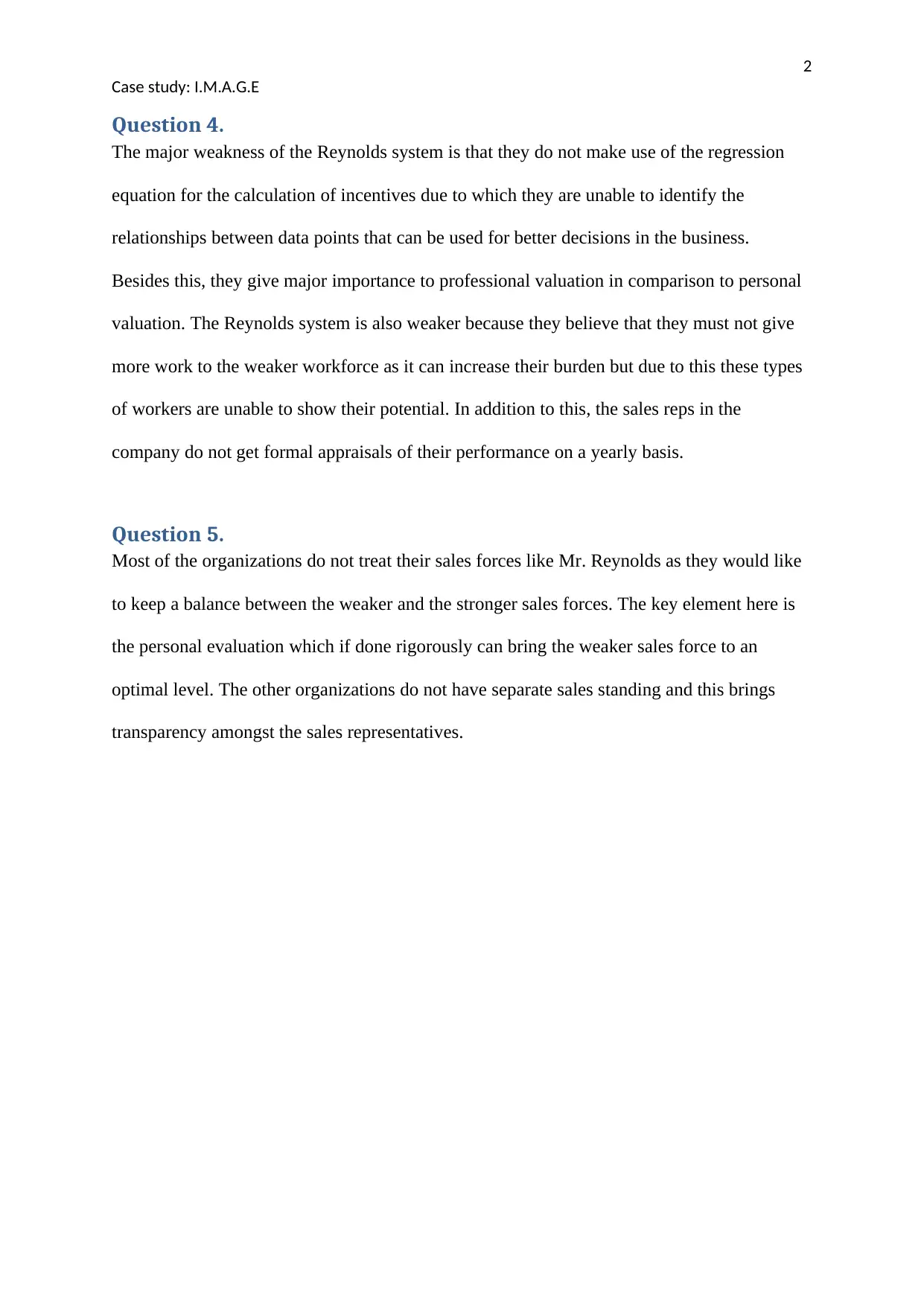
Question 4.
The major weakness of the Reynolds system is that they do not make use of the regression
equation for the calculation of incentives due to which they are unable to identify the
relationships between data points that can be used for better decisions in the business.
Besides this, they give major importance to professional valuation in comparison to personal
valuation. The Reynolds system is also weaker because they believe that they must not give
more work to the weaker workforce as it can increase their burden but due to this these types
of workers are unable to show their potential. In addition to this, the sales reps in the
company do not get formal appraisals of their performance on a yearly basis.
Question 5.
Most of the organizations do not treat their sales forces like Mr. Reynolds as they would like
to keep a balance between the weaker and the stronger sales forces. The key element here is
the personal evaluation which if done rigorously can bring the weaker sales force to an
optimal level. The other organizations do not have separate sales standing and this brings
transparency amongst the sales representatives.
chevron_up_icon
1 out of 3
circle_padding
hide_on_mobile
zoom_out_icon
[object Object]