Financial Accounting Report: IAS 16 Paragraph 17 Amendment Analysis
VerifiedAdded on 2023/01/06
|10
|2220
|62
Report
AI Summary
This report analyzes the recent amendments made to paragraph 17 of IAS 16, focusing on their impact on financial accounting practices. The report examines how these amendments affect the reporting of sales, particularly concerning property, plant, and equipment (PPE). It delves into the changes in accounting for testing costs, depreciation, and the treatment of sale proceeds before PPE is ready for use. The analysis includes a critical evaluation of the current requirements of IAS 16 and the proposed amendments, assessing their implications for profitability and financial statements. The report also presents a memo and a letter to a company, illustrating the practical effects of these amendments on financial reporting and the overall financial performance of an organization. The report also discusses the impact of the amendments on the overall cost of PPE, including the inclusion of testing costs and the implications for depreciation calculations. The author argues that while certain amendments may improve the accuracy of financial reporting, they also introduce complexities in determining the cost of production and profitability.

finance accounting
Paraphrase This Document
Need a fresh take? Get an instant paraphrase of this document with our AI Paraphraser

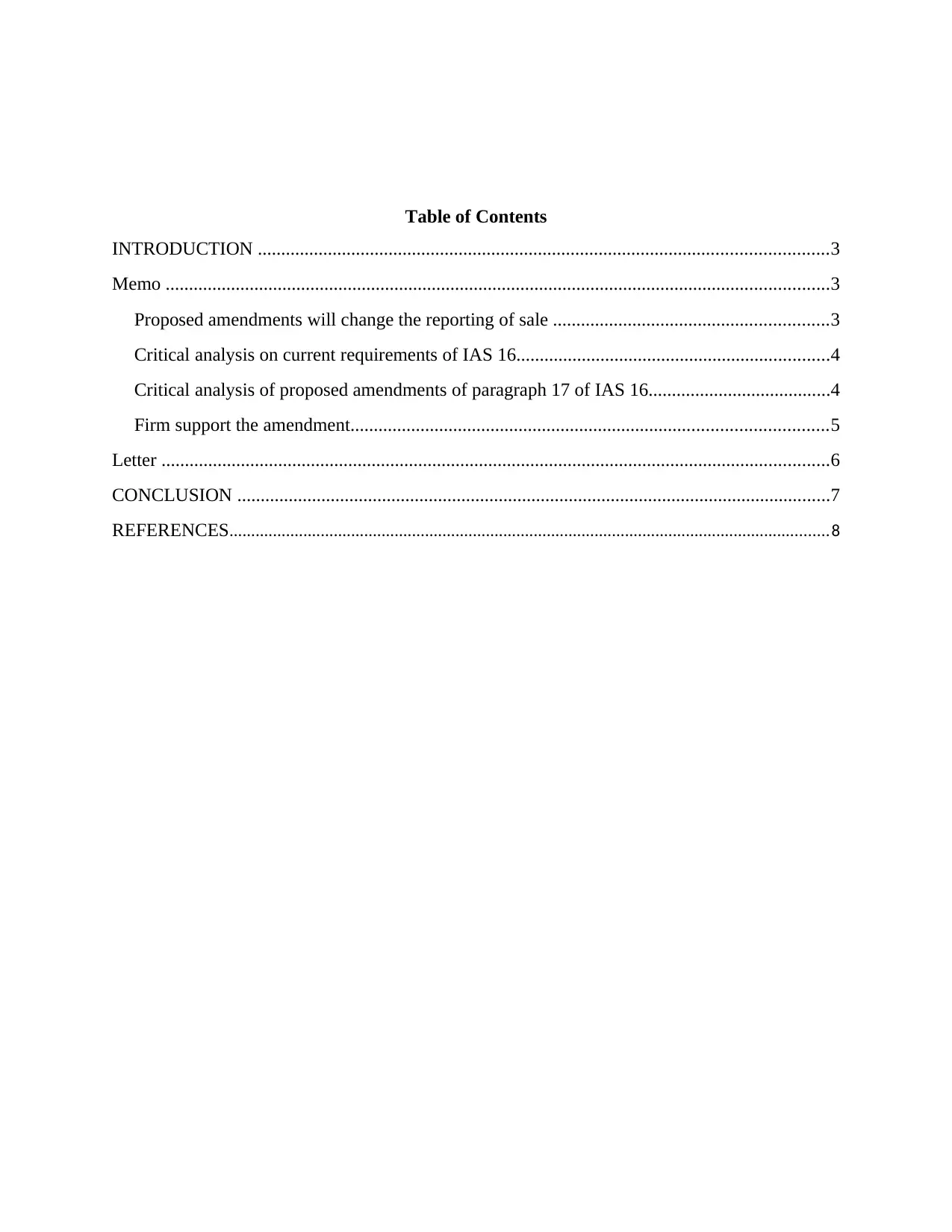
Table of Contents
INTRODUCTION ..........................................................................................................................3
Memo ..............................................................................................................................................3
Proposed amendments will change the reporting of sale ...........................................................3
Critical analysis on current requirements of IAS 16...................................................................4
Critical analysis of proposed amendments of paragraph 17 of IAS 16.......................................4
Firm support the amendment......................................................................................................5
Letter ...............................................................................................................................................6
CONCLUSION ...............................................................................................................................7
REFERENCES..........................................................................................................................................8
INTRODUCTION ..........................................................................................................................3
Memo ..............................................................................................................................................3
Proposed amendments will change the reporting of sale ...........................................................3
Critical analysis on current requirements of IAS 16...................................................................4
Critical analysis of proposed amendments of paragraph 17 of IAS 16.......................................4
Firm support the amendment......................................................................................................5
Letter ...............................................................................................................................................6
CONCLUSION ...............................................................................................................................7
REFERENCES..........................................................................................................................................8

INTRODUCTION
Finance accounting is denoted as reporting the financial transactions of company in
accounting books. Financial accounting is conducted based on the standards and norms provided
by International Accounting Standard. This report would briefly emphasis on recent amendments
made in IAS paragraph 17. Henceforth, report will emphasis on how these amendments would
change the accounting for sale. Current requirements of amendments will also analyses in this
report. Weather these amendments are acceptable on the basis of convenience will also analyses.
Furthermore, this report will also provide a brief overview over the current requirement of
amendments made in paragraph 17. Impacts of such amendments will also address in this report.
Finance accounting is denoted as reporting the financial transactions of company in
accounting books. Financial accounting is conducted based on the standards and norms provided
by International Accounting Standard. This report would briefly emphasis on recent amendments
made in IAS paragraph 17. Henceforth, report will emphasis on how these amendments would
change the accounting for sale. Current requirements of amendments will also analyses in this
report. Weather these amendments are acceptable on the basis of convenience will also analyses.
Furthermore, this report will also provide a brief overview over the current requirement of
amendments made in paragraph 17. Impacts of such amendments will also address in this report.
⊘ This is a preview!⊘
Do you want full access?
Subscribe today to unlock all pages.

Trusted by 1+ million students worldwide

Memo
Paraphrase This Document
Need a fresh take? Get an instant paraphrase of this document with our AI Paraphraser

Proposed amendments will change the reporting of sale
In recent time amendments has made in paragraph 17 of IAS 16. Every amendments has
its own impact over reporting transactions in accounting books as they directly relate to
accounting procedures. The recent amendments specified that all such proceed of sale that
entertained before the PPE is ready to use will be recorded separately in the profit and loss
account of company. Such sales proceed will not have any impact over the overall cost of
making the PPE ready to use (Bergmann and Fuchs, 2017). The proposed amendment provided
that cost of testing would be a part of overall cost. This would reduce the profitability as the
cost will increase out of the transaction occurred. All such direct material and direct labor
entertained in selling would reduce the overall profitability of the selling transaction. The new
amendment would impact the overall profitability of sale as now additional cost like tasting cost
will also be a part of overall cost which will reduce the profitability margin. The new
amendment would also improve the profit margin as now depreciation cost of all such PPE that
are not available for use will not be reported so it will increase the profitability of organization
against the sales entertained. Abnormal cost will also not be a part of overall cost of making
PPE ready to use which will also further reduce the depreciation cost that will also increase the
sale revenue.
Critical analysis on current requirements of IAS 16
In the current situation sale proceeds occurred during the time any of the PPE is ready to
use are directly reduces from the overall cost of making such assets ready. This result into
organization generate more profit due to such sale along with other sales in the normal course of
business. In the existing situation cost of testing the PPE assets are not considered as a part of
overall cost occurred to complete such assets (Camfferman and Zeff, 2018). In the current
circumstances depreciation associated with the PPE assets are also a part of cost of production
as it takes a part of operation in order to produce the products. In the current practice there is
not any issue related to identify the normal capacity of equipment to produce products. It is also
not needed to differentiate cost such as direct material and direct labor require to sale products
and to complete PPE.
Critical analysis of proposed amendments of paragraph 17 of IAS 16
Paragraph 17 of IAS 16 is associated with the directly attribute cost in respect to
property, plant and equipment which also indicate as PPE. The amendments implemented
In recent time amendments has made in paragraph 17 of IAS 16. Every amendments has
its own impact over reporting transactions in accounting books as they directly relate to
accounting procedures. The recent amendments specified that all such proceed of sale that
entertained before the PPE is ready to use will be recorded separately in the profit and loss
account of company. Such sales proceed will not have any impact over the overall cost of
making the PPE ready to use (Bergmann and Fuchs, 2017). The proposed amendment provided
that cost of testing would be a part of overall cost. This would reduce the profitability as the
cost will increase out of the transaction occurred. All such direct material and direct labor
entertained in selling would reduce the overall profitability of the selling transaction. The new
amendment would impact the overall profitability of sale as now additional cost like tasting cost
will also be a part of overall cost which will reduce the profitability margin. The new
amendment would also improve the profit margin as now depreciation cost of all such PPE that
are not available for use will not be reported so it will increase the profitability of organization
against the sales entertained. Abnormal cost will also not be a part of overall cost of making
PPE ready to use which will also further reduce the depreciation cost that will also increase the
sale revenue.
Critical analysis on current requirements of IAS 16
In the current situation sale proceeds occurred during the time any of the PPE is ready to
use are directly reduces from the overall cost of making such assets ready. This result into
organization generate more profit due to such sale along with other sales in the normal course of
business. In the existing situation cost of testing the PPE assets are not considered as a part of
overall cost occurred to complete such assets (Camfferman and Zeff, 2018). In the current
circumstances depreciation associated with the PPE assets are also a part of cost of production
as it takes a part of operation in order to produce the products. In the current practice there is
not any issue related to identify the normal capacity of equipment to produce products. It is also
not needed to differentiate cost such as direct material and direct labor require to sale products
and to complete PPE.
Critical analysis of proposed amendments of paragraph 17 of IAS 16
Paragraph 17 of IAS 16 is associated with the directly attribute cost in respect to
property, plant and equipment which also indicate as PPE. The amendments implemented

surrounded aspects like cost allocation, exclusion of depreciation, PPE available for use,
assessment of ordinary activities, interaction with existing requirements, overall approach,
transition and other aspects. The new amendments carry a different opinions of all the expert
professionals. Item sold before the PPE is ready to use will be reared as the income in profit and
loss account. It can be deducted from the overall cost of developing such PPE. The respective
sale will also not involve the value of depreciation consume in producing such products as the
PPE is not ready to use (Coetzee and et.al., 2016). It can be critically assessed that this
amendment is unfair in respect to accounting principles. As even if the PPE is not ready to use
the product company has sold consume such PPE so they also must consist the depreciation of
such asset. Excluding depreciation in calculating accounting profit of such sales do not
represent the correct profitability. It will represent inappropriate and better financial stability
and profitability of organization for no reason. After the amendments are made cost of testing
will also be a part of PPE over cost required to make the asset ready to use. This was earlier not
a part of overall cost of such equipment, property and plant. After the implementation of this
amendment now financial professionals requires to evaluate the direct labor and material cost
incurred in testing such property. This has also increased the overall depreciation value of the
organization as now the depreciation of such testing cost will also involve in the financial
statements of company (Derun, 2017). This can be projected as the relevant amendment as
earlier all such cost entertained to make the PPE ready to use except the testing cost. This cost
also contribute in making the PPE ready to use so it must be considered while evaluating the
overall cost incurred to make the asset ready to use so as depreciation of testing cost must also
be a included in the overall depreciation value of organization. Determination of overall cost of
production of such units consumes the PPE even they are not ready to use is also a critical
aspect. Its not easy to calculate the cost of production of such units which also make the
evaluation more difficult to determine the profitability of such transaction. It has also stated that
consumption of property, plant and equipment before they are ready to use are likely to be
negligible. Excluding depreciation in calculating overall cost of production might consist as a
result unit cost and profitability margins do not reflect the exact profitability statistics in the
normal business circumstances. The amendment related to involving testing cost in the overall
cost of PPE is also significant amendment decision in respect to assets contain limited useful
assessment of ordinary activities, interaction with existing requirements, overall approach,
transition and other aspects. The new amendments carry a different opinions of all the expert
professionals. Item sold before the PPE is ready to use will be reared as the income in profit and
loss account. It can be deducted from the overall cost of developing such PPE. The respective
sale will also not involve the value of depreciation consume in producing such products as the
PPE is not ready to use (Coetzee and et.al., 2016). It can be critically assessed that this
amendment is unfair in respect to accounting principles. As even if the PPE is not ready to use
the product company has sold consume such PPE so they also must consist the depreciation of
such asset. Excluding depreciation in calculating accounting profit of such sales do not
represent the correct profitability. It will represent inappropriate and better financial stability
and profitability of organization for no reason. After the amendments are made cost of testing
will also be a part of PPE over cost required to make the asset ready to use. This was earlier not
a part of overall cost of such equipment, property and plant. After the implementation of this
amendment now financial professionals requires to evaluate the direct labor and material cost
incurred in testing such property. This has also increased the overall depreciation value of the
organization as now the depreciation of such testing cost will also involve in the financial
statements of company (Derun, 2017). This can be projected as the relevant amendment as
earlier all such cost entertained to make the PPE ready to use except the testing cost. This cost
also contribute in making the PPE ready to use so it must be considered while evaluating the
overall cost incurred to make the asset ready to use so as depreciation of testing cost must also
be a included in the overall depreciation value of organization. Determination of overall cost of
production of such units consumes the PPE even they are not ready to use is also a critical
aspect. Its not easy to calculate the cost of production of such units which also make the
evaluation more difficult to determine the profitability of such transaction. It has also stated that
consumption of property, plant and equipment before they are ready to use are likely to be
negligible. Excluding depreciation in calculating overall cost of production might consist as a
result unit cost and profitability margins do not reflect the exact profitability statistics in the
normal business circumstances. The amendment related to involving testing cost in the overall
cost of PPE is also significant amendment decision in respect to assets contain limited useful
⊘ This is a preview!⊘
Do you want full access?
Subscribe today to unlock all pages.

Trusted by 1+ million students worldwide

life.
Firm support the amendment
The proposed amendments made in paragraph 17 of IAS 16 can create both positive and
negative impacts over the financial performance of organization. The current amendment
related to inclusion of cost of testing in the overall cost of PPE is an effective amendment as
testing cost also a part of cost incurred to produce the PPE (Lucianelli and Citro, 2018).
Previously this was not a part of overall cost of PPE but now after the adamant has made this is
a part of overall cost of producing PPE. Firm must implement this regulation as according to
accounting terminologies all cost incurred to make the PPE ready to use are consider as the
overall cost of such PPE. This cost must be a part of the overall cost as it contribute in the PPE
ready to use condition. Inclusion of testing cost will make a better representation of the value of
PPE in company’s book of accounts. The amendment in respect to sale made is critical as the
overall cost of PPE can be reduced from the overall cost of developing such asset (Pinto and
Morais, 2019). This will also reduce the value of depreciation company charge every year
which would further improve the profitability of organization. Organization should not
implement this regulation as it will not present the correct value of PPE in financial statements
of company.
Letter
TO,
The Company A
207, Post Box Road, London, United Kingdom
Sub.: Analysis impacts of amendments of Paragraph 17 of IAS 16 over company's affairs.
Respective Board of Directors of Company A, we have analyzed the entire modifications
amended in Paragraph 17 of IAS 16. On the basis of the modifications granted in IAS 16
Firm support the amendment
The proposed amendments made in paragraph 17 of IAS 16 can create both positive and
negative impacts over the financial performance of organization. The current amendment
related to inclusion of cost of testing in the overall cost of PPE is an effective amendment as
testing cost also a part of cost incurred to produce the PPE (Lucianelli and Citro, 2018).
Previously this was not a part of overall cost of PPE but now after the adamant has made this is
a part of overall cost of producing PPE. Firm must implement this regulation as according to
accounting terminologies all cost incurred to make the PPE ready to use are consider as the
overall cost of such PPE. This cost must be a part of the overall cost as it contribute in the PPE
ready to use condition. Inclusion of testing cost will make a better representation of the value of
PPE in company’s book of accounts. The amendment in respect to sale made is critical as the
overall cost of PPE can be reduced from the overall cost of developing such asset (Pinto and
Morais, 2019). This will also reduce the value of depreciation company charge every year
which would further improve the profitability of organization. Organization should not
implement this regulation as it will not present the correct value of PPE in financial statements
of company.
Letter
TO,
The Company A
207, Post Box Road, London, United Kingdom
Sub.: Analysis impacts of amendments of Paragraph 17 of IAS 16 over company's affairs.
Respective Board of Directors of Company A, we have analyzed the entire modifications
amended in Paragraph 17 of IAS 16. On the basis of the modifications granted in IAS 16
Paraphrase This Document
Need a fresh take? Get an instant paraphrase of this document with our AI Paraphraser

following are the impact would create over the business affairs of Company A in respect to the
acquisition of Plant done by company.
Overview of current requirement
The above mentioned information project that acquisition cost of Plant is $200 million,
testing cost till date worth $7 million. On the basis of the amendments made in paragraph 17 of
IAS 16 this testing cost will also be a part of the overall cost of Plant. Based on the regulations
now the overall cost of plant for Company A will be $ 207 million. This cost comprises with the
acquisition cost and testing cost of such Plant. The information further state that cost of
producing product in the testing period is worth $ 6 million and selling price entertained out of
such product produced worth $ 9 million so the accounting profit generated out of selling the
products in testing phase worth $ 3 million would be recorded as profit in the Profit and Loss
Account of the Company A. The above analysis are done on the basis of the amendment created
in IAS 16 in paragraph 17. In accounting sense it is logical to include the testing cost in the
overall cost of acquisition of the Plant as even the testing cost is incurred in order to make the
asset ready to use for doing business operations. Profitability generated worth $ 3 million out of
the sale of testing products A would record as the profitability of the organization. This is also
logical to record such earning as the profitability of the company. This profit worth $ 3 million
can also be excluded from the overall cost of acquisition of Plant but due to amendments lade in
Paragraph 17 of IAS 16 it would record as the profitability of the Company A.
Posible impacts of proposed amendment
The amendment has created an impact over the profitability of the Company A. The
average profitability of the organization is estimated worth $ 30 million which will now be
recorded as $ 33 million. The regulations created in Paragraph 17 of IAS 16 also created impact
over the overall acquisition cost of Plant which earlier was supposed to be only $ 200 million
which will not be recorded as $ 207 million. This will further influence the annual depreciation
amount Company A will suffer as earlier it would have charged on $ 200 million which will now
be charged over the amount of $ 207 million. This inclusion of the testing cost in the overall
acquisition cost of Plant will also increase the amount of depreciation every year will be charged
against the profitability of Company A.
acquisition of Plant done by company.
Overview of current requirement
The above mentioned information project that acquisition cost of Plant is $200 million,
testing cost till date worth $7 million. On the basis of the amendments made in paragraph 17 of
IAS 16 this testing cost will also be a part of the overall cost of Plant. Based on the regulations
now the overall cost of plant for Company A will be $ 207 million. This cost comprises with the
acquisition cost and testing cost of such Plant. The information further state that cost of
producing product in the testing period is worth $ 6 million and selling price entertained out of
such product produced worth $ 9 million so the accounting profit generated out of selling the
products in testing phase worth $ 3 million would be recorded as profit in the Profit and Loss
Account of the Company A. The above analysis are done on the basis of the amendment created
in IAS 16 in paragraph 17. In accounting sense it is logical to include the testing cost in the
overall cost of acquisition of the Plant as even the testing cost is incurred in order to make the
asset ready to use for doing business operations. Profitability generated worth $ 3 million out of
the sale of testing products A would record as the profitability of the organization. This is also
logical to record such earning as the profitability of the company. This profit worth $ 3 million
can also be excluded from the overall cost of acquisition of Plant but due to amendments lade in
Paragraph 17 of IAS 16 it would record as the profitability of the Company A.
Posible impacts of proposed amendment
The amendment has created an impact over the profitability of the Company A. The
average profitability of the organization is estimated worth $ 30 million which will now be
recorded as $ 33 million. The regulations created in Paragraph 17 of IAS 16 also created impact
over the overall acquisition cost of Plant which earlier was supposed to be only $ 200 million
which will not be recorded as $ 207 million. This will further influence the annual depreciation
amount Company A will suffer as earlier it would have charged on $ 200 million which will now
be charged over the amount of $ 207 million. This inclusion of the testing cost in the overall
acquisition cost of Plant will also increase the amount of depreciation every year will be charged
against the profitability of Company A.

Thank You.
CONCLUSION
Amendments made in IAS 16 of Paragraph 17 contain various regulations such as testing
cost will also be a part of the overall cost of acquisition in case of Plant, Property and
Equipment. Any profits entertained out of selling products in the tenure of testing would be a
part of the income side of income statement of company.
REFERENCES
Books and Journals
Bergmann, A. and Fuchs, S., 2017. Accounting standards for complex resources of international
organizations. Global Policy. 8. pp.26-35.
Camfferman, K. and Zeff, S. A., 2018. The challenge of setting standards for a worldwide
constituency: Research implications from the IASB’s early history. European
Accounting Review. 27(2). pp.289-312.
Coetzee, S. A and et.al., 2016. Differences in students’ reading comprehension of international
financial reporting standards: a South African case. Accounting Education. 25(4).
pp.306-326.
Derun, I., 2017. Improvement of the essence of professional judgment in accounting of
Ukraine. Technology audit and production reserves. 2(4 (34). pp.25-29.
CONCLUSION
Amendments made in IAS 16 of Paragraph 17 contain various regulations such as testing
cost will also be a part of the overall cost of acquisition in case of Plant, Property and
Equipment. Any profits entertained out of selling products in the tenure of testing would be a
part of the income side of income statement of company.
REFERENCES
Books and Journals
Bergmann, A. and Fuchs, S., 2017. Accounting standards for complex resources of international
organizations. Global Policy. 8. pp.26-35.
Camfferman, K. and Zeff, S. A., 2018. The challenge of setting standards for a worldwide
constituency: Research implications from the IASB’s early history. European
Accounting Review. 27(2). pp.289-312.
Coetzee, S. A and et.al., 2016. Differences in students’ reading comprehension of international
financial reporting standards: a South African case. Accounting Education. 25(4).
pp.306-326.
Derun, I., 2017. Improvement of the essence of professional judgment in accounting of
Ukraine. Technology audit and production reserves. 2(4 (34). pp.25-29.
⊘ This is a preview!⊘
Do you want full access?
Subscribe today to unlock all pages.

Trusted by 1+ million students worldwide

Lucianelli, G. and Citro, F., 2018. Accounting Education for Professional Accountants: Evidence
from Italy. International Journal of Business and Management. 13(8). pp.1-15.
Pinto, I. and Morais, A. I., 2019. What matters in disclosures of key audit matters: Evidence
from Europe. Journal of International Financial Management & Accounting. 30(2).
pp.145-162.
Online:
IAS 16 Paragraph 17 amendments, 2020. [Online]. Available Through:
<https://www.ifrs.org/issued-standards/list-of-standards/ias-16-property-plant-and-equipment/>.
from Italy. International Journal of Business and Management. 13(8). pp.1-15.
Pinto, I. and Morais, A. I., 2019. What matters in disclosures of key audit matters: Evidence
from Europe. Journal of International Financial Management & Accounting. 30(2).
pp.145-162.
Online:
IAS 16 Paragraph 17 amendments, 2020. [Online]. Available Through:
<https://www.ifrs.org/issued-standards/list-of-standards/ias-16-property-plant-and-equipment/>.
1 out of 10
Related Documents
Your All-in-One AI-Powered Toolkit for Academic Success.
+13062052269
info@desklib.com
Available 24*7 on WhatsApp / Email
Unlock your academic potential
Copyright © 2020–2026 A2Z Services. All Rights Reserved. Developed and managed by ZUCOL.