Comprehensive Analysis of IAS 8 on Accounting Policies and Estimates

Verified

Added on  2021/06/15

|9
|1865
|100
Report
AI Summary
This report provides a detailed analysis of IAS 8, focusing on accounting policies, changes in accounting estimates, and errors. It examines the proposed amendments in ED/2017/5, highlighting the clarification of terms like 'accounting estimates' and 'measurement bases.' The report outlines the perceptions of various organizations, including the UK Financial Reporting Council (FRC), the Australian Council of Auditors-General (ACAG), RMS International Limited, and Volkswagen, regarding the proposed changes. It assesses the effectiveness of the amendments, particularly in distinguishing between accounting policies and estimates, and discusses the implications of different valuation methods, such as FIFO, in inventory valuation. The conclusion emphasizes the consistency of the proposed changes and recommends the consideration of cost formulas in inventory valuation as accounting estimates.

Document Page
Question 2
tabler-icon-diamond-filled.svg

Paraphrase This Document

Need a fresh take? Get an instant paraphrase of this document with our AI Paraphraser
Document Page
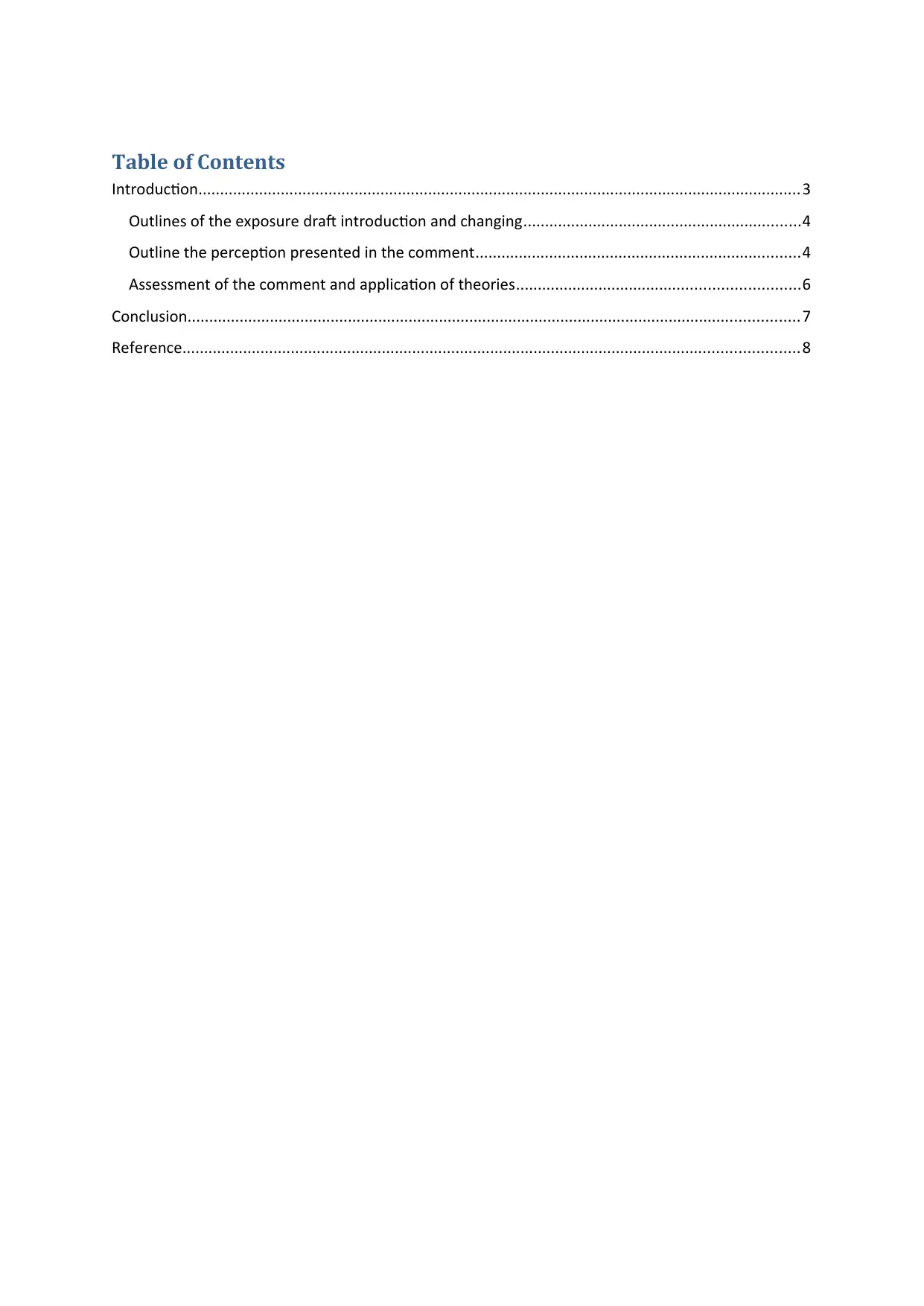
Table of Contents
Introduction...........................................................................................................................................3
Outlines of the exposure draft introduction and changing................................................................4
Outline the perception presented in the comment...........................................................................4
Assessment of the comment and application of theories.................................................................6
Conclusion.............................................................................................................................................7
Reference..............................................................................................................................................8
Document Page
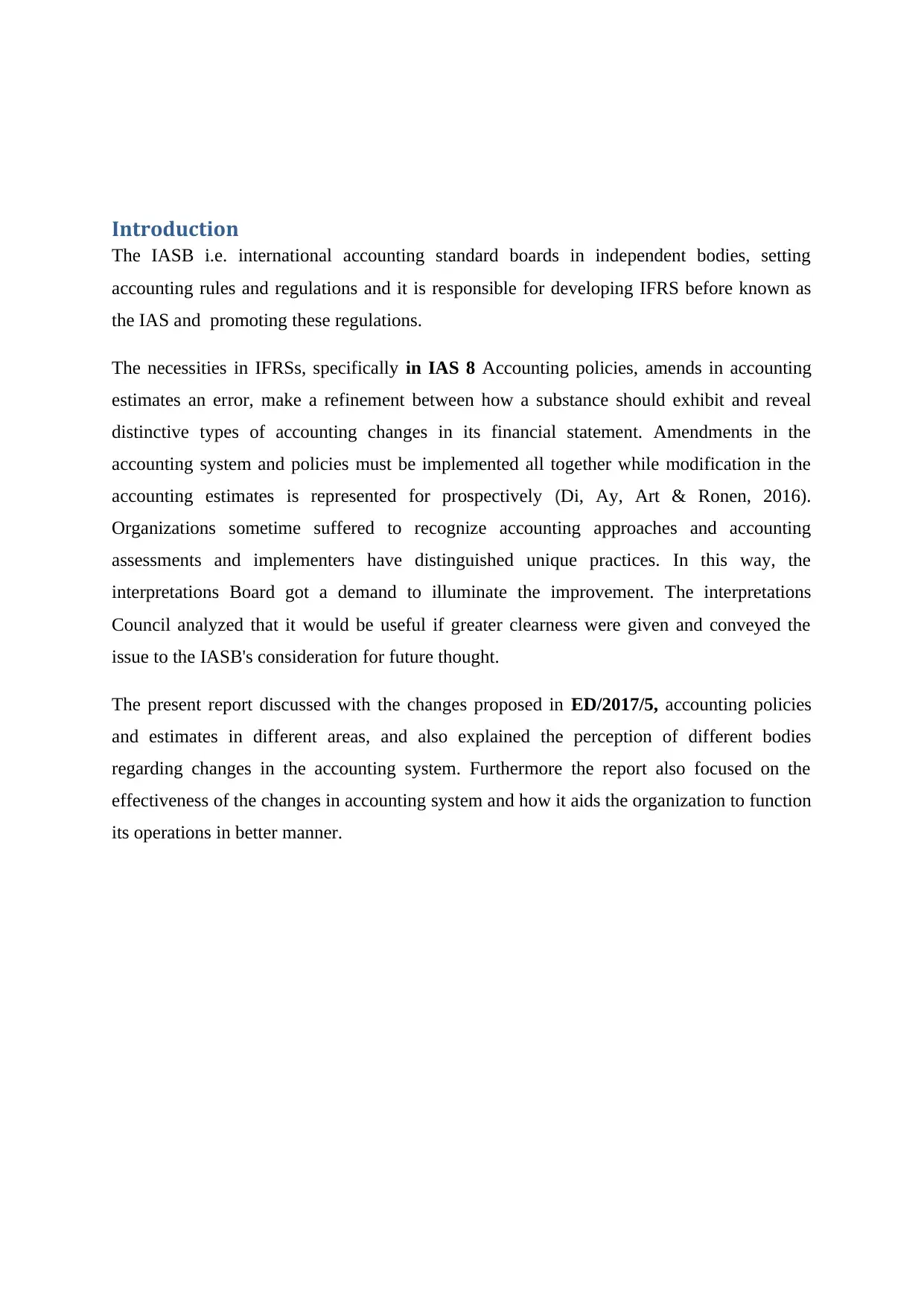
Introduction
The IASB i.e. international accounting standard boards in independent bodies, setting
accounting rules and regulations and it is responsible for developing IFRS before known as
the IAS and promoting these regulations.
The necessities in IFRSs, specifically in IAS 8 Accounting policies, amends in accounting
estimates an error, make a refinement between how a substance should exhibit and reveal
distinctive types of accounting changes in its financial statement. Amendments in the
accounting system and policies must be implemented all together while modification in the
accounting estimates is represented for prospectively (Di, Ay, Art & Ronen, 2016).
Organizations sometime suffered to recognize accounting approaches and accounting
assessments and implementers have distinguished unique practices. In this way, the
interpretations Board got a demand to illuminate the improvement. The interpretations
Council analyzed that it would be useful if greater clearness were given and conveyed the
issue to the IASB's consideration for future thought.
The present report discussed with the changes proposed in ED/2017/5, accounting policies
and estimates in different areas, and also explained the perception of different bodies
regarding changes in the accounting system. Furthermore the report also focused on the
effectiveness of the changes in accounting system and how it aids the organization to function
its operations in better manner.
Document Page
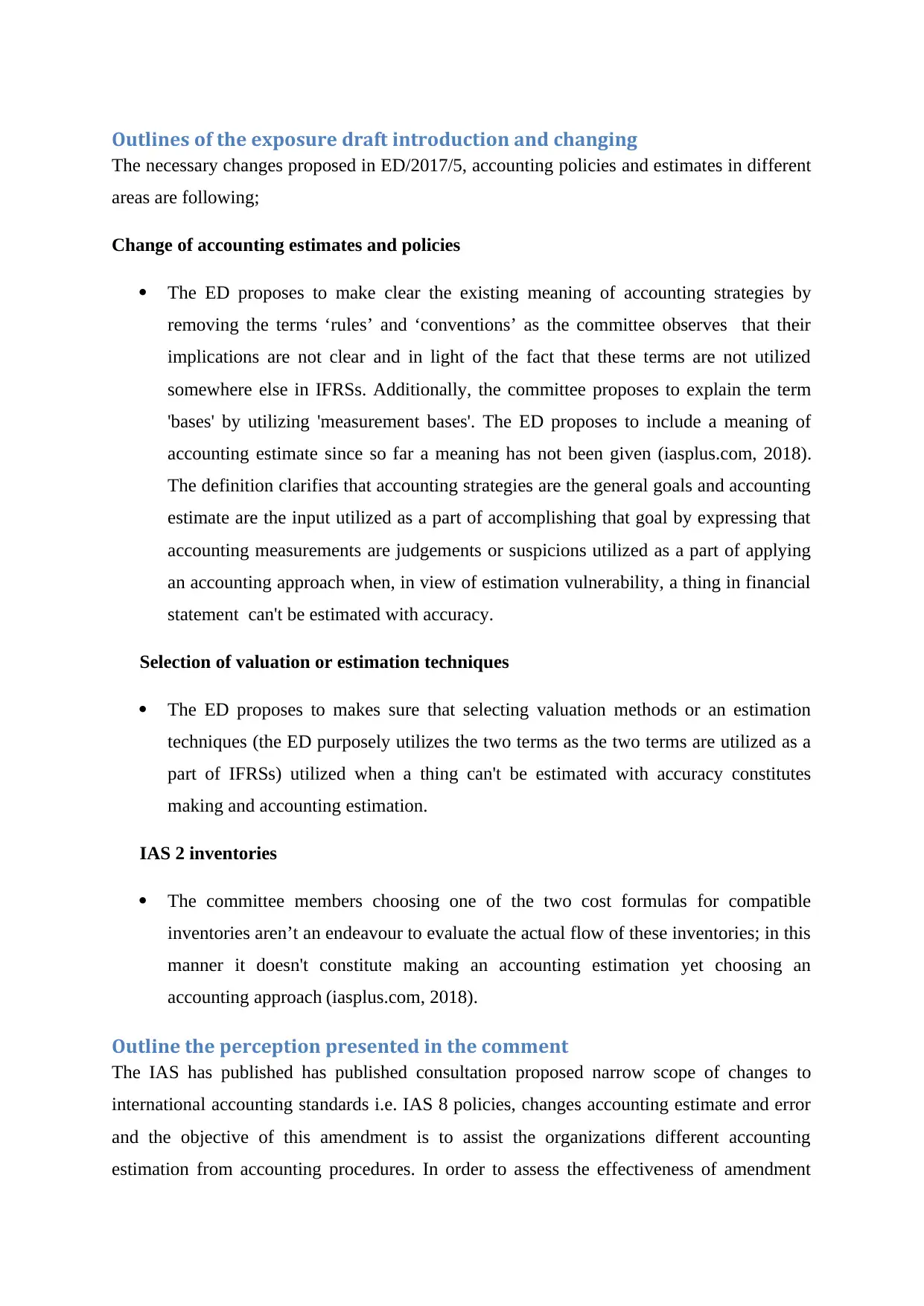
Outlines of the exposure draft introduction and changing
The necessary changes proposed in ED/2017/5, accounting policies and estimates in different
areas are following;
Change of accounting estimates and policies
The ED proposes to make clear the existing meaning of accounting strategies by
removing the terms ‘rules’ and ‘conventions’ as the committee observes that their
implications are not clear and in light of the fact that these terms are not utilized
somewhere else in IFRSs. Additionally, the committee proposes to explain the term
'bases' by utilizing 'measurement bases'. The ED proposes to include a meaning of
accounting estimate since so far a meaning has not been given (iasplus.com, 2018).
The definition clarifies that accounting strategies are the general goals and accounting
estimate are the input utilized as a part of accomplishing that goal by expressing that
accounting measurements are judgements or suspicions utilized as a part of applying
an accounting approach when, in view of estimation vulnerability, a thing in financial
statement can't be estimated with accuracy.
Selection of valuation or estimation techniques
The ED proposes to makes sure that selecting valuation methods or an estimation
techniques (the ED purposely utilizes the two terms as the two terms are utilized as a
part of IFRSs) utilized when a thing can't be estimated with accuracy constitutes
making and accounting estimation.
IAS 2 inventories
The committee members choosing one of the two cost formulas for compatible
inventories aren’t an endeavour to evaluate the actual flow of these inventories; in this
manner it doesn't constitute making an accounting estimation yet choosing an
accounting approach (iasplus.com, 2018).
Outline the perception presented in the comment
The IAS has published has published consultation proposed narrow scope of changes to
international accounting standards i.e. IAS 8 policies, changes accounting estimate and error
and the objective of this amendment is to assist the organizations different accounting
estimation from accounting procedures. In order to assess the effectiveness of amendment
tabler-icon-diamond-filled.svg

Paraphrase This Document

Need a fresh take? Get an instant paraphrase of this document with our AI Paraphraser
Document Page
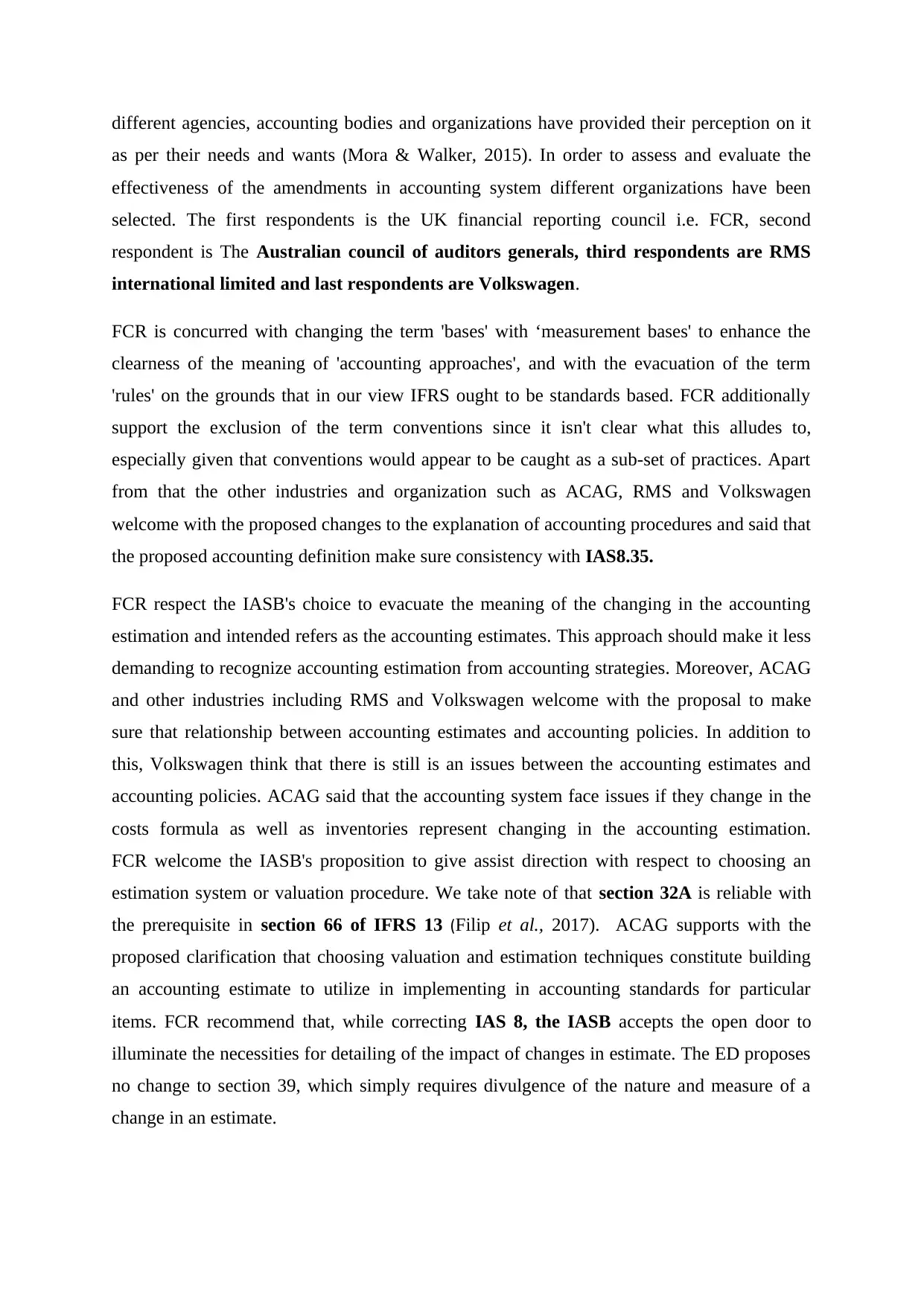
different agencies, accounting bodies and organizations have provided their perception on it
as per their needs and wants (Mora & Walker, 2015). In order to assess and evaluate the
effectiveness of the amendments in accounting system different organizations have been
selected. The first respondents is the UK financial reporting council i.e. FCR, second
respondent is The Australian council of auditors generals, third respondents are RMS
international limited and last respondents are Volkswagen.
FCR is concurred with changing the term 'bases' with ‘measurement bases' to enhance the
clearness of the meaning of 'accounting approaches', and with the evacuation of the term
'rules' on the grounds that in our view IFRS ought to be standards based. FCR additionally
support the exclusion of the term conventions since it isn't clear what this alludes to,
especially given that conventions would appear to be caught as a sub-set of practices. Apart
from that the other industries and organization such as ACAG, RMS and Volkswagen
welcome with the proposed changes to the explanation of accounting procedures and said that
the proposed accounting definition make sure consistency with IAS8.35.
FCR respect the IASB's choice to evacuate the meaning of the changing in the accounting
estimation and intended refers as the accounting estimates. This approach should make it less
demanding to recognize accounting estimation from accounting strategies. Moreover, ACAG
and other industries including RMS and Volkswagen welcome with the proposal to make
sure that relationship between accounting estimates and accounting policies. In addition to
this, Volkswagen think that there is still is an issues between the accounting estimates and
accounting policies. ACAG said that the accounting system face issues if they change in the
costs formula as well as inventories represent changing in the accounting estimation.
FCR welcome the IASB's proposition to give assist direction with respect to choosing an
estimation system or valuation procedure. We take note of that section 32A is reliable with
the prerequisite in section 66 of IFRS 13 (Filip et al., 2017). ACAG supports with the
proposed clarification that choosing valuation and estimation techniques constitute building
an accounting estimate to utilize in implementing in accounting standards for particular
items. FCR recommend that, while correcting IAS 8, the IASB accepts the open door to
illuminate the necessities for detailing of the impact of changes in estimate. The ED proposes
no change to section 39, which simply requires divulgence of the nature and measure of a
change in an estimate.
Document Page
Assessment of the comment and application of theories
From the findings and analysis of all theories and the amendment policies it can be observed
that several industries are in favour of the proposed changes to the definition of accounting
procedures. Although, from the analysis it can be said that replacing the term with
measurement bases made clarification of the definition (Abdallah, 2017). Therefore this
would help the organization to solve issues regarding definition of the accounting definition
in better manner. From the analysis it can be observed that several financial bodies and
industries are not in favour of applying IAS2 inventories, choosing FIFO i.e. first in first out
cost formula or weight average formula. For instance, when such inventories is routinely
utilized as a part of creation or sold, the FIFO cost methods is effectively best consumption
patterned and be chosen on that premise. From the findings it can be noted that sections
BC10-BC11 of IAS 2 Inventories (IAS 2) expressly recognize that, as opposed to the
attestation in section 32B of the ED, cost equations are an estimate of the utilization example
of stock, henceforth the way that utilization of the LIFO equation is disallowed in light of the
fact that it is effectively not a reliable presentation of the authentic inventories flow and
forces an unlikely cost flow assumption. The estimation base connected to inventories is the
accounting arrangement (i.e. that inventories are estimated at the lower of expenditure and
net feasible value) and the cost formula is an accounting estimate chose to be utilized as a
part of applying that accounting approach. Section 32B likewise seems to issues with section
35 of IAS 8, which expresses that when it is hard to recognize an adjustment in an accounting
approach from an adjustment in accounting evaluate, the change is dealt with as an
adjustment in an accounting estimate. From the evaluation it can be seen that section 35
suggests that an adjustment in the cost techniques connected to inventory ought to be dealt
with as an adjustment in accounting estimate. Section 32A, states that choosing estimation
method or valuation method constitutes influencing an accounting to evaluate while section
32B states that choosing one of the two cost equations does not include the utilization of
assumptions or judgment. As in my point of view choosing FIFO as stock valuation strategy
is an assumption that has been made on deciding the sequence of how inventories are being
put up for sold (Goodacre, Ball, McGrath, & Pratt, 2018). The point of proposed revisions to
IAS 8 is to enable elements to recognize accounting strategies from accounting estimates.
Thereby it can be said that the alterations of the policies and procedures, will be no troubles
to recognize an adjustment in an accounting approach from an adjustment in an accounting
estimate.
Document Page
Conclusion
From the evaluation and findings it can be concluded that section 32A and 32B are
consistent. The observation it can be recommended that selecting either Weight Average cost
or first in first out cost in arriving in the cost of inventories is acquainted with an accounting
estimate.
tabler-icon-diamond-filled.svg

Paraphrase This Document

Need a fresh take? Get an instant paraphrase of this document with our AI Paraphraser
Document Page
Reference
Abdallah, A. A. J. (2017). The Conformity Level of Income Tax Accounting In Jordan with
the Requirements of the International Accounting Standard IAS (12) in Terms of
Taxable Temporary Differences’ Recognition. International Business
Research, 10(5), 51.
Di Pietr, A., Ay, M., Art, S., & Ronen, J. (2016). Accounting and regulation. Springer,.
Filip, A., Hammami, A., Huang, Z., Jeny, A., Magnan, M., & Moldovan, R. (2017).
Literature Review on the Effect of Implementation of IFRS 13 Fair Value
Measurement.
Goodacre, A., Ball, R., McGrath, J., & Pratt, K. (2018). 13 Accounting for R & D costs. New
Technologies and the Firm: Innovation and Competition, 48, 292.
iasplus.com. (2018). Retrieved from
https://www.iasplus.com/en/resources/ifrsf/due-process/iasb-eds
Mora, A., & Walker, M. (2015). The implications of research on accounting conservatism for
accounting standard setting. Accounting and Business Research, 45(5), 620-650.
Whittington, G. (2008). Fair value and the IASB/FASB conceptual framework project: an
alternative view. Abacus, 44(2), 139-168.
Document Page
chevron_up_icon
1 out of 9
circle_padding
hide_on_mobile
zoom_out_icon
[object Object]