IBU5HRM Essay: Evaluating International HRM, Culture, and Performance
VerifiedAdded on 2023/06/08
|11
|3182
|54
Essay
AI Summary
This essay provides an overview of Human Resource Management (HRM) in multinational organizations, focusing on the challenges and strategies for managing cultural diversity, international performance, and training and development. It examines the importance of cultural sensitivity in HRM practices, highlighting the need for strategies that respect diverse cultural values and promote inclusivity. The essay also discusses the complexities of international performance management, including the lack of universal appraisal systems and the influence of socio-economic factors. Furthermore, it emphasizes the role of training and development in enhancing employee skills and organizational performance, particularly through cross-cultural training programs. The essay concludes by underscoring the need for HRM strategies that effectively address cultural diversity to improve organizational performance and employee satisfaction.

Human Resource Management

Paraphrase This Document
Need a fresh take? Get an instant paraphrase of this document with our AI Paraphraser
Contents
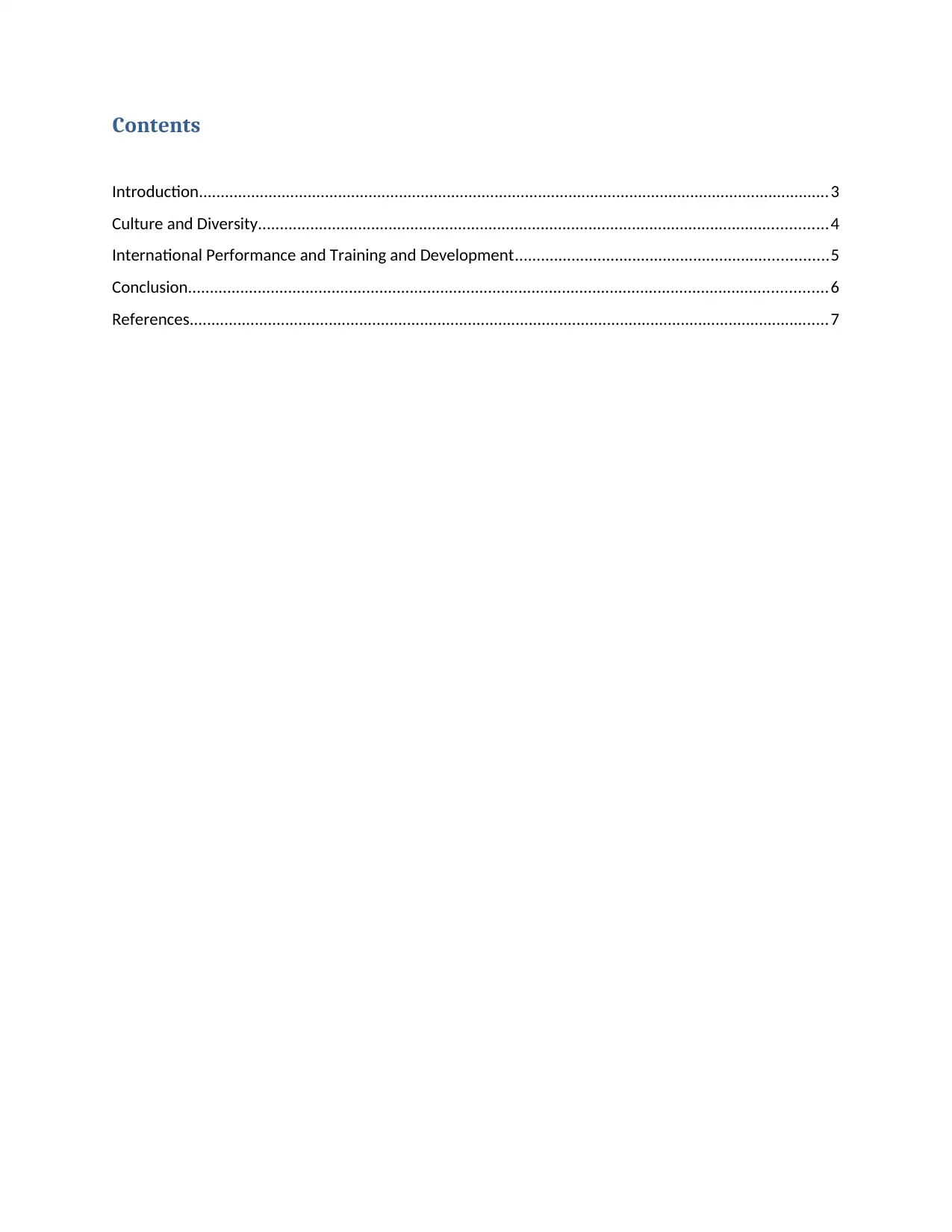
Introduction.................................................................................................................................................3
Culture and Diversity...................................................................................................................................4
International Performance and Training and Development........................................................................5
Conclusion...................................................................................................................................................6
References...................................................................................................................................................7
Introduction.................................................................................................................................................3
Culture and Diversity...................................................................................................................................4
International Performance and Training and Development........................................................................5
Conclusion...................................................................................................................................................6
References...................................................................................................................................................7
Introduction
Human Resource refers to the management of human resources in an organization who works for the
fulfillment of a common goal or objective. There are many multinational organizations in which people
belong to different cultures works and it is very difficult to make them work together for common
objective irrespective of their culture, language, tradition and belongingness. There are so many
concerns or issues that falls under these types of organizations. In multinational companies, people sit at
different location or country and work together on a specific project. They communicate with each other
regarding business but in some cases they contradict each other. The reason behind this contradiction is
that they belong to different diversity and their way of thinking is different from the people sit in other
countries. This creates a huge issue because in such cases, no one can reach to a common decision. In
such organizations, human resource management has to take care about the cultural values of the
people belong to different culture as well as respect their sentiments and way of thinking. Human
resource management also faces some issues in providing training to people belong to different cultures
because their learning capabilities are different and the teaching method suitable to them might also
different. It is the responsivity of human resource management to plan all the trainings in a suitable way
so that it can be beneficial for each and every person irrespective of religion.
Human Resource refers to the management of human resources in an organization who works for the
fulfillment of a common goal or objective. There are many multinational organizations in which people
belong to different cultures works and it is very difficult to make them work together for common
objective irrespective of their culture, language, tradition and belongingness. There are so many
concerns or issues that falls under these types of organizations. In multinational companies, people sit at
different location or country and work together on a specific project. They communicate with each other
regarding business but in some cases they contradict each other. The reason behind this contradiction is
that they belong to different diversity and their way of thinking is different from the people sit in other
countries. This creates a huge issue because in such cases, no one can reach to a common decision. In
such organizations, human resource management has to take care about the cultural values of the
people belong to different culture as well as respect their sentiments and way of thinking. Human
resource management also faces some issues in providing training to people belong to different cultures
because their learning capabilities are different and the teaching method suitable to them might also
different. It is the responsivity of human resource management to plan all the trainings in a suitable way
so that it can be beneficial for each and every person irrespective of religion.
⊘ This is a preview!⊘
Do you want full access?
Subscribe today to unlock all pages.

Trusted by 1+ million students worldwide
Culture and Diversity
As per the literature ‘Increasing diversity as a HRM’ Change strategy has described a lot about all the
changes that human resource management needs to be done for the management of diverse workforce.
According to the author, human resource management has to create strategies by which there is a high
representation on women and minorities at workplace (Dessler, 2014). It is important to manage
demographic change in the economic market as well as the labor market and for the same a common
HR strategy needs to be created that helps in the hiring of diverse workforce. Although the major HR
strategies are related to the management of diversity and they generally apply all the strategies
practically on work groups. There are different department in an organization and employees are hired
for different departments so it is very important to focus on the demographic changes on each and
every department in order to maintain a balance (Amaram, 2011). Employees are divided into
departments and this is how it becomes an easier task for human resource management to manage
them in an efficient way. There are different work groups into departments and it provides a way of
shaping the social meaning to Human resource strategies in order to shift demography of the
organization. HR department is responsible to assess the environment and climate of the organization
and the direction of all the perceptions. As per the author, his study is also designed to create an
exploration of the theoretical stances of the literature that is well grounded as well as mixed. It also
described how diversity within the organization leads to change of strategies at work on group level. In
this study, author analyzed that there are chances of high variability in the work groups and they would
share some common perceptions for the climate for diversity and similar thoughts regarding social
reality (Fernandez et al., 2010).
This study basically concluded that there is a link between the change in the structure of the
organization, its demography and work group interpretation. There are human resource departments
that only works in the structural change and do not focus on developing group normal and positive
atmosphere. It is important to develop an understanding in each individual regarding the diversity
change and the importance of working in a group. Basically it also shows the way to behave in a work
group where people work together as per their own convenient way. There is an assumption that hiring
of women and minorities creates a hindrance in organizational practice on diversification but this is not
right because when there is a mixed crowd then it becomes easy to balance everything. One other
objective of the study was to analyze that when there is a high demographic shift then in such cases
As per the literature ‘Increasing diversity as a HRM’ Change strategy has described a lot about all the
changes that human resource management needs to be done for the management of diverse workforce.
According to the author, human resource management has to create strategies by which there is a high
representation on women and minorities at workplace (Dessler, 2014). It is important to manage
demographic change in the economic market as well as the labor market and for the same a common
HR strategy needs to be created that helps in the hiring of diverse workforce. Although the major HR
strategies are related to the management of diversity and they generally apply all the strategies
practically on work groups. There are different department in an organization and employees are hired
for different departments so it is very important to focus on the demographic changes on each and
every department in order to maintain a balance (Amaram, 2011). Employees are divided into
departments and this is how it becomes an easier task for human resource management to manage
them in an efficient way. There are different work groups into departments and it provides a way of
shaping the social meaning to Human resource strategies in order to shift demography of the
organization. HR department is responsible to assess the environment and climate of the organization
and the direction of all the perceptions. As per the author, his study is also designed to create an
exploration of the theoretical stances of the literature that is well grounded as well as mixed. It also
described how diversity within the organization leads to change of strategies at work on group level. In
this study, author analyzed that there are chances of high variability in the work groups and they would
share some common perceptions for the climate for diversity and similar thoughts regarding social
reality (Fernandez et al., 2010).
This study basically concluded that there is a link between the change in the structure of the
organization, its demography and work group interpretation. There are human resource departments
that only works in the structural change and do not focus on developing group normal and positive
atmosphere. It is important to develop an understanding in each individual regarding the diversity
change and the importance of working in a group. Basically it also shows the way to behave in a work
group where people work together as per their own convenient way. There is an assumption that hiring
of women and minorities creates a hindrance in organizational practice on diversification but this is not
right because when there is a mixed crowd then it becomes easy to balance everything. One other
objective of the study was to analyze that when there is a high demographic shift then in such cases
Paraphrase This Document
Need a fresh take? Get an instant paraphrase of this document with our AI Paraphraser
work groups feels positivity or not (Ivancevich and Konopaske, 2013). The study done by author has
described that it is partially supported as some people feels like the demographic shift is good for them
while the other take it in a negative way. It has been observed that in demographic work groups, there is
a high chance of conflicts as they have to work together on daily basis. When the change strategies start
working on work groups then in such cases the demographic shift may get disappeared in order to
increase the representation of minorities and women within the actual work groups. All the HR
strategies should be related to the characteristics of the people involved in the work groups so that it
can be implemented without any issue or concern. People like to follow their own culture as they have
an emotional connection with the same so the strategies should not be created in a way that contradicts
their culture. In this way the human resources belong to different culture and diversities can be
managed in an easy way (Burke, 2010).
International Performance and Training and Development
International performance management is a very difficult task as there are people belong to different
nationalities and there are different approaches of performance management followed in the same. In
the literature ‘International Performance Management- issues and challenges’ It is clearly discussed that
what king of issues organizations are facing in handling diverse human resource and performance
management process of the same (Knecht, 2014). Human resource is the most valuable department in
the organization as it carries the organizational culture and environment b working upon it and converts
it into positive vibes. International performance management is a very crucial function that has to be
carried out by human resource management of global organization. By the introduction of globalization,
the job of human resource management has become more complex or full of complexities. According to
the author, effective performance management is necessary to calculate the efficiency of employee’s
performance (Romanenko, 2012). Employee performance has been measured by analyzing the
performance on a specific task and the time taken in the completion. There is a set standard of
performance so actual performance has been calculated and comparison between the set standard and
actual performance has been done. It helps in knowing the level of improvement an employee wants
and the challenges he is facing in completing a particular task (Thacker, 2012). Performance
management can be a reason for the success and failure of an organization because it is a very complex
described that it is partially supported as some people feels like the demographic shift is good for them
while the other take it in a negative way. It has been observed that in demographic work groups, there is
a high chance of conflicts as they have to work together on daily basis. When the change strategies start
working on work groups then in such cases the demographic shift may get disappeared in order to
increase the representation of minorities and women within the actual work groups. All the HR
strategies should be related to the characteristics of the people involved in the work groups so that it
can be implemented without any issue or concern. People like to follow their own culture as they have
an emotional connection with the same so the strategies should not be created in a way that contradicts
their culture. In this way the human resources belong to different culture and diversities can be
managed in an easy way (Burke, 2010).
International Performance and Training and Development
International performance management is a very difficult task as there are people belong to different
nationalities and there are different approaches of performance management followed in the same. In
the literature ‘International Performance Management- issues and challenges’ It is clearly discussed that
what king of issues organizations are facing in handling diverse human resource and performance
management process of the same (Knecht, 2014). Human resource is the most valuable department in
the organization as it carries the organizational culture and environment b working upon it and converts
it into positive vibes. International performance management is a very crucial function that has to be
carried out by human resource management of global organization. By the introduction of globalization,
the job of human resource management has become more complex or full of complexities. According to
the author, effective performance management is necessary to calculate the efficiency of employee’s
performance (Romanenko, 2012). Employee performance has been measured by analyzing the
performance on a specific task and the time taken in the completion. There is a set standard of
performance so actual performance has been calculated and comparison between the set standard and
actual performance has been done. It helps in knowing the level of improvement an employee wants
and the challenges he is facing in completing a particular task (Thacker, 2012). Performance
management can be a reason for the success and failure of an organization because it is a very complex
process and performance management is a very challenging task when it comes to global organizations.
Employees in global organizations belong to different countries as well as different cultures (Dickie and
Soldan, 2008). Performance management helps in assessing the performance of an employee and
behavior in the organization. It also helps in identification of the contribution of the employee in
company’s success or failure. Proper implementation is necessary for overcoming the issue in
performance management. Good performance management system enables the control of MNC
subsidiaries and to start emphasize orientation on the goals of the organization and provide a real
picture of international operations to motivate the subsidiaries in order to improve the performance in
future (Curseu, 2015).
According to the author, performance management majorly helps in two ways-to make all the
administrative decisions and to review compensation and promotions but there are some other
objectives too like creating developmental objectives for employees, to calculating employees’
efficiency, recognition of the performance of individuals and for making managerial decisions. There are
different issues in conducting performance management in international organizations like there is
always a lack of a common and universal performance appraisal system that helps in performance
management (Davis, 2012). They do not know the most effective approach of performance management
suitable for a global business unit. It is also very difficult to separate only job related factors in the
process of performance management in an international setting because there are some other factors
too that has been judged (Mondy and Martocchio, 2016). There are no common attributes that every
organization considers in the performance management process so sometimes it becomes unfair for
some people. It was claimed by many international companies that they want to assess the technical
capabilities of the employees and it has been notices that it may not be considered as a sufficient criteria
for the success of a global organization (Set Up Regular Scenario Trainings, 2016). There are certain
criteria that are considered better fir evaluating employee’s performance like personal attitude, cross
cultural skills, communication and learning skills. International performance management also consist a
challenge because appraisal depends upon the existence of the margin between the evaluation of the
rate and the rater (Campling, 2008). Multinational companies are facing a lot of challenges as there is
not a single way to analyze the performance of the employees working from different geographies.
There are some other factors that add on the complexities in the performance appraisal process like
different legal and socio economic environment, different cultures and different social status. These
factors might give different results at different places that are not correct (Pecherskaya, 2015).
Employees in global organizations belong to different countries as well as different cultures (Dickie and
Soldan, 2008). Performance management helps in assessing the performance of an employee and
behavior in the organization. It also helps in identification of the contribution of the employee in
company’s success or failure. Proper implementation is necessary for overcoming the issue in
performance management. Good performance management system enables the control of MNC
subsidiaries and to start emphasize orientation on the goals of the organization and provide a real
picture of international operations to motivate the subsidiaries in order to improve the performance in
future (Curseu, 2015).
According to the author, performance management majorly helps in two ways-to make all the
administrative decisions and to review compensation and promotions but there are some other
objectives too like creating developmental objectives for employees, to calculating employees’
efficiency, recognition of the performance of individuals and for making managerial decisions. There are
different issues in conducting performance management in international organizations like there is
always a lack of a common and universal performance appraisal system that helps in performance
management (Davis, 2012). They do not know the most effective approach of performance management
suitable for a global business unit. It is also very difficult to separate only job related factors in the
process of performance management in an international setting because there are some other factors
too that has been judged (Mondy and Martocchio, 2016). There are no common attributes that every
organization considers in the performance management process so sometimes it becomes unfair for
some people. It was claimed by many international companies that they want to assess the technical
capabilities of the employees and it has been notices that it may not be considered as a sufficient criteria
for the success of a global organization (Set Up Regular Scenario Trainings, 2016). There are certain
criteria that are considered better fir evaluating employee’s performance like personal attitude, cross
cultural skills, communication and learning skills. International performance management also consist a
challenge because appraisal depends upon the existence of the margin between the evaluation of the
rate and the rater (Campling, 2008). Multinational companies are facing a lot of challenges as there is
not a single way to analyze the performance of the employees working from different geographies.
There are some other factors that add on the complexities in the performance appraisal process like
different legal and socio economic environment, different cultures and different social status. These
factors might give different results at different places that are not correct (Pecherskaya, 2015).
⊘ This is a preview!⊘
Do you want full access?
Subscribe today to unlock all pages.
Trusted by 1+ million students worldwide
As per the journal ‘Benefits of Training and Development for Individuals and Teams, Organizations, and
Society’ the author described that there is a high importance of training and development in an
organization (Kahn, 2013). He explained that training provides some extra knowledge and skills to the
employees working in an organization so that they can apply all the knowledge in practical aspect. There
is different kind d of training as some are directly related to the job role of the employee while some are
regarding the personal growth of the employee that helps in his future growth . It also helps in providing
motivation to the employees as well as empowerment in the organization. It helps in the improvement
of the performance and brings new positive changes in the organization. It also create a broad positive
impact as training provides high benefits to the individuals of an organization that basically improve the
nation’s human resources or human capital. This all leads to increase in economic growth of the nation
(Özbilgin, Jonsen and Tatli, 2015).
There are some employees who face challenge in doing their work or they want to improve the work
process by implementing better ideas so training help them in such cases by providing them the
required knowledge sessions or trainings. Performance of all the employees has been assessed on timely
basis so that administration can know about the shortcomings and the issues regarding performance of
employees (Schwartz, 2011). Performance review actually helps in knowing the need of training and
development of employees. When there is a global organization and people belong to different
diversities work over there then in such cases it becomes difficult to provide training to all of them. For
resolving the issue, cross cultural training is necessary so that employees can actually know about each
other’s culture and understand thoughts and emotions. On organizational level, performance
management leads in the improvement of productivity of workforce, increase in sales and overall
profitability of the organization (Patel, 2012).
Society’ the author described that there is a high importance of training and development in an
organization (Kahn, 2013). He explained that training provides some extra knowledge and skills to the
employees working in an organization so that they can apply all the knowledge in practical aspect. There
is different kind d of training as some are directly related to the job role of the employee while some are
regarding the personal growth of the employee that helps in his future growth . It also helps in providing
motivation to the employees as well as empowerment in the organization. It helps in the improvement
of the performance and brings new positive changes in the organization. It also create a broad positive
impact as training provides high benefits to the individuals of an organization that basically improve the
nation’s human resources or human capital. This all leads to increase in economic growth of the nation
(Özbilgin, Jonsen and Tatli, 2015).
There are some employees who face challenge in doing their work or they want to improve the work
process by implementing better ideas so training help them in such cases by providing them the
required knowledge sessions or trainings. Performance of all the employees has been assessed on timely
basis so that administration can know about the shortcomings and the issues regarding performance of
employees (Schwartz, 2011). Performance review actually helps in knowing the need of training and
development of employees. When there is a global organization and people belong to different
diversities work over there then in such cases it becomes difficult to provide training to all of them. For
resolving the issue, cross cultural training is necessary so that employees can actually know about each
other’s culture and understand thoughts and emotions. On organizational level, performance
management leads in the improvement of productivity of workforce, increase in sales and overall
profitability of the organization (Patel, 2012).
Paraphrase This Document
Need a fresh take? Get an instant paraphrase of this document with our AI Paraphraser
Conclusion
These different diversities and culture creates an issue in the management of human resources and in
the implementation of training and development programs. According to different authors, such kind of
issue can only be resolves with the proper human resource management strategies that can easily
handle the human resources belong to different diversities. It also creates an issue in the performance
management system of the people in an organization because of different culture and diversity. Human
Resource management plays a very important role in managing everything related to diverse workforce.
There are different norms and habits of the people belong to different culture like the way they greet
each other or how they resolve disputes in an organization. So, it is important select the best possible
suitable way to handle such activities or tasks. There should be strategies and norms according to a
particular set standard that needs to be followed by everyone irrespective of their culture and human
resource management has to work upon that in proper implementation of the same. In contemporary
work environment, this is a very common thing to find out people of different culture in an organization
so as there are new policies and procedures that these organizations are following to make them
comfortable at a different culture. In such organizations, no one can feel that he/she is belong to some
different community or different diversity as work environment is almost similar in every office premises
of that organization. It also provides benefits to the society. Trainings help people to develop some
extraordinary skills in themselves and make them more confident. In many big companies, training has
become the part of their regular curriculum and they schedule timely trainings for the employees so
that they can develop a habit of learning within themselves.
Organizations can maximize the benefits of the training by asking for feedbacks and surveys. This can
helps an organization to know about the effectiveness of the training as well as the requirement of the
employees. In Multinational companies, people basically have different choices because they belong to
different diversities. It might be possible that some part of employees like the training and some do not
like it. Such matters basically increase the chances of conflicts and mismatch of thoughts. Training
sessions should be used in a way so that it can make all of them together and start making them known
to each other in a better way. People learn so many things in such organizations because there are
different people with different knowledge areas so they can also get the benefit out of it. There are
some people who suffer from linguistic issues so people from different culture can help them in learning
different languages and make them understand the same. Training evaluation is also very important
These different diversities and culture creates an issue in the management of human resources and in
the implementation of training and development programs. According to different authors, such kind of
issue can only be resolves with the proper human resource management strategies that can easily
handle the human resources belong to different diversities. It also creates an issue in the performance
management system of the people in an organization because of different culture and diversity. Human
Resource management plays a very important role in managing everything related to diverse workforce.
There are different norms and habits of the people belong to different culture like the way they greet
each other or how they resolve disputes in an organization. So, it is important select the best possible
suitable way to handle such activities or tasks. There should be strategies and norms according to a
particular set standard that needs to be followed by everyone irrespective of their culture and human
resource management has to work upon that in proper implementation of the same. In contemporary
work environment, this is a very common thing to find out people of different culture in an organization
so as there are new policies and procedures that these organizations are following to make them
comfortable at a different culture. In such organizations, no one can feel that he/she is belong to some
different community or different diversity as work environment is almost similar in every office premises
of that organization. It also provides benefits to the society. Trainings help people to develop some
extraordinary skills in themselves and make them more confident. In many big companies, training has
become the part of their regular curriculum and they schedule timely trainings for the employees so
that they can develop a habit of learning within themselves.
Organizations can maximize the benefits of the training by asking for feedbacks and surveys. This can
helps an organization to know about the effectiveness of the training as well as the requirement of the
employees. In Multinational companies, people basically have different choices because they belong to
different diversities. It might be possible that some part of employees like the training and some do not
like it. Such matters basically increase the chances of conflicts and mismatch of thoughts. Training
sessions should be used in a way so that it can make all of them together and start making them known
to each other in a better way. People learn so many things in such organizations because there are
different people with different knowledge areas so they can also get the benefit out of it. There are
some people who suffer from linguistic issues so people from different culture can help them in learning
different languages and make them understand the same. Training evaluation is also very important
because sometimes employees are unable to understand certain thing because of the bad skills of
trainer or improper training environment. It is good to create an evaluation of training so that it
becomes easy for an organization to resolve all the issues and make training sessions more effective.
Training evaluation should be confidential so employees can easily represent their views and concerns.
The author concluded that there are multiple benefits of providing training sessions at workplace and it
actually helps in the fulfillment of the goals of the organization. It increases the efficiency of the
employees and makes them more brilliant and knowledgeable.
trainer or improper training environment. It is good to create an evaluation of training so that it
becomes easy for an organization to resolve all the issues and make training sessions more effective.
Training evaluation should be confidential so employees can easily represent their views and concerns.
The author concluded that there are multiple benefits of providing training sessions at workplace and it
actually helps in the fulfillment of the goals of the organization. It increases the efficiency of the
employees and makes them more brilliant and knowledgeable.
⊘ This is a preview!⊘
Do you want full access?
Subscribe today to unlock all pages.
Trusted by 1+ million students worldwide
References-
Amaram, D. (2011). Cultural Diversity: Implications For Workplace Management. Journal of Diversity
Management (JDM), 2(4), p.1.
Burke, R. (2010). Cross cultural management. Bingley, UK: Emerald.
Campling, J. (2008). Management. Milton, Qld.: John Wiley & Sons Australia.
Curseu, P. (2015). Team Performance Management – 2014. Team Performance Management: An
International Journal, 21(1/2).
Davis, R. (2012). Selected international best practices in police performance measurement. Santa Monica,
Calif.: Rand Corporation.
Dessler, G. (2014). Fundamentals of human resource management. Boston: Pearson.
Dickie, C. and Soldan, Z. (2008). Diversity management. Prahran, Vic.: Tilde University Press.
Fernandez, S., Lustig, M., Browaeys, M., Ferraro, G., Wicks, A., Deresky, H. and Dessler, G. (2010). Cross
cultural management. Frenchs Forest, N.S.W.: Pearson Custom Publishing.
Human Resource Management. Paripex - Indian Journal Of Research, 3(4), pp.1-3.
Ivancevich, J. and Konopaske, R. (2013). Human resource management. New York: McGraw-Hill.
Kahn, A. (2013). Diversity Work in Organizations. Journal of Psychological Issues in Organizational Culture,
3(S1), pp.174-189.
Knecht, M. (2014). Diversification. Springer Fachmedien Wiesbaden.
Mondy, R. and Martocchio, J. (2016). Human resource management. Harlow, Essex, England: PearsonÖ
zbilgin, M., Jonsen, K. and Tatli, A. (2015). Global diversity management. London: Palgrave Macmillan.
Patel, D. (2012). Importance of Competency Mapping in Human Resource Management
Amaram, D. (2011). Cultural Diversity: Implications For Workplace Management. Journal of Diversity
Management (JDM), 2(4), p.1.
Burke, R. (2010). Cross cultural management. Bingley, UK: Emerald.
Campling, J. (2008). Management. Milton, Qld.: John Wiley & Sons Australia.
Curseu, P. (2015). Team Performance Management – 2014. Team Performance Management: An
International Journal, 21(1/2).
Davis, R. (2012). Selected international best practices in police performance measurement. Santa Monica,
Calif.: Rand Corporation.
Dessler, G. (2014). Fundamentals of human resource management. Boston: Pearson.
Dickie, C. and Soldan, Z. (2008). Diversity management. Prahran, Vic.: Tilde University Press.
Fernandez, S., Lustig, M., Browaeys, M., Ferraro, G., Wicks, A., Deresky, H. and Dessler, G. (2010). Cross
cultural management. Frenchs Forest, N.S.W.: Pearson Custom Publishing.
Human Resource Management. Paripex - Indian Journal Of Research, 3(4), pp.1-3.
Ivancevich, J. and Konopaske, R. (2013). Human resource management. New York: McGraw-Hill.
Kahn, A. (2013). Diversity Work in Organizations. Journal of Psychological Issues in Organizational Culture,
3(S1), pp.174-189.
Knecht, M. (2014). Diversification. Springer Fachmedien Wiesbaden.
Mondy, R. and Martocchio, J. (2016). Human resource management. Harlow, Essex, England: PearsonÖ
zbilgin, M., Jonsen, K. and Tatli, A. (2015). Global diversity management. London: Palgrave Macmillan.
Patel, D. (2012). Importance of Competency Mapping in Human Resource Management
Paraphrase This Document
Need a fresh take? Get an instant paraphrase of this document with our AI Paraphraser
Pecherskaya, O. (2015). Considering National Features in Successful Cultural Diversity Management and
Cross-Cultural Communication. SSRN Electronic Journal. Pp. 44-46
Romanenko, A. (2012). Cultural diversity management in organizations. Hamburg: Diplomica Verlag. Pp
376
Schwartz, A. (2011). Leadership development in a global environment: lessons learned from one of the
world's largest employers. Industrial and Commercial Training, 43(1), pp.13-16.
Set Up Regular Scenario Trainings. (2016). Nonprofit Communications Report, 15(1), pp.5-5.
Thacker, R. (2012). Introduction to special issue on Human Resource Management certification. Human
Resource Management Review, 22(4), p.245.
Cross-Cultural Communication. SSRN Electronic Journal. Pp. 44-46
Romanenko, A. (2012). Cultural diversity management in organizations. Hamburg: Diplomica Verlag. Pp
376
Schwartz, A. (2011). Leadership development in a global environment: lessons learned from one of the
world's largest employers. Industrial and Commercial Training, 43(1), pp.13-16.
Set Up Regular Scenario Trainings. (2016). Nonprofit Communications Report, 15(1), pp.5-5.
Thacker, R. (2012). Introduction to special issue on Human Resource Management certification. Human
Resource Management Review, 22(4), p.245.

1 out of 11


Related Documents


Your All-in-One AI-Powered Toolkit for Academic Success.
+13062052269
info@desklib.com
Available 24*7 on WhatsApp / Email
![[object Object]](/_next/static/media/star-bottom.7253800d.svg)
Unlock your academic potential
Copyright © 2020–2026 A2Z Services. All Rights Reserved. Developed and managed by ZUCOL.