KIT714 ICT Research Principles: Literature Review on ICT & Education
VerifiedAdded on 2023/04/08
|10
|2194
|329
Literature Review
AI Summary
This literature review assesses and reviews ten ICT-related articles focusing on education, the roles of ICT, and its integration within the education sector. It defines ICT, highlights its advantages in education, and discusses planning for ICT integration in classrooms. The review explores the relationship between education and ICT, emphasizing the importance of teacher roles and the need for continuous professional development. It also covers the integration of ICT in teaching and learning processes, its significance, and innovative uses, concluding with the impact of ICT on teacher preparation and pedagogical approaches. The review emphasizes how ICT devices are replacing textbooks and empowering students with a wide range of knowledge, affecting education positively and negatively.
Running head: ICT & EDUCATION 1
ICT and Education
Institutional Affiliation(s)
Student Name
ICT and Education
Institutional Affiliation(s)
Student Name

Paraphrase This Document
Need a fresh take? Get an instant paraphrase of this document with our AI Paraphraser
ICT & EDUCATION 2
Introduction
ICT is an abbreviation of Information & Communication Technology, this has been able
to change things as the way they are being done in this century. Technology has greatly
influenced the way we do things and much more it has reshaped all the fields of life. It has come
to our notice that, it is very hard nowadays to do anything without the inclusion of ICT.
Johannessen (2009), has claimed ICT in the educational lives to be a “ life at all the crossroads
which appears in between the evidence on the basis of policy making, learning and the rapid
change in the technology world” (Johannessen, 2013).
Notably, it will be true to say that, technology has provided other routine tools peoples’
lives. In addition, it has led to people being enforced to change. The enforcement of such
changes has been considered to be imperative as people will change themselves with regards to
the advancement in technology. In the future, the economy of the world will be digital and thus
making the education system to be able to train all the teachers who are computer illiterate to be
computer literate. Nevertheless, the National state will be responsible for training of the
computer illiterate teachers (Paun, 2003). Teacher roles in the education sector has always been
vital and thus when it is applied in the ICT field, this will assure that all people will be acquiring
all the required and basic skills at a small age (Davis, 2013). She has gone on by stating that the
professional development of the tutors in the ICT field and all the appropriate academic skills
can be said to be critical.
ICT integration has been able to change the rapid pace in the education system
developments. The challenge that comes in is that it may be hard to develop a capacity to change
imminently. This had led to many initiatives to be taken, this has been driven in a manner that it
will help to integrate the ICT in the learning process though there are so many areas of concern.
Introduction
ICT is an abbreviation of Information & Communication Technology, this has been able
to change things as the way they are being done in this century. Technology has greatly
influenced the way we do things and much more it has reshaped all the fields of life. It has come
to our notice that, it is very hard nowadays to do anything without the inclusion of ICT.
Johannessen (2009), has claimed ICT in the educational lives to be a “ life at all the crossroads
which appears in between the evidence on the basis of policy making, learning and the rapid
change in the technology world” (Johannessen, 2013).
Notably, it will be true to say that, technology has provided other routine tools peoples’
lives. In addition, it has led to people being enforced to change. The enforcement of such
changes has been considered to be imperative as people will change themselves with regards to
the advancement in technology. In the future, the economy of the world will be digital and thus
making the education system to be able to train all the teachers who are computer illiterate to be
computer literate. Nevertheless, the National state will be responsible for training of the
computer illiterate teachers (Paun, 2003). Teacher roles in the education sector has always been
vital and thus when it is applied in the ICT field, this will assure that all people will be acquiring
all the required and basic skills at a small age (Davis, 2013). She has gone on by stating that the
professional development of the tutors in the ICT field and all the appropriate academic skills
can be said to be critical.
ICT integration has been able to change the rapid pace in the education system
developments. The challenge that comes in is that it may be hard to develop a capacity to change
imminently. This had led to many initiatives to be taken, this has been driven in a manner that it
will help to integrate the ICT in the learning process though there are so many areas of concern.
ICT & EDUCATION 3
The purpose of this review was giving an assess and reviewing ten ICT related articles on themes
based on the Education, ICT roles and its Integration in Education Sector.
Role of ICT in Education
ICT can be defined as an electronic means that is used to capture, process, and store and
disseminate all the information (Adeya, 2002). At the end of 1980, IT replaced the term
computer, this signified the shift and thus putting more focus on computing technology in a
capacity where one could be able to store and retrieve information.
According to Johannessen (2009), he has claimed that, “ICT roles in the education sector
has been linked with problems of educational attainment. In addition, the importance of ICT has
advanced robust learning strategies on the student sides”. The second, major part is that ICT is
considered to be a tool that supports the strategies personalization in the learning and teaching
fields.
Education process and use of ICT has helped in achieving the goals of education and thus
impacting revolutionary in the offered instructions and the education by use of various ICT tools
for giving instructions. Narasaiah (2007), has pointed out that, “technology is related with skills
with regards to the staff concerned and in particular the teachers and the trainers as there is
always a need to improve”. This has the fact that the integration of ICT and thus transforming the
way instructions have potentially affected the learning process (Narasaiah, 2007).
Advantages of ICT in Education
ICT has-been on the frontline in changing the paradigms of the education and the
associated instructions. It has offered provisions of best opportunities in enhancing perception
and comprehension by use of tools and better ways of communication. According to Heyneman
(2004), “adapting the new technologies will need ICT adaption to educational settings as well as
The purpose of this review was giving an assess and reviewing ten ICT related articles on themes
based on the Education, ICT roles and its Integration in Education Sector.
Role of ICT in Education
ICT can be defined as an electronic means that is used to capture, process, and store and
disseminate all the information (Adeya, 2002). At the end of 1980, IT replaced the term
computer, this signified the shift and thus putting more focus on computing technology in a
capacity where one could be able to store and retrieve information.
According to Johannessen (2009), he has claimed that, “ICT roles in the education sector
has been linked with problems of educational attainment. In addition, the importance of ICT has
advanced robust learning strategies on the student sides”. The second, major part is that ICT is
considered to be a tool that supports the strategies personalization in the learning and teaching
fields.
Education process and use of ICT has helped in achieving the goals of education and thus
impacting revolutionary in the offered instructions and the education by use of various ICT tools
for giving instructions. Narasaiah (2007), has pointed out that, “technology is related with skills
with regards to the staff concerned and in particular the teachers and the trainers as there is
always a need to improve”. This has the fact that the integration of ICT and thus transforming the
way instructions have potentially affected the learning process (Narasaiah, 2007).
Advantages of ICT in Education
ICT has-been on the frontline in changing the paradigms of the education and the
associated instructions. It has offered provisions of best opportunities in enhancing perception
and comprehension by use of tools and better ways of communication. According to Heyneman
(2004), “adapting the new technologies will need ICT adaption to educational settings as well as
⊘ This is a preview!⊘
Do you want full access?
Subscribe today to unlock all pages.

Trusted by 1+ million students worldwide
ICT & EDUCATION 4
the cultural changes in the role of teachers and other stakeholders in the educational process.
technology has altered many schooling areas, this includes both teaching and the processes of
learning”. (Pg.61).
Notably, information being accessed easily has offered provisions of opportunity or
forums where people can share their information with a common interest and thus able to
understand other peoples’ ideas. By use of technology in the field of technology, this may be
termed as an innovative idea and thus the tutors will have to act in a receptive way in adopting
the new methods that are applied in teaching. Through the Integration of Technology, the
methods applied in teaching have been advanced to use the machine instructions and thus this
has made the tools used by the technology to be very much useful and much more have long-life
learning (Mehta, 2005).
Planning For ICTs Integration into a Classroom
ICT in most classrooms has been considered as a term that is known for its inclusion of
all the communication gadgets which may be encompassing such as the radio, TV, Phones
network hardware’s and software’s among other things. Education has reformed as there have
been so many cases occurring like everywhere in the world and in this case it is ICT integration
in the education system. In need of successful ICT integration in the classroom, one will require
to have careful planning and thus largely depending on how well the makers of the policies will
understand and appreciate all the integration dynamics.
Chandra (2004), has pointed out that “The use of ICT in the classroom has many
effective sways on the trainee and the learning process”. The following impacts were identified
when there is a successful integration of ICT in a classroom. One is that all the materials are
always presented in the multiple media channels for easy learning:
the cultural changes in the role of teachers and other stakeholders in the educational process.
technology has altered many schooling areas, this includes both teaching and the processes of
learning”. (Pg.61).
Notably, information being accessed easily has offered provisions of opportunity or
forums where people can share their information with a common interest and thus able to
understand other peoples’ ideas. By use of technology in the field of technology, this may be
termed as an innovative idea and thus the tutors will have to act in a receptive way in adopting
the new methods that are applied in teaching. Through the Integration of Technology, the
methods applied in teaching have been advanced to use the machine instructions and thus this
has made the tools used by the technology to be very much useful and much more have long-life
learning (Mehta, 2005).
Planning For ICTs Integration into a Classroom
ICT in most classrooms has been considered as a term that is known for its inclusion of
all the communication gadgets which may be encompassing such as the radio, TV, Phones
network hardware’s and software’s among other things. Education has reformed as there have
been so many cases occurring like everywhere in the world and in this case it is ICT integration
in the education system. In need of successful ICT integration in the classroom, one will require
to have careful planning and thus largely depending on how well the makers of the policies will
understand and appreciate all the integration dynamics.
Chandra (2004), has pointed out that “The use of ICT in the classroom has many
effective sways on the trainee and the learning process”. The following impacts were identified
when there is a successful integration of ICT in a classroom. One is that all the materials are
always presented in the multiple media channels for easy learning:
Paraphrase This Document
Need a fresh take? Get an instant paraphrase of this document with our AI Paraphraser
ICT & EDUCATION 5
• This will help in motivation and engaging students in the process of learning
• Bringing the abstract concepts of life
• Enhancement of critical thinking
• Offering provisions of opportunities for students in that they can practice the basic
skills in ICT at a tender age and on their own time using their own pace.
• Lastly is that they can be able to use such information they acquire is solving
problems, formulation of new problems and thus being able to explain the world around them
(Sharma, 2005). This will indeed help in providing access to information resources worldwide.
Chandra (2005), has pointed out more on the integration that “integration has offered
teachers and students a platform where they help in communication between the colleagues in
distant places, research development and functions if there happen to have no geographical
boundaries.”
The relationship between Education and ICT
Technology advancement has started so many debates in finding out how it is related
to Education. One of the most vital roles is that of teacher and the concept applied in the
teaching of the learning process. According to Pulist (2010), “In the world of technology, ICT
has contributed to long term possibilities such as adult training and re-training of the work-
place.” (Pg.17). Citizens are supposed to be prepared for life-long learning and thus introducing
themselves to the team basics and the project work which is a part of the education necessity.
Integration of ICT in Teaching and Learning Process
According to Beauchamp (2006), he has pointed out that “ICT Integration has offered
provisions of opportunities to the teachers and thus making it to be more effective in the classes,
this has offered various numerous solutions and thus making the teacher to be more efficient
• This will help in motivation and engaging students in the process of learning
• Bringing the abstract concepts of life
• Enhancement of critical thinking
• Offering provisions of opportunities for students in that they can practice the basic
skills in ICT at a tender age and on their own time using their own pace.
• Lastly is that they can be able to use such information they acquire is solving
problems, formulation of new problems and thus being able to explain the world around them
(Sharma, 2005). This will indeed help in providing access to information resources worldwide.
Chandra (2005), has pointed out more on the integration that “integration has offered
teachers and students a platform where they help in communication between the colleagues in
distant places, research development and functions if there happen to have no geographical
boundaries.”
The relationship between Education and ICT
Technology advancement has started so many debates in finding out how it is related
to Education. One of the most vital roles is that of teacher and the concept applied in the
teaching of the learning process. According to Pulist (2010), “In the world of technology, ICT
has contributed to long term possibilities such as adult training and re-training of the work-
place.” (Pg.17). Citizens are supposed to be prepared for life-long learning and thus introducing
themselves to the team basics and the project work which is a part of the education necessity.
Integration of ICT in Teaching and Learning Process
According to Beauchamp (2006), he has pointed out that “ICT Integration has offered
provisions of opportunities to the teachers and thus making it to be more effective in the classes,
this has offered various numerous solutions and thus making the teacher to be more efficient
ICT & EDUCATION 6
when teaching. Advancement and increment in Utility of ICT has evidenced that, it very much
important for students and the researchers to use ICT in the teaching and learning processes”
(Pg.7).
Notably, by the use of ICT, it will not only offer provisions of increment in the efficiency
of the teacher educators but it will also simplify the teaching as well as the learning process. The
tools of ICT has helped in the teaching sector as it has helped teachers to be able to modify the
training materials according to the student needs.]Pelgrum (2001), stated that “active learning
can be facilitated by ICT.” (Pg.165).
On the other hand, Integrating ICT has helped in improving the learning outcomes of the
students' centered approach. According to UNESCO (2013), they have emphasized that
“technology can support teachers by increasing their efficiency in and outside the classroom;
help teachers respond better to students’ individual needs; and facilitate communication between
teachers, students, parents, and administrators.” (Pg.18).
ICT integration in teaching has been considered to be a very vital significance especially
in learning of the students' attitudes, creativity and construction knowledge as well as the
learning environment. Learners will have an opportunity of keeping records of information in
the versions of electronic and being able to understand the concepts on the basis of what they
learn (Owen, 2004).
The significance of ICT in teaching Leaning Process
According to Trinidad (2003), they have been able to recognize that “ Technology-rich
learning environment using e-learning can engage the learner giving them a sense of
empowerment where they are no longer dependent of the specific and often limited knowledge of
their educator.” (Pg. 110).
when teaching. Advancement and increment in Utility of ICT has evidenced that, it very much
important for students and the researchers to use ICT in the teaching and learning processes”
(Pg.7).
Notably, by the use of ICT, it will not only offer provisions of increment in the efficiency
of the teacher educators but it will also simplify the teaching as well as the learning process. The
tools of ICT has helped in the teaching sector as it has helped teachers to be able to modify the
training materials according to the student needs.]Pelgrum (2001), stated that “active learning
can be facilitated by ICT.” (Pg.165).
On the other hand, Integrating ICT has helped in improving the learning outcomes of the
students' centered approach. According to UNESCO (2013), they have emphasized that
“technology can support teachers by increasing their efficiency in and outside the classroom;
help teachers respond better to students’ individual needs; and facilitate communication between
teachers, students, parents, and administrators.” (Pg.18).
ICT integration in teaching has been considered to be a very vital significance especially
in learning of the students' attitudes, creativity and construction knowledge as well as the
learning environment. Learners will have an opportunity of keeping records of information in
the versions of electronic and being able to understand the concepts on the basis of what they
learn (Owen, 2004).
The significance of ICT in teaching Leaning Process
According to Trinidad (2003), they have been able to recognize that “ Technology-rich
learning environment using e-learning can engage the learner giving them a sense of
empowerment where they are no longer dependent of the specific and often limited knowledge of
their educator.” (Pg. 110).
⊘ This is a preview!⊘
Do you want full access?
Subscribe today to unlock all pages.
Trusted by 1+ million students worldwide
ICT & EDUCATION 7
Using the opinion from Loveless & Turvey (2006), “ICT made a contribution, not only
to the creative processes and outcomes of the activities themselves but also to a deeper
understanding of pedagogy and purpose in using ICT to support learning”(Pg.9).
Innovation of Use of ICTs in Teaching Learning Process.
ICT has some braced solutions which have man folded on the functions for the
learning aftermaths which have enabled the learning attainments. In the support of natural
surroundings which is innovative of the ICT aspects, Jung (2005), explained that “selection of
the appropriate ICT tools and the supporting students in usage of such ICT tools, have helped in
promotion of the learning activities, development of new methods to facilitate learning and thus
be able to evaluate the student performance and so on.”
The trainee who are being trained through such ICT-supported strategies for teaching in
the subject area such as the Approach, instructive, teaching, based on the themes, Training plan
among many others (R.C., 2003). Teacher’s educators in this concept can easily be able to
manage the trainee which is centered in learning through the methods such as the use of ICT
tools (Yildirim, 2008).
Teacher Preparation and Pedagogical Approaches
Teacher being educated has played a very important role when it comes to reform and to
strengthen the system of education in any country. The pre-service education of teachers has
offered the provision of the knowledge and the skills to all the prospective teachers which may
be a workshop to their workplace as teachers. In most reports, the education of teacher has
focused on the ation always focuses on circular issues such as what the perspective teachers
should be learning or on the structural issues (Zeichner, 2009).
Using the opinion from Loveless & Turvey (2006), “ICT made a contribution, not only
to the creative processes and outcomes of the activities themselves but also to a deeper
understanding of pedagogy and purpose in using ICT to support learning”(Pg.9).
Innovation of Use of ICTs in Teaching Learning Process.
ICT has some braced solutions which have man folded on the functions for the
learning aftermaths which have enabled the learning attainments. In the support of natural
surroundings which is innovative of the ICT aspects, Jung (2005), explained that “selection of
the appropriate ICT tools and the supporting students in usage of such ICT tools, have helped in
promotion of the learning activities, development of new methods to facilitate learning and thus
be able to evaluate the student performance and so on.”
The trainee who are being trained through such ICT-supported strategies for teaching in
the subject area such as the Approach, instructive, teaching, based on the themes, Training plan
among many others (R.C., 2003). Teacher’s educators in this concept can easily be able to
manage the trainee which is centered in learning through the methods such as the use of ICT
tools (Yildirim, 2008).
Teacher Preparation and Pedagogical Approaches
Teacher being educated has played a very important role when it comes to reform and to
strengthen the system of education in any country. The pre-service education of teachers has
offered the provision of the knowledge and the skills to all the prospective teachers which may
be a workshop to their workplace as teachers. In most reports, the education of teacher has
focused on the ation always focuses on circular issues such as what the perspective teachers
should be learning or on the structural issues (Zeichner, 2009).
Paraphrase This Document
Need a fresh take? Get an instant paraphrase of this document with our AI Paraphraser
ICT & EDUCATION 8
Conclusion
There have been some dramatic increment in the use of ICT which integrates with the
education. All possible ICT devices such as Smart Phones and Computers have started to replace
the textbooks in schools as many universities are now using the online e-books. These types of
technology have been integrated into many classrooms and thus considered as a tool that has
empowered the students in getting a wide range of knowledge. Notably, by use of ICT, the
education in the classroom has been affected positively and negatively in all ways. Furthermore,
people may be classified into two perspectives which are different with regards to the above-
mentioned issues. Many people have believed that Technology will be able to enhance the
Student’s knowledge.
Conclusion
There have been some dramatic increment in the use of ICT which integrates with the
education. All possible ICT devices such as Smart Phones and Computers have started to replace
the textbooks in schools as many universities are now using the online e-books. These types of
technology have been integrated into many classrooms and thus considered as a tool that has
empowered the students in getting a wide range of knowledge. Notably, by use of ICT, the
education in the classroom has been affected positively and negatively in all ways. Furthermore,
people may be classified into two perspectives which are different with regards to the above-
mentioned issues. Many people have believed that Technology will be able to enhance the
Student’s knowledge.
ICT & EDUCATION 9
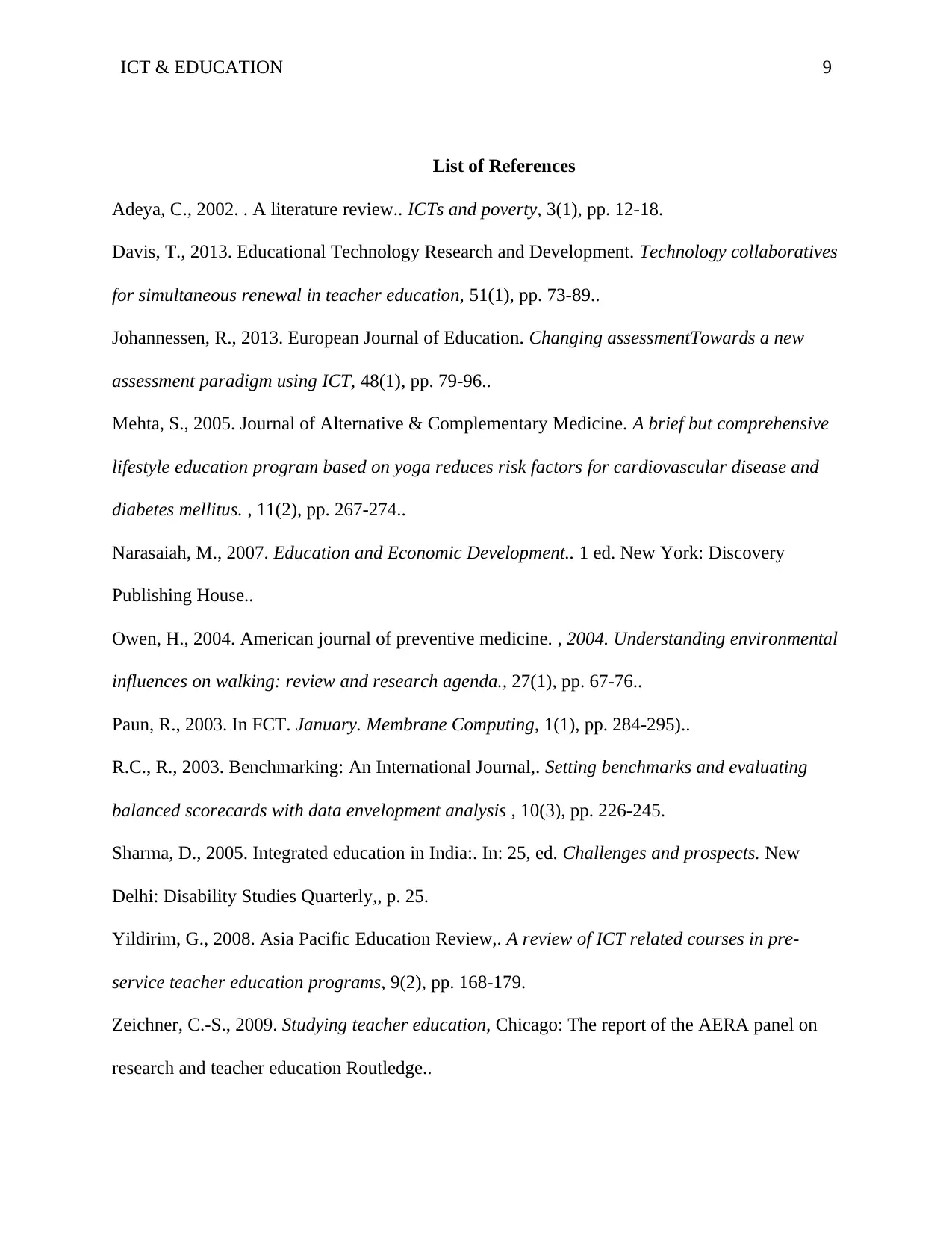
List of References
Adeya, C., 2002. . A literature review.. ICTs and poverty, 3(1), pp. 12-18.
Davis, T., 2013. Educational Technology Research and Development. Technology collaboratives
for simultaneous renewal in teacher education, 51(1), pp. 73-89..
Johannessen, R., 2013. European Journal of Education. Changing assessmentTowards a new
assessment paradigm using ICT, 48(1), pp. 79-96..
Mehta, S., 2005. Journal of Alternative & Complementary Medicine. A brief but comprehensive
lifestyle education program based on yoga reduces risk factors for cardiovascular disease and
diabetes mellitus. , 11(2), pp. 267-274..
Narasaiah, M., 2007. Education and Economic Development.. 1 ed. New York: Discovery
Publishing House..
Owen, H., 2004. American journal of preventive medicine. , 2004. Understanding environmental
influences on walking: review and research agenda., 27(1), pp. 67-76..
Paun, R., 2003. In FCT. January. Membrane Computing, 1(1), pp. 284-295)..
R.C., R., 2003. Benchmarking: An International Journal,. Setting benchmarks and evaluating
balanced scorecards with data envelopment analysis , 10(3), pp. 226-245.
Sharma, D., 2005. Integrated education in India:. In: 25, ed. Challenges and prospects. New
Delhi: Disability Studies Quarterly,, p. 25.
Yildirim, G., 2008. Asia Pacific Education Review,. A review of ICT related courses in pre-
service teacher education programs, 9(2), pp. 168-179.
Zeichner, C.-S., 2009. Studying teacher education, Chicago: The report of the AERA panel on
research and teacher education Routledge..
List of References
Adeya, C., 2002. . A literature review.. ICTs and poverty, 3(1), pp. 12-18.
Davis, T., 2013. Educational Technology Research and Development. Technology collaboratives
for simultaneous renewal in teacher education, 51(1), pp. 73-89..
Johannessen, R., 2013. European Journal of Education. Changing assessmentTowards a new
assessment paradigm using ICT, 48(1), pp. 79-96..
Mehta, S., 2005. Journal of Alternative & Complementary Medicine. A brief but comprehensive
lifestyle education program based on yoga reduces risk factors for cardiovascular disease and
diabetes mellitus. , 11(2), pp. 267-274..
Narasaiah, M., 2007. Education and Economic Development.. 1 ed. New York: Discovery
Publishing House..
Owen, H., 2004. American journal of preventive medicine. , 2004. Understanding environmental
influences on walking: review and research agenda., 27(1), pp. 67-76..
Paun, R., 2003. In FCT. January. Membrane Computing, 1(1), pp. 284-295)..
R.C., R., 2003. Benchmarking: An International Journal,. Setting benchmarks and evaluating
balanced scorecards with data envelopment analysis , 10(3), pp. 226-245.
Sharma, D., 2005. Integrated education in India:. In: 25, ed. Challenges and prospects. New
Delhi: Disability Studies Quarterly,, p. 25.
Yildirim, G., 2008. Asia Pacific Education Review,. A review of ICT related courses in pre-
service teacher education programs, 9(2), pp. 168-179.
Zeichner, C.-S., 2009. Studying teacher education, Chicago: The report of the AERA panel on
research and teacher education Routledge..
⊘ This is a preview!⊘
Do you want full access?
Subscribe today to unlock all pages.
Trusted by 1+ million students worldwide

ICT & EDUCATION 10

1 out of 10


Related Documents


Your All-in-One AI-Powered Toolkit for Academic Success.
+13062052269
info@desklib.com
Available 24*7 on WhatsApp / Email
![[object Object]](/_next/static/media/star-bottom.7253800d.svg)
Unlock your academic potential
Copyright © 2020–2026 A2Z Services. All Rights Reserved. Developed and managed by ZUCOL.