Identifying Key Departments & Their Roles in Meeting Business Goals
VerifiedAdded on 2023/04/08
|12
|2291
|294
Report
AI Summary
This report analyzes the critical departments within business organizations and their respective roles in enabling the company to meet its strategic objectives. It identifies key functional areas such as sales, operations, human resources, marketing, and finance, detailing their specific functions and how they contribute to overall business success. The sales department focuses on generating revenue and maintaining customer relationships, while the operations department manages the production of goods and services. Human resources is responsible for recruiting, training, and retaining skilled employees, and the marketing department promotes the company's products and services to target consumers. Finally, the finance department manages the organization's financial resources and ensures long-term financial stability. The report concludes that by effectively managing these key departments and aligning their functions with the company's strategic goals, businesses can achieve a competitive advantage and ensure sustainable growth. Desklib provides a wealth of resources including similar assignments and study tools to aid students in their academic pursuits.
Running head: IDENTIFYING KEY DEPARTMENTS WITHIN BUSINESSES AND THEIR
ROLES
Identifying Key Departments/ Functions within Businesses and their Role in Enabling
Organisation to Meet its Business Goals
Name of the University:
Name of the Student:
Authors Note:
ROLES
Identifying Key Departments/ Functions within Businesses and their Role in Enabling
Organisation to Meet its Business Goals
Name of the University:
Name of the Student:
Authors Note:

Paraphrase This Document
Need a fresh take? Get an instant paraphrase of this document with our AI Paraphraser
1IDENTIFYING KEY DEPARTMENTS WITHIN BUSINESSES AND THEIR ROLES
Executive Summary
Analysis of the roles and responsibilities of each department within the organizations can
facilitate in attaining long and short term goals along with enabling them to use their resources
effectively. One of the major reasons for segmenting the major business operations into
functional areas is to facilitate each department to operate within its region of expertise. The
major functional areas of the businesses are deemed to include certain departments such as
management, operations, marketing, accounting and finance. The managers in the companies are
responsible for organizing the business operations in an effective manner. When the processes
and people remain on a specified direction through responsibly fulfilling their specified roles
aligned with their departments, the organizations can attain its business goals and competitive
advantages.
Executive Summary
Analysis of the roles and responsibilities of each department within the organizations can
facilitate in attaining long and short term goals along with enabling them to use their resources
effectively. One of the major reasons for segmenting the major business operations into
functional areas is to facilitate each department to operate within its region of expertise. The
major functional areas of the businesses are deemed to include certain departments such as
management, operations, marketing, accounting and finance. The managers in the companies are
responsible for organizing the business operations in an effective manner. When the processes
and people remain on a specified direction through responsibly fulfilling their specified roles
aligned with their departments, the organizations can attain its business goals and competitive
advantages.
2IDENTIFYING KEY DEPARTMENTS WITHIN BUSINESSES AND THEIR ROLES
Table of Contents
1. Introduction..................................................................................................................................3
2. Key Departments/ Functions within Businesses and their Role in Enabling Organisation to
Meet its Business Goals...................................................................................................................3
2.1. Sales Department Functions and Roles................................................................................4
2.2. Operations Department Functions and Roles.......................................................................5
2.3. Human Resource Department Functions and Roles.............................................................6
2.4. Marketing Department Functions and Roles........................................................................7
2.5. Finance Department Functions and Roles............................................................................8
3. Conclusion...................................................................................................................................9
References......................................................................................................................................10
Table of Contents
1. Introduction..................................................................................................................................3
2. Key Departments/ Functions within Businesses and their Role in Enabling Organisation to
Meet its Business Goals...................................................................................................................3
2.1. Sales Department Functions and Roles................................................................................4
2.2. Operations Department Functions and Roles.......................................................................5
2.3. Human Resource Department Functions and Roles.............................................................6
2.4. Marketing Department Functions and Roles........................................................................7
2.5. Finance Department Functions and Roles............................................................................8
3. Conclusion...................................................................................................................................9
References......................................................................................................................................10
⊘ This is a preview!⊘
Do you want full access?
Subscribe today to unlock all pages.

Trusted by 1+ million students worldwide
3IDENTIFYING KEY DEPARTMENTS WITHIN BUSINESSES AND THEIR ROLES
1. Introduction
To attain competitive edge in the fiercely competitive global business environment, most
of the companies ensure that different functions within their businesses are performed as well as
controlled by different departments of the organizations. Becker et al. (2016) stated that “The
way a team plays as a whole determines its success”. One of the major reasons for segmenting
the major business operations into functional areas is to facilitate each department to operate
within its region of expertise. This can facilitate each of the major business departments in the
companies to build efficiency all through its business processes. Moreover, it has also been
elucidated that the major function of the managers in the organizations is to supervise
performance of each department and most of the management activities comes under specified
activities (Bratton and Gold 2017). These activities include planning, organizing, controlling and
leading. The objective of the report is to analyse and identify the major departments and
functions within businesses through explaining their role in facilitating the companies to attain
its business goals. Analysis of the roles and responsibilities of each department within the
organizations can facilitate in attaining long and short term goals along with enabling them to
use their resources effectively.
2. Key Departments/ Functions within Businesses and their Role in Enabling Organisation
to Meet its Business Goals
The major functional areas of the businesses are deemed to include certain departments
such as management, operations, marketing, accounting and finance. The managers in the
companies are responsible for organizing the business operations in an effective manner (Boshyk
2016). Moreover, through segmenting all the departments along with their specific functions and
1. Introduction
To attain competitive edge in the fiercely competitive global business environment, most
of the companies ensure that different functions within their businesses are performed as well as
controlled by different departments of the organizations. Becker et al. (2016) stated that “The
way a team plays as a whole determines its success”. One of the major reasons for segmenting
the major business operations into functional areas is to facilitate each department to operate
within its region of expertise. This can facilitate each of the major business departments in the
companies to build efficiency all through its business processes. Moreover, it has also been
elucidated that the major function of the managers in the organizations is to supervise
performance of each department and most of the management activities comes under specified
activities (Bratton and Gold 2017). These activities include planning, organizing, controlling and
leading. The objective of the report is to analyse and identify the major departments and
functions within businesses through explaining their role in facilitating the companies to attain
its business goals. Analysis of the roles and responsibilities of each department within the
organizations can facilitate in attaining long and short term goals along with enabling them to
use their resources effectively.
2. Key Departments/ Functions within Businesses and their Role in Enabling Organisation
to Meet its Business Goals
The major functional areas of the businesses are deemed to include certain departments
such as management, operations, marketing, accounting and finance. The managers in the
companies are responsible for organizing the business operations in an effective manner (Boshyk
2016). Moreover, through segmenting all the departments along with their specific functions and
Paraphrase This Document
Need a fresh take? Get an instant paraphrase of this document with our AI Paraphraser
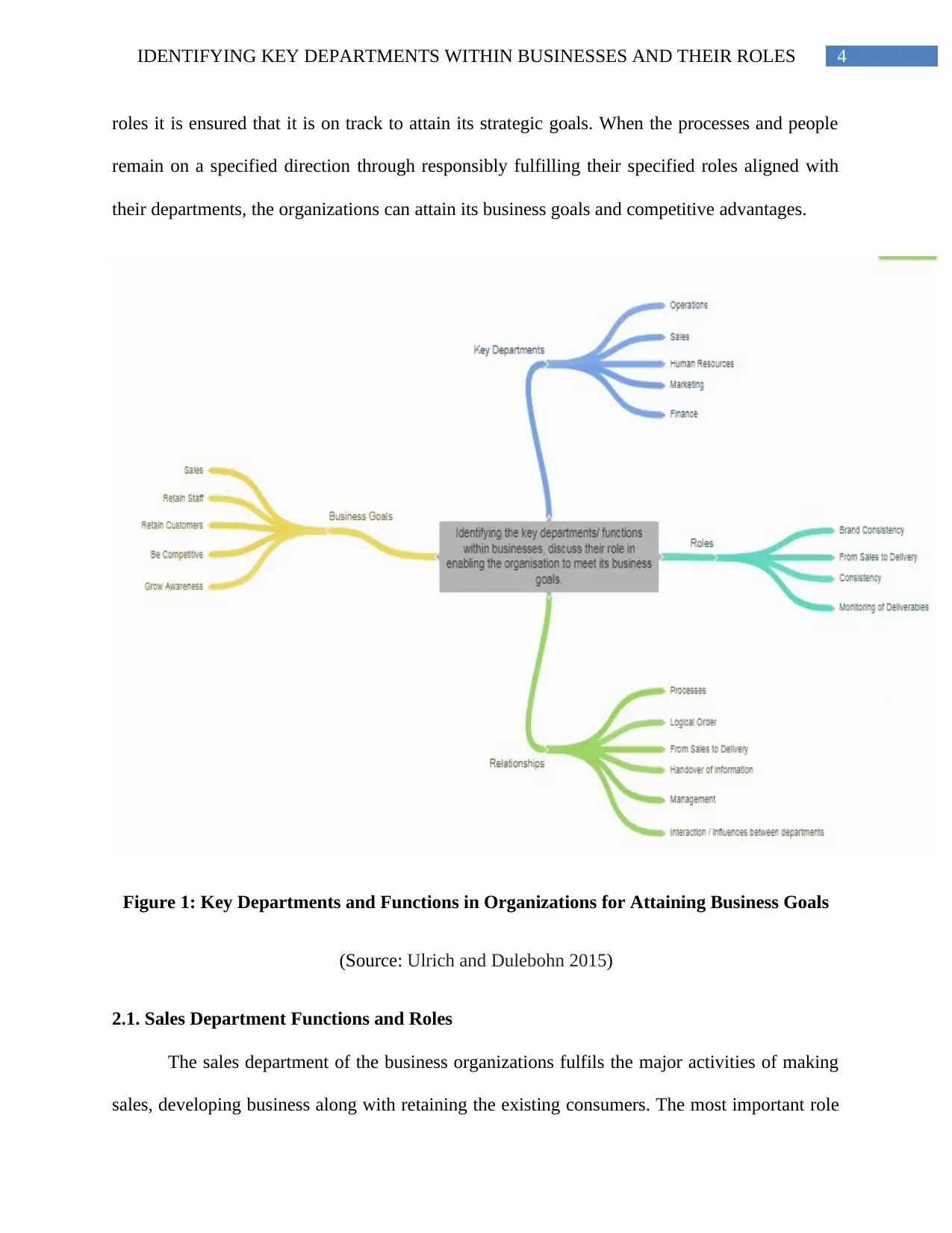
4IDENTIFYING KEY DEPARTMENTS WITHIN BUSINESSES AND THEIR ROLES
roles it is ensured that it is on track to attain its strategic goals. When the processes and people
remain on a specified direction through responsibly fulfilling their specified roles aligned with
their departments, the organizations can attain its business goals and competitive advantages.
Figure 1: Key Departments and Functions in Organizations for Attaining Business Goals
(Source: Ulrich and Dulebohn 2015)
2.1. Sales Department Functions and Roles
The sales department of the business organizations fulfils the major activities of making
sales, developing business along with retaining the existing consumers. The most important role
roles it is ensured that it is on track to attain its strategic goals. When the processes and people
remain on a specified direction through responsibly fulfilling their specified roles aligned with
their departments, the organizations can attain its business goals and competitive advantages.
Figure 1: Key Departments and Functions in Organizations for Attaining Business Goals
(Source: Ulrich and Dulebohn 2015)
2.1. Sales Department Functions and Roles
The sales department of the business organizations fulfils the major activities of making
sales, developing business along with retaining the existing consumers. The most important role
5IDENTIFYING KEY DEPARTMENTS WITHIN BUSINESSES AND THEIR ROLES
of this department is to maintaining relationship with the target consumers. Attaining such
functions facilitates the companies to attain strategic goals of attaining increased profitability.
The role of the sales department is to ensure the direct link between the organizations services or
products and its consumers (Burns 2016). The highly trained sales processionals within the
department align sales pitches to the individual consumers along with attaining insights about
changing consumer needs. The functions fulfilled by the sales department vary based on the
nature of business and the major role of this department is to reach out to the potential consumers
along with recognising relevant information needed from business market and consumers in
making sales. The sales manager of the department has the function of maintaining the
consumers satisfied through offering them with their desired services (Kavanagh and Johnson
2017). The strategic business goals those are intended to attain by the sales department through
fulfilling these functions include attaining better consumer retention, salts margin along with
attaining better relationship building.
2.2. Operations Department Functions and Roles
In the business organizations the operations department is where the inputs such as
factors of production are converted to outputs such as in the form of goods and services.
Operations department is one of the major business areas that pump out goods and services in a
specified quantity and quality for addressing consumer needs (Tantalo and Priem 2016). The role
of the operations manager is to analyse the day-to-day business operations that can include
anything from ordering raw materials to training workers to produce the tangible goods. The
operations department of the company is focussed on managing the process of production of
services and goods and it involves the process of planning, organization, coordinating and
controlling all the resources required to produce necessary goods and services of the company.
of this department is to maintaining relationship with the target consumers. Attaining such
functions facilitates the companies to attain strategic goals of attaining increased profitability.
The role of the sales department is to ensure the direct link between the organizations services or
products and its consumers (Burns 2016). The highly trained sales processionals within the
department align sales pitches to the individual consumers along with attaining insights about
changing consumer needs. The functions fulfilled by the sales department vary based on the
nature of business and the major role of this department is to reach out to the potential consumers
along with recognising relevant information needed from business market and consumers in
making sales. The sales manager of the department has the function of maintaining the
consumers satisfied through offering them with their desired services (Kavanagh and Johnson
2017). The strategic business goals those are intended to attain by the sales department through
fulfilling these functions include attaining better consumer retention, salts margin along with
attaining better relationship building.
2.2. Operations Department Functions and Roles
In the business organizations the operations department is where the inputs such as
factors of production are converted to outputs such as in the form of goods and services.
Operations department is one of the major business areas that pump out goods and services in a
specified quantity and quality for addressing consumer needs (Tantalo and Priem 2016). The role
of the operations manager is to analyse the day-to-day business operations that can include
anything from ordering raw materials to training workers to produce the tangible goods. The
operations department of the company is focussed on managing the process of production of
services and goods and it involves the process of planning, organization, coordinating and
controlling all the resources required to produce necessary goods and services of the company.
⊘ This is a preview!⊘
Do you want full access?
Subscribe today to unlock all pages.
Trusted by 1+ million students worldwide
6IDENTIFYING KEY DEPARTMENTS WITHIN BUSINESSES AND THEIR ROLES
The role of the operations department is to ensure that the plans and policies developed
by the organizations resources for supporting its long term competitive strategy. Operations
managers of the organizations have the leading role in managing the raw materials use along
with the personnel. Oversight of the inventory, purchasing along with the supplies are important
job functions within this department (Ulrich and Dulebohn 2015). Operations department of the
companies is to make sure that the smooth delivery of services with minimum disruptions.
Operations department is one of the major business areas that pump out goods and services in a
specified quantity and quality for addressing consumer needs. The role of the operations manager
is to analyse the day-to-day business operations that can include anything from ordering raw
materials to training workers to produce the tangible goods. In attaining such functions, the
businesses will attain the strategic goals of maintaining enhanced quality services and improving
the supply chain of the company to attain competitive advantages.
2.3. Human Resource Department Functions and Roles
The human resource department of the business organizations is accountable for carrying
out business activities of recruiting and developing skilled employees in order to direct them
towards common organizational goal attainment. The role of the human resource managers is to
implement competitive strategies of hiring, training and making efficient selection of employees
(Chang 2016). Addressing such functions can facilitate the companies to attain its strategic goals
of decreasing turnover, enhancing employee skills along with enhancing overall organisational
production. The function of the human resource department in any organization is huge as it
focuses on retaining as well as recruiting skilled employees for overseeing products that can
promote company-wide productivity. The human resourced departments of the business
organizations have the major function of ensuing company’s success in attaining the long term
The role of the operations department is to ensure that the plans and policies developed
by the organizations resources for supporting its long term competitive strategy. Operations
managers of the organizations have the leading role in managing the raw materials use along
with the personnel. Oversight of the inventory, purchasing along with the supplies are important
job functions within this department (Ulrich and Dulebohn 2015). Operations department of the
companies is to make sure that the smooth delivery of services with minimum disruptions.
Operations department is one of the major business areas that pump out goods and services in a
specified quantity and quality for addressing consumer needs. The role of the operations manager
is to analyse the day-to-day business operations that can include anything from ordering raw
materials to training workers to produce the tangible goods. In attaining such functions, the
businesses will attain the strategic goals of maintaining enhanced quality services and improving
the supply chain of the company to attain competitive advantages.
2.3. Human Resource Department Functions and Roles
The human resource department of the business organizations is accountable for carrying
out business activities of recruiting and developing skilled employees in order to direct them
towards common organizational goal attainment. The role of the human resource managers is to
implement competitive strategies of hiring, training and making efficient selection of employees
(Chang 2016). Addressing such functions can facilitate the companies to attain its strategic goals
of decreasing turnover, enhancing employee skills along with enhancing overall organisational
production. The function of the human resource department in any organization is huge as it
focuses on retaining as well as recruiting skilled employees for overseeing products that can
promote company-wide productivity. The human resourced departments of the business
organizations have the major function of ensuing company’s success in attaining the long term
Paraphrase This Document
Need a fresh take? Get an instant paraphrase of this document with our AI Paraphraser
7IDENTIFYING KEY DEPARTMENTS WITHIN BUSINESSES AND THEIR ROLES
objectives (Storey 2016.). The role of the human resource department in training and department
encompass evaluating the training needs, developing training manuals along with ensuring that
the training objectives are addressed (Laguna and Marklund 2018). Moreover, in attaining the
business goal of staff retaining, increasing awareness along with increasing sales margin through
employing skilled workforce can obtained. The human resource department has the function of
the getting involvement in the project management that facilitates the organizations in attaining
project goals along with evaluating the risks related with the projects.
2.4. Marketing Department Functions and Roles
Marketing department in the business organizations involves all the activities those are
conducted by the business organizations to identify the consumers’ needs long with designing
services and products that addresses such needs (Harmon 2018). The functions of the marketing
department also include promoting services and goods along with determining the ways in which
services and goods are delivered. The marketing department also has the role of developing a
pricing strategy in capturing the market share along with attaining competitive edge. In the
recent day’s technology-based business surrounding, marketing department is accountable for
developing an organizations internet existence through company website, social media, bogs and
promotional campaigns.
In the current business era, social media marketing is one of the fastest growing sectors
within the marketing function for facilitating the companies in attaining its business goals
including attaining sustainability and increased market share. For instance, the role off the
marketing department in Apple Inc is to promote the business and mission of the company to
position itself as best Smartphone brand internationally. The marketing activities have the
function of developing marketing and promotional materials in promoting the core products and
objectives (Storey 2016.). The role of the human resource department in training and department
encompass evaluating the training needs, developing training manuals along with ensuring that
the training objectives are addressed (Laguna and Marklund 2018). Moreover, in attaining the
business goal of staff retaining, increasing awareness along with increasing sales margin through
employing skilled workforce can obtained. The human resource department has the function of
the getting involvement in the project management that facilitates the organizations in attaining
project goals along with evaluating the risks related with the projects.
2.4. Marketing Department Functions and Roles
Marketing department in the business organizations involves all the activities those are
conducted by the business organizations to identify the consumers’ needs long with designing
services and products that addresses such needs (Harmon 2018). The functions of the marketing
department also include promoting services and goods along with determining the ways in which
services and goods are delivered. The marketing department also has the role of developing a
pricing strategy in capturing the market share along with attaining competitive edge. In the
recent day’s technology-based business surrounding, marketing department is accountable for
developing an organizations internet existence through company website, social media, bogs and
promotional campaigns.
In the current business era, social media marketing is one of the fastest growing sectors
within the marketing function for facilitating the companies in attaining its business goals
including attaining sustainability and increased market share. For instance, the role off the
marketing department in Apple Inc is to promote the business and mission of the company to
position itself as best Smartphone brand internationally. The marketing activities have the
function of developing marketing and promotional materials in promoting the core products and
8IDENTIFYING KEY DEPARTMENTS WITHIN BUSINESSES AND THEIR ROLES
services of the organizations. Marketing department also has the responsibility of monitoring and
managing social media promotional campaigns in marketing its offerings among target
consumers. Attaining such functions is likely to attain business goals of increasing sales margin
of the company along with attaining increased target consumer base.
2.5. Finance Department Functions and Roles
The finance and accounting department in the business organization involves carrying out
business activities that involves planning, attaining along with managing the funds of an
organization. The role of the finance department is to plan for both the short and long term
financial capital needs along with evaluating the impact that borrowing might have on the
financial situation of the business (Gupta and Sharma 2016). The finance department of the
organizations has the role of deciding the ways in which funds can be raised such as through
loans or stocks, deciding the long term borrowing funds cost along with the implications of
financial decisions. These functions attained by the finance department can ensure he business
goal of attaining long term financial position of the businesses.
The accounting department is responsible for offering the managers with relevant
information that can facilitate them in making decisions regarding allocation of necessary
resources (Hambrick, Humphrey and Gupta 2015). This department also has the role of suitably
representing the financial transactions to the external as well as internal parties along with the
investors. Financial accountants have the function of preparing financial statements to facilitate
people to attain review of the company’s financial strength. Managerial accountants have the
function of providing relevant information to managers regarding budgets, costs asset allocation
along with performance appraisal for effective decision making (Harmon 2019). Attaining such
services of the organizations. Marketing department also has the responsibility of monitoring and
managing social media promotional campaigns in marketing its offerings among target
consumers. Attaining such functions is likely to attain business goals of increasing sales margin
of the company along with attaining increased target consumer base.
2.5. Finance Department Functions and Roles
The finance and accounting department in the business organization involves carrying out
business activities that involves planning, attaining along with managing the funds of an
organization. The role of the finance department is to plan for both the short and long term
financial capital needs along with evaluating the impact that borrowing might have on the
financial situation of the business (Gupta and Sharma 2016). The finance department of the
organizations has the role of deciding the ways in which funds can be raised such as through
loans or stocks, deciding the long term borrowing funds cost along with the implications of
financial decisions. These functions attained by the finance department can ensure he business
goal of attaining long term financial position of the businesses.
The accounting department is responsible for offering the managers with relevant
information that can facilitate them in making decisions regarding allocation of necessary
resources (Hambrick, Humphrey and Gupta 2015). This department also has the role of suitably
representing the financial transactions to the external as well as internal parties along with the
investors. Financial accountants have the function of preparing financial statements to facilitate
people to attain review of the company’s financial strength. Managerial accountants have the
function of providing relevant information to managers regarding budgets, costs asset allocation
along with performance appraisal for effective decision making (Harmon 2019). Attaining such
⊘ This is a preview!⊘
Do you want full access?
Subscribe today to unlock all pages.
Trusted by 1+ million students worldwide
9IDENTIFYING KEY DEPARTMENTS WITHIN BUSINESSES AND THEIR ROLES
functions can facilitate the companies in attaining its strategic objectives of forecasting its
financial performance and make business decisions to improve such performance in future.
3. Conclusion
The objective of the report was to analyse and identify the major departments and
functions within businesses through explaining their role in facilitating the companies to attain
its business goals. It was gathered from the report that the sales department of the business
organizations fulfils the major activities of making sales, developing business along with
retaining the existing consumers. Operations department is one of the major business areas that
pump out goods and services in a specified quantity and quality for addressing consumer needs.
The human resource department of the business organizations is accountable for carrying out
business activities of recruiting and developing skilled employees in order to direct them towards
common organizational goal attainment. It was also gathered that the functions of the marketing
department also includes promoting services and goods along with determining the ways in
which services and goods are delivered. The role of the finance department is to plan for both the
short and long term financial capital needs along with evaluating the impact that borrowing
might have on the financial situation of the business.
functions can facilitate the companies in attaining its strategic objectives of forecasting its
financial performance and make business decisions to improve such performance in future.
3. Conclusion
The objective of the report was to analyse and identify the major departments and
functions within businesses through explaining their role in facilitating the companies to attain
its business goals. It was gathered from the report that the sales department of the business
organizations fulfils the major activities of making sales, developing business along with
retaining the existing consumers. Operations department is one of the major business areas that
pump out goods and services in a specified quantity and quality for addressing consumer needs.
The human resource department of the business organizations is accountable for carrying out
business activities of recruiting and developing skilled employees in order to direct them towards
common organizational goal attainment. It was also gathered that the functions of the marketing
department also includes promoting services and goods along with determining the ways in
which services and goods are delivered. The role of the finance department is to plan for both the
short and long term financial capital needs along with evaluating the impact that borrowing
might have on the financial situation of the business.
Paraphrase This Document
Need a fresh take? Get an instant paraphrase of this document with our AI Paraphraser
10IDENTIFYING KEY DEPARTMENTS WITHIN BUSINESSES AND THEIR ROLES
References
Becker, C., Betz, S., Chitchyan, R., Duboc, L., Easterbrook, S.M., Penzenstadler, B., Seyff, N.
and Venters, C.C., 2016. Requirements: The key to sustainability. IEEE Software, 33(1), pp.56-
65.
Boshyk, Y. ed., 2016. Business driven action learning: Global best practices. Springer.
Bratton, J. and Gold, J., 2017. Human resource management: theory and practice. Palgrave.
Burns, P., 2016. Entrepreneurship and small business. Palgrave Macmillan Limited.
Chang, J.F., 2016. Business process management systems: strategy and implementation.
Auerbach Publications.
Gupta, N. and Sharma, V., 2016. Exploring employee engagement—a way to better business
performance. Global Business Review, 17(3_suppl), pp.45S-63S.
Hambrick, D.C., Humphrey, S.E. and Gupta, A., 2015. Structural interdependence within top
management teams: A key moderator of upper echelons predictions. Strategic Management
Journal, 36(3), pp.449-461.
Harmon, P., 2019. Business process change: a business process management guide for managers
and process professionals. Morgan Kaufmann.
Harmon, P., 2018. Business process change: a business process management guide for managers
and process professionals. Morgan Kaufmann.
References
Becker, C., Betz, S., Chitchyan, R., Duboc, L., Easterbrook, S.M., Penzenstadler, B., Seyff, N.
and Venters, C.C., 2016. Requirements: The key to sustainability. IEEE Software, 33(1), pp.56-
65.
Boshyk, Y. ed., 2016. Business driven action learning: Global best practices. Springer.
Bratton, J. and Gold, J., 2017. Human resource management: theory and practice. Palgrave.
Burns, P., 2016. Entrepreneurship and small business. Palgrave Macmillan Limited.
Chang, J.F., 2016. Business process management systems: strategy and implementation.
Auerbach Publications.
Gupta, N. and Sharma, V., 2016. Exploring employee engagement—a way to better business
performance. Global Business Review, 17(3_suppl), pp.45S-63S.
Hambrick, D.C., Humphrey, S.E. and Gupta, A., 2015. Structural interdependence within top
management teams: A key moderator of upper echelons predictions. Strategic Management
Journal, 36(3), pp.449-461.
Harmon, P., 2019. Business process change: a business process management guide for managers
and process professionals. Morgan Kaufmann.
Harmon, P., 2018. Business process change: a business process management guide for managers
and process professionals. Morgan Kaufmann.
11IDENTIFYING KEY DEPARTMENTS WITHIN BUSINESSES AND THEIR ROLES
Kavanagh, M.J. and Johnson, R.D. eds., 2017. Human resource information systems: Basics,
applications, and future directions. Sage Publications.
Laguna, M. and Marklund, J., 2018. Business process modeling, simulation and design.
Chapman and Hall/CRC.
Storey, D.J., 2016. Understanding the small business sector. Routledge.
Tantalo, C. and Priem, R.L., 2016. Value creation through stakeholder synergy. Strategic
Management Journal, 37(2), pp.314-329.
Ulrich, D. and Dulebohn, J.H., 2015. Are we there yet? What's next for HR?. Human Resource
Management Review, 25(2), pp.188-204.
Kavanagh, M.J. and Johnson, R.D. eds., 2017. Human resource information systems: Basics,
applications, and future directions. Sage Publications.
Laguna, M. and Marklund, J., 2018. Business process modeling, simulation and design.
Chapman and Hall/CRC.
Storey, D.J., 2016. Understanding the small business sector. Routledge.
Tantalo, C. and Priem, R.L., 2016. Value creation through stakeholder synergy. Strategic
Management Journal, 37(2), pp.314-329.
Ulrich, D. and Dulebohn, J.H., 2015. Are we there yet? What's next for HR?. Human Resource
Management Review, 25(2), pp.188-204.
⊘ This is a preview!⊘
Do you want full access?
Subscribe today to unlock all pages.
Trusted by 1+ million students worldwide

1 out of 12


Related Documents


Your All-in-One AI-Powered Toolkit for Academic Success.
+13062052269
info@desklib.com
Available 24*7 on WhatsApp / Email
![[object Object]](/_next/static/media/star-bottom.7253800d.svg)
Unlock your academic potential
Copyright © 2020–2026 A2Z Services. All Rights Reserved. Developed and managed by ZUCOL.