An Analysis of Ideology's Impact on Culture and Societal Norms

Verified

Added on  2021/06/14

|11
|942
|149
Essay
AI Summary
This essay examines the significant role of ideology in shaping culture and societal beliefs. It explores how ideology influences cultural norms, values, and the overall structure of society, including the Marxist perspective. The analysis delves into the relationship between culture and society, highlighting similarities in their foundation of shared beliefs. The essay also discusses the impact of ideology on social change and acculturation, drawing on various sociological concepts and the works of influential scholars like Banks, Migdal, and Sahlberg. The study attempts to integrate theoretical approaches to understand how ideology functions within the context of reflexive modernity and its implications for cultural and psychological processes. The essay concludes by emphasizing the critical role of ideology in shaping individual and collective behaviors within society.
Document Page
Rethinking culture and society
Keyword: Ideology
Question: What are ways in which ideology
influence culture and beliefs of the society.
tabler-icon-diamond-filled.svg

Paraphrase This Document

Need a fresh take? Get an instant paraphrase of this document with our AI Paraphraser
Document Page
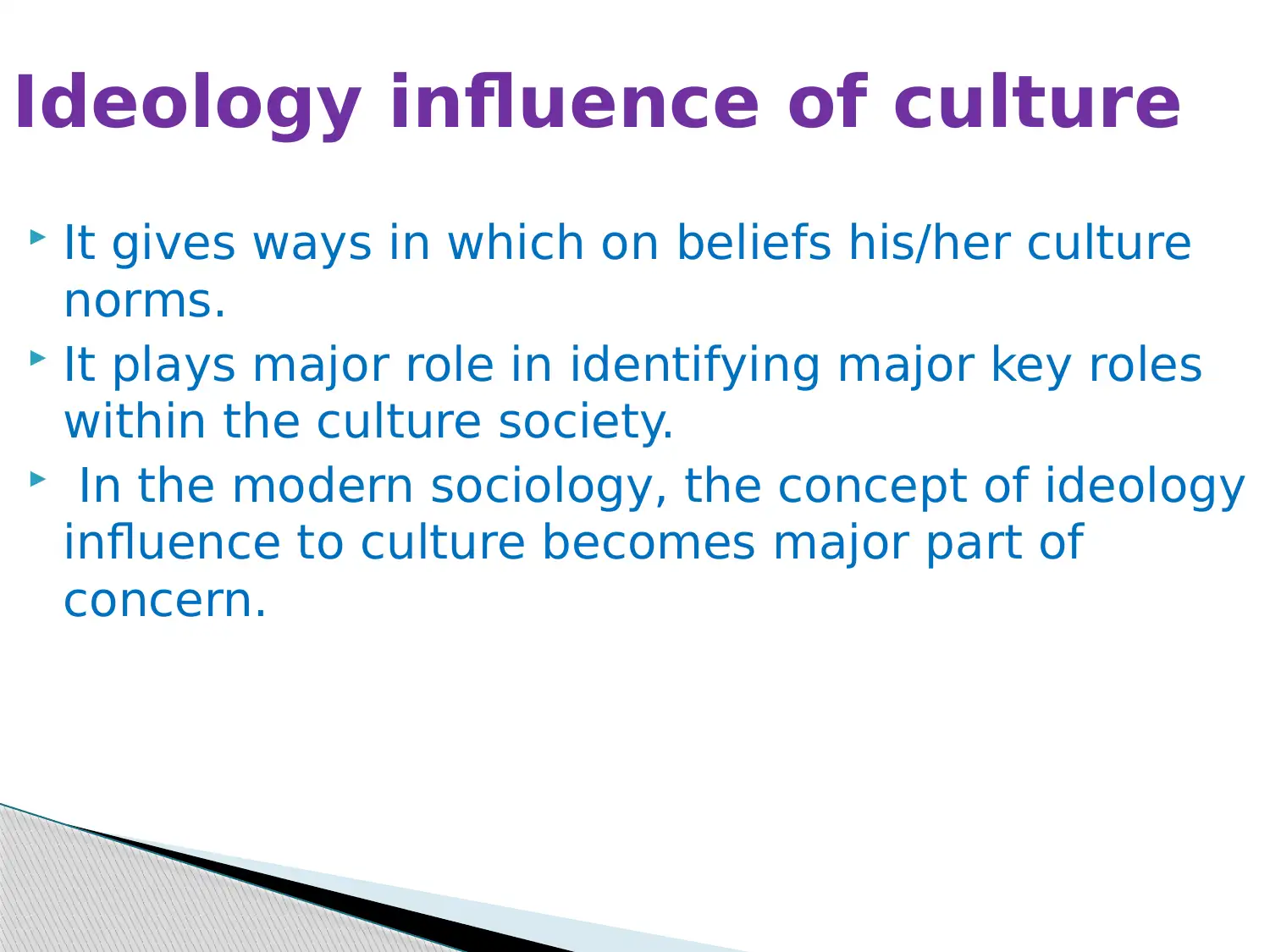
It gives ways in which on beliefs his/her culture
norms.
It plays major role in identifying major key roles
within the culture society.
In the modern sociology, the concept of ideology
influence to culture becomes major part of
concern.
Ideology influence of culture
Document Page
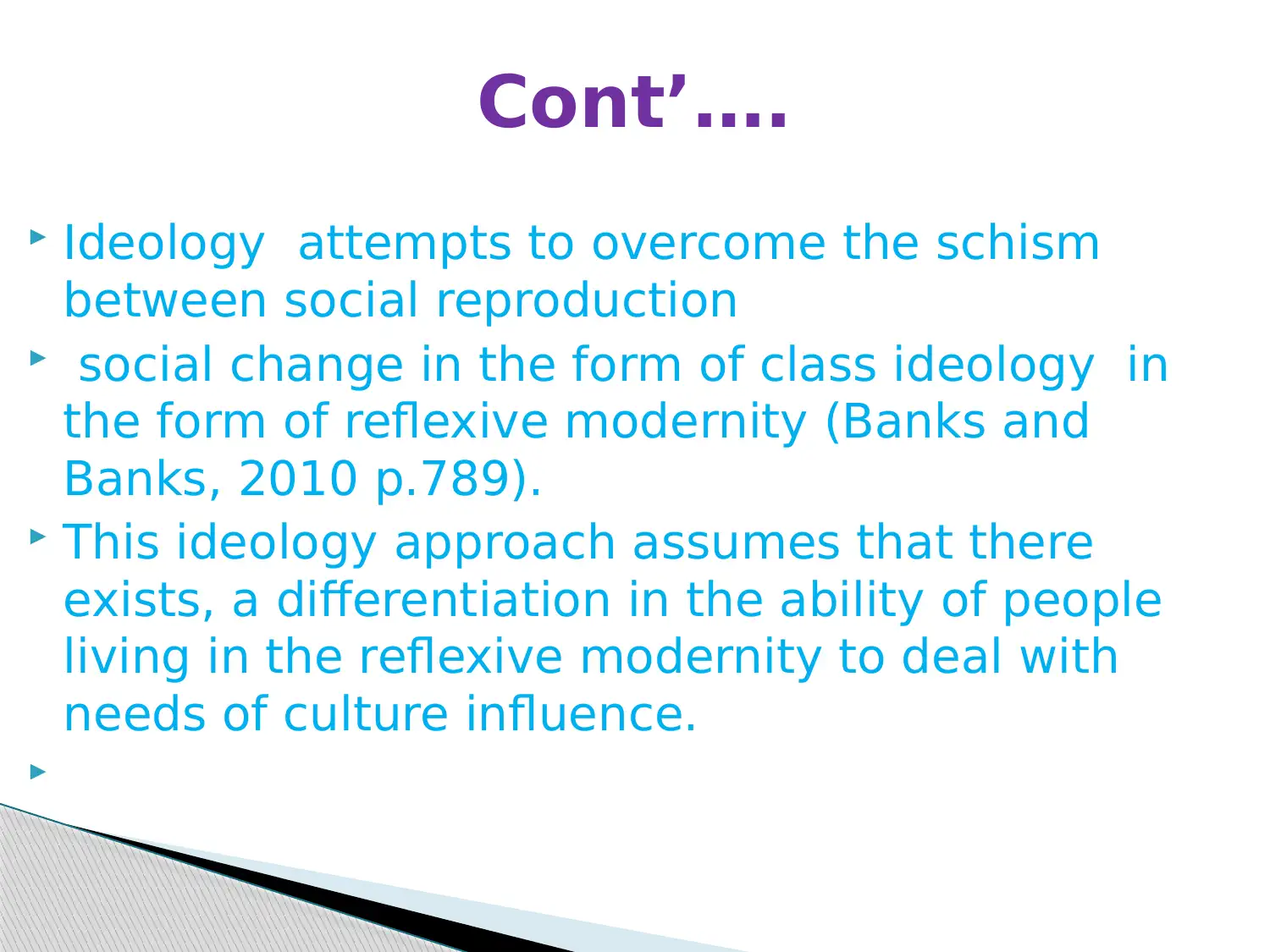
Ideology attempts to overcome the schism
between social reproduction
social change in the form of class ideology in
the form of reflexive modernity (Banks and
Banks, 2010 p.789).
This ideology approach assumes that there
exists, a differentiation in the ability of people
living in the reflexive modernity to deal with
needs of culture influence.

Cont’….
Document Page
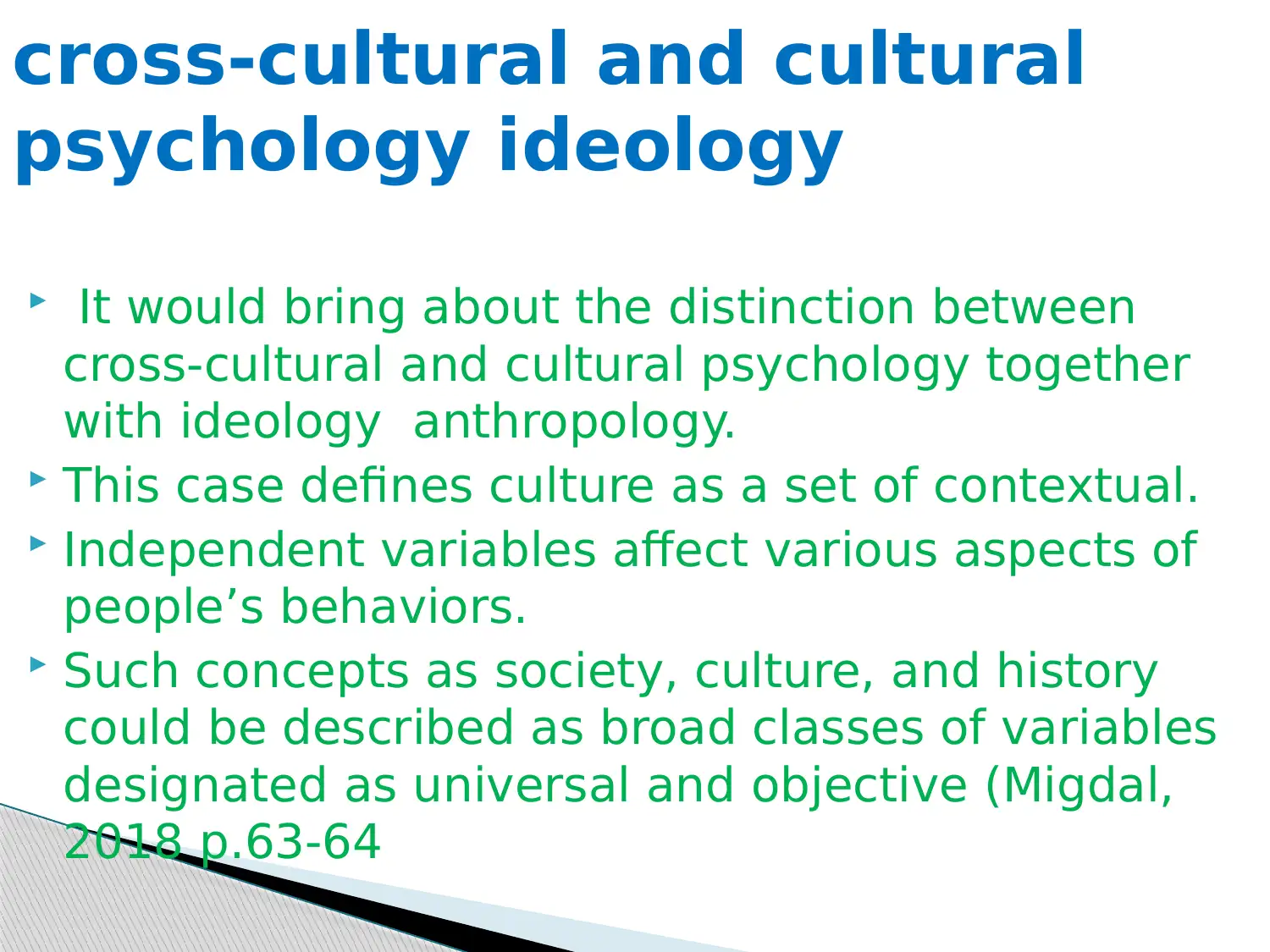
It would bring about the distinction between
cross-cultural and cultural psychology together
with ideology anthropology.
This case defines culture as a set of contextual.
Independent variables affect various aspects of
people’s behaviors.
Such concepts as society, culture, and history
could be described as broad classes of variables
designated as universal and objective (Migdal,
2018 p.63-64
cross-cultural and cultural
psychology ideology
tabler-icon-diamond-filled.svg

Paraphrase This Document

Need a fresh take? Get an instant paraphrase of this document with our AI Paraphraser
Document Page
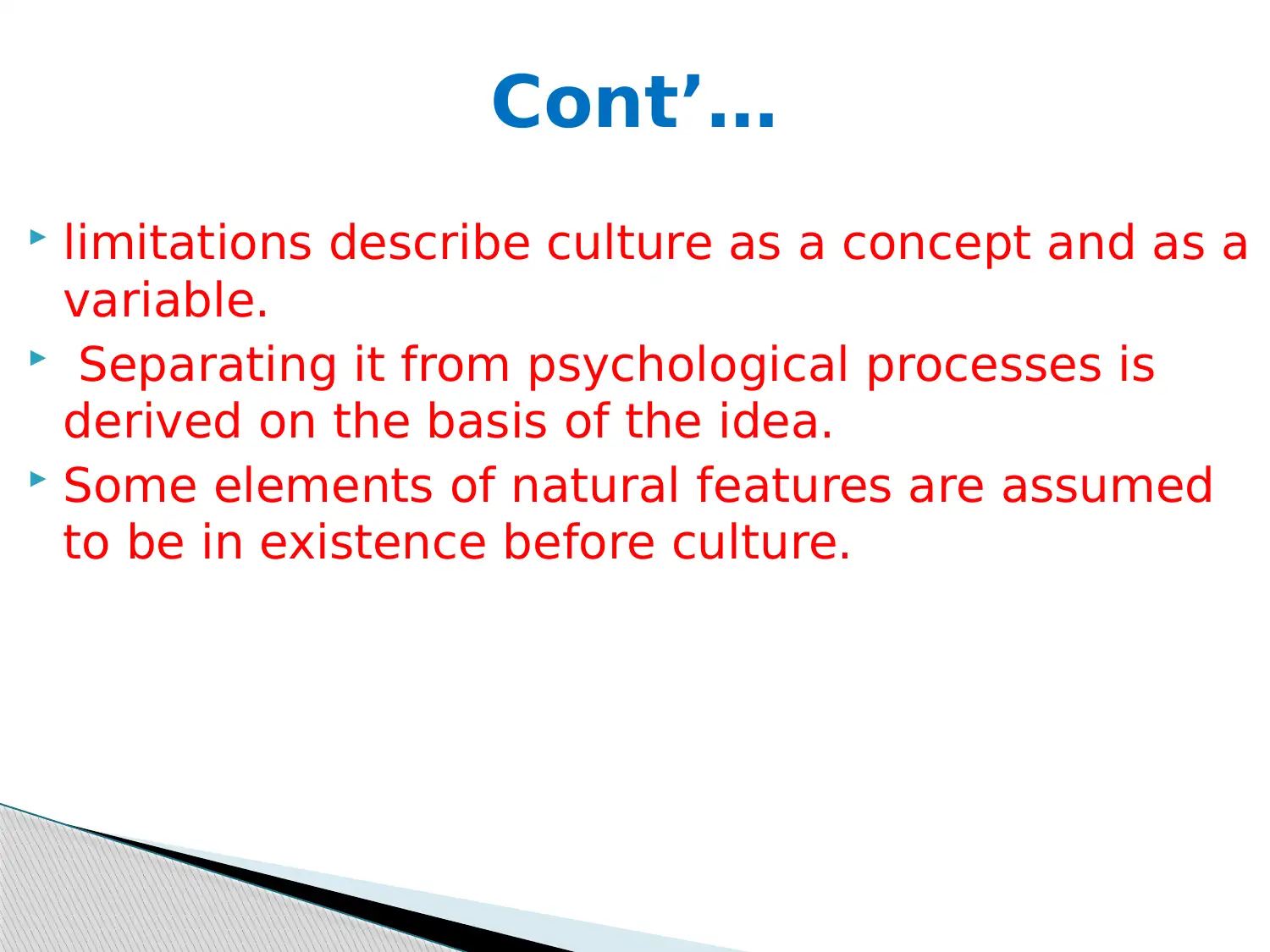
limitations describe culture as a concept and as a
variable.
Separating it from psychological processes is
derived on the basis of the idea.
Some elements of natural features are assumed
to be in existence before culture.
Cont’…
Document Page
It becomes very critical shaping the same.
The ideology and culture are historical factors
influencing the acculturation of individuals are
known as broad class variables.
Culture refers to the accumulated store of ideas
and symbols but Ideology focus on materials
that are associated with the social system, be it
the family unit or the entire society.
Ideology and Culture
Document Page
Society is social construct defined by a concept
where people live together.
It shows how people relate with one another,
driven by a common factor, mutual interests,
unique forms of interaction, characteristic
relations and shared as well as common culture.
The social aspect of society refers to the totality
of the explanations that describe how individuals
interact and make or derive meanings out of the
experiences.
Society
tabler-icon-diamond-filled.svg

Paraphrase This Document

Need a fresh take? Get an instant paraphrase of this document with our AI Paraphraser
Document Page
The Marxist view of social structure differs from
that of functionalists.
Marx holds that the social structure within a
capitalist society favors the wealthy but coerces
the poor (Sahlberg, 2010 p.45-46).
The Marxist view of social
structure
Document Page
The similarities between society and culture
occurs at the same level as the importance of
values.
This means that the society and culture are
both rooted in similar beliefs and values.
By values, what this case implies is that they
are the beliefs that individual members have on
what they deem right or wrong, and what they
regard as the most significant.
The cultural values are those beliefs that are
collectively held by people in the society.
Similarities between culture and
society
Document Page
The task has attempted to address the
possibility of having an integration of the
theoretical approaches.
There is nothing that progression the central
actualities about culture and society.
In reevaluating society and society, a few
changes should occur as to the common
conditions as to how things are worked.
The Social change is reevaluating the stratified
structures class as independence in a reflexive
innovation.
Conclusion
tabler-icon-diamond-filled.svg

Paraphrase This Document

Need a fresh take? Get an instant paraphrase of this document with our AI Paraphraser
Document Page
Banks, J.A. and Banks, C.A.M. eds., 2010. Multicultural education: Issues and perspectives. John Wiley &
Sons.p.789
Carvalho, A., 2008. Media (ted) discourse and society: Rethinking the framework of critical discourse
analysis. Journalism studies, 9(2), pp.161-177.
Castells, M., 2011. The rise of the network society (Vol. 12). John Wiley & Sons. P.23
Cotterrell, R., 2017. Law, culture and society: Legal ideas in the mirror of social theory. Routledge. P.67-89.
Hay, J. and Couldry, N., 2011. Rethinking convergence/culture: An introduction. Cultural Studies, 25(4-5),
pp.473-486.
Herbert, D., 2017. Religion and civil society: Rethinking public religion in the contemporary world.
Routledge.p.67
Hjarvard,.P., 2013. The mediatization of culture and society. Routledge.p.89-109
Migdal, J.S., 2018. The state in society. In New Directions in Comparative Politics (pp. 63-79).
Mosco, V., 2014. Political Economy. In The Routledge Companion to Global Popular Culture (pp. 35-44).
Routledge.p89.
Sahlberg, P., 2010. Rethinking accountability in a knowledge society. Journal of Educational Change, 11(1),
pp.45-61.
Sahlberg, P., 2010. Rethinking accountability in a knowledge society. Journal of Educational Change, 11(1),
pp.45-61.
Smyth, J. and Wrigley, T., 2013. Living on the Edge: Rethinking Poverty, Class and Schooling. Adolescent
Cultures, School and Society. Volume 61. Peter Lang Publishing Group. 29 Broadway 18th Floor, New York, NY
10006.p.67-78
Turner, T.S., 2009. The crisis of late structuralism. Perspectivism and animism: rethinking culture, nature, spirit,
and bodiliness. Tipití: Journal of the Society for the Anthropology of Lowland South America, 7(1), p.1.
References
chevron_up_icon
1 out of 11
circle_padding
hide_on_mobile
zoom_out_icon
[object Object]