IAL2010: Designing and Evaluating IEP for Andy in Secondary Classroom
VerifiedAdded on 2022/08/24
|8
|2965
|21
Report
AI Summary
This assignment solution discusses the Individualized Education Program (IEP) for Andy, a fifteen-year-old year 11 student with autism following a mainstream curriculum. The report highlights the importance of the IEP in addressing Andy's academic, social, and emotional needs, focusing on reducing his dependence on a Learning Support Educator (LSE). It addresses past conflicts between Andy's mother and the INCO regarding school placement and emphasizes the need for collaborative decision-making. The IEP goals include improving Andy's communication, social skills, and emotional regulation, while leveraging his strengths in memory and creativity. The plan aims to involve Andy in group work and utilize assistive technology to foster independence and better performance, ensuring his academic and functional needs are met within a supportive and less restrictive environment. This document is available on Desklib, where students can find a variety of solved assignments and study resources.

Running head: IEP
IEP
Name of the Student:
Name of the University:
Author Note:
IEP
Name of the Student:
Name of the University:
Author Note:

Paraphrase This Document
Need a fresh take? Get an instant paraphrase of this document with our AI Paraphraser
1IEP
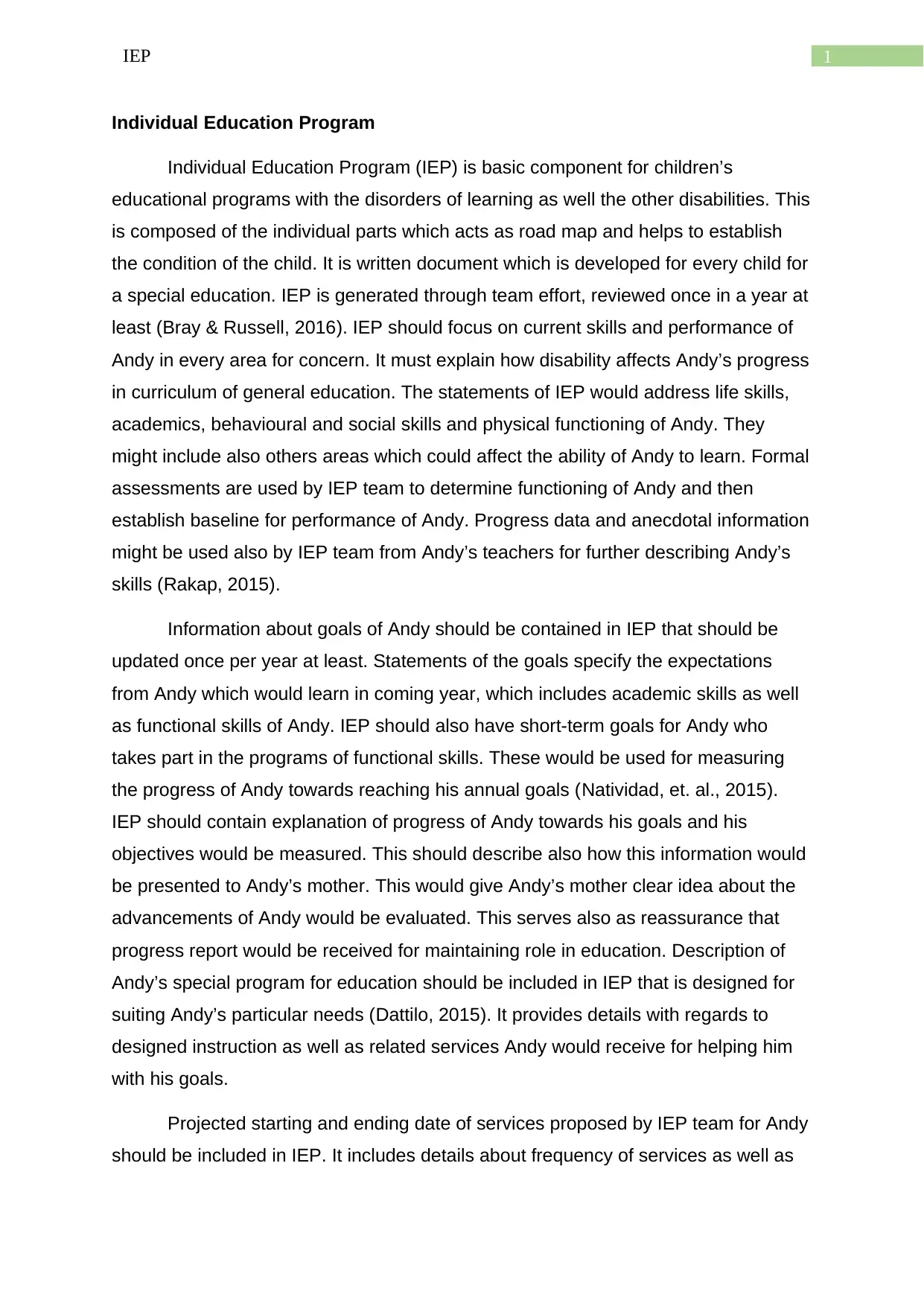
Individual Education Program
Individual Education Program (IEP) is basic component for children’s
educational programs with the disorders of learning as well the other disabilities. This
is composed of the individual parts which acts as road map and helps to establish
the condition of the child. It is written document which is developed for every child for
a special education. IEP is generated through team effort, reviewed once in a year at
least (Bray & Russell, 2016). IEP should focus on current skills and performance of
Andy in every area for concern. It must explain how disability affects Andy’s progress
in curriculum of general education. The statements of IEP would address life skills,
academics, behavioural and social skills and physical functioning of Andy. They
might include also others areas which could affect the ability of Andy to learn. Formal
assessments are used by IEP team to determine functioning of Andy and then
establish baseline for performance of Andy. Progress data and anecdotal information
might be used also by IEP team from Andy’s teachers for further describing Andy’s
skills (Rakap, 2015).
Information about goals of Andy should be contained in IEP that should be
updated once per year at least. Statements of the goals specify the expectations
from Andy which would learn in coming year, which includes academic skills as well
as functional skills of Andy. IEP should also have short-term goals for Andy who
takes part in the programs of functional skills. These would be used for measuring
the progress of Andy towards reaching his annual goals (Natividad, et. al., 2015).
IEP should contain explanation of progress of Andy towards his goals and his
objectives would be measured. This should describe also how this information would
be presented to Andy’s mother. This would give Andy’s mother clear idea about the
advancements of Andy would be evaluated. This serves also as reassurance that
progress report would be received for maintaining role in education. Description of
Andy’s special program for education should be included in IEP that is designed for
suiting Andy’s particular needs (Dattilo, 2015). It provides details with regards to
designed instruction as well as related services Andy would receive for helping him
with his goals.
Projected starting and ending date of services proposed by IEP team for Andy
should be included in IEP. It includes details about frequency of services as well as
Individual Education Program
Individual Education Program (IEP) is basic component for children’s
educational programs with the disorders of learning as well the other disabilities. This
is composed of the individual parts which acts as road map and helps to establish
the condition of the child. It is written document which is developed for every child for
a special education. IEP is generated through team effort, reviewed once in a year at
least (Bray & Russell, 2016). IEP should focus on current skills and performance of
Andy in every area for concern. It must explain how disability affects Andy’s progress
in curriculum of general education. The statements of IEP would address life skills,
academics, behavioural and social skills and physical functioning of Andy. They
might include also others areas which could affect the ability of Andy to learn. Formal
assessments are used by IEP team to determine functioning of Andy and then
establish baseline for performance of Andy. Progress data and anecdotal information
might be used also by IEP team from Andy’s teachers for further describing Andy’s
skills (Rakap, 2015).
Information about goals of Andy should be contained in IEP that should be
updated once per year at least. Statements of the goals specify the expectations
from Andy which would learn in coming year, which includes academic skills as well
as functional skills of Andy. IEP should also have short-term goals for Andy who
takes part in the programs of functional skills. These would be used for measuring
the progress of Andy towards reaching his annual goals (Natividad, et. al., 2015).
IEP should contain explanation of progress of Andy towards his goals and his
objectives would be measured. This should describe also how this information would
be presented to Andy’s mother. This would give Andy’s mother clear idea about the
advancements of Andy would be evaluated. This serves also as reassurance that
progress report would be received for maintaining role in education. Description of
Andy’s special program for education should be included in IEP that is designed for
suiting Andy’s particular needs (Dattilo, 2015). It provides details with regards to
designed instruction as well as related services Andy would receive for helping him
with his goals.
Projected starting and ending date of services proposed by IEP team for Andy
should be included in IEP. It includes details about frequency of services as well as
2IEP
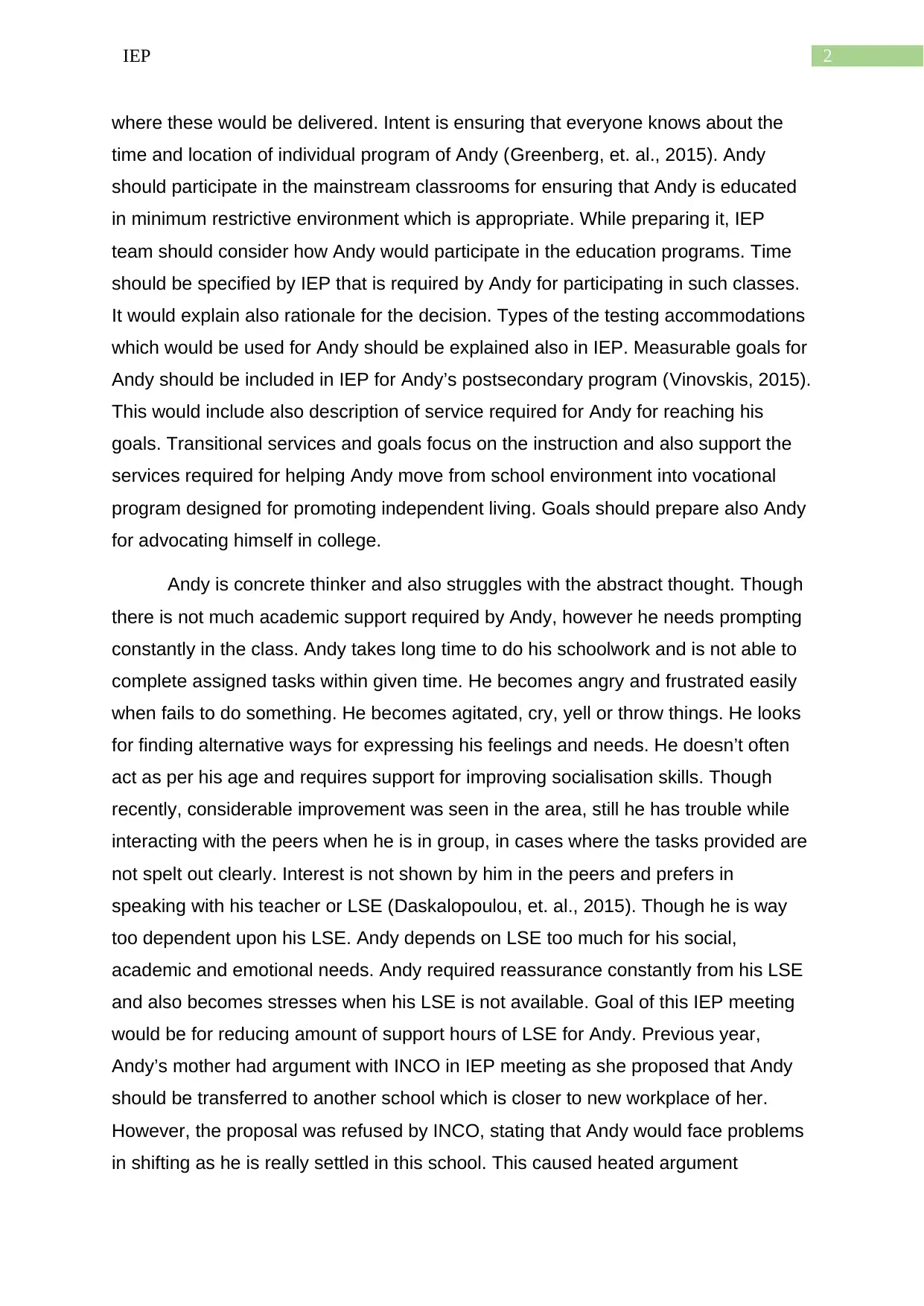
where these would be delivered. Intent is ensuring that everyone knows about the
time and location of individual program of Andy (Greenberg, et. al., 2015). Andy
should participate in the mainstream classrooms for ensuring that Andy is educated
in minimum restrictive environment which is appropriate. While preparing it, IEP
team should consider how Andy would participate in the education programs. Time
should be specified by IEP that is required by Andy for participating in such classes.
It would explain also rationale for the decision. Types of the testing accommodations
which would be used for Andy should be explained also in IEP. Measurable goals for
Andy should be included in IEP for Andy’s postsecondary program (Vinovskis, 2015).
This would include also description of service required for Andy for reaching his
goals. Transitional services and goals focus on the instruction and also support the
services required for helping Andy move from school environment into vocational
program designed for promoting independent living. Goals should prepare also Andy
for advocating himself in college.
Andy is concrete thinker and also struggles with the abstract thought. Though
there is not much academic support required by Andy, however he needs prompting
constantly in the class. Andy takes long time to do his schoolwork and is not able to
complete assigned tasks within given time. He becomes angry and frustrated easily
when fails to do something. He becomes agitated, cry, yell or throw things. He looks
for finding alternative ways for expressing his feelings and needs. He doesn’t often
act as per his age and requires support for improving socialisation skills. Though
recently, considerable improvement was seen in the area, still he has trouble while
interacting with the peers when he is in group, in cases where the tasks provided are
not spelt out clearly. Interest is not shown by him in the peers and prefers in
speaking with his teacher or LSE (Daskalopoulou, et. al., 2015). Though he is way
too dependent upon his LSE. Andy depends on LSE too much for his social,
academic and emotional needs. Andy required reassurance constantly from his LSE
and also becomes stresses when his LSE is not available. Goal of this IEP meeting
would be for reducing amount of support hours of LSE for Andy. Previous year,
Andy’s mother had argument with INCO in IEP meeting as she proposed that Andy
should be transferred to another school which is closer to new workplace of her.
However, the proposal was refused by INCO, stating that Andy would face problems
in shifting as he is really settled in this school. This caused heated argument
where these would be delivered. Intent is ensuring that everyone knows about the
time and location of individual program of Andy (Greenberg, et. al., 2015). Andy
should participate in the mainstream classrooms for ensuring that Andy is educated
in minimum restrictive environment which is appropriate. While preparing it, IEP
team should consider how Andy would participate in the education programs. Time
should be specified by IEP that is required by Andy for participating in such classes.
It would explain also rationale for the decision. Types of the testing accommodations
which would be used for Andy should be explained also in IEP. Measurable goals for
Andy should be included in IEP for Andy’s postsecondary program (Vinovskis, 2015).
This would include also description of service required for Andy for reaching his
goals. Transitional services and goals focus on the instruction and also support the
services required for helping Andy move from school environment into vocational
program designed for promoting independent living. Goals should prepare also Andy
for advocating himself in college.
Andy is concrete thinker and also struggles with the abstract thought. Though
there is not much academic support required by Andy, however he needs prompting
constantly in the class. Andy takes long time to do his schoolwork and is not able to
complete assigned tasks within given time. He becomes angry and frustrated easily
when fails to do something. He becomes agitated, cry, yell or throw things. He looks
for finding alternative ways for expressing his feelings and needs. He doesn’t often
act as per his age and requires support for improving socialisation skills. Though
recently, considerable improvement was seen in the area, still he has trouble while
interacting with the peers when he is in group, in cases where the tasks provided are
not spelt out clearly. Interest is not shown by him in the peers and prefers in
speaking with his teacher or LSE (Daskalopoulou, et. al., 2015). Though he is way
too dependent upon his LSE. Andy depends on LSE too much for his social,
academic and emotional needs. Andy required reassurance constantly from his LSE
and also becomes stresses when his LSE is not available. Goal of this IEP meeting
would be for reducing amount of support hours of LSE for Andy. Previous year,
Andy’s mother had argument with INCO in IEP meeting as she proposed that Andy
should be transferred to another school which is closer to new workplace of her.
However, the proposal was refused by INCO, stating that Andy would face problems
in shifting as he is really settled in this school. This caused heated argument
⊘ This is a preview!⊘
Do you want full access?
Subscribe today to unlock all pages.

Trusted by 1+ million students worldwide
3IEP
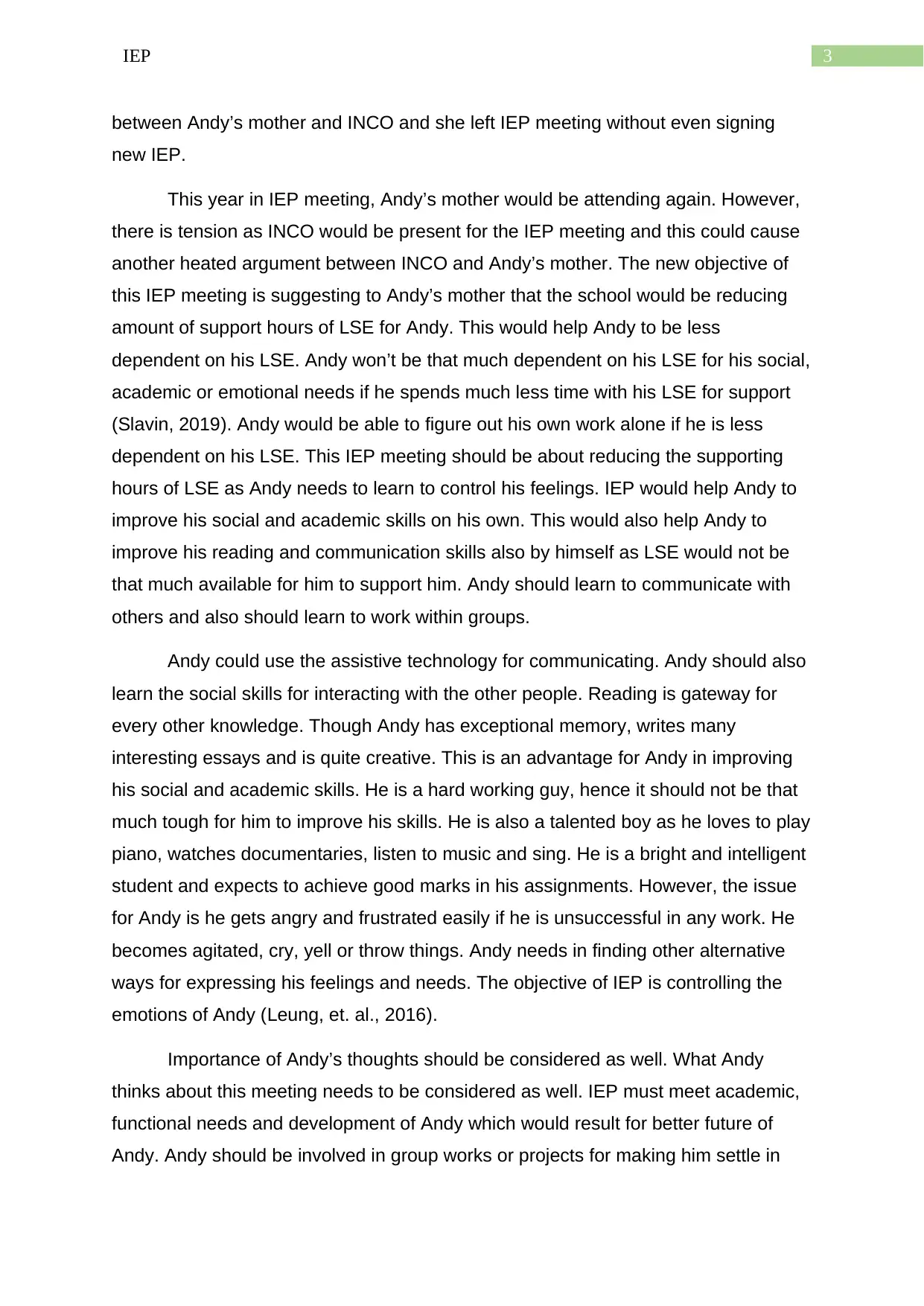
between Andy’s mother and INCO and she left IEP meeting without even signing
new IEP.
This year in IEP meeting, Andy’s mother would be attending again. However,
there is tension as INCO would be present for the IEP meeting and this could cause
another heated argument between INCO and Andy’s mother. The new objective of
this IEP meeting is suggesting to Andy’s mother that the school would be reducing
amount of support hours of LSE for Andy. This would help Andy to be less
dependent on his LSE. Andy won’t be that much dependent on his LSE for his social,
academic or emotional needs if he spends much less time with his LSE for support
(Slavin, 2019). Andy would be able to figure out his own work alone if he is less
dependent on his LSE. This IEP meeting should be about reducing the supporting
hours of LSE as Andy needs to learn to control his feelings. IEP would help Andy to
improve his social and academic skills on his own. This would also help Andy to
improve his reading and communication skills also by himself as LSE would not be
that much available for him to support him. Andy should learn to communicate with
others and also should learn to work within groups.
Andy could use the assistive technology for communicating. Andy should also
learn the social skills for interacting with the other people. Reading is gateway for
every other knowledge. Though Andy has exceptional memory, writes many
interesting essays and is quite creative. This is an advantage for Andy in improving
his social and academic skills. He is a hard working guy, hence it should not be that
much tough for him to improve his skills. He is also a talented boy as he loves to play
piano, watches documentaries, listen to music and sing. He is a bright and intelligent
student and expects to achieve good marks in his assignments. However, the issue
for Andy is he gets angry and frustrated easily if he is unsuccessful in any work. He
becomes agitated, cry, yell or throw things. Andy needs in finding other alternative
ways for expressing his feelings and needs. The objective of IEP is controlling the
emotions of Andy (Leung, et. al., 2016).
Importance of Andy’s thoughts should be considered as well. What Andy
thinks about this meeting needs to be considered as well. IEP must meet academic,
functional needs and development of Andy which would result for better future of
Andy. Andy should be involved in group works or projects for making him settle in
between Andy’s mother and INCO and she left IEP meeting without even signing
new IEP.
This year in IEP meeting, Andy’s mother would be attending again. However,
there is tension as INCO would be present for the IEP meeting and this could cause
another heated argument between INCO and Andy’s mother. The new objective of
this IEP meeting is suggesting to Andy’s mother that the school would be reducing
amount of support hours of LSE for Andy. This would help Andy to be less
dependent on his LSE. Andy won’t be that much dependent on his LSE for his social,
academic or emotional needs if he spends much less time with his LSE for support
(Slavin, 2019). Andy would be able to figure out his own work alone if he is less
dependent on his LSE. This IEP meeting should be about reducing the supporting
hours of LSE as Andy needs to learn to control his feelings. IEP would help Andy to
improve his social and academic skills on his own. This would also help Andy to
improve his reading and communication skills also by himself as LSE would not be
that much available for him to support him. Andy should learn to communicate with
others and also should learn to work within groups.
Andy could use the assistive technology for communicating. Andy should also
learn the social skills for interacting with the other people. Reading is gateway for
every other knowledge. Though Andy has exceptional memory, writes many
interesting essays and is quite creative. This is an advantage for Andy in improving
his social and academic skills. He is a hard working guy, hence it should not be that
much tough for him to improve his skills. He is also a talented boy as he loves to play
piano, watches documentaries, listen to music and sing. He is a bright and intelligent
student and expects to achieve good marks in his assignments. However, the issue
for Andy is he gets angry and frustrated easily if he is unsuccessful in any work. He
becomes agitated, cry, yell or throw things. Andy needs in finding other alternative
ways for expressing his feelings and needs. The objective of IEP is controlling the
emotions of Andy (Leung, et. al., 2016).
Importance of Andy’s thoughts should be considered as well. What Andy
thinks about this meeting needs to be considered as well. IEP must meet academic,
functional needs and development of Andy which would result for better future of
Andy. Andy should be involved in group works or projects for making him settle in
Paraphrase This Document
Need a fresh take? Get an instant paraphrase of this document with our AI Paraphraser
4IEP
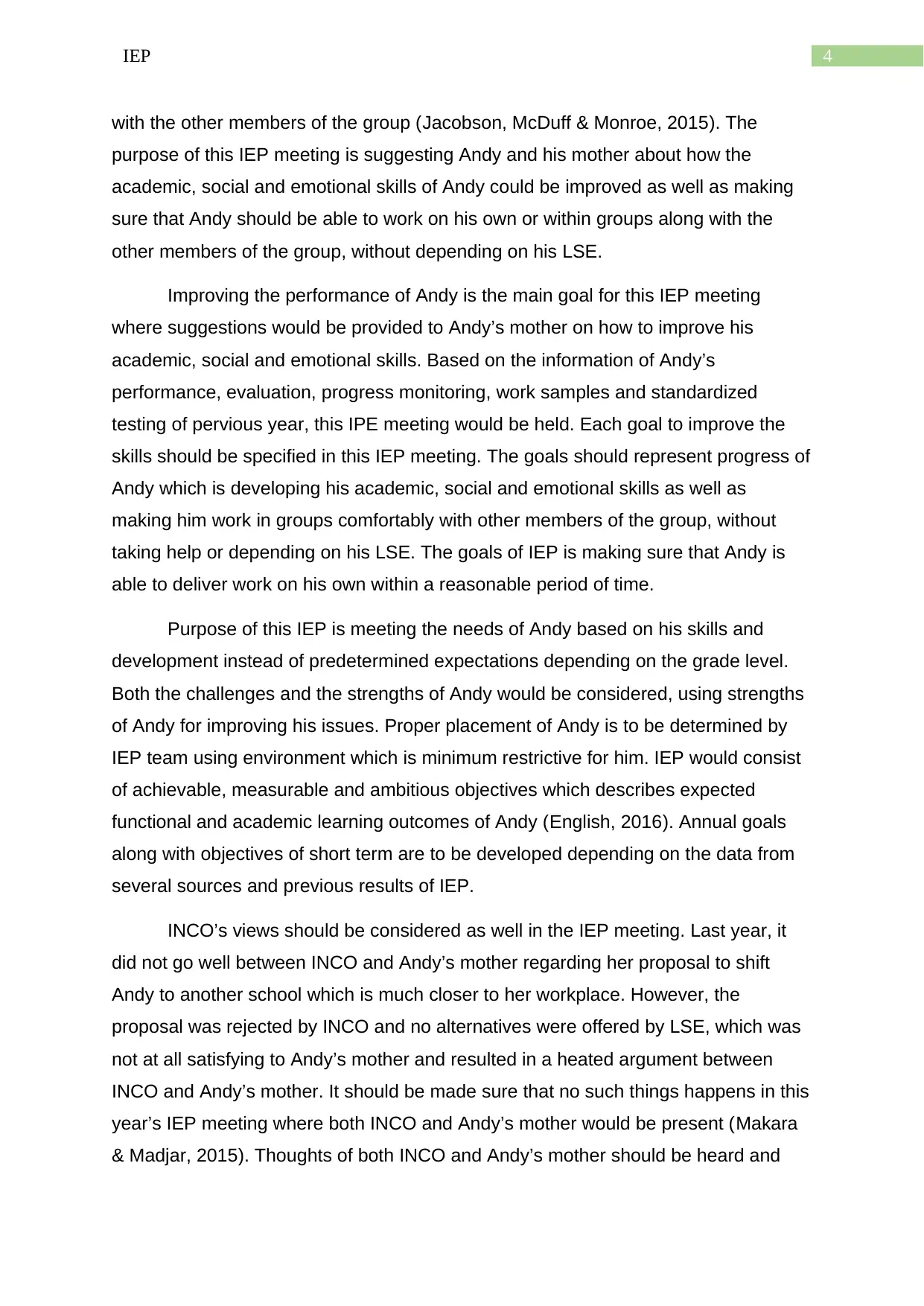
with the other members of the group (Jacobson, McDuff & Monroe, 2015). The
purpose of this IEP meeting is suggesting Andy and his mother about how the
academic, social and emotional skills of Andy could be improved as well as making
sure that Andy should be able to work on his own or within groups along with the
other members of the group, without depending on his LSE.
Improving the performance of Andy is the main goal for this IEP meeting
where suggestions would be provided to Andy’s mother on how to improve his
academic, social and emotional skills. Based on the information of Andy’s
performance, evaluation, progress monitoring, work samples and standardized
testing of pervious year, this IPE meeting would be held. Each goal to improve the
skills should be specified in this IEP meeting. The goals should represent progress of
Andy which is developing his academic, social and emotional skills as well as
making him work in groups comfortably with other members of the group, without
taking help or depending on his LSE. The goals of IEP is making sure that Andy is
able to deliver work on his own within a reasonable period of time.
Purpose of this IEP is meeting the needs of Andy based on his skills and
development instead of predetermined expectations depending on the grade level.
Both the challenges and the strengths of Andy would be considered, using strengths
of Andy for improving his issues. Proper placement of Andy is to be determined by
IEP team using environment which is minimum restrictive for him. IEP would consist
of achievable, measurable and ambitious objectives which describes expected
functional and academic learning outcomes of Andy (English, 2016). Annual goals
along with objectives of short term are to be developed depending on the data from
several sources and previous results of IEP.
INCO’s views should be considered as well in the IEP meeting. Last year, it
did not go well between INCO and Andy’s mother regarding her proposal to shift
Andy to another school which is much closer to her workplace. However, the
proposal was rejected by INCO and no alternatives were offered by LSE, which was
not at all satisfying to Andy’s mother and resulted in a heated argument between
INCO and Andy’s mother. It should be made sure that no such things happens in this
year’s IEP meeting where both INCO and Andy’s mother would be present (Makara
& Madjar, 2015). Thoughts of both INCO and Andy’s mother should be heard and
with the other members of the group (Jacobson, McDuff & Monroe, 2015). The
purpose of this IEP meeting is suggesting Andy and his mother about how the
academic, social and emotional skills of Andy could be improved as well as making
sure that Andy should be able to work on his own or within groups along with the
other members of the group, without depending on his LSE.
Improving the performance of Andy is the main goal for this IEP meeting
where suggestions would be provided to Andy’s mother on how to improve his
academic, social and emotional skills. Based on the information of Andy’s
performance, evaluation, progress monitoring, work samples and standardized
testing of pervious year, this IPE meeting would be held. Each goal to improve the
skills should be specified in this IEP meeting. The goals should represent progress of
Andy which is developing his academic, social and emotional skills as well as
making him work in groups comfortably with other members of the group, without
taking help or depending on his LSE. The goals of IEP is making sure that Andy is
able to deliver work on his own within a reasonable period of time.
Purpose of this IEP is meeting the needs of Andy based on his skills and
development instead of predetermined expectations depending on the grade level.
Both the challenges and the strengths of Andy would be considered, using strengths
of Andy for improving his issues. Proper placement of Andy is to be determined by
IEP team using environment which is minimum restrictive for him. IEP would consist
of achievable, measurable and ambitious objectives which describes expected
functional and academic learning outcomes of Andy (English, 2016). Annual goals
along with objectives of short term are to be developed depending on the data from
several sources and previous results of IEP.
INCO’s views should be considered as well in the IEP meeting. Last year, it
did not go well between INCO and Andy’s mother regarding her proposal to shift
Andy to another school which is much closer to her workplace. However, the
proposal was rejected by INCO and no alternatives were offered by LSE, which was
not at all satisfying to Andy’s mother and resulted in a heated argument between
INCO and Andy’s mother. It should be made sure that no such things happens in this
year’s IEP meeting where both INCO and Andy’s mother would be present (Makara
& Madjar, 2015). Thoughts of both INCO and Andy’s mother should be heard and
5IEP
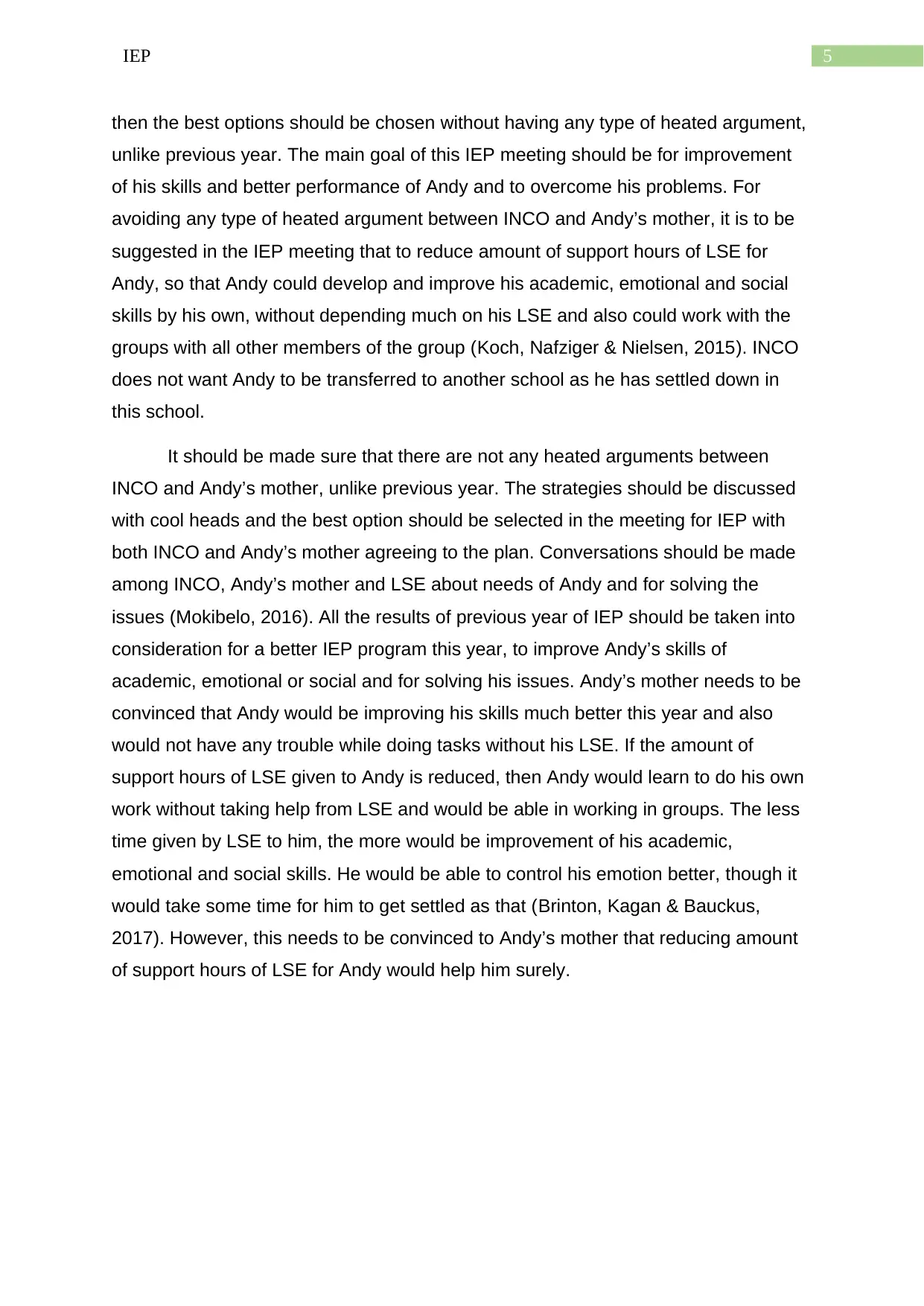
then the best options should be chosen without having any type of heated argument,
unlike previous year. The main goal of this IEP meeting should be for improvement
of his skills and better performance of Andy and to overcome his problems. For
avoiding any type of heated argument between INCO and Andy’s mother, it is to be
suggested in the IEP meeting that to reduce amount of support hours of LSE for
Andy, so that Andy could develop and improve his academic, emotional and social
skills by his own, without depending much on his LSE and also could work with the
groups with all other members of the group (Koch, Nafziger & Nielsen, 2015). INCO
does not want Andy to be transferred to another school as he has settled down in
this school.
It should be made sure that there are not any heated arguments between
INCO and Andy’s mother, unlike previous year. The strategies should be discussed
with cool heads and the best option should be selected in the meeting for IEP with
both INCO and Andy’s mother agreeing to the plan. Conversations should be made
among INCO, Andy’s mother and LSE about needs of Andy and for solving the
issues (Mokibelo, 2016). All the results of previous year of IEP should be taken into
consideration for a better IEP program this year, to improve Andy’s skills of
academic, emotional or social and for solving his issues. Andy’s mother needs to be
convinced that Andy would be improving his skills much better this year and also
would not have any trouble while doing tasks without his LSE. If the amount of
support hours of LSE given to Andy is reduced, then Andy would learn to do his own
work without taking help from LSE and would be able in working in groups. The less
time given by LSE to him, the more would be improvement of his academic,
emotional and social skills. He would be able to control his emotion better, though it
would take some time for him to get settled as that (Brinton, Kagan & Bauckus,
2017). However, this needs to be convinced to Andy’s mother that reducing amount
of support hours of LSE for Andy would help him surely.
then the best options should be chosen without having any type of heated argument,
unlike previous year. The main goal of this IEP meeting should be for improvement
of his skills and better performance of Andy and to overcome his problems. For
avoiding any type of heated argument between INCO and Andy’s mother, it is to be
suggested in the IEP meeting that to reduce amount of support hours of LSE for
Andy, so that Andy could develop and improve his academic, emotional and social
skills by his own, without depending much on his LSE and also could work with the
groups with all other members of the group (Koch, Nafziger & Nielsen, 2015). INCO
does not want Andy to be transferred to another school as he has settled down in
this school.
It should be made sure that there are not any heated arguments between
INCO and Andy’s mother, unlike previous year. The strategies should be discussed
with cool heads and the best option should be selected in the meeting for IEP with
both INCO and Andy’s mother agreeing to the plan. Conversations should be made
among INCO, Andy’s mother and LSE about needs of Andy and for solving the
issues (Mokibelo, 2016). All the results of previous year of IEP should be taken into
consideration for a better IEP program this year, to improve Andy’s skills of
academic, emotional or social and for solving his issues. Andy’s mother needs to be
convinced that Andy would be improving his skills much better this year and also
would not have any trouble while doing tasks without his LSE. If the amount of
support hours of LSE given to Andy is reduced, then Andy would learn to do his own
work without taking help from LSE and would be able in working in groups. The less
time given by LSE to him, the more would be improvement of his academic,
emotional and social skills. He would be able to control his emotion better, though it
would take some time for him to get settled as that (Brinton, Kagan & Bauckus,
2017). However, this needs to be convinced to Andy’s mother that reducing amount
of support hours of LSE for Andy would help him surely.
⊘ This is a preview!⊘
Do you want full access?
Subscribe today to unlock all pages.
Trusted by 1+ million students worldwide
6IEP
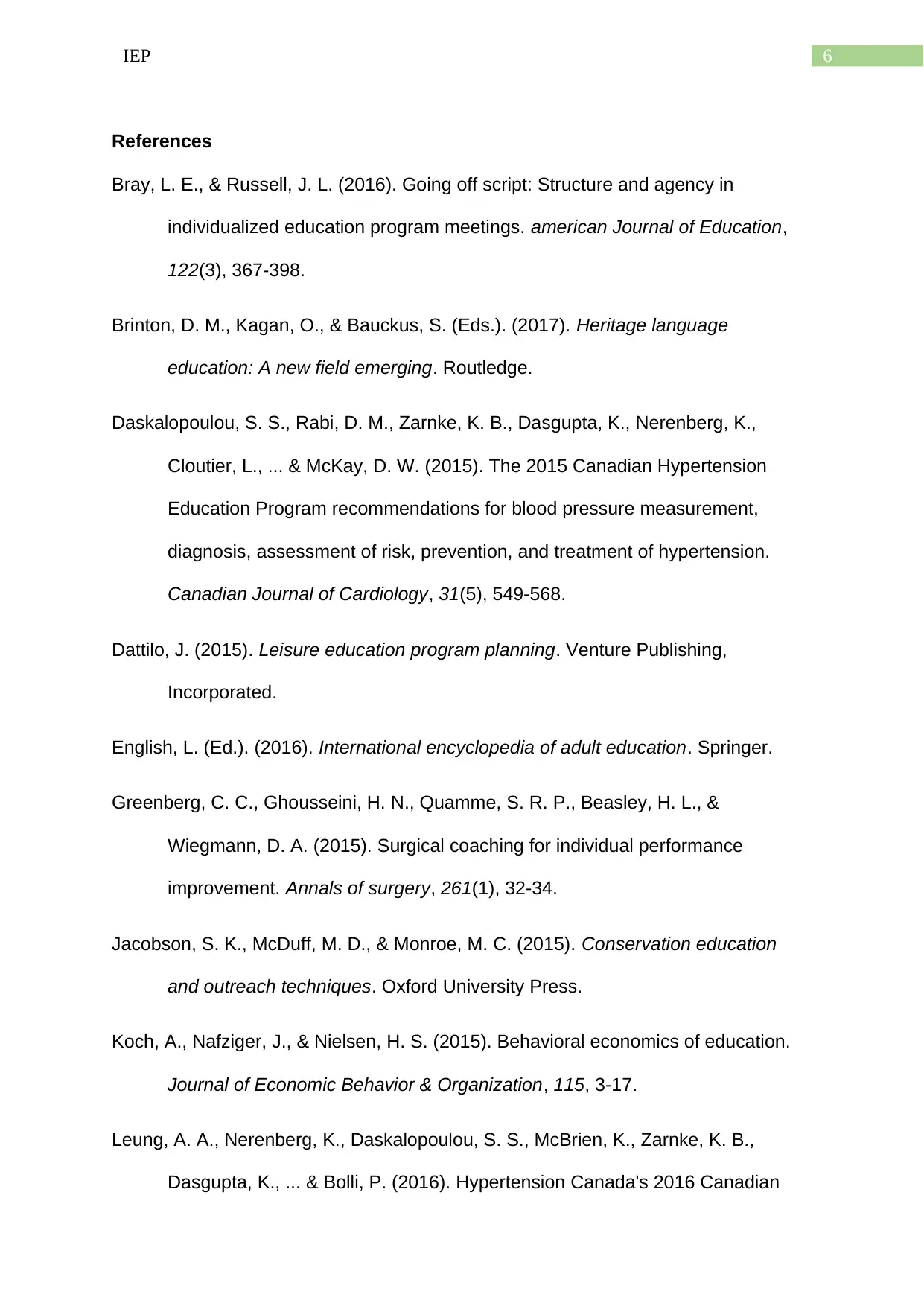
References
Bray, L. E., & Russell, J. L. (2016). Going off script: Structure and agency in
individualized education program meetings. american Journal of Education,
122(3), 367-398.
Brinton, D. M., Kagan, O., & Bauckus, S. (Eds.). (2017). Heritage language
education: A new field emerging. Routledge.
Daskalopoulou, S. S., Rabi, D. M., Zarnke, K. B., Dasgupta, K., Nerenberg, K.,
Cloutier, L., ... & McKay, D. W. (2015). The 2015 Canadian Hypertension
Education Program recommendations for blood pressure measurement,
diagnosis, assessment of risk, prevention, and treatment of hypertension.
Canadian Journal of Cardiology, 31(5), 549-568.
Dattilo, J. (2015). Leisure education program planning. Venture Publishing,
Incorporated.
English, L. (Ed.). (2016). International encyclopedia of adult education. Springer.
Greenberg, C. C., Ghousseini, H. N., Quamme, S. R. P., Beasley, H. L., &
Wiegmann, D. A. (2015). Surgical coaching for individual performance
improvement. Annals of surgery, 261(1), 32-34.
Jacobson, S. K., McDuff, M. D., & Monroe, M. C. (2015). Conservation education
and outreach techniques. Oxford University Press.
Koch, A., Nafziger, J., & Nielsen, H. S. (2015). Behavioral economics of education.
Journal of Economic Behavior & Organization, 115, 3-17.
Leung, A. A., Nerenberg, K., Daskalopoulou, S. S., McBrien, K., Zarnke, K. B.,
Dasgupta, K., ... & Bolli, P. (2016). Hypertension Canada's 2016 Canadian
References
Bray, L. E., & Russell, J. L. (2016). Going off script: Structure and agency in
individualized education program meetings. american Journal of Education,
122(3), 367-398.
Brinton, D. M., Kagan, O., & Bauckus, S. (Eds.). (2017). Heritage language
education: A new field emerging. Routledge.
Daskalopoulou, S. S., Rabi, D. M., Zarnke, K. B., Dasgupta, K., Nerenberg, K.,
Cloutier, L., ... & McKay, D. W. (2015). The 2015 Canadian Hypertension
Education Program recommendations for blood pressure measurement,
diagnosis, assessment of risk, prevention, and treatment of hypertension.
Canadian Journal of Cardiology, 31(5), 549-568.
Dattilo, J. (2015). Leisure education program planning. Venture Publishing,
Incorporated.
English, L. (Ed.). (2016). International encyclopedia of adult education. Springer.
Greenberg, C. C., Ghousseini, H. N., Quamme, S. R. P., Beasley, H. L., &
Wiegmann, D. A. (2015). Surgical coaching for individual performance
improvement. Annals of surgery, 261(1), 32-34.
Jacobson, S. K., McDuff, M. D., & Monroe, M. C. (2015). Conservation education
and outreach techniques. Oxford University Press.
Koch, A., Nafziger, J., & Nielsen, H. S. (2015). Behavioral economics of education.
Journal of Economic Behavior & Organization, 115, 3-17.
Leung, A. A., Nerenberg, K., Daskalopoulou, S. S., McBrien, K., Zarnke, K. B.,
Dasgupta, K., ... & Bolli, P. (2016). Hypertension Canada's 2016 Canadian
Paraphrase This Document
Need a fresh take? Get an instant paraphrase of this document with our AI Paraphraser
7IEP
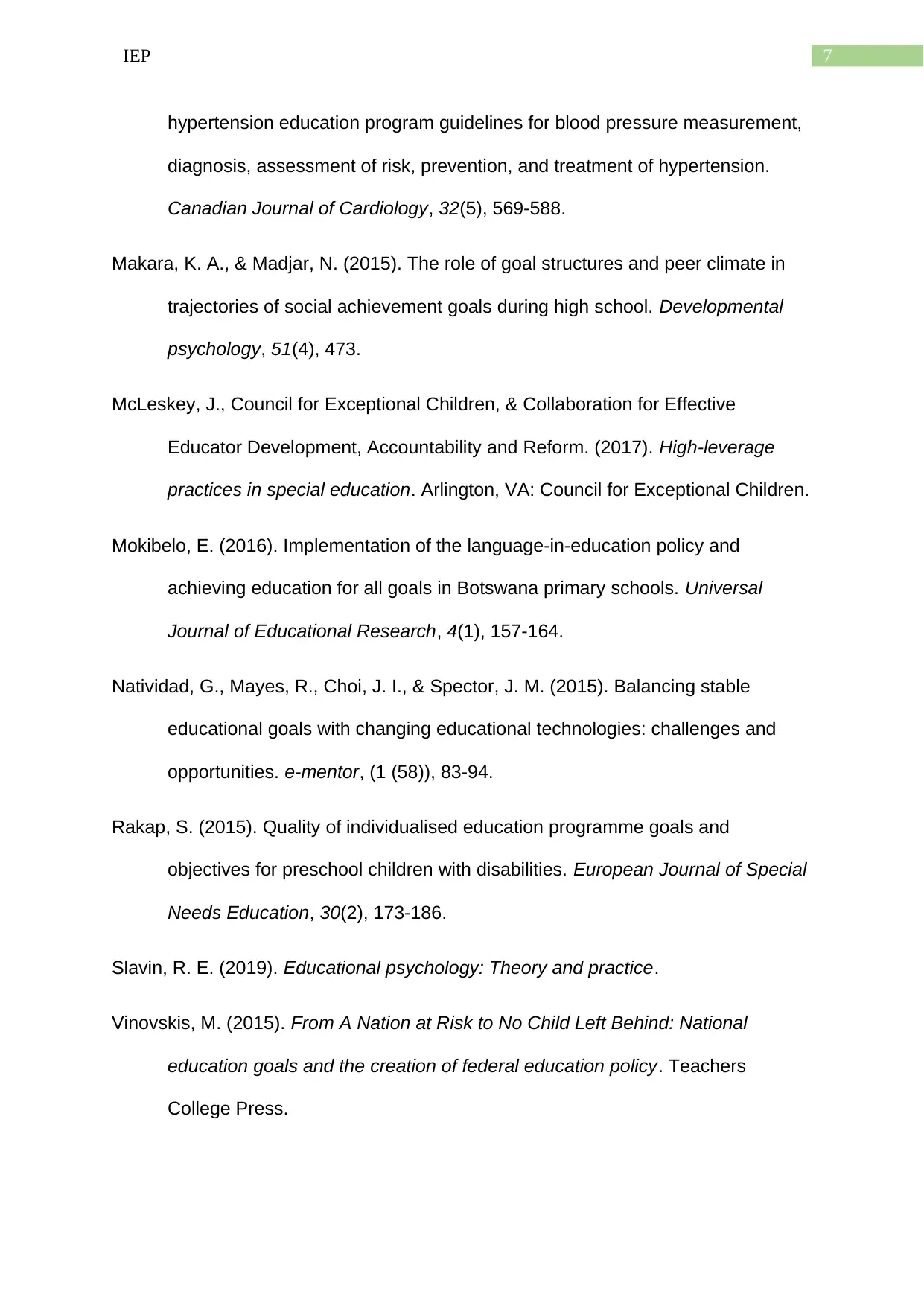
hypertension education program guidelines for blood pressure measurement,
diagnosis, assessment of risk, prevention, and treatment of hypertension.
Canadian Journal of Cardiology, 32(5), 569-588.
Makara, K. A., & Madjar, N. (2015). The role of goal structures and peer climate in
trajectories of social achievement goals during high school. Developmental
psychology, 51(4), 473.
McLeskey, J., Council for Exceptional Children, & Collaboration for Effective
Educator Development, Accountability and Reform. (2017). High-leverage
practices in special education. Arlington, VA: Council for Exceptional Children.
Mokibelo, E. (2016). Implementation of the language-in-education policy and
achieving education for all goals in Botswana primary schools. Universal
Journal of Educational Research, 4(1), 157-164.
Natividad, G., Mayes, R., Choi, J. I., & Spector, J. M. (2015). Balancing stable
educational goals with changing educational technologies: challenges and
opportunities. e-mentor, (1 (58)), 83-94.
Rakap, S. (2015). Quality of individualised education programme goals and
objectives for preschool children with disabilities. European Journal of Special
Needs Education, 30(2), 173-186.
Slavin, R. E. (2019). Educational psychology: Theory and practice.
Vinovskis, M. (2015). From A Nation at Risk to No Child Left Behind: National
education goals and the creation of federal education policy. Teachers
College Press.
hypertension education program guidelines for blood pressure measurement,
diagnosis, assessment of risk, prevention, and treatment of hypertension.
Canadian Journal of Cardiology, 32(5), 569-588.
Makara, K. A., & Madjar, N. (2015). The role of goal structures and peer climate in
trajectories of social achievement goals during high school. Developmental
psychology, 51(4), 473.
McLeskey, J., Council for Exceptional Children, & Collaboration for Effective
Educator Development, Accountability and Reform. (2017). High-leverage
practices in special education. Arlington, VA: Council for Exceptional Children.
Mokibelo, E. (2016). Implementation of the language-in-education policy and
achieving education for all goals in Botswana primary schools. Universal
Journal of Educational Research, 4(1), 157-164.
Natividad, G., Mayes, R., Choi, J. I., & Spector, J. M. (2015). Balancing stable
educational goals with changing educational technologies: challenges and
opportunities. e-mentor, (1 (58)), 83-94.
Rakap, S. (2015). Quality of individualised education programme goals and
objectives for preschool children with disabilities. European Journal of Special
Needs Education, 30(2), 173-186.
Slavin, R. E. (2019). Educational psychology: Theory and practice.
Vinovskis, M. (2015). From A Nation at Risk to No Child Left Behind: National
education goals and the creation of federal education policy. Teachers
College Press.

1 out of 8


Related Documents


Your All-in-One AI-Powered Toolkit for Academic Success.
+13062052269
info@desklib.com
Available 24*7 on WhatsApp / Email
![[object Object]](/_next/static/media/star-bottom.7253800d.svg)
Unlock your academic potential
Copyright © 2020–2026 A2Z Services. All Rights Reserved. Developed and managed by ZUCOL.