Critical Evaluation of IFRS Leases Exposure Draft ED/2013/6
VerifiedAdded on 2023/06/04
|91
|36050
|208
Report
AI Summary
This document provides a detailed overview and analysis of the International Accounting Standards Board's (IASB) Exposure Draft ED/2013/6 on Leases. It highlights the core principle of recognizing assets and liabilities arising from leases, a significant departure from previous standards. The report discusses the proposed changes to both lessee and lessor accounting, including the classification of leases into Type A and Type B, based on the economic benefits derived from the underlying asset. It covers the recognition, measurement, presentation, and disclosure requirements for both lessees and lessors, as well as the treatment of sale and leaseback transactions and short-term leases. The document also outlines the proposed effective date and transition approaches, emphasizing the impact on reporting entities. This analysis aims to provide a comprehensive understanding of the proposed changes and their implications for financial reporting.
Exposure Draft ED/2013/6
May 2013
Comments to be received by 13 September 2013
Leases
May 2013
Comments to be received by 13 September 2013
Leases

Paraphrase This Document
Need a fresh take? Get an instant paraphrase of this document with our AI Paraphraser
Exposure Draft
Leases
Comments to be received by 13 September 2013
Leases
Comments to be received by 13 September 2013
Exposure Draft ED/2013/6Leasesis published by the InternationalAccounting Standards
Board (IASB)for commentonly. The proposalsmay be modified in the light of the
comments received before being issued in final form.Comments need to be received by
13 September2013and should be submitted in writing to the addressbelow or
electronically via our website www.ifrs.org using the ‘Comment on a proposal’ page.
All responses willbe put on the public record and posted on our website unless the
respondent requests confidentiality.Confidentiality requests will not normally be granted
unless supported by good reason, such as commercial confidence.
Disclaimer:the IASB,the IFRS Foundation,the authors and the publishers do not accept
responsibility for any loss caused by acting or refraining from acting in reliance on the
material in this publication, whether such loss is caused by negligence or otherwise.
International Financial Reporting Standards (including International Accounting Standards
and SIC and IFRIC Interpretations), Exposure Drafts and other IASB and/or IFRS Foundation
publications are copyright of the IFRS Foundation.
Copyright © 2013 IFRS Foundation®
ISBN for this part: 978-1-907877-92-6; ISBN for the set of three parts: 978-1-907877-91-9
All rights reserved.Copies of the Exposure Draft may only be made for the purpose of
preparing comments to be submitted to the IASB provided that such copies are for personal
or intra-organisationaluse only and are not sold or disseminated and each copy
acknowledges the IFRS Foundation’s copyright and sets out the IASB’s address in full.
Except as permitted above no partof this publication may be translated,reprinted,
reproduced or used in any form either in whole or in part or by any electronic, mechanical
or other means, now known or hereafter invented, including photocopying and recording,
or in any information storage and retrievalsystem,without prior permission in writing
from the IFRS Foundation.
The approved text of International Financial Reporting Standardsand other IASB
publications is that published by the IASB in the English language.Copies may be obtained
from the IFRS Foundation.Please address publications and copyright matters to:
IFRS Foundation Publications Department
1st Floor, 30 Cannon Street, London EC4M 6XH, United Kingdom
Tel: +44 (0)20 7332 2730 Fax: +44 (0)20 7332 2749
Email: publications@ifrs.org Web: www.ifrs.org
The IFRS Foundation logo/the IASB logo/’Hexagon Device’, ‘IFRS Foundation’, ‘eIFRS’, ‘IASB’,
‘IFRS for SMEs’, ‘IAS’, ‘IASs’, ‘IFRIC’, ‘IFRS’, ‘IFRSs’, ‘SIC’, ‘International Accounting
Standards’and ‘International Financial Reporting Standards’are Trade Marks of the IFRS
Foundation.
The IFRS Foundation is a not-for-profit corporation under the General Corporation Law of
the State of Delaware,USA and operates in England and Wales as an overseas company
(Company number: FC023235) with its principal office as above.
Board (IASB)for commentonly. The proposalsmay be modified in the light of the
comments received before being issued in final form.Comments need to be received by
13 September2013and should be submitted in writing to the addressbelow or
electronically via our website www.ifrs.org using the ‘Comment on a proposal’ page.
All responses willbe put on the public record and posted on our website unless the
respondent requests confidentiality.Confidentiality requests will not normally be granted
unless supported by good reason, such as commercial confidence.
Disclaimer:the IASB,the IFRS Foundation,the authors and the publishers do not accept
responsibility for any loss caused by acting or refraining from acting in reliance on the
material in this publication, whether such loss is caused by negligence or otherwise.
International Financial Reporting Standards (including International Accounting Standards
and SIC and IFRIC Interpretations), Exposure Drafts and other IASB and/or IFRS Foundation
publications are copyright of the IFRS Foundation.
Copyright © 2013 IFRS Foundation®
ISBN for this part: 978-1-907877-92-6; ISBN for the set of three parts: 978-1-907877-91-9
All rights reserved.Copies of the Exposure Draft may only be made for the purpose of
preparing comments to be submitted to the IASB provided that such copies are for personal
or intra-organisationaluse only and are not sold or disseminated and each copy
acknowledges the IFRS Foundation’s copyright and sets out the IASB’s address in full.
Except as permitted above no partof this publication may be translated,reprinted,
reproduced or used in any form either in whole or in part or by any electronic, mechanical
or other means, now known or hereafter invented, including photocopying and recording,
or in any information storage and retrievalsystem,without prior permission in writing
from the IFRS Foundation.
The approved text of International Financial Reporting Standardsand other IASB
publications is that published by the IASB in the English language.Copies may be obtained
from the IFRS Foundation.Please address publications and copyright matters to:
IFRS Foundation Publications Department
1st Floor, 30 Cannon Street, London EC4M 6XH, United Kingdom
Tel: +44 (0)20 7332 2730 Fax: +44 (0)20 7332 2749
Email: publications@ifrs.org Web: www.ifrs.org
The IFRS Foundation logo/the IASB logo/’Hexagon Device’, ‘IFRS Foundation’, ‘eIFRS’, ‘IASB’,
‘IFRS for SMEs’, ‘IAS’, ‘IASs’, ‘IFRIC’, ‘IFRS’, ‘IFRSs’, ‘SIC’, ‘International Accounting
Standards’and ‘International Financial Reporting Standards’are Trade Marks of the IFRS
Foundation.
The IFRS Foundation is a not-for-profit corporation under the General Corporation Law of
the State of Delaware,USA and operates in England and Wales as an overseas company
(Company number: FC023235) with its principal office as above.
⊘ This is a preview!⊘
Do you want full access?
Subscribe today to unlock all pages.

Trusted by 1+ million students worldwide
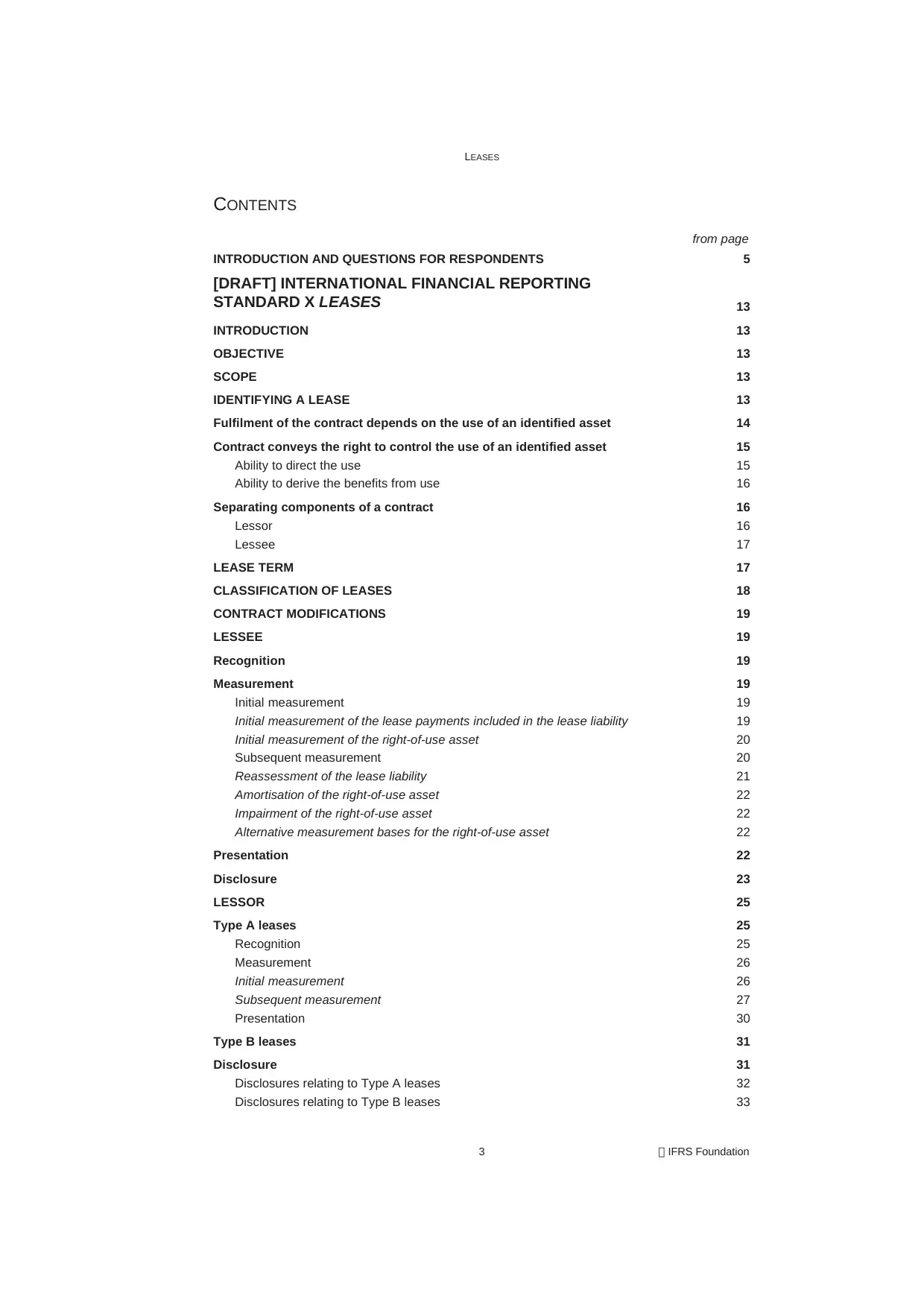
CONTENTS
from page
INTRODUCTION AND QUESTIONS FOR RESPONDENTS 5
[DRAFT] INTERNATIONAL FINANCIAL REPORTING
STANDARD X LEASES 13
INTRODUCTION 13
OBJECTIVE 13
SCOPE 13
IDENTIFYING A LEASE 13
Fulfilment of the contract depends on the use of an identified asset 14
Contract conveys the right to control the use of an identified asset 15
Ability to direct the use 15
Ability to derive the benefits from use 16
Separating components of a contract 16
Lessor 16
Lessee 17
LEASE TERM 17
CLASSIFICATION OF LEASES 18
CONTRACT MODIFICATIONS 19
LESSEE 19
Recognition 19
Measurement 19
Initial measurement 19
Initial measurement of the lease payments included in the lease liability 19
Initial measurement of the right-of-use asset 20
Subsequent measurement 20
Reassessment of the lease liability 21
Amortisation of the right-of-use asset 22
Impairment of the right-of-use asset 22
Alternative measurement bases for the right-of-use asset 22
Presentation 22
Disclosure 23
LESSOR 25
Type A leases 25
Recognition 25
Measurement 26
Initial measurement 26
Subsequent measurement 27
Presentation 30
Type B leases 31
Disclosure 31
Disclosures relating to Type A leases 32
Disclosures relating to Type B leases 33
LEASES
姝 IFRS Foundation3
from page
INTRODUCTION AND QUESTIONS FOR RESPONDENTS 5
[DRAFT] INTERNATIONAL FINANCIAL REPORTING
STANDARD X LEASES 13
INTRODUCTION 13
OBJECTIVE 13
SCOPE 13
IDENTIFYING A LEASE 13
Fulfilment of the contract depends on the use of an identified asset 14
Contract conveys the right to control the use of an identified asset 15
Ability to direct the use 15
Ability to derive the benefits from use 16
Separating components of a contract 16
Lessor 16
Lessee 17
LEASE TERM 17
CLASSIFICATION OF LEASES 18
CONTRACT MODIFICATIONS 19
LESSEE 19
Recognition 19
Measurement 19
Initial measurement 19
Initial measurement of the lease payments included in the lease liability 19
Initial measurement of the right-of-use asset 20
Subsequent measurement 20
Reassessment of the lease liability 21
Amortisation of the right-of-use asset 22
Impairment of the right-of-use asset 22
Alternative measurement bases for the right-of-use asset 22
Presentation 22
Disclosure 23
LESSOR 25
Type A leases 25
Recognition 25
Measurement 26
Initial measurement 26
Subsequent measurement 27
Presentation 30
Type B leases 31
Disclosure 31
Disclosures relating to Type A leases 32
Disclosures relating to Type B leases 33
LEASES
姝 IFRS Foundation3
Paraphrase This Document
Need a fresh take? Get an instant paraphrase of this document with our AI Paraphraser
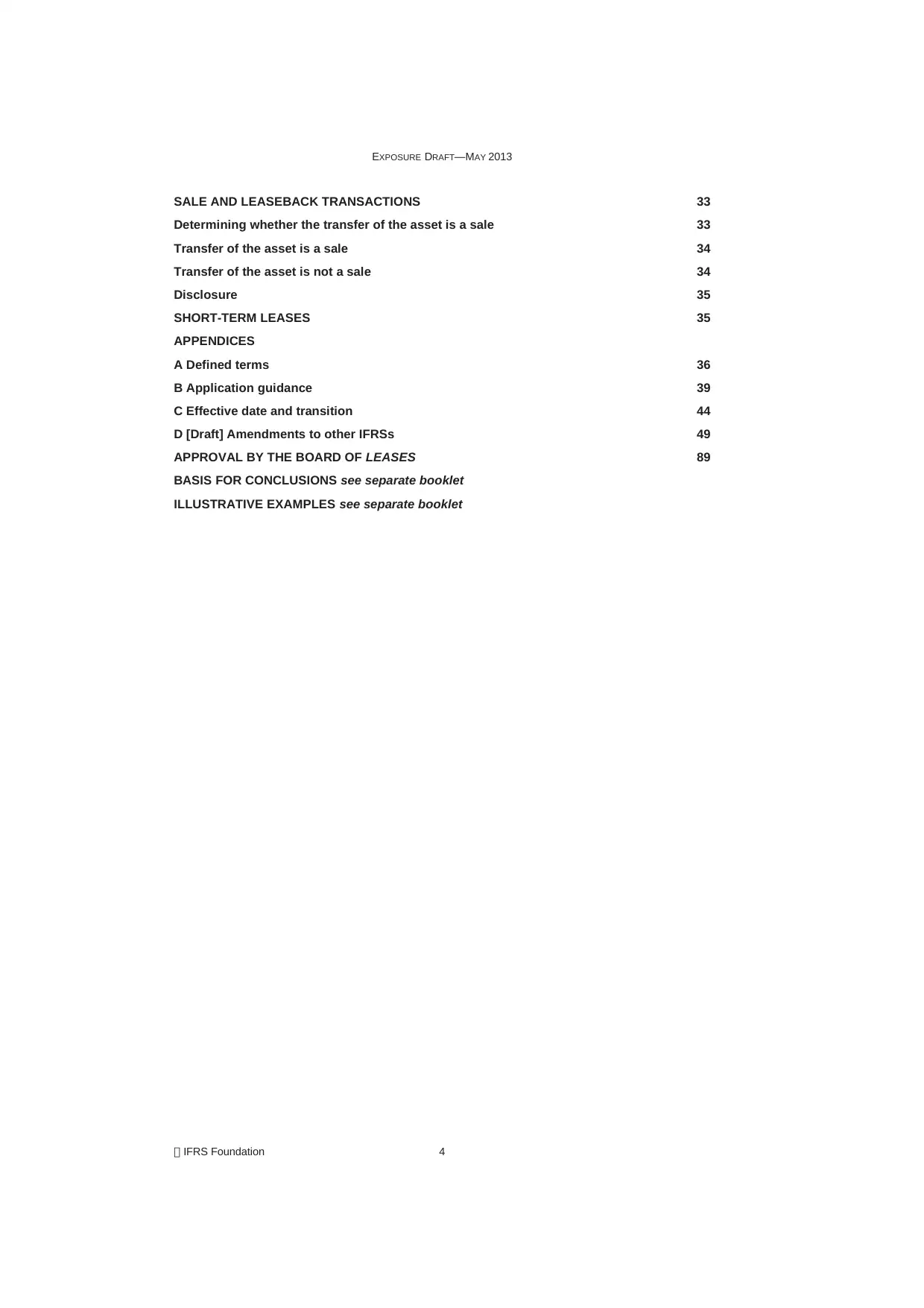
SALE AND LEASEBACK TRANSACTIONS 33
Determining whether the transfer of the asset is a sale 33
Transfer of the asset is a sale 34
Transfer of the asset is not a sale 34
Disclosure 35
SHORT-TERM LEASES 35
APPENDICES
A Defined terms 36
B Application guidance 39
C Effective date and transition 44
D [Draft] Amendments to other IFRSs 49
APPROVAL BY THE BOARD OF LEASES 89
BASIS FOR CONCLUSIONS see separate booklet
ILLUSTRATIVE EXAMPLES see separate booklet
EXPOSURE DRAFT—MAY 2013
姝 IFRS Foundation 4
Determining whether the transfer of the asset is a sale 33
Transfer of the asset is a sale 34
Transfer of the asset is not a sale 34
Disclosure 35
SHORT-TERM LEASES 35
APPENDICES
A Defined terms 36
B Application guidance 39
C Effective date and transition 44
D [Draft] Amendments to other IFRSs 49
APPROVAL BY THE BOARD OF LEASES 89
BASIS FOR CONCLUSIONS see separate booklet
ILLUSTRATIVE EXAMPLES see separate booklet
EXPOSURE DRAFT—MAY 2013
姝 IFRS Foundation 4
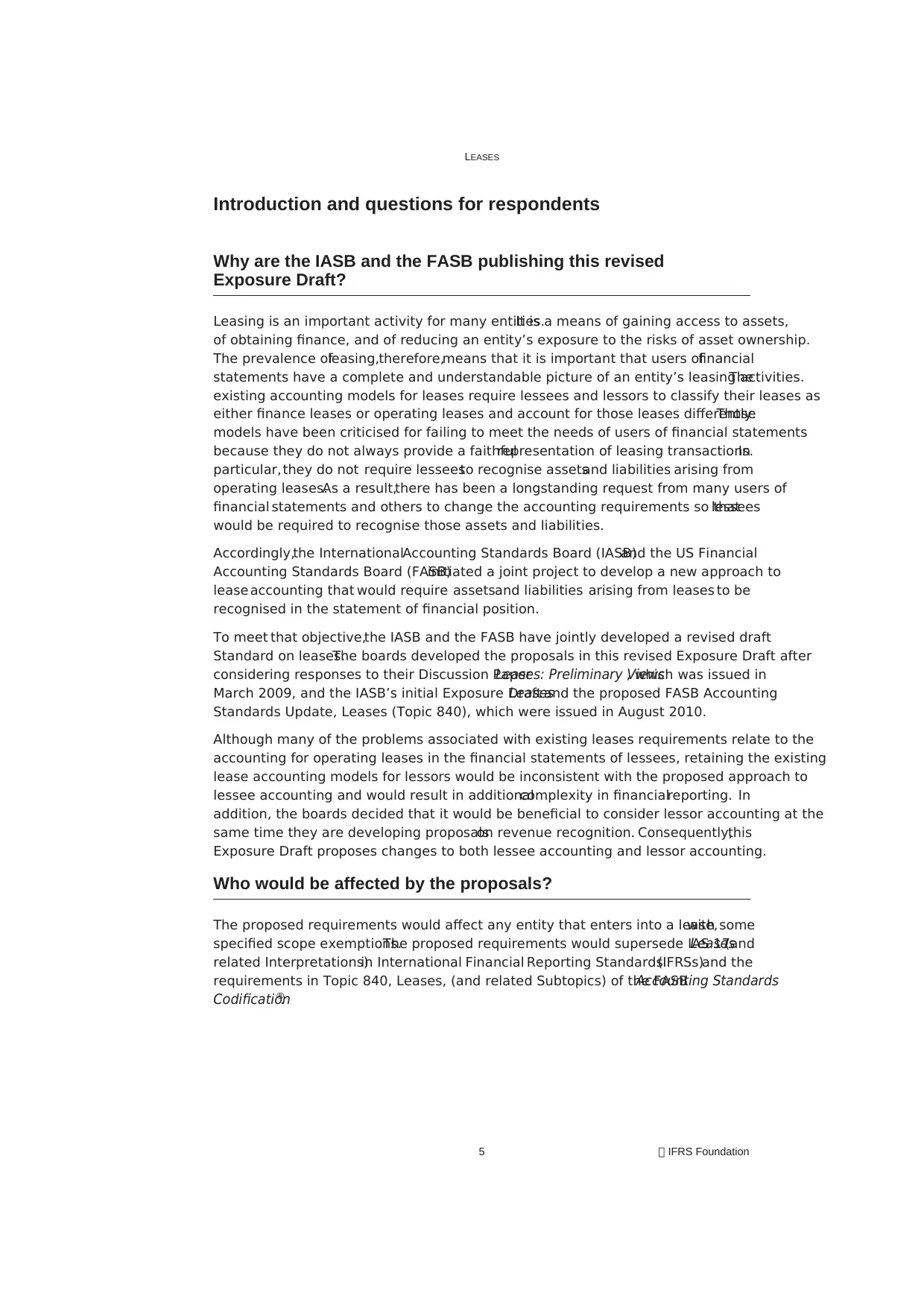
Introduction and questions for respondents
Why are the IASB and the FASB publishing this revised
Exposure Draft?
Leasing is an important activity for many entities.It is a means of gaining access to assets,
of obtaining finance, and of reducing an entity’s exposure to the risks of asset ownership.
The prevalence ofleasing,therefore,means that it is important that users offinancial
statements have a complete and understandable picture of an entity’s leasing activities.The
existing accounting models for leases require lessees and lessors to classify their leases as
either finance leases or operating leases and account for those leases differently.Those
models have been criticised for failing to meet the needs of users of financial statements
because they do not always provide a faithfulrepresentation of leasing transactions.In
particular, they do not require lesseesto recognise assetsand liabilities arising from
operating leases.As a result,there has been a longstanding request from many users of
financial statements and others to change the accounting requirements so thatlessees
would be required to recognise those assets and liabilities.
Accordingly,the InternationalAccounting Standards Board (IASB)and the US Financial
Accounting Standards Board (FASB)initiated a joint project to develop a new approach to
lease accounting that would require assetsand liabilities arising from leases to be
recognised in the statement of financial position.
To meet that objective,the IASB and the FASB have jointly developed a revised draft
Standard on leases.The boards developed the proposals in this revised Exposure Draft after
considering responses to their Discussion PaperLeases: Preliminary Views, which was issued in
March 2009, and the IASB’s initial Exposure DraftLeasesand the proposed FASB Accounting
Standards Update, Leases (Topic 840), which were issued in August 2010.
Although many of the problems associated with existing leases requirements relate to the
accounting for operating leases in the financial statements of lessees, retaining the existing
lease accounting models for lessors would be inconsistent with the proposed approach to
lessee accounting and would result in additionalcomplexity in financialreporting. In
addition, the boards decided that it would be beneficial to consider lessor accounting at the
same time they are developing proposalson revenue recognition. Consequently,this
Exposure Draft proposes changes to both lessee accounting and lessor accounting.
Who would be affected by the proposals?
The proposed requirements would affect any entity that enters into a lease,with some
specified scope exemptions.The proposed requirements would supersede IAS 17Leases(and
related Interpretations)in International Financial Reporting Standards(IFRSs)and the
requirements in Topic 840, Leases, (and related Subtopics) of the FASBAccounting Standards
Codification®
.
LEASES
姝 IFRS Foundation5
Why are the IASB and the FASB publishing this revised
Exposure Draft?
Leasing is an important activity for many entities.It is a means of gaining access to assets,
of obtaining finance, and of reducing an entity’s exposure to the risks of asset ownership.
The prevalence ofleasing,therefore,means that it is important that users offinancial
statements have a complete and understandable picture of an entity’s leasing activities.The
existing accounting models for leases require lessees and lessors to classify their leases as
either finance leases or operating leases and account for those leases differently.Those
models have been criticised for failing to meet the needs of users of financial statements
because they do not always provide a faithfulrepresentation of leasing transactions.In
particular, they do not require lesseesto recognise assetsand liabilities arising from
operating leases.As a result,there has been a longstanding request from many users of
financial statements and others to change the accounting requirements so thatlessees
would be required to recognise those assets and liabilities.
Accordingly,the InternationalAccounting Standards Board (IASB)and the US Financial
Accounting Standards Board (FASB)initiated a joint project to develop a new approach to
lease accounting that would require assetsand liabilities arising from leases to be
recognised in the statement of financial position.
To meet that objective,the IASB and the FASB have jointly developed a revised draft
Standard on leases.The boards developed the proposals in this revised Exposure Draft after
considering responses to their Discussion PaperLeases: Preliminary Views, which was issued in
March 2009, and the IASB’s initial Exposure DraftLeasesand the proposed FASB Accounting
Standards Update, Leases (Topic 840), which were issued in August 2010.
Although many of the problems associated with existing leases requirements relate to the
accounting for operating leases in the financial statements of lessees, retaining the existing
lease accounting models for lessors would be inconsistent with the proposed approach to
lessee accounting and would result in additionalcomplexity in financialreporting. In
addition, the boards decided that it would be beneficial to consider lessor accounting at the
same time they are developing proposalson revenue recognition. Consequently,this
Exposure Draft proposes changes to both lessee accounting and lessor accounting.
Who would be affected by the proposals?
The proposed requirements would affect any entity that enters into a lease,with some
specified scope exemptions.The proposed requirements would supersede IAS 17Leases(and
related Interpretations)in International Financial Reporting Standards(IFRSs)and the
requirements in Topic 840, Leases, (and related Subtopics) of the FASBAccounting Standards
Codification®
.
LEASES
姝 IFRS Foundation5
⊘ This is a preview!⊘
Do you want full access?
Subscribe today to unlock all pages.
Trusted by 1+ million students worldwide
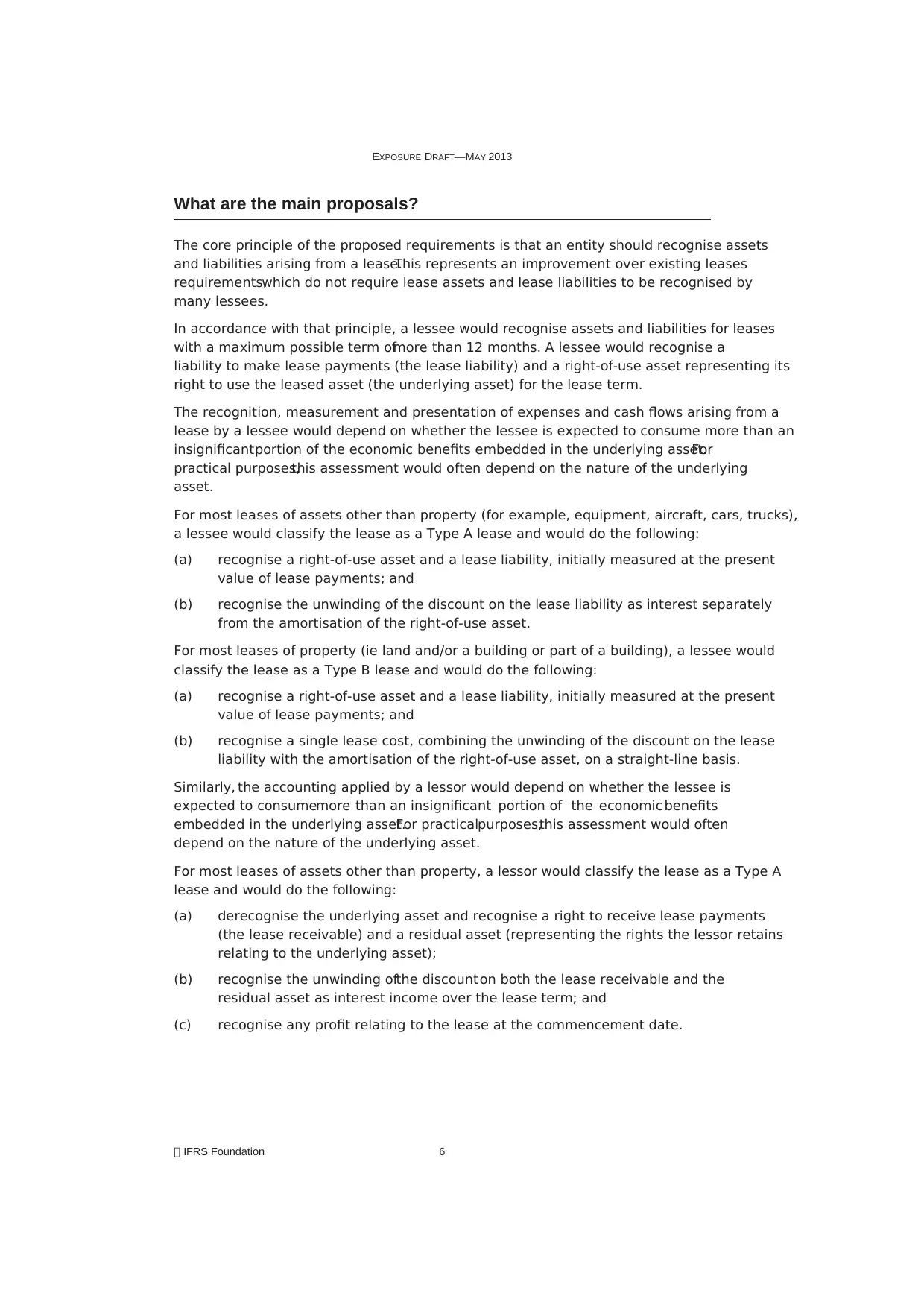
What are the main proposals?
The core principle of the proposed requirements is that an entity should recognise assets
and liabilities arising from a lease.This represents an improvement over existing leases
requirements,which do not require lease assets and lease liabilities to be recognised by
many lessees.
In accordance with that principle, a lessee would recognise assets and liabilities for leases
with a maximum possible term ofmore than 12 months. A lessee would recognise a
liability to make lease payments (the lease liability) and a right-of-use asset representing its
right to use the leased asset (the underlying asset) for the lease term.
The recognition, measurement and presentation of expenses and cash flows arising from a
lease by a lessee would depend on whether the lessee is expected to consume more than an
insignificantportion of the economic benefits embedded in the underlying asset.For
practical purposes,this assessment would often depend on the nature of the underlying
asset.
For most leases of assets other than property (for example, equipment, aircraft, cars, trucks),
a lessee would classify the lease as a Type A lease and would do the following:
(a) recognise a right-of-use asset and a lease liability, initially measured at the present
value of lease payments; and
(b) recognise the unwinding of the discount on the lease liability as interest separately
from the amortisation of the right-of-use asset.
For most leases of property (ie land and/or a building or part of a building), a lessee would
classify the lease as a Type B lease and would do the following:
(a) recognise a right-of-use asset and a lease liability, initially measured at the present
value of lease payments; and
(b) recognise a single lease cost, combining the unwinding of the discount on the lease
liability with the amortisation of the right-of-use asset, on a straight-line basis.
Similarly, the accounting applied by a lessor would depend on whether the lessee is
expected to consumemore than an insignificant portion of the economic benefits
embedded in the underlying asset.For practicalpurposes,this assessment would often
depend on the nature of the underlying asset.
For most leases of assets other than property, a lessor would classify the lease as a Type A
lease and would do the following:
(a) derecognise the underlying asset and recognise a right to receive lease payments
(the lease receivable) and a residual asset (representing the rights the lessor retains
relating to the underlying asset);
(b) recognise the unwinding ofthe discount on both the lease receivable and the
residual asset as interest income over the lease term; and
(c) recognise any profit relating to the lease at the commencement date.
EXPOSURE DRAFT—MAY 2013
姝 IFRS Foundation 6
The core principle of the proposed requirements is that an entity should recognise assets
and liabilities arising from a lease.This represents an improvement over existing leases
requirements,which do not require lease assets and lease liabilities to be recognised by
many lessees.
In accordance with that principle, a lessee would recognise assets and liabilities for leases
with a maximum possible term ofmore than 12 months. A lessee would recognise a
liability to make lease payments (the lease liability) and a right-of-use asset representing its
right to use the leased asset (the underlying asset) for the lease term.
The recognition, measurement and presentation of expenses and cash flows arising from a
lease by a lessee would depend on whether the lessee is expected to consume more than an
insignificantportion of the economic benefits embedded in the underlying asset.For
practical purposes,this assessment would often depend on the nature of the underlying
asset.
For most leases of assets other than property (for example, equipment, aircraft, cars, trucks),
a lessee would classify the lease as a Type A lease and would do the following:
(a) recognise a right-of-use asset and a lease liability, initially measured at the present
value of lease payments; and
(b) recognise the unwinding of the discount on the lease liability as interest separately
from the amortisation of the right-of-use asset.
For most leases of property (ie land and/or a building or part of a building), a lessee would
classify the lease as a Type B lease and would do the following:
(a) recognise a right-of-use asset and a lease liability, initially measured at the present
value of lease payments; and
(b) recognise a single lease cost, combining the unwinding of the discount on the lease
liability with the amortisation of the right-of-use asset, on a straight-line basis.
Similarly, the accounting applied by a lessor would depend on whether the lessee is
expected to consumemore than an insignificant portion of the economic benefits
embedded in the underlying asset.For practicalpurposes,this assessment would often
depend on the nature of the underlying asset.
For most leases of assets other than property, a lessor would classify the lease as a Type A
lease and would do the following:
(a) derecognise the underlying asset and recognise a right to receive lease payments
(the lease receivable) and a residual asset (representing the rights the lessor retains
relating to the underlying asset);
(b) recognise the unwinding ofthe discount on both the lease receivable and the
residual asset as interest income over the lease term; and
(c) recognise any profit relating to the lease at the commencement date.
EXPOSURE DRAFT—MAY 2013
姝 IFRS Foundation 6
Paraphrase This Document
Need a fresh take? Get an instant paraphrase of this document with our AI Paraphraser
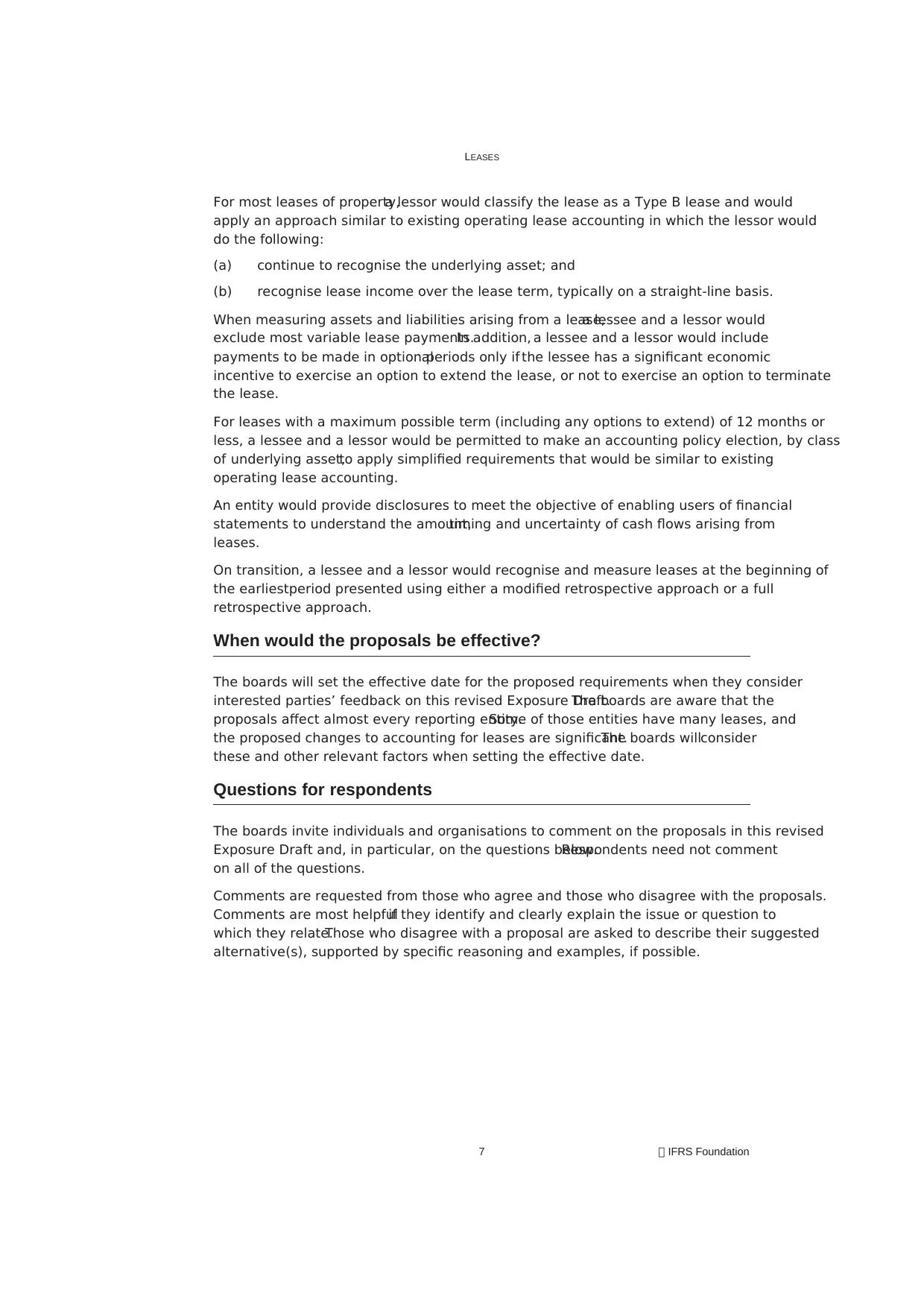
For most leases of property,a lessor would classify the lease as a Type B lease and would
apply an approach similar to existing operating lease accounting in which the lessor would
do the following:
(a) continue to recognise the underlying asset; and
(b) recognise lease income over the lease term, typically on a straight-line basis.
When measuring assets and liabilities arising from a lease,a lessee and a lessor would
exclude most variable lease payments.In addition, a lessee and a lessor would include
payments to be made in optionalperiods only if the lessee has a significant economic
incentive to exercise an option to extend the lease, or not to exercise an option to terminate
the lease.
For leases with a maximum possible term (including any options to extend) of 12 months or
less, a lessee and a lessor would be permitted to make an accounting policy election, by class
of underlying asset,to apply simplified requirements that would be similar to existing
operating lease accounting.
An entity would provide disclosures to meet the objective of enabling users of financial
statements to understand the amount,timing and uncertainty of cash flows arising from
leases.
On transition, a lessee and a lessor would recognise and measure leases at the beginning of
the earliestperiod presented using either a modified retrospective approach or a full
retrospective approach.
When would the proposals be effective?
The boards will set the effective date for the proposed requirements when they consider
interested parties’ feedback on this revised Exposure Draft.The boards are aware that the
proposals affect almost every reporting entity.Some of those entities have many leases, and
the proposed changes to accounting for leases are significant.The boards willconsider
these and other relevant factors when setting the effective date.
Questions for respondents
The boards invite individuals and organisations to comment on the proposals in this revised
Exposure Draft and, in particular, on the questions below.Respondents need not comment
on all of the questions.
Comments are requested from those who agree and those who disagree with the proposals.
Comments are most helpfulif they identify and clearly explain the issue or question to
which they relate.Those who disagree with a proposal are asked to describe their suggested
alternative(s), supported by specific reasoning and examples, if possible.
LEASES
姝 IFRS Foundation7
apply an approach similar to existing operating lease accounting in which the lessor would
do the following:
(a) continue to recognise the underlying asset; and
(b) recognise lease income over the lease term, typically on a straight-line basis.
When measuring assets and liabilities arising from a lease,a lessee and a lessor would
exclude most variable lease payments.In addition, a lessee and a lessor would include
payments to be made in optionalperiods only if the lessee has a significant economic
incentive to exercise an option to extend the lease, or not to exercise an option to terminate
the lease.
For leases with a maximum possible term (including any options to extend) of 12 months or
less, a lessee and a lessor would be permitted to make an accounting policy election, by class
of underlying asset,to apply simplified requirements that would be similar to existing
operating lease accounting.
An entity would provide disclosures to meet the objective of enabling users of financial
statements to understand the amount,timing and uncertainty of cash flows arising from
leases.
On transition, a lessee and a lessor would recognise and measure leases at the beginning of
the earliestperiod presented using either a modified retrospective approach or a full
retrospective approach.
When would the proposals be effective?
The boards will set the effective date for the proposed requirements when they consider
interested parties’ feedback on this revised Exposure Draft.The boards are aware that the
proposals affect almost every reporting entity.Some of those entities have many leases, and
the proposed changes to accounting for leases are significant.The boards willconsider
these and other relevant factors when setting the effective date.
Questions for respondents
The boards invite individuals and organisations to comment on the proposals in this revised
Exposure Draft and, in particular, on the questions below.Respondents need not comment
on all of the questions.
Comments are requested from those who agree and those who disagree with the proposals.
Comments are most helpfulif they identify and clearly explain the issue or question to
which they relate.Those who disagree with a proposal are asked to describe their suggested
alternative(s), supported by specific reasoning and examples, if possible.
LEASES
姝 IFRS Foundation7
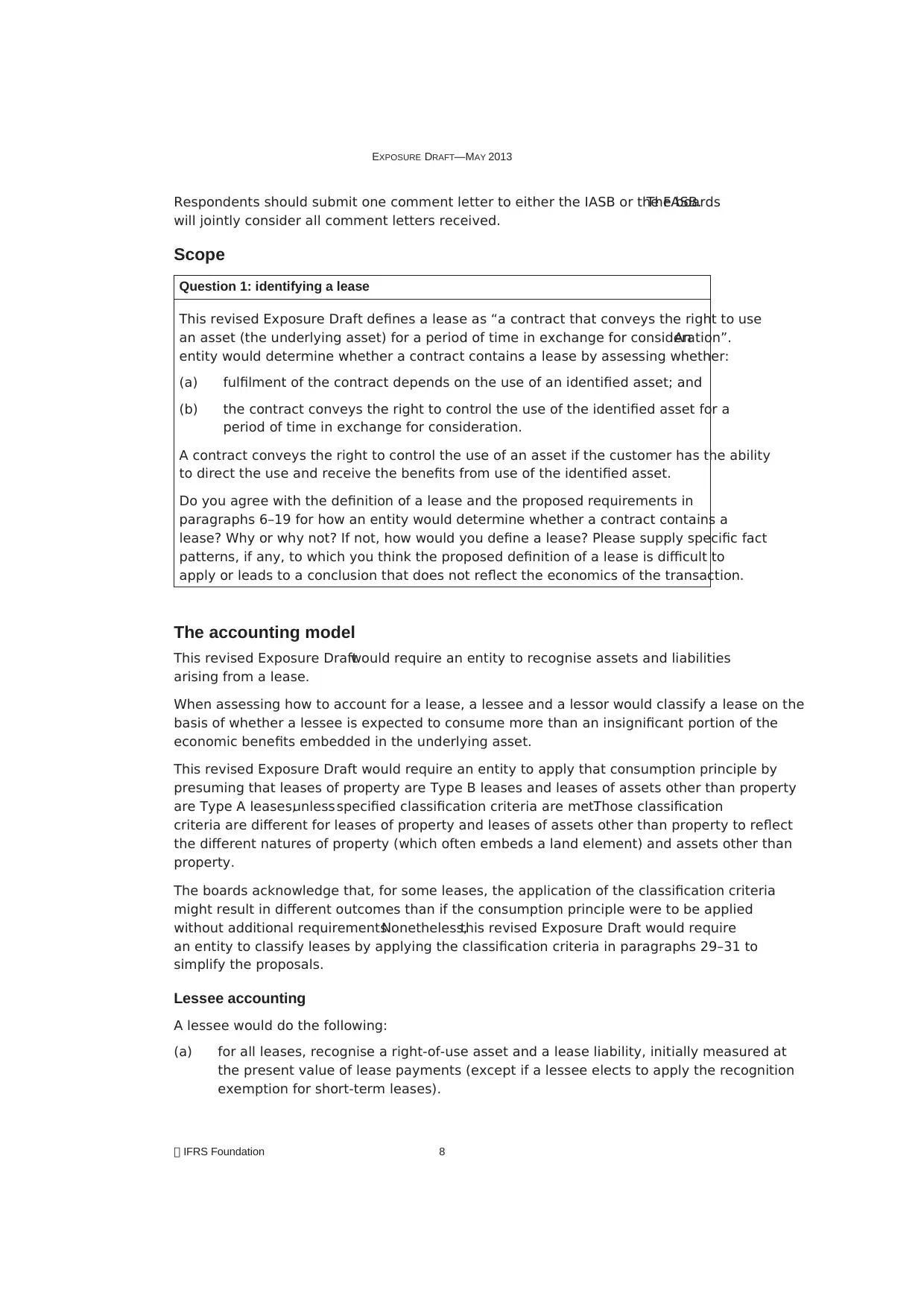
Respondents should submit one comment letter to either the IASB or the FASB.The boards
will jointly consider all comment letters received.
Scope
Question 1: identifying a lease
This revised Exposure Draft defines a lease as “a contract that conveys the right to use
an asset (the underlying asset) for a period of time in exchange for consideration”.An
entity would determine whether a contract contains a lease by assessing whether:
(a) fulfilment of the contract depends on the use of an identified asset; and
(b) the contract conveys the right to control the use of the identified asset for a
period of time in exchange for consideration.
A contract conveys the right to control the use of an asset if the customer has the ability
to direct the use and receive the benefits from use of the identified asset.
Do you agree with the definition of a lease and the proposed requirements in
paragraphs 6–19 for how an entity would determine whether a contract contains a
lease? Why or why not? If not, how would you define a lease? Please supply specific fact
patterns, if any, to which you think the proposed definition of a lease is difficult to
apply or leads to a conclusion that does not reflect the economics of the transaction.
The accounting model
This revised Exposure Draftwould require an entity to recognise assets and liabilities
arising from a lease.
When assessing how to account for a lease, a lessee and a lessor would classify a lease on the
basis of whether a lessee is expected to consume more than an insignificant portion of the
economic benefits embedded in the underlying asset.
This revised Exposure Draft would require an entity to apply that consumption principle by
presuming that leases of property are Type B leases and leases of assets other than property
are Type A leases,unless specified classification criteria are met.Those classification
criteria are different for leases of property and leases of assets other than property to reflect
the different natures of property (which often embeds a land element) and assets other than
property.
The boards acknowledge that, for some leases, the application of the classification criteria
might result in different outcomes than if the consumption principle were to be applied
without additional requirements.Nonetheless,this revised Exposure Draft would require
an entity to classify leases by applying the classification criteria in paragraphs 29–31 to
simplify the proposals.
Lessee accounting
A lessee would do the following:
(a) for all leases, recognise a right-of-use asset and a lease liability, initially measured at
the present value of lease payments (except if a lessee elects to apply the recognition
exemption for short-term leases).
EXPOSURE DRAFT—MAY 2013
姝 IFRS Foundation 8
will jointly consider all comment letters received.
Scope
Question 1: identifying a lease
This revised Exposure Draft defines a lease as “a contract that conveys the right to use
an asset (the underlying asset) for a period of time in exchange for consideration”.An
entity would determine whether a contract contains a lease by assessing whether:
(a) fulfilment of the contract depends on the use of an identified asset; and
(b) the contract conveys the right to control the use of the identified asset for a
period of time in exchange for consideration.
A contract conveys the right to control the use of an asset if the customer has the ability
to direct the use and receive the benefits from use of the identified asset.
Do you agree with the definition of a lease and the proposed requirements in
paragraphs 6–19 for how an entity would determine whether a contract contains a
lease? Why or why not? If not, how would you define a lease? Please supply specific fact
patterns, if any, to which you think the proposed definition of a lease is difficult to
apply or leads to a conclusion that does not reflect the economics of the transaction.
The accounting model
This revised Exposure Draftwould require an entity to recognise assets and liabilities
arising from a lease.
When assessing how to account for a lease, a lessee and a lessor would classify a lease on the
basis of whether a lessee is expected to consume more than an insignificant portion of the
economic benefits embedded in the underlying asset.
This revised Exposure Draft would require an entity to apply that consumption principle by
presuming that leases of property are Type B leases and leases of assets other than property
are Type A leases,unless specified classification criteria are met.Those classification
criteria are different for leases of property and leases of assets other than property to reflect
the different natures of property (which often embeds a land element) and assets other than
property.
The boards acknowledge that, for some leases, the application of the classification criteria
might result in different outcomes than if the consumption principle were to be applied
without additional requirements.Nonetheless,this revised Exposure Draft would require
an entity to classify leases by applying the classification criteria in paragraphs 29–31 to
simplify the proposals.
Lessee accounting
A lessee would do the following:
(a) for all leases, recognise a right-of-use asset and a lease liability, initially measured at
the present value of lease payments (except if a lessee elects to apply the recognition
exemption for short-term leases).
EXPOSURE DRAFT—MAY 2013
姝 IFRS Foundation 8
⊘ This is a preview!⊘
Do you want full access?
Subscribe today to unlock all pages.
Trusted by 1+ million students worldwide
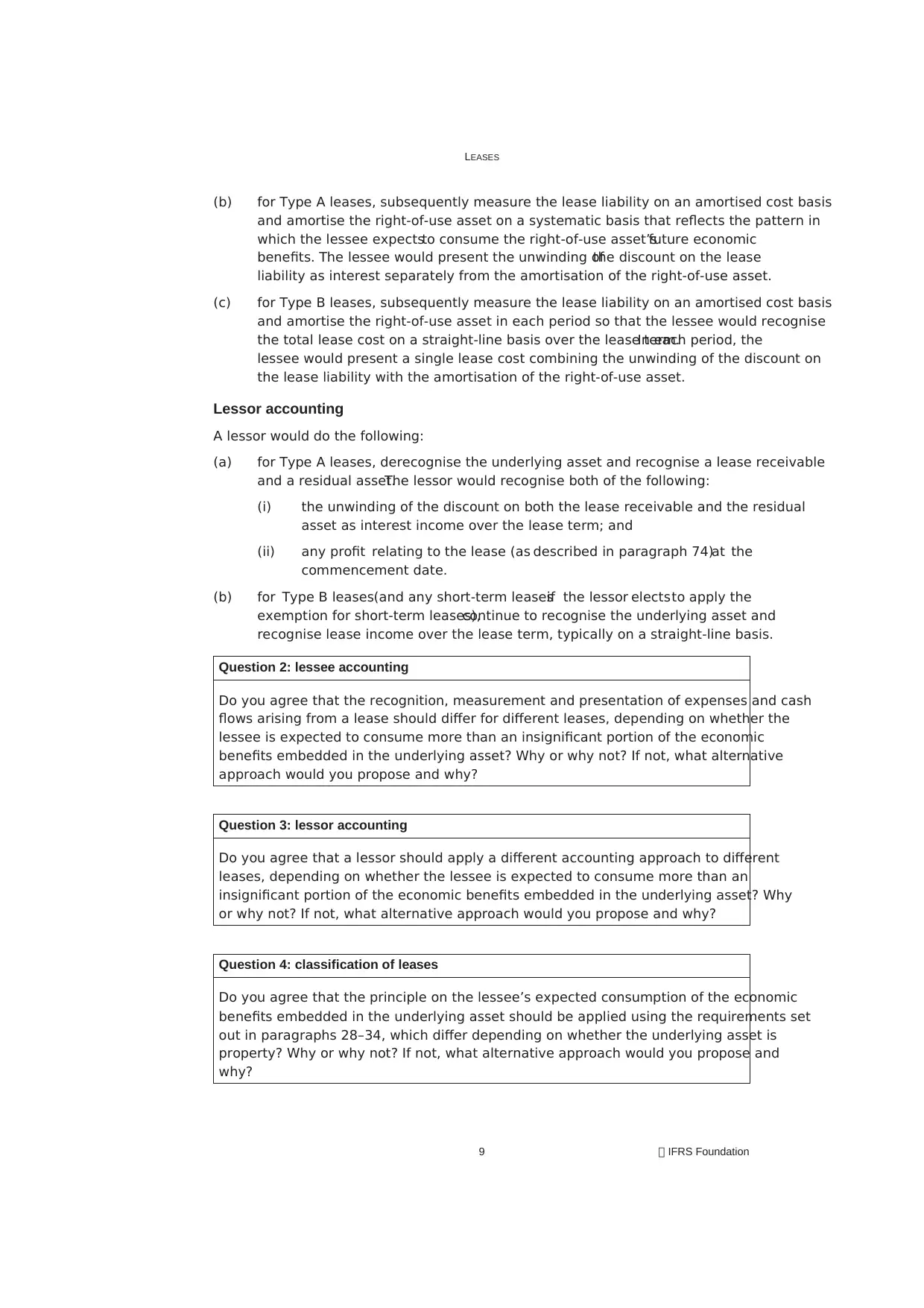
(b) for Type A leases, subsequently measure the lease liability on an amortised cost basis
and amortise the right-of-use asset on a systematic basis that reflects the pattern in
which the lessee expectsto consume the right-of-use asset’sfuture economic
benefits. The lessee would present the unwinding ofthe discount on the lease
liability as interest separately from the amortisation of the right-of-use asset.
(c) for Type B leases, subsequently measure the lease liability on an amortised cost basis
and amortise the right-of-use asset in each period so that the lessee would recognise
the total lease cost on a straight-line basis over the lease term.In each period, the
lessee would present a single lease cost combining the unwinding of the discount on
the lease liability with the amortisation of the right-of-use asset.
Lessor accounting
A lessor would do the following:
(a) for Type A leases, derecognise the underlying asset and recognise a lease receivable
and a residual asset.The lessor would recognise both of the following:
(i) the unwinding of the discount on both the lease receivable and the residual
asset as interest income over the lease term; and
(ii) any profit relating to the lease (as described in paragraph 74)at the
commencement date.
(b) for Type B leases(and any short-term leasesif the lessor electsto apply the
exemption for short-term leases),continue to recognise the underlying asset and
recognise lease income over the lease term, typically on a straight-line basis.
Question 2: lessee accounting
Do you agree that the recognition, measurement and presentation of expenses and cash
flows arising from a lease should differ for different leases, depending on whether the
lessee is expected to consume more than an insignificant portion of the economic
benefits embedded in the underlying asset? Why or why not? If not, what alternative
approach would you propose and why?
Question 3: lessor accounting
Do you agree that a lessor should apply a different accounting approach to different
leases, depending on whether the lessee is expected to consume more than an
insignificant portion of the economic benefits embedded in the underlying asset? Why
or why not? If not, what alternative approach would you propose and why?
Question 4: classification of leases
Do you agree that the principle on the lessee’s expected consumption of the economic
benefits embedded in the underlying asset should be applied using the requirements set
out in paragraphs 28–34, which differ depending on whether the underlying asset is
property? Why or why not? If not, what alternative approach would you propose and
why?
LEASES
姝 IFRS Foundation9
and amortise the right-of-use asset on a systematic basis that reflects the pattern in
which the lessee expectsto consume the right-of-use asset’sfuture economic
benefits. The lessee would present the unwinding ofthe discount on the lease
liability as interest separately from the amortisation of the right-of-use asset.
(c) for Type B leases, subsequently measure the lease liability on an amortised cost basis
and amortise the right-of-use asset in each period so that the lessee would recognise
the total lease cost on a straight-line basis over the lease term.In each period, the
lessee would present a single lease cost combining the unwinding of the discount on
the lease liability with the amortisation of the right-of-use asset.
Lessor accounting
A lessor would do the following:
(a) for Type A leases, derecognise the underlying asset and recognise a lease receivable
and a residual asset.The lessor would recognise both of the following:
(i) the unwinding of the discount on both the lease receivable and the residual
asset as interest income over the lease term; and
(ii) any profit relating to the lease (as described in paragraph 74)at the
commencement date.
(b) for Type B leases(and any short-term leasesif the lessor electsto apply the
exemption for short-term leases),continue to recognise the underlying asset and
recognise lease income over the lease term, typically on a straight-line basis.
Question 2: lessee accounting
Do you agree that the recognition, measurement and presentation of expenses and cash
flows arising from a lease should differ for different leases, depending on whether the
lessee is expected to consume more than an insignificant portion of the economic
benefits embedded in the underlying asset? Why or why not? If not, what alternative
approach would you propose and why?
Question 3: lessor accounting
Do you agree that a lessor should apply a different accounting approach to different
leases, depending on whether the lessee is expected to consume more than an
insignificant portion of the economic benefits embedded in the underlying asset? Why
or why not? If not, what alternative approach would you propose and why?
Question 4: classification of leases
Do you agree that the principle on the lessee’s expected consumption of the economic
benefits embedded in the underlying asset should be applied using the requirements set
out in paragraphs 28–34, which differ depending on whether the underlying asset is
property? Why or why not? If not, what alternative approach would you propose and
why?
LEASES
姝 IFRS Foundation9
Paraphrase This Document
Need a fresh take? Get an instant paraphrase of this document with our AI Paraphraser
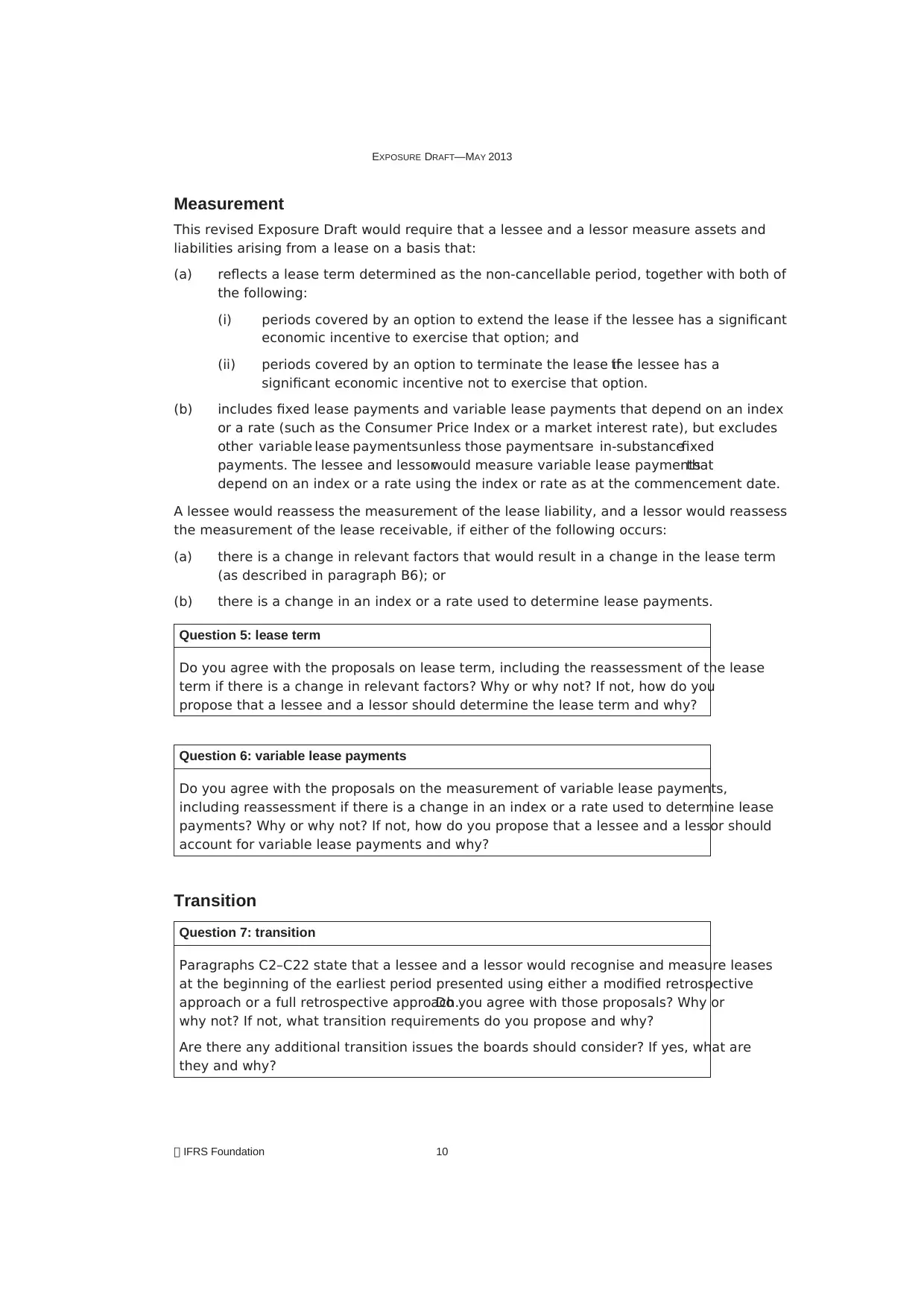
Measurement
This revised Exposure Draft would require that a lessee and a lessor measure assets and
liabilities arising from a lease on a basis that:
(a) reflects a lease term determined as the non-cancellable period, together with both of
the following:
(i) periods covered by an option to extend the lease if the lessee has a significant
economic incentive to exercise that option; and
(ii) periods covered by an option to terminate the lease ifthe lessee has a
significant economic incentive not to exercise that option.
(b) includes fixed lease payments and variable lease payments that depend on an index
or a rate (such as the Consumer Price Index or a market interest rate), but excludes
other variable lease paymentsunless those paymentsare in-substancefixed
payments. The lessee and lessorwould measure variable lease paymentsthat
depend on an index or a rate using the index or rate as at the commencement date.
A lessee would reassess the measurement of the lease liability, and a lessor would reassess
the measurement of the lease receivable, if either of the following occurs:
(a) there is a change in relevant factors that would result in a change in the lease term
(as described in paragraph B6); or
(b) there is a change in an index or a rate used to determine lease payments.
Question 5: lease term
Do you agree with the proposals on lease term, including the reassessment of the lease
term if there is a change in relevant factors? Why or why not? If not, how do you
propose that a lessee and a lessor should determine the lease term and why?
Question 6: variable lease payments
Do you agree with the proposals on the measurement of variable lease payments,
including reassessment if there is a change in an index or a rate used to determine lease
payments? Why or why not? If not, how do you propose that a lessee and a lessor should
account for variable lease payments and why?
Transition
Question 7: transition
Paragraphs C2–C22 state that a lessee and a lessor would recognise and measure leases
at the beginning of the earliest period presented using either a modified retrospective
approach or a full retrospective approach.Do you agree with those proposals? Why or
why not? If not, what transition requirements do you propose and why?
Are there any additional transition issues the boards should consider? If yes, what are
they and why?
EXPOSURE DRAFT—MAY 2013
姝 IFRS Foundation 10
This revised Exposure Draft would require that a lessee and a lessor measure assets and
liabilities arising from a lease on a basis that:
(a) reflects a lease term determined as the non-cancellable period, together with both of
the following:
(i) periods covered by an option to extend the lease if the lessee has a significant
economic incentive to exercise that option; and
(ii) periods covered by an option to terminate the lease ifthe lessee has a
significant economic incentive not to exercise that option.
(b) includes fixed lease payments and variable lease payments that depend on an index
or a rate (such as the Consumer Price Index or a market interest rate), but excludes
other variable lease paymentsunless those paymentsare in-substancefixed
payments. The lessee and lessorwould measure variable lease paymentsthat
depend on an index or a rate using the index or rate as at the commencement date.
A lessee would reassess the measurement of the lease liability, and a lessor would reassess
the measurement of the lease receivable, if either of the following occurs:
(a) there is a change in relevant factors that would result in a change in the lease term
(as described in paragraph B6); or
(b) there is a change in an index or a rate used to determine lease payments.
Question 5: lease term
Do you agree with the proposals on lease term, including the reassessment of the lease
term if there is a change in relevant factors? Why or why not? If not, how do you
propose that a lessee and a lessor should determine the lease term and why?
Question 6: variable lease payments
Do you agree with the proposals on the measurement of variable lease payments,
including reassessment if there is a change in an index or a rate used to determine lease
payments? Why or why not? If not, how do you propose that a lessee and a lessor should
account for variable lease payments and why?
Transition
Question 7: transition
Paragraphs C2–C22 state that a lessee and a lessor would recognise and measure leases
at the beginning of the earliest period presented using either a modified retrospective
approach or a full retrospective approach.Do you agree with those proposals? Why or
why not? If not, what transition requirements do you propose and why?
Are there any additional transition issues the boards should consider? If yes, what are
they and why?
EXPOSURE DRAFT—MAY 2013
姝 IFRS Foundation 10
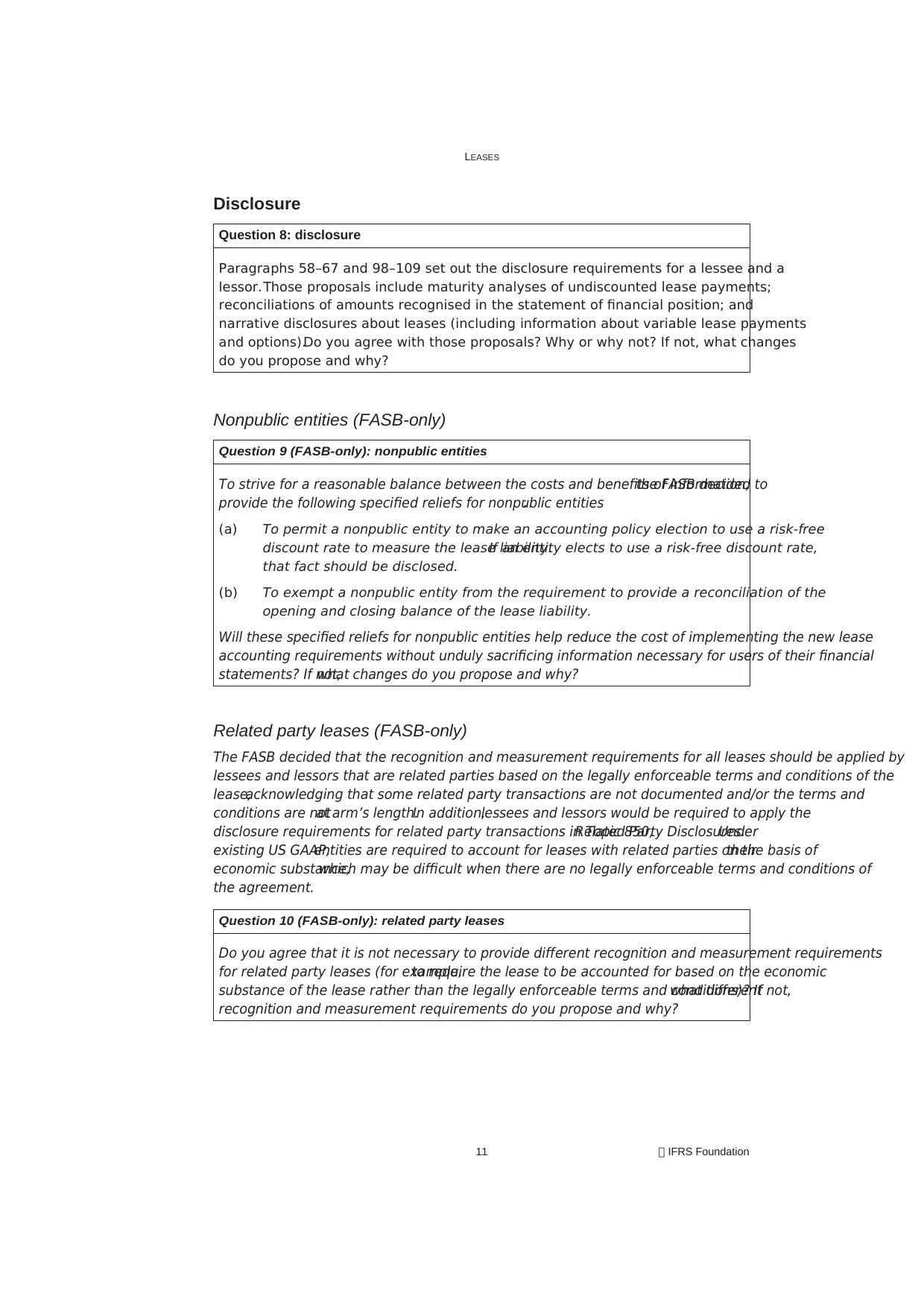
Disclosure
Question 8: disclosure
Paragraphs 58–67 and 98–109 set out the disclosure requirements for a lessee and a
lessor.Those proposals include maturity analyses of undiscounted lease payments;
reconciliations of amounts recognised in the statement of financial position; and
narrative disclosures about leases (including information about variable lease payments
and options).Do you agree with those proposals? Why or why not? If not, what changes
do you propose and why?
Nonpublic entities (FASB-only)
Question 9 (FASB-only): nonpublic entities
To strive for a reasonable balance between the costs and benefits of information,the FASB decided to
provide the following specified reliefs for nonpublic entities:
(a) To permit a nonpublic entity to make an accounting policy election to use a risk-free
discount rate to measure the lease liability.If an entity elects to use a risk-free discount rate,
that fact should be disclosed.
(b) To exempt a nonpublic entity from the requirement to provide a reconciliation of the
opening and closing balance of the lease liability.
Will these specified reliefs for nonpublic entities help reduce the cost of implementing the new lease
accounting requirements without unduly sacrificing information necessary for users of their financial
statements? If not,what changes do you propose and why?
Related party leases (FASB-only)
The FASB decided that the recognition and measurement requirements for all leases should be applied by
lessees and lessors that are related parties based on the legally enforceable terms and conditions of the
lease,acknowledging that some related party transactions are not documented and/or the terms and
conditions are notat arm’s length.In addition,lessees and lessors would be required to apply the
disclosure requirements for related party transactions in Topic 850,Related Party Disclosures.Under
existing US GAAP,entities are required to account for leases with related parties on the basis oftheir
economic substance,which may be difficult when there are no legally enforceable terms and conditions of
the agreement.
Question 10 (FASB-only): related party leases
Do you agree that it is not necessary to provide different recognition and measurement requirements
for related party leases (for example,to require the lease to be accounted for based on the economic
substance of the lease rather than the legally enforceable terms and conditions)? If not,what different
recognition and measurement requirements do you propose and why?
LEASES
姝 IFRS Foundation11
Question 8: disclosure
Paragraphs 58–67 and 98–109 set out the disclosure requirements for a lessee and a
lessor.Those proposals include maturity analyses of undiscounted lease payments;
reconciliations of amounts recognised in the statement of financial position; and
narrative disclosures about leases (including information about variable lease payments
and options).Do you agree with those proposals? Why or why not? If not, what changes
do you propose and why?
Nonpublic entities (FASB-only)
Question 9 (FASB-only): nonpublic entities
To strive for a reasonable balance between the costs and benefits of information,the FASB decided to
provide the following specified reliefs for nonpublic entities:
(a) To permit a nonpublic entity to make an accounting policy election to use a risk-free
discount rate to measure the lease liability.If an entity elects to use a risk-free discount rate,
that fact should be disclosed.
(b) To exempt a nonpublic entity from the requirement to provide a reconciliation of the
opening and closing balance of the lease liability.
Will these specified reliefs for nonpublic entities help reduce the cost of implementing the new lease
accounting requirements without unduly sacrificing information necessary for users of their financial
statements? If not,what changes do you propose and why?
Related party leases (FASB-only)
The FASB decided that the recognition and measurement requirements for all leases should be applied by
lessees and lessors that are related parties based on the legally enforceable terms and conditions of the
lease,acknowledging that some related party transactions are not documented and/or the terms and
conditions are notat arm’s length.In addition,lessees and lessors would be required to apply the
disclosure requirements for related party transactions in Topic 850,Related Party Disclosures.Under
existing US GAAP,entities are required to account for leases with related parties on the basis oftheir
economic substance,which may be difficult when there are no legally enforceable terms and conditions of
the agreement.
Question 10 (FASB-only): related party leases
Do you agree that it is not necessary to provide different recognition and measurement requirements
for related party leases (for example,to require the lease to be accounted for based on the economic
substance of the lease rather than the legally enforceable terms and conditions)? If not,what different
recognition and measurement requirements do you propose and why?
LEASES
姝 IFRS Foundation11
⊘ This is a preview!⊘
Do you want full access?
Subscribe today to unlock all pages.
Trusted by 1+ million students worldwide

1 out of 91


Your All-in-One AI-Powered Toolkit for Academic Success.
+13062052269
info@desklib.com
Available 24*7 on WhatsApp / Email
![[object Object]](/_next/static/media/star-bottom.7253800d.svg)
Unlock your academic potential
Copyright © 2020–2026 A2Z Services. All Rights Reserved. Developed and managed by ZUCOL.