International Financial Reporting Standards: A Detailed Examination
VerifiedAdded on 2021/02/19
|16
|4195
|25
Report
AI Summary
This report offers a comprehensive analysis of financial reporting, beginning with its purpose and the importance of providing financial information to various stakeholders, including investors, employees, and creditors. It delves into the conceptual and regulatory frameworks that govern financial reporting, emphasizing the need for accurate, reliable, and comparable information. The report identifies and explains the roles of internal and external stakeholders, highlighting their specific interests in financial data. It then explores the necessity of financial information in achieving organizational objectives and fostering growth, including financial planning, benchmarking, and decision-making. The report also includes examples of financial statements like the statement of profit and loss, statement of changes in equity, and statement of financial position, providing a practical understanding of how financial information is presented. Finally, it discusses the benefits of IFRS and the differences between IFRS and IAS, emphasizing the importance of adhering to these standards for effective financial reporting. The report concludes by touching upon the varying degrees of compliance with IFRS.

International Financial
Reporting
Reporting

Paraphrase This Document
Need a fresh take? Get an instant paraphrase of this document with our AI Paraphraser
TABLE OF CONTENTS
INTRODUCTION...........................................................................................................................1
MAIN BODY...................................................................................................................................1
1. Purpose of financial reporting.................................................................................................1
2. Conceptual and regulatory framework....................................................................................2
3. Different kinds of stakeholders in the organization................................................................4
4. Need of financial information to meet the organizational objective and growth....................5
5. presenting financial statements of the company.....................................................................6
6. Interpretation and communication of financial information by using ratio analysis..............8
7. Difference between IFRS and International Accounting standard (IAS).............................10
8. Benefits of IFRS....................................................................................................................10
9. Varying degree of compliance with IFRS.............................................................................11
CONCLUSION..............................................................................................................................12
REFERENCES..............................................................................................................................13
INTRODUCTION...........................................................................................................................1
MAIN BODY...................................................................................................................................1
1. Purpose of financial reporting.................................................................................................1
2. Conceptual and regulatory framework....................................................................................2
3. Different kinds of stakeholders in the organization................................................................4
4. Need of financial information to meet the organizational objective and growth....................5
5. presenting financial statements of the company.....................................................................6
6. Interpretation and communication of financial information by using ratio analysis..............8
7. Difference between IFRS and International Accounting standard (IAS).............................10
8. Benefits of IFRS....................................................................................................................10
9. Varying degree of compliance with IFRS.............................................................................11
CONCLUSION..............................................................................................................................12
REFERENCES..............................................................................................................................13
INTRODUCTION
Financial reporting is the process of disclosing and communicate all the financial
information or the information related to the finance to the management and different users such
as investors, employee, customers, creditors, lenders, regulators, government etc. and inform
them about the growth and performance of the company. The aim of the accountancy firm is to
provide the financial information to their client and support their performance through efficient
decision making process. The report present the various role and purpose of financial reporting
achieving the target of the company. The different conceptual and regulatory framework
provides the set of rules ans regulation to regulate the performance of the company and the
various qualitative characteristics to help the organization to provide the information with the
accuracy and reliability. The report explains the different users of the financial information and
the benefits from the financial information. It also explains the different financial statement such
as income statement, balance sheet, ratio analysis etc. it highlights the benefits of IFRS and the
various financial standards like IFRS, IAS etc. in the organization to achieve the goal and
objective.
MAIN BODY
1. Purpose of financial reporting
Meaning : Financial reporting is the process of communicate the financial information to the
different external and internal users to evaluate the performance of the organization and improve
the productivity and profitability (Williams and Dobelman, 2017). Financial reporting helps the
company to analyses the various financial report to support the decisions of the management
team.
Purpose of financial reporting
Provide financial information : The main purpose of financial reporting is to provide the
financial information. It helps them to evaluate the financial position and the changes in the
financial position due to the internal and external changes in the company. It provides the various
information such as profit, revenue, sales, expenses, operating expenses etc.
1
Financial reporting is the process of disclosing and communicate all the financial
information or the information related to the finance to the management and different users such
as investors, employee, customers, creditors, lenders, regulators, government etc. and inform
them about the growth and performance of the company. The aim of the accountancy firm is to
provide the financial information to their client and support their performance through efficient
decision making process. The report present the various role and purpose of financial reporting
achieving the target of the company. The different conceptual and regulatory framework
provides the set of rules ans regulation to regulate the performance of the company and the
various qualitative characteristics to help the organization to provide the information with the
accuracy and reliability. The report explains the different users of the financial information and
the benefits from the financial information. It also explains the different financial statement such
as income statement, balance sheet, ratio analysis etc. it highlights the benefits of IFRS and the
various financial standards like IFRS, IAS etc. in the organization to achieve the goal and
objective.
MAIN BODY
1. Purpose of financial reporting
Meaning : Financial reporting is the process of communicate the financial information to the
different external and internal users to evaluate the performance of the organization and improve
the productivity and profitability (Williams and Dobelman, 2017). Financial reporting helps the
company to analyses the various financial report to support the decisions of the management
team.
Purpose of financial reporting
Provide financial information : The main purpose of financial reporting is to provide the
financial information. It helps them to evaluate the financial position and the changes in the
financial position due to the internal and external changes in the company. It provides the various
information such as profit, revenue, sales, expenses, operating expenses etc.
1
⊘ This is a preview!⊘
Do you want full access?
Subscribe today to unlock all pages.

Trusted by 1+ million students worldwide
Provide legal support : It keeps the financial report legal. Financial report is governed
and regulated by different accounting standard such as GAAP, IFRS, IAS etc. which
provides the legal support to the information and protect the information and company from the
various scandals (Bonsall and et.al., 2017).
Analyze the information : It helps the users to analyses the information regarding the
company performance and position in the market and provide the information that whether the
company is able to sustain in the market or not. Stakeholders can get the information through
various accounting statements such as balance sheet, profit and loss account, cash flow, ratio
analysis etc. from the annual report from the organization.
2. Conceptual and regulatory framework
Conceptual frameworks : Conceptual frameworks help the company to analyses the
performance by setting objectives and policies for the organization. The aim of conceptual
framework to set fundamental concepts for the financial reporting system (Schram and et.al.,
2018). It helps to ensure that the standard are consistent and the all similar transaction are treated
in same manner so the investor can easily get the information and understand them in more
precise form.
Requirement of conceptual frameworks
To set the general rules and regulation for the financial reporting.
Set standard to measure the performance and provide the information in same manner to
the stakeholders.
To treat the all similar transaction in same manner and methods.
Regulatory frameworks : Regulatory frameworks are used to set the rules and
regulation for the company to treat the financial transaction in the books of account (Laubichler
and Renn, 2015). It helps the company to decide that what should be recorded in the company's
account.
Requirement of regulatory frameworks
It helps the company to follow the accounting standard in the organization.
2
and regulated by different accounting standard such as GAAP, IFRS, IAS etc. which
provides the legal support to the information and protect the information and company from the
various scandals (Bonsall and et.al., 2017).
Analyze the information : It helps the users to analyses the information regarding the
company performance and position in the market and provide the information that whether the
company is able to sustain in the market or not. Stakeholders can get the information through
various accounting statements such as balance sheet, profit and loss account, cash flow, ratio
analysis etc. from the annual report from the organization.
2. Conceptual and regulatory framework
Conceptual frameworks : Conceptual frameworks help the company to analyses the
performance by setting objectives and policies for the organization. The aim of conceptual
framework to set fundamental concepts for the financial reporting system (Schram and et.al.,
2018). It helps to ensure that the standard are consistent and the all similar transaction are treated
in same manner so the investor can easily get the information and understand them in more
precise form.
Requirement of conceptual frameworks
To set the general rules and regulation for the financial reporting.
Set standard to measure the performance and provide the information in same manner to
the stakeholders.
To treat the all similar transaction in same manner and methods.
Regulatory frameworks : Regulatory frameworks are used to set the rules and
regulation for the company to treat the financial transaction in the books of account (Laubichler
and Renn, 2015). It helps the company to decide that what should be recorded in the company's
account.
Requirement of regulatory frameworks
It helps the company to follow the accounting standard in the organization.
2
Paraphrase This Document
Need a fresh take? Get an instant paraphrase of this document with our AI Paraphraser
It provides the sustainable growth of the company and help them to evaluate the
performance of the organization via different accounting statements.
Qualitative characteristics of financial report
Fundamental qualitative characteristics
Relevance : It refers to provide the relevant information regarding the financial
transaction to t eh different stakeholders and minimize all the unnecessary information (Ioannou
and Serafeim, 2017). It helps the investors and lenders to concentrate on the specific subject area
and evaluate the relevant information to take the decisions of lending and investing the money in
the particular company.
Faithfulness : it states that the presented data are must be faithful which present the true
and accurate position and information of the company (The qualitative characteristics of
financial statements, 2019). It helps to ensure that the user can rely on the information and use
them for the further analyses of the data.
Enhancing qualitative characteristics
Understand-ability : It ensures that the information must be understandable to the
financial user so they can get the information in same manner in which they are presented. The
information must be presented with some additional information as in footnotes so the user can
understand the origin of the information and evaluate them according to their need.
Comparability : The information provided by the finance manager must be comparable
to the different accounting years of the same company or other competitive companies (Perego,
Kennedy and Whiteman, 2016). It helps the stakeholders to evaluate the financial position and
performance of the company in different financial year and evaluate the trend of change in profit
and revenue of the organization. It elaborates the position of the company in the market.
Verifiability : It means that the information presented in the financial report must be
ready to verify with different methods such as internal and external audit. It ensures the
credibility and reliability of the data and provide the accurate information to the internal and
external stakeholders.
3
performance of the organization via different accounting statements.
Qualitative characteristics of financial report
Fundamental qualitative characteristics
Relevance : It refers to provide the relevant information regarding the financial
transaction to t eh different stakeholders and minimize all the unnecessary information (Ioannou
and Serafeim, 2017). It helps the investors and lenders to concentrate on the specific subject area
and evaluate the relevant information to take the decisions of lending and investing the money in
the particular company.
Faithfulness : it states that the presented data are must be faithful which present the true
and accurate position and information of the company (The qualitative characteristics of
financial statements, 2019). It helps to ensure that the user can rely on the information and use
them for the further analyses of the data.
Enhancing qualitative characteristics
Understand-ability : It ensures that the information must be understandable to the
financial user so they can get the information in same manner in which they are presented. The
information must be presented with some additional information as in footnotes so the user can
understand the origin of the information and evaluate them according to their need.
Comparability : The information provided by the finance manager must be comparable
to the different accounting years of the same company or other competitive companies (Perego,
Kennedy and Whiteman, 2016). It helps the stakeholders to evaluate the financial position and
performance of the company in different financial year and evaluate the trend of change in profit
and revenue of the organization. It elaborates the position of the company in the market.
Verifiability : It means that the information presented in the financial report must be
ready to verify with different methods such as internal and external audit. It ensures the
credibility and reliability of the data and provide the accurate information to the internal and
external stakeholders.
3
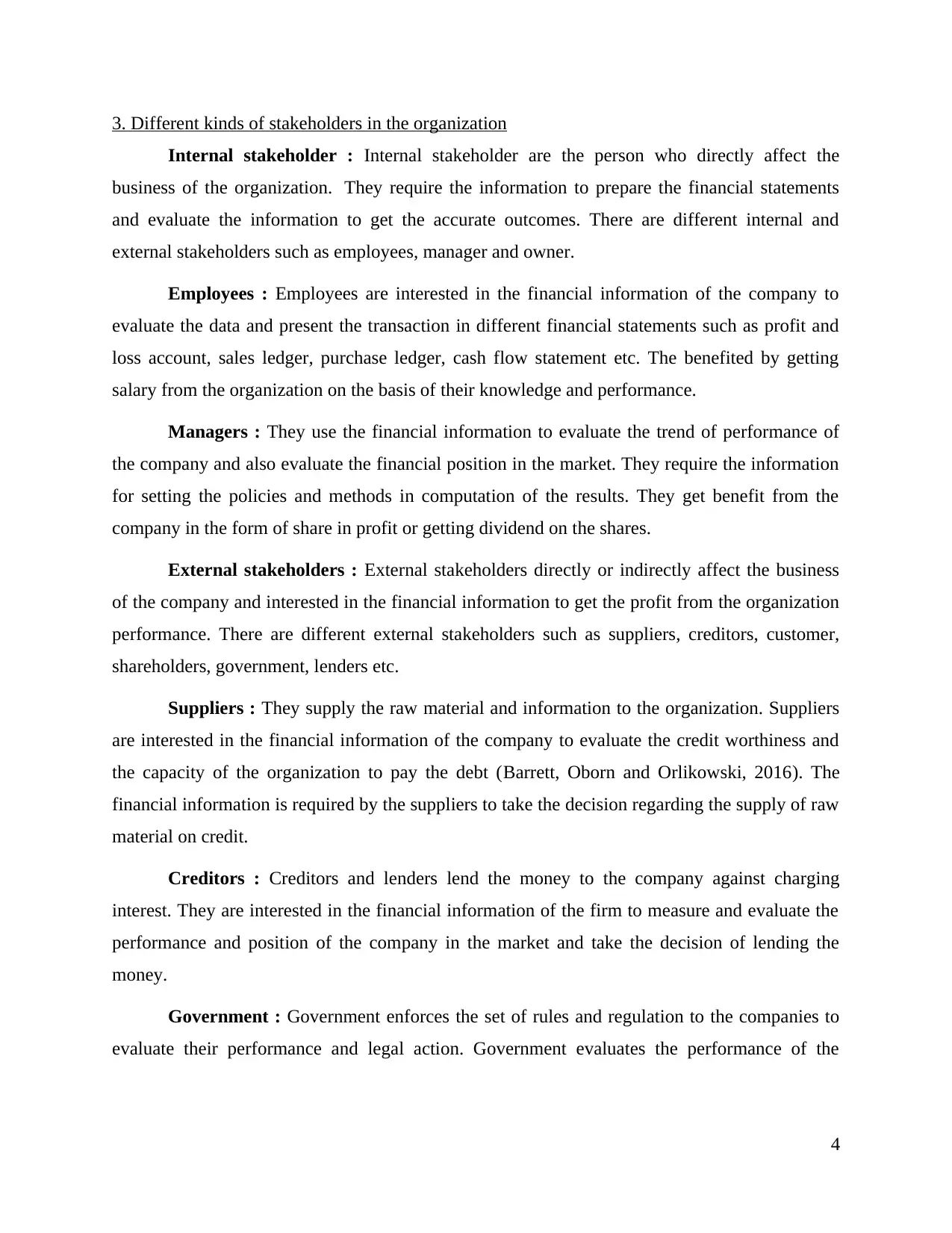
3. Different kinds of stakeholders in the organization
Internal stakeholder : Internal stakeholder are the person who directly affect the
business of the organization. They require the information to prepare the financial statements
and evaluate the information to get the accurate outcomes. There are different internal and
external stakeholders such as employees, manager and owner.
Employees : Employees are interested in the financial information of the company to
evaluate the data and present the transaction in different financial statements such as profit and
loss account, sales ledger, purchase ledger, cash flow statement etc. The benefited by getting
salary from the organization on the basis of their knowledge and performance.
Managers : They use the financial information to evaluate the trend of performance of
the company and also evaluate the financial position in the market. They require the information
for setting the policies and methods in computation of the results. They get benefit from the
company in the form of share in profit or getting dividend on the shares.
External stakeholders : External stakeholders directly or indirectly affect the business
of the company and interested in the financial information to get the profit from the organization
performance. There are different external stakeholders such as suppliers, creditors, customer,
shareholders, government, lenders etc.
Suppliers : They supply the raw material and information to the organization. Suppliers
are interested in the financial information of the company to evaluate the credit worthiness and
the capacity of the organization to pay the debt (Barrett, Oborn and Orlikowski, 2016). The
financial information is required by the suppliers to take the decision regarding the supply of raw
material on credit.
Creditors : Creditors and lenders lend the money to the company against charging
interest. They are interested in the financial information of the firm to measure and evaluate the
performance and position of the company in the market and take the decision of lending the
money.
Government : Government enforces the set of rules and regulation to the companies to
evaluate their performance and legal action. Government evaluates the performance of the
4
Internal stakeholder : Internal stakeholder are the person who directly affect the
business of the organization. They require the information to prepare the financial statements
and evaluate the information to get the accurate outcomes. There are different internal and
external stakeholders such as employees, manager and owner.
Employees : Employees are interested in the financial information of the company to
evaluate the data and present the transaction in different financial statements such as profit and
loss account, sales ledger, purchase ledger, cash flow statement etc. The benefited by getting
salary from the organization on the basis of their knowledge and performance.
Managers : They use the financial information to evaluate the trend of performance of
the company and also evaluate the financial position in the market. They require the information
for setting the policies and methods in computation of the results. They get benefit from the
company in the form of share in profit or getting dividend on the shares.
External stakeholders : External stakeholders directly or indirectly affect the business
of the company and interested in the financial information to get the profit from the organization
performance. There are different external stakeholders such as suppliers, creditors, customer,
shareholders, government, lenders etc.
Suppliers : They supply the raw material and information to the organization. Suppliers
are interested in the financial information of the company to evaluate the credit worthiness and
the capacity of the organization to pay the debt (Barrett, Oborn and Orlikowski, 2016). The
financial information is required by the suppliers to take the decision regarding the supply of raw
material on credit.
Creditors : Creditors and lenders lend the money to the company against charging
interest. They are interested in the financial information of the firm to measure and evaluate the
performance and position of the company in the market and take the decision of lending the
money.
Government : Government enforces the set of rules and regulation to the companies to
evaluate their performance and legal action. Government evaluates the performance of the
4
⊘ This is a preview!⊘
Do you want full access?
Subscribe today to unlock all pages.
Trusted by 1+ million students worldwide
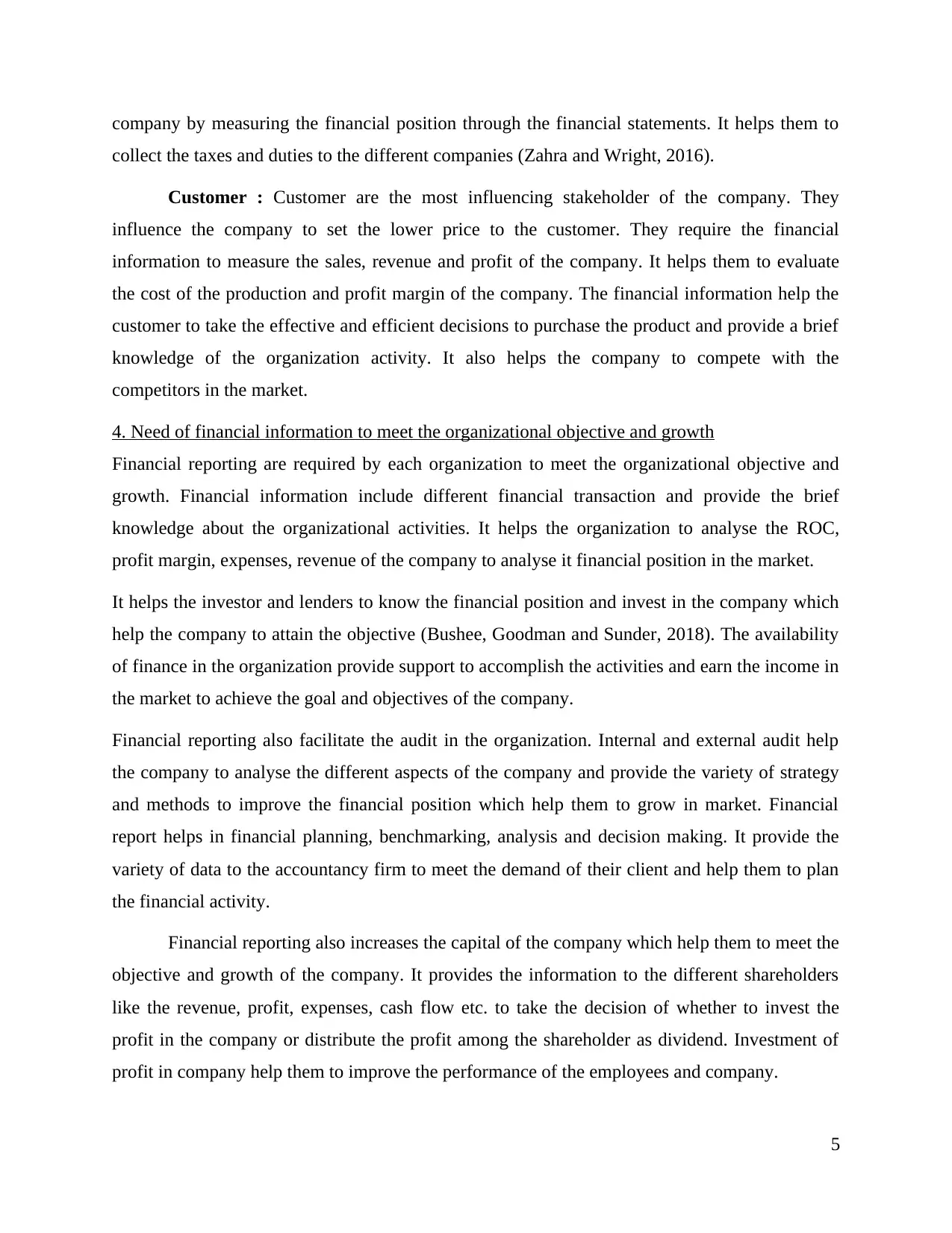
company by measuring the financial position through the financial statements. It helps them to
collect the taxes and duties to the different companies (Zahra and Wright, 2016).
Customer : Customer are the most influencing stakeholder of the company. They
influence the company to set the lower price to the customer. They require the financial
information to measure the sales, revenue and profit of the company. It helps them to evaluate
the cost of the production and profit margin of the company. The financial information help the
customer to take the effective and efficient decisions to purchase the product and provide a brief
knowledge of the organization activity. It also helps the company to compete with the
competitors in the market.
4. Need of financial information to meet the organizational objective and growth
Financial reporting are required by each organization to meet the organizational objective and
growth. Financial information include different financial transaction and provide the brief
knowledge about the organizational activities. It helps the organization to analyse the ROC,
profit margin, expenses, revenue of the company to analyse it financial position in the market.
It helps the investor and lenders to know the financial position and invest in the company which
help the company to attain the objective (Bushee, Goodman and Sunder, 2018). The availability
of finance in the organization provide support to accomplish the activities and earn the income in
the market to achieve the goal and objectives of the company.
Financial reporting also facilitate the audit in the organization. Internal and external audit help
the company to analyse the different aspects of the company and provide the variety of strategy
and methods to improve the financial position which help them to grow in market. Financial
report helps in financial planning, benchmarking, analysis and decision making. It provide the
variety of data to the accountancy firm to meet the demand of their client and help them to plan
the financial activity.
Financial reporting also increases the capital of the company which help them to meet the
objective and growth of the company. It provides the information to the different shareholders
like the revenue, profit, expenses, cash flow etc. to take the decision of whether to invest the
profit in the company or distribute the profit among the shareholder as dividend. Investment of
profit in company help them to improve the performance of the employees and company.
5
collect the taxes and duties to the different companies (Zahra and Wright, 2016).
Customer : Customer are the most influencing stakeholder of the company. They
influence the company to set the lower price to the customer. They require the financial
information to measure the sales, revenue and profit of the company. It helps them to evaluate
the cost of the production and profit margin of the company. The financial information help the
customer to take the effective and efficient decisions to purchase the product and provide a brief
knowledge of the organization activity. It also helps the company to compete with the
competitors in the market.
4. Need of financial information to meet the organizational objective and growth
Financial reporting are required by each organization to meet the organizational objective and
growth. Financial information include different financial transaction and provide the brief
knowledge about the organizational activities. It helps the organization to analyse the ROC,
profit margin, expenses, revenue of the company to analyse it financial position in the market.
It helps the investor and lenders to know the financial position and invest in the company which
help the company to attain the objective (Bushee, Goodman and Sunder, 2018). The availability
of finance in the organization provide support to accomplish the activities and earn the income in
the market to achieve the goal and objectives of the company.
Financial reporting also facilitate the audit in the organization. Internal and external audit help
the company to analyse the different aspects of the company and provide the variety of strategy
and methods to improve the financial position which help them to grow in market. Financial
report helps in financial planning, benchmarking, analysis and decision making. It provide the
variety of data to the accountancy firm to meet the demand of their client and help them to plan
the financial activity.
Financial reporting also increases the capital of the company which help them to meet the
objective and growth of the company. It provides the information to the different shareholders
like the revenue, profit, expenses, cash flow etc. to take the decision of whether to invest the
profit in the company or distribute the profit among the shareholder as dividend. Investment of
profit in company help them to improve the performance of the employees and company.
5
Paraphrase This Document
Need a fresh take? Get an instant paraphrase of this document with our AI Paraphraser
Financial reporting provide the different measures to compare the financial statement of
one company to other company and one accounting year to another accounting year. It helps the
company to change the accounting techniques and method to choose the best method to improve
the performance. It also helps to prepare the budget of the company and compare it with the
standard budget and analyse the different activities to minimize the variances in the organization.
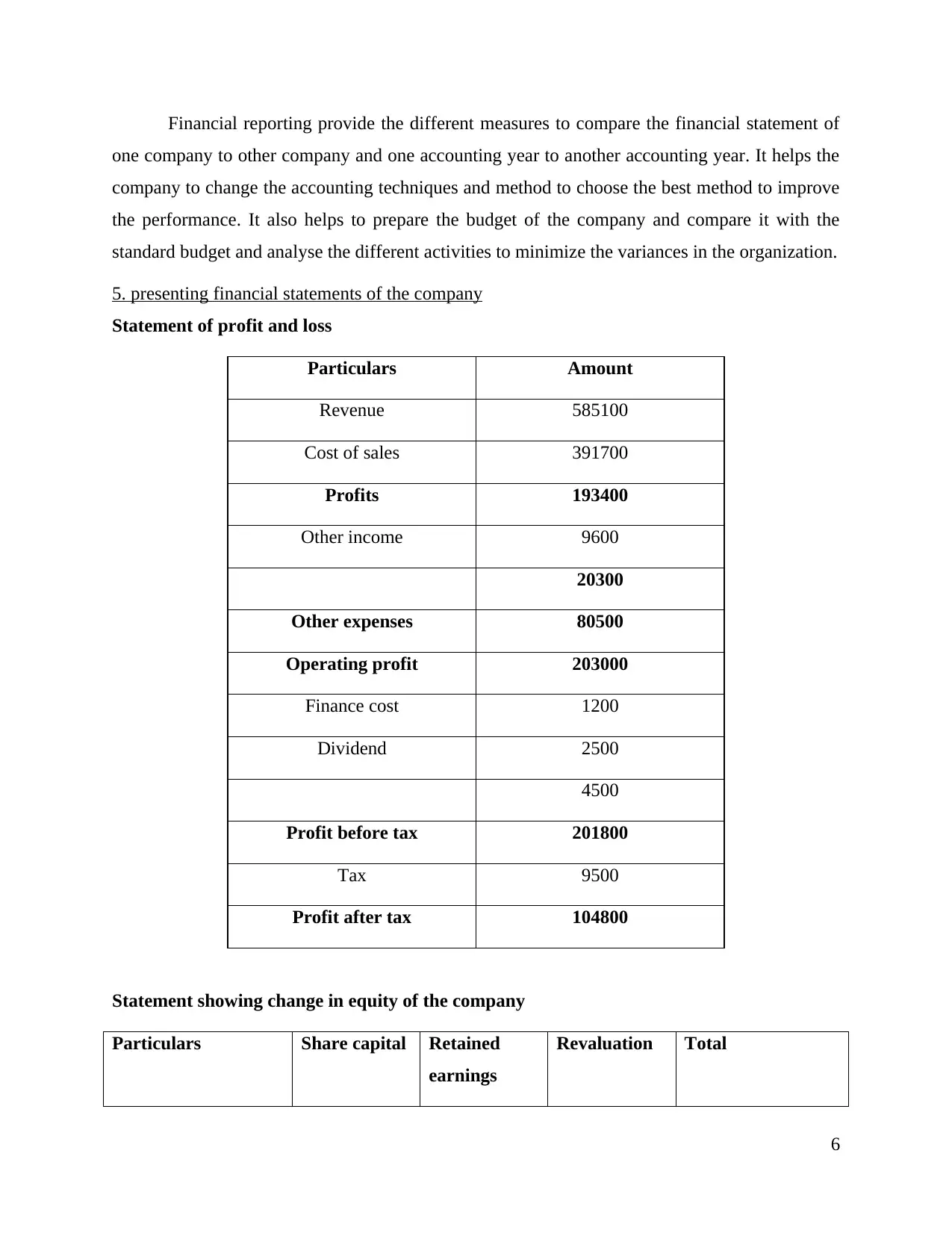
5. presenting financial statements of the company
Statement of profit and loss
Particulars Amount
Revenue 585100
Cost of sales 391700
Profits 193400
Other income 9600
20300
Other expenses 80500
Operating profit 203000
Finance cost 1200
Dividend 2500
4500
Profit before tax 201800
Tax 9500
Profit after tax 104800
Statement showing change in equity of the company
Particulars Share capital Retained
earnings
Revaluation Total
6
one company to other company and one accounting year to another accounting year. It helps the
company to change the accounting techniques and method to choose the best method to improve
the performance. It also helps to prepare the budget of the company and compare it with the
standard budget and analyse the different activities to minimize the variances in the organization.
5. presenting financial statements of the company
Statement of profit and loss
Particulars Amount
Revenue 585100
Cost of sales 391700
Profits 193400
Other income 9600
20300
Other expenses 80500
Operating profit 203000
Finance cost 1200
Dividend 2500
4500
Profit before tax 201800
Tax 9500
Profit after tax 104800
Statement showing change in equity of the company
Particulars Share capital Retained
earnings
Revaluation Total
6
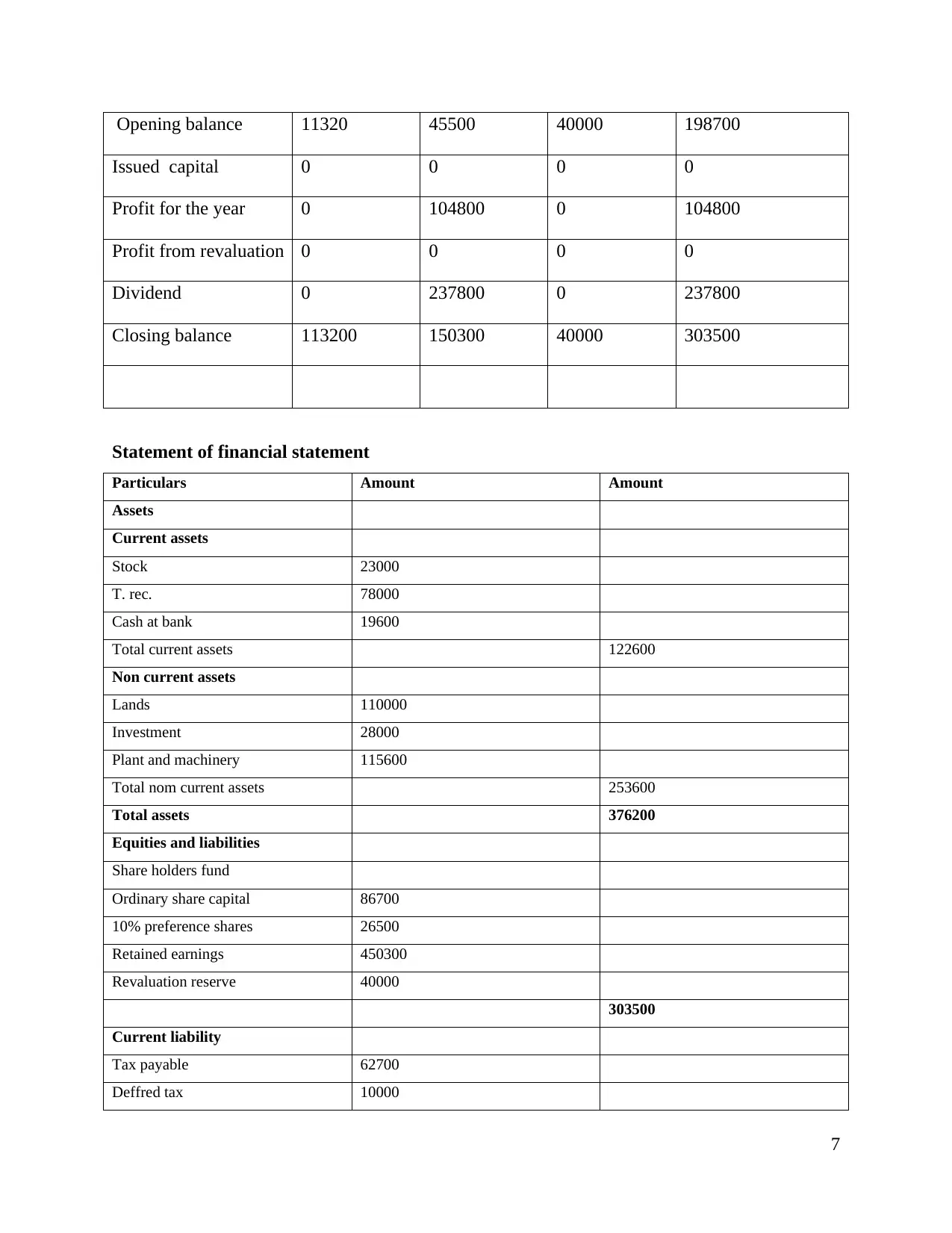
Opening balance 11320 45500 40000 198700
Issued capital 0 0 0 0
Profit for the year 0 104800 0 104800
Profit from revaluation 0 0 0 0
Dividend 0 237800 0 237800
Closing balance 113200 150300 40000 303500
Statement of financial statement
Particulars Amount Amount
Assets
Current assets
Stock 23000
T. rec. 78000
Cash at bank 19600
Total current assets 122600
Non current assets
Lands 110000
Investment 28000
Plant and machinery 115600
Total nom current assets 253600
Total assets 376200
Equities and liabilities
Share holders fund
Ordinary share capital 86700
10% preference shares 26500
Retained earnings 450300
Revaluation reserve 40000
303500
Current liability
Tax payable 62700
Deffred tax 10000
7
Issued capital 0 0 0 0
Profit for the year 0 104800 0 104800
Profit from revaluation 0 0 0 0
Dividend 0 237800 0 237800
Closing balance 113200 150300 40000 303500
Statement of financial statement
Particulars Amount Amount
Assets
Current assets
Stock 23000
T. rec. 78000
Cash at bank 19600
Total current assets 122600
Non current assets
Lands 110000
Investment 28000
Plant and machinery 115600
Total nom current assets 253600
Total assets 376200
Equities and liabilities
Share holders fund
Ordinary share capital 86700
10% preference shares 26500
Retained earnings 450300
Revaluation reserve 40000
303500
Current liability
Tax payable 62700
Deffred tax 10000
7
⊘ This is a preview!⊘
Do you want full access?
Subscribe today to unlock all pages.
Trusted by 1+ million students worldwide
Total current liabilities 72700
Total liabilities 376200
6. Interpretation and communication of financial information by using ratio analysis
Liquidity ratio
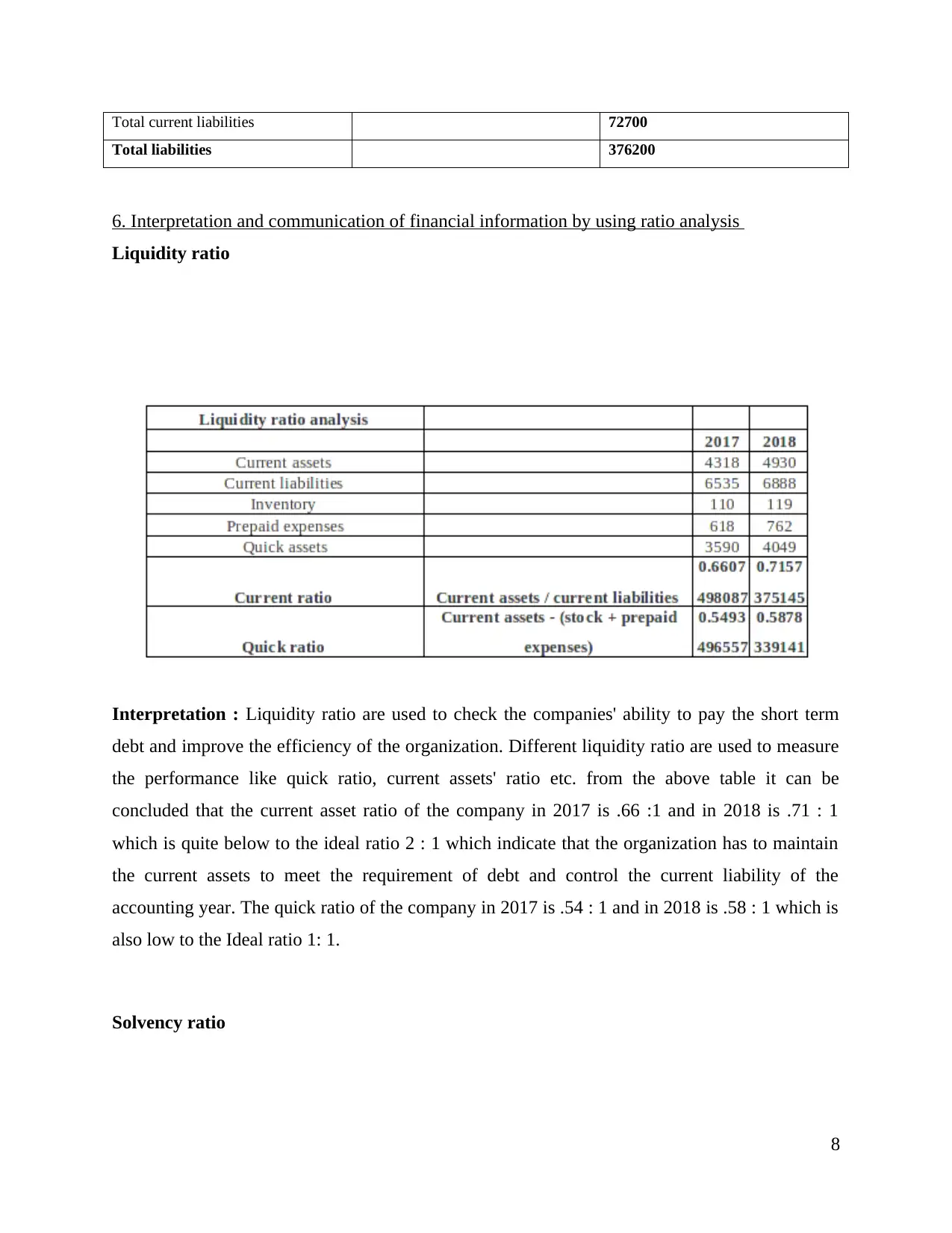
Interpretation : Liquidity ratio are used to check the companies' ability to pay the short term
debt and improve the efficiency of the organization. Different liquidity ratio are used to measure
the performance like quick ratio, current assets' ratio etc. from the above table it can be
concluded that the current asset ratio of the company in 2017 is .66 :1 and in 2018 is .71 : 1
which is quite below to the ideal ratio 2 : 1 which indicate that the organization has to maintain
the current assets to meet the requirement of debt and control the current liability of the
accounting year. The quick ratio of the company in 2017 is .54 : 1 and in 2018 is .58 : 1 which is
also low to the Ideal ratio 1: 1.
Solvency ratio
8
Total liabilities 376200
6. Interpretation and communication of financial information by using ratio analysis
Liquidity ratio
Interpretation : Liquidity ratio are used to check the companies' ability to pay the short term
debt and improve the efficiency of the organization. Different liquidity ratio are used to measure
the performance like quick ratio, current assets' ratio etc. from the above table it can be
concluded that the current asset ratio of the company in 2017 is .66 :1 and in 2018 is .71 : 1
which is quite below to the ideal ratio 2 : 1 which indicate that the organization has to maintain
the current assets to meet the requirement of debt and control the current liability of the
accounting year. The quick ratio of the company in 2017 is .54 : 1 and in 2018 is .58 : 1 which is
also low to the Ideal ratio 1: 1.
Solvency ratio
8
Paraphrase This Document
Need a fresh take? Get an instant paraphrase of this document with our AI Paraphraser
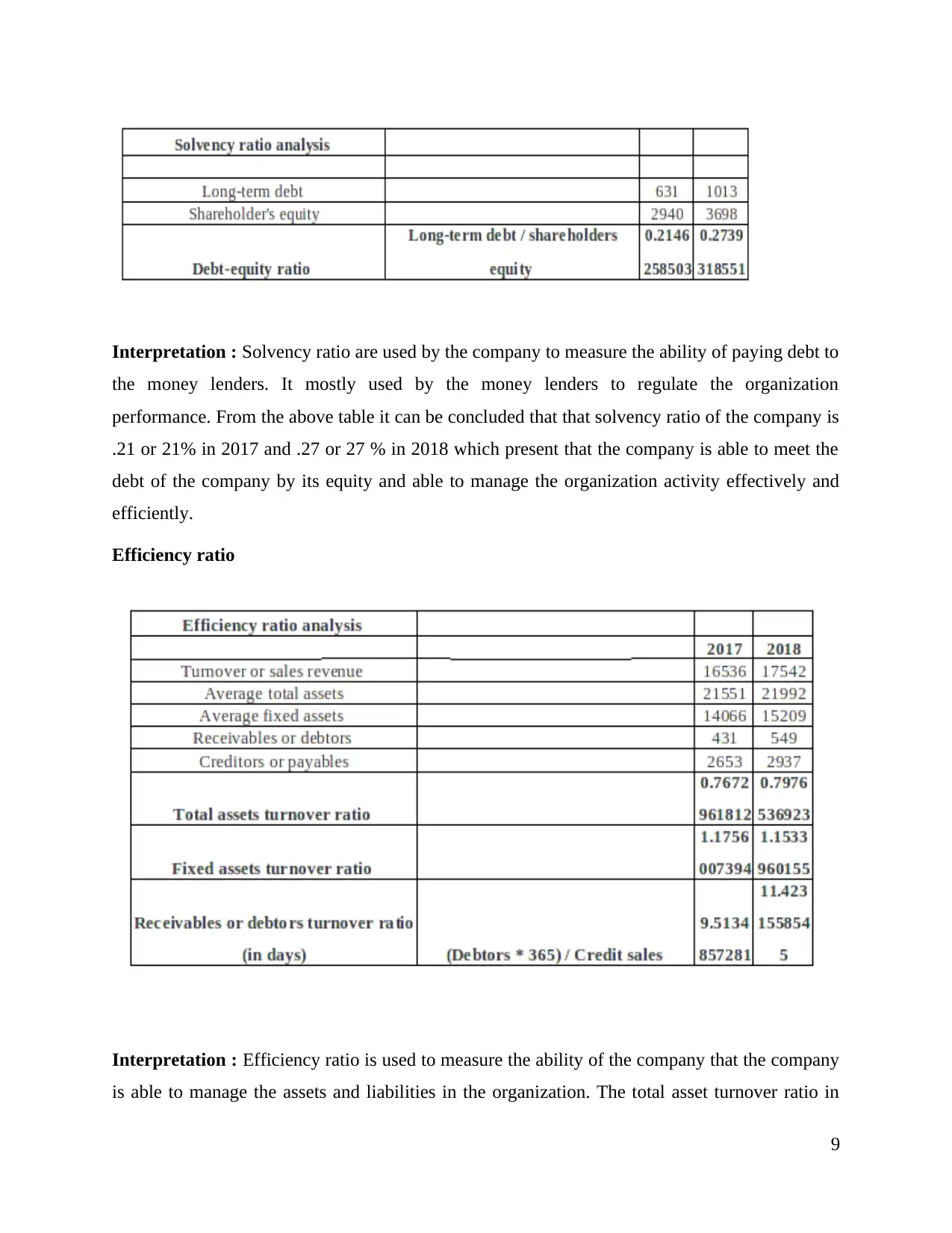
Interpretation : Solvency ratio are used by the company to measure the ability of paying debt to
the money lenders. It mostly used by the money lenders to regulate the organization
performance. From the above table it can be concluded that that solvency ratio of the company is
.21 or 21% in 2017 and .27 or 27 % in 2018 which present that the company is able to meet the
debt of the company by its equity and able to manage the organization activity effectively and
efficiently.
Efficiency ratio
Interpretation : Efficiency ratio is used to measure the ability of the company that the company
is able to manage the assets and liabilities in the organization. The total asset turnover ratio in
9
the money lenders. It mostly used by the money lenders to regulate the organization
performance. From the above table it can be concluded that that solvency ratio of the company is
.21 or 21% in 2017 and .27 or 27 % in 2018 which present that the company is able to meet the
debt of the company by its equity and able to manage the organization activity effectively and
efficiently.
Efficiency ratio
Interpretation : Efficiency ratio is used to measure the ability of the company that the company
is able to manage the assets and liabilities in the organization. The total asset turnover ratio in
9
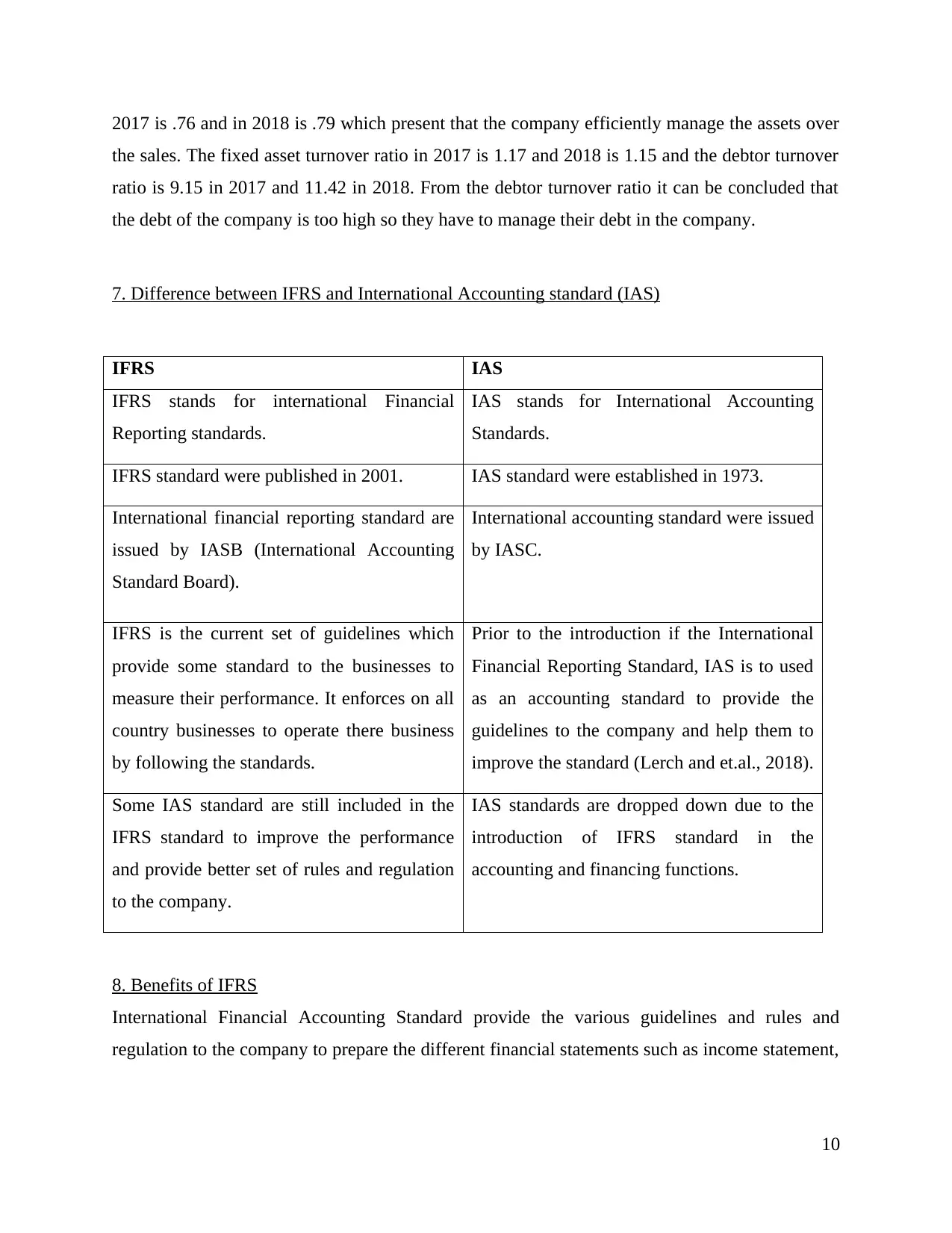
2017 is .76 and in 2018 is .79 which present that the company efficiently manage the assets over
the sales. The fixed asset turnover ratio in 2017 is 1.17 and 2018 is 1.15 and the debtor turnover
ratio is 9.15 in 2017 and 11.42 in 2018. From the debtor turnover ratio it can be concluded that
the debt of the company is too high so they have to manage their debt in the company.
7. Difference between IFRS and International Accounting standard (IAS)
IFRS IAS
IFRS stands for international Financial
Reporting standards.
IAS stands for International Accounting
Standards.
IFRS standard were published in 2001. IAS standard were established in 1973.
International financial reporting standard are
issued by IASB (International Accounting
Standard Board).
International accounting standard were issued
by IASC.
IFRS is the current set of guidelines which
provide some standard to the businesses to
measure their performance. It enforces on all
country businesses to operate there business
by following the standards.
Prior to the introduction if the International
Financial Reporting Standard, IAS is to used
as an accounting standard to provide the
guidelines to the company and help them to
improve the standard (Lerch and et.al., 2018).
Some IAS standard are still included in the
IFRS standard to improve the performance
and provide better set of rules and regulation
to the company.
IAS standards are dropped down due to the
introduction of IFRS standard in the
accounting and financing functions.
8. Benefits of IFRS
International Financial Accounting Standard provide the various guidelines and rules and
regulation to the company to prepare the different financial statements such as income statement,
10
the sales. The fixed asset turnover ratio in 2017 is 1.17 and 2018 is 1.15 and the debtor turnover
ratio is 9.15 in 2017 and 11.42 in 2018. From the debtor turnover ratio it can be concluded that
the debt of the company is too high so they have to manage their debt in the company.
7. Difference between IFRS and International Accounting standard (IAS)
IFRS IAS
IFRS stands for international Financial
Reporting standards.
IAS stands for International Accounting
Standards.
IFRS standard were published in 2001. IAS standard were established in 1973.
International financial reporting standard are
issued by IASB (International Accounting
Standard Board).
International accounting standard were issued
by IASC.
IFRS is the current set of guidelines which
provide some standard to the businesses to
measure their performance. It enforces on all
country businesses to operate there business
by following the standards.
Prior to the introduction if the International
Financial Reporting Standard, IAS is to used
as an accounting standard to provide the
guidelines to the company and help them to
improve the standard (Lerch and et.al., 2018).
Some IAS standard are still included in the
IFRS standard to improve the performance
and provide better set of rules and regulation
to the company.
IAS standards are dropped down due to the
introduction of IFRS standard in the
accounting and financing functions.
8. Benefits of IFRS
International Financial Accounting Standard provide the various guidelines and rules and
regulation to the company to prepare the different financial statements such as income statement,
10
⊘ This is a preview!⊘
Do you want full access?
Subscribe today to unlock all pages.
Trusted by 1+ million students worldwide

1 out of 16


Related Documents


Your All-in-One AI-Powered Toolkit for Academic Success.
+13062052269
info@desklib.com
Available 24*7 on WhatsApp / Email
![[object Object]](/_next/static/media/star-bottom.7253800d.svg)
Unlock your academic potential
Copyright © 2020–2026 A2Z Services. All Rights Reserved. Developed and managed by ZUCOL.