IGA Marketing and Communication: Strategies, Analysis, and ODP Project
VerifiedAdded on 2023/06/13
|20
|3012
|466
Case Study
AI Summary
This assignment provides a comprehensive analysis of IGA's marketing and communication strategies through a detailed case study. It identifies key issues such as lower staff morale, organizational culture weaknesses, and ineffective leadership, proposing solutions like product differentiation and cost leadership. The assignment explores development factors for expansion, the roles needed in an Organizational Development Program (ODP), and methods for collecting data on attitudes toward change. It also outlines relevant organizational development and change management strategies, emphasizing effective communication and process simplification. Furthermore, the assignment discusses maximizing staff participation, team dynamics, conflict resolution, and essential communication plans for IGA's development. Task 2 includes brainstorming activities, meeting minutes templates, and employee evaluation templates related to the ODP project, covering objectives, change management, communication strategies, and roles/responsibilities. The document aims to provide actionable insights for improving IGA's marketing and communication effectiveness.
Running head: MARKETING AND COMMUNICATION
MARKETING AND COMMUNICATION
Name of the Student
Name of the University
Author Note
MARKETING AND COMMUNICATION
Name of the Student
Name of the University
Author Note
Paraphrase This Document
Need a fresh take? Get an instant paraphrase of this document with our AI Paraphraser

1MARKETING AND COMMUNICATION
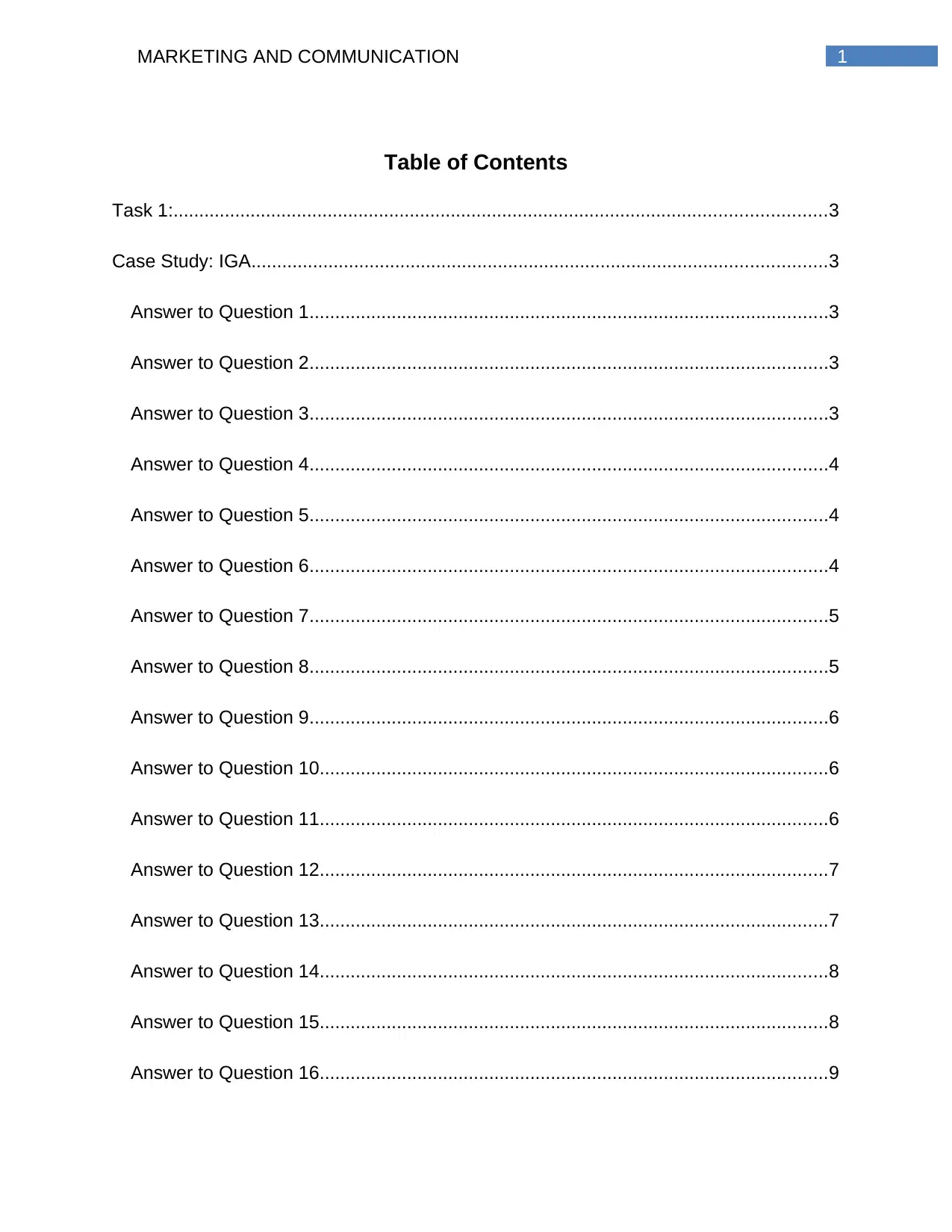
Table of Contents
Task 1:...............................................................................................................................3
Case Study: IGA................................................................................................................3
Answer to Question 1.....................................................................................................3
Answer to Question 2.....................................................................................................3
Answer to Question 3.....................................................................................................3
Answer to Question 4.....................................................................................................4
Answer to Question 5.....................................................................................................4
Answer to Question 6.....................................................................................................4
Answer to Question 7.....................................................................................................5
Answer to Question 8.....................................................................................................5
Answer to Question 9.....................................................................................................6
Answer to Question 10...................................................................................................6
Answer to Question 11...................................................................................................6
Answer to Question 12...................................................................................................7
Answer to Question 13...................................................................................................7
Answer to Question 14...................................................................................................8
Answer to Question 15...................................................................................................8
Answer to Question 16...................................................................................................9
Table of Contents
Task 1:...............................................................................................................................3
Case Study: IGA................................................................................................................3
Answer to Question 1.....................................................................................................3
Answer to Question 2.....................................................................................................3
Answer to Question 3.....................................................................................................3
Answer to Question 4.....................................................................................................4
Answer to Question 5.....................................................................................................4
Answer to Question 6.....................................................................................................4
Answer to Question 7.....................................................................................................5
Answer to Question 8.....................................................................................................5
Answer to Question 9.....................................................................................................6
Answer to Question 10...................................................................................................6
Answer to Question 11...................................................................................................6
Answer to Question 12...................................................................................................7
Answer to Question 13...................................................................................................7
Answer to Question 14...................................................................................................8
Answer to Question 15...................................................................................................8
Answer to Question 16...................................................................................................9

2MARKETING AND COMMUNICATION
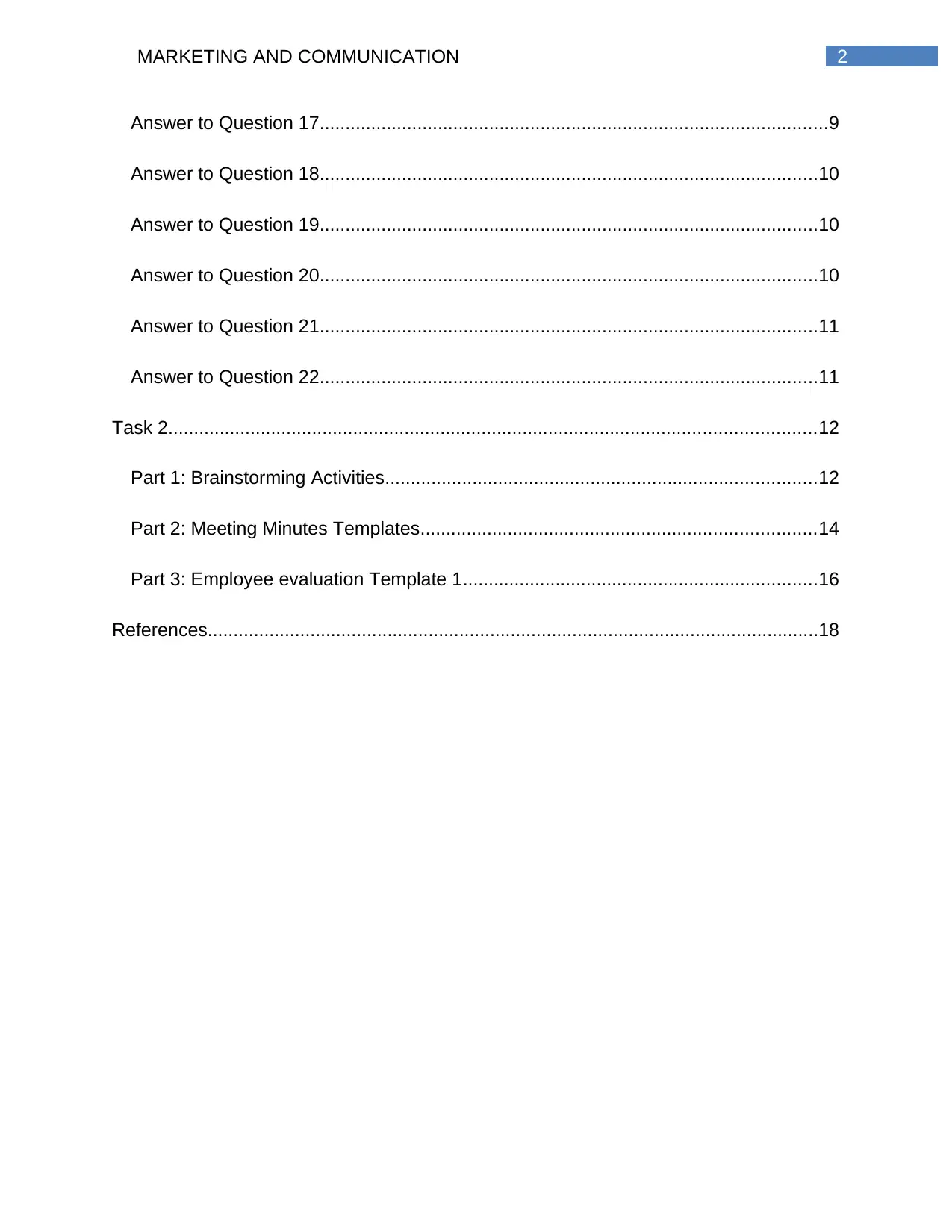
Answer to Question 17...................................................................................................9
Answer to Question 18.................................................................................................10
Answer to Question 19.................................................................................................10
Answer to Question 20.................................................................................................10
Answer to Question 21.................................................................................................11
Answer to Question 22.................................................................................................11
Task 2..............................................................................................................................12
Part 1: Brainstorming Activities....................................................................................12
Part 2: Meeting Minutes Templates.............................................................................14
Part 3: Employee evaluation Template 1.....................................................................16
References.......................................................................................................................18
Answer to Question 17...................................................................................................9
Answer to Question 18.................................................................................................10
Answer to Question 19.................................................................................................10
Answer to Question 20.................................................................................................10
Answer to Question 21.................................................................................................11
Answer to Question 22.................................................................................................11
Task 2..............................................................................................................................12
Part 1: Brainstorming Activities....................................................................................12
Part 2: Meeting Minutes Templates.............................................................................14
Part 3: Employee evaluation Template 1.....................................................................16
References.......................................................................................................................18
⊘ This is a preview!⊘
Do you want full access?
Subscribe today to unlock all pages.

Trusted by 1+ million students worldwide

3MARKETING AND COMMUNICATION
Task 1:
Case Study: IGA
Answer to Question 1
The primary issues being faced by the company are as follows:
Lower staff morale and higher turnover- The employees present in the
organization are have lowered morale’s and the turnover rate is quite high which
needs to be improved (Borrego et al. 2013)
Organizational culture- The organizational culture of the firm is weak.
Leadership- The leadership present in the organization is not effective.
Answer to Question 2
The strategies to be adopted by IGA are as follows:
Product differentiation – In order to gain a competitive advantage n the given
market, the company needs to adapt to the product differentiation strategy
whereby the firm is able to take advantage of the market and proceed
(Buckingham and Goodall 2015).
Cost leadership- The Company can also follow a cost leadership strategy in
order to perform better than its competitors.
Answer to Question 3
The given development factors need to be considered before expansion:
Task 1:
Case Study: IGA
Answer to Question 1
The primary issues being faced by the company are as follows:
Lower staff morale and higher turnover- The employees present in the
organization are have lowered morale’s and the turnover rate is quite high which
needs to be improved (Borrego et al. 2013)
Organizational culture- The organizational culture of the firm is weak.
Leadership- The leadership present in the organization is not effective.
Answer to Question 2
The strategies to be adopted by IGA are as follows:
Product differentiation – In order to gain a competitive advantage n the given
market, the company needs to adapt to the product differentiation strategy
whereby the firm is able to take advantage of the market and proceed
(Buckingham and Goodall 2015).
Cost leadership- The Company can also follow a cost leadership strategy in
order to perform better than its competitors.
Answer to Question 3
The given development factors need to be considered before expansion:
Paraphrase This Document
Need a fresh take? Get an instant paraphrase of this document with our AI Paraphraser

4MARKETING AND COMMUNICATION
Communication factors- If there is a lack of communication between the various
members, an organization will not be able to succeed.
People factors- the people form the lifeline of the business and their development
is crucial.
Capital- The capital of the organization needs to be considered adequately
Timing- The timing factor plays a major role.
Answer to Question 4
The four roles needed in an ODP are as follows:
Facilitator- This shall go a long way in helping the chosen target audience.
Leader- The leader will guide the organizational members towards success
Manager- The manager will look after the process of each task (Pulakos et al.
2015)
Mentor- The mentor shall look after the development of each individual.
Answer to Question 5
Survey- Various surveys can be conducted to find out the attitude towards
change (Cascio 2018).
Feedback forms- The feedback forms can act as a good source of identification
for the organization.
Answer to Question 6
The two ways in which data can be collected are as follows:
Communication factors- If there is a lack of communication between the various
members, an organization will not be able to succeed.
People factors- the people form the lifeline of the business and their development
is crucial.
Capital- The capital of the organization needs to be considered adequately
Timing- The timing factor plays a major role.
Answer to Question 4
The four roles needed in an ODP are as follows:
Facilitator- This shall go a long way in helping the chosen target audience.
Leader- The leader will guide the organizational members towards success
Manager- The manager will look after the process of each task (Pulakos et al.
2015)
Mentor- The mentor shall look after the development of each individual.
Answer to Question 5
Survey- Various surveys can be conducted to find out the attitude towards
change (Cascio 2018).
Feedback forms- The feedback forms can act as a good source of identification
for the organization.
Answer to Question 6
The two ways in which data can be collected are as follows:

5MARKETING AND COMMUNICATION
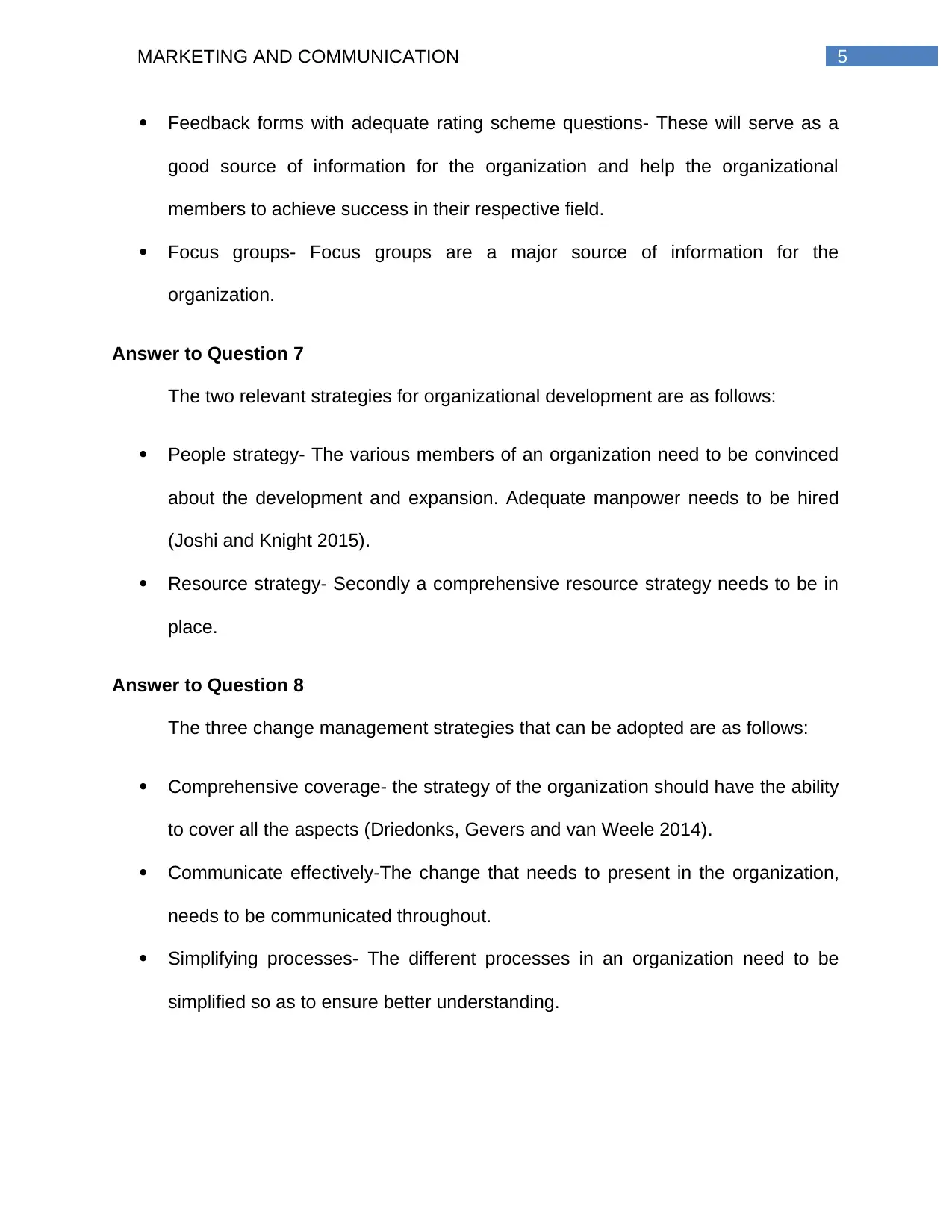
Feedback forms with adequate rating scheme questions- These will serve as a
good source of information for the organization and help the organizational
members to achieve success in their respective field.
Focus groups- Focus groups are a major source of information for the
organization.
Answer to Question 7
The two relevant strategies for organizational development are as follows:
People strategy- The various members of an organization need to be convinced
about the development and expansion. Adequate manpower needs to be hired
(Joshi and Knight 2015).
Resource strategy- Secondly a comprehensive resource strategy needs to be in
place.
Answer to Question 8
The three change management strategies that can be adopted are as follows:
Comprehensive coverage- the strategy of the organization should have the ability
to cover all the aspects (Driedonks, Gevers and van Weele 2014).
Communicate effectively-The change that needs to present in the organization,
needs to be communicated throughout.
Simplifying processes- The different processes in an organization need to be
simplified so as to ensure better understanding.
Feedback forms with adequate rating scheme questions- These will serve as a
good source of information for the organization and help the organizational
members to achieve success in their respective field.
Focus groups- Focus groups are a major source of information for the
organization.
Answer to Question 7
The two relevant strategies for organizational development are as follows:
People strategy- The various members of an organization need to be convinced
about the development and expansion. Adequate manpower needs to be hired
(Joshi and Knight 2015).
Resource strategy- Secondly a comprehensive resource strategy needs to be in
place.
Answer to Question 8
The three change management strategies that can be adopted are as follows:
Comprehensive coverage- the strategy of the organization should have the ability
to cover all the aspects (Driedonks, Gevers and van Weele 2014).
Communicate effectively-The change that needs to present in the organization,
needs to be communicated throughout.
Simplifying processes- The different processes in an organization need to be
simplified so as to ensure better understanding.
⊘ This is a preview!⊘
Do you want full access?
Subscribe today to unlock all pages.

Trusted by 1+ million students worldwide

6MARKETING AND COMMUNICATION
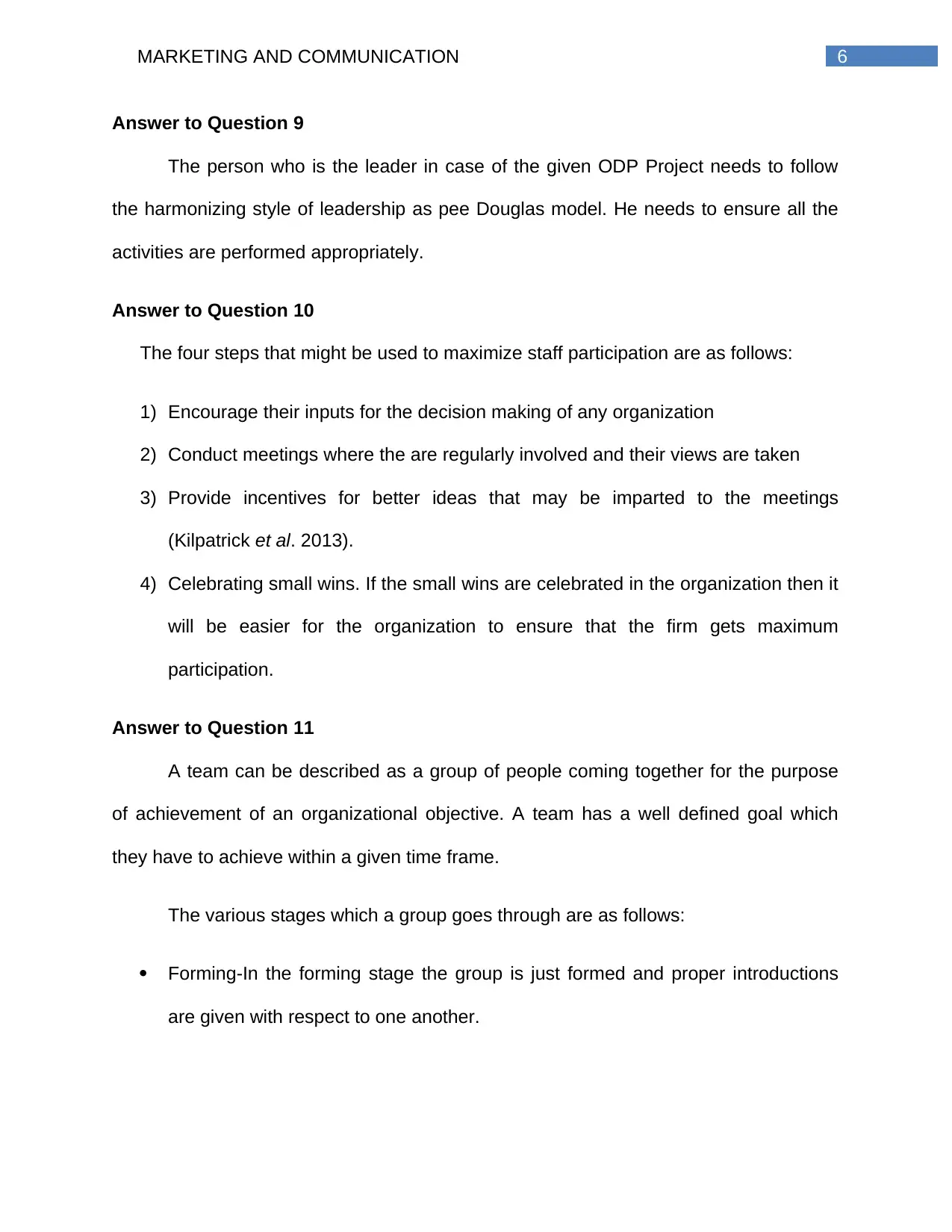
Answer to Question 9
The person who is the leader in case of the given ODP Project needs to follow
the harmonizing style of leadership as pee Douglas model. He needs to ensure all the
activities are performed appropriately.
Answer to Question 10
The four steps that might be used to maximize staff participation are as follows:
1) Encourage their inputs for the decision making of any organization
2) Conduct meetings where the are regularly involved and their views are taken
3) Provide incentives for better ideas that may be imparted to the meetings
(Kilpatrick et al. 2013).
4) Celebrating small wins. If the small wins are celebrated in the organization then it
will be easier for the organization to ensure that the firm gets maximum
participation.
Answer to Question 11
A team can be described as a group of people coming together for the purpose
of achievement of an organizational objective. A team has a well defined goal which
they have to achieve within a given time frame.
The various stages which a group goes through are as follows:
Forming-In the forming stage the group is just formed and proper introductions
are given with respect to one another.
Answer to Question 9
The person who is the leader in case of the given ODP Project needs to follow
the harmonizing style of leadership as pee Douglas model. He needs to ensure all the
activities are performed appropriately.
Answer to Question 10
The four steps that might be used to maximize staff participation are as follows:
1) Encourage their inputs for the decision making of any organization
2) Conduct meetings where the are regularly involved and their views are taken
3) Provide incentives for better ideas that may be imparted to the meetings
(Kilpatrick et al. 2013).
4) Celebrating small wins. If the small wins are celebrated in the organization then it
will be easier for the organization to ensure that the firm gets maximum
participation.
Answer to Question 11
A team can be described as a group of people coming together for the purpose
of achievement of an organizational objective. A team has a well defined goal which
they have to achieve within a given time frame.
The various stages which a group goes through are as follows:
Forming-In the forming stage the group is just formed and proper introductions
are given with respect to one another.
Paraphrase This Document
Need a fresh take? Get an instant paraphrase of this document with our AI Paraphraser

7MARKETING AND COMMUNICATION
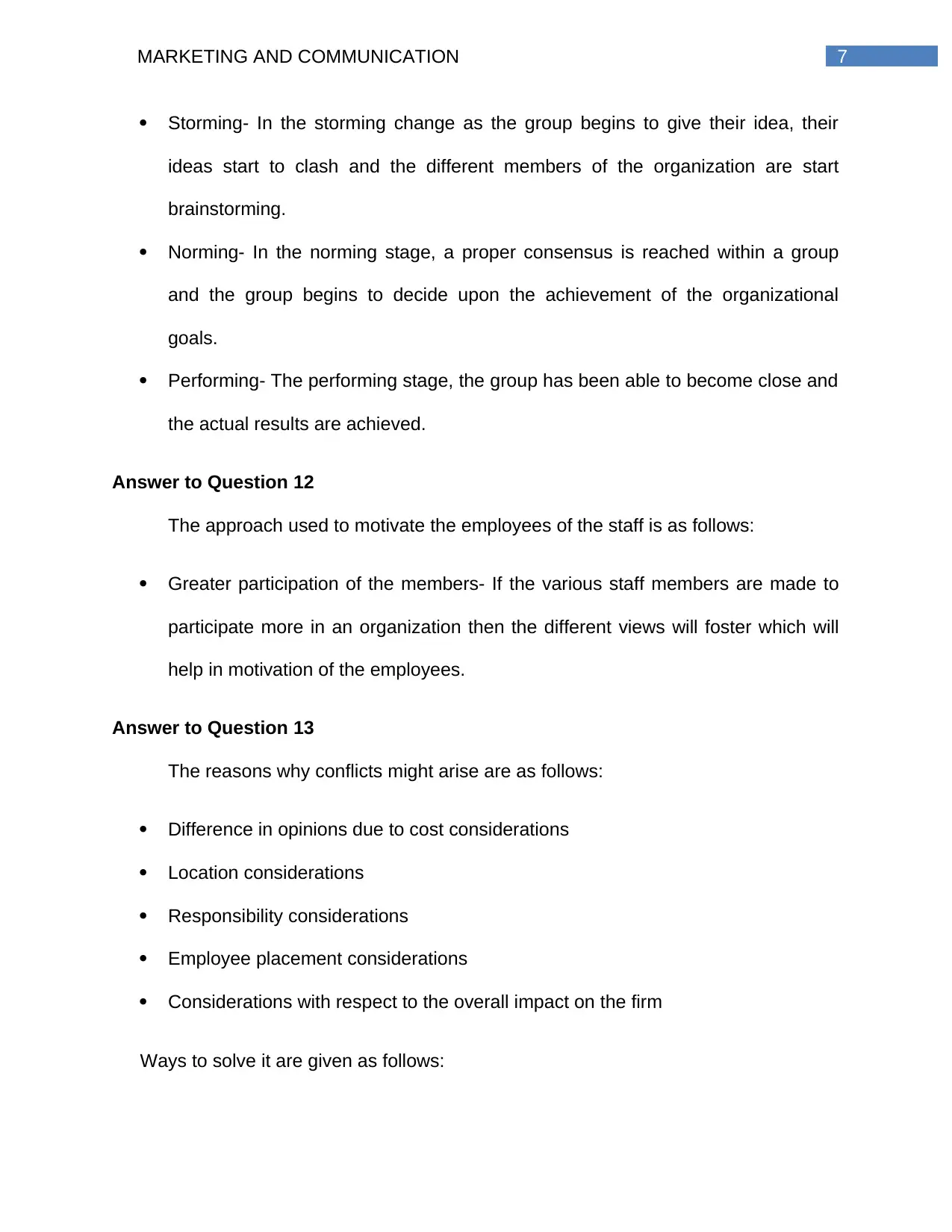
Storming- In the storming change as the group begins to give their idea, their
ideas start to clash and the different members of the organization are start
brainstorming.
Norming- In the norming stage, a proper consensus is reached within a group
and the group begins to decide upon the achievement of the organizational
goals.
Performing- The performing stage, the group has been able to become close and
the actual results are achieved.
Answer to Question 12
The approach used to motivate the employees of the staff is as follows:
Greater participation of the members- If the various staff members are made to
participate more in an organization then the different views will foster which will
help in motivation of the employees.
Answer to Question 13
The reasons why conflicts might arise are as follows:
Difference in opinions due to cost considerations
Location considerations
Responsibility considerations
Employee placement considerations
Considerations with respect to the overall impact on the firm
Ways to solve it are given as follows:
Storming- In the storming change as the group begins to give their idea, their
ideas start to clash and the different members of the organization are start
brainstorming.
Norming- In the norming stage, a proper consensus is reached within a group
and the group begins to decide upon the achievement of the organizational
goals.
Performing- The performing stage, the group has been able to become close and
the actual results are achieved.
Answer to Question 12
The approach used to motivate the employees of the staff is as follows:
Greater participation of the members- If the various staff members are made to
participate more in an organization then the different views will foster which will
help in motivation of the employees.
Answer to Question 13
The reasons why conflicts might arise are as follows:
Difference in opinions due to cost considerations
Location considerations
Responsibility considerations
Employee placement considerations
Considerations with respect to the overall impact on the firm
Ways to solve it are given as follows:

8MARKETING AND COMMUNICATION
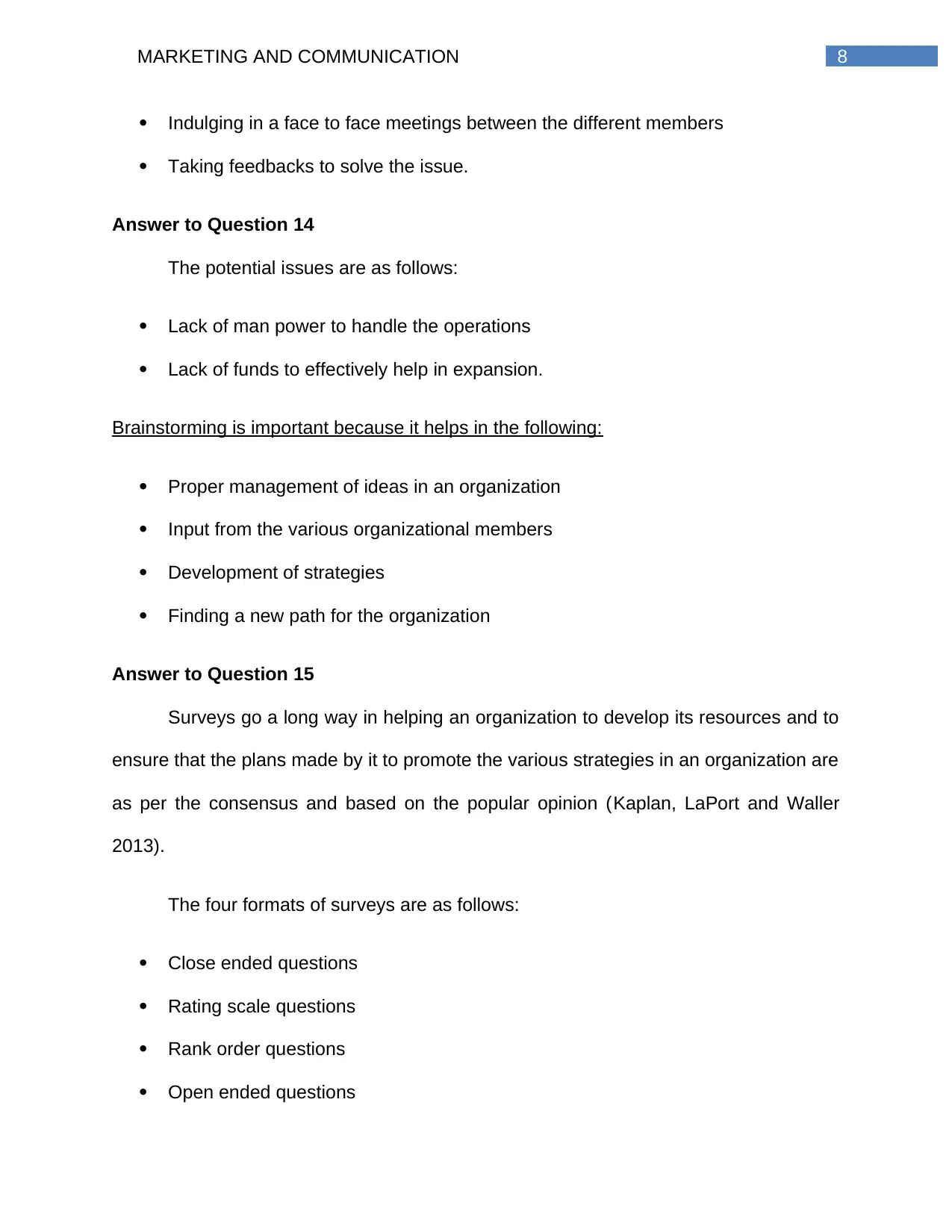
Indulging in a face to face meetings between the different members
Taking feedbacks to solve the issue.
Answer to Question 14
The potential issues are as follows:
Lack of man power to handle the operations
Lack of funds to effectively help in expansion.
Brainstorming is important because it helps in the following:
Proper management of ideas in an organization
Input from the various organizational members
Development of strategies
Finding a new path for the organization
Answer to Question 15
Surveys go a long way in helping an organization to develop its resources and to
ensure that the plans made by it to promote the various strategies in an organization are
as per the consensus and based on the popular opinion (Kaplan, LaPort and Waller
2013).
The four formats of surveys are as follows:
Close ended questions
Rating scale questions
Rank order questions
Open ended questions
Indulging in a face to face meetings between the different members
Taking feedbacks to solve the issue.
Answer to Question 14
The potential issues are as follows:
Lack of man power to handle the operations
Lack of funds to effectively help in expansion.
Brainstorming is important because it helps in the following:
Proper management of ideas in an organization
Input from the various organizational members
Development of strategies
Finding a new path for the organization
Answer to Question 15
Surveys go a long way in helping an organization to develop its resources and to
ensure that the plans made by it to promote the various strategies in an organization are
as per the consensus and based on the popular opinion (Kaplan, LaPort and Waller
2013).
The four formats of surveys are as follows:
Close ended questions
Rating scale questions
Rank order questions
Open ended questions
⊘ This is a preview!⊘
Do you want full access?
Subscribe today to unlock all pages.

Trusted by 1+ million students worldwide

9MARKETING AND COMMUNICATION
o Open ended questions- Open ended questions are those questions which
go a long way in helping an organization to attain the views of the survey
takers in a detailed manner. They help the employees or other people
giving their opinion to express their views freely.
o Close ended questions- The close ended question just want the responder
to answer in a yes or a no and do not wish to take any further response.
Answer to Question 16
The different communicational plans necessary for the development plan at IGA
can be as follows;
Informational communicational plan- the customer need to be given out an
information of all the relevant factors in an organization so that they are able to
associate with the different factors (Mone and London 2014).
Mandatory communication plan- This comprises of these informational aspects
which are equally important to convey to.
Answer to Question 17
Ad Hoc Meeting- These meetings take place suddenly and it becomes necessary
to manage certain crucial aspects of the project.
Board Meeting- The board meetings are held at a regular interval which helps the
senior management to keep a track of the happenings of the organization.
Work meeting- The work meetings are purely based on the wok related aspects.
Staff meeting- The staff meeting is generally held to facilitate the management of
working members in an organization.
o Open ended questions- Open ended questions are those questions which
go a long way in helping an organization to attain the views of the survey
takers in a detailed manner. They help the employees or other people
giving their opinion to express their views freely.
o Close ended questions- The close ended question just want the responder
to answer in a yes or a no and do not wish to take any further response.
Answer to Question 16
The different communicational plans necessary for the development plan at IGA
can be as follows;
Informational communicational plan- the customer need to be given out an
information of all the relevant factors in an organization so that they are able to
associate with the different factors (Mone and London 2014).
Mandatory communication plan- This comprises of these informational aspects
which are equally important to convey to.
Answer to Question 17
Ad Hoc Meeting- These meetings take place suddenly and it becomes necessary
to manage certain crucial aspects of the project.
Board Meeting- The board meetings are held at a regular interval which helps the
senior management to keep a track of the happenings of the organization.
Work meeting- The work meetings are purely based on the wok related aspects.
Staff meeting- The staff meeting is generally held to facilitate the management of
working members in an organization.
Paraphrase This Document
Need a fresh take? Get an instant paraphrase of this document with our AI Paraphraser

10MARKETING AND COMMUNICATION
Ways to maintain regular meetings are as follows:
1) Plan
2) Schedule
3) Encourage topic of meetings
4) Delegate responsibilities towards the various members of the organization.
Answer to Question 18
Feedback can be effectively described as the response which is received from
the various organizational members with respect to the performance of a particular
product and opportunity. Feedback helps the organization to improve its task (Pangil
and Moi Chan 2014).
Types of feedbacks are as follows:
Constructive feedback- This kind of feedback goes a long way in helping an
organization to maintain the activities and improve them
Corrective feedback- This is specifically given to correct a particular aspect.
Answer to Question 19
Property management act 2014
Fair trading act 1987
Fair Trading Regulations Act 2012
Answer to Question 20
Activity:
Team building excursion to a nearby tourist destination
Ways to maintain regular meetings are as follows:
1) Plan
2) Schedule
3) Encourage topic of meetings
4) Delegate responsibilities towards the various members of the organization.
Answer to Question 18
Feedback can be effectively described as the response which is received from
the various organizational members with respect to the performance of a particular
product and opportunity. Feedback helps the organization to improve its task (Pangil
and Moi Chan 2014).
Types of feedbacks are as follows:
Constructive feedback- This kind of feedback goes a long way in helping an
organization to maintain the activities and improve them
Corrective feedback- This is specifically given to correct a particular aspect.
Answer to Question 19
Property management act 2014
Fair trading act 1987
Fair Trading Regulations Act 2012
Answer to Question 20
Activity:
Team building excursion to a nearby tourist destination

11MARKETING AND COMMUNICATION
Intervention: Indulge in regular meetings
Answer to Question 21
Strategies used are as follows:
Results reflection strategy- This strategy will be used to reflect to the results or
the improved results to the management in order to portray that they are
performing well.
Strategy related to compliance- These strategies will be used to portray that the
organization is abiding by all the compliances.
Answer to Question 22
Cost factors
Staffing costs
Resources required
Time spent
Benefits
Improved processes
Improvised sales
Intervention: Indulge in regular meetings
Answer to Question 21
Strategies used are as follows:
Results reflection strategy- This strategy will be used to reflect to the results or
the improved results to the management in order to portray that they are
performing well.
Strategy related to compliance- These strategies will be used to portray that the
organization is abiding by all the compliances.
Answer to Question 22
Cost factors
Staffing costs
Resources required
Time spent
Benefits
Improved processes
Improvised sales
⊘ This is a preview!⊘
Do you want full access?
Subscribe today to unlock all pages.

Trusted by 1+ million students worldwide
1 out of 20
Related Documents
Your All-in-One AI-Powered Toolkit for Academic Success.
+13062052269
info@desklib.com
Available 24*7 on WhatsApp / Email
Unlock your academic potential
Copyright © 2020–2025 A2Z Services. All Rights Reserved. Developed and managed by ZUCOL.