International Hospitality Management: IHG's Strategy in Kuala Lumpur
VerifiedAdded on 2023/06/18
|18
|5485
|280
Report
AI Summary
This report provides an analysis of InterContinental Hotels Group's (IHG) strategy for entering emerging markets, with a specific focus on Kuala Lumpur, Malaysia. It begins by providing a background of the hospitality industry and IHG, followed by a SWOT analysis of the company. The report then examines the characteristics of emerging markets, particularly Kuala Lumpur, and conducts a PESTEL analysis to assess the external factors influencing the market. A strategic growth plan for IHG is proposed, considering options such as licensing and acquisitions/partnerships with local businesses, and the Porter's Five Forces model is used to evaluate the competitiveness of these strategies. The chosen strategy's justification and practical application over the next 5 and 10 years are also discussed, ultimately aiming to provide a comprehensive overview of IHG's potential market entry and growth strategies in Kuala Lumpur.
INTERNATIONAL
HOSPITALITY
MANAGEMENT
1
HOSPITALITY
MANAGEMENT
1

Paraphrase This Document
Need a fresh take? Get an instant paraphrase of this document with our AI Paraphraser
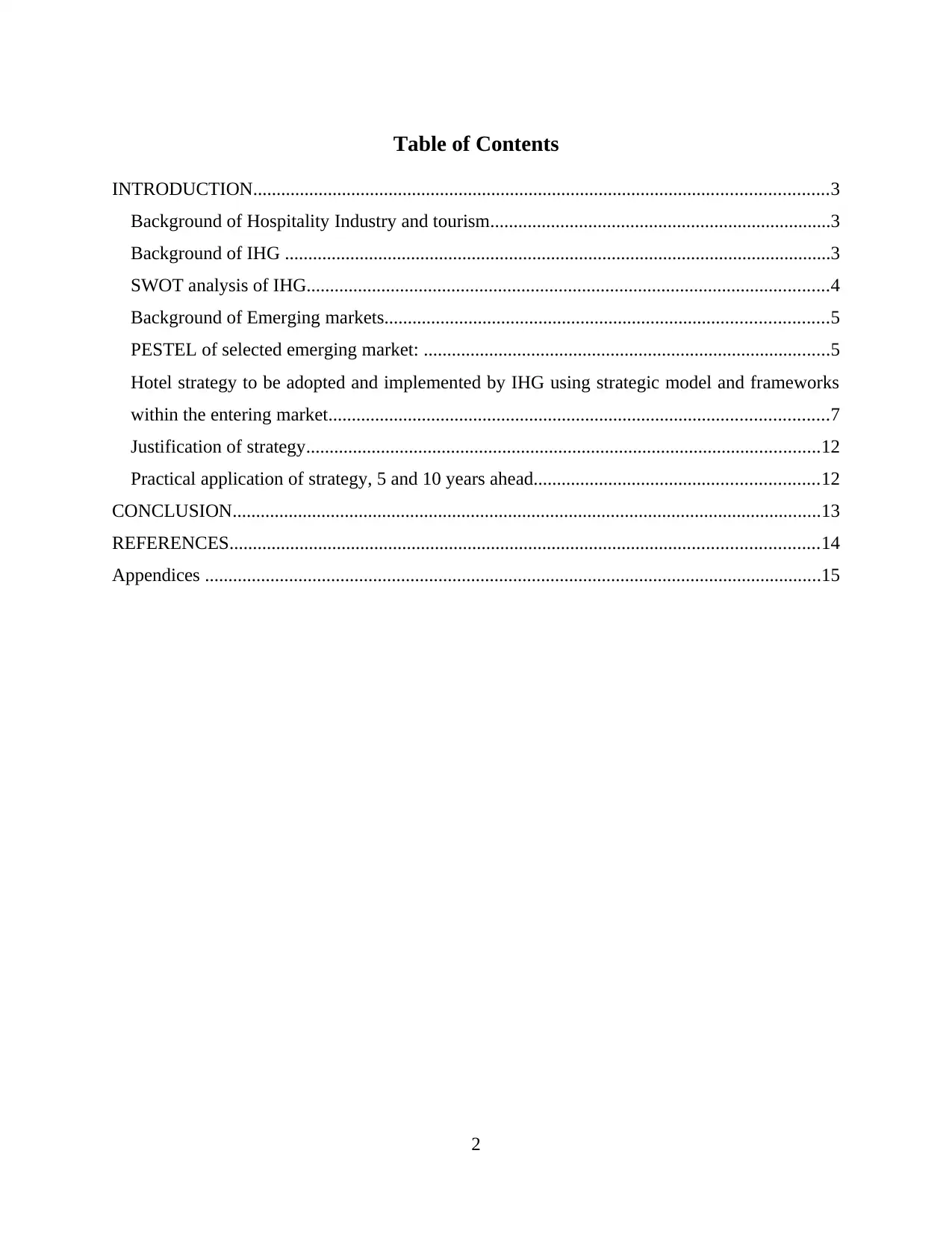
Table of Contents
INTRODUCTION...........................................................................................................................3
Background of Hospitality Industry and tourism.........................................................................3
Background of IHG .....................................................................................................................3
SWOT analysis of IHG................................................................................................................4
Background of Emerging markets...............................................................................................5
PESTEL of selected emerging market: .......................................................................................5
Hotel strategy to be adopted and implemented by IHG using strategic model and frameworks
within the entering market...........................................................................................................7
Justification of strategy..............................................................................................................12
Practical application of strategy, 5 and 10 years ahead.............................................................12
CONCLUSION..............................................................................................................................13
REFERENCES..............................................................................................................................14
Appendices ....................................................................................................................................15
2
INTRODUCTION...........................................................................................................................3
Background of Hospitality Industry and tourism.........................................................................3
Background of IHG .....................................................................................................................3
SWOT analysis of IHG................................................................................................................4
Background of Emerging markets...............................................................................................5
PESTEL of selected emerging market: .......................................................................................5
Hotel strategy to be adopted and implemented by IHG using strategic model and frameworks
within the entering market...........................................................................................................7
Justification of strategy..............................................................................................................12
Practical application of strategy, 5 and 10 years ahead.............................................................12
CONCLUSION..............................................................................................................................13
REFERENCES..............................................................................................................................14
Appendices ....................................................................................................................................15
2
INTRODUCTION
The international hospitality management refers to the field that involves overseeing the
day to day administration and management, commercial and operational activities of
international businesses in tourism and hospitality industry (Gardini, Ottenbacher and Schuckert,
2020). Various management concepts and administrative skills are applied in the tourism and
hospitality management.
InterContinental hotels group (IHG) is one of the leading hotel companies in the world
with a purpose of providing true hospitality to everyone. The company have 16 brands including
luxury, premium, essential and suits collection as their heads.
In this report, the background of the company and markets will be analysed. An emerging
market for the company to tap and its PESTEL analysis will be conducted. The SWOT analysis
of the company and its strategic growth strategies using Porter's 5 forces model, Ansoff Matrix
and various growth options will be analysed. The chosen strategy's justification and practical
application will also be provided.
Background of Hospitality Industry and tourism
The history of hospitality rises from ancient times around 40 BC, according to the
experts. It was the idea of Greeks to conduct social and religious gathering and providing thermal
baths for relaxation. These baths are called Modern Spa days today. Then the Romans came up
with the ideas to provide accommodations for travellers on the budget of the rulers. Every
community have different contribution in bringing the idea of hospitality generation.
Background of IHG
In 1946, Juan Trippe established American InterContinental chains. In 1981, he sold the
company to Grand Metropolitan, who then sold it to Japanese based Saisan group. In 1998,
Saisan group sold the company to British brewery Bass who changed its name to Six Continents.
In 2003, the independent corporation of InterContinental Hotels Group (IHG) was created after
the Six continents (previous incorporation) split into two companies. IHG then focused on hotels
and soft-drinks. However, after some time it sold its interest of soft drinks by IPOs
(INTERCONTINENTAL HOTELS GROUP PLC, 2021).
3
The international hospitality management refers to the field that involves overseeing the
day to day administration and management, commercial and operational activities of
international businesses in tourism and hospitality industry (Gardini, Ottenbacher and Schuckert,
2020). Various management concepts and administrative skills are applied in the tourism and
hospitality management.
InterContinental hotels group (IHG) is one of the leading hotel companies in the world
with a purpose of providing true hospitality to everyone. The company have 16 brands including
luxury, premium, essential and suits collection as their heads.
In this report, the background of the company and markets will be analysed. An emerging
market for the company to tap and its PESTEL analysis will be conducted. The SWOT analysis
of the company and its strategic growth strategies using Porter's 5 forces model, Ansoff Matrix
and various growth options will be analysed. The chosen strategy's justification and practical
application will also be provided.
Background of Hospitality Industry and tourism
The history of hospitality rises from ancient times around 40 BC, according to the
experts. It was the idea of Greeks to conduct social and religious gathering and providing thermal
baths for relaxation. These baths are called Modern Spa days today. Then the Romans came up
with the ideas to provide accommodations for travellers on the budget of the rulers. Every
community have different contribution in bringing the idea of hospitality generation.
Background of IHG
In 1946, Juan Trippe established American InterContinental chains. In 1981, he sold the
company to Grand Metropolitan, who then sold it to Japanese based Saisan group. In 1998,
Saisan group sold the company to British brewery Bass who changed its name to Six Continents.
In 2003, the independent corporation of InterContinental Hotels Group (IHG) was created after
the Six continents (previous incorporation) split into two companies. IHG then focused on hotels
and soft-drinks. However, after some time it sold its interest of soft drinks by IPOs
(INTERCONTINENTAL HOTELS GROUP PLC, 2021).
3
⊘ This is a preview!⊘
Do you want full access?
Subscribe today to unlock all pages.

Trusted by 1+ million students worldwide
SWOT analysis of IHG
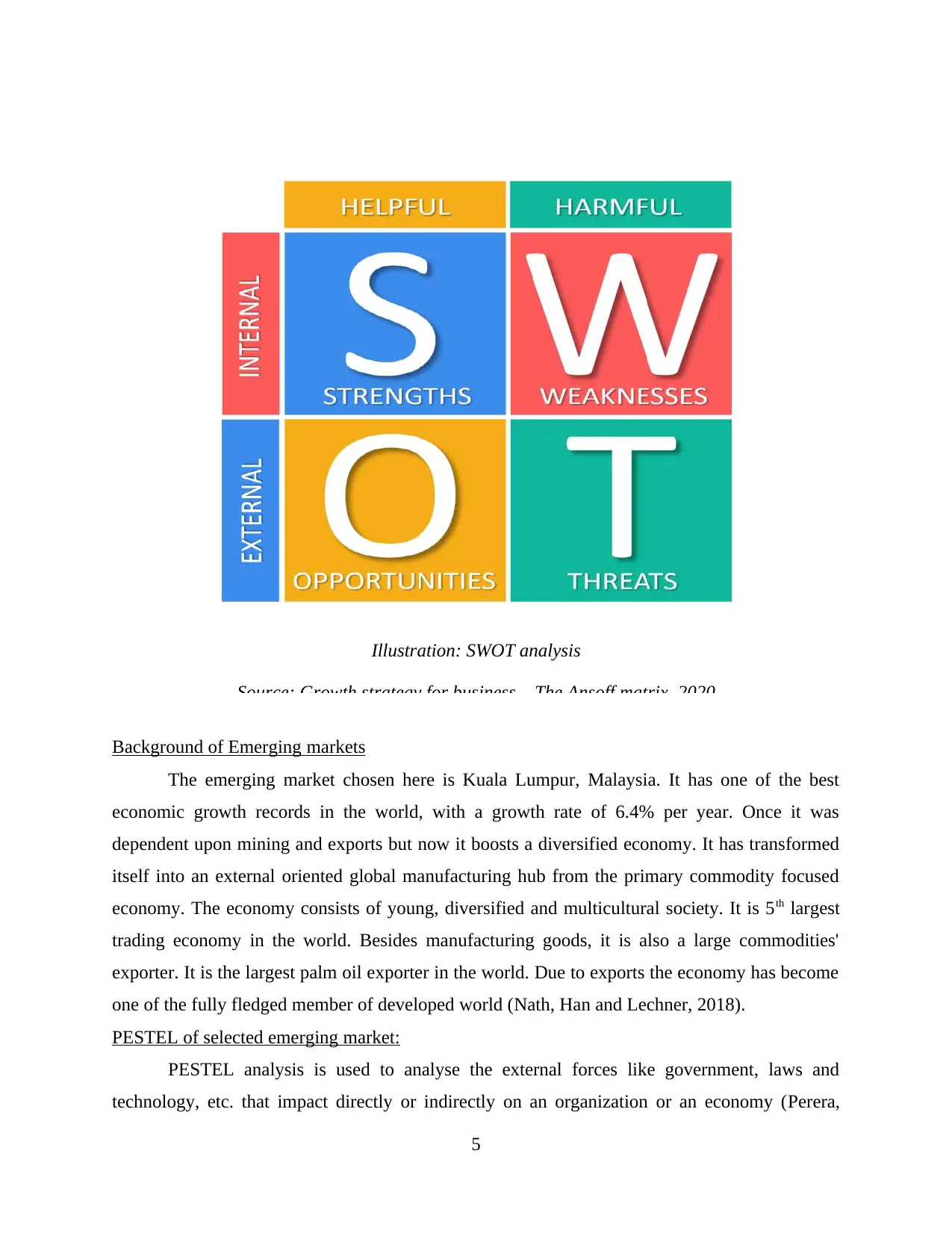
SWOT analysis is a strategic tool that is used by the organizations to analyse their
internal environments (Vlados, 2019). IHG can maintain its leading position in the market by
analysing its Strengths, Weaknesses, Opportunities and Threats.
Strengths: The leading company in its industry, IHG has a number of strengths that enables it to
maintain its leading position in the market. The company have highly skilled workforce through
their training programs. The company enjoys consistent quality by implementing automation in
activities. IHG's go to strategic are highly successful in the market. It has a great track records in
product innovation. The customers of the company and highly satisfied through its delicates
consumer relationship management. The expansion of company in new markets have creates
new streams of revenue generation and has diversified its economic cycle of risks in the markets
it operates in.
Weaknesses: There are some areas where the company needs improvements. The company is not
very good at forecasting the market demands of its customers. Financial planning and marketing
of the products is not efficient. Even tough the product have good sales in the market but the
positioning is not clearly defied which can be attacked by the competitors. The company needs to
put more investments in its product innovations given the size of expansion it is planning.
Opportunities: The company can use new technologies which can be used to practice
differentiated pricing strategies in new segments or new market. It will enable the company to
maintain its customer loyalty (Vlados, 2019). New trends in consumer behaviour provides the
company to build new revenue streams and new product categories. The stable cash flow
provides the company an opportunity to invest more in product segments. Market developments
can help the company in building a competitive advantage in the market. The company can also
diversify its online channels of sales such as social media platforms which can be used to
forecast the product demand easily.
Threats: IHG operates in a highly competitive industry. The storage of skilled workers and
rising pay scale of workers in a certain global market poses a threat to the company. The highly
profitable products are only seasonal and any event organized expect in the season will incur
huge losses to the company. Product imitation of IHG is easy which can impact the sale margin
of the company. Changing government regulations posses big threats to the company (Quezada
and et.al., 2019).
4
SWOT analysis is a strategic tool that is used by the organizations to analyse their
internal environments (Vlados, 2019). IHG can maintain its leading position in the market by
analysing its Strengths, Weaknesses, Opportunities and Threats.
Strengths: The leading company in its industry, IHG has a number of strengths that enables it to
maintain its leading position in the market. The company have highly skilled workforce through
their training programs. The company enjoys consistent quality by implementing automation in
activities. IHG's go to strategic are highly successful in the market. It has a great track records in
product innovation. The customers of the company and highly satisfied through its delicates
consumer relationship management. The expansion of company in new markets have creates
new streams of revenue generation and has diversified its economic cycle of risks in the markets
it operates in.
Weaknesses: There are some areas where the company needs improvements. The company is not
very good at forecasting the market demands of its customers. Financial planning and marketing
of the products is not efficient. Even tough the product have good sales in the market but the
positioning is not clearly defied which can be attacked by the competitors. The company needs to
put more investments in its product innovations given the size of expansion it is planning.
Opportunities: The company can use new technologies which can be used to practice
differentiated pricing strategies in new segments or new market. It will enable the company to
maintain its customer loyalty (Vlados, 2019). New trends in consumer behaviour provides the
company to build new revenue streams and new product categories. The stable cash flow
provides the company an opportunity to invest more in product segments. Market developments
can help the company in building a competitive advantage in the market. The company can also
diversify its online channels of sales such as social media platforms which can be used to
forecast the product demand easily.
Threats: IHG operates in a highly competitive industry. The storage of skilled workers and
rising pay scale of workers in a certain global market poses a threat to the company. The highly
profitable products are only seasonal and any event organized expect in the season will incur
huge losses to the company. Product imitation of IHG is easy which can impact the sale margin
of the company. Changing government regulations posses big threats to the company (Quezada
and et.al., 2019).
4
Paraphrase This Document
Need a fresh take? Get an instant paraphrase of this document with our AI Paraphraser
Background of Emerging markets
The emerging market chosen here is Kuala Lumpur, Malaysia. It has one of the best
economic growth records in the world, with a growth rate of 6.4% per year. Once it was
dependent upon mining and exports but now it boosts a diversified economy. It has transformed
itself into an external oriented global manufacturing hub from the primary commodity focused
economy. The economy consists of young, diversified and multicultural society. It is 5th largest
trading economy in the world. Besides manufacturing goods, it is also a large commodities'
exporter. It is the largest palm oil exporter in the world. Due to exports the economy has become
one of the fully fledged member of developed world (Nath, Han and Lechner, 2018).
PESTEL of selected emerging market:
PESTEL analysis is used to analyse the external forces like government, laws and
technology, etc. that impact directly or indirectly on an organization or an economy (Perera,
5
Illustration: SWOT analysis
Source: Growth strategy for business – The Ansoff matrix, 2020
The emerging market chosen here is Kuala Lumpur, Malaysia. It has one of the best
economic growth records in the world, with a growth rate of 6.4% per year. Once it was
dependent upon mining and exports but now it boosts a diversified economy. It has transformed
itself into an external oriented global manufacturing hub from the primary commodity focused
economy. The economy consists of young, diversified and multicultural society. It is 5th largest
trading economy in the world. Besides manufacturing goods, it is also a large commodities'
exporter. It is the largest palm oil exporter in the world. Due to exports the economy has become
one of the fully fledged member of developed world (Nath, Han and Lechner, 2018).
PESTEL of selected emerging market:
PESTEL analysis is used to analyse the external forces like government, laws and
technology, etc. that impact directly or indirectly on an organization or an economy (Perera,
5
Illustration: SWOT analysis
Source: Growth strategy for business – The Ansoff matrix, 2020
2017). PESTEL analysis of Kuala Lumpur can be used by IHG to explore its emerging market
trends.
Political factors: The politics in the state has been stable from last few decades. Despite
changing governments the political situated remained stable. The government has established
various schemes to support various MSMEs and to deal with the impacts of COVID-19 global
pandemic. The country's ease of trade across the borders is high as compared to internationals.
Government has been recalling its foreign policy framework especially when dealing with the
United States and China.
However, the country faces the major problem of corruption. The political corruption is a
recent highlight of high state political figures. There are general guidelines on halal food
production its preparation and storage which is considered as stricter than other halal standards.
The country is also facing issue of internal hostility.
Economic factors: The country has a healthy and industrialized economy. The economy receives
benefits from adoption of cutting edge technologies (Quezada and et.al., 2019). The economy
will achieve the high income status in upcoming years. New economic policy was introduced by
the government to improve the economy by doubling up its Per Capita income. The further plans
of the country are to step towards the advanced economy status and greater inclusion by a range
of developed issues like equity, inclusiveness, economic stability and human resource and
infrastructure development. Unemployment rates will be stabilized by next year according to the
experts.
However, Due to the political crisis and low exports the economy of Kuala Lumpur, the
unemployment rates are more than triple in which the rural youth is not considered statistically.
Social factors: The communities of Kuala Lumpur is multi-ethnic and multi religious. Even
though the community is diversified, the city is known for its communal harmony. People enjoy
high standards of living because of its low income tax, free health care systems, low cost of local
foods and household products and social welfare system. The people of the country live a rich
and luxurious lifestyle.
However, the society in the country have set different dimensions of social status like the
rich families send their kids to foreign counties. The society prefers to be within their ethnic
social groups only (Shtal and et.al., 2018).
6
trends.
Political factors: The politics in the state has been stable from last few decades. Despite
changing governments the political situated remained stable. The government has established
various schemes to support various MSMEs and to deal with the impacts of COVID-19 global
pandemic. The country's ease of trade across the borders is high as compared to internationals.
Government has been recalling its foreign policy framework especially when dealing with the
United States and China.
However, the country faces the major problem of corruption. The political corruption is a
recent highlight of high state political figures. There are general guidelines on halal food
production its preparation and storage which is considered as stricter than other halal standards.
The country is also facing issue of internal hostility.
Economic factors: The country has a healthy and industrialized economy. The economy receives
benefits from adoption of cutting edge technologies (Quezada and et.al., 2019). The economy
will achieve the high income status in upcoming years. New economic policy was introduced by
the government to improve the economy by doubling up its Per Capita income. The further plans
of the country are to step towards the advanced economy status and greater inclusion by a range
of developed issues like equity, inclusiveness, economic stability and human resource and
infrastructure development. Unemployment rates will be stabilized by next year according to the
experts.
However, Due to the political crisis and low exports the economy of Kuala Lumpur, the
unemployment rates are more than triple in which the rural youth is not considered statistically.
Social factors: The communities of Kuala Lumpur is multi-ethnic and multi religious. Even
though the community is diversified, the city is known for its communal harmony. People enjoy
high standards of living because of its low income tax, free health care systems, low cost of local
foods and household products and social welfare system. The people of the country live a rich
and luxurious lifestyle.
However, the society in the country have set different dimensions of social status like the
rich families send their kids to foreign counties. The society prefers to be within their ethnic
social groups only (Shtal and et.al., 2018).
6
⊘ This is a preview!⊘
Do you want full access?
Subscribe today to unlock all pages.
Trusted by 1+ million students worldwide
Technological factors: It is one of the most digitally connected economies in the world. It is
great place for technological countries due to its tech savy workforce, strategic location and its
IT infrastructure.
However, the employees in the economy are concerned with issues like shortage of
locally skilled workers. There are other technical barriers to trade such as halal certification for
the import of meat and poultry are regulated through licensing controls.
Environmental factors: The country is considered as a beautiful destination for tourism. Its
dynamic cities, food, beaches and weather attract tourists in a large number to the country. The
climate is best for the tourist and hospitality industries.
However, climates related natural disasters and air pollution affect the businesses a lot.
The other factors like excessive waste and river pollution and escalating carbon footprints are big
challenges faced by the economy (Aithal, 2017).
Legal factors: It is a common law country consisting two laws; Separate Islamic law for Muslim
community and British common law for secular and Non-Muslim population. The main
legislation on the labour matters of the country is The Employment Act, 1995. The government
implements the Federal Laws throughout the whole country as common. The constitution of the
country is their supreme law which provides basic rights and frameworks to its citizens.
Hotel strategy to be adopted and implemented by IHG using strategic model and frameworks
within the entering market
A strategic growth planning is the plan of the organization for overcoming or reducing
the possible future challenges to attain its goals for development and expansion (Roghani,
2017). The Best strategic growth options that the company can adapt to persuade its business in
Kuala Lumpur are:
Licensing: Kuala Lumpur is a beautiful destination for tourists and hospitality industries. The
government policies are stable in the state and the trading policies are very simple. The foreign
trade policies are simplified by the government which just require appropriate licensing for
business operations and licensing for food standards. Communities of the city also lives a
luxurious lifestyle which enhance the chances of profitability. IHG can easily enter the market
and set up its business in the city by acquiring trading licence.
Acquisition/ Partnerships with local businesses: The city have the best food and local stores
that the people of the city feel attached to. If the company grabs this opportunity and partners
7
great place for technological countries due to its tech savy workforce, strategic location and its
IT infrastructure.
However, the employees in the economy are concerned with issues like shortage of
locally skilled workers. There are other technical barriers to trade such as halal certification for
the import of meat and poultry are regulated through licensing controls.
Environmental factors: The country is considered as a beautiful destination for tourism. Its
dynamic cities, food, beaches and weather attract tourists in a large number to the country. The
climate is best for the tourist and hospitality industries.
However, climates related natural disasters and air pollution affect the businesses a lot.
The other factors like excessive waste and river pollution and escalating carbon footprints are big
challenges faced by the economy (Aithal, 2017).
Legal factors: It is a common law country consisting two laws; Separate Islamic law for Muslim
community and British common law for secular and Non-Muslim population. The main
legislation on the labour matters of the country is The Employment Act, 1995. The government
implements the Federal Laws throughout the whole country as common. The constitution of the
country is their supreme law which provides basic rights and frameworks to its citizens.
Hotel strategy to be adopted and implemented by IHG using strategic model and frameworks
within the entering market
A strategic growth planning is the plan of the organization for overcoming or reducing
the possible future challenges to attain its goals for development and expansion (Roghani,
2017). The Best strategic growth options that the company can adapt to persuade its business in
Kuala Lumpur are:
Licensing: Kuala Lumpur is a beautiful destination for tourists and hospitality industries. The
government policies are stable in the state and the trading policies are very simple. The foreign
trade policies are simplified by the government which just require appropriate licensing for
business operations and licensing for food standards. Communities of the city also lives a
luxurious lifestyle which enhance the chances of profitability. IHG can easily enter the market
and set up its business in the city by acquiring trading licence.
Acquisition/ Partnerships with local businesses: The city have the best food and local stores
that the people of the city feel attached to. If the company grabs this opportunity and partners
7
Paraphrase This Document
Need a fresh take? Get an instant paraphrase of this document with our AI Paraphraser
with the local businesses around that are it will build a trust of customers on the company. The
company can either start partnerships or can acquire the business. The already set up business
can help the company in better settlement and better demand forecasting (Soundarya, Lavanya
and Hemalatha, 2018).
Porter's 5 forces model:
The company's competitiveness can be analyzed by using porter's five forces model
(Grebenshchikova and Yakushev, 2017). The company can use above mentioned strategies to
expand its business in emerging market of Kuala Lumpur. These strategies can be analyzed using
the Porter's five forces model to study its compatibility and competitiveness:
Threat of new entries: Threat of new entries explains the powers of new entries to enter a
particular market. The hospitality industry requires huge capital investments and licensing that
every company cannot afford. IHG can start partnership or either acquire the local businesses
which will gain public trust. This will lower the threat of new entries to the company.
Threat of substitutes: Threat of new entries means the power of other companies to enter the
business. The company will be partnering with the local businesses which will enhance its
marketing positioning and create goodwill. The industry requires food licensing and maintaining
food standards which are not easily maintained. Local businesses and IHG have established
names in the hospitality industry which can lower the threat of substitutes.
Bargaining power of suppliers: The bargaining power of suppliers refers to the power of
negotiation of suppliers of materials (van Steenbergen, Ramos and Sousa, 2021). The company
will be establishing in a new market. The suppliers can use this a leverage and can bargain hard.
This provides the suppliers high bargaining powers to IHG. But with the acquisition or
partnership with local businesses the company can have a portfolio of suppliers to whom it can
go and bargain with. So the threat of bargaining power of the suppliers is mediocre on IHG.
Bargaining power of buyers: Bargaining power of buyers is the power of negotiation that the
customers have with the business. Since, the company will be new in Kuala Lumpur's market
then the customer base will be small. The smaller the circle of buyers, the greater is the threat of
customer bargaining to the company. The company can increase the number of buyers by
partnerships or acquisition of local businesses. The potential customers of that local business can
be tapped and retained. Thus, the bargaining power of the customers will be low on IHG.
8
company can either start partnerships or can acquire the business. The already set up business
can help the company in better settlement and better demand forecasting (Soundarya, Lavanya
and Hemalatha, 2018).
Porter's 5 forces model:
The company's competitiveness can be analyzed by using porter's five forces model
(Grebenshchikova and Yakushev, 2017). The company can use above mentioned strategies to
expand its business in emerging market of Kuala Lumpur. These strategies can be analyzed using
the Porter's five forces model to study its compatibility and competitiveness:
Threat of new entries: Threat of new entries explains the powers of new entries to enter a
particular market. The hospitality industry requires huge capital investments and licensing that
every company cannot afford. IHG can start partnership or either acquire the local businesses
which will gain public trust. This will lower the threat of new entries to the company.
Threat of substitutes: Threat of new entries means the power of other companies to enter the
business. The company will be partnering with the local businesses which will enhance its
marketing positioning and create goodwill. The industry requires food licensing and maintaining
food standards which are not easily maintained. Local businesses and IHG have established
names in the hospitality industry which can lower the threat of substitutes.
Bargaining power of suppliers: The bargaining power of suppliers refers to the power of
negotiation of suppliers of materials (van Steenbergen, Ramos and Sousa, 2021). The company
will be establishing in a new market. The suppliers can use this a leverage and can bargain hard.
This provides the suppliers high bargaining powers to IHG. But with the acquisition or
partnership with local businesses the company can have a portfolio of suppliers to whom it can
go and bargain with. So the threat of bargaining power of the suppliers is mediocre on IHG.
Bargaining power of buyers: Bargaining power of buyers is the power of negotiation that the
customers have with the business. Since, the company will be new in Kuala Lumpur's market
then the customer base will be small. The smaller the circle of buyers, the greater is the threat of
customer bargaining to the company. The company can increase the number of buyers by
partnerships or acquisition of local businesses. The potential customers of that local business can
be tapped and retained. Thus, the bargaining power of the customers will be low on IHG.
8
Rivalry among competitors: Hospitality industries faces huge competition in the market
(Berisha , Kutllovci and Shiroka Pula, 2017). IHG can enjoy distinct advantages of partnerships
and acquisitions with the local business of the city. However, the already established businesses
having a greater goodwill can give a tough competition to IHG. So the threat of competition or
rivalry is high to the company.
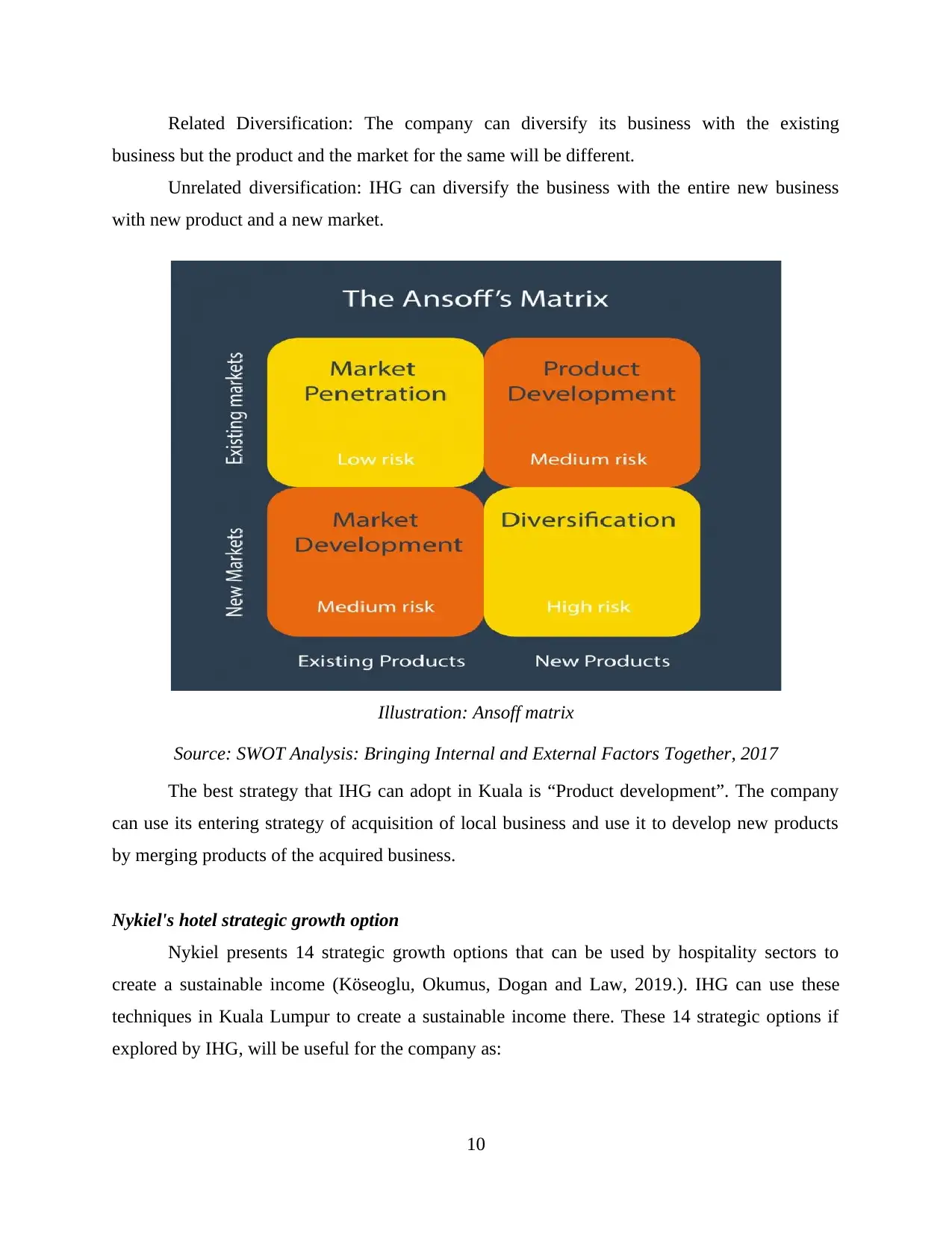
Ansoff matrix in IHG
It is a product or marketing extension/ development tool which is used by the companies to plan
and analyse their growth strategies. It shows 4 possible strategies that can be used by a company
to grow and analyse the risk associated with those strategies (Loredana, 2017.). IHG can use
Ansoff matrix to check the feasibility of its entry strategies in Kuala Lumpur.
Market penetration: The company can use its existing products in its market segment. There is
no need to change the market or any products in Kuala Lumpur. The company will increase its
market share by decreasing the prices of its product to tap new customers. IHG can also increase
its promotional strategies and distribution channels. The company can penetrate the market by
acquisition of local businesses and grab their share of the market too.
Product development: The company can also innovate a new product or service to attract
customers to its existing market (Schawel and Billing, 2018). This will require huge R&D and
expansion of its product range. The company can use the strategy of acquisition to enter the
market and merge the acquired businesses' products and resources to create a new product that
can fulfil the needs of customers better. The company can also gain access to distribution
channels of other businesses by partnering with them.
Market development: IHG can also enter the market by using its existing products but in a
different market segment (InterContinental Hotels, 2021). These strategies can help the company
in exploring new customer segments. This strategy will be more successful when the company
will leverage its technology in new market. The strategy will be more successful as Kuala
Lumpur's people live a luxurious lifestyle and their disposable incomes are very high. IHG can
expand its market internationally.
Diversification: In this strategy the company can enter a new market with a new product. This
strategy is the riskiest but the potential for revenue generation is also very high. IHG can adopt
two types of diversifications;
9
(Berisha , Kutllovci and Shiroka Pula, 2017). IHG can enjoy distinct advantages of partnerships
and acquisitions with the local business of the city. However, the already established businesses
having a greater goodwill can give a tough competition to IHG. So the threat of competition or
rivalry is high to the company.
Ansoff matrix in IHG
It is a product or marketing extension/ development tool which is used by the companies to plan
and analyse their growth strategies. It shows 4 possible strategies that can be used by a company
to grow and analyse the risk associated with those strategies (Loredana, 2017.). IHG can use
Ansoff matrix to check the feasibility of its entry strategies in Kuala Lumpur.
Market penetration: The company can use its existing products in its market segment. There is
no need to change the market or any products in Kuala Lumpur. The company will increase its
market share by decreasing the prices of its product to tap new customers. IHG can also increase
its promotional strategies and distribution channels. The company can penetrate the market by
acquisition of local businesses and grab their share of the market too.
Product development: The company can also innovate a new product or service to attract
customers to its existing market (Schawel and Billing, 2018). This will require huge R&D and
expansion of its product range. The company can use the strategy of acquisition to enter the
market and merge the acquired businesses' products and resources to create a new product that
can fulfil the needs of customers better. The company can also gain access to distribution
channels of other businesses by partnering with them.
Market development: IHG can also enter the market by using its existing products but in a
different market segment (InterContinental Hotels, 2021). These strategies can help the company
in exploring new customer segments. This strategy will be more successful when the company
will leverage its technology in new market. The strategy will be more successful as Kuala
Lumpur's people live a luxurious lifestyle and their disposable incomes are very high. IHG can
expand its market internationally.
Diversification: In this strategy the company can enter a new market with a new product. This
strategy is the riskiest but the potential for revenue generation is also very high. IHG can adopt
two types of diversifications;
9
⊘ This is a preview!⊘
Do you want full access?
Subscribe today to unlock all pages.
Trusted by 1+ million students worldwide
Related Diversification: The company can diversify its business with the existing
business but the product and the market for the same will be different.
Unrelated diversification: IHG can diversify the business with the entire new business
with new product and a new market.
The best strategy that IHG can adopt in Kuala is “Product development”. The company
can use its entering strategy of acquisition of local business and use it to develop new products
by merging products of the acquired business.
Nykiel's hotel strategic growth option
Nykiel presents 14 strategic growth options that can be used by hospitality sectors to
create a sustainable income (Köseoglu, Okumus, Dogan and Law, 2019.). IHG can use these
techniques in Kuala Lumpur to create a sustainable income there. These 14 strategic options if
explored by IHG, will be useful for the company as:
10
Illustration: Ansoff matrix
Source: SWOT Analysis: Bringing Internal and External Factors Together, 2017
business but the product and the market for the same will be different.
Unrelated diversification: IHG can diversify the business with the entire new business
with new product and a new market.
The best strategy that IHG can adopt in Kuala is “Product development”. The company
can use its entering strategy of acquisition of local business and use it to develop new products
by merging products of the acquired business.
Nykiel's hotel strategic growth option
Nykiel presents 14 strategic growth options that can be used by hospitality sectors to
create a sustainable income (Köseoglu, Okumus, Dogan and Law, 2019.). IHG can use these
techniques in Kuala Lumpur to create a sustainable income there. These 14 strategic options if
explored by IHG, will be useful for the company as:
10
Illustration: Ansoff matrix
Source: SWOT Analysis: Bringing Internal and External Factors Together, 2017
Paraphrase This Document
Need a fresh take? Get an instant paraphrase of this document with our AI Paraphraser
Horizontal expansion: IHG can try to expand from one line of hospitality to another for entering
the market of Kuala Lumpur and enhance its market share.
Geographical expansion: IHG can grow its international boundaries to greater geographical
locations before entering the market and leverage this to lure more customers.
Specialization specialist: IHG can specialize in associating with upscale growth in pricing and
services being provided by them before entering the market (Wang and Nie, 2019,).
Product tiering: The company have to deal with demographic and economic changes and
population growth and the increased segments of Kuala Lumpur before entering their markets.
The company can then explore these dimensions and tap the desired dimensions for the growth
of business and products.
Product Re-Branding: The company can rebrand its products in new ways to diversify its
portfolio before entering the market. Re-Branding will ensure that the new market and customers
are aware of the products and services being offered by IHG.
Non Franchising: IHG can acquire the local business and keep the whole control on their
products, services, quality, ownership and management with themselves when entering the
market.
Franchising: The company can use the highly established strategy of development, Franchising
with the businesses which is followed inside the hospitality industry before entering the market.
IHG can enjoy perks of less economic risk cycle.
Brand collection: The company can seek the benefits of its comparatively limited stock for
purchasing branded functions which are assumed to have potential growth.
Management contacts: The company is already specialized in the field, yet it can improve further
more its management in managing the hotels and their services in Kuala Lumpur (Heath, 2020).
Vertical and horizontal integration: IGH can involve more than one segment of hospitality with
a view to gain competitive edge by investing in numerous elements of the hospitality industry for
entering the new market of Kuala Lumpur.
Singleness: The company can develop a single services whose control, ownership and
management will be all in the hands of itself even when partnering with the local businesses.
Value related products and service: IHG can spend investments to gain knowledge of customer
demands and needs in Kuala Lumpur and launch the same products and services when it will
enter the market.
11
the market of Kuala Lumpur and enhance its market share.
Geographical expansion: IHG can grow its international boundaries to greater geographical
locations before entering the market and leverage this to lure more customers.
Specialization specialist: IHG can specialize in associating with upscale growth in pricing and
services being provided by them before entering the market (Wang and Nie, 2019,).
Product tiering: The company have to deal with demographic and economic changes and
population growth and the increased segments of Kuala Lumpur before entering their markets.
The company can then explore these dimensions and tap the desired dimensions for the growth
of business and products.
Product Re-Branding: The company can rebrand its products in new ways to diversify its
portfolio before entering the market. Re-Branding will ensure that the new market and customers
are aware of the products and services being offered by IHG.
Non Franchising: IHG can acquire the local business and keep the whole control on their
products, services, quality, ownership and management with themselves when entering the
market.
Franchising: The company can use the highly established strategy of development, Franchising
with the businesses which is followed inside the hospitality industry before entering the market.
IHG can enjoy perks of less economic risk cycle.
Brand collection: The company can seek the benefits of its comparatively limited stock for
purchasing branded functions which are assumed to have potential growth.
Management contacts: The company is already specialized in the field, yet it can improve further
more its management in managing the hotels and their services in Kuala Lumpur (Heath, 2020).
Vertical and horizontal integration: IGH can involve more than one segment of hospitality with
a view to gain competitive edge by investing in numerous elements of the hospitality industry for
entering the new market of Kuala Lumpur.
Singleness: The company can develop a single services whose control, ownership and
management will be all in the hands of itself even when partnering with the local businesses.
Value related products and service: IHG can spend investments to gain knowledge of customer
demands and needs in Kuala Lumpur and launch the same products and services when it will
enter the market.
11
Global positioning: The company can spend more to remain on the leading position and leverage
this when entering the new market.
IHG can use Value related products and service strategies while entering the market of
Kuala Lumpur and ensure its profitability and increased market share.
Justification of strategy
Company can use Value Related Products and Service strategy and Product Development
strategy to enter the market of Kuala Lumpur through acquisition and licensing to expand its
business. When the company enters the market through Licensing or acquisition of local business
then it will be easy for the company to grab the market share and attract a lot of customers. The
company can merge its products and market with the products and markets of acquired local
business. It can help the company to forecast need and preferences of customers in new market.
This will generate new distribution channels and product innovations which can satisfy the needs
of customers.
The population of Kuala Lumpur is luxurious and have high disposable income, they will
prefer to spend on innovative products and services that are distinct from others. The company
will use product development strategy to generate innovative and distinct products. The company
can forecast the demands of customers with the help of acquired business and provide those
products that will satisfy the needs of its customers.
Practical application of strategy, 5 and 10 years ahead
The strategies that IHG can adopt are feasible in the future. The company is planning to
enter the markets of Kuala Lumpur in upcoming year for market expansion. The company have
chosen entry strategies of licensing and acquisition or partnership with the local business in the
market.
The strategy of licensing is applicable in the region as Kuala Lumpur have various food
standards laid out by the government. Trade entry is easy but there are some strict legislations
that are to followed by the trading companies. If the company acquires the licence of foreign
trade, then it is very easy for the company to trade in Kuala Lumpur for next 5 to 10 years easily.
Through the application of acquisition of local business or partnership with local
business, the company can operate in the country as long as it wants. The acquisition strategy is
more feasible here because the company can acquire local business that are existing from a long
12
this when entering the new market.
IHG can use Value related products and service strategies while entering the market of
Kuala Lumpur and ensure its profitability and increased market share.
Justification of strategy
Company can use Value Related Products and Service strategy and Product Development
strategy to enter the market of Kuala Lumpur through acquisition and licensing to expand its
business. When the company enters the market through Licensing or acquisition of local business
then it will be easy for the company to grab the market share and attract a lot of customers. The
company can merge its products and market with the products and markets of acquired local
business. It can help the company to forecast need and preferences of customers in new market.
This will generate new distribution channels and product innovations which can satisfy the needs
of customers.
The population of Kuala Lumpur is luxurious and have high disposable income, they will
prefer to spend on innovative products and services that are distinct from others. The company
will use product development strategy to generate innovative and distinct products. The company
can forecast the demands of customers with the help of acquired business and provide those
products that will satisfy the needs of its customers.
Practical application of strategy, 5 and 10 years ahead
The strategies that IHG can adopt are feasible in the future. The company is planning to
enter the markets of Kuala Lumpur in upcoming year for market expansion. The company have
chosen entry strategies of licensing and acquisition or partnership with the local business in the
market.
The strategy of licensing is applicable in the region as Kuala Lumpur have various food
standards laid out by the government. Trade entry is easy but there are some strict legislations
that are to followed by the trading companies. If the company acquires the licence of foreign
trade, then it is very easy for the company to trade in Kuala Lumpur for next 5 to 10 years easily.
Through the application of acquisition of local business or partnership with local
business, the company can operate in the country as long as it wants. The acquisition strategy is
more feasible here because the company can acquire local business that are existing from a long
12
⊘ This is a preview!⊘
Do you want full access?
Subscribe today to unlock all pages.
Trusted by 1+ million students worldwide

1 out of 18


Related Documents


Your All-in-One AI-Powered Toolkit for Academic Success.
+13062052269
info@desklib.com
Available 24*7 on WhatsApp / Email
![[object Object]](/_next/static/media/star-bottom.7253800d.svg)
Unlock your academic potential
Copyright © 2020–2026 A2Z Services. All Rights Reserved. Developed and managed by ZUCOL.