Report on Organisational Behaviour: Leadership and Management at IHG
VerifiedAdded on 2020/02/05
|13
|4042
|289
Report
AI Summary
This report provides an in-depth analysis of organisational behaviour within InterContinental Hotels Group (IHG). It examines the roles of management and leadership, exploring various theories such as contingency, systems, and chaos theories in management, and transactional, transformational, and contingency theories in leadership. The report further investigates the impact of power and politics within the organisation, differentiating between various sources of power and the implications of organisational politics on IHG's effectiveness. It also assesses how management and leadership styles influence the company's culture, encompassing ethical practices, employee relations, and productivity levels. The report emphasizes the importance of effective leadership and management in achieving organisational goals and maintaining a positive work environment, highlighting the significance of power dynamics and political influences on IHG's overall success.
Organisational Behaviour

Paraphrase This Document
Need a fresh take? Get an instant paraphrase of this document with our AI Paraphraser
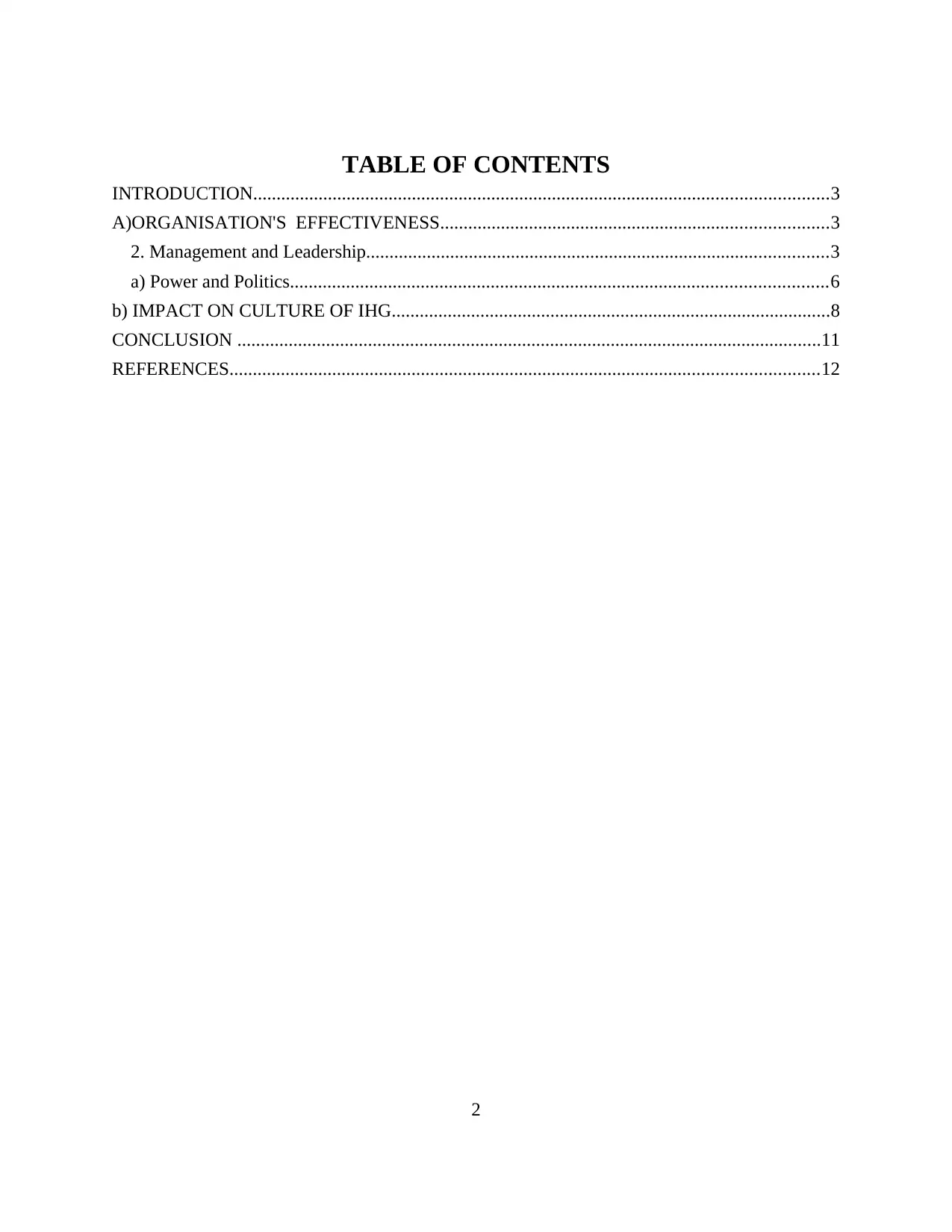
TABLE OF CONTENTS
INTRODUCTION...........................................................................................................................3
A)ORGANISATION'S EFFECTIVENESS...................................................................................3
2. Management and Leadership...................................................................................................3
a) Power and Politics...................................................................................................................6
b) IMPACT ON CULTURE OF IHG..............................................................................................8
CONCLUSION .............................................................................................................................11
REFERENCES..............................................................................................................................12
2
INTRODUCTION...........................................................................................................................3
A)ORGANISATION'S EFFECTIVENESS...................................................................................3
2. Management and Leadership...................................................................................................3
a) Power and Politics...................................................................................................................6
b) IMPACT ON CULTURE OF IHG..............................................................................................8
CONCLUSION .............................................................................................................................11
REFERENCES..............................................................................................................................12
2
INTRODUCTION
Organisation structure is an essential part of business that ensure hierarchical department
that perform their tasks in order to accomplish the overall goal of business. It is composed of
small units that are employees and departments. The hierarchical structure brings together
resources and individuals for producing efficient services and earn profits to enhance reputation
in corporate world. For present study IHG has been chosen. The purpose of this report is to
examine human behaviour in workplace of IHG through management and leadership theories. It
also aims to provide understanding regarding organisational politics and power which are a part
of human behaviour.
A)ORGANISATION'S EFFECTIVENESS
2. Management and Leadership
A leader can create influences on individual and support them to work for the objectives
defined for the group. An Effective leader is one who influences and directs people regarding
their work so that their purpose of serving organisation positively is complete. On the other hand,
management refers to an ability of getting things done through individuals in formally organized
group. Management is a goal oriented process. It has power and responsibility to make decisions
and provide instructions for accomplishing goals and targets. Both leadership and management
can be attributes of one single individual working for an institution (Effective Quality
Management in the Hotel Industry, 2017).
Different theories to management
Management is organising all activities and business functions in a systematic manner so
that no two functions are overlapped. This improves quality and efficiency of business. Different
types of theories and concepts are applicable for management which can be adopted by IHG
(International Hotel Group) to deliver best in class services. These theories are described below:
1. Contingency theory: This theory is applicable in situations where decisions are made
quickly. The major applications of this theory is during crisis situations, when fast
decisions are required. Generally autocratic leaders have this approach of management.
They do not require major support from co-workers to formulate decisions (Wood and
et. al., 2010).
3
Organisation structure is an essential part of business that ensure hierarchical department
that perform their tasks in order to accomplish the overall goal of business. It is composed of
small units that are employees and departments. The hierarchical structure brings together
resources and individuals for producing efficient services and earn profits to enhance reputation
in corporate world. For present study IHG has been chosen. The purpose of this report is to
examine human behaviour in workplace of IHG through management and leadership theories. It
also aims to provide understanding regarding organisational politics and power which are a part
of human behaviour.
A)ORGANISATION'S EFFECTIVENESS
2. Management and Leadership
A leader can create influences on individual and support them to work for the objectives
defined for the group. An Effective leader is one who influences and directs people regarding
their work so that their purpose of serving organisation positively is complete. On the other hand,
management refers to an ability of getting things done through individuals in formally organized
group. Management is a goal oriented process. It has power and responsibility to make decisions
and provide instructions for accomplishing goals and targets. Both leadership and management
can be attributes of one single individual working for an institution (Effective Quality
Management in the Hotel Industry, 2017).
Different theories to management
Management is organising all activities and business functions in a systematic manner so
that no two functions are overlapped. This improves quality and efficiency of business. Different
types of theories and concepts are applicable for management which can be adopted by IHG
(International Hotel Group) to deliver best in class services. These theories are described below:
1. Contingency theory: This theory is applicable in situations where decisions are made
quickly. The major applications of this theory is during crisis situations, when fast
decisions are required. Generally autocratic leaders have this approach of management.
They do not require major support from co-workers to formulate decisions (Wood and
et. al., 2010).
3
⊘ This is a preview!⊘
Do you want full access?
Subscribe today to unlock all pages.

Trusted by 1+ million students worldwide
2. Systems theory: Every organisation is divided into certain individual systems that
cooperatively function. Managers with system thinking approach manage all these
different systems. They are capable of identifying effects and factors that components
working in a system can have on IHG.
3. Chaos theory: Often certain instances occur in an organisation when organised
functioning is not possible. This happens in case of uncontrollable situations. Complete
strategy fails and confusion is scattered amongst workers. Hence, management has to
take charge by applying chaos theory (Huczynski and Buchanan, 2010). This helps in
admonishing situations effectively. Chaos theory helps in managing changes and
complex bearings which provides stability to organisation.
Different theories to leadership
Leaders are drivers of a group. This group can be a business, team or even a country.
There are certain leadership theories that help in increasing effectiveness of IHG. There are
mentioned below: Transactional leadership theories: Based on exchange of ideas and thoughts this theory is
mostly cultivated from transactional leaders. In this approach people transact or exchange
attributes for better strategic development (Schoenly, 2012). Positive atmosphere is
maintained in this theoretical approach. Moreover, IHG can have innovation generated
strategies which will help the firm acquire competitive advantage. Transformational leadership theories: A manager or leader is said to have a
transformational approach when he/she thinks of overall development. No individual
benefits are perceived. Decisions are democratically taken (Gold, Thorpe and Mumford,
2012). This leadership style also encourages positive atmosphere within the organisation
with more efficiency. With high levels of motivation and charisma in their behaviour,
transformational leaders are quite flexible and humane. This quality makes them more
eligible for organisational dynamics.
Contingency theories: Every leadership theory is based on single path of functioning. But
this principle is based on alternative paths which can be adopted according to need of
hour (Effective Quality Management in the Hotel Industry, 2017). IHG functions with
real time customer interaction. Deliberate positions in which negative comments are
4
cooperatively function. Managers with system thinking approach manage all these
different systems. They are capable of identifying effects and factors that components
working in a system can have on IHG.
3. Chaos theory: Often certain instances occur in an organisation when organised
functioning is not possible. This happens in case of uncontrollable situations. Complete
strategy fails and confusion is scattered amongst workers. Hence, management has to
take charge by applying chaos theory (Huczynski and Buchanan, 2010). This helps in
admonishing situations effectively. Chaos theory helps in managing changes and
complex bearings which provides stability to organisation.
Different theories to leadership
Leaders are drivers of a group. This group can be a business, team or even a country.
There are certain leadership theories that help in increasing effectiveness of IHG. There are
mentioned below: Transactional leadership theories: Based on exchange of ideas and thoughts this theory is
mostly cultivated from transactional leaders. In this approach people transact or exchange
attributes for better strategic development (Schoenly, 2012). Positive atmosphere is
maintained in this theoretical approach. Moreover, IHG can have innovation generated
strategies which will help the firm acquire competitive advantage. Transformational leadership theories: A manager or leader is said to have a
transformational approach when he/she thinks of overall development. No individual
benefits are perceived. Decisions are democratically taken (Gold, Thorpe and Mumford,
2012). This leadership style also encourages positive atmosphere within the organisation
with more efficiency. With high levels of motivation and charisma in their behaviour,
transformational leaders are quite flexible and humane. This quality makes them more
eligible for organisational dynamics.
Contingency theories: Every leadership theory is based on single path of functioning. But
this principle is based on alternative paths which can be adopted according to need of
hour (Effective Quality Management in the Hotel Industry, 2017). IHG functions with
real time customer interaction. Deliberate positions in which negative comments are
4
Paraphrase This Document
Need a fresh take? Get an instant paraphrase of this document with our AI Paraphraser
received from customers are dealt through contingency theory for leadership (Watson,
2013). Here, leader acts as per the requirement and level of efforts needed in particular
situation. It is based on portrayal of different traits which also means situational
leadership.
Application of management and leadership to organisation's effectiveness
Organisation effectiveness is a parameter that is used for judging market position. It also
helps in understanding the peculiarities of meeting objectives and goals during a business cycle.
IHG has to maintain its brand name and reputation. Efficiency for achieving the purpose of
business functioning can be increased by applying management and leadership principles (Muijs,
2011). As mentioned above there are certain theoretical approaches that can be adopted by
respective authorities. Factors that help in contributing to organisation effectiveness are stated
ahead:
When activities are organised and managed with setting up of targets then authorities feel
confident. IHG can face it as a motivational factor. Leadership enhances performance of
staff. Dominantly transformational leaders think about their staff before themselves
(Robbins and Judge, 2012). With their great oration skills and inspirational talks, stronger
bonding is created within the institution. Managers are visualised as representatives of
Hotels. Hence, their skills for handling staff and clients must be near perfect.
Subordinates perceive IHG through manager. If no management approaches and
leadership qualities are engaged by him then, staff members will feel discouraged and
less confident to execute any instruction.
Effectiveness is increased when commitment is guaranteed. Management and leadership
go hand in hand (Hartley, 2010). A leader has to be a manger and manger has to portray
some leadership skills. The purpose behind these two models of business is organising
human resource in such a manner that mission and objectives are fulfilled timely. This
can only be possible through commitment. It creates a sense of responsibility which
increases productivity.
Great management and leadership skills definitely help in growth of IHG. For a business
like hotels and resorts to be successful growth is essential. IHG could not have acquired
current market status if opportunities were not explored. From business expansion in
5
2013). Here, leader acts as per the requirement and level of efforts needed in particular
situation. It is based on portrayal of different traits which also means situational
leadership.
Application of management and leadership to organisation's effectiveness
Organisation effectiveness is a parameter that is used for judging market position. It also
helps in understanding the peculiarities of meeting objectives and goals during a business cycle.
IHG has to maintain its brand name and reputation. Efficiency for achieving the purpose of
business functioning can be increased by applying management and leadership principles (Muijs,
2011). As mentioned above there are certain theoretical approaches that can be adopted by
respective authorities. Factors that help in contributing to organisation effectiveness are stated
ahead:
When activities are organised and managed with setting up of targets then authorities feel
confident. IHG can face it as a motivational factor. Leadership enhances performance of
staff. Dominantly transformational leaders think about their staff before themselves
(Robbins and Judge, 2012). With their great oration skills and inspirational talks, stronger
bonding is created within the institution. Managers are visualised as representatives of
Hotels. Hence, their skills for handling staff and clients must be near perfect.
Subordinates perceive IHG through manager. If no management approaches and
leadership qualities are engaged by him then, staff members will feel discouraged and
less confident to execute any instruction.
Effectiveness is increased when commitment is guaranteed. Management and leadership
go hand in hand (Hartley, 2010). A leader has to be a manger and manger has to portray
some leadership skills. The purpose behind these two models of business is organising
human resource in such a manner that mission and objectives are fulfilled timely. This
can only be possible through commitment. It creates a sense of responsibility which
increases productivity.
Great management and leadership skills definitely help in growth of IHG. For a business
like hotels and resorts to be successful growth is essential. IHG could not have acquired
current market status if opportunities were not explored. From business expansion in
5
other countries to internal development of organisation, the company has earned its brand
recognition globally.
Assignment of individual duties helps in making employees more involved with IHG.
This can only be possible if an authority monitors their activities. Management and
leadership helps in evaluation and screening of internal activities of IHG. Managers are
accountable for ground staff. Their seniors are accountable for managerial functions and
the hierarchy goes on. This creates progress and easy execution of actions. Major
advantage with this organisation system is that people liable for mistakes can be easily
identified due to transparency and effective management (Pinder, 2014).
a) Power and Politics
Power in organisation: Power is a sense of authority with responsibility. It allows a
person to instruct and take care of particular activities that are under his territory. In business
organisations these powerful personalities are leaders, managers, senior managers, chief
executive officers, etc. (Goetsch and Davis, 2014). The level or intensity of ruling can be
different and depends upon position of individual. IHG manages to distribute power amongst its
senior level managers so that effective functioning is guaranteed. It is a human trait that is
utilised for managing different business operations.
The aspects and understanding or power differs for every employee working in IHG. A
ground level staff has the power to perform his tasks but is guided by his manager. While
manager has authorisation of looking after complete set of functions on ground level. There can
be some sources of power in IHG: Legitimate: This source gives potential inputs to people in a particular position. For
example, managers have legitimate power to assign duties their subordinates. Expert: The people who have expertise and skills with deep knowledge and
understanding regarding a particular function are given expert power. Referent: Interpersonal relations often transfer power from one individual to another on
personal basis. This is referent source of power. Coercive: When unfair means or threats and sanctions are involved for influencing people
then coercive power is generated.
6
recognition globally.
Assignment of individual duties helps in making employees more involved with IHG.
This can only be possible if an authority monitors their activities. Management and
leadership helps in evaluation and screening of internal activities of IHG. Managers are
accountable for ground staff. Their seniors are accountable for managerial functions and
the hierarchy goes on. This creates progress and easy execution of actions. Major
advantage with this organisation system is that people liable for mistakes can be easily
identified due to transparency and effective management (Pinder, 2014).
a) Power and Politics
Power in organisation: Power is a sense of authority with responsibility. It allows a
person to instruct and take care of particular activities that are under his territory. In business
organisations these powerful personalities are leaders, managers, senior managers, chief
executive officers, etc. (Goetsch and Davis, 2014). The level or intensity of ruling can be
different and depends upon position of individual. IHG manages to distribute power amongst its
senior level managers so that effective functioning is guaranteed. It is a human trait that is
utilised for managing different business operations.
The aspects and understanding or power differs for every employee working in IHG. A
ground level staff has the power to perform his tasks but is guided by his manager. While
manager has authorisation of looking after complete set of functions on ground level. There can
be some sources of power in IHG: Legitimate: This source gives potential inputs to people in a particular position. For
example, managers have legitimate power to assign duties their subordinates. Expert: The people who have expertise and skills with deep knowledge and
understanding regarding a particular function are given expert power. Referent: Interpersonal relations often transfer power from one individual to another on
personal basis. This is referent source of power. Coercive: When unfair means or threats and sanctions are involved for influencing people
then coercive power is generated.
6
⊘ This is a preview!⊘
Do you want full access?
Subscribe today to unlock all pages.
Trusted by 1+ million students worldwide
Reward: Employees who can generate abilities in other individuals to avail incentives is
reward power. This creates a competitive environment in IHG.
Politics in organisation: Organisational politics is a term often not perceived in a
positive way. Whenever, politics is involved, misuse of power is significant (Ferris, 2012). But
politics can play an optimistic role in long run when benefits of company are considered. When a
network is designed internally for communicating and achieving personal or organisational
benefits then, the process is termed as politics. If used for a positive purpose then, business
politics can be less manipulative and more profit oriented (Thiel and et. al., 2012). IHG has to
screen its internal activities so that organisational politics do not ruin its long term goals or
objectives.
At times in external environment of businesses; rivals and businesses initiate politics so
that they can curb competition and manage to acquire better customer share. This is not ethical
and legitimate. Self interests and unethical practises are roots of negative politics.
Application of power and politics to organisation's effectiveness
Perseverance for success is through acquisition of power. IHG is a powerful company in
international markets due to its successful business composition. Anticipation of positive power
will enhance efficiency and productivity while negative power will ruin all favourable
circumstances. Henceforth, it is essential that power is controlled and managed for adding to
effectiveness of company. Politics is intentional enhancement of self interests. Ethical
organisations do not motivate politics but authenticity can be imbibed in politics (Goetsch and
Davis, 2014). IHG' s working efficiency will decrease if politics and power are negatively
handled. Ambience is spoiled and people cannot concentrate on objectives or purpose of the
company. They will apply their energy in overcoming barriers that are produced due to negative
politics and overpowering instructors.
Politics creates a connection of illegal or unfair practises inside IHG. Factors like
allocation of responsibilities, performance standards, rewards and incentive distribution,
employee expectations, etc. when controlled help in producing positive politics. Workplace must
be free of grudges, hard feelings, negativity and oppressions. This will not only boost the
confidence of employees and improve retention (Lux, Crook and Woehr, 2011). Negative factors
will give birth to negative politics and this will limit progress of IHG. The reason behind people
7
reward power. This creates a competitive environment in IHG.
Politics in organisation: Organisational politics is a term often not perceived in a
positive way. Whenever, politics is involved, misuse of power is significant (Ferris, 2012). But
politics can play an optimistic role in long run when benefits of company are considered. When a
network is designed internally for communicating and achieving personal or organisational
benefits then, the process is termed as politics. If used for a positive purpose then, business
politics can be less manipulative and more profit oriented (Thiel and et. al., 2012). IHG has to
screen its internal activities so that organisational politics do not ruin its long term goals or
objectives.
At times in external environment of businesses; rivals and businesses initiate politics so
that they can curb competition and manage to acquire better customer share. This is not ethical
and legitimate. Self interests and unethical practises are roots of negative politics.
Application of power and politics to organisation's effectiveness
Perseverance for success is through acquisition of power. IHG is a powerful company in
international markets due to its successful business composition. Anticipation of positive power
will enhance efficiency and productivity while negative power will ruin all favourable
circumstances. Henceforth, it is essential that power is controlled and managed for adding to
effectiveness of company. Politics is intentional enhancement of self interests. Ethical
organisations do not motivate politics but authenticity can be imbibed in politics (Goetsch and
Davis, 2014). IHG' s working efficiency will decrease if politics and power are negatively
handled. Ambience is spoiled and people cannot concentrate on objectives or purpose of the
company. They will apply their energy in overcoming barriers that are produced due to negative
politics and overpowering instructors.
Politics creates a connection of illegal or unfair practises inside IHG. Factors like
allocation of responsibilities, performance standards, rewards and incentive distribution,
employee expectations, etc. when controlled help in producing positive politics. Workplace must
be free of grudges, hard feelings, negativity and oppressions. This will not only boost the
confidence of employees and improve retention (Lux, Crook and Woehr, 2011). Negative factors
will give birth to negative politics and this will limit progress of IHG. The reason behind people
7
Paraphrase This Document
Need a fresh take? Get an instant paraphrase of this document with our AI Paraphraser
indulging in such activities is weak leadership and monitoring. Equality amongst employees is a
must to curb politics. Discrimination on the basis of gender, religion or personal preference must
never be entertained in IHG or any other enterprise.
Person at a powerful position always faces criticism. Despite of his selfless efforts there
are certain elements that would work for ruining the reputation and success path of authority in
power. IHG' s effectiveness will be increased if leadership is excellent. Managers are considered
as representatives of the company. Hence, their power to instruct and manage all operations is
controlled by giving responsibilities. With proper distribution of opportunities and timely
rewards generate better productivity. Respect towards authorities increases due to such selfless
decisions (The Impact of Power and Politics in Organizational Productivity, 2017). Concerns
regarding strategies and decisions taken of benefit of IHG can be expressed clearly, that too
without any hesitation.
B) IMPACT ON CULTURE OF IHG
Impact of management and leadership on the culture of organization
IHG is one of the largest multinational organisations that functions in various countries
and with various subsidiaries. To mange this large chain of services specific skills and efficient
leadership is required. Both leadership and management go hand in hand. Deficiency of any one
element can lead to crucial consequences. Organisational culture is something that is made up of
beliefs and values that are set in internal environment. Ethical practises, employee relations and
productivity levels are major part of organisational culture.
Culture in IHG is formed by actions and behaviours of its staff with efforts and
contributions from the leader or manager. To create a good culture and working atmosphere it is
the duty of leaders to adequately perform their roles (Higgs and Dulewicz, 2016). Managers in
hotels play a vital role. They are responsible for all ground operations that are executed in
Hotels. They are answerable to senior managers or leader like authorities. Following impact is
often felt by IHG due to management and leadership.
1. Culture is build by leaders and managers. In IHG, leaders could be a hypothetical image
residing inside a manager. If a manager is dictating all activities but doesn't cooperate
with his sub ordinates then a negativity will be formulated in minds of employees. They
8
must to curb politics. Discrimination on the basis of gender, religion or personal preference must
never be entertained in IHG or any other enterprise.
Person at a powerful position always faces criticism. Despite of his selfless efforts there
are certain elements that would work for ruining the reputation and success path of authority in
power. IHG' s effectiveness will be increased if leadership is excellent. Managers are considered
as representatives of the company. Hence, their power to instruct and manage all operations is
controlled by giving responsibilities. With proper distribution of opportunities and timely
rewards generate better productivity. Respect towards authorities increases due to such selfless
decisions (The Impact of Power and Politics in Organizational Productivity, 2017). Concerns
regarding strategies and decisions taken of benefit of IHG can be expressed clearly, that too
without any hesitation.
B) IMPACT ON CULTURE OF IHG
Impact of management and leadership on the culture of organization
IHG is one of the largest multinational organisations that functions in various countries
and with various subsidiaries. To mange this large chain of services specific skills and efficient
leadership is required. Both leadership and management go hand in hand. Deficiency of any one
element can lead to crucial consequences. Organisational culture is something that is made up of
beliefs and values that are set in internal environment. Ethical practises, employee relations and
productivity levels are major part of organisational culture.
Culture in IHG is formed by actions and behaviours of its staff with efforts and
contributions from the leader or manager. To create a good culture and working atmosphere it is
the duty of leaders to adequately perform their roles (Higgs and Dulewicz, 2016). Managers in
hotels play a vital role. They are responsible for all ground operations that are executed in
Hotels. They are answerable to senior managers or leader like authorities. Following impact is
often felt by IHG due to management and leadership.
1. Culture is build by leaders and managers. In IHG, leaders could be a hypothetical image
residing inside a manager. If a manager is dictating all activities but doesn't cooperate
with his sub ordinates then a negativity will be formulated in minds of employees. They
8
won't be able to express their views and ideas that could be beneficial for betterment of
the company (Bello, 2012).
2. Performance gets affected. It is not possible for a new comer who has recently joined
IHG to achieve targets set for a person working since a long time. This management
skills has to be perfect for manager and leader. Allotment of tasks and analysis of
performance must be done on a legitimate barometer.
3. Leadership affects the morale and input capacity of an employee. Unlike transformational
leaders, autocratic leaders do not receive positive feedback or reception. This is due to
dictatorship nature of the leader. Every staff member requires certain cooperation and
moral support from his mentor or senior authority (Schein, 2010). If this flexibility is not
received then peer pressure increases and employees are not able to portray 100% of their
hard work. Management and leadership must be engrossed in IHG in such a manner that
staff doesn't feel deserted or burdened. They must be motivated and rewarded according
to their actions.
4. Often employee relations affect productivity graphs and effective functioning of
organisation. Since, culture consists of employee relations and their nature it is handled
correctly through management and leadership. The essence of these two terms must be
felt and not just implemented (Moran, Abramson and Moran, 2014). IHG for smooth
functioning imbibes an organised culture through democratic leadership and great
communication mediums. This helps in producing positive employee relations without
biasses towards particular individuals.
5. Communication enhances work culture in IHG. Customer needs and demands are
changing constantly. For meeting these expectations, there must be harmony inside the
organisation. Effective communication helps in building this harmonic culture. Leaders
and mangers take care of communication mediums and techniques so that no employee is
oppressed due to distortions in information (Vaccaro and et. al., 2012).
Impact of power and politics on culture of organisation
IHG' s workplace culture consists of diversity amongst people. Because the company
resides in culturally diverse regions, it is important to develop a positive working atmosphere
9
the company (Bello, 2012).
2. Performance gets affected. It is not possible for a new comer who has recently joined
IHG to achieve targets set for a person working since a long time. This management
skills has to be perfect for manager and leader. Allotment of tasks and analysis of
performance must be done on a legitimate barometer.
3. Leadership affects the morale and input capacity of an employee. Unlike transformational
leaders, autocratic leaders do not receive positive feedback or reception. This is due to
dictatorship nature of the leader. Every staff member requires certain cooperation and
moral support from his mentor or senior authority (Schein, 2010). If this flexibility is not
received then peer pressure increases and employees are not able to portray 100% of their
hard work. Management and leadership must be engrossed in IHG in such a manner that
staff doesn't feel deserted or burdened. They must be motivated and rewarded according
to their actions.
4. Often employee relations affect productivity graphs and effective functioning of
organisation. Since, culture consists of employee relations and their nature it is handled
correctly through management and leadership. The essence of these two terms must be
felt and not just implemented (Moran, Abramson and Moran, 2014). IHG for smooth
functioning imbibes an organised culture through democratic leadership and great
communication mediums. This helps in producing positive employee relations without
biasses towards particular individuals.
5. Communication enhances work culture in IHG. Customer needs and demands are
changing constantly. For meeting these expectations, there must be harmony inside the
organisation. Effective communication helps in building this harmonic culture. Leaders
and mangers take care of communication mediums and techniques so that no employee is
oppressed due to distortions in information (Vaccaro and et. al., 2012).
Impact of power and politics on culture of organisation
IHG' s workplace culture consists of diversity amongst people. Because the company
resides in culturally diverse regions, it is important to develop a positive working atmosphere
9
⊘ This is a preview!⊘
Do you want full access?
Subscribe today to unlock all pages.
Trusted by 1+ million students worldwide
(Ferris, 2012). Politics is something that always disturbs smooth working of businesses. The
impact that is felt on culture of IHG due to power and politics are:
Power is an extensional function of leadership. When a person acquires some position at
which he/she is enabled to instruct or order subordinates then it is legitimate power (Lux,
Crook and Woehr, 2011). Leader has to manage his attitudes when power is given in his
hands. Interactions with employees and working for their betterment by utilising given
authority is positive power and it definitely enhances work culture. Labourers do not feel
exploited because their services are being used in ethical manner (Zaleznik, 2017).
Moreover, when they are paid with rewards and recognition, leaders gain respect and
dignity in eyes of workers. This is a positive aspect of power.
On the contrary, this power is misused when politics gets mixed up. It is a normal human
tendency to think about personal interests first and then concentrate on overall
development. But politics is totally different concept. It demolishes the substantial
meaning of corporate governance. IHG will start depleting from its roots if politics is
imbibed with power. No wrong practise can survive without power. Often cultural ethics
are disturbed to satisfy greed for immense power (Schein, 2010). This spoils the spirit for
working in an organisation. Furthermore, productivity of employees decreases because
they feel deprived of rights and opportunities.
While IHG is focusing on further business expansion, there is developing need to control
power and end politics. As stated before, culture is made up of values and beliefs of
employees with IHG. This indicates that to maintain positive atmosphere it is essential
that rotational policies and promotion strategies must be inculcated.
Cultural politics are like computer virus. They erode authenticity of an organisation.
Deliverance of wrong information and increased stress levels amongst employees are the
end results of this kind of situation (Metcalfe and Rees, 2010). Rightful use of power will
not only eradicate such processes but also maintain trust and faith of workers in the
company.
Commitment and responsibilities are established when power utilisation is done in
correct manner (Gold, Thorpe and Mumford, 2012). Individuals may perform better if
10
impact that is felt on culture of IHG due to power and politics are:
Power is an extensional function of leadership. When a person acquires some position at
which he/she is enabled to instruct or order subordinates then it is legitimate power (Lux,
Crook and Woehr, 2011). Leader has to manage his attitudes when power is given in his
hands. Interactions with employees and working for their betterment by utilising given
authority is positive power and it definitely enhances work culture. Labourers do not feel
exploited because their services are being used in ethical manner (Zaleznik, 2017).
Moreover, when they are paid with rewards and recognition, leaders gain respect and
dignity in eyes of workers. This is a positive aspect of power.
On the contrary, this power is misused when politics gets mixed up. It is a normal human
tendency to think about personal interests first and then concentrate on overall
development. But politics is totally different concept. It demolishes the substantial
meaning of corporate governance. IHG will start depleting from its roots if politics is
imbibed with power. No wrong practise can survive without power. Often cultural ethics
are disturbed to satisfy greed for immense power (Schein, 2010). This spoils the spirit for
working in an organisation. Furthermore, productivity of employees decreases because
they feel deprived of rights and opportunities.
While IHG is focusing on further business expansion, there is developing need to control
power and end politics. As stated before, culture is made up of values and beliefs of
employees with IHG. This indicates that to maintain positive atmosphere it is essential
that rotational policies and promotion strategies must be inculcated.
Cultural politics are like computer virus. They erode authenticity of an organisation.
Deliverance of wrong information and increased stress levels amongst employees are the
end results of this kind of situation (Metcalfe and Rees, 2010). Rightful use of power will
not only eradicate such processes but also maintain trust and faith of workers in the
company.
Commitment and responsibilities are established when power utilisation is done in
correct manner (Gold, Thorpe and Mumford, 2012). Individuals may perform better if
10
Paraphrase This Document
Need a fresh take? Get an instant paraphrase of this document with our AI Paraphraser
person in position is justified and guarantees democratic and transformational governance
in IHG.
An important role is demonstrated by power and politics in business environment. The
reason behind such great importance in work culture is decision making process. IHG has
a hierarchical organisation structure\. Hence, decisions cannot be taken by operational
level employee. Workers have to rely on authorities or managers for this process. The
impact of every decision is felt by both internal and external stakeholders. Politics
influenced powerful decisions will be partial and biased.
CONCLUSION
Organisational behaviour is just not limited to attitudes of employees. It also refers to
major functional aspects that is management and leadership with power and politics. This
assessment helps in gaining knowledge about ways in which these four elements influence
organisation effectiveness of IHG. It was also realised that choice and implementation of proper
theories and strategies decided the output on culture of the company. This power resides in hands
of leaders or managers. In final section of this report, the impact or influence management and
leadership can have on IHG' s working culture is portrayed with effects of power and politics on
the same. Hence, to maintain better organisation behaviour in the company, IHG must inculcate
effective leadership with negligible negative politics.
11
in IHG.
An important role is demonstrated by power and politics in business environment. The
reason behind such great importance in work culture is decision making process. IHG has
a hierarchical organisation structure\. Hence, decisions cannot be taken by operational
level employee. Workers have to rely on authorities or managers for this process. The
impact of every decision is felt by both internal and external stakeholders. Politics
influenced powerful decisions will be partial and biased.
CONCLUSION
Organisational behaviour is just not limited to attitudes of employees. It also refers to
major functional aspects that is management and leadership with power and politics. This
assessment helps in gaining knowledge about ways in which these four elements influence
organisation effectiveness of IHG. It was also realised that choice and implementation of proper
theories and strategies decided the output on culture of the company. This power resides in hands
of leaders or managers. In final section of this report, the impact or influence management and
leadership can have on IHG' s working culture is portrayed with effects of power and politics on
the same. Hence, to maintain better organisation behaviour in the company, IHG must inculcate
effective leadership with negligible negative politics.
11
REFERENCES
Books and Journals
Baylis, J., Smith, S. and Owens, P., 2013. The globalization of world politics: An introduction to
international relations. Oxford University Press.
Bello, S. M., 2012. Impact of ethical leadership on employee job performance. International
Journal of Business and Social Science. 3(11).
Ferris, G. R., 2012. Politics in organizations: Theory and research considerations. Routledge.
Goetsch, D. L. and Davis, S. B., 2014. Quality management for organizational excellence.
Pearson.
Gold, J., Thorpe, R. and Mumford, A., 2012. Leadership and management development.
Hartley, J., 2010. Political leadership. In The New Public Leadership Challenge . Palgrave
Macmillan UK. pp. 133-149.
Higgs, M. and Dulewicz, V., 2016. Developments in leadership thinking. In Leading with
Emotional Intelligence . Springer International Publishing.pp. 75-103.
Huczynski, A. and Buchanan, D. A., 2010. Organizational behaviour. Financial Times Prentice
Hall.
Lux, S., Crook, T. R. and Woehr, D. J., 2011. Mixing business with politics: A meta-analysis of
the antecedents and outcomes of corporate political activity. Journal of Management.
37(1). pp.223-247.
Metcalfe, B. D. and Rees, C. J., 2010. Gender, globalization and organization: exploring power,
relations and intersections. Equality, Diversity and Inclusion: An International Journal.
29(1). p.5.
Moran, R. T., Abramson, N. R. and Moran, S. V., 2014. Managing cultural differences.
Routledge.
Muijs, D., 2011. Leadership and organisational performance: from research to prescription?.
International Journal of Educational Management. 25(1). pp.45-60.
Pinder, C. C., 2014. Work motivation in organizational behavior. Psychology Press.
Robbins, S. P. and Judge, T., 2012. Essentials of organizational behavior. Boston: Pearson.
Schein, E. H., 2010. Organizational culture and leadership (Vol. 2). John Wiley & Sons.
Schoenly, L., 2012. Management and Leadership. Essentials of Correctional Nursing, p.327.
Thiel, C. E. and et. al., 2012. Leader ethical decision-making in organizations: Strategies for
sensemaking. Journal of Business Ethics. 107(1). pp.49-64.
Vaccaro, I. G. and et. al., 2012. Management innovation and leadership: The moderating role of
organizational size. Journal of Management Studies. 49(1). pp.28-51.
Watson, T., 2013. Management, organisation and employment strategy: New directions in
theory and practice. Routledge.
Wood, J. and et. al., 2010. Organisational behaviour: Core concepts and applications. John
Wiley & Sons Australia, Ltd.
Online
Effective Quality Management in the Hotel Industry. 2017. [Online]. Available
Through:<http://work.chron.com/effective-quality-management-hotel-industry-
27514.html>. [Accessed on 6th Janurary, 2017].
12
Books and Journals
Baylis, J., Smith, S. and Owens, P., 2013. The globalization of world politics: An introduction to
international relations. Oxford University Press.
Bello, S. M., 2012. Impact of ethical leadership on employee job performance. International
Journal of Business and Social Science. 3(11).
Ferris, G. R., 2012. Politics in organizations: Theory and research considerations. Routledge.
Goetsch, D. L. and Davis, S. B., 2014. Quality management for organizational excellence.
Pearson.
Gold, J., Thorpe, R. and Mumford, A., 2012. Leadership and management development.
Hartley, J., 2010. Political leadership. In The New Public Leadership Challenge . Palgrave
Macmillan UK. pp. 133-149.
Higgs, M. and Dulewicz, V., 2016. Developments in leadership thinking. In Leading with
Emotional Intelligence . Springer International Publishing.pp. 75-103.
Huczynski, A. and Buchanan, D. A., 2010. Organizational behaviour. Financial Times Prentice
Hall.
Lux, S., Crook, T. R. and Woehr, D. J., 2011. Mixing business with politics: A meta-analysis of
the antecedents and outcomes of corporate political activity. Journal of Management.
37(1). pp.223-247.
Metcalfe, B. D. and Rees, C. J., 2010. Gender, globalization and organization: exploring power,
relations and intersections. Equality, Diversity and Inclusion: An International Journal.
29(1). p.5.
Moran, R. T., Abramson, N. R. and Moran, S. V., 2014. Managing cultural differences.
Routledge.
Muijs, D., 2011. Leadership and organisational performance: from research to prescription?.
International Journal of Educational Management. 25(1). pp.45-60.
Pinder, C. C., 2014. Work motivation in organizational behavior. Psychology Press.
Robbins, S. P. and Judge, T., 2012. Essentials of organizational behavior. Boston: Pearson.
Schein, E. H., 2010. Organizational culture and leadership (Vol. 2). John Wiley & Sons.
Schoenly, L., 2012. Management and Leadership. Essentials of Correctional Nursing, p.327.
Thiel, C. E. and et. al., 2012. Leader ethical decision-making in organizations: Strategies for
sensemaking. Journal of Business Ethics. 107(1). pp.49-64.
Vaccaro, I. G. and et. al., 2012. Management innovation and leadership: The moderating role of
organizational size. Journal of Management Studies. 49(1). pp.28-51.
Watson, T., 2013. Management, organisation and employment strategy: New directions in
theory and practice. Routledge.
Wood, J. and et. al., 2010. Organisational behaviour: Core concepts and applications. John
Wiley & Sons Australia, Ltd.
Online
Effective Quality Management in the Hotel Industry. 2017. [Online]. Available
Through:<http://work.chron.com/effective-quality-management-hotel-industry-
27514.html>. [Accessed on 6th Janurary, 2017].
12
⊘ This is a preview!⊘
Do you want full access?
Subscribe today to unlock all pages.
Trusted by 1+ million students worldwide

1 out of 13


Related Documents


Your All-in-One AI-Powered Toolkit for Academic Success.
+13062052269
info@desklib.com
Available 24*7 on WhatsApp / Email
![[object Object]](/_next/static/media/star-bottom.7253800d.svg)
Unlock your academic potential
Copyright © 2020–2026 A2Z Services. All Rights Reserved. Developed and managed by ZUCOL.