Comparative Human Resource Management Report: BUS851
VerifiedAdded on 2023/01/19
|9
|2678
|80
Report
AI Summary
This report provides a comprehensive analysis of International Human Resource Management (IHRM), focusing on the interplay of institutional and cultural/societal factors. It begins by defining IHRM and highlighting its significance in a globalized economy, emphasizing the challenges faced by multinational companies (MNCs). The report delves into how institutional factors, including economic systems, political regulations, and corporate hierarchies, influence HR strategies, policies, and practices. It further examines the impact of cultural and social factors, such as gender gaps, recruitment processes, and moral values, on IHRM. The report explores how companies can balance the need for global integration of HR strategies with the pressure to adapt to host country requirements, offering insights into creating effective HR policies and strategies to achieve competitive advantages. The report references academic journals, books, and websites to support its arguments, offering a detailed understanding of the complexities of IHRM in a global landscape, with the aim of providing guidance for companies navigating the global market.

Human Resource Management

Paraphrase This Document
Need a fresh take? Get an instant paraphrase of this document with our AI Paraphraser
Comparative Human Resource Management 1
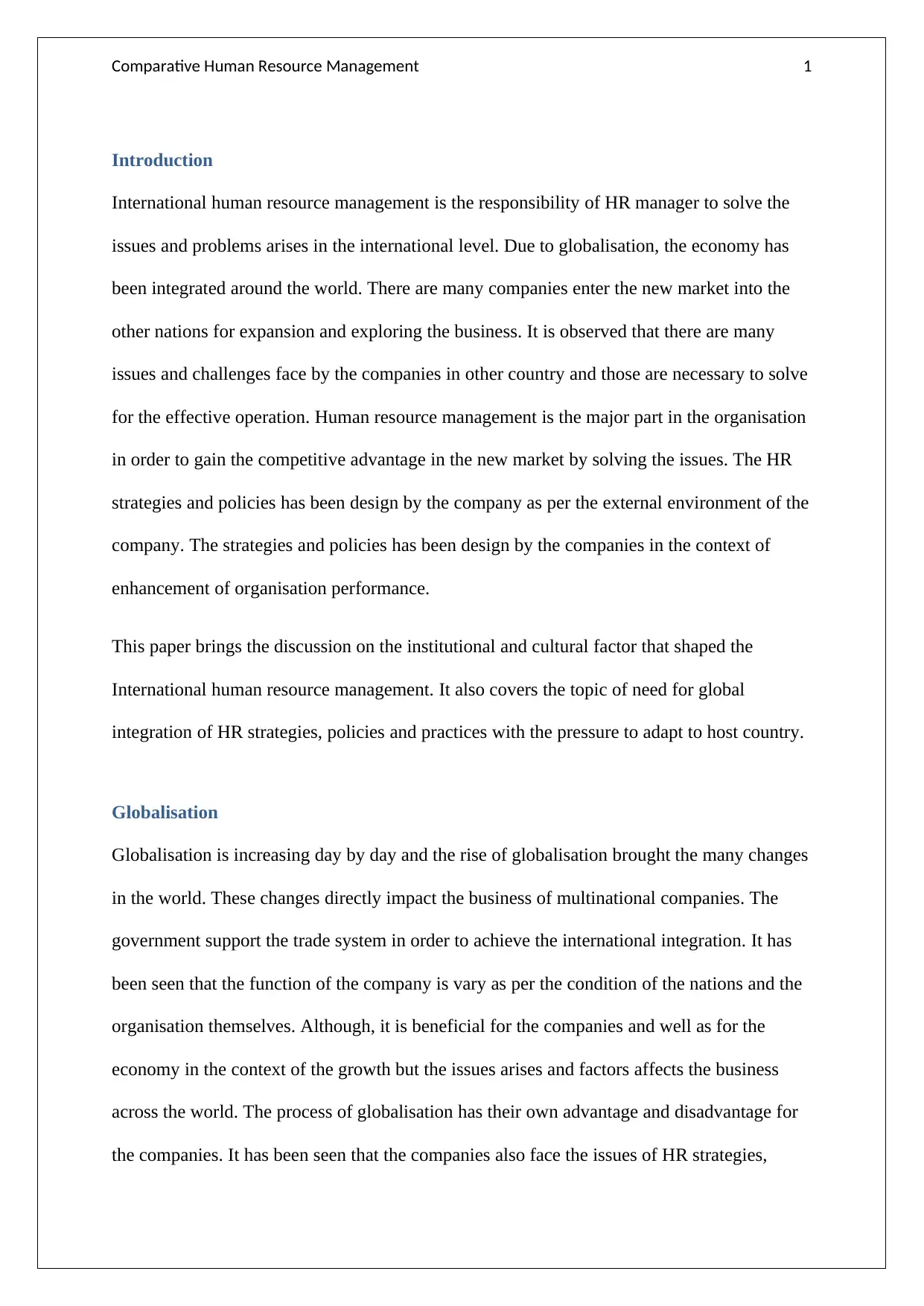
Introduction
International human resource management is the responsibility of HR manager to solve the
issues and problems arises in the international level. Due to globalisation, the economy has
been integrated around the world. There are many companies enter the new market into the
other nations for expansion and exploring the business. It is observed that there are many
issues and challenges face by the companies in other country and those are necessary to solve
for the effective operation. Human resource management is the major part in the organisation
in order to gain the competitive advantage in the new market by solving the issues. The HR
strategies and policies has been design by the company as per the external environment of the
company. The strategies and policies has been design by the companies in the context of
enhancement of organisation performance.
This paper brings the discussion on the institutional and cultural factor that shaped the
International human resource management. It also covers the topic of need for global
integration of HR strategies, policies and practices with the pressure to adapt to host country.
Globalisation
Globalisation is increasing day by day and the rise of globalisation brought the many changes
in the world. These changes directly impact the business of multinational companies. The
government support the trade system in order to achieve the international integration. It has
been seen that the function of the company is vary as per the condition of the nations and the
organisation themselves. Although, it is beneficial for the companies and well as for the
economy in the context of the growth but the issues arises and factors affects the business
across the world. The process of globalisation has their own advantage and disadvantage for
the companies. It has been seen that the companies also face the issues of HR strategies,
Introduction
International human resource management is the responsibility of HR manager to solve the
issues and problems arises in the international level. Due to globalisation, the economy has
been integrated around the world. There are many companies enter the new market into the
other nations for expansion and exploring the business. It is observed that there are many
issues and challenges face by the companies in other country and those are necessary to solve
for the effective operation. Human resource management is the major part in the organisation
in order to gain the competitive advantage in the new market by solving the issues. The HR
strategies and policies has been design by the company as per the external environment of the
company. The strategies and policies has been design by the companies in the context of
enhancement of organisation performance.
This paper brings the discussion on the institutional and cultural factor that shaped the
International human resource management. It also covers the topic of need for global
integration of HR strategies, policies and practices with the pressure to adapt to host country.
Globalisation
Globalisation is increasing day by day and the rise of globalisation brought the many changes
in the world. These changes directly impact the business of multinational companies. The
government support the trade system in order to achieve the international integration. It has
been seen that the function of the company is vary as per the condition of the nations and the
organisation themselves. Although, it is beneficial for the companies and well as for the
economy in the context of the growth but the issues arises and factors affects the business
across the world. The process of globalisation has their own advantage and disadvantage for
the companies. It has been seen that the companies also face the issues of HR strategies,
Comparative Human Resource Management 2
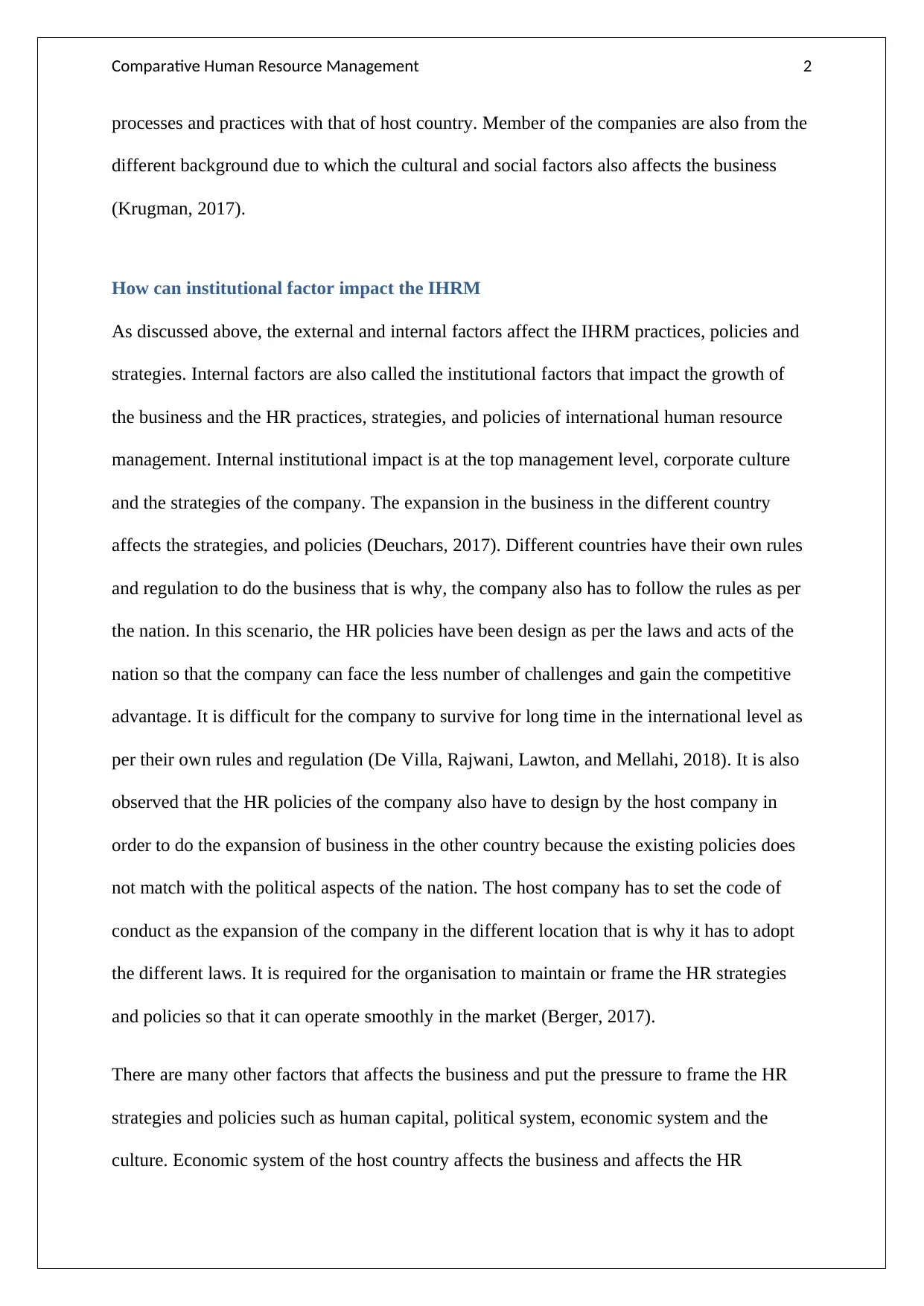
processes and practices with that of host country. Member of the companies are also from the
different background due to which the cultural and social factors also affects the business
(Krugman, 2017).
How can institutional factor impact the IHRM
As discussed above, the external and internal factors affect the IHRM practices, policies and
strategies. Internal factors are also called the institutional factors that impact the growth of
the business and the HR practices, strategies, and policies of international human resource
management. Internal institutional impact is at the top management level, corporate culture
and the strategies of the company. The expansion in the business in the different country
affects the strategies, and policies (Deuchars, 2017). Different countries have their own rules
and regulation to do the business that is why, the company also has to follow the rules as per
the nation. In this scenario, the HR policies have been design as per the laws and acts of the
nation so that the company can face the less number of challenges and gain the competitive
advantage. It is difficult for the company to survive for long time in the international level as
per their own rules and regulation (De Villa, Rajwani, Lawton, and Mellahi, 2018). It is also
observed that the HR policies of the company also have to design by the host company in
order to do the expansion of business in the other country because the existing policies does
not match with the political aspects of the nation. The host company has to set the code of
conduct as the expansion of the company in the different location that is why it has to adopt
the different laws. It is required for the organisation to maintain or frame the HR strategies
and policies so that it can operate smoothly in the market (Berger, 2017).
There are many other factors that affects the business and put the pressure to frame the HR
strategies and policies such as human capital, political system, economic system and the
culture. Economic system of the host country affects the business and affects the HR
processes and practices with that of host country. Member of the companies are also from the
different background due to which the cultural and social factors also affects the business
(Krugman, 2017).
How can institutional factor impact the IHRM
As discussed above, the external and internal factors affect the IHRM practices, policies and
strategies. Internal factors are also called the institutional factors that impact the growth of
the business and the HR practices, strategies, and policies of international human resource
management. Internal institutional impact is at the top management level, corporate culture
and the strategies of the company. The expansion in the business in the different country
affects the strategies, and policies (Deuchars, 2017). Different countries have their own rules
and regulation to do the business that is why, the company also has to follow the rules as per
the nation. In this scenario, the HR policies have been design as per the laws and acts of the
nation so that the company can face the less number of challenges and gain the competitive
advantage. It is difficult for the company to survive for long time in the international level as
per their own rules and regulation (De Villa, Rajwani, Lawton, and Mellahi, 2018). It is also
observed that the HR policies of the company also have to design by the host company in
order to do the expansion of business in the other country because the existing policies does
not match with the political aspects of the nation. The host company has to set the code of
conduct as the expansion of the company in the different location that is why it has to adopt
the different laws. It is required for the organisation to maintain or frame the HR strategies
and policies so that it can operate smoothly in the market (Berger, 2017).
There are many other factors that affects the business and put the pressure to frame the HR
strategies and policies such as human capital, political system, economic system and the
culture. Economic system of the host country affects the business and affects the HR
⊘ This is a preview!⊘
Do you want full access?
Subscribe today to unlock all pages.

Trusted by 1+ million students worldwide
Comparative Human Resource Management 3
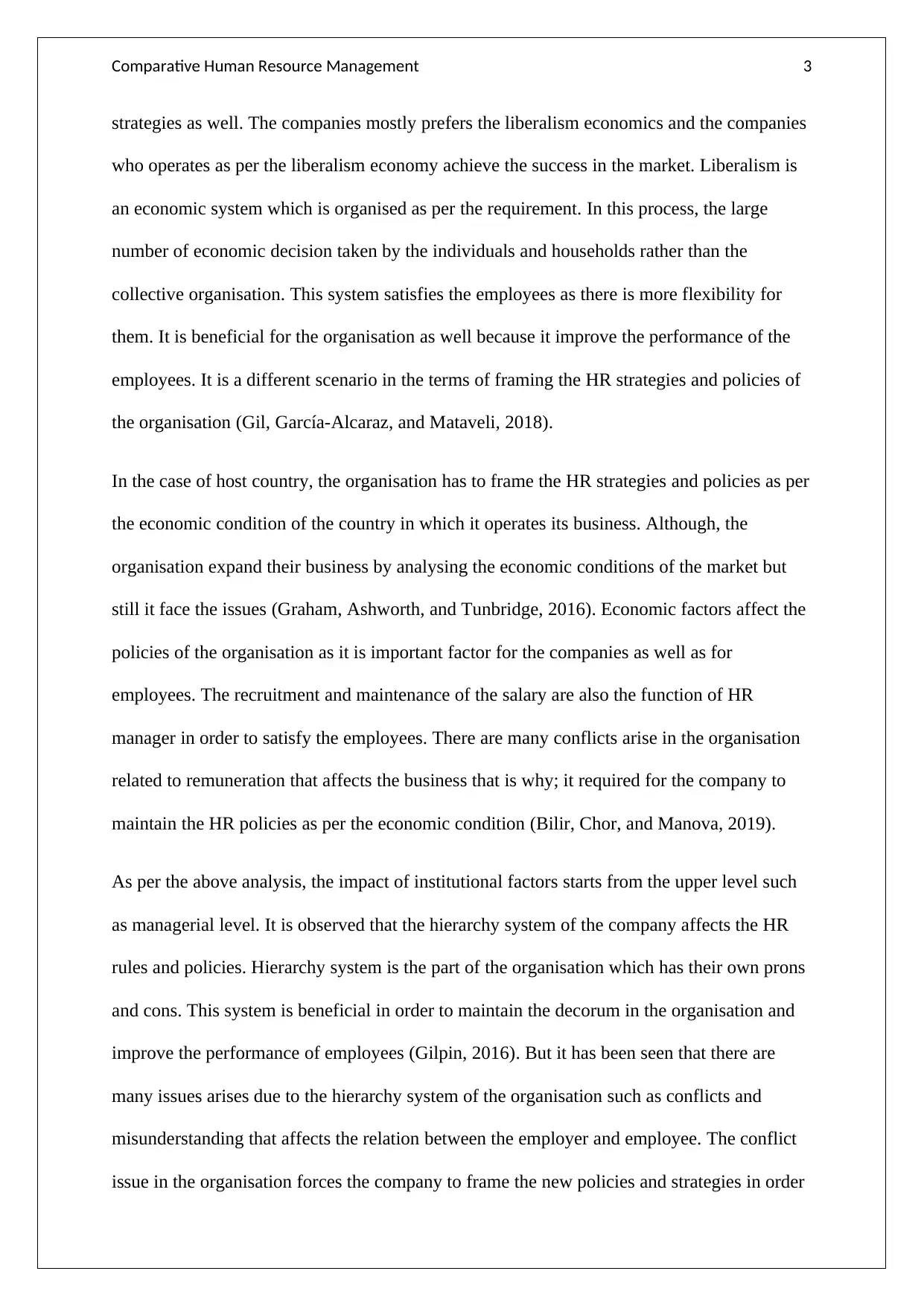
strategies as well. The companies mostly prefers the liberalism economics and the companies
who operates as per the liberalism economy achieve the success in the market. Liberalism is
an economic system which is organised as per the requirement. In this process, the large
number of economic decision taken by the individuals and households rather than the
collective organisation. This system satisfies the employees as there is more flexibility for
them. It is beneficial for the organisation as well because it improve the performance of the
employees. It is a different scenario in the terms of framing the HR strategies and policies of
the organisation (Gil, García-Alcaraz, and Mataveli, 2018).
In the case of host country, the organisation has to frame the HR strategies and policies as per
the economic condition of the country in which it operates its business. Although, the
organisation expand their business by analysing the economic conditions of the market but
still it face the issues (Graham, Ashworth, and Tunbridge, 2016). Economic factors affect the
policies of the organisation as it is important factor for the companies as well as for
employees. The recruitment and maintenance of the salary are also the function of HR
manager in order to satisfy the employees. There are many conflicts arise in the organisation
related to remuneration that affects the business that is why; it required for the company to
maintain the HR policies as per the economic condition (Bilir, Chor, and Manova, 2019).
As per the above analysis, the impact of institutional factors starts from the upper level such
as managerial level. It is observed that the hierarchy system of the company affects the HR
rules and policies. Hierarchy system is the part of the organisation which has their own prons
and cons. This system is beneficial in order to maintain the decorum in the organisation and
improve the performance of employees (Gilpin, 2016). But it has been seen that there are
many issues arises due to the hierarchy system of the organisation such as conflicts and
misunderstanding that affects the relation between the employer and employee. The conflict
issue in the organisation forces the company to frame the new policies and strategies in order
strategies as well. The companies mostly prefers the liberalism economics and the companies
who operates as per the liberalism economy achieve the success in the market. Liberalism is
an economic system which is organised as per the requirement. In this process, the large
number of economic decision taken by the individuals and households rather than the
collective organisation. This system satisfies the employees as there is more flexibility for
them. It is beneficial for the organisation as well because it improve the performance of the
employees. It is a different scenario in the terms of framing the HR strategies and policies of
the organisation (Gil, García-Alcaraz, and Mataveli, 2018).
In the case of host country, the organisation has to frame the HR strategies and policies as per
the economic condition of the country in which it operates its business. Although, the
organisation expand their business by analysing the economic conditions of the market but
still it face the issues (Graham, Ashworth, and Tunbridge, 2016). Economic factors affect the
policies of the organisation as it is important factor for the companies as well as for
employees. The recruitment and maintenance of the salary are also the function of HR
manager in order to satisfy the employees. There are many conflicts arise in the organisation
related to remuneration that affects the business that is why; it required for the company to
maintain the HR policies as per the economic condition (Bilir, Chor, and Manova, 2019).
As per the above analysis, the impact of institutional factors starts from the upper level such
as managerial level. It is observed that the hierarchy system of the company affects the HR
rules and policies. Hierarchy system is the part of the organisation which has their own prons
and cons. This system is beneficial in order to maintain the decorum in the organisation and
improve the performance of employees (Gilpin, 2016). But it has been seen that there are
many issues arises due to the hierarchy system of the organisation such as conflicts and
misunderstanding that affects the relation between the employer and employee. The conflict
issue in the organisation forces the company to frame the new policies and strategies in order
Paraphrase This Document
Need a fresh take? Get an instant paraphrase of this document with our AI Paraphraser
Comparative Human Resource Management 4
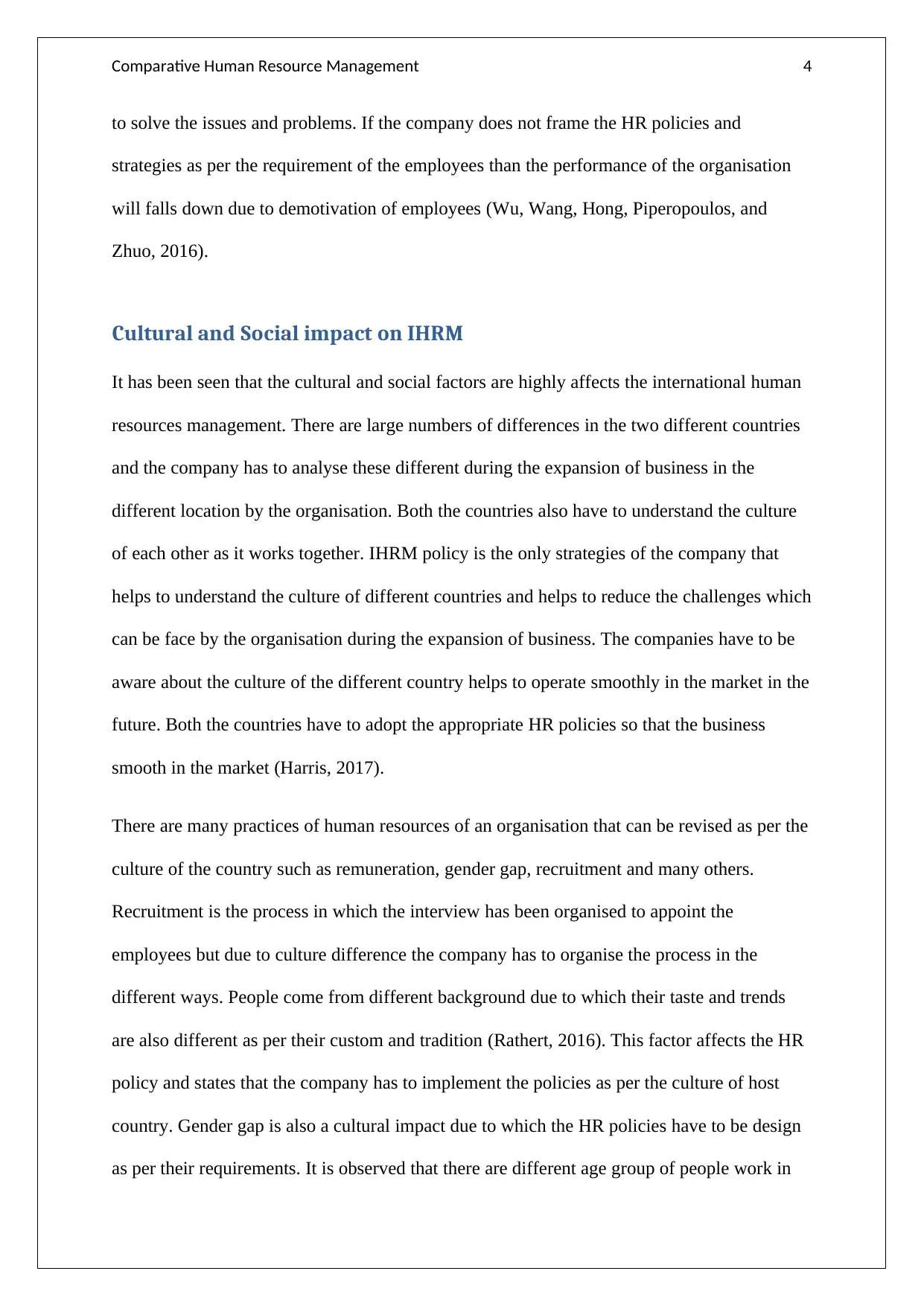
to solve the issues and problems. If the company does not frame the HR policies and
strategies as per the requirement of the employees than the performance of the organisation
will falls down due to demotivation of employees (Wu, Wang, Hong, Piperopoulos, and
Zhuo, 2016).
Cultural and Social impact on IHRM
It has been seen that the cultural and social factors are highly affects the international human
resources management. There are large numbers of differences in the two different countries
and the company has to analyse these different during the expansion of business in the
different location by the organisation. Both the countries also have to understand the culture
of each other as it works together. IHRM policy is the only strategies of the company that
helps to understand the culture of different countries and helps to reduce the challenges which
can be face by the organisation during the expansion of business. The companies have to be
aware about the culture of the different country helps to operate smoothly in the market in the
future. Both the countries have to adopt the appropriate HR policies so that the business
smooth in the market (Harris, 2017).
There are many practices of human resources of an organisation that can be revised as per the
culture of the country such as remuneration, gender gap, recruitment and many others.
Recruitment is the process in which the interview has been organised to appoint the
employees but due to culture difference the company has to organise the process in the
different ways. People come from different background due to which their taste and trends
are also different as per their custom and tradition (Rathert, 2016). This factor affects the HR
policy and states that the company has to implement the policies as per the culture of host
country. Gender gap is also a cultural impact due to which the HR policies have to be design
as per their requirements. It is observed that there are different age group of people work in
to solve the issues and problems. If the company does not frame the HR policies and
strategies as per the requirement of the employees than the performance of the organisation
will falls down due to demotivation of employees (Wu, Wang, Hong, Piperopoulos, and
Zhuo, 2016).
Cultural and Social impact on IHRM
It has been seen that the cultural and social factors are highly affects the international human
resources management. There are large numbers of differences in the two different countries
and the company has to analyse these different during the expansion of business in the
different location by the organisation. Both the countries also have to understand the culture
of each other as it works together. IHRM policy is the only strategies of the company that
helps to understand the culture of different countries and helps to reduce the challenges which
can be face by the organisation during the expansion of business. The companies have to be
aware about the culture of the different country helps to operate smoothly in the market in the
future. Both the countries have to adopt the appropriate HR policies so that the business
smooth in the market (Harris, 2017).
There are many practices of human resources of an organisation that can be revised as per the
culture of the country such as remuneration, gender gap, recruitment and many others.
Recruitment is the process in which the interview has been organised to appoint the
employees but due to culture difference the company has to organise the process in the
different ways. People come from different background due to which their taste and trends
are also different as per their custom and tradition (Rathert, 2016). This factor affects the HR
policy and states that the company has to implement the policies as per the culture of host
country. Gender gap is also a cultural impact due to which the HR policies have to be design
as per their requirements. It is observed that there are different age group of people work in
Comparative Human Resource Management 5
the organisation. It is necessary for the company to frame the strategies and policies as per
the age of the employees so that the facilities and requirements of the employees will be
satisfied. The thoughts are also different as per the age group which affects the business
growth because conflict is arises at the workplace and the efficiency of work is reduces.
Efficiency of employees affects the business work and the growth of the organisation.
By understanding the culture impact has over the policies and strategies of international
human resources management. It is observed that the understanding the culture impact does
not estimated the societal impact of the country (Hiršová, Komárková, and Pirožek, 2018).
The company has to analyse the societal factor during the expansion of business. Social
impact is a wide concept as the people come from the different background and religion.
There are many social factors that affect the business and forces to develop the new HR
policies and strategies such as conflicts between the people regarding their culture and
tradition.
Moral values are plays the major role in affecting the IHRM policies of the company. As
discussed above, the different people have their different background due to which they also
have different moral values. It is essential for the company to take care of moral values of
people of countries (Levy, et. al, 2015). Moral values affect the business in the terms of
employee’s performance and the consumer demand. For example- H&M Company
introduced its sweatshirts with the black child model in order to support the phrase of cool
monkey in the jungle. It affects the brand image as well as the moral value of the black
people. It is observed that the company has to develop the HR policies and strategies so that
the challenges arises related to the moral values will reduces and the business can smoothly
operates in the host country (CNBC, 2018). The company has to develop the strategies as per
the ethics and moral value so that the company achieve the high success in the market by
attracting the large number of consumers.
the organisation. It is necessary for the company to frame the strategies and policies as per
the age of the employees so that the facilities and requirements of the employees will be
satisfied. The thoughts are also different as per the age group which affects the business
growth because conflict is arises at the workplace and the efficiency of work is reduces.
Efficiency of employees affects the business work and the growth of the organisation.
By understanding the culture impact has over the policies and strategies of international
human resources management. It is observed that the understanding the culture impact does
not estimated the societal impact of the country (Hiršová, Komárková, and Pirožek, 2018).
The company has to analyse the societal factor during the expansion of business. Social
impact is a wide concept as the people come from the different background and religion.
There are many social factors that affect the business and forces to develop the new HR
policies and strategies such as conflicts between the people regarding their culture and
tradition.
Moral values are plays the major role in affecting the IHRM policies of the company. As
discussed above, the different people have their different background due to which they also
have different moral values. It is essential for the company to take care of moral values of
people of countries (Levy, et. al, 2015). Moral values affect the business in the terms of
employee’s performance and the consumer demand. For example- H&M Company
introduced its sweatshirts with the black child model in order to support the phrase of cool
monkey in the jungle. It affects the brand image as well as the moral value of the black
people. It is observed that the company has to develop the HR policies and strategies so that
the challenges arises related to the moral values will reduces and the business can smoothly
operates in the host country (CNBC, 2018). The company has to develop the strategies as per
the ethics and moral value so that the company achieve the high success in the market by
attracting the large number of consumers.
⊘ This is a preview!⊘
Do you want full access?
Subscribe today to unlock all pages.
Trusted by 1+ million students worldwide
Comparative Human Resource Management 6
Labour market is a social factor that affects the IHRM policies during the host country. It is
observed that the demand of people for the wages is different as per the economic condition
of the country. HR manager of the company has to develop the recruitment policies so that
the employees of host country also perform well in the organisation (Mata, and Alves, 2018).
From the above analysis, it has been concluded that there are many institutional, cultural and
societal factor that affects the business and forces the organisation to design the IHRM
policies. The organisation has to balance the HR strategies, policies and practices as per the
requirement of the host country. It has to analyse the internal and external environment
during the expansion of the business in the new market. The company has to frame the
policies and strategies as per the requirement of the host country so that the challenges and
issues arises will be reduces. It is recommended that the company has to set their code of
conduct so that they can easily operate in the new market. Appropriate policies and strategies
helps to gain the competitive advantage and helps to achieve the success in the market.
Labour market is a social factor that affects the IHRM policies during the host country. It is
observed that the demand of people for the wages is different as per the economic condition
of the country. HR manager of the company has to develop the recruitment policies so that
the employees of host country also perform well in the organisation (Mata, and Alves, 2018).
From the above analysis, it has been concluded that there are many institutional, cultural and
societal factor that affects the business and forces the organisation to design the IHRM
policies. The organisation has to balance the HR strategies, policies and practices as per the
requirement of the host country. It has to analyse the internal and external environment
during the expansion of the business in the new market. The company has to frame the
policies and strategies as per the requirement of the host country so that the challenges and
issues arises will be reduces. It is recommended that the company has to set their code of
conduct so that they can easily operate in the new market. Appropriate policies and strategies
helps to gain the competitive advantage and helps to achieve the success in the market.
Paraphrase This Document
Need a fresh take? Get an instant paraphrase of this document with our AI Paraphraser
Comparative Human Resource Management 7
References
Berger, A.A. (2017) Political parties: A sociological study of the oligarchical tendencies of
modern democracy. Routledge.
Bilir, L.K., Chor, D. and Manova, K. (2019) Host-country financial development and
multinational activity. European Economic Review.
CNBC. (2018) H&M slammed as racist for ‘monkey in the jungle’ hoodie. [online] Available
from: https://www.cnbc.com/2018/01/08/hm-slammed-for-racist-monkey-in-the-jungle-
hoodie.html [Accessed 7/4/19].
De Villa, M.A., Rajwani, T., Lawton, T.C. and Mellahi, K. (2018) To engage or not to
engage with host governments: Corporate political activity and host country political risk.
Global Strategy Journal.
Deuchars, R. (2017) The international political economy of risk: rationalism, calculation and
power. Routledge.
Gil, A.J., García-Alcaraz, J.L. and Mataveli, M. (2018) The effect of learning culture on
training transfer: empirical evidence in Spanish teachers. The International Journal of Human
Resource Management, pp.1-24.
Gilpin, R. (2016) The political economy of international relations. Princeton University
Press.
Graham, B., Ashworth, G. and Tunbridge, J. (2016) A geography of heritage: Power, culture
and economy. Routledge.
Harris, P.G. (2017) International equity and global environmental politics: power and
principles in US foreign policy. Routledge.
References
Berger, A.A. (2017) Political parties: A sociological study of the oligarchical tendencies of
modern democracy. Routledge.
Bilir, L.K., Chor, D. and Manova, K. (2019) Host-country financial development and
multinational activity. European Economic Review.
CNBC. (2018) H&M slammed as racist for ‘monkey in the jungle’ hoodie. [online] Available
from: https://www.cnbc.com/2018/01/08/hm-slammed-for-racist-monkey-in-the-jungle-
hoodie.html [Accessed 7/4/19].
De Villa, M.A., Rajwani, T., Lawton, T.C. and Mellahi, K. (2018) To engage or not to
engage with host governments: Corporate political activity and host country political risk.
Global Strategy Journal.
Deuchars, R. (2017) The international political economy of risk: rationalism, calculation and
power. Routledge.
Gil, A.J., García-Alcaraz, J.L. and Mataveli, M. (2018) The effect of learning culture on
training transfer: empirical evidence in Spanish teachers. The International Journal of Human
Resource Management, pp.1-24.
Gilpin, R. (2016) The political economy of international relations. Princeton University
Press.
Graham, B., Ashworth, G. and Tunbridge, J. (2016) A geography of heritage: Power, culture
and economy. Routledge.
Harris, P.G. (2017) International equity and global environmental politics: power and
principles in US foreign policy. Routledge.
Comparative Human Resource Management 8
Hiršová, M., Komárková, L. and Pirožek, P. (2018) The Prediction of Financial Performance
in Dependence on the Type of Organisational Culture. Trends Economics and Management,
12(32), pp.63-74.
Krugman, P. (2017) Crises: The price of globalisation?. In Economics of Globalisation (pp.
31-50). Routledge.
Levy, O., Taylor, S., Boyacigiller, N.A., Bodner, T.E., Peiperl, M.A. and Beechler, S. (2015)
Perceived senior leadership opportunities in MNCs: The effect of social hierarchy and
capital. Journal of International Business Studies, 46(3), pp.285-307.
Mata, J. and Alves, C. (2018) The survival of firms founded by immigrants: Institutional
distance between home and host country, and experience in the host country. Strategic
Management Journal, 39(11), pp.2965-2991.
Rathert, N. (2016) Strategies of legitimation: MNEs and the adoption of CSR in response to
host-country institutions. Journal of International Business Studies, 47(7), pp.858-879.
Reich, M. (2017) Racial inequality: A political-economic analysis (Vol. 4883). Princeton
University Press.
Weyl, W.E. (2017) The New Democracy: An Essay on Certain Political and Economic
Tendencies in the United States. Routledge.
Wu, J., Wang, C., Hong, J., Piperopoulos, P. and Zhuo, S. (2016) Internationalization and
innovation performance of emerging market enterprises: The role of host-country institutional
development. Journal of World Business, 51(2), pp.251-263.
Hiršová, M., Komárková, L. and Pirožek, P. (2018) The Prediction of Financial Performance
in Dependence on the Type of Organisational Culture. Trends Economics and Management,
12(32), pp.63-74.
Krugman, P. (2017) Crises: The price of globalisation?. In Economics of Globalisation (pp.
31-50). Routledge.
Levy, O., Taylor, S., Boyacigiller, N.A., Bodner, T.E., Peiperl, M.A. and Beechler, S. (2015)
Perceived senior leadership opportunities in MNCs: The effect of social hierarchy and
capital. Journal of International Business Studies, 46(3), pp.285-307.
Mata, J. and Alves, C. (2018) The survival of firms founded by immigrants: Institutional
distance between home and host country, and experience in the host country. Strategic
Management Journal, 39(11), pp.2965-2991.
Rathert, N. (2016) Strategies of legitimation: MNEs and the adoption of CSR in response to
host-country institutions. Journal of International Business Studies, 47(7), pp.858-879.
Reich, M. (2017) Racial inequality: A political-economic analysis (Vol. 4883). Princeton
University Press.
Weyl, W.E. (2017) The New Democracy: An Essay on Certain Political and Economic
Tendencies in the United States. Routledge.
Wu, J., Wang, C., Hong, J., Piperopoulos, P. and Zhuo, S. (2016) Internationalization and
innovation performance of emerging market enterprises: The role of host-country institutional
development. Journal of World Business, 51(2), pp.251-263.
⊘ This is a preview!⊘
Do you want full access?
Subscribe today to unlock all pages.
Trusted by 1+ million students worldwide

1 out of 9


Related Documents


Your All-in-One AI-Powered Toolkit for Academic Success.
+13062052269
info@desklib.com
Available 24*7 on WhatsApp / Email
![[object Object]](/_next/static/media/star-bottom.7253800d.svg)
Unlock your academic potential
Copyright © 2020–2026 A2Z Services. All Rights Reserved. Developed and managed by ZUCOL.