IKEA's Operation Management: Strategies, Objectives, and Analysis
VerifiedAdded on 2020/06/04
|16
|4423
|26
Report
AI Summary
This report provides a comprehensive analysis of IKEA's operation management, focusing on the importance of operational functions, the roles and responsibilities of operational management, and key strategies for business success. It examines the significance of cost reduction, quality improvement, and the five performance objectives, including reducing costs, digitization, reaching more consumers, promotional campaigns, and concentrating on efficiency. The report also evaluates the use of linear programming, critical path analysis, and the need for operational planning and control within IKEA's business model. Furthermore, it discusses the application of quality management methods to improve operations, highlighting the importance of aligning strategic, tactical, and operational decisions to achieve competitive advantage and maximize profitability.
OPERATION
MANAGEMENT IN
BUSINESS
MANAGEMENT IN
BUSINESS

Paraphrase This Document
Need a fresh take? Get an instant paraphrase of this document with our AI Paraphraser
Table of Contents
INTRODUCTION...........................................................................................................................1
TASK 1............................................................................................................................................1
1.1 Operations management is important....................................................................................1
1.2 Operations functions of a IKEA............................................................................................2
1.3 Operations management for IKEA by using a process model.............................................2
TASK 2............................................................................................................................................3
2.1 Importance of the ‘Three Es’................................................................................................3
2.2 Impact of the tension between cost reduction and quality increment..................................4
2.3 Significance of the five performance objectives...................................................................5
TASK 3............................................................................................................................................6
3.1 How linear programming adds value....................................................................................6
3.2 Evaluation of critical path analysis and network designing.................................................6
3.3 Need for operational planning and control............................................................................7
TASK 4............................................................................................................................................7
4.1 Set of clearly defined operational outcomes.........................................................................7
4.2 Network plan and indicate the resultant critical path............................................................8
4.3 How quality management method are applied to improve operations................................10
CONCLUSION ..........................................................................................................................10
REFERENCES..............................................................................................................................12
INTRODUCTION...........................................................................................................................1
TASK 1............................................................................................................................................1
1.1 Operations management is important....................................................................................1
1.2 Operations functions of a IKEA............................................................................................2
1.3 Operations management for IKEA by using a process model.............................................2
TASK 2............................................................................................................................................3
2.1 Importance of the ‘Three Es’................................................................................................3
2.2 Impact of the tension between cost reduction and quality increment..................................4
2.3 Significance of the five performance objectives...................................................................5
TASK 3............................................................................................................................................6
3.1 How linear programming adds value....................................................................................6
3.2 Evaluation of critical path analysis and network designing.................................................6
3.3 Need for operational planning and control............................................................................7
TASK 4............................................................................................................................................7
4.1 Set of clearly defined operational outcomes.........................................................................7
4.2 Network plan and indicate the resultant critical path............................................................8
4.3 How quality management method are applied to improve operations................................10
CONCLUSION ..........................................................................................................................10
REFERENCES..............................................................................................................................12

⊘ This is a preview!⊘
Do you want full access?
Subscribe today to unlock all pages.

Trusted by 1+ million students worldwide
INTRODUCTION
Operation management can be simply define as administration of business related
activities in order to create advanced level of skilfulness that is achievable within an
corporation. It is associated with transformation of material and labour into products or
services as expeditiously as possible so that profit of enterprise can be maximized (Alexander,
2013). It is a function of business that design, arrange, order and process the assets required to
produce products. Each and every organisation has an operational function because they all
produce some types of goods or services. The present report is based on operation management
of IKEA. In this project, operational functions, roles and responsibility of operational
management, etc. are explained.
TASK 1
1.1 Operations management is important
Operation management is very necessary since it is the soul or heart of the company
that controls overall system while performing business in IKEA. This company is doing
business of manufacturing furnitures and making home appliances like bed, doors, etc. The
main vision of this corporation is to provide goods and services at minimum prices to their
customers (Yang, Hong and Modi, 2011). For achieving this operational management is
needed. It deals with designing, improving the system and various other operations that
generate and transfer important goods or services to users. As in the case of commerce and
economics, management of operations is a serviceable field of business having a clear
administration duty. Main decisions are that are taken with the help of it are listed below:
Strategic Decisions : OM( Operation management) help managers of high rank in
making strategical level decisions. These finding view present constraint as well as
situations in order to make effectual system and corporation-wide processing so that
competitive benefit can be gained.
Tactical decisions: OM manages effectively the available resources as well as
employees under norms and discipline of organisation. For instance, tactical decisions
involves shift related planning of workers that is who are order to do night shift and
who are happy in doing morning shift.
Operation management can be simply define as administration of business related
activities in order to create advanced level of skilfulness that is achievable within an
corporation. It is associated with transformation of material and labour into products or
services as expeditiously as possible so that profit of enterprise can be maximized (Alexander,
2013). It is a function of business that design, arrange, order and process the assets required to
produce products. Each and every organisation has an operational function because they all
produce some types of goods or services. The present report is based on operation management
of IKEA. In this project, operational functions, roles and responsibility of operational
management, etc. are explained.
TASK 1
1.1 Operations management is important
Operation management is very necessary since it is the soul or heart of the company
that controls overall system while performing business in IKEA. This company is doing
business of manufacturing furnitures and making home appliances like bed, doors, etc. The
main vision of this corporation is to provide goods and services at minimum prices to their
customers (Yang, Hong and Modi, 2011). For achieving this operational management is
needed. It deals with designing, improving the system and various other operations that
generate and transfer important goods or services to users. As in the case of commerce and
economics, management of operations is a serviceable field of business having a clear
administration duty. Main decisions are that are taken with the help of it are listed below:
Strategic Decisions : OM( Operation management) help managers of high rank in
making strategical level decisions. These finding view present constraint as well as
situations in order to make effectual system and corporation-wide processing so that
competitive benefit can be gained.
Tactical decisions: OM manages effectively the available resources as well as
employees under norms and discipline of organisation. For instance, tactical decisions
involves shift related planning of workers that is who are order to do night shift and
who are happy in doing morning shift.
Paraphrase This Document
Need a fresh take? Get an instant paraphrase of this document with our AI Paraphraser
Operational decisions: The operational decisions such as designing, observation and
controlling are performed by taking help of OM. Example includes decisions taken by
leaders of team such as making chart of daily work of an employee, etc.
1.2 Operations functions of a IKEA
The operational function of organisation are described below:
Planning: It is nothing but an important task that is performed by organisation in order
to start their business. Process of making certain course of action and decisions of
future are called planning (Wheelen and Hunger, 2011). In this aims and objectives of
organisation are considered and certain strategies are decided. The strategies include
manufacturing and designing process, and various other methods that aid in running
business. At same time, roles and responsibilities of all team member are divided so
that working can be done effectively.
Organizing: It is defined as those activities that design structuring of tasks and
authority. Operation management determines those tasks that are essential in achieving
goals and allocating duty and power to perform those activities. It involves designing of
job, measuring of work, management of project, etc.
Controlling: Controlling can be defined as those activities that ensure real performance
according to the already done planning. In order to pass the plans made by employers
operational managers checks or measures the actual output in comparison to planned
one (Wirtz, 2011). If any fault occurs, then this work is repeated again and goods are
manufactured again so that it satisfy the managerial officers when they are examining
their quality.
Behaviour: Managers are concerning with the efforts of planning, organising, and
controlling that how they affects the behaviour of human. Then they come to know that
behaviour is impacted by the leaders, motivating power, act of communicating, inter
and intra-personal skills and their attitudes.
1.3 Operations management for IKEA by using a process model
Process model are processes of identical quality that are categorized collectively into a
model. IKEA use similar process model continuously for development of various applications
and thus have many instantiations. One important use of a process model is to impose how
things should be finished in comparison to process itself which is truly what occurs. It is
controlling are performed by taking help of OM. Example includes decisions taken by
leaders of team such as making chart of daily work of an employee, etc.
1.2 Operations functions of a IKEA
The operational function of organisation are described below:
Planning: It is nothing but an important task that is performed by organisation in order
to start their business. Process of making certain course of action and decisions of
future are called planning (Wheelen and Hunger, 2011). In this aims and objectives of
organisation are considered and certain strategies are decided. The strategies include
manufacturing and designing process, and various other methods that aid in running
business. At same time, roles and responsibilities of all team member are divided so
that working can be done effectively.
Organizing: It is defined as those activities that design structuring of tasks and
authority. Operation management determines those tasks that are essential in achieving
goals and allocating duty and power to perform those activities. It involves designing of
job, measuring of work, management of project, etc.
Controlling: Controlling can be defined as those activities that ensure real performance
according to the already done planning. In order to pass the plans made by employers
operational managers checks or measures the actual output in comparison to planned
one (Wirtz, 2011). If any fault occurs, then this work is repeated again and goods are
manufactured again so that it satisfy the managerial officers when they are examining
their quality.
Behaviour: Managers are concerning with the efforts of planning, organising, and
controlling that how they affects the behaviour of human. Then they come to know that
behaviour is impacted by the leaders, motivating power, act of communicating, inter
and intra-personal skills and their attitudes.
1.3 Operations management for IKEA by using a process model
Process model are processes of identical quality that are categorized collectively into a
model. IKEA use similar process model continuously for development of various applications
and thus have many instantiations. One important use of a process model is to impose how
things should be finished in comparison to process itself which is truly what occurs. It is
approximately an expectation of how the process should look like. The goals of process model
are explained below:
Descriptive:
▪ It tracks what really occurs during a process.
▪ According to the view point of external observer who examines the way of
process implementation and find the area of improvement so that it can be
performed more effectively (Van Der Aalst, 2013).
Prescriptive:
▪ It specify the wanted processes and how they should be performed.
▪ Establishment of rules and regulations, guidelines, and action pattern that must
be followed in order to perform the activities. This can be range from exact
implementation to negotiable guidance.
Explanatory:
▪ Providing information about principle of process
▪ Establishment of an explicit link-up between processes and the necessity that the
model requires to fulfil.
▪ Pre-defining points at which information can be selected for coverage purposes.
TASK 2
2.1 Importance of the ‘Three Es’
The three 'Es' for IKEA are listed below:
Economy: Economy refers to doing things in most cheaper manner by avoiding extra
expenditures. Organisation is taking several methods or measures so that cutting down
of extra expenses or unnecessary costs can be done effectively (Trkman, 2010). It has
developed different low productive projects and as a result save a large amount of
money. It covers all financial side on which action is achieved. As every one is living
in a world where economics pervade each and every prospect of life, hence it is
important to balance the use of resources so that exact goals can be achieved at sensible
price.
Efficiency: Efficiency means performing working as smoothly as manageable by
removing processes and methods that are not giving right product or good quality
are explained below:
Descriptive:
▪ It tracks what really occurs during a process.
▪ According to the view point of external observer who examines the way of
process implementation and find the area of improvement so that it can be
performed more effectively (Van Der Aalst, 2013).
Prescriptive:
▪ It specify the wanted processes and how they should be performed.
▪ Establishment of rules and regulations, guidelines, and action pattern that must
be followed in order to perform the activities. This can be range from exact
implementation to negotiable guidance.
Explanatory:
▪ Providing information about principle of process
▪ Establishment of an explicit link-up between processes and the necessity that the
model requires to fulfil.
▪ Pre-defining points at which information can be selected for coverage purposes.
TASK 2
2.1 Importance of the ‘Three Es’
The three 'Es' for IKEA are listed below:
Economy: Economy refers to doing things in most cheaper manner by avoiding extra
expenditures. Organisation is taking several methods or measures so that cutting down
of extra expenses or unnecessary costs can be done effectively (Trkman, 2010). It has
developed different low productive projects and as a result save a large amount of
money. It covers all financial side on which action is achieved. As every one is living
in a world where economics pervade each and every prospect of life, hence it is
important to balance the use of resources so that exact goals can be achieved at sensible
price.
Efficiency: Efficiency means performing working as smoothly as manageable by
removing processes and methods that are not giving right product or good quality
⊘ This is a preview!⊘
Do you want full access?
Subscribe today to unlock all pages.
Trusted by 1+ million students worldwide
product. By doing proper management in business IKEA has achieved drastic growth
in terms of turnover. This made possible after taking essential and bravery decisions. It
is considered as an efficiency. On the other hand, efficiency states that correct
utilization of resources to complete a task. This means wise consumption of inputs or
raw materials through which work get accomplished. Improvement in efficiency means
enterprise are using a trend of reducing waste materials and ingesting less in order to
deliver the required amount of value (Slack, 2015). The proper way of measuring
efficiency is recognising processes to finish a task and delegating the correct amount of
resources.
Effectiveness: Effectiveness means doing right things in order to produce quality
product and services so that it is manufactured as per the need or wishes of their
consumers. By taking active decisions and making effective plans, corporation has
given good competition to their competitors like Ilva, Asda, Barn Furniture, etc.
Company is also performing online business so that large number of customers get
attracted towards their shops and their selling will increase. These all signal of
effectiveness.
2.2 Impact of the tension between cost reduction and quality increment
At the starting of earlier decade, when IKEA was troubled to endure in the business,
lowering of cost had become most essential. But without making any plan, this minimisation
led to very risky. Hence, by examining the requirement of economy, management have taken a
active decision to minimize less growth directed products. BY this decision, a large quantity of
revenue gets saved by enterprise without impacting its leading gainful business. Company is
helping itself by earning more revenue by putting up stores at several locations and taking risk
of settlement of new shops. This will aid organisation in rising their attribute (Myers, 2013).
Quality should be given more priority while making performance objectives and goals because
customers wants quality in goods and services. The extrinsic effect of good attribute within
management operation is that users who uses these best quality product will give appreciate
corporation for this or give no complain. They get happy as they are satisfied by the product
and services of corporation. This make more revenue for enterprise. Quality management has a
also give different internal impact. If conformity is done for high level of quality ten fewer or
even no mistake is done. This will saves the revenue and increases the speed of response. If
in terms of turnover. This made possible after taking essential and bravery decisions. It
is considered as an efficiency. On the other hand, efficiency states that correct
utilization of resources to complete a task. This means wise consumption of inputs or
raw materials through which work get accomplished. Improvement in efficiency means
enterprise are using a trend of reducing waste materials and ingesting less in order to
deliver the required amount of value (Slack, 2015). The proper way of measuring
efficiency is recognising processes to finish a task and delegating the correct amount of
resources.
Effectiveness: Effectiveness means doing right things in order to produce quality
product and services so that it is manufactured as per the need or wishes of their
consumers. By taking active decisions and making effective plans, corporation has
given good competition to their competitors like Ilva, Asda, Barn Furniture, etc.
Company is also performing online business so that large number of customers get
attracted towards their shops and their selling will increase. These all signal of
effectiveness.
2.2 Impact of the tension between cost reduction and quality increment
At the starting of earlier decade, when IKEA was troubled to endure in the business,
lowering of cost had become most essential. But without making any plan, this minimisation
led to very risky. Hence, by examining the requirement of economy, management have taken a
active decision to minimize less growth directed products. BY this decision, a large quantity of
revenue gets saved by enterprise without impacting its leading gainful business. Company is
helping itself by earning more revenue by putting up stores at several locations and taking risk
of settlement of new shops. This will aid organisation in rising their attribute (Myers, 2013).
Quality should be given more priority while making performance objectives and goals because
customers wants quality in goods and services. The extrinsic effect of good attribute within
management operation is that users who uses these best quality product will give appreciate
corporation for this or give no complain. They get happy as they are satisfied by the product
and services of corporation. This make more revenue for enterprise. Quality management has a
also give different internal impact. If conformity is done for high level of quality ten fewer or
even no mistake is done. This will saves the revenue and increases the speed of response. If
Paraphrase This Document
Need a fresh take? Get an instant paraphrase of this document with our AI Paraphraser
company is continuously doing mistakes and correction is done regularly then to response at
time is not possible but as no mistake or fault occurs quick response can be given by
organisation as per the request of clients.
2.3 Significance of the five performance objectives
The importance of five performance objectives of IKEA are explained below:
Reducing cost: The strategy of reducing cost is proved to be more powerful and attract
large number of consumers. The removal all unnecessary or less growth oriented
products effectively saves a large sum of money for corporation. This also opens new
opportunities where they can invest in order to earn more profit. Commonly, enterprise
should keep low prices products in comparison to their competitors. If they will not do
so then number of users shift towards other companies and this is termed as a loss for
this organisation. Hence, they have to impose low or affordable costs to their goods or
services.
Digitization: The modern technologies should be used by company in order to make it
more digitalize. For example, enterprise should make their effective and attractive web
site where they offer online business to their consumers. The paying option is also
available on the website. And consumers will receive their orders by same day as
enterprise is offering home delivery also (Jeston and Nelis, 2014). This will increase
their profitability as by purchasing goods on internet, they gain more popularity and
recognised by large group of people not at national but at international level also.
Company should use modern communication tools like Face book, What's app, twitter,
video conferencing, etc. In traditional days or earlier era, workers have to move from
one place to other for attending meeting, taking order, etc. But now they can use video
conferencing and attend meeting without being physically present at that location. The
other works can be done by messaging only. So, this saves time as well as money that
was wasting in earlier days. Enterprise should also use spreadsheets, Ms-excel, etc. for
doing large calculation work only by writing a single formula, etc. Presentation of
products and services can be created by using power point.
Reaching more consumers: More number of customers can be reached by making or
setting large number of stores at different locations. They have to establish shops where
more population survive (Krajewski, Ritzman and Malhotra, 2013). This will increase
time is not possible but as no mistake or fault occurs quick response can be given by
organisation as per the request of clients.
2.3 Significance of the five performance objectives
The importance of five performance objectives of IKEA are explained below:
Reducing cost: The strategy of reducing cost is proved to be more powerful and attract
large number of consumers. The removal all unnecessary or less growth oriented
products effectively saves a large sum of money for corporation. This also opens new
opportunities where they can invest in order to earn more profit. Commonly, enterprise
should keep low prices products in comparison to their competitors. If they will not do
so then number of users shift towards other companies and this is termed as a loss for
this organisation. Hence, they have to impose low or affordable costs to their goods or
services.
Digitization: The modern technologies should be used by company in order to make it
more digitalize. For example, enterprise should make their effective and attractive web
site where they offer online business to their consumers. The paying option is also
available on the website. And consumers will receive their orders by same day as
enterprise is offering home delivery also (Jeston and Nelis, 2014). This will increase
their profitability as by purchasing goods on internet, they gain more popularity and
recognised by large group of people not at national but at international level also.
Company should use modern communication tools like Face book, What's app, twitter,
video conferencing, etc. In traditional days or earlier era, workers have to move from
one place to other for attending meeting, taking order, etc. But now they can use video
conferencing and attend meeting without being physically present at that location. The
other works can be done by messaging only. So, this saves time as well as money that
was wasting in earlier days. Enterprise should also use spreadsheets, Ms-excel, etc. for
doing large calculation work only by writing a single formula, etc. Presentation of
products and services can be created by using power point.
Reaching more consumers: More number of customers can be reached by making or
setting large number of stores at different locations. They have to establish shops where
more population survive (Krajewski, Ritzman and Malhotra, 2013). This will increase
turnover of company. Company have to offer online as well as offline services to
customers.
Promotional campaign: Firm have to invest a large sum of money in doing
advertising. This can be done by making creative and attractive banners, posters and
using other methodologies. Other ways can be used like Social media ( Face book,
What's app, twitter, email, etc.), books, journals, through television channel, etc. This
will increase sales as more consumers get attracted by such campaigns.
Concentrating on efficiency: Another way to achieve success is running corporation
more effectively or efficiently. Proper schemes should be made by company in order to
speed up the work of employees. Efficiency can be shown by taking more proactive
decisions.
TASK 3
3.1 How linear programming adds value
Linear programming is nothing but a mathematical process that is used in making
decisions. This is vastly used and now become best known tool in management science and
industrial engineering. It is considered as best tool for making proactive decisions because it
aids in reducing costs and increasing profits (Houy, Fettke and Loos, 2010). Via this
programming, managers of company can calculate the costs and sales unit which can enhance
the profitability. Hence, there are different problems which is incurred by firm in terms of costs
and prices. Therefore, linear programming is considered as best tool that aids in decision
making process.
Linear programming is very strong mathematical tool that is created to use in doing
operation management. This is done by operational managers. It can be used in obtaining
optimal solutions that involves problems regarding budgeting, labour and machines. Such
problems are called constrained optimization problems. There are four components that are
providing the structure of linear programming model that are listed below:
Objective
Decision variables
Constraints
Parameters
customers.
Promotional campaign: Firm have to invest a large sum of money in doing
advertising. This can be done by making creative and attractive banners, posters and
using other methodologies. Other ways can be used like Social media ( Face book,
What's app, twitter, email, etc.), books, journals, through television channel, etc. This
will increase sales as more consumers get attracted by such campaigns.
Concentrating on efficiency: Another way to achieve success is running corporation
more effectively or efficiently. Proper schemes should be made by company in order to
speed up the work of employees. Efficiency can be shown by taking more proactive
decisions.
TASK 3
3.1 How linear programming adds value
Linear programming is nothing but a mathematical process that is used in making
decisions. This is vastly used and now become best known tool in management science and
industrial engineering. It is considered as best tool for making proactive decisions because it
aids in reducing costs and increasing profits (Houy, Fettke and Loos, 2010). Via this
programming, managers of company can calculate the costs and sales unit which can enhance
the profitability. Hence, there are different problems which is incurred by firm in terms of costs
and prices. Therefore, linear programming is considered as best tool that aids in decision
making process.
Linear programming is very strong mathematical tool that is created to use in doing
operation management. This is done by operational managers. It can be used in obtaining
optimal solutions that involves problems regarding budgeting, labour and machines. Such
problems are called constrained optimization problems. There are four components that are
providing the structure of linear programming model that are listed below:
Objective
Decision variables
Constraints
Parameters
⊘ This is a preview!⊘
Do you want full access?
Subscribe today to unlock all pages.
Trusted by 1+ million students worldwide
3.2 Evaluation of critical path analysis and network designing
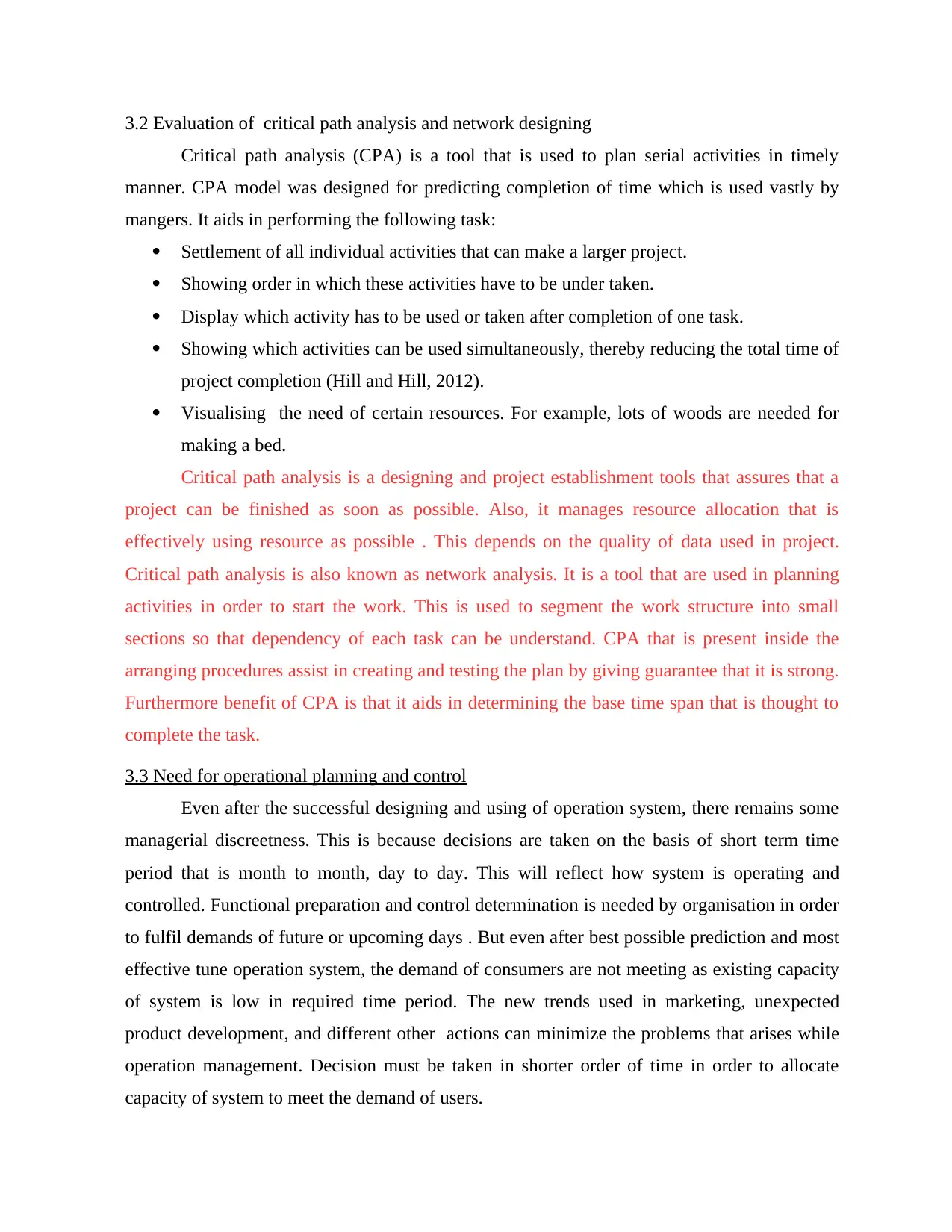
Critical path analysis (CPA) is a tool that is used to plan serial activities in timely
manner. CPA model was designed for predicting completion of time which is used vastly by
mangers. It aids in performing the following task:
Settlement of all individual activities that can make a larger project.
Showing order in which these activities have to be under taken.
Display which activity has to be used or taken after completion of one task.
Showing which activities can be used simultaneously, thereby reducing the total time of
project completion (Hill and Hill, 2012).
Visualising the need of certain resources. For example, lots of woods are needed for
making a bed.
Critical path analysis is a designing and project establishment tools that assures that a
project can be finished as soon as possible. Also, it manages resource allocation that is
effectively using resource as possible . This depends on the quality of data used in project.
Critical path analysis is also known as network analysis. It is a tool that are used in planning
activities in order to start the work. This is used to segment the work structure into small
sections so that dependency of each task can be understand. CPA that is present inside the
arranging procedures assist in creating and testing the plan by giving guarantee that it is strong.
Furthermore benefit of CPA is that it aids in determining the base time span that is thought to
complete the task.
3.3 Need for operational planning and control
Even after the successful designing and using of operation system, there remains some
managerial discreetness. This is because decisions are taken on the basis of short term time
period that is month to month, day to day. This will reflect how system is operating and
controlled. Functional preparation and control determination is needed by organisation in order
to fulfil demands of future or upcoming days . But even after best possible prediction and most
effective tune operation system, the demand of consumers are not meeting as existing capacity
of system is low in required time period. The new trends used in marketing, unexpected
product development, and different other actions can minimize the problems that arises while
operation management. Decision must be taken in shorter order of time in order to allocate
capacity of system to meet the demand of users.
Critical path analysis (CPA) is a tool that is used to plan serial activities in timely
manner. CPA model was designed for predicting completion of time which is used vastly by
mangers. It aids in performing the following task:
Settlement of all individual activities that can make a larger project.
Showing order in which these activities have to be under taken.
Display which activity has to be used or taken after completion of one task.
Showing which activities can be used simultaneously, thereby reducing the total time of
project completion (Hill and Hill, 2012).
Visualising the need of certain resources. For example, lots of woods are needed for
making a bed.
Critical path analysis is a designing and project establishment tools that assures that a
project can be finished as soon as possible. Also, it manages resource allocation that is
effectively using resource as possible . This depends on the quality of data used in project.
Critical path analysis is also known as network analysis. It is a tool that are used in planning
activities in order to start the work. This is used to segment the work structure into small
sections so that dependency of each task can be understand. CPA that is present inside the
arranging procedures assist in creating and testing the plan by giving guarantee that it is strong.
Furthermore benefit of CPA is that it aids in determining the base time span that is thought to
complete the task.
3.3 Need for operational planning and control
Even after the successful designing and using of operation system, there remains some
managerial discreetness. This is because decisions are taken on the basis of short term time
period that is month to month, day to day. This will reflect how system is operating and
controlled. Functional preparation and control determination is needed by organisation in order
to fulfil demands of future or upcoming days . But even after best possible prediction and most
effective tune operation system, the demand of consumers are not meeting as existing capacity
of system is low in required time period. The new trends used in marketing, unexpected
product development, and different other actions can minimize the problems that arises while
operation management. Decision must be taken in shorter order of time in order to allocate
capacity of system to meet the demand of users.
Paraphrase This Document
Need a fresh take? Get an instant paraphrase of this document with our AI Paraphraser
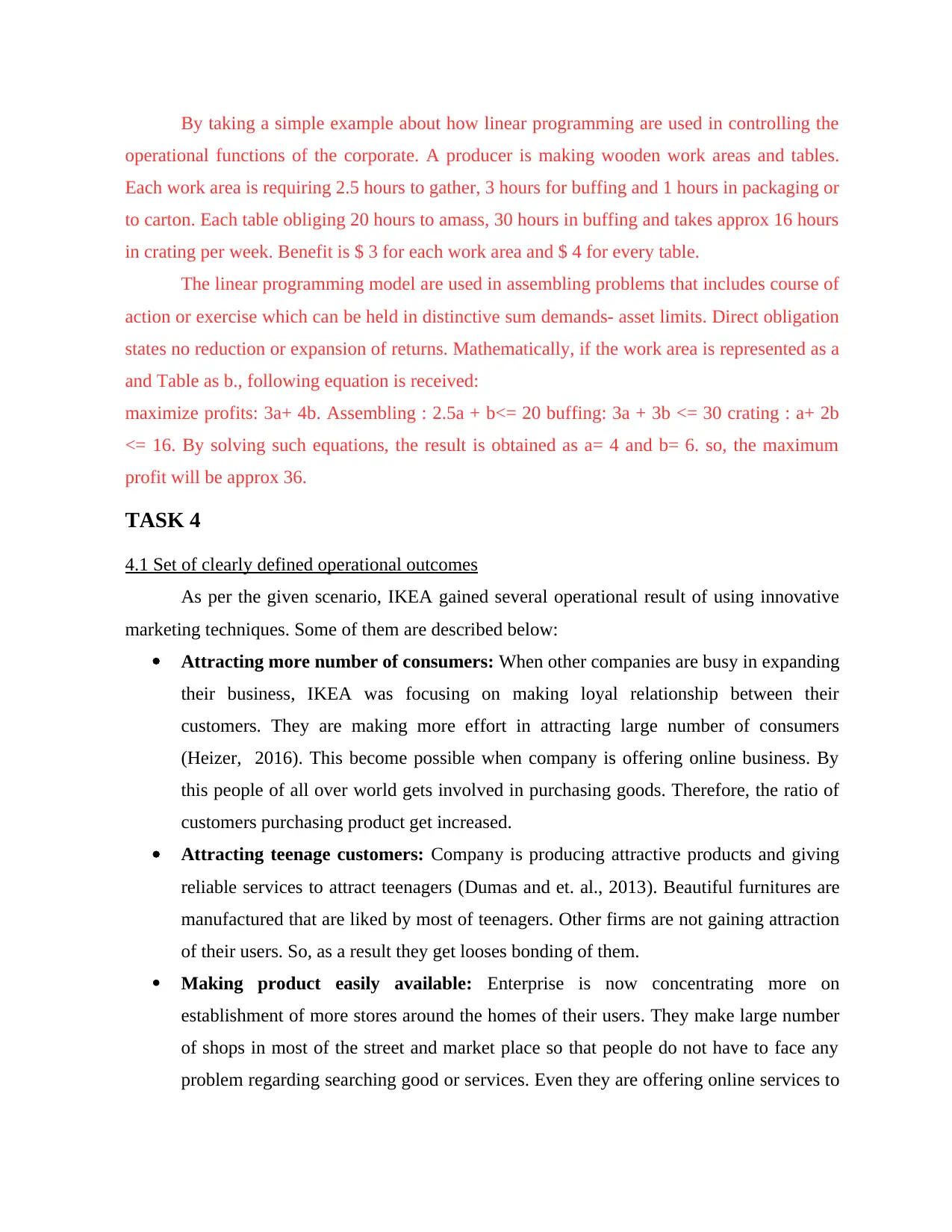
By taking a simple example about how linear programming are used in controlling the
operational functions of the corporate. A producer is making wooden work areas and tables.
Each work area is requiring 2.5 hours to gather, 3 hours for buffing and 1 hours in packaging or
to carton. Each table obliging 20 hours to amass, 30 hours in buffing and takes approx 16 hours
in crating per week. Benefit is $ 3 for each work area and $ 4 for every table.
The linear programming model are used in assembling problems that includes course of
action or exercise which can be held in distinctive sum demands- asset limits. Direct obligation
states no reduction or expansion of returns. Mathematically, if the work area is represented as a
and Table as b., following equation is received:
maximize profits: 3a+ 4b. Assembling : 2.5a + b<= 20 buffing: 3a + 3b <= 30 crating : a+ 2b
<= 16. By solving such equations, the result is obtained as a= 4 and b= 6. so, the maximum
profit will be approx 36.
TASK 4
4.1 Set of clearly defined operational outcomes
As per the given scenario, IKEA gained several operational result of using innovative
marketing techniques. Some of them are described below:
Attracting more number of consumers: When other companies are busy in expanding
their business, IKEA was focusing on making loyal relationship between their
customers. They are making more effort in attracting large number of consumers
(Heizer, 2016). This become possible when company is offering online business. By
this people of all over world gets involved in purchasing goods. Therefore, the ratio of
customers purchasing product get increased.
Attracting teenage customers: Company is producing attractive products and giving
reliable services to attract teenagers (Dumas and et. al., 2013). Beautiful furnitures are
manufactured that are liked by most of teenagers. Other firms are not gaining attraction
of their users. So, as a result they get looses bonding of them.
Making product easily available: Enterprise is now concentrating more on
establishment of more stores around the homes of their users. They make large number
of shops in most of the street and market place so that people do not have to face any
problem regarding searching good or services. Even they are offering online services to
operational functions of the corporate. A producer is making wooden work areas and tables.
Each work area is requiring 2.5 hours to gather, 3 hours for buffing and 1 hours in packaging or
to carton. Each table obliging 20 hours to amass, 30 hours in buffing and takes approx 16 hours
in crating per week. Benefit is $ 3 for each work area and $ 4 for every table.
The linear programming model are used in assembling problems that includes course of
action or exercise which can be held in distinctive sum demands- asset limits. Direct obligation
states no reduction or expansion of returns. Mathematically, if the work area is represented as a
and Table as b., following equation is received:
maximize profits: 3a+ 4b. Assembling : 2.5a + b<= 20 buffing: 3a + 3b <= 30 crating : a+ 2b
<= 16. By solving such equations, the result is obtained as a= 4 and b= 6. so, the maximum
profit will be approx 36.
TASK 4
4.1 Set of clearly defined operational outcomes
As per the given scenario, IKEA gained several operational result of using innovative
marketing techniques. Some of them are described below:
Attracting more number of consumers: When other companies are busy in expanding
their business, IKEA was focusing on making loyal relationship between their
customers. They are making more effort in attracting large number of consumers
(Heizer, 2016). This become possible when company is offering online business. By
this people of all over world gets involved in purchasing goods. Therefore, the ratio of
customers purchasing product get increased.
Attracting teenage customers: Company is producing attractive products and giving
reliable services to attract teenagers (Dumas and et. al., 2013). Beautiful furnitures are
manufactured that are liked by most of teenagers. Other firms are not gaining attraction
of their users. So, as a result they get looses bonding of them.
Making product easily available: Enterprise is now concentrating more on
establishment of more stores around the homes of their users. They make large number
of shops in most of the street and market place so that people do not have to face any
problem regarding searching good or services. Even they are offering online services to
their customers. Now users do not need to move here and there in search of product.
They only have to select goods from their websites. And product get available at their
door by same day as company is giving home delivery which is free of cost for some
distances.
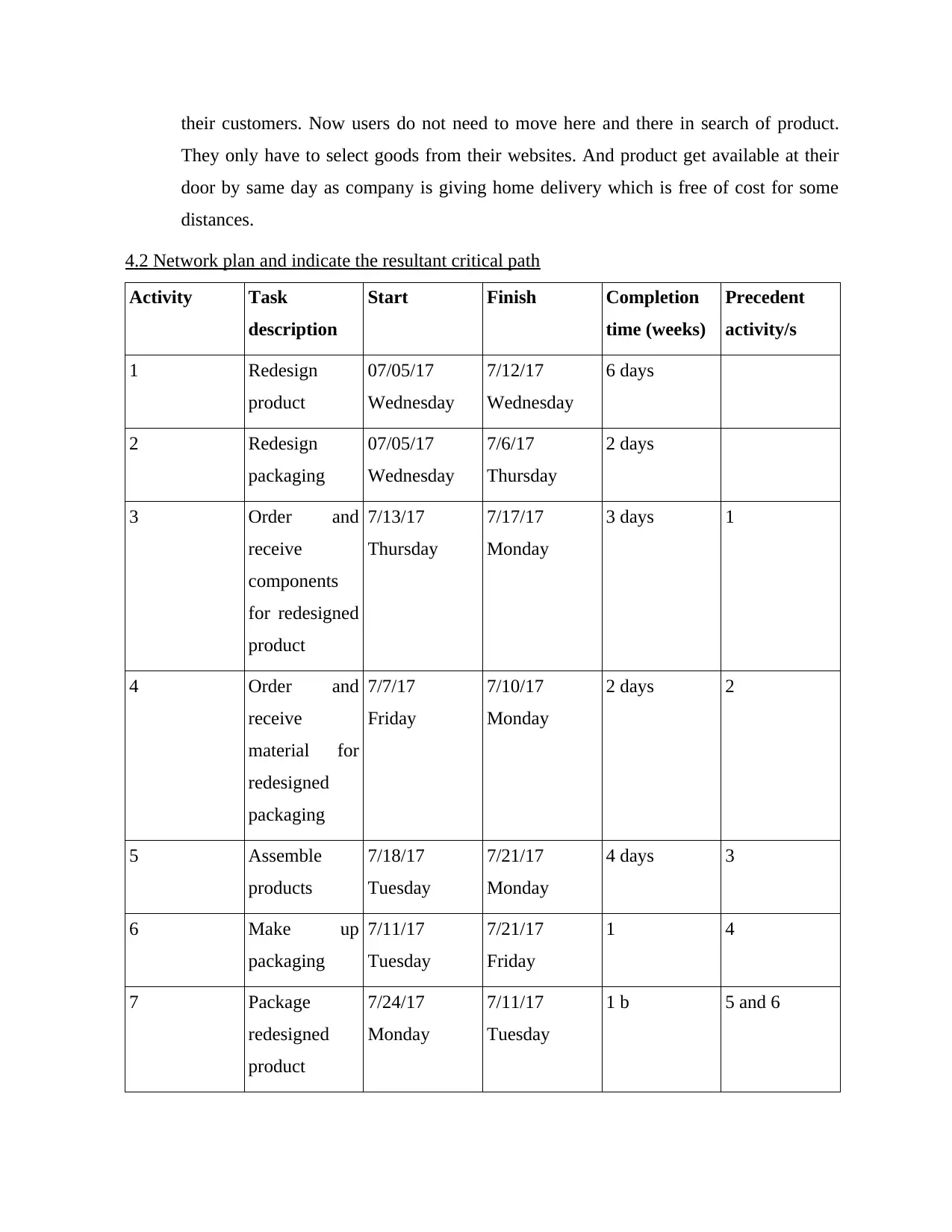
4.2 Network plan and indicate the resultant critical path
Activity Task
description
Start Finish Completion
time (weeks)
Precedent
activity/s
1 Redesign
product
07/05/17
Wednesday
7/12/17
Wednesday
6 days
2 Redesign
packaging
07/05/17
Wednesday
7/6/17
Thursday
2 days
3 Order and
receive
components
for redesigned
product
7/13/17
Thursday
7/17/17
Monday
3 days 1
4 Order and
receive
material for
redesigned
packaging
7/7/17
Friday
7/10/17
Monday
2 days 2
5 Assemble
products
7/18/17
Tuesday
7/21/17
Monday
4 days 3
6 Make up
packaging
7/11/17
Tuesday
7/21/17
Friday
1 4
7 Package
redesigned
product
7/24/17
Monday
7/11/17
Tuesday
1 b 5 and 6
They only have to select goods from their websites. And product get available at their
door by same day as company is giving home delivery which is free of cost for some
distances.
4.2 Network plan and indicate the resultant critical path
Activity Task
description
Start Finish Completion
time (weeks)
Precedent
activity/s
1 Redesign
product
07/05/17
Wednesday
7/12/17
Wednesday
6 days
2 Redesign
packaging
07/05/17
Wednesday
7/6/17
Thursday
2 days
3 Order and
receive
components
for redesigned
product
7/13/17
Thursday
7/17/17
Monday
3 days 1
4 Order and
receive
material for
redesigned
packaging
7/7/17
Friday
7/10/17
Monday
2 days 2
5 Assemble
products
7/18/17
Tuesday
7/21/17
Monday
4 days 3
6 Make up
packaging
7/11/17
Tuesday
7/21/17
Friday
1 4
7 Package
redesigned
product
7/24/17
Monday
7/11/17
Tuesday
1 b 5 and 6
⊘ This is a preview!⊘
Do you want full access?
Subscribe today to unlock all pages.
Trusted by 1+ million students worldwide

1 out of 16


Related Documents


Your All-in-One AI-Powered Toolkit for Academic Success.
+13062052269
info@desklib.com
Available 24*7 on WhatsApp / Email
![[object Object]](/_next/static/media/star-bottom.7253800d.svg)
Unlock your academic potential
Copyright © 2020–2026 A2Z Services. All Rights Reserved. Developed and managed by ZUCOL.