HI6006 Competitive Strategy: IKEA Case Study and Analysis
VerifiedAdded on 2022/11/13
|10
|2501
|167
Report
AI Summary
This report presents a case study analysis of IKEA, examining its business strategies within the context of competitive strategy. It begins with an executive summary highlighting IKEA's approach to establishing its business in India, its history, values, and business vision. The introduction provides an overview of IKEA, its history, growth, and strategic decisions. The case study delves into IKEA's background, its modular designs, cost control, and global presence, including its expansion to 52 countries by 2018. The report then analyzes IKEA's strengths, such as quality and price, its vision to create a better everyday life, and its focus on cost reduction through self-assembly products and bulk purchasing. Opportunities like increasing demand for greener products and online solutions are also explored. Weaknesses such as management issues and lack of direct communication with customers are discussed. The report also identifies threats, including social trends, market forces, and economic factors, as well as the application of Porter's Five Forces. The analysis covers corporate and business-level strategies, including how IKEA maintains its existence in the market. The conclusion summarizes the company's focus on quality and cost, SWOT analysis, and strategic approaches to productivity, employee and customer relations, and competition.
Running Head: Case Study of IKEA: 0
CASE STUDY OF IKEA
2019
Strategies in business
CASE STUDY OF IKEA
2019
Strategies in business

Paraphrase This Document
Need a fresh take? Get an instant paraphrase of this document with our AI Paraphraser
Case study of IKEA: 1
Table of Contents
Executive Summary.........................................................................................................................2
Introduction......................................................................................................................................3
Case-Study.......................................................................................................................................3
Strength and Weakness of IKEA:....................................................................................................4
Threats of the company...................................................................................................................6
Corporate level Strategy:.................................................................................................................8
Business Level Strategy:..................................................................................................................9
Conclusion:......................................................................................................................................9
References......................................................................................................................................10
Table of Contents
Executive Summary.........................................................................................................................2
Introduction......................................................................................................................................3
Case-Study.......................................................................................................................................3
Strength and Weakness of IKEA:....................................................................................................4
Threats of the company...................................................................................................................6
Corporate level Strategy:.................................................................................................................8
Business Level Strategy:..................................................................................................................9
Conclusion:......................................................................................................................................9
References......................................................................................................................................10
Case study of IKEA: 2
Executive Summary
This report gives summary about the strategies adopted by company which belongs from other
nations and tries to establish their business plans in India. The discussion is made regarding the
history of the company their values and vision with their business. IKEA starts its business with
from very small scale as the demand get increase the founder of the company then established it
as shop where the furniture were made by the local carpenters. It is the commitment of the
company on which they are still working and providing their services. They are providing the
quality products in furniture and other appliances of house in the low cost which is not provided
by any of its competitor. The report is included with the different strategies used by the company
to get settled in India also the challenges which they face while in the whole process.
Executive Summary
This report gives summary about the strategies adopted by company which belongs from other
nations and tries to establish their business plans in India. The discussion is made regarding the
history of the company their values and vision with their business. IKEA starts its business with
from very small scale as the demand get increase the founder of the company then established it
as shop where the furniture were made by the local carpenters. It is the commitment of the
company on which they are still working and providing their services. They are providing the
quality products in furniture and other appliances of house in the low cost which is not provided
by any of its competitor. The report is included with the different strategies used by the company
to get settled in India also the challenges which they face while in the whole process.
⊘ This is a preview!⊘
Do you want full access?
Subscribe today to unlock all pages.

Trusted by 1+ million students worldwide
Case study of IKEA: 3
Introduction
In the project the study is done on multinational retail brand which want to setup its business in
India. The history of the company is described with the growth. Their business strategies are also
described in the project, challenges which they face while setting up the business and how they
overcome from it. In the assignment SWOT analysis of company is also described which explain
the strength, weakness, opportunity and threats of the company.
Case-Study
Introduction of IKEA:
IKEA is Swedish multinational brand that designs and sells furniture, kitchen appliances and the
products which are used in home. The headquarter of company is situated in Delft, Netherlands it
was founded by Ingvar Kamprad in the year 1943.In 2015 in the list of Forbs the founder of the
company was listed as most richest person of the world. The company is well known for its
modular designs and eco-friendly furniture’s and other appliances. The most important factors
behind the success of the company are its cost control, operational works and regular production
of goods. By November 2018 Company was setup with 424 stores in 52 countries of world.
Company focus on producing the products which can be self-assembled instead of selling the
pre-assembled products it is one of the reason by which company reduces its production costs
and the products of company are much cheaper than other competitors. The founder of the
company transferred the all of the equity to a foundation INGKA which was developed in order
to fund the charity and to keep the company safe from the destruction. At first the furniture were
manufactured by the local manufactures when Kampard receives the good response for the
product then he decided to expand the range of the product (Nguyen, Cai and Evans, 2018).
Strength and Weakness of IKEA:
Strength of Organization: The market strength of the company includes various factors which
are described below these factors makes the company different from its competitors:
It maintains the quality and price of the products which build the trust of the customer.
The Vision of the company is 'to create a better everyday life for many people'
Introduction
In the project the study is done on multinational retail brand which want to setup its business in
India. The history of the company is described with the growth. Their business strategies are also
described in the project, challenges which they face while setting up the business and how they
overcome from it. In the assignment SWOT analysis of company is also described which explain
the strength, weakness, opportunity and threats of the company.
Case-Study
Introduction of IKEA:
IKEA is Swedish multinational brand that designs and sells furniture, kitchen appliances and the
products which are used in home. The headquarter of company is situated in Delft, Netherlands it
was founded by Ingvar Kamprad in the year 1943.In 2015 in the list of Forbs the founder of the
company was listed as most richest person of the world. The company is well known for its
modular designs and eco-friendly furniture’s and other appliances. The most important factors
behind the success of the company are its cost control, operational works and regular production
of goods. By November 2018 Company was setup with 424 stores in 52 countries of world.
Company focus on producing the products which can be self-assembled instead of selling the
pre-assembled products it is one of the reason by which company reduces its production costs
and the products of company are much cheaper than other competitors. The founder of the
company transferred the all of the equity to a foundation INGKA which was developed in order
to fund the charity and to keep the company safe from the destruction. At first the furniture were
manufactured by the local manufactures when Kampard receives the good response for the
product then he decided to expand the range of the product (Nguyen, Cai and Evans, 2018).
Strength and Weakness of IKEA:
Strength of Organization: The market strength of the company includes various factors which
are described below these factors makes the company different from its competitors:
It maintains the quality and price of the products which build the trust of the customer.
The Vision of the company is 'to create a better everyday life for many people'
Paraphrase This Document
Need a fresh take? Get an instant paraphrase of this document with our AI Paraphraser
Case study of IKEA: 4
The company offered a long range of product in low cost than other manufacturers.
These are some major points which keep the faith of the customers towards the company. One of
the other point on which company focused i.e. Key point Indicators, that helps the company to
set the targets and to achieve them (Noe, Hollenbeck, Gerhart, and Wright, 2017).The strength of
IKEA in its complete production process
By the end of 2009 the company improves the overall use of its renewable sources by
75%.
As Company is using the smart techniques to use its sources hence they are able to
generate the energy sources up to 84% in 2007 later on it was updated to 90% in 2009.
The suppliers of the company have completely secured about the supply of the volume as
the company is committing for the same for long term period.
IKEA purchase the material in bulk which helps company in reducing costs and affect its
economy rate as well.
The materials are delivered from the suppliers to IKEA directly due to which the
handling costs of the product get reduced (Wu and Peng, 2018).
Opportunity: Company states that there should be always attempt the work with respect of
opportunity, the work should be conducted according to environment. Some of the opportunities
where the company uses them as advantage:
The greener products of the company are getting increase it their demands.
Due to low costs of products the customer prefers products of IKEA rather than to select
same product of some costlier brand (Lim, Chalmers, and Hanlon, 2018)
IKEA different zones for working with dedication, each of which it supports in various ways:
1. IKEA using acceptable solutions for the products as tips through online.
2. The aim of the company is that they use the resources wisely and properly without any
wastage as in their manufacturing plant they have waste resource plant which reuses the
resources.
The company offered a long range of product in low cost than other manufacturers.
These are some major points which keep the faith of the customers towards the company. One of
the other point on which company focused i.e. Key point Indicators, that helps the company to
set the targets and to achieve them (Noe, Hollenbeck, Gerhart, and Wright, 2017).The strength of
IKEA in its complete production process
By the end of 2009 the company improves the overall use of its renewable sources by
75%.
As Company is using the smart techniques to use its sources hence they are able to
generate the energy sources up to 84% in 2007 later on it was updated to 90% in 2009.
The suppliers of the company have completely secured about the supply of the volume as
the company is committing for the same for long term period.
IKEA purchase the material in bulk which helps company in reducing costs and affect its
economy rate as well.
The materials are delivered from the suppliers to IKEA directly due to which the
handling costs of the product get reduced (Wu and Peng, 2018).
Opportunity: Company states that there should be always attempt the work with respect of
opportunity, the work should be conducted according to environment. Some of the opportunities
where the company uses them as advantage:
The greener products of the company are getting increase it their demands.
Due to low costs of products the customer prefers products of IKEA rather than to select
same product of some costlier brand (Lim, Chalmers, and Hanlon, 2018)
IKEA different zones for working with dedication, each of which it supports in various ways:
1. IKEA using acceptable solutions for the products as tips through online.
2. The aim of the company is that they use the resources wisely and properly without any
wastage as in their manufacturing plant they have waste resource plant which reuses the
resources.
Case study of IKEA: 5
3. IKEA uses renewable resources in their production. Its process of green transports
reduces the flights of business by 60% at the end of 2015.
4. Company is also acting in charities in special programs by UNESCO for children and
against their exploitation.
5. As company have open communication strategy with the customers and with the
stakeholders which build up their trust with the company and its policies (Mukherjee,
2018).
Weakness of the company: The management team of IKEA examined some of its major
weaknesses which sometimes affect the company in certain ways.
The large scale or size of the company affects it sometimes, as because in some of the
countries the control is not that much effective which impact on the supply chain of the
company.
The company has not communicative way direct with customers who sometime hassle
the customers and management of the company with the transaction records.
As IKEA believes that there should be no compromise with the quality of the product and
they also have to maintain their cost lower than other competitors so sometimes it is the
major concern where companies have to face hassle and they had to go through loss
(Amedzro, Hilaire, and Boisselier, 2018).
Threats of the company: Social trends: Company is developing an online support for its
customers where they can get help related with their concern without any hassle and without
wasting their money and time they can check the suitable appliance for their buildings and
infrastructure.
Market forces: The economy scale of company is very large, suppose if the company is using
advance technology and skilled supervisors then the economy of the company will rise as the
production of the company will be improve.
3. IKEA uses renewable resources in their production. Its process of green transports
reduces the flights of business by 60% at the end of 2015.
4. Company is also acting in charities in special programs by UNESCO for children and
against their exploitation.
5. As company have open communication strategy with the customers and with the
stakeholders which build up their trust with the company and its policies (Mukherjee,
2018).
Weakness of the company: The management team of IKEA examined some of its major
weaknesses which sometimes affect the company in certain ways.
The large scale or size of the company affects it sometimes, as because in some of the
countries the control is not that much effective which impact on the supply chain of the
company.
The company has not communicative way direct with customers who sometime hassle
the customers and management of the company with the transaction records.
As IKEA believes that there should be no compromise with the quality of the product and
they also have to maintain their cost lower than other competitors so sometimes it is the
major concern where companies have to face hassle and they had to go through loss
(Amedzro, Hilaire, and Boisselier, 2018).
Threats of the company: Social trends: Company is developing an online support for its
customers where they can get help related with their concern without any hassle and without
wasting their money and time they can check the suitable appliance for their buildings and
infrastructure.
Market forces: The economy scale of company is very large, suppose if the company is using
advance technology and skilled supervisors then the economy of the company will rise as the
production of the company will be improve.
⊘ This is a preview!⊘
Do you want full access?
Subscribe today to unlock all pages.
Trusted by 1+ million students worldwide
Case study of IKEA: 6
Economic factors: The low price of the product of IKEA demotivates other retail stores to
compete with it. It is the responsibility of company to maintain the quality and quantity of the
product with the limited sources. Five forces of Porter’s Model are described as:
a.Competitive Rivalry: This factor explains the number of the rivals any company have,
how strong the company is with the policy. If the number of the competitors are more in
number than how to beat them with attracting customers. On the other hand, in the case
when the company has no any competitor and not performing any activity which is getting
done by IKEA will lead to increase in the strength (Gerard, 2018).
b. Supplier Power. This factor is totally depending upon the number of supplier a company
have and in what manner they can change in the cost of the supplies. The type and quality
of their services which they provide more the number of suppliers a company have more
the strength will have a company (Gerard, 2018).
c.Buyer Power. It is all about the buyer of the product. More the number of buyer more the
products will be distributed all along the corners of world. This factor also decides the cost
of the product manufactured by the company. When the company has enough customers
they can vary in their cost and productions as well (Gerard, 2018).
d. Threat of Substitution. It shows the how much customer are satisfied with the product of
company, if there would be any substitution in market is available then it will be leading
to competition and weak the position of the product. So it should be considered to
maintain the quality of the product.
e.Threat of New Entry. With the increase in the competition in every sector new companies
are getting introduced and they are making entry with different kind of attractive strategies
which make the switch in the preference of brand by customers now for that company
should be aware of its competitor and its working efficiency and according to that they
should act, the management of the company have the knowledge of technology and
costing of their competitor (Gerard, 2018).
Economic factors: The low price of the product of IKEA demotivates other retail stores to
compete with it. It is the responsibility of company to maintain the quality and quantity of the
product with the limited sources. Five forces of Porter’s Model are described as:
a.Competitive Rivalry: This factor explains the number of the rivals any company have,
how strong the company is with the policy. If the number of the competitors are more in
number than how to beat them with attracting customers. On the other hand, in the case
when the company has no any competitor and not performing any activity which is getting
done by IKEA will lead to increase in the strength (Gerard, 2018).
b. Supplier Power. This factor is totally depending upon the number of supplier a company
have and in what manner they can change in the cost of the supplies. The type and quality
of their services which they provide more the number of suppliers a company have more
the strength will have a company (Gerard, 2018).
c.Buyer Power. It is all about the buyer of the product. More the number of buyer more the
products will be distributed all along the corners of world. This factor also decides the cost
of the product manufactured by the company. When the company has enough customers
they can vary in their cost and productions as well (Gerard, 2018).
d. Threat of Substitution. It shows the how much customer are satisfied with the product of
company, if there would be any substitution in market is available then it will be leading
to competition and weak the position of the product. So it should be considered to
maintain the quality of the product.
e.Threat of New Entry. With the increase in the competition in every sector new companies
are getting introduced and they are making entry with different kind of attractive strategies
which make the switch in the preference of brand by customers now for that company
should be aware of its competitor and its working efficiency and according to that they
should act, the management of the company have the knowledge of technology and
costing of their competitor (Gerard, 2018).
Paraphrase This Document
Need a fresh take? Get an instant paraphrase of this document with our AI Paraphraser
Case study of IKEA: 7
Corporate level Strategy:
The most important part of business strategy for any company it impacts on the company and its
operations. The achievements and the targets affect the company efficiency. If the company is
facing any challenges for its existence than at that point corporate level strategy is used to
maintain the existence and to keep the company survive in market (Manasakis, Mitrokostas, and
Petrakis, 2018).
Business Level Strategy:
The strategy which is more focused rather than corporate level strategy as this process helps any
organization to achieve different achievements which are to make broad in the exposure of the
business, to improve the budget of market, to work for the quality and to improve them, to have
knowledge about the trending and new dimensions of market (Galpin, 2019).
Conclusion:
In this project the complete background of IKEA is studied, the first product which was
produced, the method which they are still using for production of their products. This project
have the analysis report on working concept of the company which is still maintained by IKEA
as from the beginning when company was founded the main focus was on quality and cost of the
product they should not be compromised in any case, which is the major factor due to which the
company is famous for its excellency in their products and no other company can beat them. In
the project the SWOT analysis is described where the strength of company, threats of company,
opportunities and weakness of the company are briefly explained. In the this report the strategy
which are adopted by IKEA is also explained which is helping them in their productivity,
relationship between employees and customer and competition towards the other competitor in
market.
References
Corporate level Strategy:
The most important part of business strategy for any company it impacts on the company and its
operations. The achievements and the targets affect the company efficiency. If the company is
facing any challenges for its existence than at that point corporate level strategy is used to
maintain the existence and to keep the company survive in market (Manasakis, Mitrokostas, and
Petrakis, 2018).
Business Level Strategy:
The strategy which is more focused rather than corporate level strategy as this process helps any
organization to achieve different achievements which are to make broad in the exposure of the
business, to improve the budget of market, to work for the quality and to improve them, to have
knowledge about the trending and new dimensions of market (Galpin, 2019).
Conclusion:
In this project the complete background of IKEA is studied, the first product which was
produced, the method which they are still using for production of their products. This project
have the analysis report on working concept of the company which is still maintained by IKEA
as from the beginning when company was founded the main focus was on quality and cost of the
product they should not be compromised in any case, which is the major factor due to which the
company is famous for its excellency in their products and no other company can beat them. In
the project the SWOT analysis is described where the strength of company, threats of company,
opportunities and weakness of the company are briefly explained. In the this report the strategy
which are adopted by IKEA is also explained which is helping them in their productivity,
relationship between employees and customer and competition towards the other competitor in
market.
References
Case study of IKEA: 8
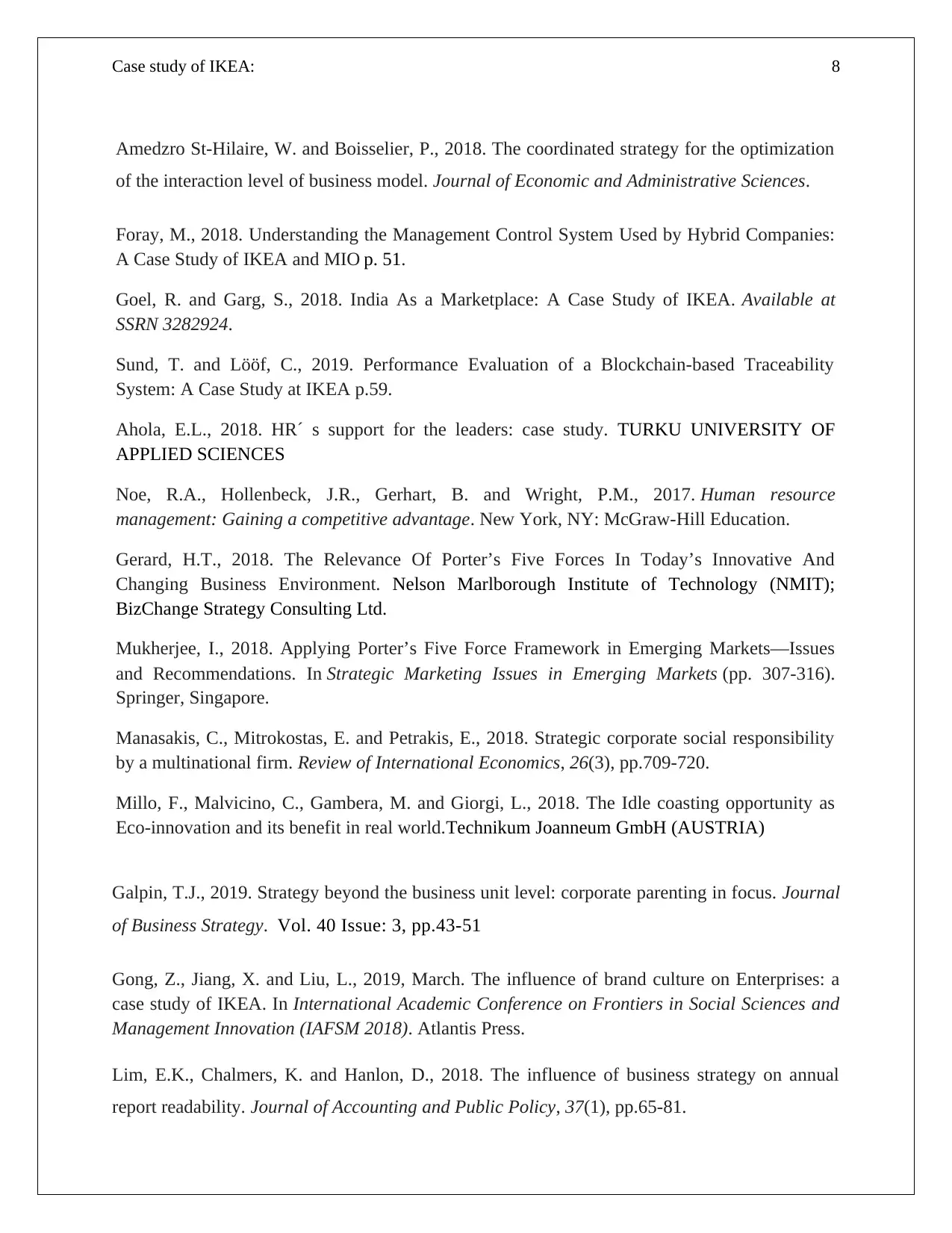
Amedzro St-Hilaire, W. and Boisselier, P., 2018. The coordinated strategy for the optimization
of the interaction level of business model. Journal of Economic and Administrative Sciences.
Foray, M., 2018. Understanding the Management Control System Used by Hybrid Companies:
A Case Study of IKEA and MIO p. 51.
Goel, R. and Garg, S., 2018. India As a Marketplace: A Case Study of IKEA. Available at
SSRN 3282924.
Sund, T. and Lööf, C., 2019. Performance Evaluation of a Blockchain-based Traceability
System: A Case Study at IKEA p.59.
Ahola, E.L., 2018. HR´ s support for the leaders: case study. TURKU UNIVERSITY OF
APPLIED SCIENCES
Noe, R.A., Hollenbeck, J.R., Gerhart, B. and Wright, P.M., 2017. Human resource
management: Gaining a competitive advantage. New York, NY: McGraw-Hill Education.
Gerard, H.T., 2018. The Relevance Of Porter’s Five Forces In Today’s Innovative And
Changing Business Environment. Nelson Marlborough Institute of Technology (NMIT);
BizChange Strategy Consulting Ltd.
Mukherjee, I., 2018. Applying Porter’s Five Force Framework in Emerging Markets—Issues
and Recommendations. In Strategic Marketing Issues in Emerging Markets (pp. 307-316).
Springer, Singapore.
Manasakis, C., Mitrokostas, E. and Petrakis, E., 2018. Strategic corporate social responsibility
by a multinational firm. Review of International Economics, 26(3), pp.709-720.
Millo, F., Malvicino, C., Gambera, M. and Giorgi, L., 2018. The Idle coasting opportunity as
Eco-innovation and its benefit in real world.Technikum Joanneum GmbH (AUSTRIA)
Galpin, T.J., 2019. Strategy beyond the business unit level: corporate parenting in focus. Journal
of Business Strategy. Vol. 40 Issue: 3, pp.43-51
Gong, Z., Jiang, X. and Liu, L., 2019, March. The influence of brand culture on Enterprises: a
case study of IKEA. In International Academic Conference on Frontiers in Social Sciences and
Management Innovation (IAFSM 2018). Atlantis Press.
Lim, E.K., Chalmers, K. and Hanlon, D., 2018. The influence of business strategy on annual
report readability. Journal of Accounting and Public Policy, 37(1), pp.65-81.
Amedzro St-Hilaire, W. and Boisselier, P., 2018. The coordinated strategy for the optimization
of the interaction level of business model. Journal of Economic and Administrative Sciences.
Foray, M., 2018. Understanding the Management Control System Used by Hybrid Companies:
A Case Study of IKEA and MIO p. 51.
Goel, R. and Garg, S., 2018. India As a Marketplace: A Case Study of IKEA. Available at
SSRN 3282924.
Sund, T. and Lööf, C., 2019. Performance Evaluation of a Blockchain-based Traceability
System: A Case Study at IKEA p.59.
Ahola, E.L., 2018. HR´ s support for the leaders: case study. TURKU UNIVERSITY OF
APPLIED SCIENCES
Noe, R.A., Hollenbeck, J.R., Gerhart, B. and Wright, P.M., 2017. Human resource
management: Gaining a competitive advantage. New York, NY: McGraw-Hill Education.
Gerard, H.T., 2018. The Relevance Of Porter’s Five Forces In Today’s Innovative And
Changing Business Environment. Nelson Marlborough Institute of Technology (NMIT);
BizChange Strategy Consulting Ltd.
Mukherjee, I., 2018. Applying Porter’s Five Force Framework in Emerging Markets—Issues
and Recommendations. In Strategic Marketing Issues in Emerging Markets (pp. 307-316).
Springer, Singapore.
Manasakis, C., Mitrokostas, E. and Petrakis, E., 2018. Strategic corporate social responsibility
by a multinational firm. Review of International Economics, 26(3), pp.709-720.
Millo, F., Malvicino, C., Gambera, M. and Giorgi, L., 2018. The Idle coasting opportunity as
Eco-innovation and its benefit in real world.Technikum Joanneum GmbH (AUSTRIA)
Galpin, T.J., 2019. Strategy beyond the business unit level: corporate parenting in focus. Journal
of Business Strategy. Vol. 40 Issue: 3, pp.43-51
Gong, Z., Jiang, X. and Liu, L., 2019, March. The influence of brand culture on Enterprises: a
case study of IKEA. In International Academic Conference on Frontiers in Social Sciences and
Management Innovation (IAFSM 2018). Atlantis Press.
Lim, E.K., Chalmers, K. and Hanlon, D., 2018. The influence of business strategy on annual
report readability. Journal of Accounting and Public Policy, 37(1), pp.65-81.
⊘ This is a preview!⊘
Do you want full access?
Subscribe today to unlock all pages.
Trusted by 1+ million students worldwide
Case study of IKEA: 9
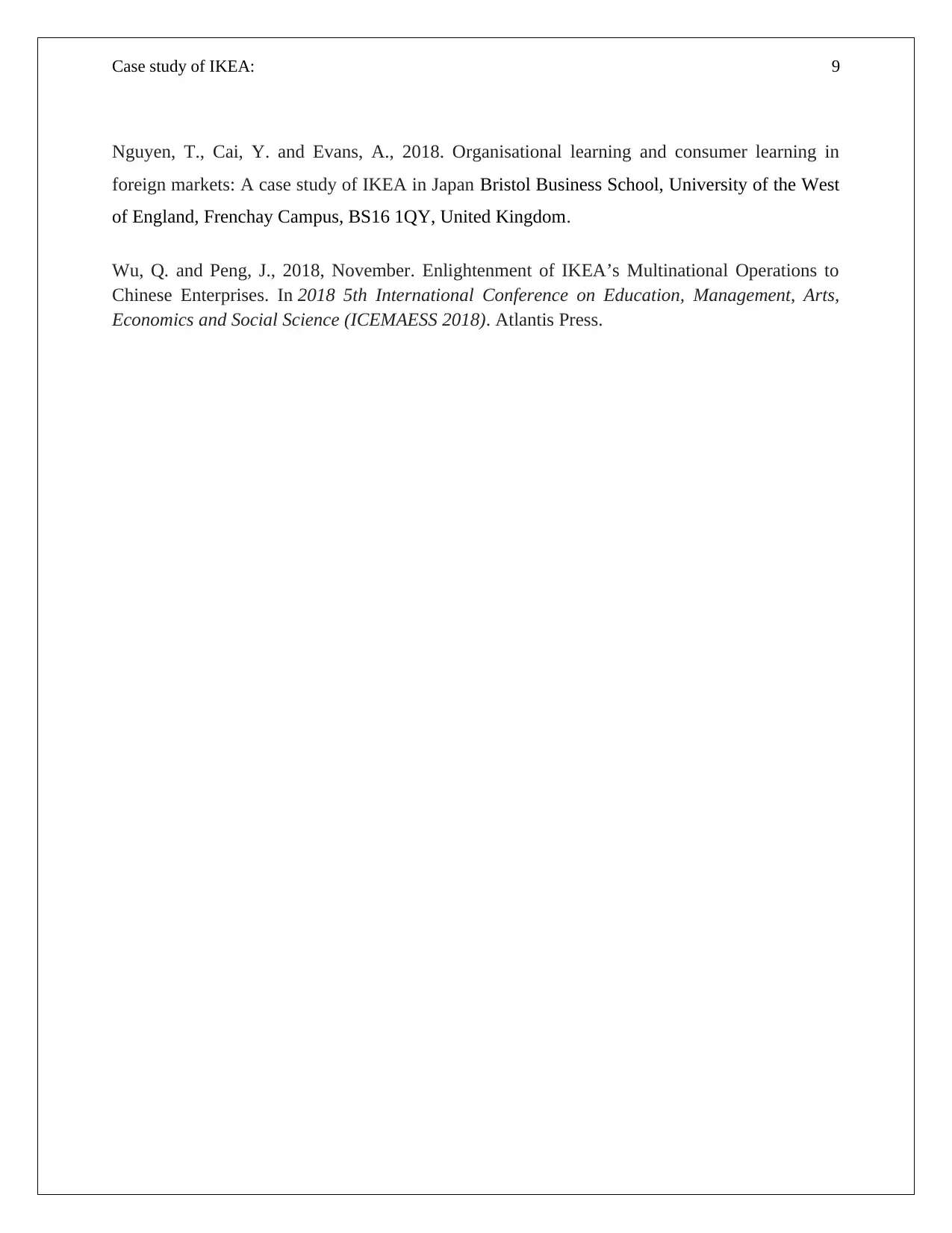
Nguyen, T., Cai, Y. and Evans, A., 2018. Organisational learning and consumer learning in
foreign markets: A case study of IKEA in Japan Bristol Business School, University of the West
of England, Frenchay Campus, BS16 1QY, United Kingdom.
Wu, Q. and Peng, J., 2018, November. Enlightenment of IKEA’s Multinational Operations to
Chinese Enterprises. In 2018 5th International Conference on Education, Management, Arts,
Economics and Social Science (ICEMAESS 2018). Atlantis Press.
Nguyen, T., Cai, Y. and Evans, A., 2018. Organisational learning and consumer learning in
foreign markets: A case study of IKEA in Japan Bristol Business School, University of the West
of England, Frenchay Campus, BS16 1QY, United Kingdom.
Wu, Q. and Peng, J., 2018, November. Enlightenment of IKEA’s Multinational Operations to
Chinese Enterprises. In 2018 5th International Conference on Education, Management, Arts,
Economics and Social Science (ICEMAESS 2018). Atlantis Press.

1 out of 10


Related Documents


Your All-in-One AI-Powered Toolkit for Academic Success.
+13062052269
info@desklib.com
Available 24*7 on WhatsApp / Email
![[object Object]](/_next/static/media/star-bottom.7253800d.svg)
Unlock your academic potential
Copyright © 2020–2026 A2Z Services. All Rights Reserved. Developed and managed by ZUCOL.