Comprehensive Report on IKEA's Stakeholders and Community Engagement
VerifiedAdded on 2021/01/01
|15
|5338
|413
Report
AI Summary
This report provides a detailed analysis of IKEA's stakeholders, including customers, employees, managers, suppliers, the government, and shareholders. It examines the impact of each stakeholder group on IKEA's projects and overall business operations. The report explores the importance of community engagement and communication strategies to maximize the purpose of identified stakeholder groups. It also discusses the prediction of individual stakeholder behavior and proposes contingency plans to mitigate risks, particularly in the context of IKEA's expansion into new markets like India. Furthermore, the report evaluates stakeholder management theories and the role of retailers in reviewing their stakeholder lists and communication methods, providing a comprehensive overview of stakeholder and community engagement strategies for business development.
STAKEHOLDER AND COMMUNITY
ENGAGEMENT
ENGAGEMENT

Paraphrase This Document
Need a fresh take? Get an instant paraphrase of this document with our AI Paraphraser
TABLE OF CONTENTS
INTRODUCTION...........................................................................................................................1
MAIN BODY..................................................................................................................................1
1. Stakeholders of IKEA and stakeholder matrix........................................................................1
2. Prediction of individual stakeholders and proposing contingency plan..................................3
3. Importance of community engagement with appropriate communication strategies to
maximise purpose of identified stakeholder groups....................................................................5
4. Evaluation of stakeholder management theories and role of retailer in reviewing its
stakeholder list and communication methods..............................................................................8
CONCLUSION..............................................................................................................................10
REFERENCES..............................................................................................................................11
INTRODUCTION...........................................................................................................................1
MAIN BODY..................................................................................................................................1
1. Stakeholders of IKEA and stakeholder matrix........................................................................1
2. Prediction of individual stakeholders and proposing contingency plan..................................3
3. Importance of community engagement with appropriate communication strategies to
maximise purpose of identified stakeholder groups....................................................................5
4. Evaluation of stakeholder management theories and role of retailer in reviewing its
stakeholder list and communication methods..............................................................................8
CONCLUSION..............................................................................................................................10
REFERENCES..............................................................................................................................11
INTRODUCTION
Stakeholder is an individual person, group or an organization who will be affected by the
project outcome and they have interest in the success of the project. These individuals are the
sponsors of the project from inside or outside the organization. Community engagement is a
process of collaboration with the community groups to address the issues that have impact on the
wellbeing of those groups.
This report is evaluating about stakeholders of IKEA Company which has influence on
the project. This study is explaining the ways to predict the behavior to manage the risk related to
the stakeholders. The importance of the community engagement for a project and explaining the
stakeholder management theories with the methods of communication with the stake holders.
Overview of Company: IKEA is a Swedish multinational group that designs and sells the
kitchen appliances, ready to assemble furniture and home accessories with other useful products.
IKEA is known for the innovation in furniture design and packaging of products. IKEA is the
one of the largest furniture retailer in the world since 2008.
MAIN BODY
1. Stakeholders of IKEA and stakeholder matrix
According to Schnackenberg and Tomlinson (2016) the customer of the organization are
the most important stakeholders of the company. The policies and strategies decides by the
organization is to attract customer towards the company product. The goal of the company is to
improve the sale of the product and the buyer of the product are the customers. The project is
highly influenced by the customers of the organization. The product development through the
project is designed as per the consumer requirement. The consumer are also the part of the
society and they can be the shareholders of the company. The shareholder can support the
investment of the company in particular project or location
As per view of Bosse and Coughlan (2016) the employees of organization are the most
important stakeholder. The organization is working cause of these employees. Skills and
experience of the employees is the most important thing for the company. These skills and
experience of the employees make the product designs and functionality of furniture more
creative and innovative. The innovation in the company working and procedures are the result of
the creative thinking of the company employee. The projects of the company are dependent on
1
Stakeholder is an individual person, group or an organization who will be affected by the
project outcome and they have interest in the success of the project. These individuals are the
sponsors of the project from inside or outside the organization. Community engagement is a
process of collaboration with the community groups to address the issues that have impact on the
wellbeing of those groups.
This report is evaluating about stakeholders of IKEA Company which has influence on
the project. This study is explaining the ways to predict the behavior to manage the risk related to
the stakeholders. The importance of the community engagement for a project and explaining the
stakeholder management theories with the methods of communication with the stake holders.
Overview of Company: IKEA is a Swedish multinational group that designs and sells the
kitchen appliances, ready to assemble furniture and home accessories with other useful products.
IKEA is known for the innovation in furniture design and packaging of products. IKEA is the
one of the largest furniture retailer in the world since 2008.
MAIN BODY
1. Stakeholders of IKEA and stakeholder matrix
According to Schnackenberg and Tomlinson (2016) the customer of the organization are
the most important stakeholders of the company. The policies and strategies decides by the
organization is to attract customer towards the company product. The goal of the company is to
improve the sale of the product and the buyer of the product are the customers. The project is
highly influenced by the customers of the organization. The product development through the
project is designed as per the consumer requirement. The consumer are also the part of the
society and they can be the shareholders of the company. The shareholder can support the
investment of the company in particular project or location
As per view of Bosse and Coughlan (2016) the employees of organization are the most
important stakeholder. The organization is working cause of these employees. Skills and
experience of the employees is the most important thing for the company. These skills and
experience of the employees make the product designs and functionality of furniture more
creative and innovative. The innovation in the company working and procedures are the result of
the creative thinking of the company employee. The projects of the company are dependent on
1
⊘ This is a preview!⊘
Do you want full access?
Subscribe today to unlock all pages.

Trusted by 1+ million students worldwide
the employees. Employees can influences the projects of the company in both positive and
negative ways.
Miles, (2017) thinks that the managers and owner of the company have huge impact on
the business of the organization. The most of the decision related to the company are taken by
owner and managers of company. This decision can affect the working and production of the
company. Decisions taken by management affects the working procedures and methods of the
company alongside the working of employees and other stakeholders. Managers and owners of
the organization are the stakeholders who manages the working and operation within the
organization. The resources and task allocation for the particular project are managed by
managers and leadership. The procedures and methods used in the project handling are decided
by them. So, the success and the effectiveness of project is dependent on the decision of
management. These impacts can be positive or negative.
According to Daft, (2015) the suppliers are also the stakeholder of the organization. The
raw material is provided by the suppliers which is used by the company to develop the product.
The suppliers have impact on the working and procedure used in the project. The effectiveness of
the project is depended on the quality and the punctuality of the supply. This can have positive
and negative impact on the working on the project.
Barney, (2018) says that the government is also the stakeholder of the organization and it
can also have impact on the projects of company. The rules and regulation made by the
government can minimize the limitations for the project. The company have to follow the rules
and regulations decided by the government. This can either these policies can support the project
or make the implementation process difficult.
Evaluation of Impact of Stakeholder on Project of IKEA
The stakeholders of the organizations are from both inside and outside of the
organization. The stakeholders inside the organization are employees, managers and owner of
IKEA. The stakeholder outside the organization are suppliers, society, government, creditor’s
shareholders and the customers of IKEA. The consumers are the main stake holders of the
organization and in IKEA the products are designed as per the consumer requirement and the
design of the ready to assemble furniture is customer friendly to offer more facility to the
consumer
2
negative ways.
Miles, (2017) thinks that the managers and owner of the company have huge impact on
the business of the organization. The most of the decision related to the company are taken by
owner and managers of company. This decision can affect the working and production of the
company. Decisions taken by management affects the working procedures and methods of the
company alongside the working of employees and other stakeholders. Managers and owners of
the organization are the stakeholders who manages the working and operation within the
organization. The resources and task allocation for the particular project are managed by
managers and leadership. The procedures and methods used in the project handling are decided
by them. So, the success and the effectiveness of project is dependent on the decision of
management. These impacts can be positive or negative.
According to Daft, (2015) the suppliers are also the stakeholder of the organization. The
raw material is provided by the suppliers which is used by the company to develop the product.
The suppliers have impact on the working and procedure used in the project. The effectiveness of
the project is depended on the quality and the punctuality of the supply. This can have positive
and negative impact on the working on the project.
Barney, (2018) says that the government is also the stakeholder of the organization and it
can also have impact on the projects of company. The rules and regulation made by the
government can minimize the limitations for the project. The company have to follow the rules
and regulations decided by the government. This can either these policies can support the project
or make the implementation process difficult.
Evaluation of Impact of Stakeholder on Project of IKEA
The stakeholders of the organizations are from both inside and outside of the
organization. The stakeholders inside the organization are employees, managers and owner of
IKEA. The stakeholder outside the organization are suppliers, society, government, creditor’s
shareholders and the customers of IKEA. The consumers are the main stake holders of the
organization and in IKEA the products are designed as per the consumer requirement and the
design of the ready to assemble furniture is customer friendly to offer more facility to the
consumer
2
Paraphrase This Document
Need a fresh take? Get an instant paraphrase of this document with our AI Paraphraser
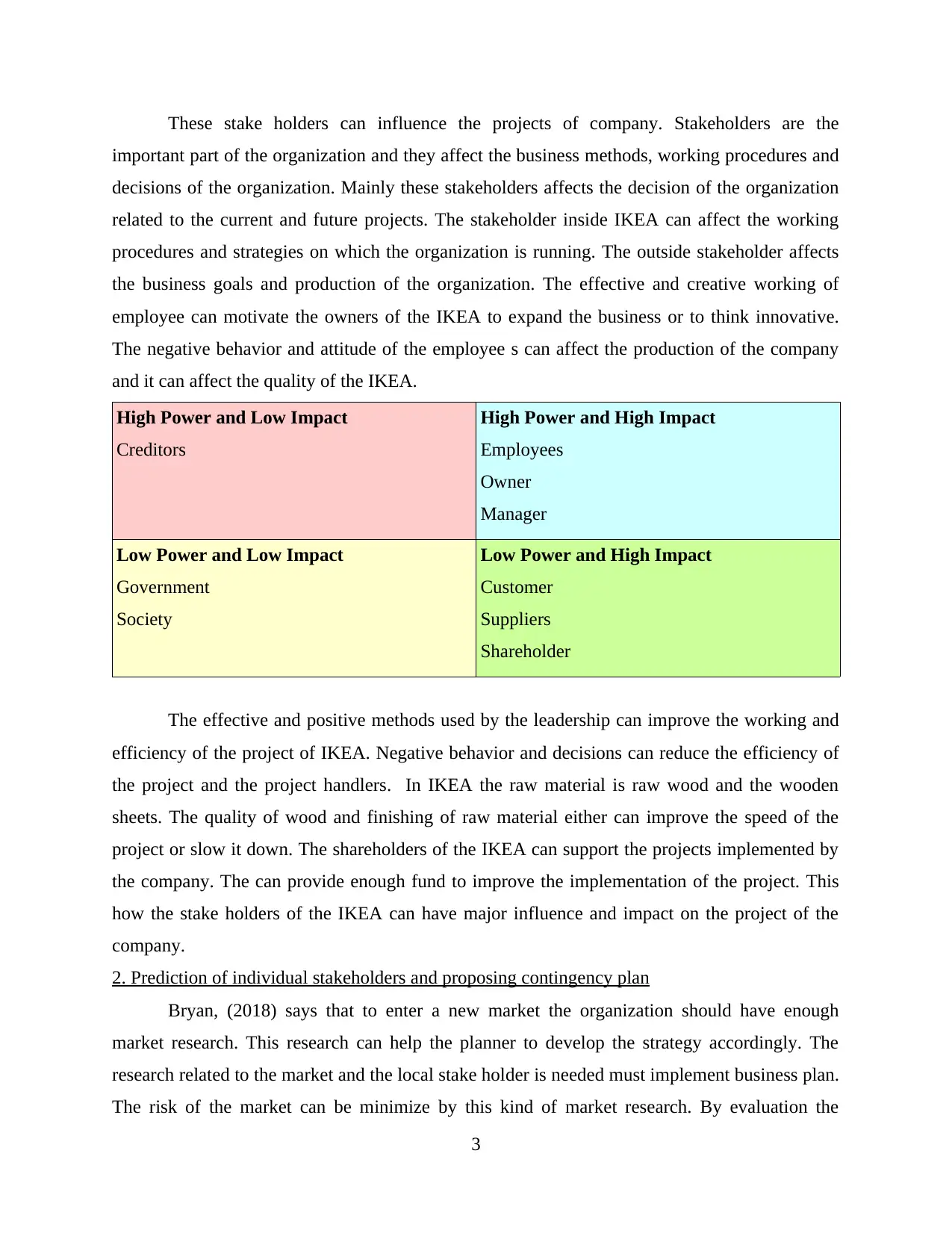
These stake holders can influence the projects of company. Stakeholders are the
important part of the organization and they affect the business methods, working procedures and
decisions of the organization. Mainly these stakeholders affects the decision of the organization
related to the current and future projects. The stakeholder inside IKEA can affect the working
procedures and strategies on which the organization is running. The outside stakeholder affects
the business goals and production of the organization. The effective and creative working of
employee can motivate the owners of the IKEA to expand the business or to think innovative.
The negative behavior and attitude of the employee s can affect the production of the company
and it can affect the quality of the IKEA.
High Power and Low Impact
Creditors
High Power and High Impact
Employees
Owner
Manager
Low Power and Low Impact
Government
Society
Low Power and High Impact
Customer
Suppliers
Shareholder
The effective and positive methods used by the leadership can improve the working and
efficiency of the project of IKEA. Negative behavior and decisions can reduce the efficiency of
the project and the project handlers. In IKEA the raw material is raw wood and the wooden
sheets. The quality of wood and finishing of raw material either can improve the speed of the
project or slow it down. The shareholders of the IKEA can support the projects implemented by
the company. The can provide enough fund to improve the implementation of the project. This
how the stake holders of the IKEA can have major influence and impact on the project of the
company.
2. Prediction of individual stakeholders and proposing contingency plan
Bryan, (2018) says that to enter a new market the organization should have enough
market research. This research can help the planner to develop the strategy accordingly. The
research related to the market and the local stake holder is needed must implement business plan.
The risk of the market can be minimize by this kind of market research. By evaluation the
3
important part of the organization and they affect the business methods, working procedures and
decisions of the organization. Mainly these stakeholders affects the decision of the organization
related to the current and future projects. The stakeholder inside IKEA can affect the working
procedures and strategies on which the organization is running. The outside stakeholder affects
the business goals and production of the organization. The effective and creative working of
employee can motivate the owners of the IKEA to expand the business or to think innovative.
The negative behavior and attitude of the employee s can affect the production of the company
and it can affect the quality of the IKEA.
High Power and Low Impact
Creditors
High Power and High Impact
Employees
Owner
Manager
Low Power and Low Impact
Government
Society
Low Power and High Impact
Customer
Suppliers
Shareholder
The effective and positive methods used by the leadership can improve the working and
efficiency of the project of IKEA. Negative behavior and decisions can reduce the efficiency of
the project and the project handlers. In IKEA the raw material is raw wood and the wooden
sheets. The quality of wood and finishing of raw material either can improve the speed of the
project or slow it down. The shareholders of the IKEA can support the projects implemented by
the company. The can provide enough fund to improve the implementation of the project. This
how the stake holders of the IKEA can have major influence and impact on the project of the
company.
2. Prediction of individual stakeholders and proposing contingency plan
Bryan, (2018) says that to enter a new market the organization should have enough
market research. This research can help the planner to develop the strategy accordingly. The
research related to the market and the local stake holder is needed must implement business plan.
The risk of the market can be minimize by this kind of market research. By evaluation the
3
behaviour of the stakeholder can help the business planner to develop the implementation plan to
minimize the risk related to the stake holders. The other factor is the contingency measures are
also useful for the company to keep the conditions under control when the implementation plan
of company backfires. The consequences can be minimized by contingency measures before
entering a new market. The stake holder who is supporting the business project can help the
organizational to implement the project for the new location. The uncertain stake holder can put
under monitoring to prevent the backfiring of the project. This how the company can use the
contingency plan to start a business in new market.
According to Andriof and Waddock, (2017) IKEA is known for its furniture products.
The IKEA is the largest organization which is providing different kind of attractive and flexible
furniture to customers. IKEA is performing the business in the all over the world except the
south East Asia. IKEA was not in India till year 2018. The furniture market of India is different
from the European and other part of the world. The people of India use the furniture for multiple
operation. To establish the business in the different market is challenge. The project of
establishing the business in different market can be risky for the company. The stakeholder in the
target is can be different from the previous market. The uncertainty of the stakeholder can put the
whole project in danger.
As per view of Hayibor, (2017) to establish a company in a new market is difficult. To
develop a new business the company need to evaluate the local condition conditions and develop
the plan accordingly. This can be helpful for the business owners to plan a strategy to enter the
new market. In the new market there are different kinds of risks which can lead to the failure of
the initial plan and this is not good for the company to face the economical failure in new market
places. This can also damage the brand image of the company. To comer over it the company
can develop a contingency plan as plan B in case of failure of main plan.
Case scenario:
It is clear that IKEA has carved its name as the furniture retailer of the world since 2008
and has consistently expanding its operations and gaining diversified perspectives among the
audience ad stakeholders. When this company decided to establish its operations in India, it was
evident that this country's geographic and demographics vary from other operational countries
like Portugal, China, Australia, Sweden and more. Therefore, it took almost 12 years of planning
to open IKEA's first store in India (Tronvoll and et.al., 2019). Before divulging details on the
4
minimize the risk related to the stake holders. The other factor is the contingency measures are
also useful for the company to keep the conditions under control when the implementation plan
of company backfires. The consequences can be minimized by contingency measures before
entering a new market. The stake holder who is supporting the business project can help the
organizational to implement the project for the new location. The uncertain stake holder can put
under monitoring to prevent the backfiring of the project. This how the company can use the
contingency plan to start a business in new market.
According to Andriof and Waddock, (2017) IKEA is known for its furniture products.
The IKEA is the largest organization which is providing different kind of attractive and flexible
furniture to customers. IKEA is performing the business in the all over the world except the
south East Asia. IKEA was not in India till year 2018. The furniture market of India is different
from the European and other part of the world. The people of India use the furniture for multiple
operation. To establish the business in the different market is challenge. The project of
establishing the business in different market can be risky for the company. The stakeholder in the
target is can be different from the previous market. The uncertainty of the stakeholder can put the
whole project in danger.
As per view of Hayibor, (2017) to establish a company in a new market is difficult. To
develop a new business the company need to evaluate the local condition conditions and develop
the plan accordingly. This can be helpful for the business owners to plan a strategy to enter the
new market. In the new market there are different kinds of risks which can lead to the failure of
the initial plan and this is not good for the company to face the economical failure in new market
places. This can also damage the brand image of the company. To comer over it the company
can develop a contingency plan as plan B in case of failure of main plan.
Case scenario:
It is clear that IKEA has carved its name as the furniture retailer of the world since 2008
and has consistently expanding its operations and gaining diversified perspectives among the
audience ad stakeholders. When this company decided to establish its operations in India, it was
evident that this country's geographic and demographics vary from other operational countries
like Portugal, China, Australia, Sweden and more. Therefore, it took almost 12 years of planning
to open IKEA's first store in India (Tronvoll and et.al., 2019). Before divulging details on the
4
⊘ This is a preview!⊘
Do you want full access?
Subscribe today to unlock all pages.
Trusted by 1+ million students worldwide
rich architecture and extreme facilities and accurate pricing strategies adopted by IKEA to
inaugurate its store in Hyderabad, one must know that the stakeholders were not supportive
towards this plan of action. Along with this, the contingency measures and the risk mitigating
management helped the project team of IKEA to take decisions that proved advantageous.
In addition to this, the risks were minimised due to the detailed planning of opening the
store. The location was chosen due to the welcoming support from the state government and also
proposed to open a metro station in order to target the customers'. Moreover, the government
took this as an opportunity for employment and facilitate in becoming a potential supplier of
furniture including mattresses, sofas etc. Nevertheless, the aim was to gain proper responses
since IKEA failed initially and missed the pricing strategy when trying to expand in China,
Australia etc. They employed a huge ground staff and implemented the unique strategy of DIY
(Do it Yourself) where the customers were given a platform to create a product using the
dismantled forms (Thomsen, 2018).
Critical Analysis
The impact of this scenario is to gain an understanding regarding the role of stakeholders
in the form of local suppliers who were impressed with the marketing and sales strategy of IKEA
when inaugurated their first ever store at Hyderabad. The suppliers were Home stop, Future
Groups, Home centre etc. who collaborated with them and in an indirect pathway, IKEA gained
their customers ad increased their businesses without using any other means (Li, 2018). This not
only minimised the additional risks of competing with the already established brands like Urban
Ladder, Godrej Interior etc. but helped them to enter the Indian markets through multi channels
which gained the attention of the buyers' and the leading investors.
Consequently, IKEA also focused on using the contingency measures in terms of
changing the pricing strategy on the basis of accessibility and affordability. Its purpose to use
sustainable products help the customer to move towards eco-friendly perspectives which make
them again come and use the products they provide to them. However, they must focus to build a
customer centric online platform due to growing competition from e-commerce companies like
Amazon, Flip-Kart etc. (Ghauri and Elg, 2018) Thus, IKEA must plan a robust framework to
maintain its quality and enhance the delivery services to attract the customers and must also
restructure the warehousing and other structures in accordance to the weather conditions of the
particular country for longer terms of success.
5
inaugurate its store in Hyderabad, one must know that the stakeholders were not supportive
towards this plan of action. Along with this, the contingency measures and the risk mitigating
management helped the project team of IKEA to take decisions that proved advantageous.
In addition to this, the risks were minimised due to the detailed planning of opening the
store. The location was chosen due to the welcoming support from the state government and also
proposed to open a metro station in order to target the customers'. Moreover, the government
took this as an opportunity for employment and facilitate in becoming a potential supplier of
furniture including mattresses, sofas etc. Nevertheless, the aim was to gain proper responses
since IKEA failed initially and missed the pricing strategy when trying to expand in China,
Australia etc. They employed a huge ground staff and implemented the unique strategy of DIY
(Do it Yourself) where the customers were given a platform to create a product using the
dismantled forms (Thomsen, 2018).
Critical Analysis
The impact of this scenario is to gain an understanding regarding the role of stakeholders
in the form of local suppliers who were impressed with the marketing and sales strategy of IKEA
when inaugurated their first ever store at Hyderabad. The suppliers were Home stop, Future
Groups, Home centre etc. who collaborated with them and in an indirect pathway, IKEA gained
their customers ad increased their businesses without using any other means (Li, 2018). This not
only minimised the additional risks of competing with the already established brands like Urban
Ladder, Godrej Interior etc. but helped them to enter the Indian markets through multi channels
which gained the attention of the buyers' and the leading investors.
Consequently, IKEA also focused on using the contingency measures in terms of
changing the pricing strategy on the basis of accessibility and affordability. Its purpose to use
sustainable products help the customer to move towards eco-friendly perspectives which make
them again come and use the products they provide to them. However, they must focus to build a
customer centric online platform due to growing competition from e-commerce companies like
Amazon, Flip-Kart etc. (Ghauri and Elg, 2018) Thus, IKEA must plan a robust framework to
maintain its quality and enhance the delivery services to attract the customers and must also
restructure the warehousing and other structures in accordance to the weather conditions of the
particular country for longer terms of success.
5
Paraphrase This Document
Need a fresh take? Get an instant paraphrase of this document with our AI Paraphraser
Henceforth, companies like IKEA must adopt some strategic planning to minimise the
challenges and the uncertainties related to setting up of stores or warehousing operations in other
countries. The management must adopt an open end communication channels for making the
stakeholders understand the project plan and the associated deliverables to build trust. In
addition, they must also follow ethical code of conduct and legal policies to establish the
operational activities in transparent manner for the stakeholders who might oppose the ideas or
concepts. This would make the entire organizational framework flexible and reliable to
overcome the risks and bring solutions in sustainable manner to maintain the reputation and curb
any damages that might take place to the unwarranted or unregulated practices.
3. Importance of community engagement with appropriate communication strategies to
maximise purpose of identified stakeholder groups
Community engagement refers to a process in which people focus on working
collaboratively with other groups of community to solve the issues and conflicts that are arises in
between achieving business objectives. Activities and events help management team of IKEA to
engage community people to make decision process easier and efficient. As per view of (Barnes
and Schmitz, 2016) community engagement increase the trust between organization and
employees. Their desire are heard by management team of IKEA can try to fulfill their needs to
make employee relation better. Group of employees are engaged in their work which results in
reduction of issues. Organizational leaders need to increase the area to understand the
responsibilities and roles of stakeholders to be supportive and collaborative.
As per view of Lam (2016), stakeholders role is crucial in organization for engaging
communities. Collaborative working is a support for employees to have success in their work
performance. Community engagement is important to align objectives of project on the basis of
priorities. Managing plans to do project accordingy so that they can finish on time. This becomes
a challenging task for employees in IKEA to manage time and involved in working together to
get efficient results. This will result in good employee relation. Community engagement also
motivates employees to increase their interest to do work. Work based on priorities will help
employees to engage in work accordingly to have the best outcomes. Instant changes makes
6
challenges and the uncertainties related to setting up of stores or warehousing operations in other
countries. The management must adopt an open end communication channels for making the
stakeholders understand the project plan and the associated deliverables to build trust. In
addition, they must also follow ethical code of conduct and legal policies to establish the
operational activities in transparent manner for the stakeholders who might oppose the ideas or
concepts. This would make the entire organizational framework flexible and reliable to
overcome the risks and bring solutions in sustainable manner to maintain the reputation and curb
any damages that might take place to the unwarranted or unregulated practices.
3. Importance of community engagement with appropriate communication strategies to
maximise purpose of identified stakeholder groups
Community engagement refers to a process in which people focus on working
collaboratively with other groups of community to solve the issues and conflicts that are arises in
between achieving business objectives. Activities and events help management team of IKEA to
engage community people to make decision process easier and efficient. As per view of (Barnes
and Schmitz, 2016) community engagement increase the trust between organization and
employees. Their desire are heard by management team of IKEA can try to fulfill their needs to
make employee relation better. Group of employees are engaged in their work which results in
reduction of issues. Organizational leaders need to increase the area to understand the
responsibilities and roles of stakeholders to be supportive and collaborative.
As per view of Lam (2016), stakeholders role is crucial in organization for engaging
communities. Collaborative working is a support for employees to have success in their work
performance. Community engagement is important to align objectives of project on the basis of
priorities. Managing plans to do project accordingy so that they can finish on time. This becomes
a challenging task for employees in IKEA to manage time and involved in working together to
get efficient results. This will result in good employee relation. Community engagement also
motivates employees to increase their interest to do work. Work based on priorities will help
employees to engage in work accordingly to have the best outcomes. Instant changes makes
6
group irritated and decrease their efficiency to do work. Working together gives creative thinking
ideas to solve the problems and issues. This also saves time to achieve business objectives. IKEA
focused on engaging employees at initial level only so that they get to know the importance of
collaborative working.
Dessart, Veloutsou and Morgan-Thomas (2015) suggest that community engagement is
important in increasing skills of employees. Different activities and events are organized by
management team of IKEA to have involvement of employees. Active participation will increase
interaction power of employees and results in open communication. This will lead to efficient
transfer of information form one employee to other employee. Transferring information will
increase their skills and intelligence to have creative thinking. One employee makes learn to
other employee about new technologies. This makes employee engage in their work and to
acquire new techniques to improve their work performance. It will helpful in making strategies
and plans to enhance the development of organization. Project is easily managed by efficient
process of sharing information and issues are solved at initial level only.
Dumlao (2018) defines the communication strategy that will increase the efficiency of
stakeholders. Community engagement involves strategies for communication to have sharing of
information in transparent way. Honestly sharing information to all members of team will result
in positive outcome as compared to other strategies. Attitude is very important in having
effective communication. Different stakeholders keep an open attitude to make employees
comfortable for sharing information and issues that they are dealing with. It will helpful in
understanding concern of different stakeholders. This will align their area of interest and helps
stakeholders to make decisions in favour of other communities. If at initial level only, issues are
known, then it will be easier for stakeholder to address them and makes profit for IKEA.
Stakeholder gets chance to coordinate employees in efficient way and to guide the w\right way
for achieving targets and goals.
Goodman (2017) says about channels that are used for communication in industry. There
are different channels that are present in IKEA for sharing information and to have interaction.
Mails are found to be official the best way to spread information in industry. Different
stakeholders in IKEA are authorized with their official mail Id where other stakeholders can
share information. This is also beneficial in getting record of information for the future purpose
to have sustainability in workplace. Other channels of communication are to use social media
7
ideas to solve the problems and issues. This also saves time to achieve business objectives. IKEA
focused on engaging employees at initial level only so that they get to know the importance of
collaborative working.
Dessart, Veloutsou and Morgan-Thomas (2015) suggest that community engagement is
important in increasing skills of employees. Different activities and events are organized by
management team of IKEA to have involvement of employees. Active participation will increase
interaction power of employees and results in open communication. This will lead to efficient
transfer of information form one employee to other employee. Transferring information will
increase their skills and intelligence to have creative thinking. One employee makes learn to
other employee about new technologies. This makes employee engage in their work and to
acquire new techniques to improve their work performance. It will helpful in making strategies
and plans to enhance the development of organization. Project is easily managed by efficient
process of sharing information and issues are solved at initial level only.
Dumlao (2018) defines the communication strategy that will increase the efficiency of
stakeholders. Community engagement involves strategies for communication to have sharing of
information in transparent way. Honestly sharing information to all members of team will result
in positive outcome as compared to other strategies. Attitude is very important in having
effective communication. Different stakeholders keep an open attitude to make employees
comfortable for sharing information and issues that they are dealing with. It will helpful in
understanding concern of different stakeholders. This will align their area of interest and helps
stakeholders to make decisions in favour of other communities. If at initial level only, issues are
known, then it will be easier for stakeholder to address them and makes profit for IKEA.
Stakeholder gets chance to coordinate employees in efficient way and to guide the w\right way
for achieving targets and goals.
Goodman (2017) says about channels that are used for communication in industry. There
are different channels that are present in IKEA for sharing information and to have interaction.
Mails are found to be official the best way to spread information in industry. Different
stakeholders in IKEA are authorized with their official mail Id where other stakeholders can
share information. This is also beneficial in getting record of information for the future purpose
to have sustainability in workplace. Other channels of communication are to use social media
7
⊘ This is a preview!⊘
Do you want full access?
Subscribe today to unlock all pages.
Trusted by 1+ million students worldwide
and online platforms. These online based channels are effective in sharing information to operate
globally. IKEA is a multinational company which operates globally. Therefore, online platform
is the best channel to have communication and sharing of information regarding problems and
issues. It did not consume time and efficient in getting instant response.
According to Douglas, (2017) consistent meetings are analysed as a good channel to
make decisions. Different stakeholders who are operating IKEA globally need to meet in a
meeting for discussing achievements, problems and solutions. Face to face interaction is better
than other forms of channels it clears all queries at a time only. This saves time and to have
healthier discussion to n\make decisions easily.
Critical evaluation
It has been evaluated that community engagement has most important role in
organization. This makes employee motivated and trusted towards organization. Motivate
employee has an efficient potential to improve their work performance as compared to
demotivate one. IKEA organized activities and events that are beneficial for making employee
engaged in their work. One most effective factor is found in community engagement is to have
collaborative working nature. This approach to work together increases potential and interest. It
is also helpful in solving problems and issues that are get occurred in between process of achieve
business objectives. It is also evaluated that community engagement is effective in increasing
skills of employees. Working together will take innovating nature which increases creative
thinking skills to manage work efficiently according to their priority.
Community engagement involves communication strategies that will helpful in work
place to increase the open communication. By this, sharing of information can be taken place
easily and helps in making decisions to stakeholders. To take instant decisions is main
responsibility of stakeholders to achieve business objectives on time. Therefore, regular meetings
are held by IKEA to discuss the issue and achievements that are rising in industry. This strategy
is effective in having open communication and sharing information. Different channels like
online platforms are adopted by IKEA to have efficient process of solving queries instantly. This
makes community engagement better.
8
globally. IKEA is a multinational company which operates globally. Therefore, online platform
is the best channel to have communication and sharing of information regarding problems and
issues. It did not consume time and efficient in getting instant response.
According to Douglas, (2017) consistent meetings are analysed as a good channel to
make decisions. Different stakeholders who are operating IKEA globally need to meet in a
meeting for discussing achievements, problems and solutions. Face to face interaction is better
than other forms of channels it clears all queries at a time only. This saves time and to have
healthier discussion to n\make decisions easily.
Critical evaluation
It has been evaluated that community engagement has most important role in
organization. This makes employee motivated and trusted towards organization. Motivate
employee has an efficient potential to improve their work performance as compared to
demotivate one. IKEA organized activities and events that are beneficial for making employee
engaged in their work. One most effective factor is found in community engagement is to have
collaborative working nature. This approach to work together increases potential and interest. It
is also helpful in solving problems and issues that are get occurred in between process of achieve
business objectives. It is also evaluated that community engagement is effective in increasing
skills of employees. Working together will take innovating nature which increases creative
thinking skills to manage work efficiently according to their priority.
Community engagement involves communication strategies that will helpful in work
place to increase the open communication. By this, sharing of information can be taken place
easily and helps in making decisions to stakeholders. To take instant decisions is main
responsibility of stakeholders to achieve business objectives on time. Therefore, regular meetings
are held by IKEA to discuss the issue and achievements that are rising in industry. This strategy
is effective in having open communication and sharing information. Different channels like
online platforms are adopted by IKEA to have efficient process of solving queries instantly. This
makes community engagement better.
8
Paraphrase This Document
Need a fresh take? Get an instant paraphrase of this document with our AI Paraphraser
4. Evaluation of stakeholder management theories and role of retailer in reviewing its
stakeholder list and communication methods
The stakeholder management is beneficial in engaging the stakeholders on same and
equal levels through adopting ethical code of practices. A Retailer is the one who purchase goods
from distributor, manufacturer or wholesaler and sell it to the customers. For instance, IKEA has
collaborated with UrbanClap in India for delivery and assembly services to their customers after
booking furniture.
In accordance to the Jones, Wicks and Freeman, (2017) the stakeholder theory is one of
the approaches to deal with the organisational management and work ethics to fulfil the
requirements. It focuses on analysing the values, morals and code of conduct to maintain the
positive relationships between the organization's management and its shareholders consisting of
employees, investors, suppliers, customers and others. Moreover, the impact of a stakeholder is
crucial for completion of any project to provide goods and services to the customers'. There is
also need to create value for the stakeholders' to establish interconnected relationships by
following the key principles to maintain profit generation in terms of economic and
technological factors.
Additionally, Cordeiro and Tewari (2015) proposed the stakeholder theory to understand
the ethics and organizational management of company. Their participation is crucial for decision
making for smooth running of operational activities. Nevertheless, it helps in exploring the
unethical dilemmas which supports in analysing the potential outcomes for fulfilling the statutory
instructions. It emphasis on both the advantages and disadvantages of role of retailers who is
treated as an important stakeholder. Retailers have influenced the greater productivity levels
while dealing with the people in the logistics and supply chain departments and has substantial
role for implementation of strategic planning. The negative aspect is the disagreement where the
different stakeholders have different interests and this leads to an imbalance in the consistencies
of the work allocation and resources utilization.
According to Tantalo and Priem (2016) the retailers are the bridge between the
company's brand value and the customers. They must communicate with their stakeholders to
understand the overall influence on the operations and working practices of the company. These
stakeholders support in maintaining the quality and delivery of services through indirect means
and establish a reputation of the organization. The contribution of stakeholders depends upon
9
stakeholder list and communication methods
The stakeholder management is beneficial in engaging the stakeholders on same and
equal levels through adopting ethical code of practices. A Retailer is the one who purchase goods
from distributor, manufacturer or wholesaler and sell it to the customers. For instance, IKEA has
collaborated with UrbanClap in India for delivery and assembly services to their customers after
booking furniture.
In accordance to the Jones, Wicks and Freeman, (2017) the stakeholder theory is one of
the approaches to deal with the organisational management and work ethics to fulfil the
requirements. It focuses on analysing the values, morals and code of conduct to maintain the
positive relationships between the organization's management and its shareholders consisting of
employees, investors, suppliers, customers and others. Moreover, the impact of a stakeholder is
crucial for completion of any project to provide goods and services to the customers'. There is
also need to create value for the stakeholders' to establish interconnected relationships by
following the key principles to maintain profit generation in terms of economic and
technological factors.
Additionally, Cordeiro and Tewari (2015) proposed the stakeholder theory to understand
the ethics and organizational management of company. Their participation is crucial for decision
making for smooth running of operational activities. Nevertheless, it helps in exploring the
unethical dilemmas which supports in analysing the potential outcomes for fulfilling the statutory
instructions. It emphasis on both the advantages and disadvantages of role of retailers who is
treated as an important stakeholder. Retailers have influenced the greater productivity levels
while dealing with the people in the logistics and supply chain departments and has substantial
role for implementation of strategic planning. The negative aspect is the disagreement where the
different stakeholders have different interests and this leads to an imbalance in the consistencies
of the work allocation and resources utilization.
According to Tantalo and Priem (2016) the retailers are the bridge between the
company's brand value and the customers. They must communicate with their stakeholders to
understand the overall influence on the operations and working practices of the company. These
stakeholders support in maintaining the quality and delivery of services through indirect means
and establish a reputation of the organization. The contribution of stakeholders depends upon
9
the type of stakeholders and their management that includes both internal and external
stakeholders. Their impact is omnipresent on the brand value and in the eyes of the retailers and
assist the company to flourish under ethical standards. Thus, retailers must have stakeholders' list
to know about the company's or product's segmentation in the targeted markets.
In regard to the same, Chiu and Wang (2015) critiqued that the presence of stakeholders
is important but their contribution do not help in the maintenance of financial gains or brand
image in the marketplaces. However, it further emphasized on the levels of powers and interests
of stakeholders for the survival of product or service to balance the workplace environment.
Additionally, Andriof and et.al. (2017) shed light on another factor that is communication which
helps in gaining knowledge about their presence on company's decision making. Herein, it is
clearly demonstrated that it must be done via using transparent and coherent channels for
interaction. Tools like emails, texts, bots etc. help in mapping of priorities and highlighted the
need to interact with the stakeholders to maintain tryst, commitment with loyalty. Along with, a
basic understanding is required to complete the work at the right time, format and audience.
Critical Analysis
IKEA has mainly reached the top most positioning in the retailing sector for more than a
decade now and has successfully achieved the loyal customer base. Its major agenda is to expand
and grow its operations through reaching the sustainability factor under corporate social
responsibility. The complete evaluation and examination of this company's management to
explore the relevancy of the management theory and role of stakeholders' list to connect with
them on direct modes is necessary (Miles, 2017). For instance, BWI has a long standing
partnership with IKEA and share long term co-operation for promoting the sustainable and
organic materials like forestry products, bamboo, wood etc. It is a Global Union Federation of
Democratic and Free Trade Unions and given protection to more than 12 million members with
350 trade unions. Together these two organizations promote social responsibility and
maintaining the ethical code of practices to bring balance at workplace.
Moreover, the methods of communication used here are diversified and contains image
and silent communication, paper based communication and communication channels like
webinar, webcasts, phone, fax, emails, reports etc. These channels are beneficial in establishing
consistent ties to do business appropriately. For e.g. BSR has representation from IKEA on the
board and from time to time, it takes up initiatives and inputs as well to bring positive and
10
stakeholders. Their impact is omnipresent on the brand value and in the eyes of the retailers and
assist the company to flourish under ethical standards. Thus, retailers must have stakeholders' list
to know about the company's or product's segmentation in the targeted markets.
In regard to the same, Chiu and Wang (2015) critiqued that the presence of stakeholders
is important but their contribution do not help in the maintenance of financial gains or brand
image in the marketplaces. However, it further emphasized on the levels of powers and interests
of stakeholders for the survival of product or service to balance the workplace environment.
Additionally, Andriof and et.al. (2017) shed light on another factor that is communication which
helps in gaining knowledge about their presence on company's decision making. Herein, it is
clearly demonstrated that it must be done via using transparent and coherent channels for
interaction. Tools like emails, texts, bots etc. help in mapping of priorities and highlighted the
need to interact with the stakeholders to maintain tryst, commitment with loyalty. Along with, a
basic understanding is required to complete the work at the right time, format and audience.
Critical Analysis
IKEA has mainly reached the top most positioning in the retailing sector for more than a
decade now and has successfully achieved the loyal customer base. Its major agenda is to expand
and grow its operations through reaching the sustainability factor under corporate social
responsibility. The complete evaluation and examination of this company's management to
explore the relevancy of the management theory and role of stakeholders' list to connect with
them on direct modes is necessary (Miles, 2017). For instance, BWI has a long standing
partnership with IKEA and share long term co-operation for promoting the sustainable and
organic materials like forestry products, bamboo, wood etc. It is a Global Union Federation of
Democratic and Free Trade Unions and given protection to more than 12 million members with
350 trade unions. Together these two organizations promote social responsibility and
maintaining the ethical code of practices to bring balance at workplace.
Moreover, the methods of communication used here are diversified and contains image
and silent communication, paper based communication and communication channels like
webinar, webcasts, phone, fax, emails, reports etc. These channels are beneficial in establishing
consistent ties to do business appropriately. For e.g. BSR has representation from IKEA on the
board and from time to time, it takes up initiatives and inputs as well to bring positive and
10
⊘ This is a preview!⊘
Do you want full access?
Subscribe today to unlock all pages.
Trusted by 1+ million students worldwide

1 out of 15


Related Documents


Your All-in-One AI-Powered Toolkit for Academic Success.
+13062052269
info@desklib.com
Available 24*7 on WhatsApp / Email
![[object Object]](/_next/static/media/star-bottom.7253800d.svg)
Unlock your academic potential
Copyright © 2020–2026 A2Z Services. All Rights Reserved. Developed and managed by ZUCOL.