Management and Operation Report: Leadership, Roles, and Theories
VerifiedAdded on 2023/01/19
|16
|3435
|64
Report
AI Summary
This report provides an in-depth analysis of management and operations, focusing on the context of IKEA. It begins by defining the roles and characteristics of leaders and managers, differentiating between their responsibilities and functions. The report then explores various leadership theories, including situational and system leadership, and their application within an organizational setting. Furthermore, it examines different approaches to operations management, such as Total Quality Management (TQM), Just in Time inventory, and continuous improvement (Kaizen), highlighting their importance in enhancing efficiency and reducing costs. The report also discusses the significance of operations management in improving product quality, reducing waste, and increasing revenue. Overall, the report offers a comprehensive overview of management strategies and their impact on achieving business objectives within IKEA.
MANAGEMENT AND OPERATION

Paraphrase This Document
Need a fresh take? Get an instant paraphrase of this document with our AI Paraphraser
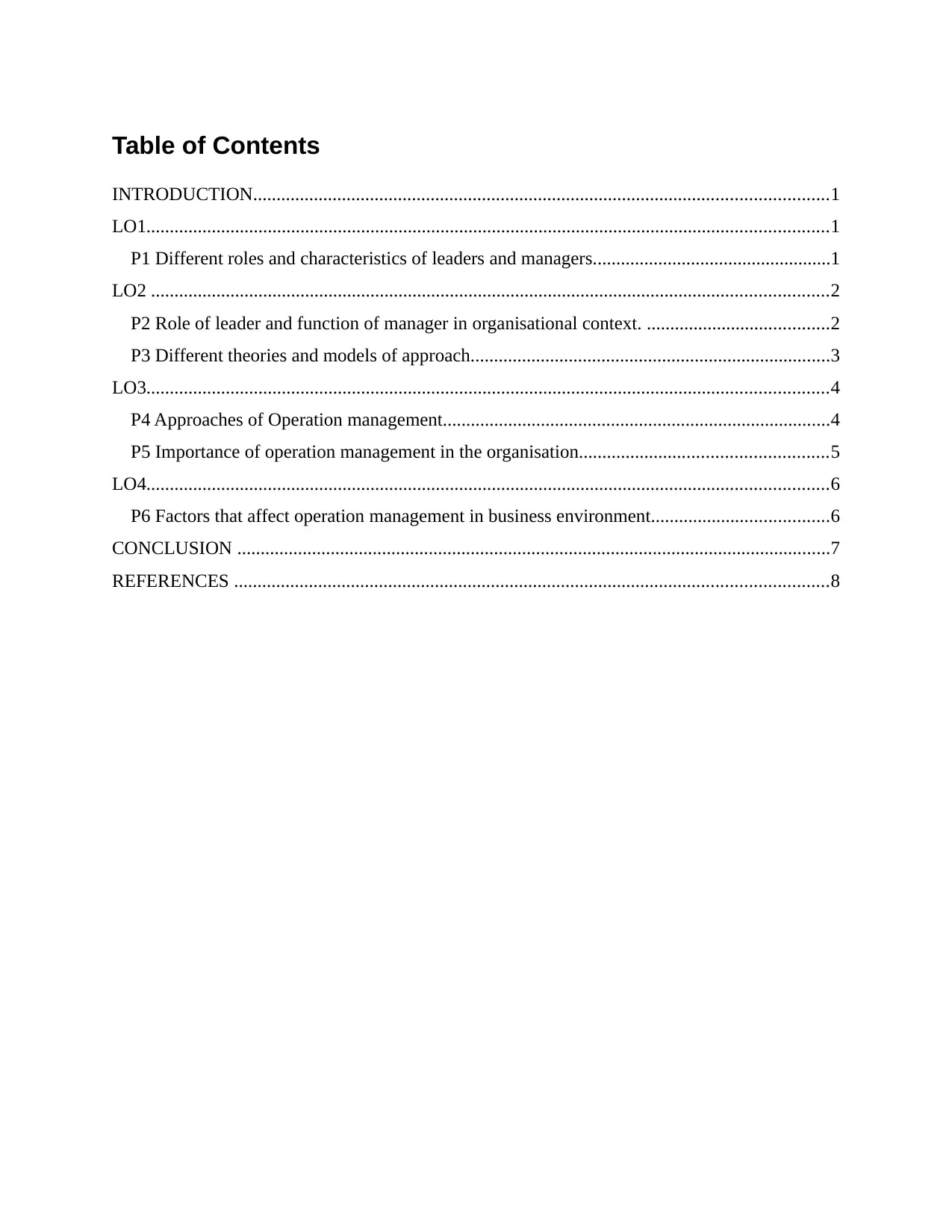
Table of Contents
INTRODUCTION...........................................................................................................................1
LO1..................................................................................................................................................1
P1 Different roles and characteristics of leaders and managers...................................................1
LO2 .................................................................................................................................................2
P2 Role of leader and function of manager in organisational context. .......................................2
P3 Different theories and models of approach.............................................................................3
LO3..................................................................................................................................................4
P4 Approaches of Operation management...................................................................................4
P5 Importance of operation management in the organisation.....................................................5
LO4..................................................................................................................................................6
P6 Factors that affect operation management in business environment......................................6
CONCLUSION ...............................................................................................................................7
REFERENCES ...............................................................................................................................8
INTRODUCTION...........................................................................................................................1
LO1..................................................................................................................................................1
P1 Different roles and characteristics of leaders and managers...................................................1
LO2 .................................................................................................................................................2
P2 Role of leader and function of manager in organisational context. .......................................2
P3 Different theories and models of approach.............................................................................3
LO3..................................................................................................................................................4
P4 Approaches of Operation management...................................................................................4
P5 Importance of operation management in the organisation.....................................................5
LO4..................................................................................................................................................6
P6 Factors that affect operation management in business environment......................................6
CONCLUSION ...............................................................................................................................7
REFERENCES ...............................................................................................................................8
INTRODUCTION
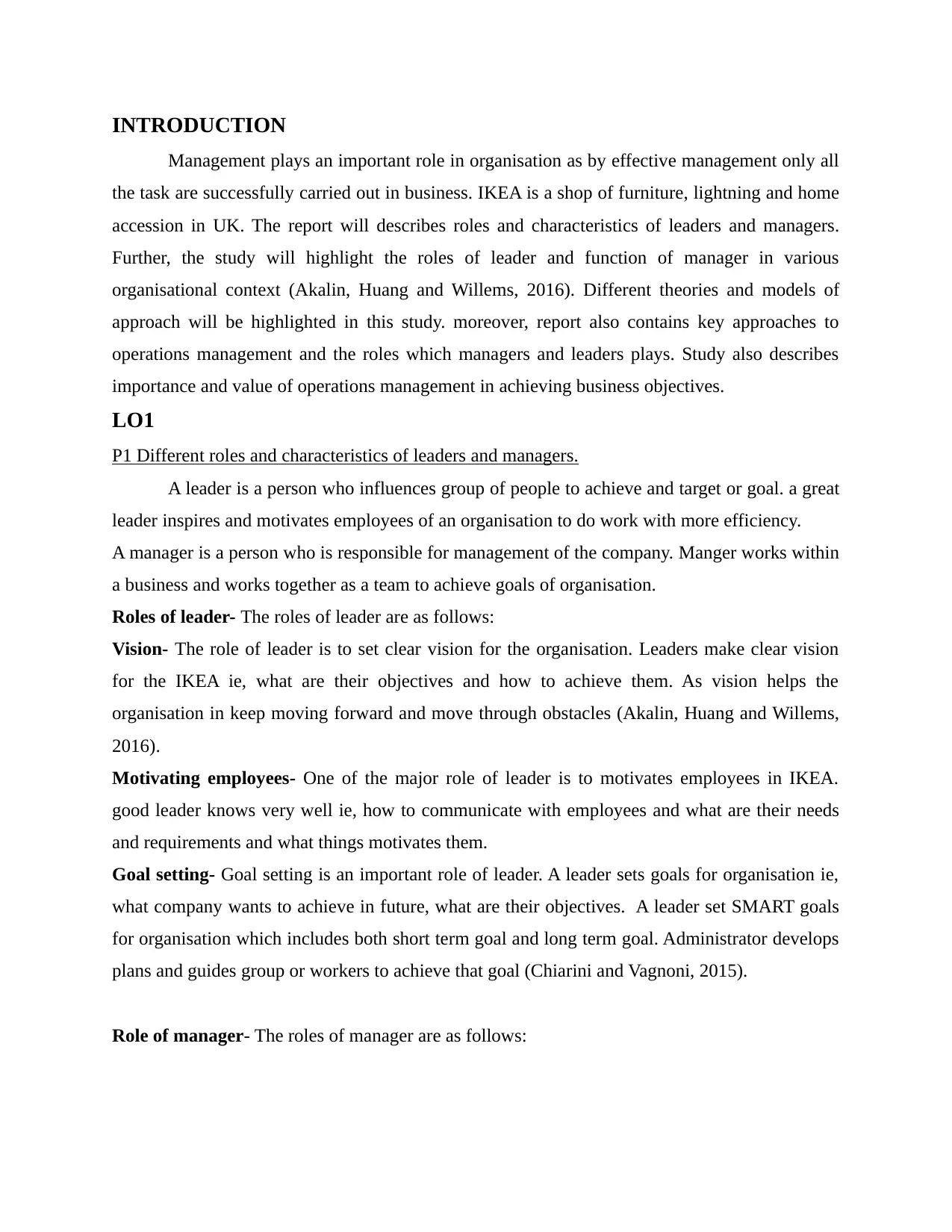
Management plays an important role in organisation as by effective management only all
the task are successfully carried out in business. IKEA is a shop of furniture, lightning and home
accession in UK. The report will describes roles and characteristics of leaders and managers.
Further, the study will highlight the roles of leader and function of manager in various
organisational context (Akalin, Huang and Willems, 2016). Different theories and models of
approach will be highlighted in this study. moreover, report also contains key approaches to
operations management and the roles which managers and leaders plays. Study also describes
importance and value of operations management in achieving business objectives.
LO1
P1 Different roles and characteristics of leaders and managers.
A leader is a person who influences group of people to achieve and target or goal. a great
leader inspires and motivates employees of an organisation to do work with more efficiency.
A manager is a person who is responsible for management of the company. Manger works within
a business and works together as a team to achieve goals of organisation.
Roles of leader- The roles of leader are as follows:
Vision- The role of leader is to set clear vision for the organisation. Leaders make clear vision
for the IKEA ie, what are their objectives and how to achieve them. As vision helps the
organisation in keep moving forward and move through obstacles (Akalin, Huang and Willems,
2016).
Motivating employees- One of the major role of leader is to motivates employees in IKEA.
good leader knows very well ie, how to communicate with employees and what are their needs
and requirements and what things motivates them.
Goal setting- Goal setting is an important role of leader. A leader sets goals for organisation ie,
what company wants to achieve in future, what are their objectives. A leader set SMART goals
for organisation which includes both short term goal and long term goal. Administrator develops
plans and guides group or workers to achieve that goal (Chiarini and Vagnoni, 2015).
Role of manager- The roles of manager are as follows:
Management plays an important role in organisation as by effective management only all
the task are successfully carried out in business. IKEA is a shop of furniture, lightning and home
accession in UK. The report will describes roles and characteristics of leaders and managers.
Further, the study will highlight the roles of leader and function of manager in various
organisational context (Akalin, Huang and Willems, 2016). Different theories and models of
approach will be highlighted in this study. moreover, report also contains key approaches to
operations management and the roles which managers and leaders plays. Study also describes
importance and value of operations management in achieving business objectives.
LO1
P1 Different roles and characteristics of leaders and managers.
A leader is a person who influences group of people to achieve and target or goal. a great
leader inspires and motivates employees of an organisation to do work with more efficiency.
A manager is a person who is responsible for management of the company. Manger works within
a business and works together as a team to achieve goals of organisation.
Roles of leader- The roles of leader are as follows:
Vision- The role of leader is to set clear vision for the organisation. Leaders make clear vision
for the IKEA ie, what are their objectives and how to achieve them. As vision helps the
organisation in keep moving forward and move through obstacles (Akalin, Huang and Willems,
2016).
Motivating employees- One of the major role of leader is to motivates employees in IKEA.
good leader knows very well ie, how to communicate with employees and what are their needs
and requirements and what things motivates them.
Goal setting- Goal setting is an important role of leader. A leader sets goals for organisation ie,
what company wants to achieve in future, what are their objectives. A leader set SMART goals
for organisation which includes both short term goal and long term goal. Administrator develops
plans and guides group or workers to achieve that goal (Chiarini and Vagnoni, 2015).
Role of manager- The roles of manager are as follows:
⊘ This is a preview!⊘
Do you want full access?
Subscribe today to unlock all pages.

Trusted by 1+ million students worldwide
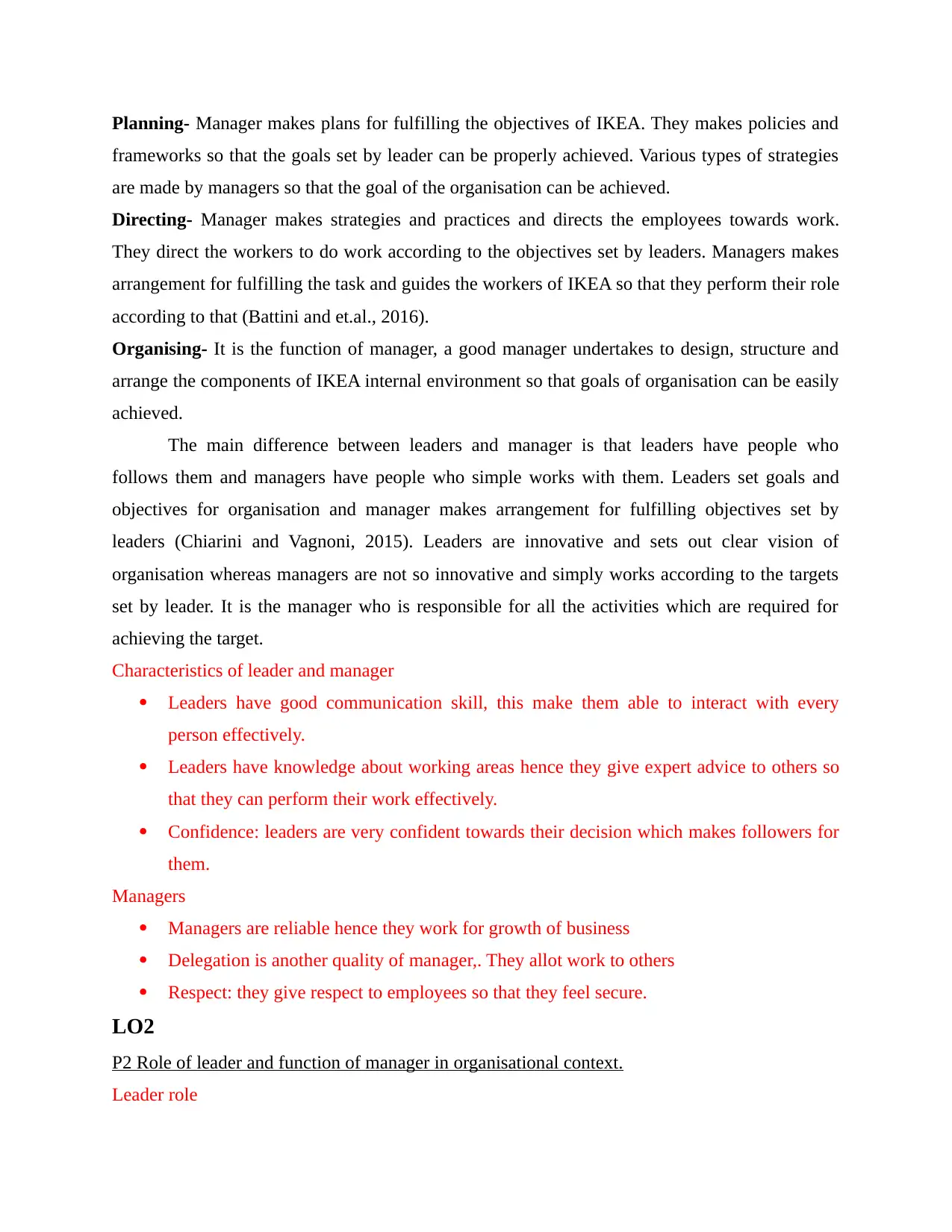
Planning- Manager makes plans for fulfilling the objectives of IKEA. They makes policies and
frameworks so that the goals set by leader can be properly achieved. Various types of strategies
are made by managers so that the goal of the organisation can be achieved.
Directing- Manager makes strategies and practices and directs the employees towards work.
They direct the workers to do work according to the objectives set by leaders. Managers makes
arrangement for fulfilling the task and guides the workers of IKEA so that they perform their role
according to that (Battini and et.al., 2016).
Organising- It is the function of manager, a good manager undertakes to design, structure and
arrange the components of IKEA internal environment so that goals of organisation can be easily
achieved.
The main difference between leaders and manager is that leaders have people who
follows them and managers have people who simple works with them. Leaders set goals and
objectives for organisation and manager makes arrangement for fulfilling objectives set by
leaders (Chiarini and Vagnoni, 2015). Leaders are innovative and sets out clear vision of
organisation whereas managers are not so innovative and simply works according to the targets
set by leader. It is the manager who is responsible for all the activities which are required for
achieving the target.
Characteristics of leader and manager
Leaders have good communication skill, this make them able to interact with every
person effectively.
Leaders have knowledge about working areas hence they give expert advice to others so
that they can perform their work effectively.
Confidence: leaders are very confident towards their decision which makes followers for
them.
Managers
Managers are reliable hence they work for growth of business
Delegation is another quality of manager,. They allot work to others
Respect: they give respect to employees so that they feel secure.
LO2
P2 Role of leader and function of manager in organisational context.
Leader role
frameworks so that the goals set by leader can be properly achieved. Various types of strategies
are made by managers so that the goal of the organisation can be achieved.
Directing- Manager makes strategies and practices and directs the employees towards work.
They direct the workers to do work according to the objectives set by leaders. Managers makes
arrangement for fulfilling the task and guides the workers of IKEA so that they perform their role
according to that (Battini and et.al., 2016).
Organising- It is the function of manager, a good manager undertakes to design, structure and
arrange the components of IKEA internal environment so that goals of organisation can be easily
achieved.
The main difference between leaders and manager is that leaders have people who
follows them and managers have people who simple works with them. Leaders set goals and
objectives for organisation and manager makes arrangement for fulfilling objectives set by
leaders (Chiarini and Vagnoni, 2015). Leaders are innovative and sets out clear vision of
organisation whereas managers are not so innovative and simply works according to the targets
set by leader. It is the manager who is responsible for all the activities which are required for
achieving the target.
Characteristics of leader and manager
Leaders have good communication skill, this make them able to interact with every
person effectively.
Leaders have knowledge about working areas hence they give expert advice to others so
that they can perform their work effectively.
Confidence: leaders are very confident towards their decision which makes followers for
them.
Managers
Managers are reliable hence they work for growth of business
Delegation is another quality of manager,. They allot work to others
Respect: they give respect to employees so that they feel secure.
LO2
P2 Role of leader and function of manager in organisational context.
Leader role
Paraphrase This Document
Need a fresh take? Get an instant paraphrase of this document with our AI Paraphraser
Staff turnover is the situation in which leaders work hard to determine the cause of
problem and they find innovative ideas through which this problem can be resolved timely.
Managers role
Fayol describes function of manager
Planning
Organising
Directing are the major function of manager. If company makes technological changes then
managers give direction to people so that they work on new machines easily. They plan for
implementing changes effectively and organise activities in the manner so that people do not feel
overburden.
Situational leadership is a style which in this leadership style leaders and managers of
organisation their styles according to the situation in the organisation. As in IKEA situation arises
that sales of the organisation decreases so for dealing that situation leader make new policies and
practices so that the sale can be boost and manager makes arrangements and plans for expansion
of sales (Battini and et.al., 2016).
System leadership- System leadership enables the leaders in IKEA to create the condition where
people at all levels can work productively to their full potential. system leadership uses sound
principles about human behaviour for creating models of good leadership, system design and
organisational strategy.
Relationship oriented leadership- Relationship leadership is a behavioural approach in which
the leaders focus on the satisfaction, motivation and well being of team members. According to
this situation leaders focus on those things which satisfies the employee so that they can work
hard and helps in raising their morale (Ferguson and et.al., 2016).
P3 Different theories and models of approach.
Situational leadership- Situational leadership is a style that has been developed and studied by
Kenneth Blanchard and Paul Hersey. In this types of leadership style, leader or managers
changes their leadership styles according to the situation. Thev study was first developed in 1969
and then during mid 1970s it was renamed and in late 1970 and early 1980s the two persons
developed their own styles.
problem and they find innovative ideas through which this problem can be resolved timely.
Managers role
Fayol describes function of manager
Planning
Organising
Directing are the major function of manager. If company makes technological changes then
managers give direction to people so that they work on new machines easily. They plan for
implementing changes effectively and organise activities in the manner so that people do not feel
overburden.
Situational leadership is a style which in this leadership style leaders and managers of
organisation their styles according to the situation in the organisation. As in IKEA situation arises
that sales of the organisation decreases so for dealing that situation leader make new policies and
practices so that the sale can be boost and manager makes arrangements and plans for expansion
of sales (Battini and et.al., 2016).
System leadership- System leadership enables the leaders in IKEA to create the condition where
people at all levels can work productively to their full potential. system leadership uses sound
principles about human behaviour for creating models of good leadership, system design and
organisational strategy.
Relationship oriented leadership- Relationship leadership is a behavioural approach in which
the leaders focus on the satisfaction, motivation and well being of team members. According to
this situation leaders focus on those things which satisfies the employee so that they can work
hard and helps in raising their morale (Ferguson and et.al., 2016).
P3 Different theories and models of approach.
Situational leadership- Situational leadership is a style that has been developed and studied by
Kenneth Blanchard and Paul Hersey. In this types of leadership style, leader or managers
changes their leadership styles according to the situation. Thev study was first developed in 1969
and then during mid 1970s it was renamed and in late 1970 and early 1980s the two persons
developed their own styles.
This leadership style is beneficial for IKEA as it encourages successful collaboration
among team members. it assesses maturity levels of staff within the organisation. it helps in
encouraging socio emotional support for subordinates. If this type of leadership style is applied
in IKEA it will impact the performance of company in a positive manner as leaders will take best
decision which is suitable for that situation (Nakagawa and NEC Corp, 2015).
System leadership- System leadership is that type of leadership style in which leaders create
such conditions where workers of all level can work full according to their potential. system
leaders see themselves responsible, they have responsibility to motivates the employees so that
they can work to their full extent. The skills require for being a situational leaders is directing
and problem skills. Leaders must have good directing skills so that they direct and guide
employees to work more efficiently.
If system leadership is applied in IKEA it will result in this way that the workers productivity
will be increased. Administrator in this style motivates the employees in such a manner that their
morale increases and help them in achieving their target (Nakagawa and NEC Corp, 2015).
Contingency theory- Contingency theory of leadership emphasis the importance of both leader's
personality and situation in which leaders operates. The contingency approach was influenced by
two research programs which impact leadership behaviour. In 1950's researchers at Ohio State
University administered questionnaires, measuring a range of possible leader behaviour. This
theory is advantageous to IKEA as there are many situations leaders determines the situation
which is best suited to them.
LO3
P4 Approaches of Operation management
OM is the administration process that works to get high level of efficiency of operations.
There are several approaches of operation management, description is as below:
Total quality management
TQM is the approach of management that works to raise satisfaction level of consumers
and gaining long term success for business unit. This approach aids in eliminating errors and
streamline the SCM (supply chain management) activities of IKEA. TQM always ensure to get
best quality of products and developing integrated system. This aids in handling operational
process effectively and managing loop fall timely. TQM approach focus on consumers, IKEA
makes efforts in production in such manner so that company can meet requirements of its
among team members. it assesses maturity levels of staff within the organisation. it helps in
encouraging socio emotional support for subordinates. If this type of leadership style is applied
in IKEA it will impact the performance of company in a positive manner as leaders will take best
decision which is suitable for that situation (Nakagawa and NEC Corp, 2015).
System leadership- System leadership is that type of leadership style in which leaders create
such conditions where workers of all level can work full according to their potential. system
leaders see themselves responsible, they have responsibility to motivates the employees so that
they can work to their full extent. The skills require for being a situational leaders is directing
and problem skills. Leaders must have good directing skills so that they direct and guide
employees to work more efficiently.
If system leadership is applied in IKEA it will result in this way that the workers productivity
will be increased. Administrator in this style motivates the employees in such a manner that their
morale increases and help them in achieving their target (Nakagawa and NEC Corp, 2015).
Contingency theory- Contingency theory of leadership emphasis the importance of both leader's
personality and situation in which leaders operates. The contingency approach was influenced by
two research programs which impact leadership behaviour. In 1950's researchers at Ohio State
University administered questionnaires, measuring a range of possible leader behaviour. This
theory is advantageous to IKEA as there are many situations leaders determines the situation
which is best suited to them.
LO3
P4 Approaches of Operation management
OM is the administration process that works to get high level of efficiency of operations.
There are several approaches of operation management, description is as below:
Total quality management
TQM is the approach of management that works to raise satisfaction level of consumers
and gaining long term success for business unit. This approach aids in eliminating errors and
streamline the SCM (supply chain management) activities of IKEA. TQM always ensure to get
best quality of products and developing integrated system. This aids in handling operational
process effectively and managing loop fall timely. TQM approach focus on consumers, IKEA
makes efforts in production in such manner so that company can meet requirements of its
⊘ This is a preview!⊘
Do you want full access?
Subscribe today to unlock all pages.
Trusted by 1+ million students worldwide
customers (Faruk and et.al., 2018). This aids in continuously quality improvement in end
products. Leaders involve employees and ask about quarries of buyers, managers train people so
that they can manage work properly. By this way IKEA becomes able to offer satisfactory goods
and services to its customers. Planning, doing, checking and acting are major elements of TQM
that aids IKEA in ensuring high quality products are being delivered to consumers in cost
effective manner (Ferguson and et.al., 2016).
Just in time inventory
This is another great approach of OM which works to enhance operational efficiency and
cutting the operational cost as well. IKEA’s managers improve its supply chain activities and
ensure that there is not overstock problems. By this way wastage of raw material gets minimised
and operational cost of company gets lower. Apart from this, changes in supply chain activities
are helpful in raising quality of products and utilising resources well (Faruk and et.al., 2018).
Managers of IKEA monitor the supplier activities that aids in evaluating that adequate material is
available to meet the current demand. Leaders motivate workers so that they follow the pre-
determined process so that mistakes and operational time can be minimised.
Continuous improvement (Kaizen)
This is the approach that ensures making continuous efforts for improving existing
operations and satisfying stakeholders. It works on several elements: sort out things, organise,
shine, standardization and self-discipline. IKEA sort the material and resources properly and
ensure that it meet the industry standards. If there is something wrong, then makes immediate
changes in operations. This approach helps the organisation in raising product quality and
offering standardised products to consumers at affordable rates. Leaders of IKEA implements
innovative ideas so that operations can be improved and managers monitor the all activities so
that no issues take place and enterprise meet the industry standard (Baxley and et.al., 2016).
P5 Importance of operation management in the organisation
Operation management (OM) is the tool that aids in managing business activities in
effective manner by controlling over resource uses. Values and importance of OM are described
as below:
Raising product quality: This is the application which helps the IKEA in analysing the mistakes
in existing operations and make changes in the operational activities so that quality of final
goods can be raised. As inventory management is the major function of OM that aids in using
products. Leaders involve employees and ask about quarries of buyers, managers train people so
that they can manage work properly. By this way IKEA becomes able to offer satisfactory goods
and services to its customers. Planning, doing, checking and acting are major elements of TQM
that aids IKEA in ensuring high quality products are being delivered to consumers in cost
effective manner (Ferguson and et.al., 2016).
Just in time inventory
This is another great approach of OM which works to enhance operational efficiency and
cutting the operational cost as well. IKEA’s managers improve its supply chain activities and
ensure that there is not overstock problems. By this way wastage of raw material gets minimised
and operational cost of company gets lower. Apart from this, changes in supply chain activities
are helpful in raising quality of products and utilising resources well (Faruk and et.al., 2018).
Managers of IKEA monitor the supplier activities that aids in evaluating that adequate material is
available to meet the current demand. Leaders motivate workers so that they follow the pre-
determined process so that mistakes and operational time can be minimised.
Continuous improvement (Kaizen)
This is the approach that ensures making continuous efforts for improving existing
operations and satisfying stakeholders. It works on several elements: sort out things, organise,
shine, standardization and self-discipline. IKEA sort the material and resources properly and
ensure that it meet the industry standards. If there is something wrong, then makes immediate
changes in operations. This approach helps the organisation in raising product quality and
offering standardised products to consumers at affordable rates. Leaders of IKEA implements
innovative ideas so that operations can be improved and managers monitor the all activities so
that no issues take place and enterprise meet the industry standard (Baxley and et.al., 2016).
P5 Importance of operation management in the organisation
Operation management (OM) is the tool that aids in managing business activities in
effective manner by controlling over resource uses. Values and importance of OM are described
as below:
Raising product quality: This is the application which helps the IKEA in analysing the mistakes
in existing operations and make changes in the operational activities so that quality of final
goods can be raised. As inventory management is the major function of OM that aids in using
Paraphrase This Document
Need a fresh take? Get an instant paraphrase of this document with our AI Paraphraser
high quality raw material in the production process so that final goods can meet the needs of
potential buyers. IKEA implements quality management process to deliver durable products to
end user. Hence through operation management activities company can enhance quality of
products to great extent (Baxley and et.al., 2016).
Waste reduction: This is another important element of operation management, IKEA being a
leading manufacturing firm has to ensure reducing unnecessary cost that is only possible when
firm reduce its wastage. By implementing correct operational process enterprise can monitor
progress of current operations which will help in analysing problem that would help in
minimising wastage in the firm. Resources are utilised in appropriate manner hence over
allocation of resource do not occur in IKEA
Improving product design: This is another important aspect of operation management, OM helps
in making positive changes in process designing which improve designing of existing products
that gives positive result to IKEA and help in gaining competitive advantage to business
(Bromiley and Rau, 2016).
Revenue increase: OM in IKEA supports the organisation in serving quality products to
consumers which help in gaining trust of buyers hence sales of company gets increased which is
beneficial in raising revenue in the company.
M3
Leaders are the key player and managers work as back bone of IKEA. Contribution of
both is essential for the success of company. Process designing is essential function of OM, in
which leaders give innovative ideas so that designing can be done properly and managers give
training to staff so that such process can be implemented at workplace significantly.
Inventory management is the function of operation management, managers of IKEA
ensure that stock is being utilised in proper manner and there is no wastage of resources.
Whereas leaders ensure that people work with motivation so that company’s goal can be
accomplished successfully (Bromiley and Rau, 2016).
LO4
P6 Factors that affect operation management in business environment
Several elements that influence the business and affect operational process of IKEA are
described as below:
potential buyers. IKEA implements quality management process to deliver durable products to
end user. Hence through operation management activities company can enhance quality of
products to great extent (Baxley and et.al., 2016).
Waste reduction: This is another important element of operation management, IKEA being a
leading manufacturing firm has to ensure reducing unnecessary cost that is only possible when
firm reduce its wastage. By implementing correct operational process enterprise can monitor
progress of current operations which will help in analysing problem that would help in
minimising wastage in the firm. Resources are utilised in appropriate manner hence over
allocation of resource do not occur in IKEA
Improving product design: This is another important aspect of operation management, OM helps
in making positive changes in process designing which improve designing of existing products
that gives positive result to IKEA and help in gaining competitive advantage to business
(Bromiley and Rau, 2016).
Revenue increase: OM in IKEA supports the organisation in serving quality products to
consumers which help in gaining trust of buyers hence sales of company gets increased which is
beneficial in raising revenue in the company.
M3
Leaders are the key player and managers work as back bone of IKEA. Contribution of
both is essential for the success of company. Process designing is essential function of OM, in
which leaders give innovative ideas so that designing can be done properly and managers give
training to staff so that such process can be implemented at workplace significantly.
Inventory management is the function of operation management, managers of IKEA
ensure that stock is being utilised in proper manner and there is no wastage of resources.
Whereas leaders ensure that people work with motivation so that company’s goal can be
accomplished successfully (Bromiley and Rau, 2016).
LO4
P6 Factors that affect operation management in business environment
Several elements that influence the business and affect operational process of IKEA are
described as below:
Culture and values: Organisational culture create the good impression on employees
those who are continuously working for the growth of IKEA. Healthy culture motivates
them and make them positive. By this way they support the firm and perform the task
well which help in managing operations in effective manner. Good culture and values aid
in raising productivity and minimising mistakes as people are free to interact with each
other properly which will help them in managing work in significant manner.
Corporate social responsibility: IKEA always fulfil its CSR duties; it works for the
betterment of society hence use high quality material. This CSR element supports the
business in raising quality of products and improving operational efficiency as well
(Ghosh and et.al., 2016). Furthermore, IKEA working for improving environmental
condition that helps in creating strong brand image or firm that improves profit of
business unit and improve operational efficiency as well because resources are being
utilised in appropriate manner.
Ethics: Business ethics paly significant role in OM, IKEA ensure that it works under the
ethical guideline. It has sustainable product designing and ensure to keep its employees
safe. This makes them positive and they work hard to meet the organisational goal. This
improves operational process of IKEA to great extent.
Sustainability: This is the factors that influence operational efficiency to great extent, if
IKEA implements effective sustainable strategies that it would help the firm in improving
supply chain process and control over designing, planning. This would help the IKEA in
improving operational efficiency and raising profit of company to great extent.
M4
Business ethics, sustainability, culture, CSR are essential factors that impact on business
environment of IKEA to great extent (Reid and Sanders, 2015). Employees like to work in
healthy workplace, hence IKEA is taking care of it and provide them healthy culture and safe
environment which motivates them and they work hard to raise productivity of business unit to
great extent. Investors like to get high return over their investments. This need is fulfilled by
IKEA by implements sustainable practices and fulfilling CSR responsibilities because these
practices attract people and help the firm in gaining competitive advantage. Hence goal of
organisation accomplished successfully. This is also beneficial for community because they get
those who are continuously working for the growth of IKEA. Healthy culture motivates
them and make them positive. By this way they support the firm and perform the task
well which help in managing operations in effective manner. Good culture and values aid
in raising productivity and minimising mistakes as people are free to interact with each
other properly which will help them in managing work in significant manner.
Corporate social responsibility: IKEA always fulfil its CSR duties; it works for the
betterment of society hence use high quality material. This CSR element supports the
business in raising quality of products and improving operational efficiency as well
(Ghosh and et.al., 2016). Furthermore, IKEA working for improving environmental
condition that helps in creating strong brand image or firm that improves profit of
business unit and improve operational efficiency as well because resources are being
utilised in appropriate manner.
Ethics: Business ethics paly significant role in OM, IKEA ensure that it works under the
ethical guideline. It has sustainable product designing and ensure to keep its employees
safe. This makes them positive and they work hard to meet the organisational goal. This
improves operational process of IKEA to great extent.
Sustainability: This is the factors that influence operational efficiency to great extent, if
IKEA implements effective sustainable strategies that it would help the firm in improving
supply chain process and control over designing, planning. This would help the IKEA in
improving operational efficiency and raising profit of company to great extent.
M4
Business ethics, sustainability, culture, CSR are essential factors that impact on business
environment of IKEA to great extent (Reid and Sanders, 2015). Employees like to work in
healthy workplace, hence IKEA is taking care of it and provide them healthy culture and safe
environment which motivates them and they work hard to raise productivity of business unit to
great extent. Investors like to get high return over their investments. This need is fulfilled by
IKEA by implements sustainable practices and fulfilling CSR responsibilities because these
practices attract people and help the firm in gaining competitive advantage. Hence goal of
organisation accomplished successfully. This is also beneficial for community because they get
⊘ This is a preview!⊘
Do you want full access?
Subscribe today to unlock all pages.
Trusted by 1+ million students worldwide
new job opportunities and get quality products that means value of money (Ghosh and et.al.,
2016).
CONCLUSION
From the above study it is concluded that leaders and managers plays and important role
in running any business. As without good leader goals of the firm can not be made and without
an efficient manager the operations in the organisation can not be maintained. Leaders plays an
important role in motivating the employees which results in employees productivity. Manager
makes plans and directs workers to do work according to the goals and objectives of
organisation. the study also concluded various leadership style such as situational, this leadership
style is best as leaders change the style according to situation. Leaders and managers work
together to improve operational process so that firm can meet with its organisational goal
successfully.
2016).
CONCLUSION
From the above study it is concluded that leaders and managers plays and important role
in running any business. As without good leader goals of the firm can not be made and without
an efficient manager the operations in the organisation can not be maintained. Leaders plays an
important role in motivating the employees which results in employees productivity. Manager
makes plans and directs workers to do work according to the goals and objectives of
organisation. the study also concluded various leadership style such as situational, this leadership
style is best as leaders change the style according to situation. Leaders and managers work
together to improve operational process so that firm can meet with its organisational goal
successfully.
Paraphrase This Document
Need a fresh take? Get an instant paraphrase of this document with our AI Paraphraser
REFERENCES
Books and Journals:
Akalin, G.I., Huang, Z. and Willems, J.R., 2016. Is Supply Chain Management Replacing
Operations Management in the Business Core Curriculum. Operations and Supply Chain
Management: An International Journal. 9(2). pp.119-130.
Battini, D. and et.al., 2016. Sustainable humanitarian operations: closed-loop supply chain.
International Journal of Services and Operations Management. 25(1). pp.65-79.
Baxley, B.T. and et.al., 2016. Human-in-the-loop assessment of alternative clearances in interval
management arrival operations.
Bromiley, P. and Rau, D., 2016. Operations management and the resource based view: Another
view. Journal of Operations Management. 41. pp.95-106.
Chiarini, A. and Vagnoni, E., 2015. World-class manufacturing by Fiat. Comparison with Toyota
production system from a strategic management, management accounting, operations
management and performance measurement dimension. International Journal of
Production Research. 53(2). pp.590-606.
Faruk, M.O. and et.al., 2018. Wrong-way driving: a regional transportation systems management
and operations approach to a regional problem. Transportation research record. 2672(14).
pp.106-116.
Ferguson, N.T. and et.al., 2016. Secure management of operations on protected virtual machines.
U.S. Patent Application 15/243,647.
Ghosh, I. and et.al., 2016. September. Machine learning for predictive modeling in management
of operations of EDM equipment product. In 2016 Second International Conference on
Research in Computational Intelligence and Communication Networks (ICRCICN) (pp.
169-174). IEEE.
Gillen, D., Jacquillat, A. and Odoni, A.R., 2016. Airport demand management: The operations
research and economics perspectives and potential synergies. Transportation Research
Part A: Policy and Practice. 94. pp.495-513.
Nakagawa, K., NEC Corp, 2015. Operations management apparatus, operations management
method and program. U.S. Patent 8.930.757.
Radnor, Z. and Bateman, N., 2016. Debate: The development of a new discipline—public service
operations management. Public Money & Management. 36(4). pp.246-248.
Reid, R.D. and Sanders, N.R., 2015. Operations Management, Binder Ready Version: An
Integrated Approach. John Wiley & Sons.
(Reid and Sanders, 2015)
(Ghosh and et.al., 2016)
(Bromiley and Rau, 2016)
(Baxley and et.al., 2016)
(Faruk and et.al., 2018)
(Nakagawa and NEC Corp, 2015)
(Battini and et.al., 2016)
(Akalin, Huang and Willems, 2016)
Books and Journals:
Akalin, G.I., Huang, Z. and Willems, J.R., 2016. Is Supply Chain Management Replacing
Operations Management in the Business Core Curriculum. Operations and Supply Chain
Management: An International Journal. 9(2). pp.119-130.
Battini, D. and et.al., 2016. Sustainable humanitarian operations: closed-loop supply chain.
International Journal of Services and Operations Management. 25(1). pp.65-79.
Baxley, B.T. and et.al., 2016. Human-in-the-loop assessment of alternative clearances in interval
management arrival operations.
Bromiley, P. and Rau, D., 2016. Operations management and the resource based view: Another
view. Journal of Operations Management. 41. pp.95-106.
Chiarini, A. and Vagnoni, E., 2015. World-class manufacturing by Fiat. Comparison with Toyota
production system from a strategic management, management accounting, operations
management and performance measurement dimension. International Journal of
Production Research. 53(2). pp.590-606.
Faruk, M.O. and et.al., 2018. Wrong-way driving: a regional transportation systems management
and operations approach to a regional problem. Transportation research record. 2672(14).
pp.106-116.
Ferguson, N.T. and et.al., 2016. Secure management of operations on protected virtual machines.
U.S. Patent Application 15/243,647.
Ghosh, I. and et.al., 2016. September. Machine learning for predictive modeling in management
of operations of EDM equipment product. In 2016 Second International Conference on
Research in Computational Intelligence and Communication Networks (ICRCICN) (pp.
169-174). IEEE.
Gillen, D., Jacquillat, A. and Odoni, A.R., 2016. Airport demand management: The operations
research and economics perspectives and potential synergies. Transportation Research
Part A: Policy and Practice. 94. pp.495-513.
Nakagawa, K., NEC Corp, 2015. Operations management apparatus, operations management
method and program. U.S. Patent 8.930.757.
Radnor, Z. and Bateman, N., 2016. Debate: The development of a new discipline—public service
operations management. Public Money & Management. 36(4). pp.246-248.
Reid, R.D. and Sanders, N.R., 2015. Operations Management, Binder Ready Version: An
Integrated Approach. John Wiley & Sons.
(Reid and Sanders, 2015)
(Ghosh and et.al., 2016)
(Bromiley and Rau, 2016)
(Baxley and et.al., 2016)
(Faruk and et.al., 2018)
(Nakagawa and NEC Corp, 2015)
(Battini and et.al., 2016)
(Akalin, Huang and Willems, 2016)

(Ferguson and et.al., 2016)
(Chiarini and Vagnoni, 2015)
(Chiarini and Vagnoni, 2015)
⊘ This is a preview!⊘
Do you want full access?
Subscribe today to unlock all pages.
Trusted by 1+ million students worldwide

1 out of 16


Related Documents


Your All-in-One AI-Powered Toolkit for Academic Success.
+13062052269
info@desklib.com
Available 24*7 on WhatsApp / Email
![[object Object]](/_next/static/media/star-bottom.7253800d.svg)
Unlock your academic potential
Copyright © 2020–2026 A2Z Services. All Rights Reserved. Developed and managed by ZUCOL.