An Analysis of IUU Fishing: Impacts and Management Strategies
VerifiedAdded on 2022/09/05
|11
|3516
|17
Report
AI Summary
This report examines the multifaceted issue of Illegal, Unreported, and Unregulated (IUU) fishing, highlighting its significant threat to global fisheries, marine ecosystems, and economic stability. It delves into the various types of IUU fishing, including illegal, unreported, and unregulated practices, and their detrimental impacts on fish stocks, food security, and international relations. The report explores the global implications, such as the depletion of marine life, heightened tensions between countries, and increased maritime piracy. It further analyzes the negative consequences on food safety, vital ecosystems, and the rise of conflicts. The report also discusses the efforts to combat IUU fishing, including the role of Regional Fisheries Management Organizations (RFMOs) and international agreements like the Port State Measures Agreement (PSMA). The report concludes by emphasizing the need for comprehensive management strategies to address IUU fishing and ensure the sustainability of global fisheries. The report uses several sources, including academic studies, government reports, and international organizations such as the Food and Agriculture Organization (FAO) of the United Nations. The report includes figures to represent IUU fishing and Regional Fisheries Management Organizations.
Name
Instructor
Geography
27 December 2019
Managing Tropical Fisheries
Illegal fishing applies to fishing practices carried out in violation of pertinent laws in addition to
principles, with such laws and regulations implemented at local and global level.
Unreported fishing denotes to fishing practices which are not recorded or misrepresented to the
proper systems in breach of regional regulations and laws or compliance measures of a particular
regional fisheries conservation agency.
Unregulated fishing befalls in waters or fish stocks of which no protection or administration
procedures are available and where certain fishing practices are carried out in a way that violates
the State obligations under universal law for the protection of living marine resources.
Introduction
Global fisheries face the existential threat of rising global demand, decreasing marine life, and
continuing illegal, unreported, and unregulated (IUU)fishing in the decades ahead. illegal,
unreported, and unregulated fishing likewise threatens legal fishing operations and source of
revenue, endangers sustenance and fiscal prosperity, facilitates global crime, manipulates
economies, leads to human trafficking, and compromises continued exertions to enforce
sustainable fisheries procedures. This can similarly raise tensions and promote piracy within and
between countries. The unauthorized nature of IUU fishing means that this is only loosely
possible to measure the magnitude of the problem and its negative consequences (Borg 2012).
Over the past decades, international efforts against IUU fishing have developed, along with the
Port State Measures Agreement, which was adopted in June 2016. Nonetheless, fish demand
continues to grow, villains continue to evolve, besides changing climate will bring more anxiety
to global fish stocks.
Instructor
Geography
27 December 2019
Managing Tropical Fisheries
Illegal fishing applies to fishing practices carried out in violation of pertinent laws in addition to
principles, with such laws and regulations implemented at local and global level.
Unreported fishing denotes to fishing practices which are not recorded or misrepresented to the
proper systems in breach of regional regulations and laws or compliance measures of a particular
regional fisheries conservation agency.
Unregulated fishing befalls in waters or fish stocks of which no protection or administration
procedures are available and where certain fishing practices are carried out in a way that violates
the State obligations under universal law for the protection of living marine resources.
Introduction
Global fisheries face the existential threat of rising global demand, decreasing marine life, and
continuing illegal, unreported, and unregulated (IUU)fishing in the decades ahead. illegal,
unreported, and unregulated fishing likewise threatens legal fishing operations and source of
revenue, endangers sustenance and fiscal prosperity, facilitates global crime, manipulates
economies, leads to human trafficking, and compromises continued exertions to enforce
sustainable fisheries procedures. This can similarly raise tensions and promote piracy within and
between countries. The unauthorized nature of IUU fishing means that this is only loosely
possible to measure the magnitude of the problem and its negative consequences (Borg 2012).
Over the past decades, international efforts against IUU fishing have developed, along with the
Port State Measures Agreement, which was adopted in June 2016. Nonetheless, fish demand
continues to grow, villains continue to evolve, besides changing climate will bring more anxiety
to global fish stocks.

Paraphrase This Document
Need a fresh take? Get an instant paraphrase of this document with our AI Paraphraser
2
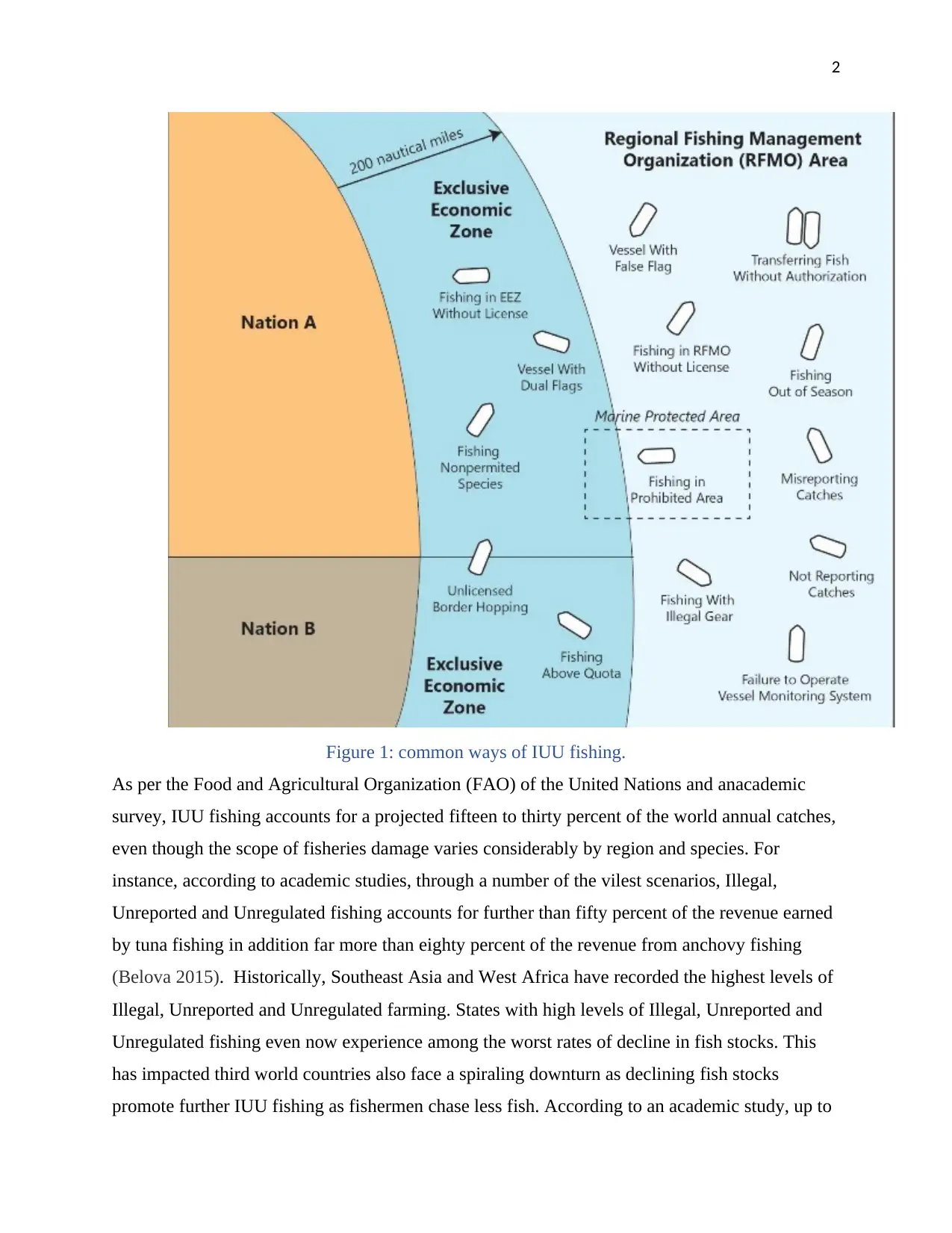
Figure 1: common ways of IUU fishing.
As per the Food and Agricultural Organization (FAO) of the United Nations and anacademic
survey, IUU fishing accounts for a projected fifteen to thirty percent of the world annual catches,
even though the scope of fisheries damage varies considerably by region and species. For
instance, according to academic studies, through a number of the vilest scenarios, Illegal,
Unreported and Unregulated fishing accounts for further than fifty percent of the revenue earned
by tuna fishing in addition far more than eighty percent of the revenue from anchovy fishing
(Belova 2015). Historically, Southeast Asia and West Africa have recorded the highest levels of
Illegal, Unreported and Unregulated farming. States with high levels of Illegal, Unreported and
Unregulated fishing even now experience among the worst rates of decline in fish stocks. This
has impacted third world countries also face a spiraling downturn as declining fish stocks
promote further IUU fishing as fishermen chase less fish. According to an academic study, up to
Figure 1: common ways of IUU fishing.
As per the Food and Agricultural Organization (FAO) of the United Nations and anacademic
survey, IUU fishing accounts for a projected fifteen to thirty percent of the world annual catches,
even though the scope of fisheries damage varies considerably by region and species. For
instance, according to academic studies, through a number of the vilest scenarios, Illegal,
Unreported and Unregulated fishing accounts for further than fifty percent of the revenue earned
by tuna fishing in addition far more than eighty percent of the revenue from anchovy fishing
(Belova 2015). Historically, Southeast Asia and West Africa have recorded the highest levels of
Illegal, Unreported and Unregulated farming. States with high levels of Illegal, Unreported and
Unregulated fishing even now experience among the worst rates of decline in fish stocks. This
has impacted third world countries also face a spiraling downturn as declining fish stocks
promote further IUU fishing as fishermen chase less fish. According to an academic study, up to
3
forty percent of illegal fish products imported into the US in 2011 was illegally fished. The Food
and Agriculture Organization projects more fisheries to be overfished, a phenomenon converges
with such factors as aquatic ecologies depletion besides climate change to variety fish stocks
even more fragile. As just that, IUU fishing's negative impact should expand as more fisheries
become increasingly vulnerable ("EU Regulations on Illegal, Unreported, and Unregulated
Fishing (IUU): Implications for ASEAN Community Fisheries Legal Frameworks" 2016).
Global implications
Illegal, Unreported and Unregulated fishing presents a more credible danger to economic
development and food security in ocean-dependent states as a main food source and
employment, however this practice also presents increasing dangers to biodiversity, conflicts
amongst states and the rule of law, particularly exertions to address exploitation and crime.
Negative consequences on food safety and vital ecosystems
Illegal, Unreported and Unregulated fishing leads to a disastrous lessening in ecologically
vibrant fisheries that serves over four billion individuals across the world. Fish harvested by
Illegal, Unreported and Unregulated vessels aren't encompassed in the scientific resource
evaluations and thus Illegal, Unreported and Unregulated fishing threatens attempts to collect the
data needed to bring about the la-di-da fisheries sustainably, based on the most recent NOAA.
Fish stocks, according to a body of scientific study, typically recover gradually from overfishing.
As shown in a scientific report, unreported captures of Atlantic Bluefin tuna in the
Mediterranean have made a significant contribution to the serious decline in the population
("FAO.org"). The Atlantic Bluefin tuna has also been itemized as vulnerable in the Red List of
Critically endangered species from 2011, even if it stays a common food source in many places
globally.
As per published scientific enquiry, nearly a third of Mexico's cumulative marine fisheries
captures from as far as nineteen fifty have never been documented, discrediting the precision of
fishery evaluations in Mexican fisheries. Environments which require Illegal, Unreported and
Unregulated fishing operations in Mexico, comprising of deficiencies in compliance and
knowledge of the marine environment, along with shortcomings in documentation, tracking and
recording procedures, are typical to most fisheries around the world. Until recently, according to
an academic study, inability to address unreported catches thwarted restoration in North Sea cod.
forty percent of illegal fish products imported into the US in 2011 was illegally fished. The Food
and Agriculture Organization projects more fisheries to be overfished, a phenomenon converges
with such factors as aquatic ecologies depletion besides climate change to variety fish stocks
even more fragile. As just that, IUU fishing's negative impact should expand as more fisheries
become increasingly vulnerable ("EU Regulations on Illegal, Unreported, and Unregulated
Fishing (IUU): Implications for ASEAN Community Fisheries Legal Frameworks" 2016).
Global implications
Illegal, Unreported and Unregulated fishing presents a more credible danger to economic
development and food security in ocean-dependent states as a main food source and
employment, however this practice also presents increasing dangers to biodiversity, conflicts
amongst states and the rule of law, particularly exertions to address exploitation and crime.
Negative consequences on food safety and vital ecosystems
Illegal, Unreported and Unregulated fishing leads to a disastrous lessening in ecologically
vibrant fisheries that serves over four billion individuals across the world. Fish harvested by
Illegal, Unreported and Unregulated vessels aren't encompassed in the scientific resource
evaluations and thus Illegal, Unreported and Unregulated fishing threatens attempts to collect the
data needed to bring about the la-di-da fisheries sustainably, based on the most recent NOAA.
Fish stocks, according to a body of scientific study, typically recover gradually from overfishing.
As shown in a scientific report, unreported captures of Atlantic Bluefin tuna in the
Mediterranean have made a significant contribution to the serious decline in the population
("FAO.org"). The Atlantic Bluefin tuna has also been itemized as vulnerable in the Red List of
Critically endangered species from 2011, even if it stays a common food source in many places
globally.
As per published scientific enquiry, nearly a third of Mexico's cumulative marine fisheries
captures from as far as nineteen fifty have never been documented, discrediting the precision of
fishery evaluations in Mexican fisheries. Environments which require Illegal, Unreported and
Unregulated fishing operations in Mexico, comprising of deficiencies in compliance and
knowledge of the marine environment, along with shortcomings in documentation, tracking and
recording procedures, are typical to most fisheries around the world. Until recently, according to
an academic study, inability to address unreported catches thwarted restoration in North Sea cod.
⊘ This is a preview!⊘
Do you want full access?
Subscribe today to unlock all pages.

Trusted by 1+ million students worldwide
4
Illegal, Unreported and Unregulated IUU fishing also leads to significant bycatch — incidental
catch of un-target species — which threatens the food supply of larger predators and decomposes
and leads to oxygen-deprived "dead zones" when discarded in the ocean. Bycatch jeopardizes a
range of vulnerable species — including New Zealand's Maui dolphin besides the vaquita
porpoise of the Gulf of California — as well as, as shown by UN and academic reports, tacitly
lessens albatross species and sea turtles.
On seas, several fishermen use prohibited driftnets, that are massive-scale reflexive harvesting
networks which catch wantonly whatever marine creature which cannot fit through the openings.
The nets are left to float unreceptively with transmitters before the fishing vessel is able to
retrieve its catch; as per the NOAA, some of these nets are not retrieved and proceed to
continuously trap and even destroy marine faunae.
Heightened Tensions Between and Within Countries
For states that count on fishing significantly for food or employment, conflicts over access to
fisheries and fishing rights are becoming key causes for concern.
Conflict between Sri Lanka and India over traditional fishing rights in the Bay of Bengal has
contributed to the detention and confiscation of fishermen from either state. As of March 2016,
the Indian authorities estimated that ninety-nine Indian fishers and eighty-three boats were kept
by the Sri Lankan Navy ("Fishing Disputes in the Context of International Maritime Disputes"
2018).
Researchers, citizens and fishermen from Somalia protested in March 2015 in contradiction of
the existence fishing vessels from Italy that were reported to have been operating illegally in
Indian Ocean waters near Mogadishu (Baird 2019).
In January 2014, a fishing vessel confiscated for potentially illegal fishing seized sixty-two
Russians and twenty Bissau-Guineans on crew. Several days later, the ship was released until
$1.2 million was paid by the private entity, his third fine in a decade (Grancher 2016).
In March 2016, the coast patrol of Argentina drowned off the Patagonian cost a Chinese vessel
alleged of illegal fishing in the EEZ of Argentina. The Chinese boat started evasive measures
when it was detected but then, according to the Argentine Naval Prefecture, tried to collide with
the Argentine vessel.
Illegal, Unreported and Unregulated IUU fishing also leads to significant bycatch — incidental
catch of un-target species — which threatens the food supply of larger predators and decomposes
and leads to oxygen-deprived "dead zones" when discarded in the ocean. Bycatch jeopardizes a
range of vulnerable species — including New Zealand's Maui dolphin besides the vaquita
porpoise of the Gulf of California — as well as, as shown by UN and academic reports, tacitly
lessens albatross species and sea turtles.
On seas, several fishermen use prohibited driftnets, that are massive-scale reflexive harvesting
networks which catch wantonly whatever marine creature which cannot fit through the openings.
The nets are left to float unreceptively with transmitters before the fishing vessel is able to
retrieve its catch; as per the NOAA, some of these nets are not retrieved and proceed to
continuously trap and even destroy marine faunae.
Heightened Tensions Between and Within Countries
For states that count on fishing significantly for food or employment, conflicts over access to
fisheries and fishing rights are becoming key causes for concern.
Conflict between Sri Lanka and India over traditional fishing rights in the Bay of Bengal has
contributed to the detention and confiscation of fishermen from either state. As of March 2016,
the Indian authorities estimated that ninety-nine Indian fishers and eighty-three boats were kept
by the Sri Lankan Navy ("Fishing Disputes in the Context of International Maritime Disputes"
2018).
Researchers, citizens and fishermen from Somalia protested in March 2015 in contradiction of
the existence fishing vessels from Italy that were reported to have been operating illegally in
Indian Ocean waters near Mogadishu (Baird 2019).
In January 2014, a fishing vessel confiscated for potentially illegal fishing seized sixty-two
Russians and twenty Bissau-Guineans on crew. Several days later, the ship was released until
$1.2 million was paid by the private entity, his third fine in a decade (Grancher 2016).
In March 2016, the coast patrol of Argentina drowned off the Patagonian cost a Chinese vessel
alleged of illegal fishing in the EEZ of Argentina. The Chinese boat started evasive measures
when it was detected but then, according to the Argentine Naval Prefecture, tried to collide with
the Argentine vessel.
Paraphrase This Document
Need a fresh take? Get an instant paraphrase of this document with our AI Paraphraser
5
From an academic study, for several years in the 1990s and 2000s, the terrorist organization
Liberation Tigers of Tamil Eelam (LTTE) targeted the prevalence of prohibited fishing in the
waters of Sri Lanka and India to conceal criminals between fishing vessels. The smuggling
activities of the LTTE supposedly capitalized on the skills on navigation and maritime evasion of
local illegal fishermen.
Amplified Risk of Maritime Piracy
The deficiencies in sea regulation that allow Illegal, Unreported and Unregulated fishing
likewise encourage naval piracy, albeit according to the same body of academic studies, there are
other factors in play, including government weakness, a history of maritime competence, and
favorable geography ("IUU Fishing" 2016).
In a study evaluating two thousand six hundred piracy reported occurrences to the International
Maritime Bureau (IMB) between two thousand and four and twenty thirteen, the researchers
noted that piracy is much more likely to arise in countries with declining levels of fish (Putra &
Lestari 2019). The study concludes that trends in career prospects in the fisheries subdivision,
largely motivated by overfishing, boost the numeral of prospective pirate recruits.
Illegal, Unreported and Unregulated fishing led to the rise in piracy off Somalia in the 2000's as,
as shown by scholars, several Somali fishermen, that had trained to capture ships to prevent
illegal fishing in their historic fishing, converted these previously defensive qualities to piracy
(Omar, Mohamed, & Bambale 2019). As the income of Somali fishermen decreased when
stocks declined, their newly discovered ship-seizing skills were transferred to piracy ("Improving
Safety on Indonesian Fishing Fleet: A Case Study on Local Fishing Communities in East Java"
2019).
In turn, piracy challenges legitimate fishing. Nigeria's fishing industry has been obliterated by
piracy, and the nation is already importing eighty percent of its fish, as per a Nigerian fishing
executive questioned for a news article. A same report concluded the savagery of certain
assaults wherein fishing crewmen froze to death upon being locked in storage units in
refrigeration (Baird 2018).
From an academic study, for several years in the 1990s and 2000s, the terrorist organization
Liberation Tigers of Tamil Eelam (LTTE) targeted the prevalence of prohibited fishing in the
waters of Sri Lanka and India to conceal criminals between fishing vessels. The smuggling
activities of the LTTE supposedly capitalized on the skills on navigation and maritime evasion of
local illegal fishermen.
Amplified Risk of Maritime Piracy
The deficiencies in sea regulation that allow Illegal, Unreported and Unregulated fishing
likewise encourage naval piracy, albeit according to the same body of academic studies, there are
other factors in play, including government weakness, a history of maritime competence, and
favorable geography ("IUU Fishing" 2016).
In a study evaluating two thousand six hundred piracy reported occurrences to the International
Maritime Bureau (IMB) between two thousand and four and twenty thirteen, the researchers
noted that piracy is much more likely to arise in countries with declining levels of fish (Putra &
Lestari 2019). The study concludes that trends in career prospects in the fisheries subdivision,
largely motivated by overfishing, boost the numeral of prospective pirate recruits.
Illegal, Unreported and Unregulated fishing led to the rise in piracy off Somalia in the 2000's as,
as shown by scholars, several Somali fishermen, that had trained to capture ships to prevent
illegal fishing in their historic fishing, converted these previously defensive qualities to piracy
(Omar, Mohamed, & Bambale 2019). As the income of Somali fishermen decreased when
stocks declined, their newly discovered ship-seizing skills were transferred to piracy ("Improving
Safety on Indonesian Fishing Fleet: A Case Study on Local Fishing Communities in East Java"
2019).
In turn, piracy challenges legitimate fishing. Nigeria's fishing industry has been obliterated by
piracy, and the nation is already importing eighty percent of its fish, as per a Nigerian fishing
executive questioned for a news article. A same report concluded the savagery of certain
assaults wherein fishing crewmen froze to death upon being locked in storage units in
refrigeration (Baird 2018).
6
Prospects
Global exertions to address Illegal, Unreported and Unregulated fishing have gained traction
since the term first was officially shown in the 1997 Convention on the Conservation of
Antarctic Marine Living Resources (CCAMLR) report, illustrating the increasing danger of
overfishing in the Southern Ocean. Lack of cooperative fishery management efforts has led some
countries to accept further radical measures to combat Illegal, Unreported and Unregulated
fishing by attempting to lessen demand or ramp up compliance (Jessica Aldred November 21
2019).
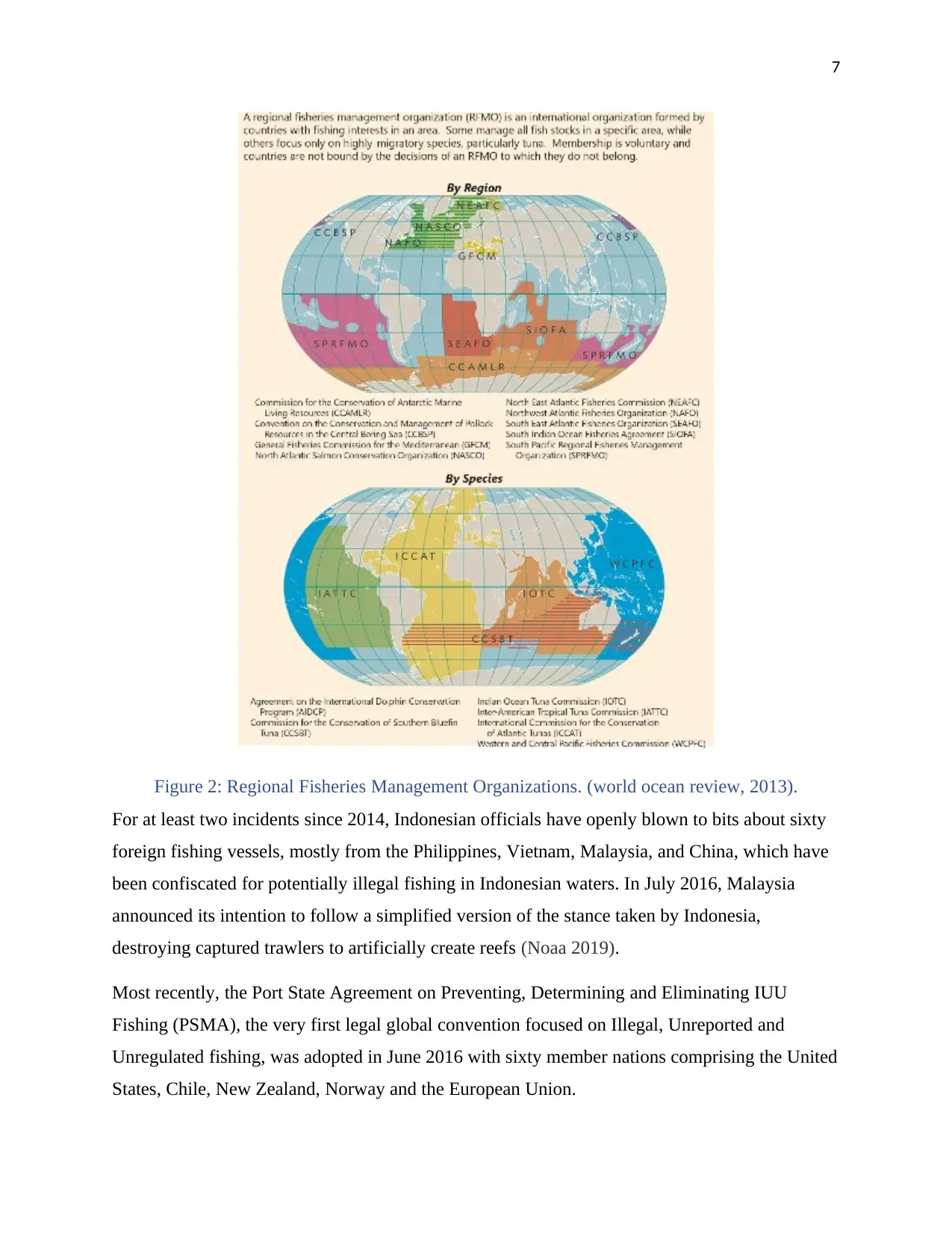
Throughout the decades, several assemblies of countries have worked in unity to form Regional
RFMOs (see figure 2)—to concur jointly, with varying levels of success, on the management and
conservation of global fisheries. It is probable that States not faction to such agencies will honor
global or other treaties (Baird 2010).
CCAMLR in the Southern Ocean around Antarctica was undoubtedly the best RFMO and
Illegal, Unreported and Unregulated fishing for certain species — including toothfish — will be
at its bottommost ebb in two decades here. This is possibly since the Convention on the
Conservation of Antarctic Marine Living Resources seeks to preserve the local bionetwork in
entirety instead of a particular species, and since it is far from the Southern Ocean and has
limited EEZs (Ventura 2015). Nevertheless, some RFMOs are struggling to exchange
information, undertake fishery ecology susceptibility analyses, develop superlative
administration applies, or implement methodologies. Nonetheless, RFMOs will remain to play a
significant role in the fight against Illegal, Unreported and Unregulated fishing, notably as
RFMOs intensify their information and communication sharing.
Prospects
Global exertions to address Illegal, Unreported and Unregulated fishing have gained traction
since the term first was officially shown in the 1997 Convention on the Conservation of
Antarctic Marine Living Resources (CCAMLR) report, illustrating the increasing danger of
overfishing in the Southern Ocean. Lack of cooperative fishery management efforts has led some
countries to accept further radical measures to combat Illegal, Unreported and Unregulated
fishing by attempting to lessen demand or ramp up compliance (Jessica Aldred November 21
2019).
Throughout the decades, several assemblies of countries have worked in unity to form Regional
RFMOs (see figure 2)—to concur jointly, with varying levels of success, on the management and
conservation of global fisheries. It is probable that States not faction to such agencies will honor
global or other treaties (Baird 2010).
CCAMLR in the Southern Ocean around Antarctica was undoubtedly the best RFMO and
Illegal, Unreported and Unregulated fishing for certain species — including toothfish — will be
at its bottommost ebb in two decades here. This is possibly since the Convention on the
Conservation of Antarctic Marine Living Resources seeks to preserve the local bionetwork in
entirety instead of a particular species, and since it is far from the Southern Ocean and has
limited EEZs (Ventura 2015). Nevertheless, some RFMOs are struggling to exchange
information, undertake fishery ecology susceptibility analyses, develop superlative
administration applies, or implement methodologies. Nonetheless, RFMOs will remain to play a
significant role in the fight against Illegal, Unreported and Unregulated fishing, notably as
RFMOs intensify their information and communication sharing.
⊘ This is a preview!⊘
Do you want full access?
Subscribe today to unlock all pages.
Trusted by 1+ million students worldwide
7
Figure 2: Regional Fisheries Management Organizations. (world ocean review, 2013).
For at least two incidents since 2014, Indonesian officials have openly blown to bits about sixty
foreign fishing vessels, mostly from the Philippines, Vietnam, Malaysia, and China, which have
been confiscated for potentially illegal fishing in Indonesian waters. In July 2016, Malaysia
announced its intention to follow a simplified version of the stance taken by Indonesia,
destroying captured trawlers to artificially create reefs (Noaa 2019).
Most recently, the Port State Agreement on Preventing, Determining and Eliminating IUU
Fishing (PSMA), the very first legal global convention focused on Illegal, Unreported and
Unregulated fishing, was adopted in June 2016 with sixty member nations comprising the United
States, Chile, New Zealand, Norway and the European Union.
Figure 2: Regional Fisheries Management Organizations. (world ocean review, 2013).
For at least two incidents since 2014, Indonesian officials have openly blown to bits about sixty
foreign fishing vessels, mostly from the Philippines, Vietnam, Malaysia, and China, which have
been confiscated for potentially illegal fishing in Indonesian waters. In July 2016, Malaysia
announced its intention to follow a simplified version of the stance taken by Indonesia,
destroying captured trawlers to artificially create reefs (Noaa 2019).
Most recently, the Port State Agreement on Preventing, Determining and Eliminating IUU
Fishing (PSMA), the very first legal global convention focused on Illegal, Unreported and
Unregulated fishing, was adopted in June 2016 with sixty member nations comprising the United
States, Chile, New Zealand, Norway and the European Union.
Paraphrase This Document
Need a fresh take? Get an instant paraphrase of this document with our AI Paraphraser
8
Parties are obligated under the treaty to guarantee that all fishing vessels entering their ports
declare their entrance and send their freight, equipment and documents to an examination.
Signatory countries have agreed to exchange infringement data. Nevertheless, the initiatives to
tackle IUU fishing might be restricted as many other harbor countries join and enforce the
PSMA. Illicit parties, especially those who are exceedingly structured and proper-funded, appear
to be versatile and will definitely find ways to dodge PSMA security by using ports in states not
member to the treaty, fabricating fishing information and other ways (Anonymous 2017).
The Governments of the Chief Marine Fisheries Countries should advocate for a reduction in
fishing activity in the industry instead of in narrow-scale, society-based fisheries, as
industrialized vessels have been participating in unsustainable and illicit high-seas fishing,
especially in areas under the territorial sovereignty of third world countries, benefiting from state
subsidies, and usually did not relate to individual states ' food security ( (the "agreement")
2011). Narrow-scale, society-based fisheries seems to be a little less inefficient and more
resource-efficient, supported more individuals, and produced less by-catches / preserves by
taking all catches for use by the fishermen's families and other representatives of their
communities ashore.
Tackling IUU through trade policy
A range of importing parties of fishing and fishing industry products have begun to introduce
supportive steps in their war against IUU practices that try to address the issue from a totally
different perspective, including from a business and industrial perspective. The most notable is
the EU catch information prerequisite clearly stating that, as of January 2010, all untamed source
fish and fishery products shipped into the EU will be needed to carry paperwork attesting to the
lawful origin of the catch. The catch paperwork should be authenticated by the flag state
authority and import restrictions may apply to un-cooperating states. As a result, Brussels has
since classified Belize, Cambodia and Guinea as un-cooperative, implying maritime
commodities from such countries may no longer be shipped to the trading bloc (Young 2016).
Assess the transshipment role
Comprehend the magnitude of commercial shipping, particularly where it occurs at sea, as well
as its association with illegal fishing, and establish methodologies to guarantee transshipment
Parties are obligated under the treaty to guarantee that all fishing vessels entering their ports
declare their entrance and send their freight, equipment and documents to an examination.
Signatory countries have agreed to exchange infringement data. Nevertheless, the initiatives to
tackle IUU fishing might be restricted as many other harbor countries join and enforce the
PSMA. Illicit parties, especially those who are exceedingly structured and proper-funded, appear
to be versatile and will definitely find ways to dodge PSMA security by using ports in states not
member to the treaty, fabricating fishing information and other ways (Anonymous 2017).
The Governments of the Chief Marine Fisheries Countries should advocate for a reduction in
fishing activity in the industry instead of in narrow-scale, society-based fisheries, as
industrialized vessels have been participating in unsustainable and illicit high-seas fishing,
especially in areas under the territorial sovereignty of third world countries, benefiting from state
subsidies, and usually did not relate to individual states ' food security ( (the "agreement")
2011). Narrow-scale, society-based fisheries seems to be a little less inefficient and more
resource-efficient, supported more individuals, and produced less by-catches / preserves by
taking all catches for use by the fishermen's families and other representatives of their
communities ashore.
Tackling IUU through trade policy
A range of importing parties of fishing and fishing industry products have begun to introduce
supportive steps in their war against IUU practices that try to address the issue from a totally
different perspective, including from a business and industrial perspective. The most notable is
the EU catch information prerequisite clearly stating that, as of January 2010, all untamed source
fish and fishery products shipped into the EU will be needed to carry paperwork attesting to the
lawful origin of the catch. The catch paperwork should be authenticated by the flag state
authority and import restrictions may apply to un-cooperating states. As a result, Brussels has
since classified Belize, Cambodia and Guinea as un-cooperative, implying maritime
commodities from such countries may no longer be shipped to the trading bloc (Young 2016).
Assess the transshipment role
Comprehend the magnitude of commercial shipping, particularly where it occurs at sea, as well
as its association with illegal fishing, and establish methodologies to guarantee transshipment
9
doesn't quite condone illegal fish to be washed across legal supply chains (Jessica Aldred
November 21 2019).
Assess compliance with international instruments
Build a framework to analyze and evaluate the acceptance and application by flag states of the
most important global measures designed to combat IUU fishing. This will provide useful
information to states and distribution networks about which areas need to be strengthened and in
which nations abrogate their obligations (Petrossian 2015).
Keeping track
A crucial obstacle in confronting IUU fishing seems to be that fleets unlawfully captured fishing
may easily change their name – and therefore their marine ' identity ' – and thus escape
enforcement actions. One way to close this loophole is to provide trawlers with distinctive serial
numbers. FAO works closely with the International Maritime Organization (IMO) to identify
vessels as well as other steps to combat IUU fishing, notably via the Joint FAO / IMO Ad Hoc
Working Group on IUU Fishing and Comparable Matters (Borg 2012). In 2013, a paper
presented from several IMO member countries, along with FAO and WWF, was supported by
the IMO Maritime Safety Committee seeking to expand the IMO ship designation number
scheme to fishing vessels on a non-obligatory basis.
Next port of call
In 2001, delegates of the UN Food and Agriculture Organization (FAO) endorsed the
International Plan of Action to Prevent, Determine and Eliminate Illegal, Unreported and
Unregulated Fishing (IPOA – IUU) in view of the urgent ability to actually address this problem.
A collaborative instrument, established under the Code of Conduct for Responsible Fisheries (the
Code), is a toolbox that can be used by all stakeholders, be it general, fleet states, conservative
states or harbor states (Noaa 2019). Considering the priorities of emerging economies, it appeals
on all parties to design and develop a coherent regional response plan to fix IUU, emphasizing
the important role of Regional Fisheries Bodies (RFBs).
doesn't quite condone illegal fish to be washed across legal supply chains (Jessica Aldred
November 21 2019).
Assess compliance with international instruments
Build a framework to analyze and evaluate the acceptance and application by flag states of the
most important global measures designed to combat IUU fishing. This will provide useful
information to states and distribution networks about which areas need to be strengthened and in
which nations abrogate their obligations (Petrossian 2015).
Keeping track
A crucial obstacle in confronting IUU fishing seems to be that fleets unlawfully captured fishing
may easily change their name – and therefore their marine ' identity ' – and thus escape
enforcement actions. One way to close this loophole is to provide trawlers with distinctive serial
numbers. FAO works closely with the International Maritime Organization (IMO) to identify
vessels as well as other steps to combat IUU fishing, notably via the Joint FAO / IMO Ad Hoc
Working Group on IUU Fishing and Comparable Matters (Borg 2012). In 2013, a paper
presented from several IMO member countries, along with FAO and WWF, was supported by
the IMO Maritime Safety Committee seeking to expand the IMO ship designation number
scheme to fishing vessels on a non-obligatory basis.
Next port of call
In 2001, delegates of the UN Food and Agriculture Organization (FAO) endorsed the
International Plan of Action to Prevent, Determine and Eliminate Illegal, Unreported and
Unregulated Fishing (IPOA – IUU) in view of the urgent ability to actually address this problem.
A collaborative instrument, established under the Code of Conduct for Responsible Fisheries (the
Code), is a toolbox that can be used by all stakeholders, be it general, fleet states, conservative
states or harbor states (Noaa 2019). Considering the priorities of emerging economies, it appeals
on all parties to design and develop a coherent regional response plan to fix IUU, emphasizing
the important role of Regional Fisheries Bodies (RFBs).
⊘ This is a preview!⊘
Do you want full access?
Subscribe today to unlock all pages.
Trusted by 1+ million students worldwide
10
Works Cited
Anonymous, 2017. Illegal fishing [online]. Fisheries - European Commission. Available from:
https://ec.europa.eu/fisheries/cfp/illegal_fishing_en [Accessed 27 Dec 2019].
Baird, R.J., 2018. The CCAMLR Response to IUU Fishing. Reviews: Methods and Technologies
in Fish Biology and Fisheries Aspects of Illegal, Unreported and Unregulated Fishing in the
Southern Ocean, 161–182.
Baird, R.J., 2019. Legal Factors Contributing to the Development of IUU Fishing. Reviews:
Methods and Technologies in Fish Biology and Fisheries Aspects of Illegal, Unreported and
Unregulated Fishing in the Southern Ocean, 35–64.
Belova, G., 2015. Illegal Unreported And Unregulated Fishing In The Black Sea. International
conference KNOWLEDGE-BASED ORGANIZATION, 21 (2), 408–412.
Borg, J., 2012. Achievements and assessments of the European Commissions work in the field of
maritime affairs and fisheries over the period 2004-2009. Luxembourg: Publications Office.
EU Regulations on Illegal, Unreported, and Unregulated Fishing (IUU): Implications for
ASEAN Community Fisheries Legal Frameworks, 2016. Russian Journal of Comparative Law, 9
(3).
FAO.org [online], 2019. [online]. What is IUU fishing? | Illegal, Unreported and Unregulated
(IUU) fishing | Food and Agriculture Organization of the United Nations. Available from:
http://www.fao.org/iuu-fishing/background/what-is-iuu-fishing/en/ [Accessed 27 Dec 2019].
Fishing Disputes in the Context of International Maritime Disputes, 2018. Актуальные
проблемы российского права.
Improving Safety on Indonesian Fishing Fleet: A Case Study on Local Fishing Communities in
East Java, 2019. Maritime Safety International Conference (MASTIC 2018).
IUU Fishing Index [online], 2019. [online]. Global Initiative. Available from:
https://globalinitiative.net/iuu-fishing-index/ [Accessed 27 Dec 2019].
Works Cited
Anonymous, 2017. Illegal fishing [online]. Fisheries - European Commission. Available from:
https://ec.europa.eu/fisheries/cfp/illegal_fishing_en [Accessed 27 Dec 2019].
Baird, R.J., 2018. The CCAMLR Response to IUU Fishing. Reviews: Methods and Technologies
in Fish Biology and Fisheries Aspects of Illegal, Unreported and Unregulated Fishing in the
Southern Ocean, 161–182.
Baird, R.J., 2019. Legal Factors Contributing to the Development of IUU Fishing. Reviews:
Methods and Technologies in Fish Biology and Fisheries Aspects of Illegal, Unreported and
Unregulated Fishing in the Southern Ocean, 35–64.
Belova, G., 2015. Illegal Unreported And Unregulated Fishing In The Black Sea. International
conference KNOWLEDGE-BASED ORGANIZATION, 21 (2), 408–412.
Borg, J., 2012. Achievements and assessments of the European Commissions work in the field of
maritime affairs and fisheries over the period 2004-2009. Luxembourg: Publications Office.
EU Regulations on Illegal, Unreported, and Unregulated Fishing (IUU): Implications for
ASEAN Community Fisheries Legal Frameworks, 2016. Russian Journal of Comparative Law, 9
(3).
FAO.org [online], 2019. [online]. What is IUU fishing? | Illegal, Unreported and Unregulated
(IUU) fishing | Food and Agriculture Organization of the United Nations. Available from:
http://www.fao.org/iuu-fishing/background/what-is-iuu-fishing/en/ [Accessed 27 Dec 2019].
Fishing Disputes in the Context of International Maritime Disputes, 2018. Актуальные
проблемы российского права.
Improving Safety on Indonesian Fishing Fleet: A Case Study on Local Fishing Communities in
East Java, 2019. Maritime Safety International Conference (MASTIC 2018).
IUU Fishing Index [online], 2019. [online]. Global Initiative. Available from:
https://globalinitiative.net/iuu-fishing-index/ [Accessed 27 Dec 2019].
Paraphrase This Document
Need a fresh take? Get an instant paraphrase of this document with our AI Paraphraser
11
Jessica Aldred November 21, 2019, 2019. Explainer: Illegal, unreported and unregulated fishing
[online]. chinadialogue ocean. Available from: https://chinadialogueocean.net/11813-explainer-
illegal-unreported-and-unregulated-fishing/ [Accessed 27 Dec 2019].
Noaa, 2019. U.S. Government Task Force on Combating Illegal, Unreported, and Unregulated
Fishing and Seafood Fraud [online]. NOAA. Available from:
https://www.fisheries.noaa.gov/international-affairs/us-government-task-force-combating-
illegal-unreported-and-unregulated-fishing [Accessed 27 Dec 2019].
Omar, A.J., Mohamed, A.A., and Bambale, S.A., 2019. Impacts of Illegal, Unreported and
Unregulated (IUU) Fishing on Developing Countries: The Case of Somalia. Asian Research
Journal of Arts & Social Sciences, 1–15.
Petrossian, G.A., 2015. Preventing illegal, unreported and unregulated (IUU) fishing: A
situational approach. Biological Conservation, 189, 39–48.
Putra, A. and Lestari, D.I., 2019. Understanding The Main Consequences Of Continued Illegal,
Unreported, Unregulated (Iuu) Fishing For Maritime Security Actor And Affected Coastal
Communities Within The Indonesian Waters.
Torremolinos-Conference-safe-fishing-legal-fishing Torremolinos Conference safe fishing legal
fishing // [online], 2019. [online]. Torremolinos Conference safe fishing legal fishing. Available
from: http://www.imo.org/en/About/Events/Pages/Torremolinos-Conference-safe-fishing-legal-
fishing.aspx [Accessed 27 Dec 2019].
Ventura, V.A.M.F., 2015. Tackling illegal, unregulated and unreported fishing: the ITLOS
Advisory Opinion on Flag-state Responsibility for IUU fishing and the principle of due
diligence. Revista de Direito Internacional, 12 (1).
Young, M.A., 2016. International trade law compatibility of market-related measures to combat
illegal, unreported and unregulated (IUU) fishing. Marine Policy, 69, 209–219.
Jessica Aldred November 21, 2019, 2019. Explainer: Illegal, unreported and unregulated fishing
[online]. chinadialogue ocean. Available from: https://chinadialogueocean.net/11813-explainer-
illegal-unreported-and-unregulated-fishing/ [Accessed 27 Dec 2019].
Noaa, 2019. U.S. Government Task Force on Combating Illegal, Unreported, and Unregulated
Fishing and Seafood Fraud [online]. NOAA. Available from:
https://www.fisheries.noaa.gov/international-affairs/us-government-task-force-combating-
illegal-unreported-and-unregulated-fishing [Accessed 27 Dec 2019].
Omar, A.J., Mohamed, A.A., and Bambale, S.A., 2019. Impacts of Illegal, Unreported and
Unregulated (IUU) Fishing on Developing Countries: The Case of Somalia. Asian Research
Journal of Arts & Social Sciences, 1–15.
Petrossian, G.A., 2015. Preventing illegal, unreported and unregulated (IUU) fishing: A
situational approach. Biological Conservation, 189, 39–48.
Putra, A. and Lestari, D.I., 2019. Understanding The Main Consequences Of Continued Illegal,
Unreported, Unregulated (Iuu) Fishing For Maritime Security Actor And Affected Coastal
Communities Within The Indonesian Waters.
Torremolinos-Conference-safe-fishing-legal-fishing Torremolinos Conference safe fishing legal
fishing // [online], 2019. [online]. Torremolinos Conference safe fishing legal fishing. Available
from: http://www.imo.org/en/About/Events/Pages/Torremolinos-Conference-safe-fishing-legal-
fishing.aspx [Accessed 27 Dec 2019].
Ventura, V.A.M.F., 2015. Tackling illegal, unregulated and unreported fishing: the ITLOS
Advisory Opinion on Flag-state Responsibility for IUU fishing and the principle of due
diligence. Revista de Direito Internacional, 12 (1).
Young, M.A., 2016. International trade law compatibility of market-related measures to combat
illegal, unreported and unregulated (IUU) fishing. Marine Policy, 69, 209–219.

1 out of 11


Your All-in-One AI-Powered Toolkit for Academic Success.
+13062052269
info@desklib.com
Available 24*7 on WhatsApp / Email
![[object Object]](/_next/static/media/star-bottom.7253800d.svg)
Unlock your academic potential
Copyright © 2020–2026 A2Z Services. All Rights Reserved. Developed and managed by ZUCOL.