Essay on the Human Experience and Immortality in Gilgamesh

Verified

Added on  2021/12/10

|4
|838
|75
Essay
AI Summary
This essay examines the human experience and the concept of immortality in the Epic of Gilgamesh, focusing on the protagonist's transformation and the impact of his relationships. It explores Gilgamesh's initial self-centeredness and his journey towards understanding compassion, self-sacrifice, and the value of friendship, particularly through his bond with Enkidu. The essay argues that Gilgamesh's experiences, including loss and the failure to achieve physical immortality, ultimately lead to a deeper understanding of the human condition and the immortality of relationships, making the epic a timeless work. The analysis incorporates references to Stephen Mitchell's translation and the historical context of Uruk, highlighting Gilgamesh's evolution from a power-hungry king to a leader who cares for his people, emphasizing the importance of human connection and moral growth over personal gain.
Document Page
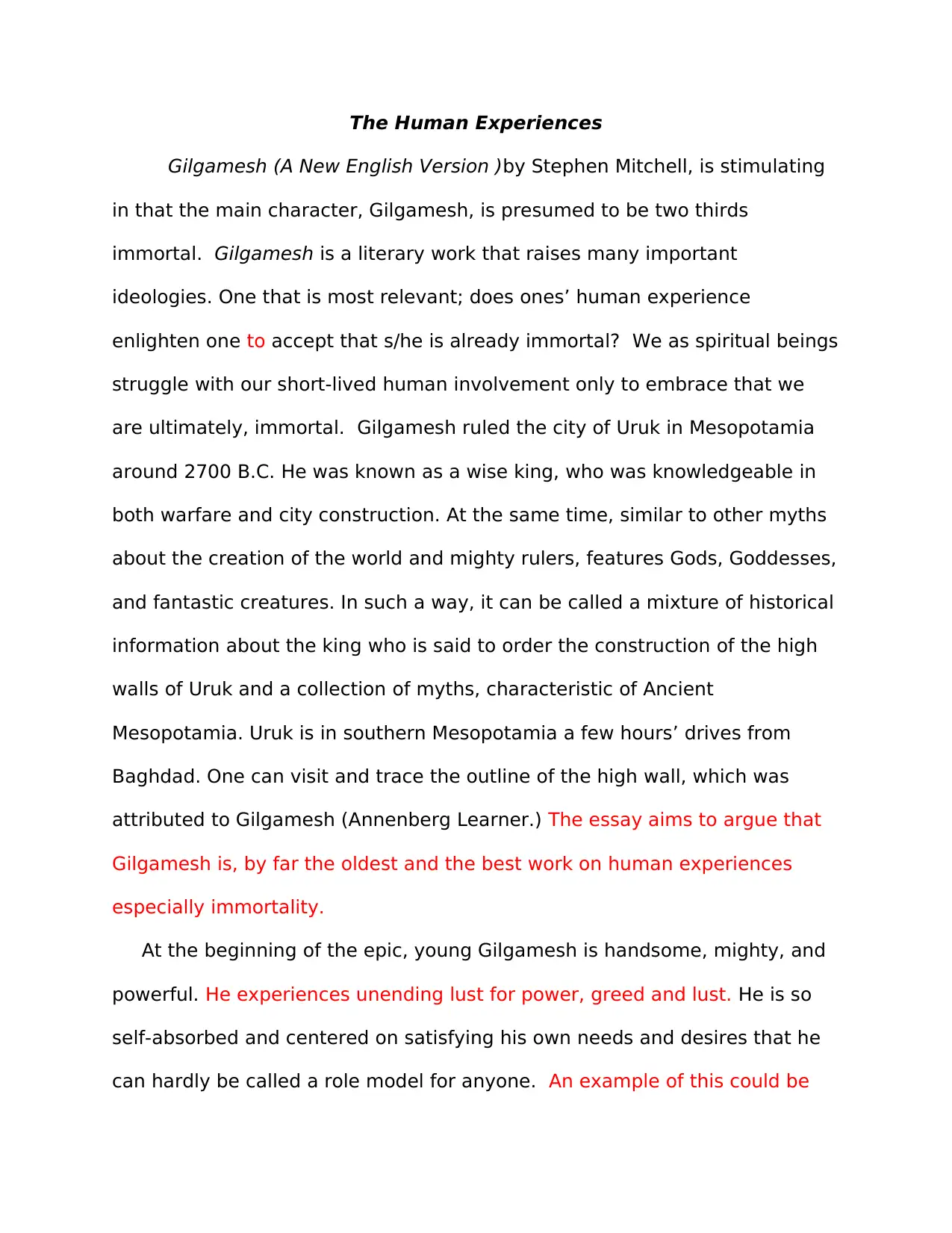
The Human Experiences
Gilgamesh (A New English Version )by Stephen Mitchell, is stimulating
in that the main character, Gilgamesh, is presumed to be two thirds
immortal. Gilgamesh is a literary work that raises many important
ideologies. One that is most relevant; does ones’ human experience
enlighten one to accept that s/he is already immortal? We as spiritual beings
struggle with our short-lived human involvement only to embrace that we
are ultimately, immortal. Gilgamesh ruled the city of Uruk in Mesopotamia
around 2700 B.C. He was known as a wise king, who was knowledgeable in
both warfare and city construction. At the same time, similar to other myths
about the creation of the world and mighty rulers, features Gods, Goddesses,
and fantastic creatures. In such a way, it can be called a mixture of historical
information about the king who is said to order the construction of the high
walls of Uruk and a collection of myths, characteristic of Ancient
Mesopotamia. Uruk is in southern Mesopotamia a few hours’ drives from
Baghdad. One can visit and trace the outline of the high wall, which was
attributed to Gilgamesh (Annenberg Learner.) The essay aims to argue that
Gilgamesh is, by far the oldest and the best work on human experiences
especially immortality.
At the beginning of the epic, young Gilgamesh is handsome, mighty, and
powerful. He experiences unending lust for power, greed and lust. He is so
self-absorbed and centered on satisfying his own needs and desires that he
can hardly be called a role model for anyone. An example of this could be
tabler-icon-diamond-filled.svg

Paraphrase This Document

Need a fresh take? Get an instant paraphrase of this document with our AI Paraphraser
Document Page
seen from the line, “He is king, he does whatever he wants, takes the son
from his father and crushes him, takes the girl from her mother and uses
her” (Mitchell 72). Enkidu, Gilgamesh’s yang of yin is also partly human;
thus, he also possesses the qualities that cannot qualify him for a worthy
example of Divinity to follow. When the two became genuine friends after
initial conflicts, only then did they have the opportunity to become better
and develop new qualities. They develop qualities such as the ability to care
for someone else, to support, understand, and even love; ultimately
embracing a mortal knowledge.
“They embraced and kissed. They held hands like brothers. They walked side
by side. They became true friends” (Mitchell 90).
The two begin to influence positively each other and they rise above
the trivial things like having intimate affairs with women, fighting, eating and
sleeping. It marks the start of the phase when Gilgamesh embarks upon the
journey of finding the true meaning of immortality and human
experience. Enkidu takes on the role of a specific restraint for Gilgamesh.
When Gilgamesh wants to fight with an unpleasant mammoth Humbaba,
Enkidu tries to reason him and talk him out of this dangerous adventure,
which may result in a serious confrontation with the Gods. However,
Gilgamesh refuses to be reasonable. Enkidu does not abandon him but joins
him in this reckless venture. His understanding of friendship does not leave
him a choice but to assist Gilgamesh. The brutal confrontation with Humbaba
Document Page
proves fatal for Enkidu and he dies, leaving Gilgamesh bewildered and grief-
stricken. .
Enkidu’s death leaves a profound influence on Gilgamesh’s
transformation towards becoming a better human. However, at the start of
the journey, Gilgamesh seems to pursue the same egoistic goal as he had,
before meeting Enkidu; he sets on a journey for immortality.
“If only I could find the one man whom the Gods made immortal, I would ask
him how to overcome death”. (Mitchell 158).
In the end, however, the failure to become immortal brings unexpected
result especially for the people of Uruk. They receive a king, who cares for
the city rather than being narcissist. Compassion is an essential trait, not
only for the king but also for others. Gilgamesh learns that self-sacrifice,
friendship, and reason are much more important than external beauty or
even military aptitudes. It is one of the most meaningful lessons
of Gilgamesh. The human experience begets immortality. The simple fact
that the story of Gilgamesh is relevant even centuries later is because of his
achievement of immortality of relationships through his human experience.
Document Page
Works Cited
Mitchell, Stephen. “Gilgamesh by Stephen Mitchell - Read
Online.” Scribd, www.scribd.com/book/224272546/Gilgamesh-A-New-
English-Version.
“Watch” Annenberg Learner,
www.learner.org/courses/worldlit/gilgamesh/watch/.
chevron_up_icon
1 out of 4
circle_padding
hide_on_mobile
zoom_out_icon
[object Object]