Age-Related Immune System Changes: Gender-Based Comparison

Verified

Added on  2022/09/27

|1
|630
|17
Homework Assignment
AI Summary
This assignment examines the effects of aging on the immune system, highlighting the increased susceptibility to infections, poorer vaccine responses, and higher incidence of diseases in older adults, particularly those over 65. It focuses on both adaptive and innate immune responses, with an emphasis on the adaptive responses being more affected by age-related changes. The study also considers the lower inflammatory state in aged individuals concerning chronic diseases like osteoporosis, atherosclerosis, Alzheimer's, and diabetes. Furthermore, it provides health promotion strategies, including dietary recommendations, exercise, sufficient sleep, vaccinations, stress management, maintaining a healthy weight, smoking cessation, and hand hygiene, offering practical advice for maintaining a strong immune system as one ages. The provided references support the information presented in this assignment. This assignment contributes to the understanding of the human immune system and how it changes with age.
Document Page
`
Name of the student:
Changes related to age
Men Women
Higher susceptibiity to
infectious diseases
Higher susceptibiity to
auto-immune diseases
The activity of innate and
inflammatory cells is
higher.
The activity of B and T
immune cells are higher.
Faster epigenomic
changes-shorter life span
Slower epigenomic
changes-longer life span
More significant loss of
chromatin accessibility-
more rapid changes in B
cells and results in loss of
function
Less significant loss of
chromatin accessibility-
slower changes in B cells
and results in less loss of
function
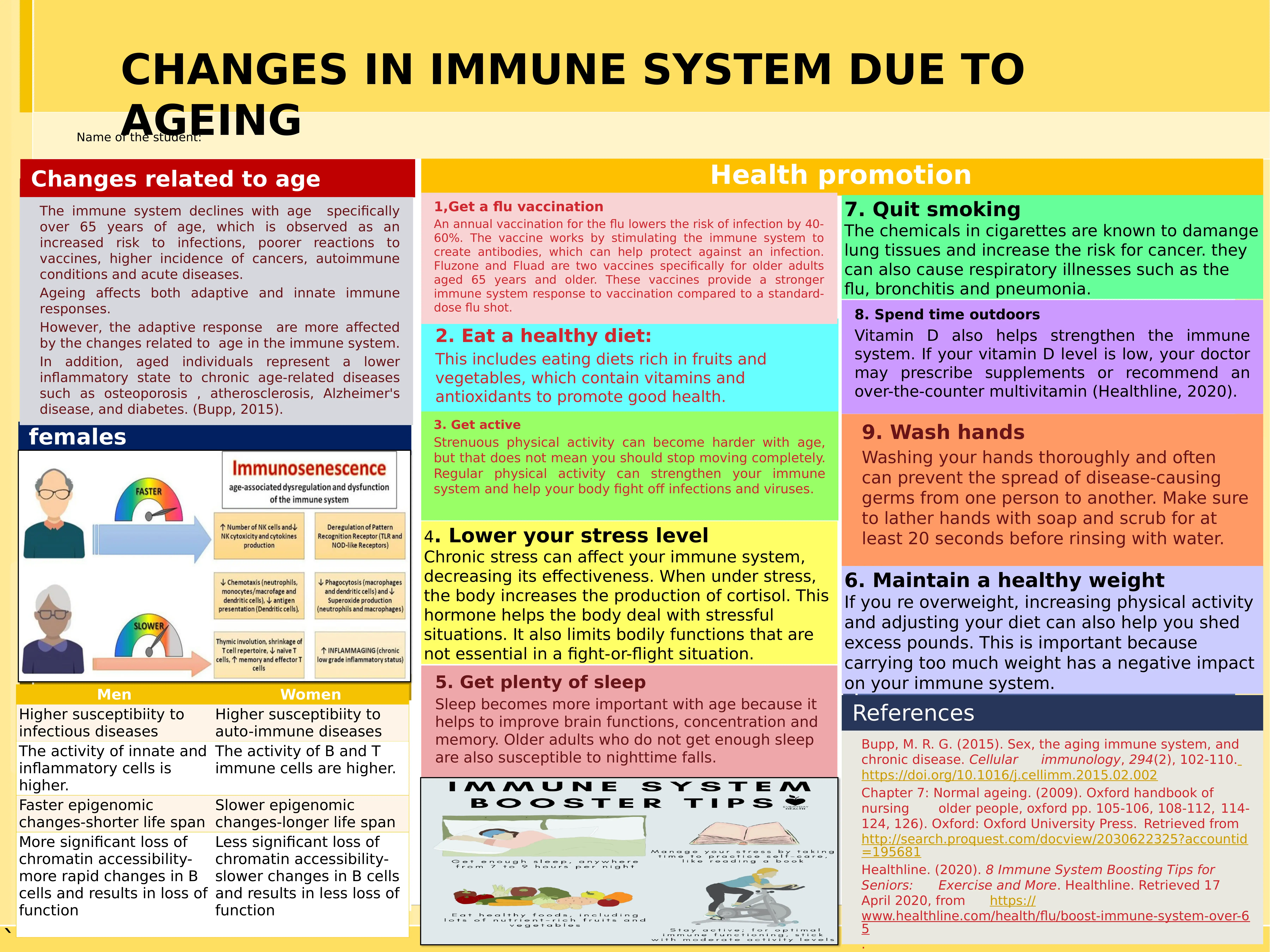
Comparison in males and
females
The immune system declines with age specifically
over 65 years of age, which is observed as an
increased risk to infections, poorer reactions to
vaccines, higher incidence of cancers, autoimmune
conditions and acute diseases.
Ageing affects both adaptive and innate immune
responses.
However, the adaptive response are more affected
by the changes related to age in the immune system.
In addition, aged individuals represent a lower
inflammatory state to chronic age-related diseases
such as osteoporosis , atherosclerosis, Alzheimer's
disease, and diabetes. (Bupp, 2015).
Health promotion
2. Eat a healthy diet:
This includes eating diets rich in fruits and
vegetables, which contain vitamins and
antioxidants to promote good health.
8. Spend time outdoors
Vitamin D also helps strengthen the immune
system. If your vitamin D level is low, your doctor
may prescribe supplements or recommend an
over-the-counter multivitamin (Healthline, 2020).
5. Get plenty of sleep
Sleep becomes more important with age because it
helps to improve brain functions, concentration and
memory. Older adults who do not get enough sleep
are also susceptible to nighttime falls.
3. Get active
Strenuous physical activity can become harder with age,
but that does not mean you should stop moving completely.
Regular physical activity can strengthen your immune
system and help your body fight off infections and viruses.
1,Get a flu vaccination
An annual vaccination for the flu lowers the risk of infection by 40-
60%. The vaccine works by stimulating the immune system to
create antibodies, which can help protect against an infection.
Fluzone and Fluad are two vaccines specifically for older adults
aged 65 years and older. These vaccines provide a stronger
immune system response to vaccination compared to a standard-
dose flu shot.
9. Wash hands
Washing your hands thoroughly and often
can prevent the spread of disease-causing
germs from one person to another. Make sure
to lather hands with soap and scrub for at
least 20 seconds before rinsing with water.
References
Bupp, M. R. G. (2015). Sex, the aging immune system, and
chronic disease. Cellular immunology, 294(2), 102-110.
https://doi.org/10.1016/j.cellimm.2015.02.002
Chapter 7: Normal ageing. (2009). Oxford handbook of
nursing older people, oxford pp. 105-106, 108-112, 114-
124, 126). Oxford: Oxford University Press. Retrieved from
http://search.proquest.com/docview/2030622325?accountid
=195681
Healthline. (2020). 8 Immune System Boosting Tips for
Seniors: Exercise and More. Healthline. Retrieved 17
April 2020, from https://
www.healthline.com/health/flu/boost-immune-system-over-6
5
.
7. Quit smoking
The chemicals in cigarettes are known to damange
lung tissues and increase the risk for cancer. they
can also cause respiratory illnesses such as the
flu, bronchitis and pneumonia.
4. Lower your stress level
Chronic stress can affect your immune system,
decreasing its effectiveness. When under stress,
the body increases the production of cortisol. This
hormone helps the body deal with stressful
situations. It also limits bodily functions that are
not essential in a fight-or-flight situation.
6. Maintain a healthy weight
If you re overweight, increasing physical activity
and adjusting your diet can also help you shed
excess pounds. This is important because
carrying too much weight has a negative impact
on your immune system.
CHANGES IN IMMUNE SYSTEM DUE TO
AGEING
tabler-icon-diamond-filled.svg

Paraphrase This Document

Need a fresh take? Get an instant paraphrase of this document with our AI Paraphraser
[object Object]